Cracker Barrel Caves to Woke Mob w/ Rainbow Rockers

(Mark Pellin, Headline USA) Faced with slumping sales and a fierce backlash for pandering to the woke mob, Cracker Barrel has remained committed to its capitulation to a radical leftist agenda.

Cracker Barrel, a national chain restaurant once famous for its country-casual cuisine and family-friendly atmosphere, became the latest in a mess of businesses that have risked alienating their core customer base by kowtowing to LGBT activists. The company was left reeling when it celebrated Pride Month by showcasing Cracker Barrels’ iconic rocking chairs painted with rainbow colors.

“Everyone is always welcome at our table (and our rainbow rocker),” Cracker Barrel captioned a photo it posted to social media that quickly went viral, as the company was rocked by conservatives who accused the restaurant chain of pulling a Bud Light.

The former titan of lowbrow brewskis saw its sales plummet after partnering with transgender shill Dylan Mulvaney and facing boycotts. Woke-aspiring companies ranging from Target, Kohl’s and The North Face to Maybelline and Nike all have encountered similar fates.

Cracker Barrel stands in line to be next, with calls for a boycott partnered with blistering criticism for selling out to the LGBT agenda.

“We take no pleasure in reporting that CrackerBarrel has fallen. A once family friendly establishment has caved to the mob,” wrote the Texas Family Project, while a disgruntled customer vowed, “My family and I are boycotting them. And Rainbows are a Christian symbol. Let’s take it back!”

Cracker Barrel’s rainbow-themed LGBT rockers have been around since their debut in 2018, when it unveiled its “limited-edition Rainbow Rocker.” The “limited-edition” has since become a regular feature, and the company’s heavy promotion of the chairs earlier this month offended a slew of customers. The rainbow rocker Twitter post was swamped with more than 2,000 comments in less than a day.

The company’s promotion prompted popular “insurrectional film and television star” Nick Searcy to create a #GroomerBarrel thread.

“Thankfully, this makes it even easier than ever to skip this mid restaurant whenever someone recommends it,” wrote Blaze TV’s Lauren Chen. “Everyone else should do their part and skip dining at the Cracker Barrel, too.”

The backlash has as much to do with Cracker Barrel as it does an increasingly aggressive leftist push to dictate social norms and force compliance, said William Wolfe, a Trump-era DOD and State Department official.

“They are intentionally and systematically trying to corrupt everything that an average conservative American enjoys,” Wolfe wrote. “They want to make you to bow before their rainbow god—even when all you want is to eat a plate of Sunday Country Fried Chicken with the family.”

Fewer and fewer plates are reportedly being sold at Cracker Barrel, with customer traffic down 3.2% last quarter.

“Cracker Barrel has no idea who their costumer base is. They’ve gone crackers, that’s for sure!” wrote conservative author and filmmaker Colette Harrington. “What is the government up to that’s making all these companies give the middle finger to their costumers? CB this Bud’s for you. Go woke go broke!”

Biden Mandated Open Borders for Illegals, Ex-Border Chief Reveals

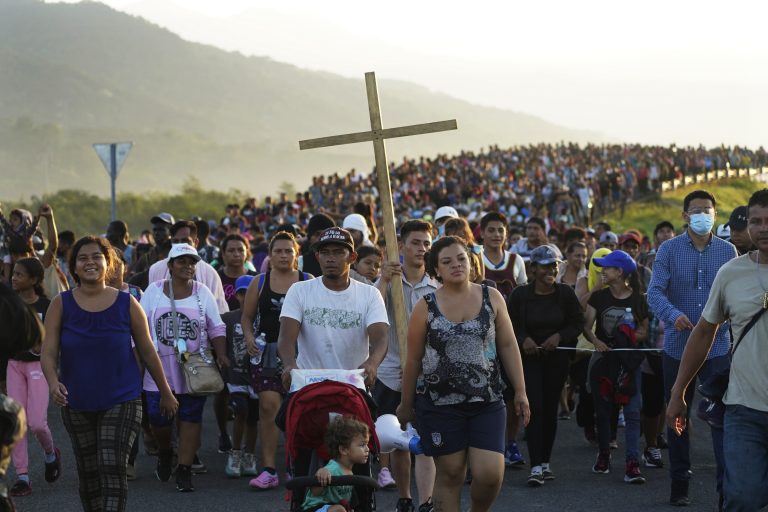
(Luis Cornelio, Headline USA) Former Border Patrol Chief Rodney Scott made a startling revelation during a congressional hearing Wednesday about Homeland Security Secretary Alejandro Mayorkas‘ dereliction of duty. Under oath, Scott exposed the true agenda of Mayorkas and President Joe Biden in 2021: opening the border for illegal aliens.

During the hearing, Rep. Carlos Gimenez, R-Fla., asked Scott whether Customs and Border Patrol had issued warnings to Mayorkas and Biden officials about the impending surge of immigrants at the border. Scott did hesitate to respond, testifying, “He was informed verbally. He was informed in writing.”

Scott further warned that chaos ensued as soon as Trump officials were replaced by Biden’s team. He emphasized, “I think it’s important for everybody to understand [that] everything fundamentally changed,” Scott added. “When I worked for Secretary [Chad] Wolf, we had team meetings, we were asked for our input. We were told, ‘Over your career, what works and what doesn’t work?’ On Jan. 20, 2021, that all got shut off.”

Scott’s damning testimony exposed Mayorkas’s disregard for the experience of border agents.

 “Our input was no longer solicited, and when my team and I gave it unsolicited, we were basically put in a box,” said Scott, who had served as CBP chief since 2020

As the former CBP chief from 2020 to August 2021, Scott emphasized that the Biden administration showed no interest in taking advice. “They did not want to know what we had to say. They made it very clear: Expedite processing and find new ways to let migrants into the U.S. That was the only agenda,” he added.

These scathing remarks were shared during a congressional investigation conducted by the House Committee on Homeland Security, which delved into Mayorkas’s alleged dereliction of duty. In his opening statement, Homeland Security Chairman Mark Green, R-Tenn., strongly condemned Mayorkas, who is also facing impeachment calls, for instigating one of the nation’s worst border crises.

“The cartels are thriving. Migrants are suffering. And Americans are dying. Their blood is on Secretary Mayorkas’ hands. I hope every member of this Committee works together to fix this disaster,” Green passionately expressed in a prepared speech obtained by Headline USA.

This statement was echoed by Scott, who had previously delivered dire testimony against Mayorkas. During a separate House hearing in May, Scott accused Mayorkas of failing to take sufficient actions to control the chaos at the southern border when questioned by Rep. Andy Biggs, R-Ariz.

“If you listen to the words he says, states every time is about creating safe pathways,” a fired-up Scott said at the time. “When I was Chief, we were not allowed to even discuss consequences or actually securing the border. It was all about expediting the processing and avoiding the optics of people backed into border patrol stations.”

RINO Backlash: 20 House Members under Fire for Refusing to Hold Schiff Accountable

(Luis Cornelio, Headline USA) A group of 20 Republican members of Congress is facing significant backlash for their refusal to support the censure plan against Rep. Adam Schiff, D-Calif.

Led by Rep. Anna Paulina Luna, R-Fla., the plan aimed to hold Schiff accountable for his role in perpetuating the debunked Russia collusion conspiracy theory against former President Donald Trump.

The Russia collusion hoax, which has long been discredited, not only wasted millions of taxpayer dollars but also caused considerable harm to the Trump administration during its early years. While a significant number of Republicans rallied behind Luna’s efforts, these 20 GOP members of the RINO herd chose to align with the Democrats, drawing criticism from the party voters.

On Wednesday, Luna announced, “20 Republicans voted w/ Dems to stop the ethics investigation, censure, & fine of Adam Schiff. So there is no confusion (as some did not accurately read the bill) I will be filing a privileged motion to censure & send Schiff to ethics for investigation. See you next week Adam.”

Rep. Thomas Massie, R-Ky., emerged as one of the most vocal Republican critics of the measure, voting against it on the grounds that it violated the Constitution. Massie expressed his stance on Twitter, stating, “The Constitution says the House may make its own rules but we can’t violate other (later) provisions of the Constitution. A $16 million fine is a violation of the 27th and 8th amendments.”

Conservative attorney Rogan O’Handley strongly criticized Massie and what he referred to as the “Coward 20” for their failure to present alternative solutions. He reported that Luna plans to reintroduce an amended version of the resolution next week.

Here’s a list of the Republicans who worked with Democrats to thwart the resolution: 

  1. Kelly Armstrong, R-N.D. 
  2. Lori Chavez-DeRemer, R, Ore. 
  3. Juan Ciscomani, R-Ariz.
  4. Tom Cole, R-Okla.
  5. Warren Davidson, R-Ohio.
  6. Brian Fitzpatrick, R-Pa.
  7. Kay Granger, R-Texas.
  8. Garrett Graves, R-La.
  9. Thomas Kean, R-N.J.
  10. Kevin Kiley, R-Calif.
  11. Young Kim, R-Calif.
  12. Mike Lawler, R-N.Y.
  13. Thomas Massie, R-Ky.
  14. Tom McClintock, R-Calif.
  15. Marc Molinaro, R-N.Y.
  16. Jay Obernolte, R-Calif.
  17. Mike Simpson, R-Idaho.
  18. Michael Turner, R-Ohio.
  19. David Valadao, R-Calif.
  20. Steve Womack, R-Ariz.

State Department Wants $76M to Push DEI

(Dmytro “Henry” Aleksandrov, Headline USA) The Biden State Department asked Congress for $76 million from the taxpayers’ pockets to fund its diversity, equity, and inclusion initiatives — a phrase that critics contend is code for being anti-white, anti-straight, anti-male and anti-Christian.

According to the Washington Examiner, on Tuesday morning, Gina Abercrombie-Winstanley, the State Department’s first chief diversity and inclusion officer, testified before Congress and asked for $76 million to increase her staff, track race and “gender” demographics in the department, and track employee reports of “discrimination, harassment and bullying.”

“The Department needs an inclusive workforce with equitable opportunities to ensure our foreign policy is as strong, smart and creative as it can be,” she wrote in her testimony.

The publication also reported that her office audited State Department employees to gain demographic information on “race, ethnicity, gender, status of disability, grade, rank and job series skill codes.” Abercrombie-Winstanley stated that she and her office plan to release an annual report tracking “trend lines” for department employees.

Rep. Brian Mast, R-Fla., chairman of the Subcommittee on Oversight and Accountability, opened the committee by telling Abercrombie-Winstanley that he believes she is “mandating division within the State Department.”

“This office has a clever name that uses strong emotional words — diversity, equity, inclusion — but functionally does the opposite of what America has always stood for, which is very simply the best man, the best woman for the job,” he said.

He then stated that it is not just the division of people, in general, but also the hatred of straight white Christian men, in particular.

“This office is giving people the impression or given many people outside of the State Department the sense that it is looking for a preferred race or at minimum not white, that it is looking for a preferred religion or at minimum not Christian, or that it is looking for a preferred sexual orientation or identity or at minimum not straight male.”

Additionally, Abercrombie-Winstanley said that she and her office want to push the DEI initiatives abroad because State Department employees “experience discrimination by foreign customs and immigration officials.”

White House Shrugs Off Insulting Violation of Flag Code at Pride Event

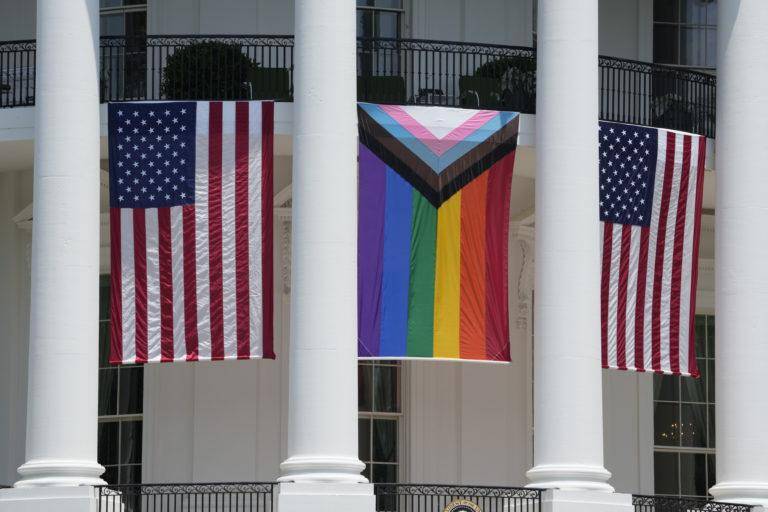
(Jacob Bruns, Headline USA) After President Joe Biden and his administration brought a slew of sexual degenerates to the White House for a LGBT “Pride” event, the administration refused to explain itself after flying the LGBT pride flag next to the American flag, Townhall reported.

When questioned about flying the flags at the same height–a violation of the flag code–White House Press Secretary Karine Jean-Pierre condemned the behavior of the transgenders who stripped topless with sexual poses, but defended the president’s decision to fly the pride flag alongside the American flag.

“The administration was proud to display the pride flag,” Jean-Pierre told reporters, several times calling it a “historic event.”

She went so far as to say that the strip-club like environment “centered around love and family… so we’re not going to let anyone distract us from that” with concerns about following the flag code.

According to the press secretary and lesbian, the administration is “proud of this historic event that we were able to put together.”

The president, however, seemed un-phased by the degenerate display, and committed the American government to supporting the LGBT cause at home and abroad.

“Happy pride month, happy pride year, happy pride life!” Biden enthusiastically told the LGBT audience in his speech during the pride event.

Our president also called those in the “LGBT community” some of “the bravest and most inspiring people I have ever known.”

During the pride event on the White House’s south lawn, a number of transgenders also took of their shirts, with children present, and fondled themselves for the camera.

In response, the White House issued an apologetic statement calling the behavior “inappropriate and disrespectful for any event at the White House.”

They also insisted that the videos and photos were not an accurate depiction of the celebration.

How the New Pick to Lead the CDC Represented the Worst of the Covid Autocracy

(By Jon Miltimore, RealClear Wire) President Joe Biden recently tapped Mandy Cohen to lead the Centers for Disease Control and Prevention, replacing Rochelle Walensky , whose resignation will go into effect at the end of the month.

Like most people, until this week, I had never heard of Cohen, the former health secretary of the North Carolina Department of Health and Human Services.

There is no denying her credentials. She holds degrees in medicine and public health from Yale and Harvard and served as chief of staff in the Centers for Medicare & Medicaid Services during the Obama administration. In 2019, she was named by Modern Healthcare as one of the top 25 women leaders in healthcare.

Unfortunately, Cohen also represents the worst of the COVID-19 autocracy , which saw public health officials trample civil liberties and inflict catastrophic damage on the population.

Cohen banned gatherings of more than 10 people after the pandemic broke out. She also closed not just schools, but day care centers, “nonessential” retail stores, and bars and restaurants. (Naturally, liquor stores were deemed “essential.”)

To be fair, public health leaders faced difficult decisions in 2020 and beyond, and Cohen is hardly the only one who aggressively pursued government mandates that proved harmful. While it’s true North Carolina’s pandemic performance was poor — the Tar Heel State ranked among the worst states in social well-being and education during the pandemic — even critics can identify with Cohen when she says choices were difficult.

“At every turn trying to make really, really hard decisions that changed the way people lived their lives. It was really, really challenging,” Cohen told WCNC Charlotte in December 2021 after she announced she was stepping down. “There was no decision that we didn’t agonize over and deliberate over.”

Those last words are important. They suggest Cohen was making decisions in a deliberative process, weighing the costs and benefits of these policy decisions. The problem is Cohen’s own statements show her claims about “agonizing over” every decision reached through a deliberative process aren’t true.

Recently surfaced video from a May 2022 talk at Duke University’s Fuqua School of Business shows Cohen talking about how she reached public health decisions while chatting on the phone with the secretary of health and human services in Massachusetts.

“She was like, ‘Are you going to let them have professional football?’ And I was like, ‘No.’ And she’s like, ‘OK. Neither are we,’” Cohen told the audience , sparking laughter. “Or I’d be like, ‘So, when are you going to think about lightening up on masks?’ They were like, ‘Next Monday.’ I’m like, ‘OK. Next Monday, right.’”

In contrast to “agonizing” over decisions, Cohen admitted to making public health policy in a manner that is objectively arbitrary and flippant. And she laughed about it.

It should go without saying that there’s nothing humorous about shutting down businesses or forcing people to comply with arbitrary orders. These nonpharmaceutical interventions proved highly ineffective, and they were accompanied with severe unintended consequences ranging from increased poverty and domestic violence to mental health deterioration, lost learning, and surging substance abuse that resulted in record overdoses .

The truth is, when we were told to “follow the science” ad nauseam, we were really being told to follow orders. Using “The Science” to ram through policies is a tried and true tactic of politicians and bureaucrats, one the economist Ludwig von Mises discussed more than 75 years ago.

“The planners pretend that their plans are scientific and that there cannot be disagreement with regard to them among well-intentioned and decent people,” Mises wrote in Planned Chaos . “[But science] can never dictate what ought to be and what ends people should aim at. It is a fact that men disagree in their value judgments.”

But dictating what ought to be was precisely what public health officials did during the pandemic. What’s more, officials seemed to confuse the edicts of Dr. Anthony Fauci with actual science, including Fauci himself.

This is no doubt one reason the CDC suffered a historic collapse in trust during the pandemic. The public witnessed the naked pollution of science with politics.

Appointing a Fauci acolyte, who in one interview laughed about the arbitrary nature of her pandemic policy while lamenting the “agonizing” process of decision-making in another, is no way to regain public trust.

SEC Awards Whistleblower $279M

(By Adam Andrzejewski, RealClear Wire) The Securities and Exchange Commission has awarded its largest whistleblower award ever, worth $279 million, to an unidentified person who alerted the SEC to misconduct at a company that was already under investigation, according to the Wall Street Journal.

In keeping with government policy, the whistleblower and the company they blew the whistle on are both unnamed to protect the individual. The SEC credits the whistleblower with “expanding its probe and for providing ongoing assistance through written submissions and interviews” according to the Journal.

Whistleblower awards are typically 10-30% of fines collected from civil enforcement actions resulting from a tip. The previous record for a whistleblower’s payout was $114 million, less than half of the recent award.

The SEC noted that tips from the whistleblower also led to enforcement action by other federal agencies, which increased the award amount, although the SEC didn’t say by how much.

While there is nothing wrong with incentivizing individuals to come forward with information, a $279 million award seems excessive, especially considering the company was already under investigation by the SEC. Merely expanding the scope of an investigation should not make you a multimillionaire.

Since the total fine amount is unclear, its’ impossible to know if this award was closer to 10% or 30% of the total fine amount. If it was closer to 30%, the SEC should explain why the whistleblower couldn’t have been fairly compensated with a smaller award, as the remaining money could go toward further enforcement action.

If it was closer to 10%, then there should be a serious discussion about caps on the total award amount to ensure award are fair and enticing, but not outrageous.

Washington Grapples with AI’s Brave New World

(By Susan Crabtree, RealClear Wire) If viewers look closely enough at a recently released video by Florida Gov. Ron DeSantis’s campaign displaying a collage of images of President Donald Trump embracing and kissing former chief medical advisor Dr. Anthony Fauci, there are telltale signs of an AI deepfake.

The positioning of Trump’s and Fauci’s faces is unnatural, and the text on the White House seal in the background seems off – almost Cyrillic-looking. A Google search produces no actual images of the two men embracing, let alone of Trump smooching the infectious disease expert and one of his top COVID-19 response leaders.

Even though establishing the images’ authenticity requires close inspection, there’s little subtlety in the DeSantis campaign’s message. Fauci is a top target of conservative anger and loathing for advocating public showdowns, mask-wearing, and near-universal vaccinations during the COVID pandemic. The video begins with dramatic music and depictions of Trump repeatedly telling contestants on The Apprentice, “You’re Fired” on his business-themed reality show, then cuts to Trump’s remarks calling Fauci a “wonderful guy” and repeated explanations that he couldn’t fire Fauci because there would be a firestorm on the left.

Campaign watchdog groups are crying foul, pressing the DeSantis campaign to take down the video, but in an already free-wheeling battle for the GOP nomination, his supporters may consider the AI-generated ad fair play.

Just a few weeks ago, Trump reacted to DeSantis’ glitch-filled campaign roll-out on Twitter with an obviously photo-shopped image the former president posted on Truth Social of DeSantis riding a rhinoceros. Trump also shared a fake campaign video of DeSantis announcing his campaign at what appeared to be a Twitter Spaces event similar to the one DeSantis used. But the participants were altered to include George Soros, the World Economic Forum’s Klaus Schwab, Dick Cheney, the FBI, Adolf Hitler and the devil.

Robert Weissman, president of Public Citizen, a liberal watchdog group, called all deceptive generative AI ads and videos “a significant threat to democracy as we know it” and urged every party and candidate to commit not to employ the deepfakes, which “definitionally involve tricking the public into believing something that is not true.”

On Capitol Hill, senators on the Judiciary Committee human rights subcommittee were grappling with the brave new AI campaign world amid a growing number of calls to regulate the emerging technology. Senators and experts who appeared before the panel warned of the dangers the technology poses to elections around the world. They debated its profound implications for civil rights, the criminal justice system, privacy, the potential disruption of labor markets, and the proliferation of scams, as well as its potential for producing life-saving technological health innovations.

The most dramatic testimony focused on the use of AI for sinister or misleading uses.

“In the past, election operatives have spread destructive information, but now bad actors can easily use AI to exponentially grow and personalize voter suppression and other targeting,” Alexandra Reeve Givens, president of the Center for Democracy & Technology, told the senators. “AI-generated images can also impact public understanding of political figures and events. Videos and images have already been altered to compromise officials.”

One hearing witness, Jennifer DeStefano of Scottsdale, Ariz., described a horrifying scam attempted against her in which the perpetrators managed to use AI to capture her teenage daughter’s voice and desperate cries for help and then threaten to harm the teen if DeStefano didn’t immediately provide a ransom.

Before transferring any funds, a terrified DeStefano learned that her daughter was safe at home, and the phone call had used AI to supercharge a deeply disturbing attempted extortion scam. The Scottsdale police department declined to investigate because a ransom was never paid, a position Sen. Jon Ossoff, a Georgia Democrat who chaired the hearing, said was woefully inadequate and promised to try to rectify.

“We intend to look into that more – namely in existing wire fraud statutes and other state and federal statutes that may create a criminal claim for precisely the circumstances you raised,” Ossoff told DeStefano. “This conduct should be criminal and severely punished. You have my commitment to identify paths to ensuring that families are protected from what you had to go through.”

Sen. Marsha Blackburn, a Tennessee Republican, pointed to China’s widescale use of AI to carry out its genocide and mass incarceration of the Uyghur Muslim minority. She highlighted Beijing’s 2017 National AI Development Plan, in which China declared its goal of becoming the world leader in AI by 2030, and a McKinsey & Company analysis predicting that China’s growth in AI could account for up to $600 billion in value over the next decade.

“We know that China has used technology – for example, exploiting vulnerabilities in Apple’s iPhones – to track the Uyghur Muslims in Xinjiang province,” Blackburn said. “The CCP uses facial recognition to track citizens throughout the country, and according to one report, logged details about people as young as nine days old.”

“This should concern everyone who cares about preserving the freedoms and democratic values we champion in America,” she added.

Geoffrey Cain, a senior fellow at the Foundation for American Innovation, previously worked as an investigative journalist in China and was one of the first reporters to document and expose the massive, systematic scale of the CCP’s surveillance state in Xinjiang, the far western region home to most of the nation’s Uyghur population.

Since at least 2017, the CCP has used its vast AI-powered facial recognition surveillance system to create the largest internment of ethnic minorities since the Holocaust. As part of Cain’s reporting for his book, “The Perfect Police State,” he recalled how he moved to Turkey and tracked down defected former Chinese intelligence officers from the Ministry of State Security.

“The spies from the ministry told me that the Uyghur genocide was the beginning of an experiment in AI surveillance – that the CCP plan was to enlist companies and then expand the experiment nationwide in China and globally wherever possible,” he said.

Recently, Cain said, the CCP unveiled AI-powered alarms that notify the police when someone unfurls a banner when a foreign journalist is traveling to certain parts of the country and when someone from an ethnic minority is present.

ByteDance, the Chinese firm that owns the popular social media app TikTok, has recently been accused by a whistleblower of running an in-house CCP committee that has access to all the app’s data, including data stores in the U.S. – a contradiction to the company executives’ testimony to Congress. Other Chinese firms under U.S. sanctions have emerged as billion-dollar companies with the backing of the Chinese state and the involvement of American venture capital firms.

“Given the CCP’s enormous success at censorship so far, I believe that it will once again succeed at coercing and co-opting Chinese and American technology firms and will transform generative AI into a tool of state oppression,” he said. “We must abandon the misguided idealism of working with AI companies and government institutes in China.”

Considering China’s horrific human rights record, Cain also warned against any effort to allow Beijing to help build the “guard rails” for AI, a suggestion that Sam Altman, the chief executive officer of Open-AI, proposed at a Beijing conference on Friday.

Altman called for enhanced collaboration between the U.S. and China on AI development in a keynote address for a conference hosted by the Beijing Academy of Artificial Intelligence. OpenAI’s products, such as ChatGPT, are not yet available in China. Still, Altman has been eager to meet with policymakers around the world to encourage and influence the development of AI regulations as Congress and international bodies contemplate new laws aimed at protecting privacy and consumers.

Last month, Altman, whose San Francisco start-up rattled the AI world after it released ChatGPT last year, told Congress that government intervention “will be critical to mitigating the risks of increasingly powerful” AI systems.

Directly countering Altman, Cain argued that the United States should lead the way in building democratic “human-rights first” AI standards, working with the United Nations and other international organizations. He also urged Congress to strengthen U.S. micro-chip supply chains and pass new laws prohibiting American technology companies from helping China build its AI surveillance state, laws that go beyond sanctions to include “prison time” for executives who help develop any form of AI in partnership with a Chinese entity.

“Sanction and export controls are not enough,” Cain said.

Queering Jesus: How It’s Going Mainstream at Progressive Churches and Top Divinity Schools

(By John Murawski, RealClear Wire)

Vignettes from progressive Christianity today:

  • A Presbyterian church goes viral online for marking the Transgender Day of Visibility with a public prayer to the “God of Pronouns.” The congregants of the church, First Presbyterian of Iowa City, pay obeisance to “the God of Trans Being,” giving due glory to “the Great They/Them.”
  • The United Methodist Church boasts the first drag queen in the world to become a certified candidate for ordination. This traveling minister, who describes drag ministry as a “divine duty,” is lauded by a Florida pastor as “an angel in heels” after appearing in that church in a sequin dress to deliver a children’s sermon and denounce the privilege of Whiteness and cis-ness.
  • At Duke University’s Methodist-affiliated divinity school, pastors-in-training and future religious leaders conduct a Pride worship service in which they glorify the Great Queer One, Fluid and Ever-Becoming One. The service leads off with a prayer honoring God as queerness incarnate: “You are drag queen and transman and genderfluid, incapable of limiting your vast expression of beauty.”
  • And the Presbyterian News Service offers online educational series such as “Queering the Bible” (2022) and “Queering the Prophets” (2023) during Pride Month. A commentary in the former refers to Jesus as “this eccentric ass freak” who challenged first-century gender norms.

These examples from this year and last are just a few illustrating how progressive churches are moving beyond gay rights, even beyond transgender acceptance, and venturing into the realm of “queer theology.”

Rather than merely settling for the acceptance of gender-nonconforming people within existing marital norms and social expectations, queer theology questions heterosexual assumptions and binary gender norms as limiting, oppressive and anti-biblical, and centers queerness as the redemptive message of Christianity.

In this form of worship, “queering” encourages the faithful to problematize, disrupt, and destabilize the assumptions behind heteronormativity and related social structures such as monogamy, marriage and capitalism.

These provocative theologians and ministers assert that queerness is not only natural and healthy but biblically celebrated. They assert that God is not the patron deity of the respectable, the privileged, and the comfortable, but rather God has a “preferential option” for the promiscuous, the outcast, the excluded and the impure.

Thus it is in the presence of the sexually marginalized – such as in a gay bathhouse or bondage dungeon – where we find the presence of Jesus. In the language of queer theology, queerness is a sign of God’s love because “queer flesh is sacramental flesh,” and authentic “Christian theology is a fundamentally queer enterprise,” whereas traditional Christianity has been corrupted into “a systematic calumny against hedonist love.”

Such claims may seem outrageous and offensive to the uninitiated, as do the antics of the Sisters of Perpetual Indulgence, the group of provocative drag queen nun impersonators scheduled to be honored at a Los Angeles Dodgers’ “Pride Night” on June 16 — this coming Friday.

But queer theology is a mature, established theological subject of scholarship now in its third decade and armed with well-honed arguments that queerness is grounded in biblical texts and classic commentaries. Most newly minted ministers coming out of mainline divinity schools today have some exposure to queer theology, either through taking a queer course, reading queer authors in other courses, or through conversations with queer students and queer professors, said Ellen Armour, chair of feminist theology and director of the Carpenter Program in Religion, Gender and Sexuality at the Vanderbilt Divinity School.

Courses on queer theology are offered at the leading progressive divinity schools, such as Harvard Divinity School, whose spring 2023 catalog lists “Queering Congregations: Contextual Approaches for Dismantling Heteronormativity.” The class trains ministers and educators in “subverting the heterosexist paradigms and binary assumptions that perpetuate oppression in American ecclesial spaces.”

Wake Forest University’s divinity program offers a course called “Readings in Queer Theology” and another course, “Queer Theologies.” The latter course’s catalog description shows how the field has proliferated and branched out into its own subspecialties: LGBTQ+ inclusive theologies, intersectional queer of color critiques, queer sexual ethics and activism, and queer ecotheologies.

Back in 2018, Duke divinity students walked out in protest during the divinity dean’s State of the School speech to demand a queer theology course. Today Duke Divinity School offers a certificate in Gender, Sexuality, Theology and Ministry, “where we privilege questions of gender and sexuality in the academic study and practices of theology, ministry, and lived religion.”

Queer theology is punctuated by a penchant for the outrageous and the scandalous, deploying graphic, carnal – and at times pornographic – imagery for shock value and dramatic effect, but its core religious claims are dead serious.

“Critics will say that a ‘Queer Jesus’ is a perverse or blasphemous fiction, invented by queer folks for reasons of self-justification, or accuse me and other LGBTQI Christians of being deviant,” queer minister and author Robert E. Shore-Goss wrote in 2021.

Shore-Goss is an ordained Catholic Jesuit priest who fell in love with another Jesuit, resigned from the Society of Jesus, and worked as a pastor in the MCC United Church of Christ in the Valley, in North Hollywood, Calif. MCC stands for the Metropolitan Community Church, reputedly the world’s most queer-affirming denomination that includes churches that perform polyamory nuptial rites to marry multiple partners.

“Jesus has been hijacked by ecclesial and political powers since the time of Constantine and right up to the present,” Shore-Goss wrote. “Jesus’s empowered companionship or God’s reign is radically queer in its inclusivity attracting queer outsiders. … Jesus is out of place with heteronormativity; he subverts the prevailing heteropatriarchal, cis-gender ideologies, welcoming outsiders.”

Perverse, blasphemous, narcissistic, heathenish, heretical and cultish are the ways in which queer theology will appear to traditional Christians and to many nonreligious people with a conventional notion of religion. Robert Gagnon, a professor of New Testament theology at Houston Baptist Seminary, described the movement as a form of Gnosticism, referring to a heresy that has surfaced in various periods of church history.

Followers of Gnostic cults claimed they possessed esoteric or mystical knowledge that is not accessible to the uninitiated and the impure, Gagnon said, a belief that often leads to obsessive or outlandish sexual practices, like radical abstinence and purity, or libertinism and licentiousness.

Beneath the theological posturing about disrupting power, he said, is an insatiable will to accumulate power.

“They’re only for subversion until they’re in power,” Gagnon said. “And then they’re adamantly opposed to subversion.”

Shore-Goss initially agreed to a phone interview for this article, then canceled with a rushed email: “Wait a second I searched Real Clear Investigations and it is a GOP organization, and I will not help you in the GOP cultural genocide of LGBTQ+ people. They are full of grace and healthy spirituality.”

Isaac Simmons, the Methodist drag queen known as Penny Cost, also initially agreed to an interview, excited to hear that this reporter had read six queer theology books, sections of other books, along with other materials: “Just about all of those books are on my bookshelf!! You are definitely hitting the nail on the head!” But Simmons/Cost never responded to follow-up emails to set up a phone call. Other queer theology experts either declined comment or did not respond. One, based in England, requested a “consultation fee.”

Encountering the established scholarly oeuvre of queer theology is an introduction to titles like “Radical Love,” “Rethinking the Western Body,” “Indecent Theology,” “The Queer God,” and “The Queer Bible Commentary,” a tome co-edited by Shore-Goss that “queers” every book in the Old Testament and New Testament, exceeding 1,000 pages. Queer theologians invite readers to see God as a sodomite, Jesus as a pervert, the disciples as gay, the Trinity as an orgy, and Christian unconditional love as a “glory hole.”

By “queering” holy writ and “cruising” the scriptures – two of the ways in which queer theologians use gay slang to describe their hermeneutical strategy – God’s revelation is “coming out” (of the closet), and those who opt to transition their gender experience the power of Christ’s resurrection. In the apocalyptic proclamation of the pioneering queer theologian Marcella Althaus-Reid: “The kenosis [self-emptying] of omnisexuality in God is a truly genderfucking process worthy of being explored.”

Queer theology presents itself as an apocalyptic, revival movement, rendering queer people as angels and saints who are a living foretaste of what’s to come, when all binaries and man-made social constructs fall away as remnants of heterosexual oppression and European colonialism. There is a sense in which to be queer is to be the chosen people, those favored by God to spread the good news.

“Thus queer theology is a call to return to a more fully realized anticipation of the Kingdom,” states a 2007 overview, “Queer Theology: Rethinking the Western Body.” The queer theology movement has been likened to a “a rehearsal for the end times,” and a “new Pentecost” that allows the Holy Spirit to “blow where it chooses,” according to “Radical Love: An Introduction to Queer Theory,” a 2011 book.

Linn Marie Tonstad, professor of systematic theology at Yale Divinity School who for the past decade has taught the nonsectarian divinity school’s first queer theology class, has no patience for conventional, outmoded assumptions about sex and gender.

“Like, if you think that, I’m fine with you doing your thing and calling that Christianity,” Tonstad said on a podcast. “You are allowed to live your life in a way that I think is deeply misguided and incredibly sad.”

For Tonstad, queer people and queer culture are where the future lies.

“I think if you’re lucky enough to be queer – Wow! Yes!” Tonstad said on the podcast. “I understand that there are some poor cis-straight people, and I sympathize with their plight in life. Like, that must be so boring. It must be awful. … I wish them all the best.”

Queer theology is an outgrowth of academic queer theory and Latin American Liberation Theology, a Marxist movement advocating for peasants, indigenous groups, and other oppressed classes, and builds on earlier social justice movements, such as radical feminism and gay rights. LGBTQ-friendly churches are typically at the forefront of progressive causes seen as united in “shared struggle,” such as immigration, climate change, and Black Lives Matter, said Heather White, an assistant professor of religious studies and gender and sexuality studies at the University of Puget Sound in Tacoma, Wash.

“It is very anti-establishment because it is the establishment that produces the marginalization,” White said. “And it especially works to identify and deconstruct how societies define what is normal and not normal.”

Bill Heming, a pastor in Washington state, recalls his first exposure to queer theology in conversations with fellow students at Princeton Theological Seminary, where he began his divinity studies in 2004 and first heard the word “queer” a few years later used not as an antigay slur but in the positive activist sense common today. This was during a time debate was heating up among Presbyterians over homosexual ordination.

“Queer theology says: We’re queer, we have something unique to offer to the church, so we should be received as prophets,” Heming said.

To the young Heming, queer advocacy looked less like theology and more like the next skirmish in a never-ending social revolution. He asked activist students what the end point of their justice advocacy would be, when they would be satisfied, and the best answer he could get was “when everyone is free to be themselves.”

“At their core, they believe there must be this continual unfolding of liberation – which really is libertinism,” Heming said in a phone interview. “There always has to be another horizon, another battle, and you always have to go looking for it.”

Heming, who left the mainline Presbyterian Church (USA) denomination and joined the more traditional Evangelical Presbyterian Church, is now a pastor at Parkway Presbyterian Church, in Tacoma, Wash.

Academic practitioners are prone to spin verbal confections around queerness being “an identity without an essence,” unstable and ever-transitioning, defined by opposition to normativity, in defiance of power hierarchies – thus always on the right side of Eternity.

New language produces new genders, creating new worlds: “The rapidly evolving languages of trans groups encourage new imaginings of gender through dazzling blurs, ironic negations, or wild escapes into brave new worlds,” Harvard theologian Mark Jordan effused a few years ago in the Harvard Divinity Bulletin.

Still, in a society where queerness is rapidly becoming a personal status symbol and Pride a marketing slogan for many corporations, queer theologians are beginning to ask how queer theology can maintain its relevance at a time when drag queens, nonbinary pronouns, and gender fluidity are no longer outré.

In the Harvard Divinity Bulletin piece, Jordan remarked, “I once complained at a national meeting that we had written the same book dozens of times.” Now the time is opportune for queer theologians to seize the moment and push the envelope further so that queer identities are not merely accepted but revered – “I await the moment when genders and sexes beyond norms are accepted as sites of divine revelation.”

Tonstad, one of the leading figures of the movement today, said in a podcast that queer theology will need to exist only as long as the world is organized to marginalize and stigmatize “unimpeachable bodily practices.” Thus a task for queer theology is to validate these amatory practices by offering a vision of “what church would become if it was going to be a place where you could live like this.”

One emerging area that shows promise for queer theologians is polyamory, which refers to non-monogamous relationships involving three or more people. It’s already an emerging legal and moral issue and a potential culture war, now that some municipalities and states are beginning to pass anti-discrimination laws that expand parenting rights and housing rights to multi-partner unions. Within queer theology circles, God is sometimes described as polyamorous and polyamory is seen as consistent with the Bible. The Metropolitan Community Church denomination, formed in 1968 and ministering to queer congregants, offers itself as a “spiritual home” to polyamorous unions.

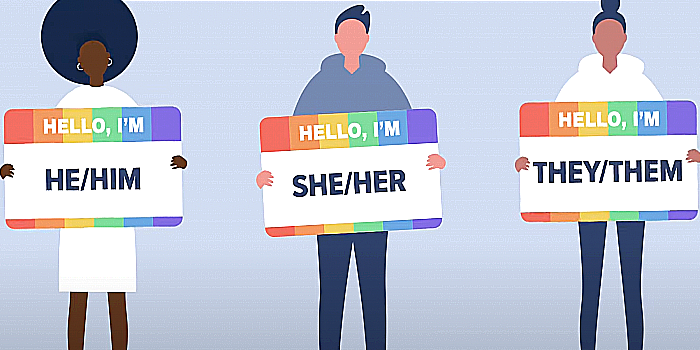
But even as the Lutherans elected a transgender bishop two years ago, it’s an open question whether progressive Protestants who adore drag queens and kneel to the Great They/Them will ever be ready to ordain a poly pastor or marry off their kids in polycules.

Within queer theology, the tyranny of sex and gender is often the organizing principle of colonialist, heterosexist global domination. If this reporter’s month-long immersion in the books, writings, commentaries, and podcasts of this movement makes anything clear, it’s that queer theology scholarship is an affirmation of all things sensual, sexual, lusty, and intemperate, a literature accentuated with allusions to anonymous hookups, communal sex, leather clubs, and sadomasochistic practices.

This wouldn’t be the first time that religious zeal scoffed at sexual norms as obstacles to holiness – the history of free-love communes and orgiastic rites offers plenty of case studies. Early Christians believed that grace and faith freed believers from observing the strictures of Jewish law, an idea called “antinomianism.” This idea historically reappears in extreme forms to make the controversial claim that breaking the earthly bonds of sin and death requires obliterating sexual taboos.

The late Marcella Althaus-Reid, an Argentine who taught theology at the University of Edinburgh in Scotland, raised that point in her 2003 work, The Queer God, which stated that queer theology embraces sadomasochists, leather folk, genderfuckers, and transvestitism in an apocalyptic birth pang every bit as libertine as Marquis de Sade. “Genderfucking” is the culture of challenging, or fucking with, conventional gender norms.

“Holiness is a Queer path of disruption made by curious amatory practices,” she wrote. “We may say that there is no possibility of justice in love unless law is transgressed. … Disruption then, fulfills the law.”

The ultimate authority for these claims is not in secular or empirical knowledge, but in the very nature of God, whom Althaus-Reid described as a Sodomite, polyamorous, omnisexual, a divinized orgy. “Queerness is something that belongs to God,” and “people are divinely Queer by grace,” she wrote.

Tonstad amplified these theological insights in her 2018 book, “Queer Theology: Beyond Apologetics,” which stated that “Christ’s body is symbolically multigendered.”

“Christianity, rightly understood, is about the transgression of boundaries,” Tonstad wrote. “Christians believe in a God whose love undoes every binary.”

As goes the binary, so does the law.

“All the laws are negated, including the law of contractual sexuality, that is, marriage,” Tonstad wrote.

Tonstad is a living embodiment of her faith. In a 2022 online magazine profile that features photos of Tonstad resembling the flamboyant Elton John of the 1970s, Tonstad describes her scholarship as a “deliberate misreading” of past theologians. “To ‘queer’ Christianity, she believes, is to ‘reframe reality,’ a project which — if undertaken with care and rigor — can orient one’s life toward progress and social justice.”

The daughter of a minister and New Testament scholar, Tonstad was brought up by Seventh Day Adventists, read the Bible cover-to-cover at age 9, and at least as of last year identified as a “queer dyke.” She is “now a staple of the New York rave scene,” the online profile states, describing Tonstad at her absolute queerest: “wearing a safety pin dangling from her septum,” pulling all-nighters in dance clubs, comparing God’s infinite love to impersonal oral sex through a “glory hole,” and writing exuberantly of “divine freedom and bliss.”

In Tonstad’s theology, sexuality and politics and divinity converge. Her first book evokes phallic and clitoral imagery to illustrate that the Trinity has been misgendered and that queering the error points to an “abortion of the church.” It is a dense and cryptic work that scholars giddily praised as “brilliant, angry, and iconoclastic,” “fearsomely rigorous,” “an exhilarating read,” and “remarkably arousing.”

“If we move from dick-sucking to clit-licking in touching God’s transcendence — if we no longer arrange ourselves kneeling around God’s Son-phallus or the priest-theologian’s asymptotic possession of it — we will no longer gag on God’s fullness nor be forced to swallow an eternal emission,” Tonstad wrote. “Instead we may find there already the differences of pleasures ‘outside the law.’”

The point is not merely to titillate, but to use language to break down social structures. She explained her ambitions in a 2017 online discussion with other religion scholars.

“Destroying the modern liberal-Enlightenment subject remains the project of much of the theoretical material I employ,” Tonstad wrote in an online discussion of her book. “That liberal-Enlightenment subject typically has its genesis, and thereby the genesis of the problems of (post)modernity (including racism, colonialism, capitalism and possessive individualism), assigned to Christianity.” Possessive individualism can be understood as selfishness and greed that thrives in heteronormative capitalist systems.

Queer theology traces its origins back to at least 1955 when an Anglican priest, Derrick Sherwin Bailey, published the pioneering historical study, “Homosexuality and the Western Christian Tradition,” but Tonstad identifies Marcella Althaus-Reid as “the theologian without whom the term ‘queer theology’ would have little content or meaning.”

Althaus-Reid’s breakthrough book, Indecent Theology: Theological Perversions in Sex, Gender and Politics, published in 2000, opens synesthetically, awakening all five senses: “Should a woman keep her pants on in the streets or not? Shall she remove them, say, at the moment of going to church, for a more intimate reminder of her sexuality in relation to God? What difference does it make if that woman is a lemon vendor and sells you lemons in the streets without using underwear? Moreover, what difference would it make if she sits down to write theology without underwear?”

Althaus-Reid contends that heterosexuality is founded on a “denial of reality,” and works by creating a Christian culture of secrecy. At every turn, she mocks Catholic purity ideals about Jesus and Mary that she encountered in her native Argentina: “Was Mary’s sexual encounter with God committed love, or a one-night stand with the unknown? Did He or Mary have someone else in their lives at that time? Did she give God a blow job?”

She rejects this colonialist version of Christianity as a European imposition and perversion: “Purity is, like the Western whiteness which represents it, a single-frequency thought.”

Many other queer theologians have developed these themes, as described chronologically in “Radical Love: An Introduction to Queer Theology,” published in 2011 by Patrick Cheng, an Episcopal priest, theologian, and lawyer in New York City.

Cheng describes one theorist’s “queer theology of sexuality” that focuses on the gift of “promiscuous” or “bodily hospitality” that many gay, lesbian, bi, and trans people exhibit. Another theologian has suggested that “nonmonogamous sex acts — including anonymous and communal sex — can be viewed in terms of a progressive ethic of hospitality,” one of the highest Christian virtues.

According to Cheng, we sin when we hew to sex essentialism and the gender binary, thereby rejecting God’s radical love, which essentially amounts to turning sinfulness into a rejection of queer theology. Cheng says that he is not endorsing total lawlessness – nonconsensual behavior like rape and sexual exploitation fall outside of radical love – but the reality is that those prohibitions are not defined, and thus, according to the precepts of queer theory, definitions are necessarily unstable, ultimately unknowable, open to new possibilities, and always subject to being queered at a moment’s notice.

For Tonstad, the most compelling queer testimony comes not from dispassionate, rational argumentation, but from the heart and body. She is committed to dazzling the world – on the dance floor, in the classroom, and on the printed page – with “a different reality that will have its own seductive power.”

“In a certain sense, to show that there could be another way of being in the world, and that way is better,” she said in a podcast appearance. “It’s more attractive, it’s more beautiful, it’s more interesting, it’s much more challenging, it’s much more dangerous.”


STEINHAUER: Globalists on ‘Humanitarian Mission’ to Destroy and Enslave America from Within

(Lee Steinhauer, Headline USA contributor) President Ronald Reagan observed that “a nation that cannot control its borders is not a nation.”

By Reagan’s definition, America’s nationhood hangs precariously in the balance, as open borders and mass immigration threaten its dissolution.

But while the current administration is undoubtedly feckless—if not outright complicit—in this regard, there are powerful interests that will do everything possible to see that the border is never secured and the invasion of mass immigration never ceases, regardless of who occupies the Oval Office.

Among these are the businesses profiting immensely from the abundance of cheap labor mass immigration supplies and the suppression of domestic wages it causes. Others see political advantage in adding hordes of favorable new voters to their column.

Then there are the elites of the World Economic Forum sort, who desire a borderless world where global capital—and those, like themselves, who control it—reign supreme as feudal lords. Through mass immigration and open borders, they are colonizing America for this purpose.

They understand, as Reagan did, that borders are more than geographical demarcations. Borders define a nation, as do those residing within them. For, like a random group of strangers does not constitute a family, so too is a population not a nation simply because it dwells within the same physical area.

Far more is required to forge a common unified national identity, such as shared culture, history, traditions and values. Without these ingredients, instead of a nation we become merely a weak colony of disparate rootless people devoid of true sovereignty and national self-determination, ripe for global capital’s exploitation—as, indeed, is already happening.

While immigration is part of American history, and immigrants are valuable contributors to it, the last few decades have been something entirely different. Unlike in the past, the current waves of immigration have been unceasing and unrelenting with no pause to digest the millions of foreigners from all over the world pouring into the country for now well over half a century. This has resulted in the rapid and drastic altering of the country’s demographic composition, virtually overnight by historical standards.

Nor have the new arrivals been required to assimilate, as in the past. To the contrary, the very idea of it is now derided, as multiculturalism—the antithesis of assimilation—has taken on an almost religious zeal. Predictably, this has led to the severe disintegration of social and national cohesion in America.

Moreover, America is now flooded with predominantly economic migrants. One could even call them economic mercenaries, for they view America as more akin to a temporary employer than a permanent homeland; to whom any allegiance goes only so far and only so long as the economic benefits one derives from it.

Many of these new migrants also have no real intention of ever becoming loyal US citizens or renouncing their former homelands. Increasingly, however, citizenship is not even required to reap all the benefits of America, including voting, with any differentiation between citizens and non-citizens rapidly vanishing.

And what about the American citizens themselves? Over the last few decades, Americans have hardly benefited from mass immigration. Schools have gotten progressively worse; services and resources overwhelmed; wages have stagnated; income inequality has grown dramatically; housing prices have gone through the roof; and crime has run rampant, to list just a few. For these reasons, polling consistently shows that Americans overwhelmingly want their borders controlled and illegal immigration to end.

However, not only have the desires of American citizens been disregarded in this respect but they have been rendered largely irrelevant.

Globalists, fearing an inevitable backlash from angry locals, have ensured that, over the last few decades, ever more governance is transferred from the national to the supranational level, in the form of multilateral organizations, which they control, and international laws, which they write and enforce.

Among other things, this has allowed them to constrain nation–states from regulating even who and what traverses their own borders.

But speaking of the “Will of the People,” such as it remains, as multiculturalism and identity politics balkanizes America into hyphenated tribes, mass immigration is increasingly becoming a political and demographic arms race, with future political power determined not by those who have lived here for generations, but by the number of new pliant voters each side can import from across the border.

Nor does this race show any signs of slowing, as the proponents of open borders and mass immigration have purchased politicians of both parties to do their bidding—providing campaign contributions in return for selling out their fellow countrymen. Meanwhile the media and other institutions keep the American public unfocused, divided and fighting over the relatively trivial rather than the existential: warring over Woke while their nation is stolen from them.

Additionally, mass immigration is falsely portrayed as an economic necessity, with the refrain that immigrants do jobs that Americans won’t. What they really mean, of course, is that they will accept far less in wages and worse conditions than American citizens. It is not a matter of American unwillingness to work, but of certain businesses adequately compensating for it.

Deprived of this cheap, and very often illegal labor, they would have to invest in an American workforce and labor-saving technology or go out of business. And while cheap immigrant workers may drive down costs for some, they suppress the wages of American workers generally while placing massive burdens on already stretched public resources, which in the end, we all pay for dearly—a fact that New York City is currently learning.

Finally, propaganda and fallacious tropes such as America being a “nation of immigrants” are advanced to establish the premise that there is no such thing as a distinct American people or identity.

Instead, the nation comprises only an unrelated collection of foreigners, none of whom possess any real claim of ownership upon the country, and therefore cannot refuse others from it. Indeed, they have even gone so far as to call America not a nation at all, but simply an “idea.” And to question these purported shibboleths is to be denounced as heretical, xenophobic, or, ironically enough, Un-American.

All of this is purposefully designed to make the country interchangeable and disposable, much like the people themselves, so that it can be easily divided and conquered; and to stave off what the elites fear more than anything else: a strong, prideful sovereign nation of patriotic unified American citizens.

Like with all feudal lords, they fear their ruled revolting against them. To that end, their nightmare is an American people realizing again that they are the true owners and rulers of America.

After deciding to secure the border and reject mass immigration, they might opt instead to govern America, not for the sake of foreigners or global capital, but for the sole and absolute benefit of American citizens, just as the Founding Fathers always intended when they threw off their own colonial masters.

To paraphrase another president, it is time to “Make America a Nation Again” and put American citizens first.

Lee Steinhauer is author of The Art of the New Cold War, an expert on U.S.–China policy, and a political & government affairs consultant. His book and analysis on China have been featured in national media outlets from Fox and Fox Business, to The Daily Caller. Steinhauer is an attorney and the president and founder of The Steinhauer Group, a strategic government and legal affairs firm located in Central Florida. Lee lives in Central Florida with his wife Allison and his son Alexander.