WATCH: Third Man Jailed in Whitmer Kidnap Conspiracy Releases Message for Congress

(Ken Silva, Headline USA) Two men convicted in the 2020 conspiracy to kidnap Michigan’s governor were sent to facilities used for political prisoners after recording public messages about the perceived injustices they experienced from the U.S. justice system.

But that hasn’t stopped a third imprisoned man in the Whitmer case from recording his own message for the House Weaponization Subcommittee, which was formed to investigate the politicization of federal agencies.

That man is former Wolverine Watchmen member Joe Morrison, who was convicted in state court last October of supporting terrorism. Morrison is incarcerated in federal prison until 2044.

Morrison recorded a message similar to the other two men—Adam Fox and Barry Croft, who were both convicted on federal charges last August—saying that the supposed plot to capture Michigan Gov. Gretchen Whitmer was largely concocted by FBI informants.

“[FBI informant] Dan Chappel led all combat training, and even paid for people to go to training at another CHS’s property, Steve Robeson in Wisconsin,” he said. “Without Dan Chappel and the FBI, no plot would have ever happened.”

Morrison urged the Weaponization Subcommittee to obtain sealed Whitmer case records, which he says will expose the full extent of the FBI’s malfeasance.

“Unseal all documents in this case, especially the text messages between Dan and his handling agents. Know the totality of the corruption,” he said.

“Don’t just use this as a prop to appease your base or get votes. We are hurting, our families are hurting. My wife, my children are hurting.”

Morrison was convicted along with his father-in-law Pete Musico, and Paul Bellar. On the federal level, Fox and Croft were found guilty last year after their second trial, while Brandon Caserta and Daniel Harris were found not guilty.

Several defendants in both cases struck plea deals to testify against the abovementioned defendants.

Meanwhile, another state trial in Antrim County, Michigan is set to begin next month. In that case, three men— Eric Molitor, Michael Null and William Null—will stand trial for providing material support for terrorism. Two other men, Shawn Fix and Brian Higgins have pleaded guilty and will testify against those defendants.

Ken Silva is a staff writer at Headline USA. Follow him at twitter.com/jd_cashless.

After SCOTUS Colorblind Ruling, Slavery Reparations Fight Lives on as ‘Not Race-Based’

(By John Murawski, RealClearInvestigations) Last month, on the same day the Supreme Court declared college admissions based on race unconstitutional, Kamilah Moore, head of the California task force at the forefront of the national reparations effort, announced on Twitter that her cause is not affected by the decision: “Our reparations recommendations are not race-based, but rather are based on lineal descent.”

It’s a subtle distinction stemming from the California Reparations Task Force’s razor-thin 5-4 vote last year to restrict eligibility for reparations only to California residents who qualify by lineal descendant – either from an enslaved African American, or from a free African American person living in the United States prior to the end of the 19th century. That eligibility criterion will exclude several hundred thousand black people living in California – namely Caribbean, African and South American black immigrants who arrived in this country in the 20th century.

As Moore affirmed that the task force’s work would endure, it rolled out an ambitious reparations program for an estimated 2 million black residents, containing more than 100 proposals, including free college tuition, a guaranteed income program, and cash payments that could exceed $1 million for some eligible African Americans.

The demands, now in the hands of state legislators, would cost California taxpayers an estimated $500 billion to $800 billion if enacted and lawsuits are virtually assured, as reparations skeptics consider eligibility by lineage to be a proxy for race. They also oppose the task force’s recommendation to repeal Prop 209, a statewide ban on racial preferences in government hiring, contracting, and college admissions that was reaffirmed by 57% of voters in a 2020 referendum.

“First and foremost, this is a legal matter. It will be challenged, if not by us, then by someone else,” said Wenyuan Wu, executive director of the California for Equal Rights Foundation, a lead group in the 2020 effort upholding Prop 209. Opponents are expected to challenge some of the historical claims as distortions or one-sided. UCLA law professor Richard Sander, who has spent his career researching the downsides of racial preferences, said the task force report is infused with Critical Race Theory, reducing complex history to simplistic explanations.

“A big challenge is going to be to put out an accurate counter-narrative,” Sander said. “One valuable thing from this process is the public can see what the critical race studies worldview and agenda is.”

Such responses might cite, for example, recent studies indicating that redlining – a practice of excluding risky neighborhoods from home lending programs and other financial services – may have affected more whites than blacks, even if blacks were disproportionately affected because of relative poverty and because of racial animus.

William Jacobson, clinical professor of law at Cornell Law School and president of the Legal Insurrection Foundation, which runs conservative websites, said the task force presumes every black person is a powerless victim who deserves compensation – precisely the sort of crude stereotyping the Supreme Court majority has rejected. Jacobson further said that calculating only harms without considering “the other side of the ledger” – like government assistance or other benefits someone’s parents or grandparents may have accrued over a lifetime – is dishonest.

“Reparations of this kind will likely lead to inter-racial and inter-ethnic strife – just the opposite of what California’s leaders should be trying to do,” said University of San Diego law professor Gail Heriot, who helped lead the movement to defeat racial preferences in 2020 as co-chair of the Californians 4 Equal Rights/No on Prop 16. “It’s unlikely to go down well with the people who are paying the taxes for this.”

Glenn Roper, an attorney with the Pacific Legal Foundation, a conservative public interest law practice that challenged the Biden administration’s debt-relief program for non-white farmers, said the task force report presents a radical challenge to the constitutional principle of equal protection.

“This would be a sweeping overhaul of the whole equal protection project,” Roper said. “It’s really going to be a pivotal test whether equal protection, colorblindness and race neutrality can withstand the moment.”

“We’ve gone from the bright optimism of the civil rights era, to the peevish political correctness of the 1990s, and on to the Age of Wokeness in which young African Americans are being told that they can’t possibly achieve, because everything about the world is rigged against them,” Heriot said. “It’s highly destructive.”

Reparations advocates see otherwise. “For those reactionaries who say slavery is old news and the time for reparations has passed, well, you know what, I’ve been a civil rights lawyer for 20 years and I say show me the statute of limitations on mass genocide,” task force member Lisa Holder said at the panel’s final meeting last month. “Show me the statute of limitations on the world’s greatest crime against humanity and show me the statute of limitations on accountability for original sin.”

This article was adapted from a RealClearInvestigations article published July 6.

Months after Toxic Train Derailment, EPA ‘Has Failed to Protect’ East Palestine

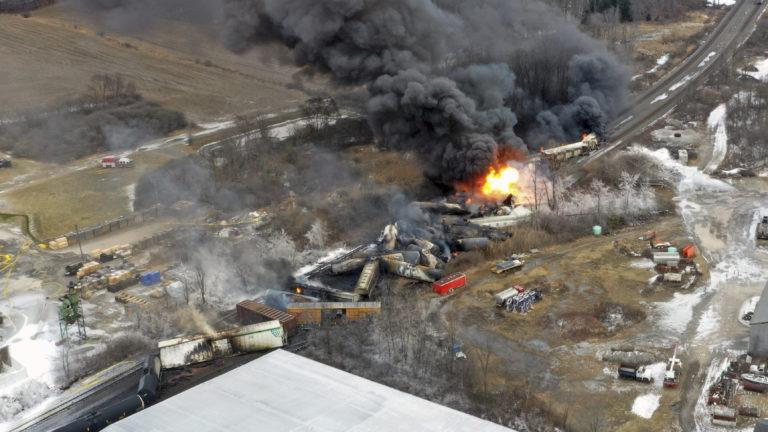
(By Anthony Hennen, The Center Square) State and federal officials continue to monitor the impact of the Norfolk Southern train derailment on the Ohio–Pennsylvania border, but independent scientists worry that indoor air quality has been ignored.

The lack of transparency, too, has made it harder to build and maintain public trust.

“We’re still waiting on a more comprehensive understanding of the areas that were impacted,” said Andrew Whelton, a professor of civil, environmental, and ecological engineering at Purdue University, who has visited the East Palestine area six times since the derailment to test air, water, and soil samples.

In May, the EPA released a soot map showing the areas where smoke and soot most likely affected the soil in the first 10 hours when the railroad corporation drained the chemicals “and (lit) them on fire in a ditch.” 

But the fire lasted longer than 10 hours, Whelton noted, and the EPA has not released a “plume map” that includes the impact of gas and vapors released by the derailment.

The soot map also differs from the map used by Ohio Gov. Mike DeWine and Pennsylvania Gov. Josh Shapiro days after the derailment on February 6. By February 8, both governors told evacuated East Palestine residents that they “can now safely return home.”

“The US EPA map shows that the impact was a lot bigger, wider, expansive than what the governor of Ohio was on TV telling everybody,” Whelton said.

“We knew the gasses and vapors went much farther than people were led to believe,” Whelton said. “This new soot map is helpful, but it’s not the whole story … My understanding is the map they used for soot was not the map they used for decision making.”

Whelton appeared at a Pennsylvania Senate Democratic Policy Committee in May advocating for more transparency from state leaders and warning of “indecipherable well testing documents” provided to residents by Norfolk Southern.

Officials and political leaders have focused on soil, water, and air quality testing — but indoor air quality has been ignored.

“The EPA, for example, allowed for indoor air contamination to remain in buildings for at least 4 1/2 months,” Whelton said. “We found that buildings inside are still contaminated, and the US EPA has done nothing of significance to abate those exposures.”

“I know I’m very critical of these agencies and the people that make the decisions, but the fact of the matter is we have to be because there’s an easier way to do things that help people more,” he said.

The concern is that the chemical burn could have wafted into residents’ homes and contaminated bedding, mattresses, clothing, and curtains, creating a health risk. Without more testing, locals can’t know if they should be concerned, and can’t monitor their health.

The EPA explains how it conducts air monitoring, but the focus has been outdoors, not indoors. The agency uses both stationary and mobile air monitors, “roaming nearly every day from at least 8 a.m. to 5 p.m. The vehicles continue to monitor air quality near the derailment site and in the surrounding community,” the EPA noted.

“There is no public data showing that the building air inside buildings is safe,” Whelton said. “They have not conducted any indoor testing and made that information public to anybody.”

Norfolk Southern posts the results of its air quality monitoring and elsewhere claims 340 in-home air tests it conducted with the EPA “does not indicate a health risk.” During Whelton’s fifth trip to East Palestine in May, however, he said their testing found “at least one building was still contaminated indoors along Sulfur Run.” Other independent testing, he said, has found other unsafe buildings.

Whelton argued that indoor contamination is there, but the EPA isn’t responding to residents’ concerns.

“I can tell you wholeheartedly that the EPA to date has failed to protect the population from harm in a thorough way — and it’s been a choice not to engage in air testing of buildings,” Whelton said. “It’s been their choice not to do it.”

Yuri Gorby, an associate professor of civil and environmental engineering at Rensselaer Polytechnic Institute, also worries about indoor air quality and contamination. But he raised the issue of water contamination that lays dormant until disturbed.

“My ongoing concern is the non-aqueous phase — that is, like a pool of oil or a pool of solvent — that can either be stuck on to the bottom of rocks or stream beds which we’re seeing,” Gorby said.

“It’s not an easy task,” Gorby said. “This is a very complex thing and I do commend the EPA on some of the things they’ve done … I give them credit for dealing with it the best they can.”

The complexity gets compounded by time because the health effects aren’t immediately apparent.

“Some of the longer-term effects of the chemicals that people were exposed to, it could be 10 years before some of those things show up,” Gorby said.

Tracing problems back to the train derailment, however, could be unfair.

“You have to put it in context — you guys live in an industrialized area, you go down to the river, you’re driving in this stuff all the time,” Gorby said. “There are abandoned coal mines, there are all kinds of other activities around there. Lots of people have poor health habits, are smokers — I’m not blaming them, that’s just the reality of it. It becomes very difficult to pinpoint some of the root causes.”

Those future problems aren’t inevitable, though.

“The indoor air safety issue is completely fixable. What they need to do — and I’ve told them this — is conduct air testing in buildings along and around Sulfur Run–multiple tests, not just one-off tests,” Whelton said. “This is recoverable, but the issue is it takes the political will and the leadership to make those decisions to protect people from harm. We haven’t seen that yet.”

In June, Whelton sent a letter to three Ohio representatives — U.S. Congressman Bill Johnson and Senators Sherrod Brown and J.D. Vance — recommending they take action to decontaminate buildings in the area, conduct more indoor air testing, and clean up the passages whereby chemicals have contaminated buildings.

“I have not seen so many mistakes made in a single disaster where those leaders continue to double, triple, quadruple down on making bad decisions,” he said. “This is a unique disaster in that sense. And the way out for them is to engage public experts in conversation so that they can rapidly use public money to remove contamination from the area and let people recover.”

Conservatives Fight Secretive Biden Voting Order as ‘Bidenbucks’ — Federal ‘Zuckbucks’ on Steroids

(By Ben Weingarten, RealClear Wire) GOP lawmakers and other conservative critics are working to expose and fight a secretive executive order by President Biden to expand voter participation in elections, which they suspect has become a powerful government-wide complement to private left-wing election financing that could tip the 2024 campaign illegally and unfairly in Democrats’ favor.

Cast as a civil rights measure issued as the nation marked the 1965 “Bloody Sunday” police beatings of voting-rights marchers outside Selma, Ala., the president’s 2021 directive orders every federal agency, more than 600 in all, to register and mobilize voters – particularly “people of color” and others the White House says face “challenges to exercise their fundamental right to vote.” It further orders the agencies to collaborate with ostensibly nonpartisan nonprofits.

Since issuing the order, critics claim, the Biden administration has stonewalled efforts to scrutinize its implementation by often ignoring document requests and litigating to shield relevant records. The critics, including members of Congress, state officials, and government watchdog groups, say the executive branch is attempting to federalize elections with an end-run around constitutionally prescribed state control over voting – in many cases using the resources of agencies with missions unrelated to registering voters.

Some have labeled the president’s order “Bidenbucks,” evoking “Zuckbucks” – Meta CEO Mark Zuckerberg and wife Priscilla Chan’s funneling of some $400 million through two nonprofits into election offices across the country during the 2020 election. That money often flowed to left-leaning nonprofits managing critical aspects of election administration that were considered crucial to Biden’s winning the White House.

In a notable recent defeat for conservatives, Judge Beryl Howell of the D.C. District Court, an Obama appointee to the generally liberal jurisdiction, on July 18 dismissed Freedom of Information Act requests from the America First Legal Foundation, siding with administration arguments that the records in question were exempt as privileged presidential communications. Trying to pry strategy documents loose, America First had sued nearly a dozen non-responsive agencies, ranging from the Departments of Agriculture, Education, and Health and Human Services to the Environmental Protection Agency.

Left-leaning think tank Demos, which in late 2020 drafted a blueprint for the order, estimates that if fully implemented, it could generate 3.5 million new or updated voter registrations annually. Even a far more modest increase could dramatically impact the 2024 presidential election, considering that recent contests have been decided by just thousands of votes in several states.

Critics say the order could violate laws including the Administrative Procedure Act, barring agency actions “in excess of statutory jurisdiction” and the Hatch Act, curbing political activities by federal employees.

Their concerns are driven in part by the fact that the directive appeared to be cribbed from the Demos white paper. Two ex-Demos executives – one of whom helped write the paper – departed for the Biden administration for roles positioning them to push for the order.

Republican House members raised the alarm about this issue in a January 2022 letter requesting documents from administration officials, calling the order “nearly identical to a federal election takeover plan crafted by the radical left-leaning group known as Demos.”

Months later, on the first anniversary of the order, Demos revealed it had worked extensively with federal agencies as well as state partners to implement the order, noting that it did so “in close partnership with the ACLU and other allies.”

Conservatives say their fears of federal government collusion with supportive progressive groups appear to have already been substantiated.

In ongoing FOIA litigation against the Justice Department, the Foundation for Government Accountability obtained an email between the White House Counsel’s Office and numerous agency officials regarding a July 2021 “Agency Listening Session” apparently led by “Civil and Voting Rights Organizations.”

The email includes a roster of “advocates.” These include representatives from progressive groups such as the ACLU, the George Soros-affiliated Open Society Policy Center, and the Southern Poverty Law Center; labor unions including the AFL-CIO and AFSCME; and a coterie of identity-focused organizations such as the Arab American Association, Black Voters Matter, and UnidosUS.

RealClearInvestigations contacted over a dozen prominent private groups supporting the order, some of which were represented at that meeting, but only one responded to its queries. The Project on Government Oversight, a self-described “nonpartisan independent watchdog,” indicated it had not met with federal agencies regarding the executive order, undertaken any activities to advance it, nor planned to do so during this election cycle. It publicly supported the executive order, according to a spokesperson, because “access to voting is a critical way to hold public officials accountable.”

The organizations that did not respond ranged from the Center for American Progress to politically powerful public-sector unions, including the American Federation for Teachers, the National Education Association, and AFSCME. Also not responding were Fair Fight Action, founded by unsuccessful Georgia Democratic gubernatorial candidate Stacey Abrams, and the Planned Parenthood Action Fund.

RCI also posed a series of questions to Demos centering on concerns expressed by lawmakers and others about its involvement in the order – including a report that it helped the Indian Health Service register and mobilize voters. It did not respond.

“Promoting voter registration and participation – i.e., mobilizing voters – is an inherently political act for a partisan president,” Tarren Bragdon and Stewart Whitson of the Foundation for Government Accountability wrote in a recent Wall Street Journal Op-Ed. “The resulting efforts can be directed at groups expected to vote for the president’s party and may take the form of pressure to support the party or its policies.”

Likewise, Hans von Spakovsky, manager of the Heritage Foundation’s Election Law Reform Initiative and a former member of the Federal Election Commission, recently submitted congressional testimony indicating that the kinds of activities contemplated under the Biden administration’s executive order “risk confusing and intimidating vulnerable members of the public who are applying for federal benefits into thinking they have to register and vote for the political party in control of the White House to ensure their applications for benefits are not declined.”

In addition to its largely successful efforts in court to date to stave off greater disclosure, the Biden administration has rebuffed Republican lawmakers’ numerous oversight inquiries into the order.

The administration has refused to produce agency-specific strategic plans that would comprehensively capture the order’s scope and has remained largely silent about which third-party groups agencies are coordinating with to execute the order, and on what grounds – a key area of concern among the directive’s critics.

RCI asked a White House spokesperson why the administration was withholding the strategic plans. RCI also asked if the Biden administration would share details about agencies’ coordination with third-party groups, and how the administration would respond to concerns raised by critics that the order codifies a de facto Democrat get-out-the-vote effort. The White House did not respond.

What is clear, based on the details that have emerged about the order, is that the Biden administration is proceeding with its implementation, undeterred by critics.

In March, near the two-year anniversary of the order, the administration released a characteristic summary statement noting that agencies as diverse as the Department of Education, Defense, and the Indian Health Service have carried out efforts ranging from making voter registration information and materials more readily available on agency websites, in documents, and across their offices, to successfully designating themselves as voter registration agencies.

Previously, agencies from the Departments of Labor, Housing and Urban Development, and Agriculture disclosed generally some of the ways they were working to comply with the order, including seeking to drive voter registration via job training centers, public housing authorities, and child nutrition programs.

The Equal Employment Opportunity Commission, the Department of Education, and the Department of Agriculture are exceptions in having provided cursory responses to the many questions posed by lawmakers regarding the order.

Much of what little is known publicly about the directive has been captured in “progress reports” released by its left-leaning champions aimed at persuading the administration to accelerate and broaden its efforts to implement it.

Myriad left-leaning organizations are urging the administration to more fully implement it in the run-up to the 2024 election. They propose, for example, that the U.S. Marshals Service provide eligible individuals in federal pre-trial detention “access to high-quality voter registration services and assistance voting”; that the Department of Education incorporate voter registration opportunities into the federal student aid process; and that U.S. Citizenship and Immigration Services offer voter registration services “at or immediately after all naturalization ceremonies.”

Republicans have recently advanced legislation to combat the executive order. The Republican-led House is seeking to neuter the executive order via appropriations.

As currently drafted, the Financial Services and General Government appropriations bill would defund the order. Perhaps more significantly, the House Administration Committee recently introduced the American Confidence in Elections (ACE) Act, which it touts as “the most conservative election bill to be seriously considered in the House in a generation.”

Among the almost 50 bills contained in the legislation is the Promoting Free and Fair Elections Act. That bill, sponsored by New York GOP Rep. Claudia Tenney, co-chair of the Election Integrity Caucus, would nullify the Biden executive order.

Progressive supporters of the directive panned the provision. The Leadership Conference on Civil and Human Rights wrote that it “strongly object[s] to the ACE Act’s attempt to thwart implementation” of the Biden executive order.

“Voter registration remains a hurdle for many eligible voters, particularly people of color,” the group said. “Real confidence in elections comes from ensuring that all Americans have the freedom to vote unimpeded by discriminatory rules.”

Notwithstanding such opposition, the ACE Act would seem poised to pass the House given the support shown by leadership, including its sponsorship by Speaker Kevin McCarthy and its more than one hundred other co-sponsors. But, as Roll Call noted, “its outlook is bleak in the Democrat-controlled Senate.”

There, Republican Sen. Ted Budd or North Carolina has introduced companion legislation to Rep. Tenney’s. Any such efforts are likely to prove fraught in a divided government. Republicans’ majority in the House, however, does arm them with subpoena powers. RCI asked several relevant committees whether they might use such authority to compel the executive branch to respond to their requests.

Wisconsin GOP Rep. Bryan Steil, Chairman of the Committee on House Administration, which has jurisdiction over federal elections, told RCI that he “will continue to demand answers from the agencies on how they are implementing the [executive order]” while touting the ACE Act.

A spokesperson for the committee told RCI its members were “not satisfied with the responses [to oversight requests] we’ve received so far” – noting that in some instances it had not received responses from agencies at all – and that the committee was planning to send a battery of follow-up requests in the near-term.

Whitson believes that such oversight efforts could hold the key to halting the executive order irrespective of what happens with pending litigation. He argues that “Congress should use its subpoena and oversight power to gather evidence, including sworn testimony and documents” that can be leveraged by state attorneys general – many red state officials having already indicated their aversion to the order – to sue the Biden administration and seek a permanent injunction blocking it. “[I]t’s up to the states and Congress to work together to stop this unprecedented scheme before time runs out,” Whitson says.


Why EVs Are ‘Piling Up’ at Dealerships, Despite Massive Taxpayer Subsidies

(By Jon Miltimore, FEE) Ford Motor recently announced it is slashing prices on its F-150 Lightning, an electric vehicle the company rolled out in 2021.

The Lightning now carries a suggested retail price of $49,995, about $10,000 lower than its previous recommended price tag ($59,974), a reduction the company says is possible because of lower “battery raw material costs and continued work on scaling production and cost.”

It’s certainly possible that reduced overhead from battery minerals and production costs played a role in Ford’s decision to trim its price tag by nearly 20%, but that may be only half the story.

Several reports show EVs are not exactly flying off dealership lots. In fact, there’s a glut of them.

“After a prolonged period in which EVs quickly disappeared from dealerships, the electric vehicle industry now has the opposite problem: unsold models are piling up,” reported Money last week. “About 92,000 EVs currently sit on dealers’ lots; that’s a 342% increase from a year ago, when only about 21,000 did so, according to automotive research firm Cox Automotive.”

Ford is not immune from the weakened demand for EVs. Sales of its flagship car, the Mustang Mach-E, have slumped, down 44 percent in May from the same month last year.

The Lightning, which won the title of EV king of pickup trucks after Ford moved nearly 16,000 units in 2022, has fared better but is still struggling to keep pace with 2022. And now the company is facing some stiff new competition. (More on that in a minute.)

This was not the scenario many people predicted.

In April, the International Energy Agency released a report in which it predicted EV sales to increase 35 percent after a record-breaking year. But economists I spoke with said such predictions were overly optimistic considering current macroeconomic conditions.

This invites important questions. Is the glut of EVs simply a product of tightened money supply?

Apparently not. As Axios noted, the 92,000 EVs currently sitting on lots is comparatively high relative to gasoline-powered cars.

“That’s a 92-day supply — roughly three months’ worth of EVs, and nearly twice the industry average,” wrote Joann Muller. “For comparison, dealers have a relatively low 54 days’ worth of gasoline-powered vehicles in inventory….”

In other words, dealerships are sitting on a lot more EVs than gasoline-powered vehicles—despite efforts to entice consumers to buy EVs with taxpayer-funded credits up to $7,500.

This is evidence that pretty much everyone—from central planners to auto manufacturers—misjudged the demand for EVs, which are not even as environmentally friendly as politicians would have you believe.

Not only do EVs require an astonishing amount of mining—an estimated 500,000 pounds of rock and minerals must be upturned to make a single battery, physicists point out—but their carbon footprint isn’t much smaller than gas-powered cars.

It turns out that EVs actually require a lot more CO2 to produce than gas-powered cars. EVs can make that up, but it takes a great deal of time because EVs also often run on electricity generated from fossil fuels. Just how long? In 2021, Volvo admitted that its C40 Recharge has to be driven 70,000 miles before its carbon impact is lower than its gas-powered version.

All of this is to say that a bunch of unused EVs isn’t just a financial headache for auto dealers and motor companies; it’s also an environmental problem.

That said, the weaker than expected demand for EVs doesn’t mean the future of electric vehicles is doomed. On the contrary, demand for EVs is likely to increase as battery technology and EV infrastructure improves. Ford’s Lightning, for example, only has half the range of its gas-powered F-150 because of its small battery—a clear concern when charging stations are not yet readily available in many places.

For now, however, motor companies are competing with one another to attract customers in a smaller than anticipated EV market. Which brings me to Elon Musk.

Tesla last week rolled out  its much-hyped Cybertruck, which is a direct challenge to the Lightning, and likely played a role in Ford’s price cut.

Federal lawmakers may have created a glut of EVs with their meddling, and it’s likely to have an adverse impact on both the auto market and the environment. But one of the virtues of capitalism is that consumers will ultimately decide who wins in the EV market and who loses.

Whether that turns out to be Musk’s Cybertruck or Ford’s Lightning remains to be seen. Either way, the competition is bringing down prices, which is a win for consumers looking to purchase an EV.

But the glut of electrical vehicles on the market reveals the danger in letting lawmakers decide what consumers should be driving.

Another Charlottesville Torch Marcher Charged by Soros DA, 6 Years after the Fact

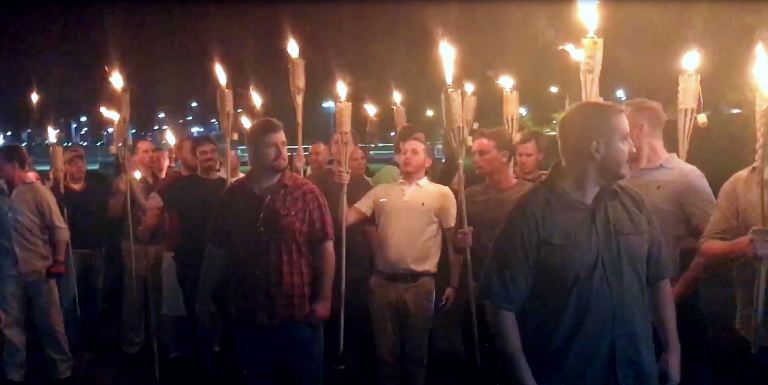
(Ken Silva, Headline USA) Another demonstrator from the infamous 2017 torch march in Charlottesville, Virginia, has been charged with a little-used law that makes it a crime to burn objects with intent to intimidate—the latest indictment over the six-year-old incident by the city’s recently elected, George Soros-backed district attorney.

The defendant, Augustus Sol Invictus (who was born Austin Mitchell Gillespie), was allegedly the author of the “official manifesto” of the 2017 Unite the Right rally. According to the Franklin News–Post, Invictus was granted bail at his court hearing on Wednesday.

Invictus is the latest torch-marcher to be charged by Charlottesville D.A Jim Hingeley, who made it a campaign promise to prosecute torch-carriers. His predecessor, Robert Tracci, had declined to press charges.

Participants on white nationalist blogs and message forums are expecting mass arrests in a Jan. 6-like prosecutorial crackdown.

“A Soros-backed prosecutor has fulfilled his campaign promise by bringing meritless charges against attendees of a 6-year-old political demonstration, which was coordinated with law enforcement,” wrote white nationalist Christopher Cantwell in April.

“Since then, a few names have been released, and we can expect more to follow,” Cantwell added. “There is a distinct possibility I may be one of them.”

The torch marchers have expressed pessimism about being arrested, but optimism about ultimately being acquitted.

The charges should ultimately be defeated in court because “there was zero intent via the organizers or the rank and file to seek out or confront any specific group or individual,” someone wrote on the blog Full Haus, which markets itself as “the world’s finest show for white fathers.”

The contrary to misinformation pushed by leftists including President Joe Biden—who has frequently claimed that demonstrators emerged from “out of the fields” (with the only nearby fields being those of the athletic variety)—the rally took place in a public space that has often been celebrated for its association with free speech, the University of Virginia’s Rotunda.

“Holding a tiki-torch burning, self-contained citronella fuel while walking on public property regardless of slogans is not remotely in the same category as burning a large wooden cross in front of your black neighbor’s house,” the blog said, referring to the slogans such as “you will not replace us” and “blood and soil.”

The state-funded university, founded by Thomas Jefferson but now run by leftist idealogues, has since amended its rules to restrict such gatherings. However, it had no specific policy in place that would have prohibited the torch rally at the time.

“Due process and First Amendment issues will jump off the page of any lawyer who agrees to fight this,” said the blog.

Invictus’s lawyer reportedly agreed.

“We’re not trying the case today,” defense attorney Terrell N. Roberts III  reportedly said. “But what I see is protected First Amendment activity.”

Invictus’s trial is set for March 2024.

The Charlottesville rally turned deadly the day after the torch march, when a 20-year-old Ohio man rammed his vehicle into a group of counterprotesters and killed a local activist. The driver, James Alex Fields Jr., was convicted of murder and given life imprisonment.

The law being used to pursue the peaceful protestors from the night before was enacted by the state in 2002 in response to Ku Klux Klan cross-burnings.

It was challenged all the way to the Supreme Court, which ultimately found the law constitutional in a 6-3 vote.

Individuals convicted under the law face one to five years imprisonment.

Ken Silva is a staff writer at Headline USA. Follow him at twitter.com/jd_cashless.

Trump’s Lawyers Meet w/ Weaponized Special Counsel Ahead of ANOTHER Indictment

(Headline USA) Lawyers for former President Donald Trump met Thursday with members of weaponized special counsel Jack Smith’s team ahead of yet another potential indictment over the former president’s efforts to challenge the dubious and still highly disputed results of the 2020 election.

Trump himself confirmed the meeting in a post on his Truth Social network, writing, “My attorneys had a productive meeting with the DOJ this morning, explaining in detail that I did nothing wrong, was advised by many lawyers, and that an Indictment of me would only further destroy our Country.”

He added that “no indication of notice was given during the meeting.”

It was not immediately clear what was discussed at the meeting, though a similar sit-down with lawyers occurred in the days before Trump was indicted last month on charges of illegally retaining classified documents following the unprecedented raid of his Mar-a-Lago resort ahead of the 2022 midterm election.

The DOJ buried similarly damning revelations concerning Joe Biden’s mishandling of classified documents in multiple locations—and while lacking the authority to declassify them under the Presidential Records Act—until two months after the election.

Thursday’s meeting included Trump attorney John Lauro, said the person familiar with the case, who spoke to the Associated Press on the condition of anonymity to describe a private gathering. Lauro said in a television interview last week that his client had done “nothing wrong.”

The status of the secretive grand jury proceedings remained unclear Thursday despite building speculation that a criminal case could be near. By late in the afternoon, no indictment had been announced, and it was not clear if one would be by the end of the day. In a sign of heightened expectations, police officers were photographed gathered outside the courthouse.

Trump, the front-runner in the 2024 Republican presidential primary, was informed earlier this month by Smith’s office that he was a target of the Justice Department’s investigation, suggesting that an indictment could be soon.

The investigation has focused on the turbulent two-month period after the November 2020 election. During that time, outrage over election-night irregularities in several swing states and the lack of proper remedy to address them through the courts—along with pent-up anger over months of COVID lockdowns, widespread censorship and politically motivated race-riots in major blue cities—culminated in the Jan. 6, 2021, uprising at the U.S. Capitol.

More than 1,000 people have since been charged with federal crimes for disrupting the congressional counting of electoral votes at the mostly peaceful, four-hour-long melee that briefly forced lawmakers into hiding.

Trump already has been acquitted once, by the U.S. Senate, for his alleged role in fomenting the protests after Democrats waged an unprecedented post-presidential impeachment campaign in an effort to block him from running for a second term.

They have not relented in the two intervening years, with Trump already having twice been indicted. In addition to Smith’s second expected indictment, Democrats are hoping for a fourth one from ethically challenged Fulton County District Attorney Fani Willis in the near future.

Thus far, however, the lawfare efforts have only strengthened Trump’s support among his GOP base, which sees clearly through the politically motivated attacks and is eager for political retribution.

Whether they can succeed in waylaying his campaign legally, or at least tarnish his public standing among independent voters who have soured on the Biden adminsitration, remains to be seen.

A spokesman for Smith declined to comment on Thursday’s meeting. Lauro, Trump’s lawyer, didn’t immediately respond to a message seeking comment.

Adapted from reporting by the Associated Press

Study: Dems Still Support Political Violence, Despite J6 Derangement

(Ezekiel Loseke, Headline USA) A study by a researcher at the University of Chicago has found that approval for political violence has risen across the political spectrum, but the trend is especially pronounced among Democrats.

Robert Pape, a political science professor at the University of Chicago who reports to be a “liberal republican,” and who confessed to voting for Democrats in the past, performed the study, according to Breitbart News.

The study, which divided Americans into three groups (Democrats, Republicans and independents), found a rise in the approval of political violence in all groups.

  • Republican support of the use of violence grew by 6%.
  • Independent support grew by 8%.
  • Democrats saw the highest growth, with a 9% increase in the approval of violence.

Purporting to be a tracker of “Dangers to Democracy,” the study reported that partisanship may be causing the effect.

“This growing anger parallels the Republican rise to power and proceedings in the House of Representatives,” the study reported.

The growth of approval for violence is directly tied with abortion policy.

“Radical, expressly violent support to restore the federal right to abortion grew from 8 percent in January 2023 to 12 percent as of June 26, 2023,” the study reported. “The increase was sharpest among Democrats, doubling over the past 6 months from 8 to 16 percent,” the study concluded showing abortion advocates rose by higher numbers than other liberals.

“This likely indicates growing anger over the Republican controlled supreme court.”

Pape said the results of the study were troubling.

“Things are definitely heading in the wrong direction in terms of the radicalization of the country. We need to be aware of that because there were some hopes that the Trump indictment would actually reduce support for Trump,” he said, in a claim running counter to arguments that the Trump indictments politically weaponized the Biden DOJ and served to bolster Trump’s popularity.

More troubling, per Pape, is the timing of the findings.

“Things are going in the wrong direction of radicalization, and we haven’t even gotten into the really heated part of the 2024 election season.”

UK Court Acquits ‘Slippery, Snaky’ Kevin Spacey of Sexually Assaulting Boys

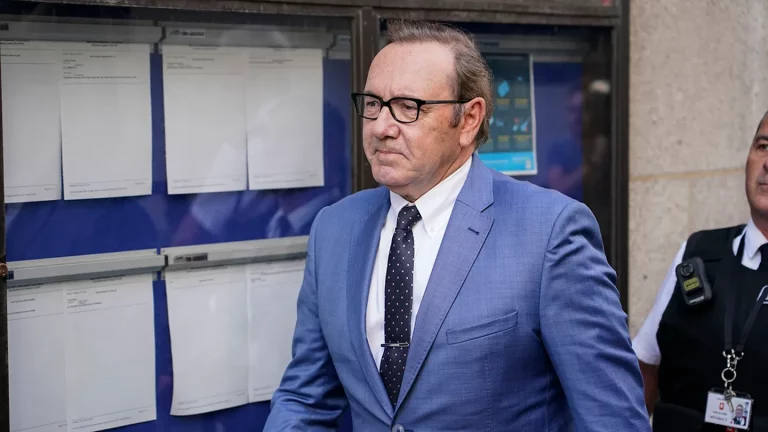
(Headline USA) A jury in London acquitted Kevin Spacey of sexual assault Wednesday after the Oscar winner’s star turn as a witness in his own defense spared him a possible prison term and offered him hope of a career comeback after six years without a job.

Tears rolled down Spacey’s cheeks as the final “not guilty” verdict was read. The House of Cards star looked at the jury, placed his hand over the lapel of his blue suit and pink shirt, and mouthed “thank you.” It was his 64th birthday.

“I imagine that many of you can understand that there’s a lot for me to process after what has just happened today,” a humbled Spacey said outside Southwark Crown Court after thanking a handful of jurors in the lobby. “I am enormously grateful to the jury for having taken the time to examine all of the evidence and all of the facts carefully before they reached their decision.”

Spacey’s two days of testimony culminated with him choking up as he spoke of his six years without work since the sex abuse allegations against him surfaced in 2017.

While the #MeToo frenzy brought to surface many of the “open secrets” involving accused Hollywood rapists, Spacey’s was unusual for the neofeminist movement in that it involved allegations of homosexuality and pedophilia.

Following multiple credible accusations, spanning various parts of his four-decade showbusiness career, the publicly closeted star angered the LGBT community by taking the opportunity to come out as gay.

Although Spacey may have been trying to garner a degree of sympathy and protection from the woke Left, which had long turned a blind eye to his alleged misconduct, there was little to be had.

“My world exploded,” Spacey testified. “There was a rush to judgment and before the first question was asked or answered, I lost my job, I lost my reputation, I lost everything in a matter of days.”

Three men accused Spacey of aggressively grabbing their crotches, describing him as “vile” and a “slippery, snaky” predator.

A fourth, an aspiring actor, said he awoke to the actor performing oral sex on him after falling asleep or passing out in Spacey’s London apartment, where he had gone for career advice and a beer.

Spacey said he was a “big flirt” who had consensual flings with men and whose only misstep was touching a man’s groin while making a “clumsy pass.”

Defense lawyer Patrick Gibbs said three of the men were liars and that their encounters had been “reimagined with a sinister spin.” He accused them of hopping on the #MeToo “bandwagon” in the hope of striking it rich. Two of the men have sued Spacey.

Prosecutor Christine Agnew called Spacey a “sexual bully” who preyed on younger men. She said he was shielded by a “trinity of protection”—he knew men were unlikely to complain; they wouldn’t be believed if they did complain; and if they did complain, no action would be taken because he was powerful.

Thus far, the latter suspicion has borne out accurately.

Spacey had faced nine charges, including multiple counts of sexual assault and one count of causing a person to engage in penetrative sexual activity without consent. Jurors deliberated for 12.5 hours over three days before reaching their verdict.

Spacey had viewed the London case as a chance for redemption, telling German magazine Zeit last month that there were “people right now who are ready to hire me the moment I am cleared of these charges in London.”

During deliberations, jurors asked Justice Mark Wall to summarize the testimony of a man who said the actor grabbed his crotch so forcefully while he was driving to a gala at Elton John’s that he almost ran off the road.

In a cameo appearance, the rock star and his husband, David Furnish, testified by video from Monaco and offered a timeline that cast doubt on the driver’s account. They said Spacey didn’t attend the White Tie & Tiara Ball the year the man said, but had been a surprise guest three or four years earlier in 2001.

That was significant because the man said he had begun working with Spacey in the early 2000s and suffered from unwanted fondling for years. He said the incident in the car was the final straw and he avoided the star afterwards.

The accusations dated from 2001 to 2013 and included a period when Spacey—after winning Academy Awards for The Usual Suspects and American Beauty—had returned to the theater. He served as artistic director of the Old Vic Theatre in London for most of that time.

One of the men called his encounter with Spacey “completely traumatic and life-ruining.” One said he sought solace by working out and drinking more. Several said they couldn’t bear to watch productions starring the actor.

With the confidence of a seasoned performer, Spacey took his seat in the witness box in what had to be the smallest stage of his career—a laminated oak desk at the front of a brightly lit courtroom.

He spoke in the warm, rich, calming voice that most audiences would instantly recognize. When pressed by Agnew, he did not take the menacing, cold tone of some of his characters, but maintained his composure and showed only flashes of indignation delivered with a flourish.

Asked about grabbing the genitals of a man backstage at a charity event, he snapped: “Absolute bollocks!”

As laughter rose in the gallery, Agnew retorted: “That’s exactly where you did grab him, isn’t it?”

“Really?” Spacey said as he looked up at Wall in disbelief.

He then denied the act and later dismissed the prosecution case as weak.

Jurors laughed and smiled at parts of his testimony, and Wall occasionally had to rein him in when he strayed into seemingly irrelevant anecdotes.

Spacey sounded like a regular guy at times, speaking of how he liked to smoke marijuana but was incapable of rolling a joint, and acknowledging that he sought sex during lonely periods, quipping “welcome to life.” He said being promiscuous does not make him a bad person.

At other moments, he illustrated his life as an award-winning actor. He talked about performing in high school with Val Kilmer, buying the most expensive Mini Cooper ever at Elton John’s charity gala, and how he taught Judi Dench to play table tennis while filming The Shipping News and later bought her a ping-pong table.

Gibbs said Spacey was “monstered” on the internet and became toxic in the entertainment industry. Aside from some small projects, he has barely worked as an actor in six years.

The court victory is his second since he beat a $40 million lawsuit last fall in New York brought by Star Trek: Discovery actor Anthony Rapp.

Prosecutors in Massachusetts dropped charges when the alleged victim suddenly refused to testify.

Los Angeles prosecutors declined to bring charges after the death of a massage therapist who said Spacey forced him to touch the actor’s genitals during a rub down at Spacey’s home in Malibu in 2016.

Spacey can now resume his career “without a stain on his character” said Mark Stephens, a London media lawyer.

“These were allegations made at the height of the #MeToo allegations in Hollywood, and out of an abundance of caution, essentially Kevin Spacey was canceled by Hollywood,” Stephens said. “I suspect he’ll be snapped up by Hollywood producers desperate to get on and make new movies.”

Adapted from reporting by the Associated Press

‘Private Citizen’ Hunter Hitches Ride to Court in Secret Service Motorcade

(Jacob Bruns, Headline USA) Drug addict and President Biden’s son, Hunter Biden, caught a ride to his court date to accept a plea deal for charges of tax evasion and a firearms offense with the Secret Service motorcade, Red State reported.

Joined by Kevin Morris, Hunter’s bong-ripping lawyer, the president’s son traveled to plead guilty to federal crimes in style.

Yet as Hunter pursues a number of recreational activities, the leftist media has continually insisted that he must be allowed to act as a private citizen, whether it be in the sales of his mediocre art for large sums of money, or his foreign business dealings.

The most recent claim that Hunter is a private citizen was made by White House press secretary Karine Jean-Pierre, who used the label to avoid talking about his trial at a recent press conference.

“I know many people have been following the news in Delaware today and are going to have a lot of questions. And so, here’s what I’ll say at the top before I turn it over to my colleague, the admiral. Hunter Biden is a private citizen, and this was a personal matter for him,” Jean-Pierre said.

But in an unexpected turn of events, the plea deal collapsed, leading to Hunter Biden’s not guilty pleas to two federal tax crimes.

District Judge Maryellen Noreika reportedly asked a number of scathing questions, leading to the alternative arrangements.

“It seems to me like you are saying ‘just rubber stamp the agreement, Your Honor.’ … This seems to me to be form over substance,” the judge said.

Noreika gave defense lawyers and prosecutors 30 days to explain why she should accept the deal.

Reporting live from the Delaware courthouse, CNN correspondent Kara Scannell began covering for Hunter.

“The judge didn’t understand exactly what this plea agreement was covering, because it seemed to be all-encompassing,” Scannell said.