


An Insightful Discussion on Silver and the Economy with Peter Krauth

(Money Metals News Service) In a recent interview on Money Metals with Mike Maharrey, Peter Krauth, author of the book The Great Silver Bull: Crush Inflation and Profit as the Dollar Dies, discussed the intricacies of silver as both a commodity and an investment. Maharrey commended Krauth on the well-organized structure of his book, which allows readers to delve into topics selectively, appreciating its concise and impactful writing style.

(Interview Begins Around the 4:30 mark)

Peter Krauth, with a background of over 20 years in resource investment and analysis, shared his motivations for writing the book, driven by a desire to consolidate his extensive research on silver. The book, emerging amid the COVID-19 pandemic, reflects a comprehensive guide, particularly beneficial for those in the industry, including fund managers specializing in silver.

The conversation with Mike Maharrey and Peter Krauth also touched on the economic implications of the depreciating dollar, a central theme in Krauth’s book. He provided a stark portrayal of the U.S. as a debtor nation, with its ballooning debt and the implications of inflation on everyday purchases, which have dramatically surged in recent years. Krauth argues that the dollar’s slow depreciation is a significant financial phenomenon, impacting savings and broader economic stability.

Krauth’s insights extend to the historical and practical applications of silver, explaining its usage over gold due to its lower value by weight and greater suitability for smaller transactions. He also highlighted the critical role of silver in modern industries, especially in green technologies like solar panels, which are becoming increasingly reliant on silver, intensifying its demand.

He underscored the inelastic nature of silver supply, pointing out that most silver is derived as a byproduct of mining for other metals, which means that its supply does not necessarily increase with rising silver prices. This, Krauth suggests, is a fundamental reason why silver is currently undervalued and why its price does not fully reflect its market dynamics and utility.

Towards the end of the interview, Krauth shared where readers can find his book and follow his ongoing analysis on silver through his newsletter, “Silver Stock Investor.” He remains active on social media platforms like Twitter and LinkedIn, continuing to engage with a broader audience interested in precious metals and their economic implications.

Key Questions and Answers from the Interview with Peter Krauth


What motivated you to write “The Great Silver Bull”?

Krauth explained that his motivation stemmed from years of accumulated research and encouragement from a colleague. The decision to write crystallized during the early days of COVID-19, driven by a desire to organize his findings and insights into silver’s market dynamics into a comprehensive guide.

Krauth shared, “I had been writing a weekly report on gold and silver for my former employer, probably for three or four years, had accumulated a lot of data on the silver market, and I said, ‘That’s a great start for me. I can use a lot of that research.'”

He added, “Deep into COVID, middle of the winter, looking around and thinking, I’m not going anywhere. I’m barely seeing anyone. This is likely to be like this for a while. Why don’t I just go ahead and do it?”

Can you make your case that the dollar is dying?

Krauth highlighted the alarming growth of U.S. national debt and inflation rates, pointing out that everything from rent to consumer goods has doubled in price in recent years. He described the erosion of the dollar’s purchasing power as a slow but inevitable process, exacerbated by financial policies that favor debt management over economic stability.

“The U.S. is a huge debtor, $34 trillion. That debt is growing at a rate of a trillion dollars every 100 days,” Krauth explained. He continued, “You just have to look at inflation, and what people are paying for things… nearly everything has doubled in price.”

Why do you prefer silver over gold as a form of money?

Krauth argued that historically, silver was used as money before gold due to its lower value by weight, making it more practical for daily transactions. He noted that silver has facilitated more business historically than gold, which is typically reserved for storing wealth and larger transactions.

Krauth reasoned, “Silver relative to gold has a lower value by weight, it is easier to use in daily transactions.”

He elaborated, “Because of the volume of use of silver, it’s proven itself historically as, perhaps… until otherwise, until something else comes along, it has proven itself as the best-found form of money.”

What are your thoughts on the current price and underlying fundamentals for silver?

Krauth pointed out that silver is undervalued, especially when compared to its historical price peak in 1980 and its significant industrial use. He discussed how silver’s supply is largely inelastic due to its production as a byproduct of other metals, which does not necessarily increase even when silver prices rise.

Addressing silver’s valuation, Krauth noted, “If you compared all of the base metals, and the precious metals, and the platinum group metals with their price in 1980, they were all dozens of percent if not hundreds of percent, and in some cases thousands of percent above their 1980 level. Silver was the only one of all of those that was still below its 1980 high.”

What is happening with silver demand in the context of green energy?

Krauth emphasized the growing demand for silver in the solar industry, where it is an essential component of solar panels. He noted that even if production of solar panels were to stabilize, the demand for silver would continue to increase due to advancements in technology that require more silver per panel.

Highlighting the impact of green technology on silver demand, Krauth stated, “I consider the solar consumption of silver, because it’s integral, it’s indispensable to solar panels, to be the 800-pound gorilla in the solar market… It grew last year by 64% over the prior year.”

These questions and answers covered the crux of the interview, highlighting Krauth’s expertise in the silver market and his perspective on broader economic issues, particularly the challenges facing the U.S. dollar.

Peter Krauth Interview Summary

The overall lesson from the interview with Peter Krauth revolves around the significant economic and investment potential of silver, especially in the context of current financial challenges such as inflation and the depreciation of the U.S. dollar.

Krauth emphasizes that silver is not only historically valuable as a form of money due to its practicality in daily transactions but also increasingly crucial in modern industries, particularly in green technologies like solar panels which demand large quantities of silver.

Furthermore, Krauth’s discussion highlights the inelastic nature of silver supply, which does not necessarily respond to increased demand, thereby contributing to its undervaluation. This scenario presents a compelling investment opportunity, as he suggests that silver is still priced below its historical peak and the fundamentals suggest it should be higher.

In broader economic terms, the interview sheds light on the impact of fiscal policies that contribute to the erosion of currency value, making a case for precious metals like silver as a hedge against such decline.

Krauth’s insights suggest that understanding the dynamics of commodities like silver can provide valuable strategies for preserving wealth and capitalizing on market inefficiencies. This underscores the importance of considering historical context, industrial demand, and economic indicators in investment decision-making.

In conclusion, the discussion with Peter Krauth not only highlighted his deep knowledge and passion for silver but also addressed broader economic concerns, making a compelling case for the strategic role of silver in hedging against inflation and currency devaluation.

To pick up a copy of Peter Krauth’s book, The Great Silver Bull: Crush Inflation and Profit as the Dollar Dies, you can get it here.

Get started buying silver here at Money Metals Exchange.

Gold Prices Have Been on Fire Recently

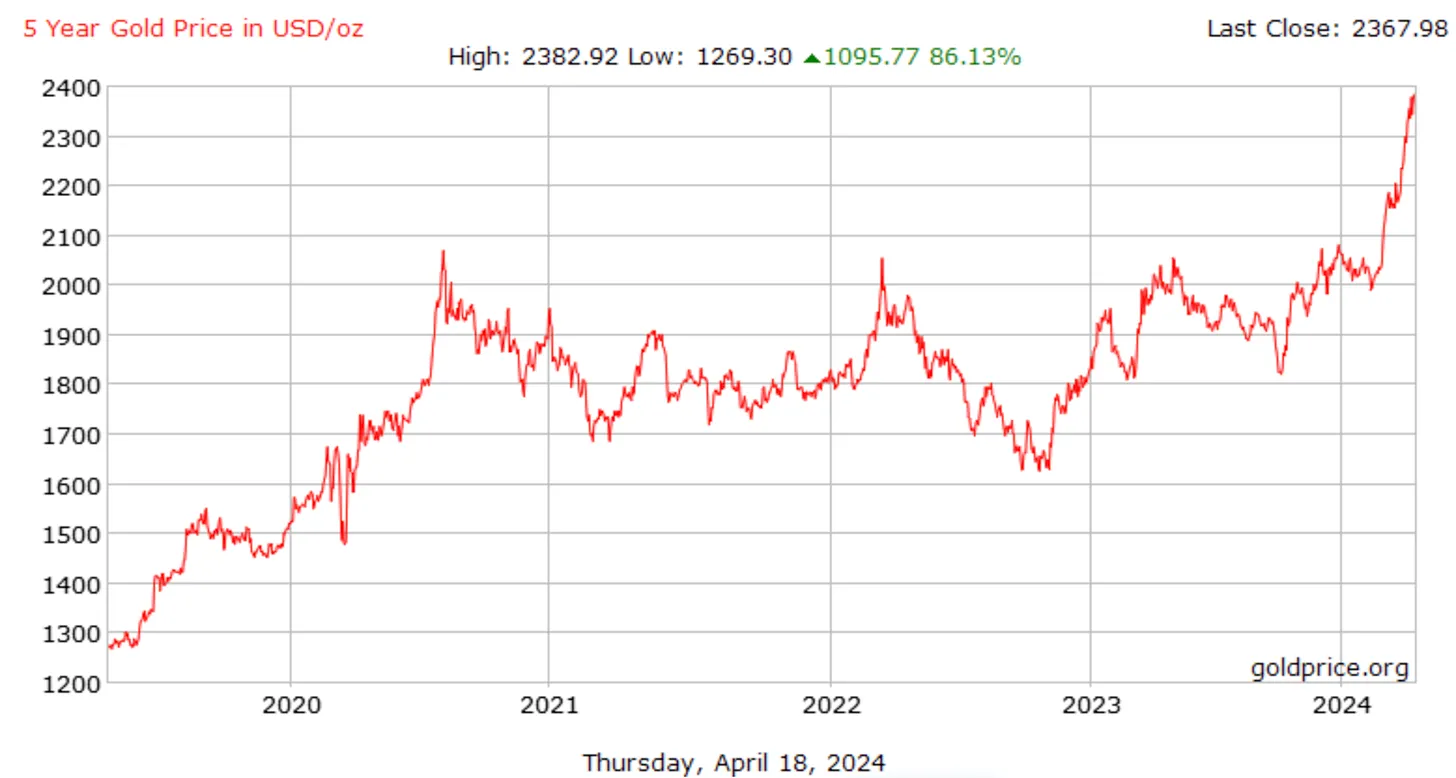
(Peter St. Onge, Money Metals News Service) In case you’ve been living under a rock, Gold prices have been on fire, jumping 20% in just the past 2 months.

That takes gold to a near-doubling since pre-pandemic, when it was meandering along at just $1500. Yesterday it closed above $2400.

So if you don’t own any gold, it might make sense to get some in case it catches on. Plus, Peter Schiff can now buy nice shirts.

Gold Is Beating the S&P 500 Again

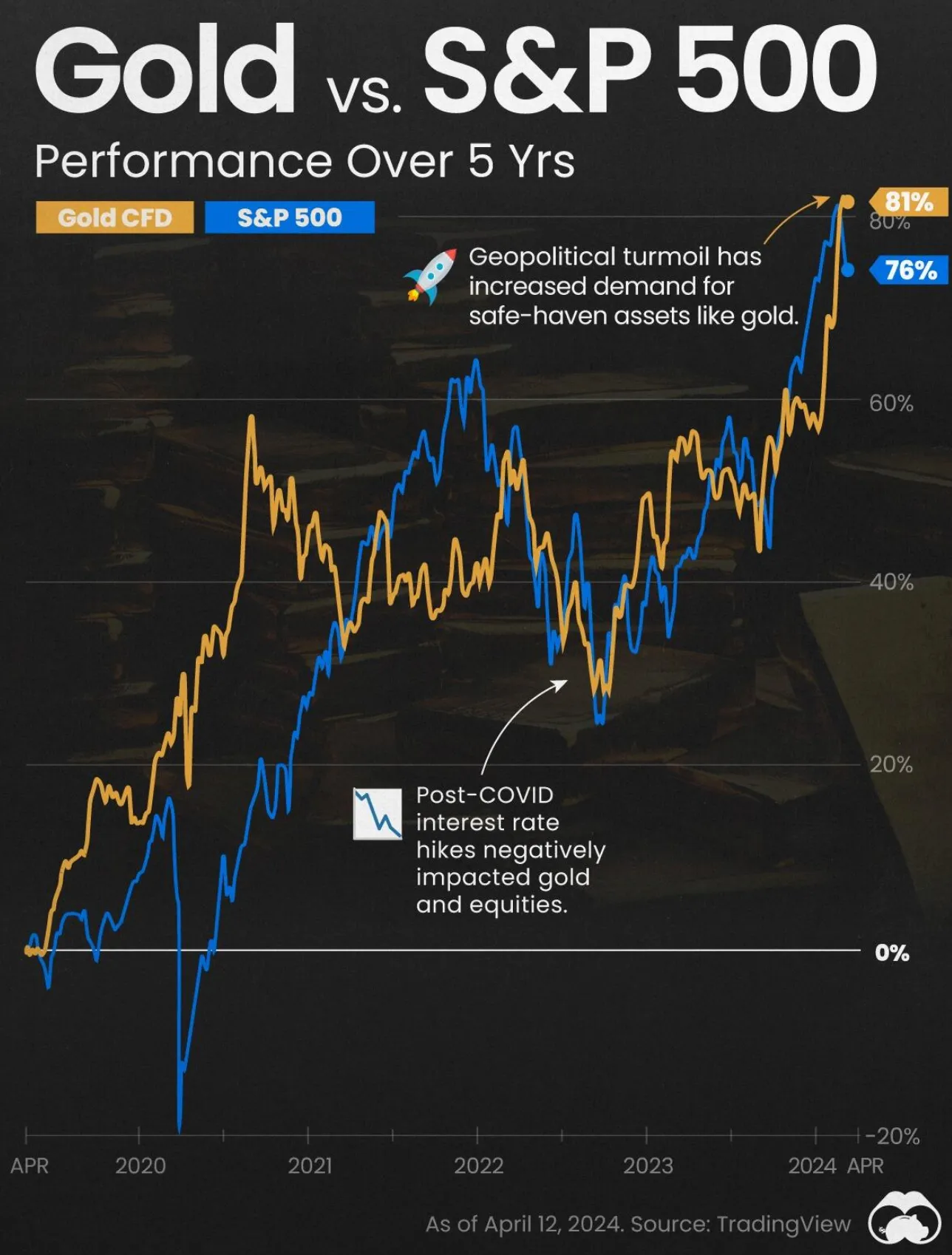
Soaring prices is a new experience for many gold investors, long accustomed to taking the slow and steady stairs while stocks take the elevator. But here we are with stocks flat and gold up 20%.

In fact, at this point, gold has now matched the S&P 500 throughout the pandemic.

And, of course, it runs circles around the US dollar, melting like ice cream in the sun thanks to federal spending and a very obliging Fed that’s knocked a fifth off the dollar’s buying power since the pandemic.

What’s driving the gold rally? 3 things: inflation, central bank buying, and geopolitical tension including Russian sanctions. With a guest appearance by some large mystery buyer — rumored to be backed by the Chinese government.

Taking each in turn, we’re coming up on 6 months now of rising inflation as the transitory inflation narrative turns out to have been a head-fake.

I also mentioned recently how central banks are now openly admitting they’re preparing for some major financial crisis — a senior Dutch central banker said the quiet part out loud a few months ago, and presumably the crisis they’re preparing for is sovereign debt and the bank collapses that tend to come along for the ride.

And then the geopolitical tensions, above all Russia and China. Russia itself isn’t very important — it really is Mexico with nukes, with a fairly inconsequential economy.

The Instability of the Dollar

The problem is the US sanctions — particularly the effort to seize the assets of the Russian central bank — have put countries around the world on notice that their dollars aren’t safe. That they can be seized any time you look at Joe Biden funny.

That sends them to the next-best asset, including gold. Gold’s a pretty small market — all the gold in the world is worth about $16 trillion. While all the government debt is worth close to $100 trillion.

That means if money’s moving out of US Treasuries and government debt, it can move the needle a lot on gold.

Banks Make Sky High Price Predictions

At this point, Wall Street is falling over each other trying to up their gold targets. Goldman says 2700, Bank of America says 3000 by next year, and UBS is saying 4000 in the next “2 to 3 years.”

If that happens, we’d be looking at a near-tripling of gold prices. Which would be the biggest rally since the 2008 crisis. Before that, you’d have to go back to the 70’s.

Fundamentally, gold is insurance. When the world is as badly run as it is today, it’s the last line of defense. And investors are finally realizing that.


Peter St. Onge writes articles about Economics and Freedom. He’s an economist at the Heritage Foundation, a Fellow at the Mises Institute, and a former professor at Taiwan’s Feng Chia University. His website is www.ProfStOnge.com.

Biden Rule Change Abolishes Title IX Protections for Women

() Critics slammed the President Joe Biden’s latest unilateral executive action, which effectively sought to rewrite a 52-year-old civil-rights law designed to protect women in educational environments by making it all inclusive for anyone who opts to identify as a woman, regardless of reality.

The Biden administration’s finalized Title IX rule change has “gutted” five decades of protections for women and girls and replaced it with “radical gender theory,” former Secretary of Education Betsy DeVos said Friday.

“The Biden administration’s radical rewrite of Title IX guts the half century of protections and opportunities for women and callously replaces them with radical gender theory, as Biden’s far-left political base demanded,” DeVos tweeted.

The Biden administration’s Department of Education has finalized its long-anticipated Title IX rule that expands the definition of sex discrimination to include gender identity and pregnancy.

A separate rule on transgender athletes has not yet been finalized.

The rule is slated to go into effect on Aug. 1. Critics say the Department of Education’s changes to gender identity protections rewrite sex-based protections for women as Congress intended.

In a video posted on Twitter, Education Secretary Miguel Cardona said he was proud to “advance the Department of Education’s work to clarify and build upon the legacy of Title IX” which has for more than 50 years “opened doors for generations of girls and women.”

Cardona claimed the final rules “advance the promise” that “no person should experience sex discrimination, sex-based harassment or sexual violence in federally funded education.”

DeVos said in a Twitter thread that the changes put women at risk.

“This regulation is an assault on women and girls. It makes it a federal requirement that boys be allowed in girls bathrooms in elementary schools,” DeVos wrote. “It makes it a federal requirement that men be allowed to play women’s sports, putting their safety, privacy and competitive opportunity at risk. And it makes it a federal requirement that feelings, not facts, dictate how Title IX is enforced.”

The changes “provide greater clarity regarding: the definition of ‘sex-based harassment;’ the scope of sex discrimination, including recipients’ obligations not to discriminate based on sex stereotypes, sex characteristics, pregnancy or related conditions, sexual orientation, and gender identity; and recipients’ obligations to provide an educational environment free from discrimination on the basis of sex,” according to the 1,577-page notice of final rulemaking.

“Additionally, these regulations aim to fulfill Title IX’s protection for students, teachers, and other employees in federally funded elementary schools and secondary schools and postsecondary institutions against all forms of sex discrimination, including sex-based harassment and sexual violence,” the notice said.

While the department claims to have sifted through more than 240,000 comments in response to the proposed rulemaking, the agency did not make changes to scrutinized sections surrounding gender identity, which were slammed by Republican attorneys general and conservative organizations.

Jennifer Braceras, the director of the Independent Women’s Law Center and a former member of the United States Commission on Civil Rights, previously told Chalkboard News (which is also owned and operated by the Franklin News Foundation, publisher of the Center Square) that the Biden administration’s changes will completely change the civil rights statute’s implementation and meaning.

The athletic rule received hundreds of thousands of comments and is still under review by the Education Department. Critics say that would change the way women’s sports teams operate.

China Is Dumping U.S. Treasuries and Buying Gold

(Mike Maharrey, Money Metals News Service) As the Chinese accumulate more and more gold, they’re dumping U.S. Treasuries.

That raises an important question: who is going to keep funding the federal government’s borrowing spree?

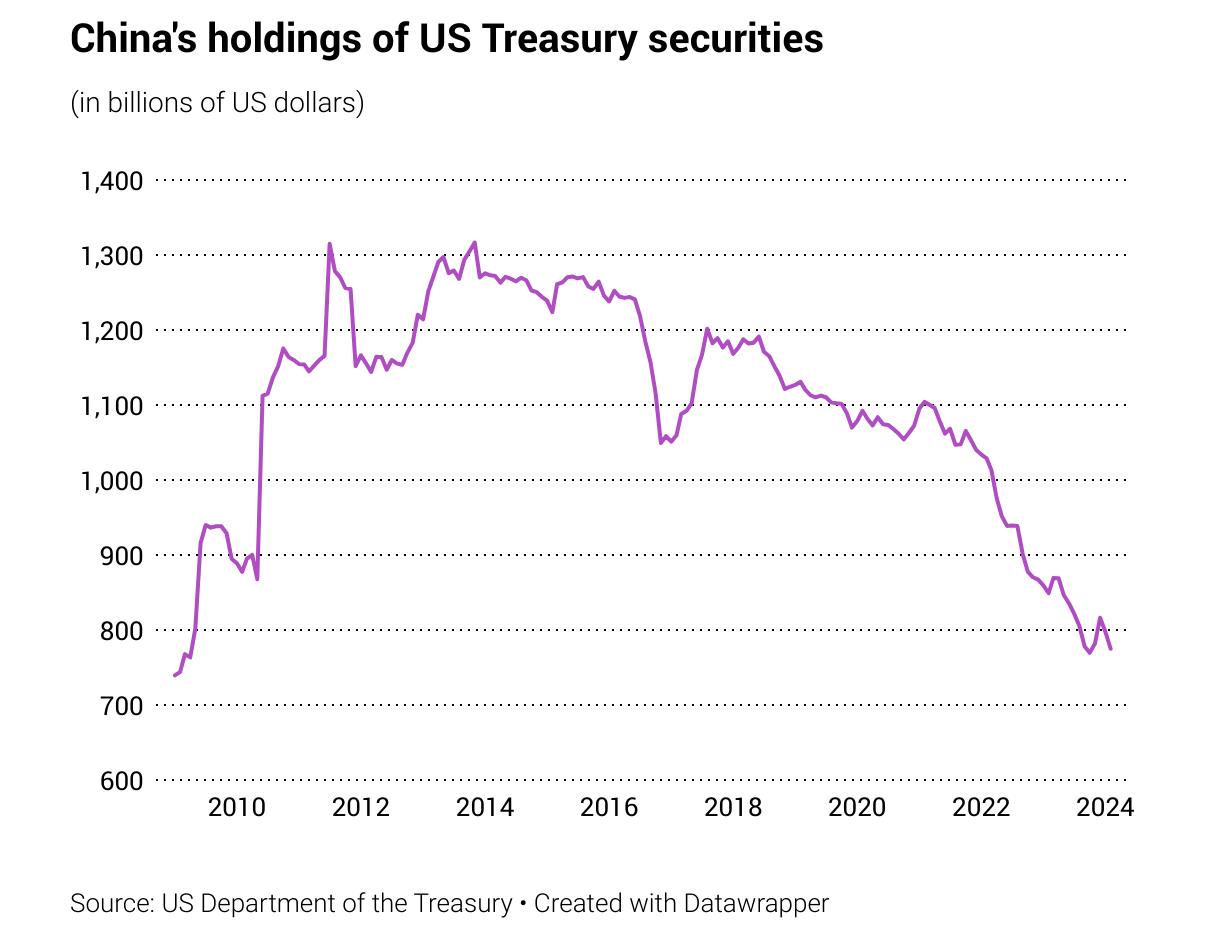
China offloaded another $22.7 billion in U.S. Treasuries in February, according to the latest data from the Federal Reserve. That dropped its total holdings to $775 billion.

China still ranks as the second-largest foreign holder of U.S. debt, but the U.K. could soon overtake China and slide into the second position if the current trend continues.

Japan ranks as the biggest foreign U.S. creditor with $1.17 trillion in Treasuries. The U.K. comes in third with $700.8 billion in U.S. Treasuries.

China has been divesting itself of U.S. debt for several years. The country’s Treasury holdings have fallen to their current level from around $1.1 trillion in 2021. Chinese investment in U.S. debt hit a 14-year low in October.

Renmin University finance professor Zhao Xijun told the South China Morning Post that the selloff will likely continue.

“China’s overseas investment has been concentrated on U.S. Treasuries in the past, [but] there is space for the Chinese government to further cut back its holdings in the future.”

China is intentionally minimizing its exposure to the dollar. Chinese policymakers have seen how the U.S. uses the dollar as a foreign policy weapon. Last month, Janet Yellen floated the idea of seizing Russia’s frozen dollar-denominated assets and giving them to Ukraine.

The Chinese aren’t dumb. They realize the U.S. could put the same kind of squeeze on them. So, if you recognize something makes you vulnerable, what do you do?

You minimize the vulnerability.

In other words, if you are concerned that the U.S. could pull the “dollar rug” out from under you, why not pull out from the dollar system first?

This seems to be China’s strategy.

Meanwhile, the Chinese are stockpiling gold, a reserve asset that carries no counterparty risk at all.

The People’s Bank of China has added gold to its reserves for 16 straight months, adding over 300 tons of gold to its stash since it resumed reporting gold purchases in October 2022. 

And China may hold far more gold than it officially reports. As Jim Rickards pointed out on Mises Daily back in 2015, many analysts believe that China keeps several thousand tons of gold “off the books” in a separate entity called the State Administration for Foreign Exchange (SAFE).

A Big Problem for the U.S. Treasury 

China’s Treasury dump underscores a big problem for the U.S. Treasury. 

The federal government is running massive deficits month after month. If China and other countries spurn U.S. debt, who is going to fund this borrowing spree?

Foreign investors make up about one-third of the market for U.S. Treasuries. You could argue that there is still plenty of capacity in the domestic market. The problem is the largest domestic U.S. bondholder is also out of the market.

That’s the Federal Reserve.

In fact, no entity holds more U.S. bonds than the Fed. As of the end of 2022, the Fed owned 35 percent of all domestically held Treasuries. Fed Treasury holdings totaled over $6 trillion. 

The Fed generally keeps its big fat thumb on the bond market. By buying and holding U.S. bonds, the central bank creates artificial demand, driving prices higher than they otherwise would be and keeping yields lower. This allows the U.S. government to borrow more at lower interest rates than it otherwise could. 

The problem is the Fed is out of the market right now. The central bank is allowing Treasuries to roll off its balance shed with a quantitative tightening policy meant to push down price inflation.

So, if the biggest player in the domestic Treasury market and the second-largest player in the foreign Treasury market are selling bonds, who is going to absorb them all, along with the new debt issued by the U.S. Treasury month after month?

This is one of the reasons Treasury yields continue to climb despite hopes of a Federal Reserve rate cut. And that’s a big problem given that the U.S. government has shelled out $522.02 billion on interest payments just halfway through fiscal 2024. That’s a 35.9 percent increase over the same period in fiscal 2023. The only category with higher spending was Social Security.

It seems likely the Fed will have to jump back into the Treasury market with another round of quantitative easing to monetize some of the federal government’s debt. The problem is that’s inflationary.

That means you and I are ultimately going to pay for all this through an ever-increasing inflation tax.


Mike Maharrey is a journalist and market analyst for MoneyMetals.com with over a decade of experience in precious metals. He holds a BS in accounting from the University of Kentucky and a BA in journalism from the University of South Florida.

Silver Demand Outstrips Supply for Third Straight Year

(Mike Maharrey, Money Metals News Service) Silver demand outstripped supply for the third straight year in 2023.

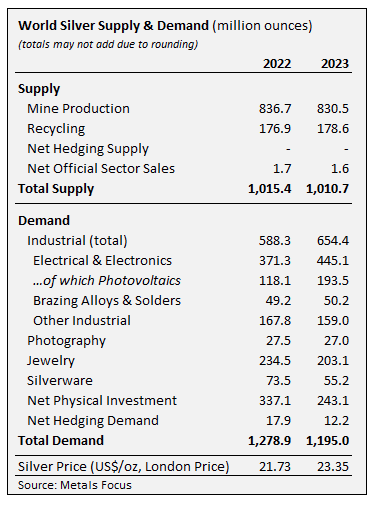
Silver mine output fell by 1 percent to 830.5 million ounces last year, according to the final data released by the Silver Institute. 

Meanwhile, total silver demand also dropped, declining about 7 percent to 1.2 billion ounces. But the decline came off a record year in 2022. 

Even with softer overall demand, the silver market charted a significant structural deficit of 184.3 million ounces.

This comes on the heels of  a 2022 production shortfall that the Silver Institute called “possibly the most significant deficit on record.” It also noted that “the combined shortfalls of the previous two years comfortably offset the cumulative surpluses of the last 11 years.”

Industrial Silver Demand Sets a Record

While silver demand was down in many sectors, industrial demand of 654.4 million ounces set a record in 2023. According to the Silver Institute, ongoing structural gains from green economy applications underpinned these advances.

“Higher than expected photovoltaic (PV) capacity additions and faster adoption of new-generation solar cells raised global electrical & electronics demand by a substantial 20 percent. At the same time, other green-related applications, including power grid construction and automotive electrification, also contributed to the gains.”

Chinese silver industrial demand rose by a remarkable 44 percent to 261.2 million ounces, primarily due to growth for green applications.

The green energy revolution is expected to continue to drive industrial silver offtake higher in the years ahead.

Due to its outstanding electrical conductivity, silver is an important element in the production of solar panels. It is used to conduct electrical charges out of the solar cell and into the system. Each solar panel only uses a small amount of silver, but with the demand for solar panels growing exponentially every year, those small amounts of silver add up.

According to a research paper by scientists at the University of New South Wales, solar manufacturers will likely require over 20 percent of the current annual silver supply by 2027. By 2050, solar panel production will use approximately 85–98 percent of the current global silver reserves.

Recession worries would typically dampen industrial demand for silver, but the photovoltaic industry is essentially recession-proof due to support from governments around the world. With battling climate change a priority, it is highly unlikely investment in solar power and other green energy technologies will fall, even during an economic downturn.

Falling investment demand drove the overall drop in silver offtake last year. Physical bar and coin demand fell off by almost one-third to a three-year low of 243.1 million ounces. According to the Silver Institute, all significant markets saw losses, but the decline was particularly acute in Germany (-73 percent). This was due to a Value Added Tax increase to kick off 2023. Most other Western markets also saw steep declines due to cost-of-living issues and range-bound prices. Meanwhile, record-high local silver prices in India drove profit-taking throughout most of the year.

Demand for silver jewelry was also down last year, falling by 13 percent to 203.1 million ounces. The decline was concentrated in India, with demand easing after a record in 2022. Excluding India, total global losses were modest at 3 percent. 

Looking Ahead at Silver Demand in 2024

The Silver Institute projects total silver demand will grow by a healthy 2 percent in 2024. 

“Industrial fabrication should post another all-time high, rising by 9 percent, propelled by an anticipated 20 percent gain in the PV market and healthy offtake from other industrial segments. Jewelry and silverware fabrication are predicted to rise by 4 and 7 percent, respectively, while bar & coin demand is forecast to contract by 13 percent.”

Meanwhile, supply is projected to contract by about 1 percent. 

If the market plays out as expected, we’ll see another significant market shortfall this year, totaling somewhere in the neighborhood of 215 million ounces. That would rank as the second-largest market deficit in more than 20 years.


Mike Maharrey is a journalist and market analyst for MoneyMetals.com with over a decade of experience in precious metals. He holds a BS in accounting from the University of Kentucky and a BA in journalism from the University of South Florida.

Middle-School Students Stage Protest over Alleged Furry Infestation

(Molly Bruns, Headline USA) Students from the Nebo School District in Payson, Utah protested the school administration for allowing “furries”—people who dress up as anthropomorphic animals—to run rampant through the halls, according to the Gateway Pundit.

Middle school students at Mt. Nebo School walked out of class after school officials repeatedly ignored requests to punish animal-identifying students who bite, scratch and bark at their peers.

“Multiple of my friends have been bitten by the furries and scratched, and the school won’t do anything about it when we tell them,” one student said.

Some students also said “furries” also chew on sticks during class and use litter boxes conveniently placed in the bathrooms for their use.

Footage of the walkout showed the group of students chanting “We the people, not the animals,” in front of the school.

“It’s crazy that it’s escalated to this point where these kids are being so distracting to their peers that their peers want to stage a walkout,” a furry identified as “Strudel” told reporters on the scene.

Students and parents who attended the protest also sent out a petition, arguing that according to Section 3.1.8. of the school’s dress code prohibits furries.

“Jewelry, accessories, tattoos, hair, facial hair, and other elements of a student’s appearance that draw undo attention, distract, disrupt, or otherwise interfere with the learning atmosphere at school or at school activities and events, or that create a health, safety, or welfare issue are prohibited,” the code read.

Parents hoped to field at least 500 signatures for their petition; they reached nearly 2,500 at publishing time.

A spokesperson for the Nebo School District released a statement claiming that the students’ objections were simply “rumors,” and implied that the protesting kids would face according punishment.

“We have had several parents reach out to us over the past few days, regarding rumors that are being spread about behaviors of a small group of students at our school,” the message read. “While students may exercise their freedom of expression, disruptions to the school day will be handled as needed.”

Furry culture is an online sect of sexual deviance. Many “furries” have mascot suits and insist they do not “identify as animals, they identify with animals.”

GRAPHIC: Protester Self-Immolates Outside Trump’s Manhattan Trial

(Headline USA) A person who was on fire in a park outside the New York courthouse where Donald Trump’s business documents trial is taking place has been rushed away on a stretcher.

According to a manifesto published on Substack, the individual’s name was Max Azzarello.

His rambling explanation appeared to suggest that it was more connected with the impending Bitcoin halving than with Trump or anything explicitly political in nature.

“We are victims of a totalitarian con, and our own government (along with many of their allies) is about to hit us with an apocalyptic fascist world coup,” he wrote before promoting several conspiracy theories about cryptocurrencies and Ponzi schemes that made wild accusations against former presidential candidate Michael Dukakis and referenced several episodes of The Simpsons as supporting evidence.

Azzarello’s Instagram includes similar references.

He said that his wormhole began after a March 2023 bank run instigated by billionaire PayPal co-founder Peter Thiel.

That prompted Azzarello to do 1,500 hours of research, which led him to uncover “the secrets of the world.”

Headline USA reached out to Thiel via email for comment and will update with any response.


View this post on Instagram


A post shared by Max Azzarello (@dipshit_secrets)

In one post, Azzarello pays tribute to his mother, who passed away in 2022.


View this post on Instagram


A post shared by Max Azzarello (@dipshit_secrets)

The fire was extinguished Friday shortly after a jury and alternates had been seated in Trump’s criminal case. A person could be seen lying on the ground on fire.

People then rushed over to douse the person with a fire extinguisher and try to bat the flames away. Emergency responders then rushed the person away on a stretcher.

The fire happened in a park across the street from the courthouse that has been a gathering point for protesters and media outlets covering jury selection for Trump’s trial.

A full jury of 12 people and six alternates had been seated in Trump’s hush money case just minutes earlier, drawing the first criminal trial of a former U.S. president a step closer to opening statements.

Lawyers spent days quizzing dozens of New Yorkers to choose the panel that has vowed to put their personal views aside and impartially judge whether the presumptive Republican presidential nominee is guilty or not. The jury includes a sales professional, a software engineer, an English teacher and multiple lawyers.

Adapted from reporting by the Associated Press

Court Filing: Officials Lost Federal Welfare Funds to African Gold Scam

(Ken Silva, Headline USA) Federal welfare funds intended for Mississippi’s poorest residents were diverted into an African heiress gold bar scam, according to a recent court filing in a state lawsuit over the matter.

The court filing was made in an ongoing lawsuit by the Mississippi Department of Human Services, which is seeking to recover millions of dollars in misspent welfare funds.

The lawsuit stems from a scandal in which Mississippi’s rich and famous—including a former governor, NFL Hall of Fame quarterback Brett Favre and three pro wrestlers—allegedly siphoned more than $20 million in federal welfare funds for their various pet projects. Those projects included a university volleyball stadium, a drug rehab center and a horse ranch—and, according to the recent court filing, an African gold scam.

The court filing—filed in December by Mississippi Community Education Center, Inc., which is one of the defendants in the ongoing lawsuit—alleges that a scientist named Jake Vanlandingham and his business partner, Don Martin, are responsible for losing welfare funds to the gold scam.

According to the filing, Farve was working with Vanlandingham to raise funds for the scientist’s pharmaceutical startup firm, Prevacus, which was trying to develop a drug to treat concussions.

Favre, who was friends with Mississippi’s governor at the time, helped divert $1.7 million in federal welfare funds to Vanlandingham’s startup, Prevacus, according to the lawsuit.

Vanlandingham then used some of that money to pursue the African gold scam in hopes of securing an even larger investment for his company, the lawsuit said.

According to the lawsuit, Vanlandingham was told by his partner, Martin, in Ghana that a woman named “Daniella wants to invest in … Prevacus.” Martin told him that the woman’s father “gave her gold bars to keep in case of an emergency before he died,” the lawsuit said.

“Vanlandingham believed the story and kept sending additional funds,” the lawsuit said. “The Prevacus funds that Vanlandingham invested in Ghana included grant funds from the State of Mississippi.”

The lawsuit said that Vanlandingham realized he was scammed by June 2019 and threatened to call the FBI on his partner in Ghana.

The scam was finally made public in early 2020, when Nancy New, Zachary New, former Mississippi Department of Human Services executive director John Davis and three other people were charged in state court.

Eight people have been indicted, six of whom have pleaded guilty for their involvement, including former MDHS director Davis and Nancy New, who was the head of the Mississippi Community Education Center, a nonprofit through which much of the funding flowed. Favre has denied wrongdoing and has not been criminally charged. He and Vanlandingham are facing civil charges. The former governor involved in the scandal, Phil Bryant, has not faced criminal or civil charges.

Martin, for his part, told Mississippi Today in December that he’d fallen for the scam and that he never received a dime from the Ghana investor group.

The criminal investigation is ongoing, as is the lawsuit.

The Associated Press contributed to this report.

Ken Silva is a staff writer at Headline USA. Follow him at twitter.com/jd_cashless.

World Bank Vows to Probe Pedo Scandal at Bill Gates-Linked School

(Ken Silva, Headline USA) World Bank President Ajay Banga has reportedly acknowledged that his institution suppressed sexual abuse allegations at a Kenyan school financed by numerous globalist organizations and billionaires, including Bill Gates.

Banga’s admission to the World Bank scandal was reported Thursday by the Center for Global Development. The announcement that an investigation will take place comes six months after The Intercept published a bombshell report on the Gates-funded Bridge International Academies in Africa.

Citing a leaked 82-page report from the World Bank’s Compliance Advisor Ombudsman, The Intercept reported last October that the World Bank had been aware of sexual-abuse complaints at the Bridge International Academies since at least 2013. The report further found that Bridge itself was aware of at least 21 credible cases of child sex abuse, according to The Intercept.

The allegations included a teacher slashing a student’s scrotum and “a dozen or more cases of serial sexual assault.” Bridge also allegedly suppressed information about a child on school grounds that had been fatally electrocuted by a dangling live wire.

The complaints were reportedly suppressed for so long, in large part, because Bridge’s founders devised a scheme with the World Bank to keep the investigatory findings secret. According to The Intercept, the parties entered into a non-disclosure agreement that would allow the World Bank to investigate Bridge, but would not be able to publish its findings.

The World Bank disputed The Intercept’s reporting all the way through February.

But last month, the World Bank approved the publication of an ombudsman report that confirmed much of the allegations.

Bunga also apologized last month on behalf of the World Bank. In an all-staff email, he reportedly noted that “early on we received reports of child sexual abuse, but protocols were not followed and children were hurt. Put simply, mistakes were made.”

The Center for Global Development said Thursday that an investigation should only be the first step in holding abusive pedophiles accountable.

“If a credible, independent investigation finds that World Bank and IFC management did indeed attempt to cover up abuse for the financial benefit of their client, the board should demand accountability. This case has stretched on for several years, but some key players remain in senior bank positions,” the organization said.

“At present, Ajay Banga has apologized and talked about how the World Bank must do better in handling reports of abuse. Meanwhile, it seems that those who tried to do so remain fired or suspended.”

Ken Silva is a staff writer at Headline USA. Follow him at twitter.com/jd_cashless.

Bitcoin’s Next ‘Halving’ Is Right Around the Corner

(Headline USA) Sometime in the next few days or even hours, the “miners” who chisel bitcoins out of complex mathematics are going to take a 50% pay cut—effectively slicing new production of the world’s largest cryptocurrency in half.

That could have a lot of implications, from the price of the asset to the bitcoin miners themselves. And, as with everything in the volatile cryptoverse, the future is hard to predict.

WHAT IS BITCOIN HALVING AND WHY DOES IT MATTER?

Bitcoin “halving,” a preprogrammed event that occurs roughly every four years, impacts the production of bitcoin. Miners use farms of noisy, specialized computers to solve convoluted math puzzles; and when they complete one, they get a fixed number of bitcoins as a reward.

Halving does exactly what it sounds like—it cuts that fixed income in half. And when the mining reward falls, so does the number of new bitcoins entering the market. That means the supply of coins available to satisfy demand grows more slowly.

Limited supply is one of bitcoin’s key features. Only 21 million bitcoins will ever exist, and more than 19.5 million of them have already been mined, leaving fewer than 1.5 million left to pull from.

So long as demand remains the same or climbs faster than supply, bitcoin prices should rise as halving limits output. Because of this, some argue that bitcoin can counteract inflation—still, experts stress that future gains are never guaranteed.

Per bitcoin’s code, halving occurs after the creation of every 210,000 “blocks” — where transactions are recorded—during the mining process.

No calendar dates are set in stone, but that divvies out to roughly once every four years. The latest estimates expect the next halving to occur sometime late Friday or early Saturday.

WILL HALVING IMPACT BITCOIN’S PRICE?

Only time will tell. Following each of the three previous halvings, the price of bitcoin was mixed in the first few months and wound up significantly higher one year later. But as investors well know, past performance is not an indicator of future results.

“I don’t know how significant we can say halving is just yet,” said Adam Morgan McCarthy, a research analyst at Kaiko. “The sample size of three [previous halvings] isn’t big enough to say ‘It’s going to go up 500% again,’ or something.”

At the time of the last halving in May 2020, for example, bitcoin’s price stood at around $8,602, according to CoinMarketCap—and climbed almost seven-fold to nearly $56,705 by May 2021. Bitcoin prices nearly quadrupled a year after July 2016’s halving and shot up by almost 80 times one year out from bitcoin’s first halving in November 2012. Experts like McCarthy stress that other bullish market conditions contributed to those returns.

This next halving also arrives after a year of steep increases for bitcoin. As of Thursday afternoon, bitcoin stood at just over $63,500 per CoinMarketCap. That’s down from the all-time-high of about $73,750 hit last month, but still double the asset’s price from a year ago.

Much of the credit for bitcoin’s recent rally is given to the early success of a new way to invest in the asset—spot bitcoin ETFs, which were only approved by U.S. regulators in January. A research report from crypto fund manager Bitwise found that these spot ETFs, short for exchange-traded funds, saw $12.1 billion in inflows during the first quarter.

Bitwise senior crypto research analyst Ryan Rasmussen said persistent or growing ETF demand, when paired with the “supply shock” resulting from the coming halving, could help propel bitcoin’s price further.

“We would expect the price of Bitcoin to have a strong performance over the next 12 months,” he said. Rasmussen notes that he’s seen some predict gains reaching as high as $400,000, but the more “consensus estimate” is closer to the $100,000-$175,000 range.

Other experts stress caution, pointing to the possibility the gains have already been realized.

In a Wednesday research note, JPMorgan analysts maintained that they don’t expect to see post-halving price increases because the event “has already been already priced in”—noting that the market is still in overbought conditions per their analysis of bitcoin futures.

WHAT ABOUT MINERS?

Miners, meanwhile, will be challenged with compensating for the reduction in rewards while also keeping operating costs down.

“Even if there’s a slight increase in bitcoin price, [halving] can really impact a miner’s ability to pay bills,” Andrew W. Balthazor, a Miami-based attorney who specializes in digital assets at Holland & Knight, said. “You can’t assume that bitcoin is just going to go to the moon. As your business model, you have to plan for extreme volatility.”

Better-prepared miners have likely laid the groundwork ahead of time, perhaps by increasing energy efficiency or raising new capital. But cracks may arise for less-efficient, struggling firms.

One likely outcome: Consolidation. That’s become increasingly common in the bitcoin mining industry, particularly following a major crypto crash in 2022.

In its recent research report, Bitwise found that total miner revenue slumped one month after each of the three previous halvings. But those figures had rebounded significantly after a full year—thanks to spikes in the price of bitcoin as well as larger miners expanding their operations.

Time will tell how mining companies fare following this next looming halving. But Rasmussen is betting that big players will continue to expand and utilize the industry’s technology advances to make operations more efficient.

WHAT ABOUT THE ENVIRONMENT?

Pinpointing definitive data on the environmental impacts directly tied to bitcoin halving is still a bit of a question mark. But it’s no secret that crypto mining consumes a lot of energy—and operations relying on pollutive sources have drawn particular concern over the years.

Recent research published by the United Nations University and Earth’s Future journal found that the carbon footprint of 2020-2021 bitcoin mining across 76 nations was equivalent to emissions of burning 84 billion pounds of coal or running 190 natural gas-fired power plants. Coal satisfied the bulk of bitcoin’s electricity demands (45%), followed by natural gas (21%) and hydropower (16%).

Environmental impacts of bitcoin mining boil largely down to the energy source used. Industry analysts have maintained that pushes towards the use of more clean energy have increased in recent years, coinciding with rising calls for climate protections from regulators around the world.

Still, production pressures could result in miners turning to cheaper, less climate-friendly energy sources. And when looking towards the looming halving, JPMorgan cautioned that some bitcoin mining firms may also “look to diversify into low energy cost regions” to deploy inefficient mining rigs.

Adapted from reporting by the Associated Press