Money Metals Midweek Memo: Economic Insights w/ Mark Skousen

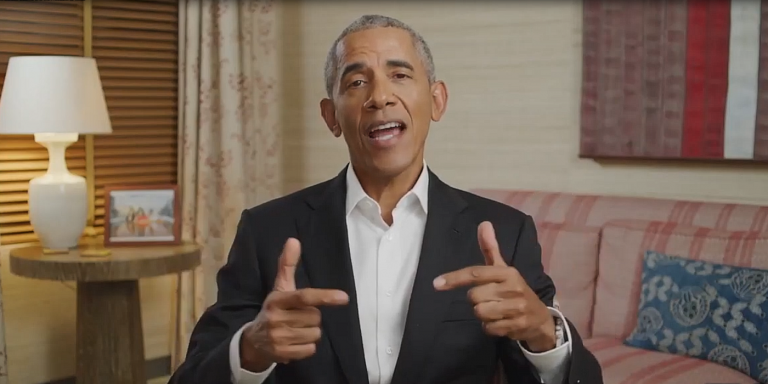
(Money Metals News Service) In a recent episode of Money Metals’ Midweek Memo, host Mike Maharrey engaged in an enlightening conversation with Mark Skousen, an eminent economist with a PhD from George Washington University. 

Skousen, who was recently named one of the top 20 living economists, delved into various pressing topics ranging from precious metals to the Federal Reserve’s policies, sharing his seasoned perspectives on the current economic landscape.

Background and Philosophy:

Mark Skousen, a celebrated academic and author, has a prolific background in economic theory and application. As the founder of FreedomFest, an annual gathering that champions discussions on liberty and economic freedom, Skousen is well-known for his advocacy of free-market principles and limited government intervention.

Mark Skousen
Mark Skousen

During the interview, Skousen delved into the resilience and recent performance of gold within financial markets, emphasizing its enduring value, particularly during periods of economic uncertainty. 

During the interview, Skousen delved into the resilience and recent performance of gold within financial markets, emphasizing its enduring value, particularly during periods of economic uncertainty. 

He highlighted the outperformance of gold itself compared to gold stocks, mentioning his personal holdings, how the Fed harms the purchasing power of USD, and how gold acts as a hedge against inflation: 

  • Gold’s Performance: “Well, I think gold itself has done a lot better than the gold stocks… I have gold, I have GLD, the iShares Gold shares bullion position in my portfolio.”
  • Central Bank Purchases: He emphasized the significant role of central banks, like the Federal Reserve, in the gold market, stating, “central banks are buying record numbers of gold… it’s definitely at, I think two years ago was a record, and then last year was close to that.”
  • Gold as a Hedge: Skousen also touched on the strategic value of gold as a hedge against economic instability and inflation, reinforcing its position as a key asset in diversified investment portfolios.

Skousen underscored the significant role of central banks in the gold market, noting their record-breaking purchases in recent years. He discussed gold’s strategic importance as a hedge against economic instability and inflation, asserting its crucial role in diversified investment portfolios. 

Transitioning to broader economic concerns, Skousen expressed apprehensions regarding inflation and Federal Reserve policies, linking these issues to gold’s recent performance as an investment.

Key Discussions in the Interview:

Do people question your choice to live in California given your stance on freedom?

Skousen robustly defended his choice, stating, “Yeah, my response is, don’t leave, we’re here to take it back.” He emphasized the importance of striving for change from within, underscoring his commitment to improving the state’s political landscape.

What do you make of the recent economic data and the Federal Reserve’s response?

Skousen expressed concern over the modest GDP growth and rising inflation rates, highlighting the challenges faced by the Federal Reserve. He quoted Friedrich Hayek, “Friedrich Hayek made the point that inflation is like a tiger by the tail, and when you loosen it, you really have a hard time controlling it.” Skousen criticized the current monetary policies, predicting difficulties in managing inflation and potential stagflation.

What’s your perspective on the recent trends in precious metals, particularly gold?

“Yeah, it’s definitely at, I think, two years ago was a record, and then last year was close to that, and of course most of it is coming from emerging market, central banks, and then China, so that’s where you see it. And I think it’s a little bit of the de-dollarization trend, they’re trying to shield themselves from getting under the thumb of the US using the dollar as a foreign policy tool.”

What is your story about China and gold?

“I should tell you, about 10 years ago, I was in China and I was honored, I received an award and everything from the mayor, I got the keys to the city to Beijing, can you imagine that? So there was this big banquet that they had in my honor, and they came up and they said, ‘listen, we want to get out of the dollar, what do you recommend?’ And they specifically asked about gold, they seemed to think that gold was the place to go, and I agreed with them, I thought, that’s your best bet to move out of the dollar, out of the bond market, the treasuries and buy gold. So I think they just want a confirmation of what they’re doing, I don’t think it’s necessarily that they followed my advice, but it was interesting what they were interested in doing.”

Can you share more about what’s planned for FreedomFest this year?

Skousen enthusiastically previewed this year’s FreedomFest, noting its diverse lineup of speakers. A highlight of some of the key speakers includes Javier Milei, Steven Pinker, Steve Forbes, John Mackey, Robert Kiyosaki, Ice-T, Justin Amash, Tom Woods, Maj Toure, Lisa Kennedy, and more. He stressed the event’s role in fostering vibrant debates and discussions that transcend traditional media narratives.

Skousen discussed the vitality of gold as an investment, noting, “Well, I think gold itself has done a lot better than the gold stocks… I have gold, I have GLD, the iShares Gold shares bullion position in my portfolio.” He highlighted the significant purchases of gold by central banks as part of a broader de-dollarization trend.

What’s your take on the recent bull run that we’ve seen in precious metals, gold and silver?

“Well, I think gold itself has done a lot better than the gold stocks. We used to think that mining stocks were a leveraged way to really make money in gold and silver, but boy, those mining stocks have struggled for years. So I’m more bullish on gold. But I have gold, I have GLD, the iShares Gold shares bullion position in my portfolio, and I do trade the mining stocks, we just got stocked out of several of them on the recent bull run, which is really good to see.”

“What’s really interesting is that gold is finally moving, even though the dollar is holding up pretty well, it’s not showing much weakness, but I think that it’s just everybody’s taking their terms. So you had the stock market reach an all-time high, you had tech stocks reaching an all-time high, you had Bitcoin reach an all-time high, and finally gold is catching up with that, I don’t know, it’s hard for me to figure, other than it’s gold’s time to finally perform, so I’m glad to see it because it’s really been a struggle. You would think with inflation taking off and increasing dramatically in 2020, in 2021, that gold would’ve just really taken off, but it’s only been in the last year that gold has finally started to move. So there’s quite a lag there, and I’m not sure how to completely explain it, but I’m in it because it looks good to me.”

FreedomFest 2024 and Exclusive Discount Offer:

In summary, Mark Skousen’s discussion with Mike Maharrey offered profound insights into economic trends and policies, the strategic importance of precious metals such as gold, and the anticipated intellectual feast at FreedomFest. His expertise and foresight make him a vital voice in contemporary economic discussions, advocating for strategies that he believes will lead to more robust and stable economic systems.
Inflation Still Runs Hot, Gold and Silver Prices Stabilize

(Mike Gleason, Money Metals News Service) As economic data comes in worse than expected, investor uncertainty is rattling markets. 

On Thursday, the Commerce Department released its estimate of Gross Domestic Product for the first quarter. GDP growth came in at a disappointing 1.6% — well short of the 2.3% consensus forecast.

Stocks sold off on the news. But gold and silver markets bounced modestly off their lows from earlier in the week.

The setback in metals markets may be temporary as inflation jitters and economic woes appear likely to persist. 

Of course, the Biden administration is attempting to reframe this week’s disappointing GDP data.  Treasury Secretary and former Fed head Janet Yellen claimed the economy is actually stronger than what the data show. She insisted future revisions will show an improvement in estimated GDP growth.

Critics argue that real economic growth is likely even lower than reported due to an elevated inflation rate.  The official GDP figure does reflect an inflation adjustment, but it tends to understate real-world costs of living – especially in the areas of housing, food, and energy. 

But even the Federal Reserve’s preferred inflation indicator is showing pricing pressures increasing rather than easing.  Thursday saw the release of the latest core Personal Consumption Expenditures index, which excludes food and energy prices. The PCE surged from 2% in the fourth quarter of 2023 to 3.7% in the first three months of 2024. That jump far exceeded economist forecasts, as inflation reports have tended to do in recent months. 

Persistently hot inflation readings are putting widespread expectations of Fed rate cuts this year in doubt.  Now the Biden administration and its backers within the central bank are going to have to do a complicated political dance around the framing of the economy.

Team Biden hopes to get a boost from the Fed this summer heading into the election. But central bankers would have to brazenly throw all their historical rationales for setting monetary policy out the window if they were to cut rates in an environment of high and rising inflation coupled with an economy that is as strong as administration officials insist it is.

Fed Chairman Jerome Powell has paved the way for rate cuts by twisting and contorting the supposed 2% inflation target beyond recognition. What Powell has made clear is that inflation staying elevated above 2% won’t necessarily stop the Fed from pumping more cash into the economy.  What remains to be seen is whether the PCE rising unexpectedly to 3.7% gives him any pause.

The more the Fed loses credibility on inflation, the more investors will be drawn to precious metals for wealth protection. Despite the recent setback in gold and silver markets, they are still in an impressive uptrend this year. 

Gold and silver have run up more rapidly than even many bulls were expecting. Year-end gold price targets of $2,400 an ounce were hit before the end of April.

Gold’s surge to new all-time highs occurred without the help of any rate cut by the Fed. Gold has risen despite expectations for rate cuts this year being continually pushed forward and dialed down. 

Even if rate cuts are canceled entirely, there’s no reason to presume that precious metals markets cannot continue going higher. They are higher today than they were when Jerome Powell and company started raising rates in 2022. And there is sound reason to believe they will continue to move higher over the long run, in terms of depreciating U.S. fiat dollars.  

How high is largely a question of how rapidly the currency loses value. Of course, fundamental factors such as mining supply, industrial demand, and investor interest in the metals can cause prices to experience cyclical swings. 

We have certainly seen more mainstream interest in gold following its run to record highs. But that followed a lull in investor buying of bullion and exchange-traded products over the past couple of years. 

Silver remains almost completely off the radar of Wall Street and most ordinary investors.

The bottom line is that gold and silver markets are far from overbought on any sort of long-term basis. They are under-owned.  

In the case of silver and the other white metals, in particular, they may be severely underpriced given their chronic supply deficits. Those deficits will eventually be closed either through plunging demand or higher spot prices that incentivize the creation of new supply.

Of course, ramping up mining production isn’t easy. It takes time – unlike ramping up the supply of new fiat currency.


Mike Gleason is a Director with Money Metals Exchange, a precious metals dealer recently named “Best in the USA” by an independent global ratings group. Gleason is a hard money advocate and a strong proponent of personal liberty, limited government and the Austrian School of Economics. A graduate of the University of Florida, Gleason has extensive experience in management, sales and logistics as well as precious metals investing. He also puts his longtime broadcasting background to good use, hosting a weekly precious metals podcast since 2011, a program listened to by tens of thousands each week.

‘Morning Joe’ Lies to His Viewers about Heckler’s ‘Fake News’ Jeer

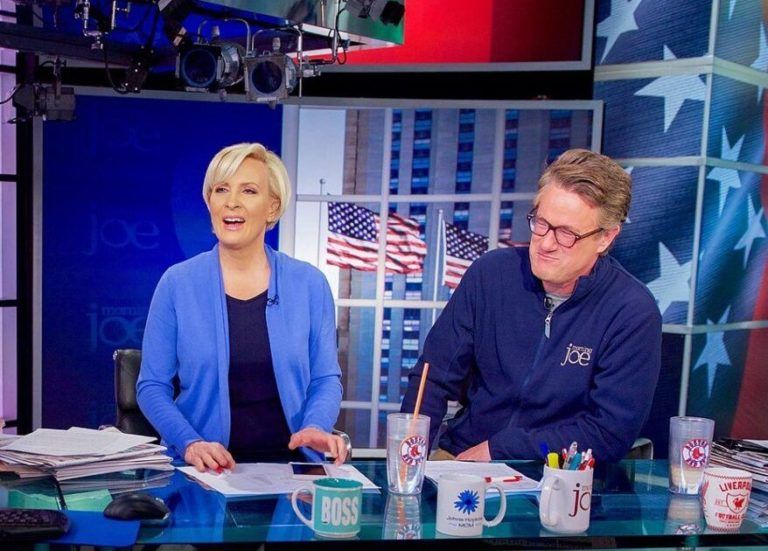
(Ben Sellers, Headline USA) The Trilateral Commission’s preferred conduit for spreading globalist propaganda—and, incidentally, President Joe Biden’s preferred source of information—MSNBC’s Morning Joe frantically lied to viewers after a heckler nearly broke through the Potemkin barrier of delusion that disgraced ex-congressman Joe Scarborough has painstakingly crafted with his nepo-baby wife, Mika Brzezinski.

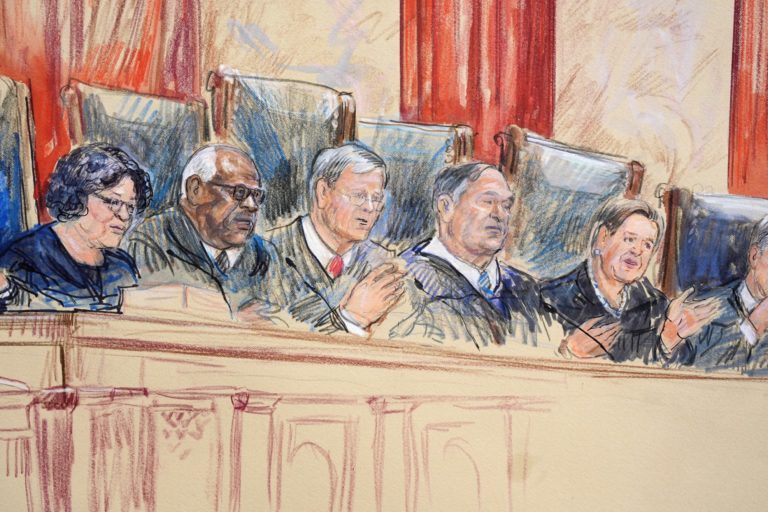
During Thursday’s Supreme Court deliberations on presidential immunity, correspondent Ken Dilanian was in the midst of his live on-air commentary in front of the building when he was disrupted several times while attempting to interpret some of the court proceedings with shouts from the off-camera critic including “Yo, fake news.”

The term, popularized by former President Donald Trump, continues to be a mainstay at his rallies when referring to mainstream media outlets like MSNBC that present a leftist slant.

As the shouts became more frequent and distracting, Brzezinski cut off Dilanian mid-broadcast to acknowledge the situation with a passive–aggressive dig at the heckler’s alpha-male aggression, even though Dilanian did not appear to be in any imminent danger.

“Ken, just making sure you’re OK. Do you—is everything OK, we hear someone yelling,” she said.

“Yeah, it’s fine. We have a heckler here outside,” Dilanian replied sheepishly.

Scarborough then interjected, feeling the need to address the substance of the criticism by persuading viewers that the person was, in fact, shouting at Trump himself.

“You know, I-I-I’ve gotta say, they obviously have been following the David Pecker testimony,” Scarborough claimed, referring to the witness in Trump’s unrelated Manhattan trial surrounding porn star Stormy Daniels’s allegations of a 2006 sexual encounter with the future president.

“They’re yelling fake news,” Scarborough said—assuming the heckler’s pronouns without asking—“and they obviously want viewers to know that Donald Trump’s lied about JFK’s assassination, tried to blame, uh, blame Ted Cruz.”

During the 2016 debates, Trump brought up an allegation that the father of then-primary opponent Sen. Ted Cruz, R-Texas, had been involved with the 1963 assassination of then-President John F. Kennedy.

Pecker, the former publisher of the National Enquirer tabloid, testified that he had helped Trump try to establish the link between Rafael Cruz and Kennedy’s alleged assassin, Lee Harvey Oswald.

“He’s yelling ‘fake news’ also because Donald Trump lied along with David Pecker—uh, they worked together to lie about Ben Carson, to lie about Hillary Clinton—fake News all around,” Scarborough said.

“So I want to thank him for actually uhhh—framing it for us,” he continued with an assist from Brzezinski as he struggled to find the proper spin. “We want to make sure you’re OK, but also, we want everybody watching to know that that person screaming fake news obviously talking about all the lies that Donald Trump perpetrated about Hillary Clinton and all of his opponents in 2020.”

Although Dilanian’s smirk suggested that Scarborough was being facetious, the show offered no clarification for gullible viewers who may have believed that the jeer was, indeed, referring to Trump and Pecker—thereby reaffirming the heckler’s underlying point of criticism.

Ben Sellers is the editor of Headline USA. Follow him at twitter.com/realbensellers.

DOJ Exonerates Obama for Murder

(Ken Silva, Headline USA) Thursday’s U.S. Supreme Court hearing over whether presidents qualified for de-facto immunity while in office confirmed what many have suspected for years: The Justice Department views it as legal for the country’s top executive to assassinate Americans.

The question of presidential assassinations was raised by Justice Brett Kavanagh after DOJ attorney Michael Dreeben suggested that there are “presidential responsibilities that Congress cannot regulate.”

“How about President Obama’s drone strikes?” Kavanaugh asked, referencing Obama’s at least 560 drone strikes that killed hundreds of civilians.

“So, the Office of Legal Counsel looked at this very carefully and determined that, number one, the federal murder statute does apply to the executive branch,” Dreeben responded.

“The president wasn’t personally carrying out the strike, but the aiding and abetting laws are broad, and it determined that a public authority exception that’s built into statutes and that applied particularly to the murder statute, because it talks about unlawful killing, did not apply to the drone strike,” he said.

“This is actually the way that the system should function. The Department of Justice takes criminal law very seriously,” Dreeben continued. “It runs it through the analysis very carefully with established principles. It documents them. It explains them. And then the president can go forward in accordance with it. And there is no risk of prosecution for that course of activity.”

Dreeben’s response not only implied that a president can kill civilians; it implied that a president can murder Americans.

President Obama reportedly killed at least four Americans during his tenure, including a 16-year-old American boy—the son of a suspected American terrorist Anwar al-Awlaki, whom Obama also murdered. Donald Trump then killed the boy’s sister when he took power.

While it may have been shocking to hear the DOJ confirm that presidents can kill citizens with impunity, legal scholars have suggested that the president had that power for years—as the ACLU noted in 2014.

“This extrajudicial killing program should make every American queasy … Four of the dead are Americans,” the ACLU said at the time.

“Astonishingly, President Obama’s Justice Department has said the courts have no role in deciding whether the killing of U.S. citizens far from any battlefield is lawful.”

Ken Silva is a staff writer at Headline USA. Follow him at twitter.com/jd_cashless.

SCOTUS Shatters Jack Smith’s J6 Ambitions in Presidential Immunity Hearing

(Ben Sellers, Headline USA) The prosecution was peppered with a wide-ranging array of weighty legal questions Thursday, chipping away at the case corrupt special prosecutor Jack Smith hoped to make in his—thus far—unprecedented attempt to incarcerate a former president while simultaneously preventing a current presidential frontrunner from assuming office.

The hearing at the U.S. Supreme Court over whether presidents qualified for de-facto immunity while in office made it all but evident that the trial would not see the light of day until after the November election, meaning that if former President Donald Trump were to win again, it would likely be dropped and allowed to expire past its statute of limitations.

“Without presidential immunity from criminal prosecution, there can be no presidency as we know it,” Trump attorney John Sauer told the justices, according to the Center Square.

“For 234 years of American history, no president was ever prosecuted for his official acts,” he continued. “If a president can be charged, put on trial and imprisoned for his most controversial decisions as soon as he leaves office, that looming threat will distort the president’s decision-making precisely when bold and fearless action is most needed.”

The justices’ questions whittled away at three of Smith’s four charges, leaving only one, “conspiracy against rights” essentially untouched, according to the Los Angeles Times’s Harry Litman.

“That charge relies on the electorate’s right to have votes counted, which is a somewhat indirect approach to accountability for Trump’s pernicious post-election conduct,” Litman noted.

But it wasn’t so much the weakness of Smith’s case that occupied the bulk of the justices’ attention as its ambitious overreach.

“I’m not as concerned about this case so much as a future one,” noted Justice Neil Gorsuch, one of the court’s three Trump appointees. “We’re writing a rule for the ages.”

Noting the immense implications of their final decision, “the justices forecast a result that could require lower courts to spend months analyzing various aspects of Trump’s election plot, from organizing fraudulent slates of electors to leaning on his Justice Department to sow false doubts about the results,” Politico reported.

Among the devastating questions raised was why no other presidents past had ever been charged for criminal behavior, such as “Operation Mongoose” during the John F. Kennedy administration, the series of covert attempts to stage a coup on the Fidel Castro regime in Cuba, which included efforts to assassinate the communist leader.

In response to the question from Justice Clarence Thomas, DOJ prosecutor Michael Dreeben daftly replied, however, that Trump was the only president ever to have broken the law, wrote journalist Simon Ateba for his new website, the Daily Letter.

“The reason why there have not been prior criminal prosecutions is that there were no crimes,” claimed Dreeben.

Likewise, Justice Samuel Alito brought up Franklin D. Roosevelt’s internment of Japanese–American citizens during World War II, to which Dreeben suggested that at the time it was not criminal for presidents to jail U.S. citizens without cause although it would be considered a crime today.

It is unclear what laws have been passed in the interim that criminalized such egregious violations of due process that were not already on the books when FDR was president. However, some have argued that presidents enjoy a greater degree of latitude during wartime, if Congress has formally declared it.

Sauer, brought up other examples of alleged criminal acts by former presidents George W. Bush, Obama and Biden, for which none were charged.

“The implications of the court’s decision here extend far beyond the facts of this case,” Sauer said.

“Could President George W. Bush have been sent to prison for obstructing an official proceeding or allegedly lying to Congress to induce war in Iraq?” he continued. “Could President Obama be charged with murder for killing U.S. citizens abroad by drone strike? Could President Biden someday be charged with unlawfully inducing immigrants to enter the country illegally for his border policies?”

Alito also raised the question—which has never before been addressed by the high court, but may be if Trump is convicted and subsequently elected president—as to whether a president can self-pardon.

Dreeben said he was not aware that the Justice Department had taken a position on the matter.

“[I]if the President has the authority to pardon himself before leaving office, and if the DC Circuit is right that there is no immunity from prosecution, won’t the predictable result be that presidents on the last couple of days of office are going to pardon themselves from anything that they might have been conceivably charged with committing?” Alito asked.

Once again obtusely discounting the possibility of selective political retribution as he, himself, was engaged in, Dreeben claimed that since the issue of a president being pardoned had only come up one time in the past, apart from the current case, it probably wasn’t that important a legal point to consider.

“It sort of presupposes a regime that we have never had except for President [Richard] Nixon,” he said.

“… I think the political consequences of a president who asserted a right of self-pardon … that seems to contradict a bedrock principle of our law, that no person shall be the judge in their own case,” he continued. “Those are adequate deterrents, I think, so that this kind of dystopian regime is not going to evolve.”

Many of the hypotheticals posed by the justices dealt with ambiguous gray areas where questions might arise over whether a president was acting in an official capacity—such as receiving a bribe to appoint an ambassador, as posed by Chief Justice John Roberts.

While that suggested that the court might be inclined toward some sort of a mixed verdict, likely punting the case back down to the lower courts rather than ruling on it outright, Roberts also signaled his skepticism regarding the lower court’s prior determination that no immunity existed.

“Looking back, one of the main points of discussion turned on the question of which situation would be worse: a world in which presidents, shorn of any legal protections against prosecution, were ceaselessly pursued in the courts by their rivals in a never-ending cycle of political retribution, or allowing presidents to be unbounded by criminal law and permitted to do whatever they wanted with impunity,” wrote the New York Times’s Alan Feuer.

Ben Sellers is the editor of Headline USA. Follow him at twitter.com/realbensellers.

The Federal Reserve’s $34.5 Trillion Problem

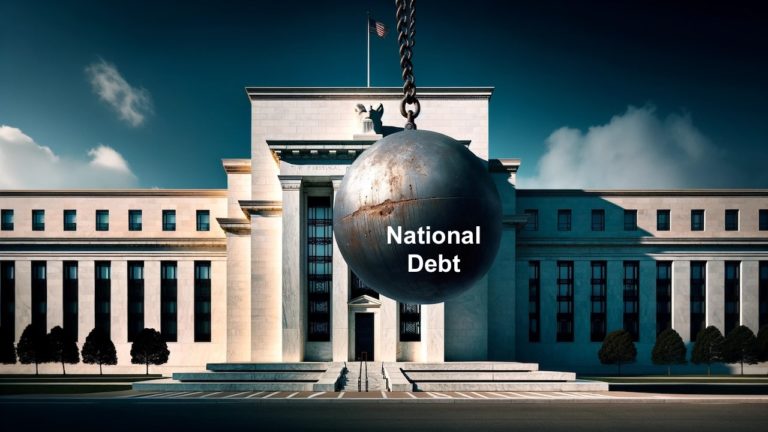
(Mike Maharrey, Money Metals News Service) The Federal Reserve has a $34.5 trillion problem. And the problem is growing. Yes, I’m talking about the national debt. 

How is the debt the Fed’s problem?

It hamstrings the Fed’s ability to fight price inflation.

In a recent interview, Crescat Capital macro strategist Tavi Costa told Kitco News that soaring debt levels could ultimately render the central bank “powerless” and “irrelevant” in the inflation fight.

That’s because the two primary weapons the Fed uses against price inflation are interest rate increases and balance sheet reductions. Both become increasingly difficult to wield as the national debt spirals upward.

“At some point, the debt problem is going to be so large… that will cause the Fed to become almost irrelevant because they can’t raise rates,” Costa said.

Every day that interest rates stay elevated raises the U.S. government’s borrowing cost. Rising interest rates drove Uncle Sam’s interest payments to over 35 percent as a percentage of total tax receipts in fiscal 2023. In other words, the government is already paying more than a third of the taxes it collects on interest expenses, and those interest payments are rising every month.

The federal government spent $288.01 billion in interest expense to finance the national debt in the first quarter of fiscal 2024. That was more than national defense ($238 billion) and more than Medicare ($168 billion). The only higher spending category was Social Security at $351 billion.

And yet the borrowing and spending continues. 

The Biden administration blows through over half a trillion dollars every single month. The national debt eclipsed $34 trillion for the first time on Dec. 29. It grew by a half-trillion dollars in less than five months. This is a massive amount of fiscal stimulus during a time when the economy is growing normally and employment is strong. Costa said, “There is no reason to see this level of spending outside of the political reasons of elections coming and so forth,” adding that the spending is “feeding a structural inflationary problem.” 

“There are many inflationary structural pillars … but one of the main ones is reckless fiscal spending.” 

The Federal Reserve Knows Borrowing and Spending Is a Problem 

This is no secret to the Federal Reserve. In fact, a 2022 paper published by the Kansas City Fed admits the central bank can’t fight price inflation with monetary policy alone.

Federal Reserve Bank of Chicago economist Leonardo Melosi and John Hopkins University economist Francesco Bianchi authored the paper. In the abstract, they state, “This increase in inflation could not have been averted by simply tightening monetary policy.”

In a nutshell, federal government fiscal policy adds to inflationary pressures and makes it more difficult for the Fed to effectively wield its monetary policy weapons.

“Trend inflation is fully controlled by the monetary authority only when public debt can be successfully stabilized by credible future fiscal plans. When the fiscal authority is not perceived as fully responsible for covering the existing fiscal imbalances, the private sector expects that inflation will rise to ensure sustainability of national debt. As a result, a large fiscal imbalance combined with a weakening fiscal credibility may lead trend inflation to drift away from the long-run target chosen by the monetary authority.” [Emphasis added]

In this paper – published by the Fed – the authors concede that merely tinkering with interest rates won’t slay inflation if the government continues to spend far beyond its means.

Also, notice that Melosi and Bianchi admit that the government depends on inflation to enable borrowing and spending. In other words, Uncle Sam leans heavily on the inflation tax.

The federal government not only depends on the central bank to keep its borrowing costs down by suppressing interest rates, but it also counts on the Fed to enable its spending spree by soaking up some of the debt.

The U.S. Treasury depends on the Fed putting its big fat thumb on the bond market in order to facilitate government borrowing. As the central bank buys bonds through quantitative easing, it creates artificial demand and holds interest rates artificially low. This allows the U.S. Treasury to issue more bonds than it otherwise could at a lower interest cost.

And how does the Fed pay for these bonds?

By printing money.

The central bank doesn’t literally print $100 bills in the basement of the Eccles Building, but the effect is the same. The Fed creates digital money, sends it to the seller, takes possession of the bonds, and then holds the Treasuries on its balance sheet. This process is called “debt monetization.”

Without the central bank’s mechanizations, the U.S. government wouldn’t be able to borrow and spend to the extent that it does. Congress wouldn’t be able to sustain deficits running in the trillions of dollars year after year. Instead, it would have to rely on direct taxation and borrowing smaller amounts for shorter terms. Because higher taxes are politically untenable, the government would be forced to constrain its spending, putting a natural check on both the warfare and the welfare state.

But with the Federal Reserve monetary operation in play, the government can borrow and spend far more than it otherwise could. And that means the government is bigger than it otherwise would be.

Melosi and Bianchi also tacitly admit that the Fed isn’t going to win this inflation fight and warn we could be heading toward stagflation. 

“When fiscal imbalances are large and fiscal credibility wanes, it may become increasingly harder for the monetary authority to stabilize inflation around its desired target. If the monetary authority increases rates in response to high inflation, the economy enters a recession, which increases the debt-to-GDP ratio. If the monetary tightening is not supported by the expectation of appropriate fiscal adjustments, the deterioration of fiscal imbalances leads to even higher inflationary pressure. As a result, a vicious circle of rising nominal interest rates, rising inflation, economic stagnation, and increasing debt would arise.”

The Fed paper authors called it “a pathological situation.”

“Monetary tightening would actually spur higher inflation and would spark a pernicious fiscal stagflation, with the inflation rate drifting away from the monetary authority’s target and with GDP growth slowing down considerably.”

This is exactly what is happening. The latest GDP data shows economic growth slowing and price inflation pressures rising.


Mike Maharrey is a journalist and market analyst for MoneyMetals.com with over a decade of experience in precious metals. He holds a BS in accounting from the University of Kentucky and a BA in journalism from the University of South Florida.

Army Officials Smear Reservist Who Warned about Maine Shooter’s Impending Attack

(Ken Silva, Headline USA) “I believe he’s going to snap and do a mass shooting.”

That was the text Robert Card’s best friend and fellow Army reservist sent to his superiors on Sept. 15, weeks before Card  allegedly killed 18 people last month in two separate shootings last October—the deadliest mass shooting in Maine history.

The friend, reservist Sean Hodgson, reportedly testified about his forewarnings Thursday during a commission investigating the killings. Another fellow reservist, Daryl Reed, also testified at the hearing, according to the Military Times.

However, some officials downplayed Hodgson’s warning, the Times reported, apparently thinking that he might have been drunk because of the late hour of his text. Army Reserve Capt. Jeremy Reamer reportedly described Hodge as “not the most credible of our soldiers” and said his message should be taken “with a grain of salt.”

Responding to that smear, Hodgson reportedly told the Maine commission on Thursday that he struggles with post-traumatic stress disorder and alcohol addiction, but that he wasn’t drinking the night of his text. He reportedly said he was awake because he works nights and was waiting for his boss to call.

Hodgson obviously had good reason to be worried about their friend. The shooter reportedly threatened to shoot up a National Guard base earlier in 2023, had reported “hearing voices and threats to shoot up” the military base, and had been committed to a mental health facility for two weeks in the summer.

Card was hospitalized after pushing a fellow reservist and locking himself in his motel room while his unit was training near West Point, New York. Fellow reservists told police who escorted Card for an evaluation that he’d been acting paranoid and accusing others of talking about him behind his back.

Card said they were right to be worried: “They’re scared ‘cause I’m gonna friggin’ do something. Because I am capable,” Card told police.

Three more months after that, he killed 18 people in a mass shooting before allegedly killing himself.

Maine’s commission is now investigating unanswered questions about the event, including what, if any, concerns were raised by Army personnel about Card’s mental health, what actions were taken in response to those concerns, and whether there was anything the Army could have done to prevent the mass shooting.

Ken Silva is a staff writer at Headline USA. Follow him at twitter.com/jd_cashless.

Over 100 Secret Videos of US Troops Masturbating Were Uploaded to Pornhub

(Ken Silva, Headline USA) More than 100 nonconsensual videos of U.S. troops masturbating at Naval Base Guam were reportedly uploaded to Pornhub in 2020, according to recently unsealed records in Guam federal court.

Pacific Daily News first reported on the records, which were unsealed April 17. According to the news outlet, the case originated with a September 2020 warrant that sought information associated with the account “playguy148”—an unknown person or persons that violated federal law by allegedly committing video voyeurism and illegal interception of communications.

A special agent with the Naval Criminal Investigative Service said he received information in 2020 that porn videos featuring U.S. troops, some in uniform and identifiable, that appeared to have been filmed without the service members’ consent.

“On Jan. 13, 2020, the agent observed that 86 videos had been uploaded and two days later, the number of videos uploaded by the account member rose to 102 videos,” the NCIS agent reportedly wrote in an affidavit for a search warrant.

“Many of the videos appeared to depict various U.S. military members masturbating in bathroom stalls. The videos appeared to be clandestinely filmed from above, below or through holes in the stalls. Some of them appeared to be filmed about U.S. Navy vessels and others at a location believed to be the men’s restroom of the Liberty Center on Naval Base Guam.”

According to the NCIS agent, several of the videos were titled with the rank and last name of the depicted subject. The agent reportedly identified the greatest number of identified victims on two Guam-based U.S. Navy commands: The USS Emory S. Land and the USS Frank Cable.

Pacific Daily News reported that on Jan. 13, 2020, the agent sought to obtain the source of the videos by communicating with MG Freesites LTD, which operated Pornhub, while also letting them know that the videos and associated photos were secretly filmed.

“He requested the content be removed and the account information preserved. Three days later, the content uploaded by playguy148 was disabled, according to the court documents,” the outlet reported.

Prosecutors reportedly kept the case sealed for nearly four years—having to obtain permission from a judge 12 times to do so.

There are no indictments or arrests associated with the case, according to Pacific Daily News.

Ken Silva is a staff writer at Headline USA. Follow him at twitter.com/jd_cashless.

Megan Rapinoe Signs Letter Urging NCAA Not to Ban Trans Athletes From Women’s Sports

(Headline USA) Former U.S. women’s soccer star Megan Rapinoe joined a letter to the NCAA this week urging the sports governing body not to ban transgender athletes from women’s sports.

The notorious leftist was one of several prominent female athletes to sign the letter. Others included U.S. women’s soccer players Becky Sauerbrunn, Sam Mewis and Lynn Williams, and former WNBA players Sue Bird, Brianna Turner and Layshia Clarendon. Olympic silver medalist swimmer Brooke Forde also signed on to it.

“We, the undersigned, call upon the NCAA, a governing body meant to serve athletes and our wellbeing, to ensure that the lifesaving power of sport is accessible to all athletes who compete in championship and emerging sports at and for NCAA-member institutions— including transgender athletes,” the letter said.

“To deny transgender athletes the fundamental right to be who they are, to access the sport they love, and to receive the proven mental and physical health benefits of sport goes against the very principles of the NCAA’s Constitution,” it added.

Rapinoe and the other athletes ignored arguments that allowing male-bodied athletes to compete against women endangers the physical safety of those women, instead claiming that banning male-bodied athletes would be an even greater safety threat.

“By barring transgender athletes, you would be severely limiting the capacity of your member institutions to protect and support their athletes,” it claimed. “Moreover, you would be actively disparaging transgender athletes—the same athletes you chose to protect when you agreed to serve on the Board of Governors”.

The athletes went on to claim that the debate over transgenders in women’s sports misses the real issues, which are “unequal pay, failure to uphold Title IX, rampant sexual abuse and harassment of women and girl athletes, and a lack of equal resources for men’s and women’s teams.”

Critics say that allowing biological men into women’s sports directly facilitates and exacerbates many of those very issues, while at least nullifying the arguments over unequal pay and resources.

In a separate statement, Rapinoe called on other “cis women athletes” to “affirm” transgender athletes’ “right” to compete in women’s sports.

“The time is now to say loud and clear that bans against trans athletes framed as ‘protecting women’s sports’ do not speak for us, and do nothing to protect us,” she said. “To the trans athletes fearing that they may be sidelined from the sport they love: I see you and hear you and I am WITH YOU.”

Ilhan Omar Defends Radical, Anti-Israel College Protests: ‘History Will Be On Their Side’

(Headline USA) Rep. Ilhan Omar, D-Minn., defended the anti-Israel campus protests that have taken place at several elite universities this week, arguing “history will be on the side” of the radical protesters.

The “Squad” congresswoman’s own daughter was arrested at a Columbia University protest this week and later suspended from Barnard College, one of the university’s four undergraduate schools.

“I want people to actually understand why these kids are risking their academics and their ability to stay in good standing at their universities,” Omar told MSNBC.

“They are worried what it means to grow up in a world where people can watch 35—nearly 35,000 people be killed, to watch nearly 70% of them be children and women, to watch the destruction of 80% of infrastructure, to see a country withhold water, food, electricity, to starve people and carry out collective punishment.”

Many of the protesters are, in fact, suspected to be part of paid activist groups that are being funded through billionaire oligarchs or Arab nations with ties to terrorist organizations like Hamas.

Omar went on to applaud the protesters for refusing to be “complacent” while their “parents’ money” goes to “supporting a genocide they oppose.”

She claimed that supporters of the Oct. 7 massacre that killed some 1,200 Israelis would ultimately be vindicated.

“I do believe that history is going to be on their side, and these members who think this is a political opportunity to turn the world against these people who are standing for a morally just, right cause are going to be looked at and mocked in history,” Omar said.

The Democrat specifically took aim at House Speaker Mike Johnson, R-La., who visited Columbia’s campus to denounce the anti-Semitic rhetoric and behavior taking place at the protests.

“It is not surprising that he would go out to Columbia University and stir up really more anger and hate and endanger the lives of young people who are at the encampment at Columbia University,” Omar claimed.

Johnson was met with boos and jeers by the protesting students during his press conference on campus.

He and several other Republicans have called for swift action from Columbia officials.

“We just can’t allow this kind of hatred and anti-Semitism to flourish on our campuses, and it must be stopped in its tracks,” Johnson said Wednesday.

“Those who are perpetrating this violence should be arrested,” he continued. “I am here today joining my colleagues, and calling on President [Nemat] Shafik to resign if she cannot immediately bring order to this chaos.”