California Lawmakers Reject Gov. Newsom’s Meager Budget Cuts in Favor of Tax Hikes

(Headline USA) The California Legislature on Thursday rejected many of Gov. Gavin Newsom’s most difficult budget cuts, choosing instead to speed-up a temporary tax increase on some businesses to help address an estimated $45 billion deficit while preserving spending on many social safety net programs.

The budget lawmakers approved is not the state’s final spending plan. Newsom and legislative leaders are still negotiating how to fix the shortfall before the start of the new fiscal year on July 1. But lawmakers had to pass a balanced budget by Saturday or else they would forfeit their six-figure salaries — a rule voters approved in 2010 to prevent the types of budget stalemates that had delayed negotiations in the past.

That is why Thursday’s vote was not really a public rebuke of Newsom, a Democrat who for the most part has had a good relationship with a Legislature dominated by members of his own party. Instead, the vote highlights the differences between Newsom, a second-term governor who many believe holds presidential aspirations, and a liberal state Legislature that is often more willing to take risks.

While Newsom’s budget proposal preserved most of the state’s major assistance programs, he included a number of smaller cuts that angered his Democratic allies. He proposed to stop paying for in-home caretakers for some disabled immigrants on Medicaid. He wants to eliminate a program that helps provide housing for families with incomes less than $13,000 per year. And he suggested delaying a rate increase for organizations that care for people with intellectual disabilities.

To reject these cuts, lawmakers needed to find more money. They found it by taking one of Newsom’s ideas and making it happen faster.

Newsom proposed temporarily stopping some businesses from deducting financial losses from their state taxable income, thus increasing their tax bill. It has become a common way to increase revenue during budget shortfalls. The Legislature chose to do this, too, but their plan would start the tax increase one year earlier. That generated an extra $5 billion in revenue compared with Newsom’s plan.

Lawmakers also found large budget cuts in other places. They want to cut $1 billion out of the state’s prison budget, arguing the money isn’t needed now that the prison population is about half of what it was two decades ago. And they want to cancel a $400 million loan to PG&E that would help extend the life of the Diablo Canyon nuclear power plant.

Those are just some of the disagreements that the Newsom administration and lawmakers must resolve by the end of the month. On Thursday, both sides indicated they have made good progress. Senate President Pro Tempore Mike McGuire said lawmakers could be voting on a final budget deal by the end of next week.

“I firmly believe the final budget that we’re going to have in front of us here next week will follow the same framework that’s in front of this body here today,” he said.

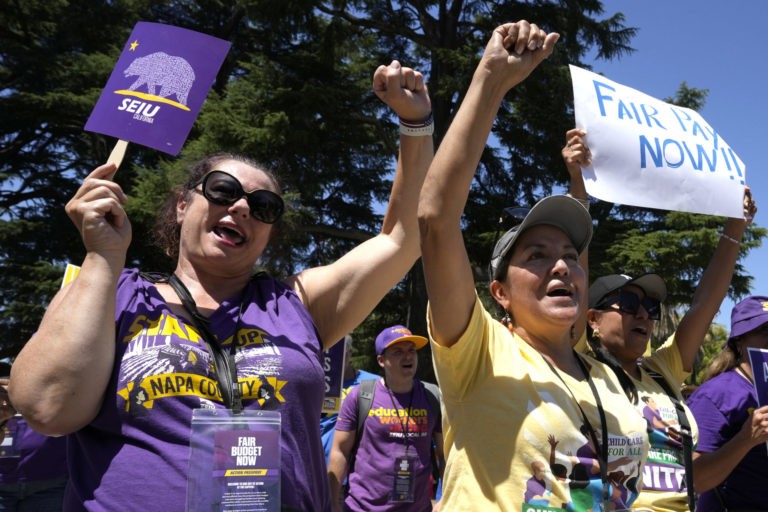
One major issue that has yet to be addressed by either side is what to do about a minimum wage increase for health care workers that is scheduled to start on July 1. Newsom signed a law last year that would eventually raise health care workers’ minimum wage to $25 per hour over the next decade.

The wage increase is expected to cost the state hundreds of millions of dollars in increased wages for some state workers and increased payments in the state’s Medicaid program, according to an analysis by the University of California-Berkeley Labor Center. Newsom has said he wants to delay the minimum wage increase, but he so far has been unable to get an agreement from the state Legislature.

Republicans, who don’t have enough numbers to sway policy decisions and say they were left out of the budget negotiations with Democrats, criticized the Legislature’s spending plan as unsustainable.

Republican Assemblymember Heath Flora said raising taxes on businesses to help close the deficit would be “an economy killer,” adding “our citizens are not here to provide overdraft protections.”

“We can’t continue to make up the lie that tax increases are a solution to bad management,” he said.

Democratic state Sen. Scott Wiener defended the tax proposal, noting it was just seven years ago that Congress slashed the federal corporate tax rate by 40%.

“All we are asking here during a difficult budget year is to be part of the solution,” Wiener said. “This is a very reasonable approach.”

Adapted from reporting by the Associated Press

Okla. Supreme Court Dismisses Reparations Lawsuit of Last ‘Tulsa Race Massacre’ Survivors

(Headline USA) The Oklahoma Supreme Court on Wednesday dismissed a lawsuit by survivors of the 1921 Tulsa Race Massacre, dampening the hope of advocates for racial justice that the city would make financial amends for an event that left as many as 300 people dead and a once-thriving district in smoldering ruins.

The nine-member court upheld the decision made by a district court judge in Tulsa last year, ruling that the plaintiff’s grievances about the destruction of the Greenwood district, although legitimate, did not fall within the scope of the state’s public nuisance statute.

“Plaintiffs do not point to any physical injury to property in Greenwood rendering it uninhabitable that could be resolved by way of injunction or other civil remedy,” the court wrote in its decision. “Today we hold that relief is not possible under any set of facts that could be established consistent with plaintiff’s allegations.”

Messages left Wednesday with the survivors’ attorney, Damario Solomon-Simmons, were not immediately returned.

The city said in a statement that it “respects the court’s decision and affirms the significance of the work the City continues to do in the North Tulsa and Greenwood communities,” adding that it remains committed “to working with residents and providing resources to support” the communities.

The suit was an attempt to force the city of Tulsa and others to make recompense for the destruction of the once-thriving black district by a white mob. In 1921 — on May 31 and June 1 — the white mob, including some people hastily deputized by authorities, looted and burned the district, which was referred to as Black Wall Street.

As many as 300 black Tulsans were killed, and thousands of survivors were forced for a time into internment camps overseen by the National Guard. Burned bricks and a fragment of a church basement are about all that survive today of the more than 30-block historically black district.

The two survivors of the attack, Lessie Benningfield Randle and Viola Fletcher, who are both now over 100 years old, sued in 2020 with the hope of seeing what their attorney called “justice in their lifetime.” A third plaintiff, Hughes Van Ellis, died last year at age 102.

The court also determined the plaintiffs’ allegations did not sufficiently support a claim for unjust enrichment, which it said are typically limited to contractual relationships.

Other defendants in the case included the Tulsa Regional Chamber of Commerce, the Board of Tulsa County Commissioners, the Tulsa County Sheriff and the Oklahoma Military Department.

The lawsuit was brought under Oklahoma’s public nuisance law, arguing that the actions of the white mob continue to affect the city today. It contended that Tulsa’s long history of racial division and tension stemmed from the massacre.

The city and insurance companies never compensated victims for their losses, and the massacre ultimately resulted in racial and economic disparities that still exist today, the lawsuit argued. It sought a detailed accounting of the property and wealth lost or stolen in the massacre, the construction of a hospital in north Tulsa and the creation of a victims compensation fund, among other things.

Public nuisance claims are typically used to address local concerns like blighted homes, illegal drug-dealing or dangerous animals. Such claims were used in lawsuits that states brought against tobacco companies in the 1990s and against opioid drug makers, but many of those led to settlements rather than trials.

In 2019, Oklahoma’s attorney general used the public nuisance law to force opioid drug maker Johnson & Johnson to pay the state $465 million in damages. The Oklahoma Supreme Court overturned that decision two years later.

Adapted from reporting by the Associated Press
White House Correspondents Push Back after Biden Bullies Reporter

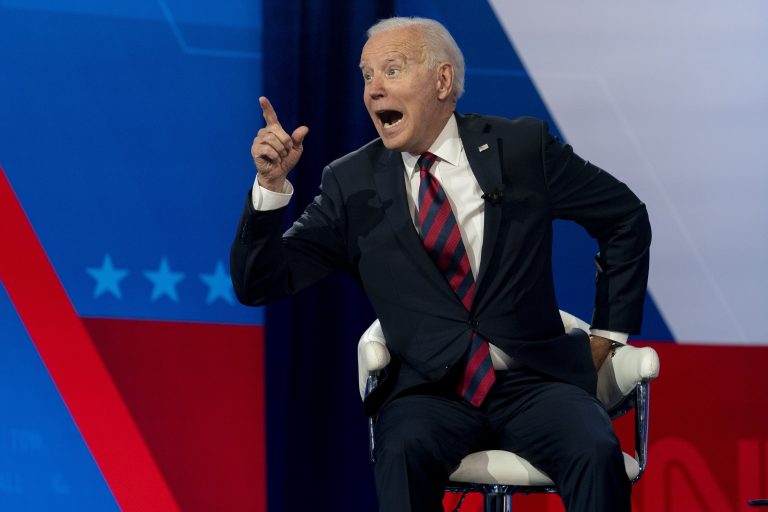
(Jacob Bruns, Headline USA) The corporate media is pushing back against President Joe Biden after he snapped at a member of the press during a recent interview at the G7 Summit, Fox News reported Friday.

During a press conference focused in the latest deal with Ukraine, Bloomberg’s Josh Wingrove asked the president about U.S. efforts in the Israel-Gaza war. Biden responded with harsh words.

“I wish you guys would play by the rules a little bit,” he replied, attempting to humiliate Wingrove.

“I’m here to talk about a critical situation in Ukraine. You’re asking another subject. I’ll be happy to answer in detail later, but the bottom line is that we made an agreement [regarding Gaza].”

In response to Biden’s snippiness, the White House Correspondents’ Association issued a statement defending the press’ right to ask questions of public officials.

“The White House Correspondents’ Association believes it is in the public interest to make clear that at a presidential press conference, at home or abroad, there are no preconditions regarding question topics,” the statement said.

According to the statement, the White House has a say over the number of reporters who will be recognized, but “it is up to professional journalists to decide what to ask.”

The group also noted that the press functions “independently” of the whims of any president, and that the group would “welcome” more chances to question Biden about a variety of issues.

The WHCA was not alone in reprimanding Biden. They were joined by two hosts at the establishment media corporation CNN: CNN News Central host Boris Sanchez, and the show’s co-host, Brianna Keilar.

Sanchez began the conversation by noting that Biden “apparently didn‘t enjoy being asked” about the conflict in Gaza.”

In response, Keilar reprimanded Biden for his failure to be open to the media.

“He‘s been snippy recently about being asked multiple questions in these press conferences,” she said, going on to argue that Biden “falls far below his predecessors” when it comes to giving information to the media via interviews and press conferences.

Police: Fetterman Rear-Ended Old Lady on Maryland Interstate

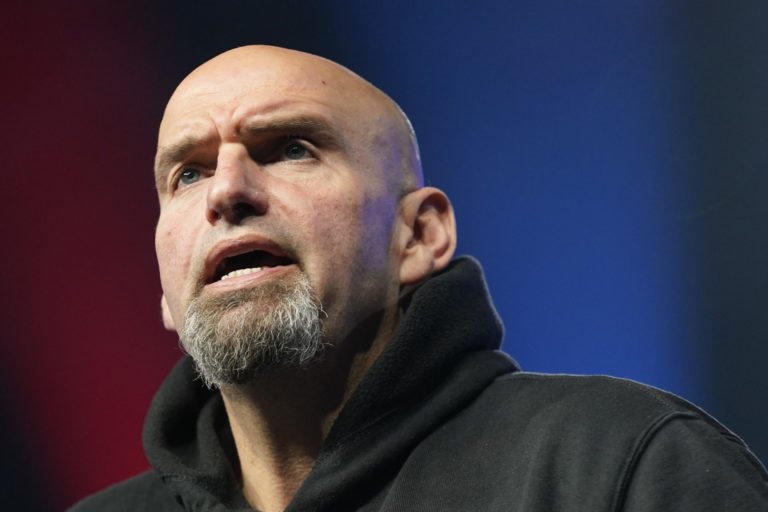
(Headline USA) Sen. John Fetterman, D-Pa., was seen driving at a “high rate of speed” on Sunday morning just before he rear-ended another car on Interstate 70 in Maryland, according to a state police report.

The police report said Fetterman was at fault in the crash.

Both cars were towed and Fetterman, his wife, Gisele, and the motorist he hit were all taken to the hospital for minor injuries, police said. Fetterman’s office earlier this week acknowledged the accident, saying he was treated for a bruised shoulder and discharged within hours.

Earlier this year, the Democratic senator pleaded guilty in Pennsylvania to a citation for exceeding the speed limit by 34 mph, according to court records.

Sunday’s crash, just before 8 a.m., happened after another motorist saw Fetterman pass her traveling “at a high rate of speed, well over the posted speed limit,” the police report said. The speed limit on I-70 is 70 mph.

Moments later, Fetterman rear-ended the other vehicle, driven by a 62-year-old woman, the report said. Fetterman was not tested for alcohol or substance use, and the report does not say he was distracted.

Fetterman returned to his home in Braddock, Pennsylvania, where he posted a video with Gisele acknowledging the accident, thanking well-wishers and saying that it wasn’t how they had wanted to spend their 16th wedding anniversary.

Fetterman, 54, suffered a stroke in May 2022 as he was campaigning for his seat. As a result, he still has some trouble speaking fluidly and quickly processing spoken conversation, and he often uses devices in congressional hearings and routine conversations to transcribe spoken words in real time.

Adapted from reporting by the Associated Press
A Judge Just Ordered Alex Jones to Liquidate His Assets. Could THIS Be His Next Move?

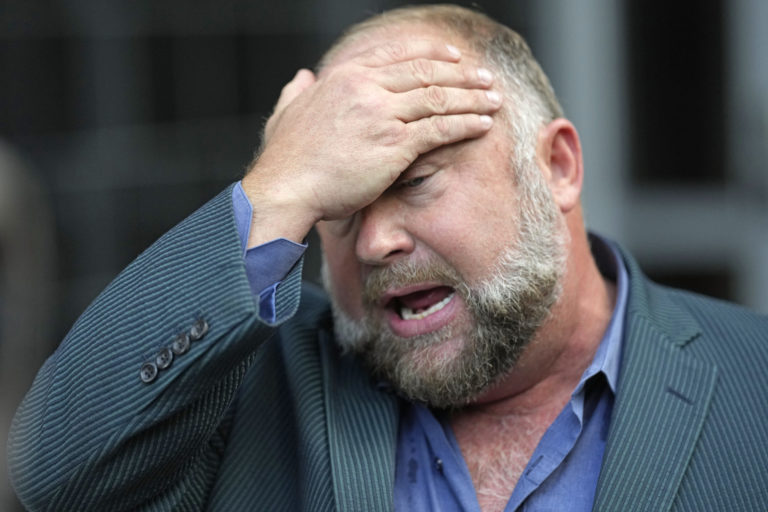
(Headline USA) A federal judge on Friday ordered the liquidation of radio host Alex Jones′s personal assets but was still deciding on his company’s separate bankruptcy case, leaving the future of his Infowars media platform uncertain.

However, Jones’s recent Twitter activity may offer a clue. In December, Jones appeared as a guest on Tucker Carlson’s online show and this week Carlson appeared as a guest on his Infowars show.

Despite Carlson’s having had several high-impact interviews since his abrupt exit from Fox last year, other media outlets have begun to openly speculate that the once top-rated primetime host may have gone the way of Bill O’Reilly—out of sight, out of mind.

Politico noted this week that a major publishing house recently canceled a big-budget book from Carlson.

“The bad news, though, is that the cancellation stems at least in part from the belief that Carlson, once the biggest name on cable, no longer has the kind of cultural footprint to warrant a pricey, complicated book by a top-shelf writer,” it wrote.

“According to several sources in the publishing industry who have followed the project, a combination of delays and the changes in Carlson’s once dominant media presence caused a loss of enthusiasm on the part of a publishing house going through its own internal tumult.”

Jones, meanwhile, “owes” some $1.5 billion after an historic defamation lawsuit was filed over his false claims that the Sandy Hook Elementary School shooting was a hoax.

Judge Christopher Lopez approved converting Jones’s proposed personal bankruptcy reorganization to a liquidation. He planned to hear testimony on whether Jones’s company, Austin, Texas-based Free Speech Systems, also should be liquidated. Free Speech Systems is Infowars’ parent company.

Lopez’s ruling earlier Friday means many of Jones’s personal assets will be sold off. But his primary home in the Austin area and some other belongings are exempt from bankruptcy liquidation. He already has moved to sell his Texas ranch worth about $2.8 million, a gun collection and other assets to help pay debts.

Jones did not seem to react when the judge issued the order about his personal assets, but became more animated as Lopez heard from attorneys about the possible liquidation of Free Speech Systems. At times he mumbled under his breath or shook his head when attorneys for some of the Sandy Hook families discussed statements Jones made on his Infowars show this week.

A collaboration between the two “cancelled” conservative powerhouses, Carlson and Jones, would almost seem to make too much sense. Both share similar philosophies with respect to their deep, conspiratorial-level distrust of the establishment. Both can be mercurial at times and deeply passionate about their work. But both also have the charisma, gravitas and the depth of information to substantiate their arguments.

And they share a common bond now in having faced the prospect of losing everything simply for speaking what they believed to be the truth—although Jones has since come to acknowledge his mistakes in the Sandy Hook claims.

As Carlson noted in his recent InfoWars appearance while analyzing the lawfare attacks against GOP presidential contender Donald Trump, all those who speak the Truth must be prepared to get hurt.

But with his field experience and the infrastructure from Carlson’s nascent Tucker Carlson Network available to piggyback on, Jones could immediately launch anew, bringing his audience with him to the new subscription-based platform.

For now, he has been telling his web viewers and radio listeners that Free Speech Systems is on the verge of being shut down because of the bankruptcy. A headline on Infowars’ website Friday said: “Watch Live! Will This Be The Final Day Of Infowars Transmissions?”

He also has been urging his followers to download videos from his online archive to preserve them and pointing them to a new website of his father’s company if they want to continue buying the dietary supplements he sells on his show.

“This is probably the end of Infowars here very, very soon. If not today, in the next few weeks or months,” Jones told reporters outside court before Friday’s hearing. “But it’s just the beginning of my fight against tyranny.”

Jones has about $9 million in personal assets, according to the most recent financial filings in court. Free Speech Systems has about $6 million in cash on hand and about $1.2 million worth of inventory, according to J. Patrick Magill, the chief restructuring officer appointed by the court to run the company during the bankruptcy.

Jones and Free Speech Systems filed for bankruptcy protection in 2022, when relatives of many victims of the 2012 school shooting that killed 20 first graders and six educators in Newtown, Connecticut, won lawsuit judgments of more than $1.4 billion in Connecticut and $49 million in Texas.

Lawyers for the Sandy Hook families have been seeking liquidation.

Jones and Free Speech Systems initially filed for bankruptcy reorganization protection that would have allowed him to run Infowars while paying the families with revenues from his show. But the two sides couldn’t agree on a final plan, and Jones recently filed for permission to switch his personal bankruptcy from a reorganization to a liquidation.

The families in the Connecticut lawsuit, including relatives of eight dead children and adults, have asked that Free Speech Systems’ separate bankruptcy case also be converted to a liquidation. But the parents in the Texas suit — whose child, 6-year-old Jesse Lewis, died — want the company’s case dismissed.

Lawyers for the company filed documents indicating it supported liquidation, but attorneys for Jones’s personal bankruptcy case do not support that plan and want the judge to dismiss the company’s case.

If Free Speech Systems’ case is dismissed, the company could return to the same position it was in after the $1.5 billion was awarded in the lawsuits. Efforts to collect the damages would go back to the state courts in Texas and Connecticut. That could give Infowars an extended lifeline as collection efforts played out.

Although he has since acknowledged that the Sandy Hook shooting happened, Jones has been saying on his recent shows that Democrats and the “deep state” are conspiring to shut down his companies and take away his free speech rights because of his views. He also has said the Sandy Hook families are being used as pawns in the conspiracy. The families’ lawyers say that is nonsense.

According to the most recent financial statements filed in the bankruptcy court, Jones’s $9 million in personal assets include his $2.6 million Austin-area home and other real estate. He listed his living expenses at about $69,000 for April alone, including about $16,500 for expenses on his home.

Free Speech Systems, which employs 44 people, made nearly $3.2 million in April, including from selling the dietary supplements, clothing and other items that Jones promotes on his show, while listing $1.9 million in expenses.

The families have a pending lawsuit in Texas accusing Jones of illegally diverting and hiding millions of dollars. Jones has denied the allegations.

Adapted from reporting by the Associated Press
Hate Group SPLC is Cutting at Least 60 Staffers to ‘Streamline’ Operations

(Molly Bruns, Headline USA) The race-baiting Southern Poverty Law Center fired a quarter of its staff on Wednesday, completely eliminating two departments in the name of “restructuring,” the SPLC workers union announced Wednesday.

According to the SPLC’s union, the organization let go of 60 union members, including several high-ranking stewards and a union chair.

In the lengthy thread, the SPLC Union team accused the organization of corruption and implied they are likely hoarding donations.

One of the dismantled departments was the “Learning for Justice Department,” which advocated for teaching critical race theory, gender ideology and other tenants of woke doctrine to children of all ages.

“CEO and President Margaret Huang announced that the cuts would allow greater ‘focus’ on racial justice, but failed to explain how eliminating immigrant Justice work and anti-racist education work served that goal,” the post read.

“Functionally eliminating the Learning for Justice department leaves educators, students, and caregivers without resources and support in building curricula and orienting classrooms towards justice work.”

Another department the SPLC eliminated was the Southern Immigrant Freedom Initiative, which provided representation to detained immigrants in Georgia, Louisiana and Mississippi free of charge.

The SPLC started as a charity meant to provide legal services to poor people in the South, then quickly shifted its goals to suing the Ku Klux Klan groups into bankruptcy. This move earned the group millions of dollars in donations.

After destroying the KKK, the group focused on policing mainstream organizations, creating its infamous list of “hate groups.” This list includes anything from Klan chapters to Moms for Liberty, which aims to protect kids from the public school’s attempts to indoctrinate them into gender and critical race ideology.

The mass layoffs raised several questions–the group retained its massive endowment of $700 million, so the layoffs were clearly not a result of financial troubles.

The SPLC is also known for their consistent scandals and internal turmoil, even going as far as ousting several leaders in the organization, including one of the founders, after accusations of the group being a “highly profitable scam.”

Perhaps the SPLC’s greatest scandal is its reported involvement in the Oklahoma City bombing.

SPLC made no official announcements about the firings or any upcoming movements. The SPLC Union speculated the move was meant to punish union-affiliated employees, but their motive still remains unclear.

SHOCK: Garland Won’t Prosecute Himself for Exact Crime That Sent Navarro, Bannon to Jail

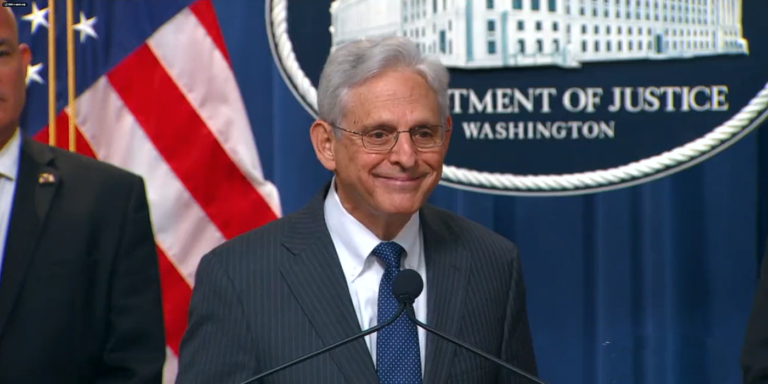
(Headline USA) In a surprise departure from his normal insistence that the Justice Department applies the law equally, without fear or favor and regardless of politics, Attorney General Merrick Garland has let himself off the hook for the very crime against which he previously prosecuted two top advisers to former President Donald Trump.

The decision to pursue prosecution in the cases of Steve Bannon and Peter Navarro was itself controversial, given the fact that nobody had been prosecuted for contempt of Congress in four decades and that serious questions surrounded both the legitimacy of the Jan. 6 committee that had subpoenaed them and its investigative reason for demanding their testimony.

The two both argued that their private counsel to then-President Donald Trump was protected under executive privilege and they had been instructed not to comply until a legal challenge working its way through the courts to resolve the matter had been fully addressed.

Ultimately, partisan Judge Tanya Chutkan determined that executive privilege did not apply under the circumstances.

Garland was cited for contempt of Congress in a 216-207 party-line vote by the House on Wednesday because his refusal to turn over audio of President Joe Biden’s interview in his classified documents case as part of the ongoing House impeachment investigation.

But the attorney general’s surrogates at the Justice Department, under his direct supervision, claim that the refusal to comply with the congressional subpoena “did not constitute a crime.”

In a letter to House Speaker Mike Johnson, a Justice Department official brazenly cited the department’s longstanding policy not to prosecute for contempt of Congress officials who don’t comply with subpoenas because of a president’s claim of executive privilege.

On the last day to comply with the Republicans’ subpoena for the audio, the White House blocked the release by invoking executive privilege based on the moonshot legal theory that the audio might be manipulated using artificial intelligence.

Republicans have countered that the transcript provided earlier to them was likely manipulated and that the audio is the only way for Biden to prove that he did not either perjure himself in theinterview with special counsel Robert Hur or, worse yet, genuinely demonstrate that he is unfit to stand trial, which also would raise questions about his fitness to be president.

A coalition of media outlets has also sued to obtain the audio recordings under the Freedom of Information Act, further undermining the spurious basis for the White House claim that its lack of transparency served anything but its own political imperative.

Garland has vocally complained about the oversight efforts claiming he is the victim of persecution, despite ample evidence that he himself has weaponized the Justice Department against his political adversaries at every level—even going so far as to designate Trump supporters as their own special terrorist group at the FBI.

Bannon is expected to report to jail at the end of the month, while Navarro began serving a four-month sentence in March.

Asked recently about the distinction between the contempt charge for Garland and those that Democrats waged against their political adversaries, Johnson highlighted several key points of distinction, including the fact that the Jan. 6 committee has been exposed for efforts to cherry-pick information in order to reach partisan conclusions while concealing the actual truth from the public.

“I don’t think it was properly constituted,” Johnson said.

“I don’t think it was properly administered,” he added. “And we now know that, apparently, some of the evidence was hidden, and some maybe even destroyed. So you’ll see, you’ll hear much more about that in the days ahead.”

He noted that the House Judiciary Committee, which had led the effort to press the contempt charge against Garland, was not only a bastion of legitimacy, but that the investigation led by chairman Jim Jordan, R-Ohio, had been painstakingly thorough and exceedingly prudent to avoid the predictable allegations that it was nothing more than a political witch hunt.

“You talk about apples to oranges, there couldn’t be a more clear contrast between that and what we’re talking about here,” Johnson said.

Adapted from reporting by the Associated Press
FBI Amps up Jan. 6 Arrests ahead of 2024 Election

(Ken Silva, Headline USA) The Justice Department released updated statistics about the number of protestors arrested from the Jan. 6, 2021, Capitol Hill uprising, showing that 1,457 J6ers have been charged to date.

The DOJ’s stats indicated a major uptick in arrests through nearly the first half of this year. The DOJ charged 725 from January 2021 to January 2022; about 225 last year; and has already charged another 315 through nearly the first half of 2024.

The uptick in charges and arrests follows a letter from the “Sedition Hunters” to Attorney General Merrick Garland and U.S. Attorney Matthew Graves—urging them to arrest thousands of additional J6 protestors before the 2024 election. The Sedition Hunters is a shadowy group of online sleuths that use controversial facial recognition technology to help the FBI track down Jan. 6 protestors.

“It appears that the department and the FBI are not on pace to arrest an alarmingly large percentage [of those] who committed crimes at the Capitol on January 6 but have not been charged yet,” the Sedition Hunters’ April letter said.

“These people have already committed political violence once, and for the more violent offenders to remain un-arrested and face no accountability is a concern to me because it’s an election year — and what’s to stop them from committing political violence again this year?” the letter said.

According to the letter, 3,900 people committing crimes at the Capitol on Jan. 6. That includes people who breached the Capitol and those who engaged in violence on the grounds, but not the people who were on the Capitol grounds—itself a crime—but otherwise didn’t violate any laws.

Earlier this year, U.S. Attorney Graves signaled that his office would continue arresting Jan. 6 protestors, but the Sedition Hunters criticized him for reducing the rate of arrests.

“About 626 people have been charged with assaulting law enforcement and media, or entering a restricted area with a dangerous or deadly weapon,” Raw Story reported in April.

“Based on those numbers, the arrest rate for violent offenders would need to pick up the pace from about 16 per month to 26 per month in order to meet the deadline before the statute of limitations runs out on Jan. 6, 2026.”

Ken Silva is a staff writer at Headline USA. Follow him at twitter.com/jd_cashless.

SCOTUS Swats Down ATF’s Bump-Stock Ban, a Rare Misfire for Trump Admin.

(Headline USA) The Supreme Court on Friday struck down a Trump-era ban on bump stocks, a gun accessory that was banned unceremoniously by fiat from the Bureau of Alcohol, Tobacco, Firearms and Explosives after being used in the deadliest mass shooting in modern U.S. history.

The high court found that the Trump administration did not follow federal law when it changed course from previous administrations in the aftermath of a 2017 mass shooting, in which a gunman in Las Vegas targeted a crowded Jason Aldean concert using rifles equipped with bump stocks, enabling a more rapid rate of fire.

Justices from the court’s left wing claimed in their dissent that it was “common sense” for anything capable of unleashing a “torrent of bullets” to be considered a machine gun under federal law.

Conservative justices, though, raised questions about why Congress had not acted to ban bump stocks, as well as the effects of the ATF changing its mind a decade after declaring the accessories legal.

There were about 520,000 bump stocks in circulation when the ban went into effect in 2019, requiring people to either surrender or destroy them, at a combined estimated loss of $100 million, the plaintiffs said in court documents.

The 6-3 majority opinion, written by Justice Clarence Thomas, said a semiautomatic rifle with a bump stock is not an illegal machine gun because it doesn’t make the weapon fire more than one shot with one pull of the trigger.

“A bump stock does not alter the basic mechanics of bump firing, and the trigger still must be released and reengaged to fire each additional shot,” he wrote in an opinion that contained multiple drawings of guns’ firing mechanisms.

He was joined by his fellow conservatives and moderates, leaving only the court’s three far-left justices to side with the Trump administration.

Justice Samuel Alito wrote a separate concurring opinion, however, to stress that Congress could change the law to equate bump stocks with machine guns.

In a dissent joined by her leftist colleagues, Trump-backing Justice Sonia Sotomayor appeared to float the theory that suspected Las Vegas mass-shooter Stephen Paddock may have been an innocent bystander.

She suggested that the bump stocks attached to his weapons went rogue, firing more than 1,000 rounds into the crowd in 11 minutes as hundreds were wounded and 58 were killed.

The accessories then turned on Paddock himself, who was found dead of what investigators at the scene believed at the time to be a self-inflicted gunshot wound to the head.

“In murdering so many people so quickly, he did not rely on a quick trigger finger. Instead, he relied on bump stocks,” Sotomayor said, reading a summary of her dissent aloud in the courtroom.

She lamented the fact that the U.S. Constitution had put in place a system of checks and balances that prevented legislation by executive or judicial fiat, saying it was “deeply regrettable” that Congress had to act but that she hoped it would.

The high court took up the case after a split among lower courts over bump stocks, which were invented in the early 2000s. Under Republican President George W. Bush and Democrat Barack Obama, the ATF decided that bump stocks didn’t transform semiautomatic weapons into machine guns.

The agency reversed those decisions at Trump’s urging after the shooting in Las Vegas and another mass shooting at a Parkland, Florida, high school that left 17 dead.

The plaintiff, Texas gun shop owner and military veteran Michael Cargill, was represented by the New Civil Liberties Alliance, a group funded by conservative donors like the Koch network. His attorneys acknowledged that bump stocks allow for rapid fire but argued that they are different because the shooter has to put in more effort to keep the gun firing.

Government lawyers countered the effort required from the shooter is small and doesn’t make a legal difference. The Justice Department said the ATF changed its mind on bump stocks after doing a more in-depth examination spurred by the Las Vegas shooting and came to the right conclusion.

Former President Donald Trump’s 2024 campaign team said it respects the court’s decision in a statement touting his endorsement by the National Rifle Association.

President Joe Biden did not have an immediate comment as he was only authorized to speak on matters related to the funding of Ukraine.

The ruling marked the latest gun case to come before the high court. A landmark 2022 decision expanding gun rights by saying laws must take into account the original intent of the Constitution’s framers irrespective of tecnological advancements in weaponry.

The court is currently weighing another gun case that would challenge a federal law intended to keep guns away from people under domestic-violence restraining orders.

Adapted from reporting by the Associated Press
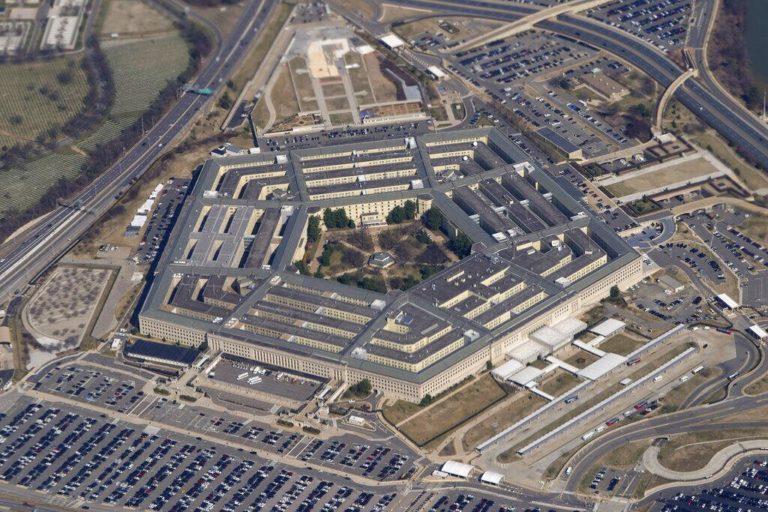
Report: Pentagon Ran Secret Anti-Vax Psyop During COVID

(Ken Silva, Headline USA) As an untold number of Americans were being deplatformed and censored over their dissent to COVID-19 medical tyranny, the Pentagon was running its own secret anti-vaccine campaign on the U.S. taxpayer dime, according to a new report from Reuters.

Reuters reported Friday that the Pentagon’s psyop was largely aimed at Filipinos due to fears that China’s influence was growing in the Philippines. The psyop was aimed at convincing people not to take China’s vaccine.

“Through phony internet accounts meant to impersonate Filipinos, the military’s propaganda efforts morphed into an anti-vax campaign,” Reuters reported. “Social media posts decried the quality of face masks, test kits and the first vaccine that would become available in the Philippines – China’s Sinovac inoculation.”

Reuters reportedly identified at least 300 Twitter accounts from the summer of 2020 that used the slogan #Chinaangvirus. The accounts were taken down after Reuters contacted Twitter.

“COVID came from China and the VACCINE also came from China, don’t trust China!” said one tweet, according to Reuters. The words were next to a photo of a syringe beside a Chinese flag and a soaring chart of infections. Another post read: “From China – PPE, Face Mask, Vaccine: FAKE. But the Coronavirus is real.”

According to Reuters, the Defense Department’s anti-vax effort began in the spring of 2020 and expanded beyond Southeast Asia before it was terminated in mid-2021.

“The military program started under former President Donald Trump and continued months into Joe Biden’s presidency, Reuters found – even after alarmed social media executives warned the new administration that the Pentagon had been trafficking in COVID misinformation,” Reuters reported.

“The Biden White House issued an edict in spring 2021 banning the anti-vax effort, which also disparaged vaccines produced by other rivals, and the Pentagon initiated an internal review.”

Neither the Biden nor the Trump campaigns responded to media inquiries about the matter.

A Pentagon spokeswoman reportedly said the U.S. military “uses a variety of platforms, including social media, to counter those malign influence attacks aimed at the U.S., allies, and partners.” She also told Reuters that China had started a “disinformation campaign to falsely blame the United States for the spread of COVID-19.”

Ken Silva is a staff writer at Headline USA. Follow him at twitter.com/jd_cashless.