Arby’s Raises Questions after Changing Logo to Occult ‘All-Seeing Eye’

(Molly Bruns, Headline USA) Arby’s, the fast-food chain known for curly fries and roast beef sandwiches, changed its social media profile pictures to a play off the “Eye of Providence”—the Masonic symbol on the Great Seal of the United States—along with other occultist symbology, raising eyebrows across the internet.

The esoteric marketing campaign was intended to create buzz about the impending return of the much-beloved, triangular potato cakes to their menu, according to Times Now News.

A message in the bio section said simply, “The return is near.”

The company also tweeted out a series of cryptic ads. One featured actor Kyle MacLachlan—known for his roles in cult classics such as Blue Velvet, Twin Peaks and Dune—begging for the return of the potato cakes in an Arby’s drive through before running into the nearby woods and receiving a vision of their return.

While the advertising offered further clues about its meaning, the chain neglected to make a formal announcement until the item officially returned to select locations on Monday.

According to many historical accounts, the triangular shape encompassing the eye was an originally Christian symbol representing the Holy Trinity.

However, some social-media users admonished Arby’s for its apparent references to supernatural forces and secret societies like the Illuminati.

“Jesus is the savior of mankind. The only way to God is through his Son,” one user said. “I rebuke all things Satanic.”

“Creepy and messed up Arby’s,” wrote another user, going by the name Smokahontas. “I don’t think I will eat Arby’s again.”

Several other users expressed excitement for the return of the potato cakes, saying they hoped they would be back forever.

When asked, the Arby’s Twitter account simply responded, “We cannot question the prophecy.”

But some were disappointed by the revelation, particularly coming on the heels of last week’s presidential debate, which made clear that President Joe Biden was not running the country and fueled considerable speculation as to who might actually be calling the shots.

“That is way way less interesting than insinuating that you control the government,” said user Stephen Stahr.

Arby’s removed the potato cakes from their menu three years ago, and brought them back for a limited time to celebrate the chain’s 60th anniversary since opening.

To celebrate the occasion, the restaurant chain also offered potato cake themed merchandise, including candles, t-shirts and enameled pins.
Wall Street Journal Reveals DEI Did Nothing for Corporate Profits

(Jacob Bruns, Headline USA) The left’s longstanding attempts to celebrate and enforce Diversity, Equity and Inclusion have backfired, failing to create the promised increase in corporate profits, the Wall Street Journal reported.

The myth that DEI is good for corporate profits began long ago, when the state attempted to leverage its power to help those at a perceived market disadvantage, such as women or minorities.

By 2015, studies were being published suggesting that not only was DEI necessary as a matter of justice, but that it was also financially beneficial for corporations to partake in it.

The most notable of those studies was conducted by the management consulting firm McKinsey—which, in 2015, declared that DEI was a boon for business and corporate profits.

Leading investment companies such as BlackRock dove headfirst into the new strategy, eager for a business model that aligned better with the values of Manhattanites and other bicostal elites who undoubtedly disdained the corporate world’s long-running love affair with conservative-friendly capitalism.

Putting a greater emphasis on social capital over shareholder returns allowed them to stave off negative publicity over their less savory practices—for example, the exploitation of Chinese slave labor—by simply virtue signaling toward a handful of woke objectives.

From the initial desire for greater corporate diversity soon was spawned the Environmental, Social and Governance movement, exerting pressure on companies to follow a political agenda through targeted investment and divestment strategies.

However, the McKinsey experiment has not been replicated since, despite several attempts, leading to concerns that the methodology is incapable of leading to conclusive results.

Other studies conducted recently have, in fact, concluded that there is no link whatsoever between DEI policies and corporate success, suggesting that the McKinsey findings are either outdated or downright unreliable.

McKinsey, however, doubled down on its original findings.

“In light of a recent study criticizing our methodologies, we have reviewed our research and continue to stand by its findings—that diverse leadership teams are associated with a higher likelihood of financial outperformance,” a representative for organization wrote.

They also backed off their prior thesis, suggesting that their “research identifies correlation, not causation.”

Still, according to the WSJ report, McKinsey still acts as if the study did in fact prove causation while correlation likewise cannot be clearly replicated.

“Even the correlation is in doubt,” the author, James Mackintosh says. “Academics can’t replicate McKinsey’s study precisely, because it keeps secret the names of the companies it used.”

Mackintosh further pointed out that such a simple mistake as confusing correlation with causation has historically led to the barbaric self-annihilation of peoples.

“The Aztecs mistook correlation for causation with tragic results, cutting out the heart of a victim to rekindle fire every 52 years in order to ensure the world’s survival,” he wrote. “There was a strong correlation between the human sacrifice and the world not ending—but no causation.”

House Judiciary Sues for Audio of Special Counsel’s Joe Biden Interview

(Ken Silva, Headline USA) The House Judiciary Committee has sued to Justice Department to force prosecutors to produce the audio of Special Counsel Robert Hur’s interview of President Joe Biden over his mishandling of classified information.

The audio sought by the GOP is related to Hur’s February report, in which he declined to prosecute Biden in part to his failing cognitive abilities.

“Mr. Biden’s memory was significantly limited, both during his recorded interviews with the ghostwriter in 2017, and in his interview with our office in 2023. And his cooperation with our investigation … will likely convince some jurors that he made an innocent mistake, rather than acting willfully-that is, with intent to break the law-as the statute requires,” Hur said in his infamous February report.

The GOP—and must of the public—wants to hear Hur’s interview with Biden for themselves. However, “Attorney General [Merrick] Garland has refused to produce the audio recordings of the Special Counsel’s interviews with President Biden and [his ghostwriter Mark] Zwonitzer,” the Judiciary Committee said in its lawsuit, filed Monday.

“Instead, Attorney General Garland asked that President Biden assert executive privilege over those recordings, and President Biden complied with that request.”

The GOP’s lawsuit explained why the audio recordings are necessary for voters to hear.

“Audio recordings are better evidence than transcripts of what happened during the Special Counsel’s interviews with President Biden and Mr. Zwonitzer. For example, they contain verbal and nonverbal context that is missing from a cold transcript …,” the lawsuit said.

“The audio recordings, not the cold transcripts, are the best available evidence of how President Biden presented himself during the interview.”

The DOJ has yet to respond.

The lawsuit follows House Republicans moving last week to hold Mark Zwonitzer in contempt of Congress for failing to comply with a subpoena related to Joe Biden’s handling of classified materials.

According to the FBI’s interview transcript with Biden’s ghostwriter, agents accused Zwonitzer of obstruction because he destroyed recordings of his interviews with Biden after learning that Special Counsel Robert Hur was investigating the President’s mishandling of classified documents.

But because of the heavy redactions, it’s unclear how exactly the line of questioning went.  Hur said in a February report that he didn’t charge Zwonitzer, either, because “the ghostwriter offered plausible, innocent reasons for why he deleted the recordings.”

Ken Silva is a staff writer at Headline USA. Follow him at twitter.com/jd_cashless.

More Details Revealed about Nashville Shooter’s Mental Health Problems

(Ken Silva, Headline USA) The Tennessee Star published more details Sunday about Nashville mass shooter Audrey Hale’s mental health problems, revealing that the transgender killer started receiving treatment for autism in 2001.

Hale, a 28-year-old woman who was identifying as a man at the time of the mass shooting, gunned down three Christian children and three adults in March 2023 before being killed by law enforcement.

In a police interview obtained by the Star, Hale’s mother told investigators her daughter began receiving treatment for autism in 2001.

“We had the meeting about the results two days after 9/11 in a conference room. Because of my background — we were meeting with a speech pathologist and she is not allowed to give diagnosis but because of my background that was really the day that I knew,” said Hale’s mother, Norma Hale.

“I was very open with the head mistress –and they agreed.  You know, we disclosed all that and they agreed to work with her. And she had a speech and language therapist to help her with a learning disability that she had, auditory processing disorder,” Hale told MNPD investigators.

“But because of the — because of therapy that she got with a very talented speech and language therapist, she was able to do things beyond what we thought she could be able to do. So she could read and do a lot of things that maybe she wouldn’t have been able to do,” she added.

The Star’s publication of the interview with Hale’s mother follows a release last month of internal medical notes about the shooter. According to those notes, Hale told psych workers about “recent thoughts of going into a school and shooting a bunch of people.” Hale began receiving treatment at Vanderbilt University Medical Center on April 23, 2001, when the shooter was just six years old.

According to The Star, Nashville police may be investigating whether Hale confided to a VUMC staff member about violent fantasies.

After Hale’s shooting, officials discovered a “manifesto” in Hale’s apartment.

Public interest and concern over what drove the trans mass shooter’s rage has led to intensified calls for the release of the manifesto, which reveals in chilling details what Hale had planned.

Ken Silva is a staff writer at Headline USA. Follow him at twitter.com/jd_cashless.

N.J. Legislature Again Votes Unanimously to End Taxes on Gold, Silver

(Jp Cortez, Sound Money Defense League) For the second time in less than a year, the New Jersey legislature has voted to end the sales tax on purchases of gold and silver coins, bars, and rounds without a single dissenting vote.

A2812 and S721, carried by Sens. Steinhardt and Sarlo and Asms. Greenwald, Swain, and Egan enjoyed overwhelming support, passing the Senate by a vote of 40-0 and the Assembly with a 71-0 vote.

Last year’s bills, A5294 and S1825, had passed out of both committees and both chambers of the New Jersey legislature without a single “no” vote. This popular bill had more than a dozen cosponsors and had unanimous approval in each legislative chamber. Despite this, Gov. Murphy chose not to enact the bill into law.

Kentucky, Wisconsin, Alabama, Tennessee, Virginia, Mississippi, and Ohio have all recently enacted legislation to exempt gold and silver from state sales tax, or extend their existing exemption on the metals. In total, 45 states have ended sales tax on gold and silver – including all three of New Jersey’s neighboring states.

Discriminatory tax policies that discourage precious metals ownership reduce the likelihood that citizens will take steps to insulate themselves from the inflation and financial turmoil that flows from the Federal Reserve System. 

Because of dramatically rising federal debt along with the excessive issuance of Federal Reserve note dollars (or their electronic equivalent), savers have been losing significant purchasing power as inflation across America.

However, holding some savings in gold and silver – the only money actually mentioned in the United States Constitution – is one way to protect one’s purchasing power. 

Ending the sales tax on precious metals purchases is good policy for several reasons:

  • Levying sales taxes on precious metals makes no sense because they are held for resale. Sales taxes are typically levied on final consumer goods. Computers, shirts, and shoes carry sales taxes because the consumer is “consuming” the goods. Precious metals are inherently held for resale, not “consumption,” making the imposition of sales taxes on precious metals illogical from the start.
  • Studies have shown that taxing precious metals is an inefficient form of revenue collection. The results of a Michigan study, for example, demonstrated that any sales tax proceeds a state collects on precious metals may be surpassed by the state revenue lost from conventions, businesses, and economic activity that are driven out of the state.  

The harm is exacerbated when you consider that ALL of New Jersey’s neighbors (Delaware, New York, Pennsylvania) have already stopped taxing gold and silver. Kentucky and Wisconsin ended this tax this year, and Mississippi ended this practice in 2023. Tennessee ended their version of this tax in 2022, and Arkansas eliminated theirs in 2021.

  • Taxing gold and silver harms in-state businesses. It’s a competitive marketplace, so buyers will take their business to neighboring states (which have all eliminated or reduced sales tax on precious metals), thereby undermining New Jersey jobs. 

Levying sales tax on precious metals harms in-state businesses who will lose business to out-of-state precious metals dealers. Investors can easily avoid paying $159 in sales taxes, for example, on a $2,400 purchase of a one-ounce gold bar. 

  • Gold and silver are the only money mentioned in the U.S. Constitution. Article 1, Section 10, states that “no state shall make any Thing but Gold and Silver a tender in payment of debts.” Exchange one form of U.S. money for another should not be taxed.
  • Other types of savings or investments do not carry a sales tax. Gold and silver are held as forms of savings and investment. New Jersey does not assess a sales tax on the purchase of stocks, bonds, ETFs, real estate, currencies, and other financial instruments.
  • Taxing precious metals is harmful to small-time savers. Purchasers of precious metals aren’t usually fat-cat investors. Most who buy precious metals do so in small increments as a way of saving money. Precious metals investors are purchasing precious metals as a way to preserve their wealth against the damages of inflation. Inflation harms the poorest among us, including pensioners, New Jerseyans on fixed incomes, wage earners, savers, and more. 

New Jersey could become the 7th state in the country to pass pro sound money legislation in 2024. More than 25 states have introduced legislation this year to end taxes on gold and silver, bolster state taxpayer funds with the metals, and more in 2024, including Alaska, Indiana, Iowa, Georgia, Kansas, Kentucky, Michigan, New Hampshire, New Jersey, Oklahoma, Vermont, West Virginia, and Wisconsin.


Jp Cortez is a graduate of Auburn University and a resident of Charlotte, North Carolina. He is the Executive Director of the Sound Money Defense League, an organization working to remonetize gold and silver through nationwide legislative efforts. Follow him on X (Twitter) @JpCortez27.

Nigeria Plans to Bring Gold Reserves Home to Minimize Risk

(Mike Maharrey, Money Metals News Service) Nigeria is bringing its gold reserves home to keep it safe.

According to a report by The Star, Nigerian officials decided to repatriate the country’s gold in April “to mitigate risks associated with the weakening U.S. economy.”

“Economic indicators such as rising inflation, escalating debt levels, and geopolitical tensions have raised apprehensions among Nigerian policymakers about the stability of the U.S. financial system.”

Nigeria holds about 21 tons of gold in its reserves.

Economist Fatima Abubakar called the gold repatriation plan “a strategic decision,” and that the country was taking “proactive measures to safeguard its wealth and strengthen its financial resilience.”

Nigerian officials also said bringing gold home would reflect the country’s self-reliance.

“By bringing its gold reserves back within its borders, Nigeria not only asserts greater control over its financial assets but also demonstrates prudence in managing economic risks amidst global uncertainties.” 

Nigeria isn’t alone in wanting to control its gold reserves and bring them home. India recently repatriated 100 tons of gold from vaults in the U.K.

Many countries have expressed concern about the U.S. and Western powers using gold and dollar reserves as a foreign policy weapon.

According to a World Gold Council survey in 2023, a “substantial share” of central banks expressed concern about potential sanctions after the U.S. and other Western countries froze almost half of Russia’s $650 billion gold and forex reserves in the wake of its invasion of Ukraine. According to the WGC, 68 percent of the banks surveyed said they plan to keep their gold reserves within their country’s borders. That was up from 50 percent in 2020.

One anonymously quoted central bank official told Reuters, “We did have it [gold] held in London… but now we’ve transferred it back to our country to hold as a safe haven asset and to keep it safe.” 

Invesco head of official institutions Rod Ringrow told Reuters this reflects a widely held view.

“‘If it’s my gold then I want it in my country,’ has been the mantra we have seen in the last year or so.”

There has been speculation that countries have been moving gold and other assets out of the U.S. in the wake of economic sanctions on Russia, but it has been difficult to confirm because the Federal Reserve refuses to release information about the amount of gold in its vaults. 

In March, Federal Reserve Chairman Jerome Powell dodged Rep. Alex Mooney’s (R-W.Va) questions about the central bank’s foreign gold holdings. Fed officials also refused to comply with a Freedom of Information Act request for records about such holdings.

As investigative reporter Ken Silva wrote, Headline USA filed a FOIA request with the Fed for records reflecting how much gold the Federal Reserve Bank of New York currently holds in its vault, as well as records reflecting the ownership stake that each of FRBNY’s central bank/government clients have in that gold following Powell’s evasive response. The FOIA request also sought records about the Fed’s gold holdings prior to Russia’s February 2022 invasion of Ukraine. 

The Fed denied the request.

The gold repatriation trend started long before the West slapped sanctions on Russia. In 2019, Poland brought home 100 tons of gold. Hungary and Romania also repatriated some of their gold reserves around that same time. In the summer of 2017, Germany completed a project returning roughly half of its gold reserves back inside its borders. In 2015, Australia launched efforts to bring half of its reserves home. The Netherlands and Belgium have also initiated repatriation programs.

This gold repatriation trend underscores the importance of holding physical gold free from counterparty risk.  

If you store your gold and silver with a third party, you could lose your metal through theft, fraud, or an act of God. Of course, you could lose silver and gold stored in your home the same way (except for fraud), so you have to weigh the risk of using third-party storage and keeping large amounts of silver and gold at home.

If you opt for third-party vaulting, it is important to choose a trusted company.


Mike Maharrey is a journalist and market analyst for MoneyMetals.com with over a decade of experience in precious metals. He holds a BS in accounting from the University of Kentucky and a BA in journalism from the University of South Florida.

Price Inflation Isn’t as Bad as You Think! It’s Worse!

(Mike Maharrey, Money Metals News Service) The political class keeps gaslighting us and trying to convince us that price inflation isn’t as bad as we think.

The fact is it’s probably worse than we think.

People like Paul Krugman keep saying Americans don’t realize how good they have it. Treasury Secretary Janet Yellen recently said she doesn’t experience sticker shock when she goes to the grocery. The White House spokesperson gets on the podium day after day telling us how great the economy is. Inflation is coming down, don’t ya know?!

Meanwhile, the rest of us are struggling to pay the bills. 

How bad is it out there for the average person?

Well, a TikToker who goes by Sewerlidd discovered an option to reorder a 2022 grocery list from Walmart. The 45 essential items cost $127 when he ordered them two years ago. 

And what did that same basket of items cost today? 

$414. 

You read that right. The cost of a basket of identical goods nearly quadrupled in just two years.

That’s a 226 percent increase, making the annual food price inflation rate 113 percent.

“I feel like I’m going to be sick,” Sewerlidd said.

We all feel that Sewerlidd. We all feel it.

Why Is There Such a Discrepancy Between Government Data and Real Life?

How in the world did prices go up that much when the official CPI is only running 3.3 percent? Heck, even at its peak in June 2022, CPI was just a little over 9.1 percent. 

If you think the government numbers might be understating the problem, you’re right.

The government CPI formula was sketchy, to begin with, and then the government revised the formula in the 1990s so that it understates the actual rise in prices even more than it used to.

The BLS calculates CPI by analyzing the total price of a “basket of  goods.” Obviously, the things the government chooses to put in that basket and the weight it assigns to each category have a big impact on the final CPI number. 

Under the current formula, 10.9 percent of the CPI is based on durable goods (computers, automobiles, appliances, etc.). Nondurable goods, primarily energy and food costs, make up 26.6 percent of CPI. Services including healthcare, rent, internet and cell phone service, etc. account for the remaining 62.5 percent of the basket.

So, why these particular divisions and percentages?

Because the government number crunchers decided it should be that way.

In other words, it’s arbitrary.

The people who created the formula would almost certainly claim they based it on some kind of objective methodology. They would make it sound sciency. But when you boil it all down, the things in the formula are in the formula because a relatively small group of government people decided that’s the way it should be.

You don’t have to be a total cynic to recognize there is a lot of room for bias in creating or changing the formula. It’s also reasonable to assume that government people are going to be biased toward making the government look as good as possible.

In 1998, it made wholesale changes to the CPI calculation because the powers that be decided the data was “overstating” inflation.

If you run today’s data through the 1970s formula, CPI would be about double what the government reports today. In other words, that 9.1 percent CPI reported in June ’22 would have been over 18 percent in the 1970s.

The bottom line is we should never trust the government’s bottom line.

The Inflation Problem Makes More Sense if You Understand Inflation

During her recent interview, Yellen blamed “cost increases, including labor cost increases that grocery firms have experienced” for rising food prices. She also said there might be “some increase in margins.”

She missed the real cause of price inflation.

Her. And her friends in government and at the Federal Reserve.

Inflation isn’t just rising prices. Price inflation is a symptom of a more fundamental type of inflation – monetary inflation.

As economist Milton Friedman once quipped, “[Inflation] is always and everywhere a monetary phenomenon. It’s always and everywhere a result of too much money.”

Simply put, central bank money creation is inflation. One of the symptoms of this monetary inflation is rising consumer prices.

Economist Henry Hazlitt explained it this way in “Inflation in One Page:“

“Inflation is an increase in the quantity of money and credit. Its chief consequence is soaring prices.

“Therefore inflation—if we misuse the term to mean the rising prices themselves—is caused solely by printing more money. For this the government’s monetary policies are entirely responsible.” (Emphasis added)

When you understand the real cause of price inflation, everything makes sense.

During the pandemic, the Fed pumped nearly $5 trillion in new money into the economy through quantitative easing alone. That doesn’t even factor in the amount of new money created because of bank lending spurred by artificially low interest rates. That is on top of nearly $4 trillion created in the aftermath of the 2008 financial crisis. With all of that new money sloshing around chasing the same amount of goods and services, prices were bound to rise.

Of course, government people never want to look in the mirror. They want you to think they’re saving you, not making your life crap.

Something to keep in mind the next time some pundit or politician tells you that your economic troubles are all in your head.

You also may want to think about preserving your wealth with an inflation hedge. Gold and silver are ideal in that capacity!


Mike Maharrey is a journalist and market analyst for MoneyMetals.com with over a decade of experience in precious metals. He holds a BS in accounting from the University of Kentucky and a BA in journalism from the University of South Florida.

SCOTUS Rules President Has ‘Presumptive Immunity’ from Prosecution

Note: This story was originally published the morning of July 1 to preview the Supreme Court’s impending presidential-immunity decision. SCOTUS released the decision shortly after the publication of this article. Headline USA has adjusted the headline and added details at the top of the story to reflect the decision. The rest of the article remains unchanged.

(Ben Sellers, Headline USA) In another win for presidential front runner Donald Trump, the U.S. Supreme Court ruled Monday that sitting presidents have “presumptive immunity” from prosecution.

“The President is not above the law. But under our system of separate powers, the President may not be prosecuted for exercising his core constitutional powers, and he is entitled to at least presumptive immunity from prosecution for his official acts,” Chief Justice John Roberts wrote in for the 6-3 conservative majority. “That immunity applies equally to all occupants of the Oval Office.”

The case will now go back to the lower courts.

Monday’s development was one of the last remaining decisions for the U.S. Supreme Court to release before a summer break. SCOTUS was deciding whether President Donald Trump and other presidents should be granted legal immunity from civil or criminal prosecution based on alleged offenses they committed while acting in the interest of the nation.

When the court first heard the case in April, several of the justices seemed to look more favorably than expected on the arguments as to why it was necessary for the chief executive to be able to act without fear of subsequent political attacks as Trump has faced repeatedly in his post-presidency, the result in large part of his decision to run again in the 2024 election.

“Without presidential immunity from criminal prosecution, there can be no presidency as we know it,” Trump attorney John Sauer told the justices.

“For 234 years of American history, no president was ever prosecuted for his official acts,” he continued. “If a president can be charged, put on trial and imprisoned for his most controversial decisions as soon as he leaves office, that looming threat will distort the president’s decision-making precisely when bold and fearless action is most needed.”

Sauer and his legal team pointed to specific examples from the recent presidencies of George W. Bush, Barack Obama and Joe Biden to underscore the fact that all, by the standard Trump had been held to, would have been subject to prosecution for controversial policies that, for all intents and purposes, violated the laws that ordinary civilians would have been subjected to.

Nonetheless, there is a strong possibility that the court, reluctant to get involved in matters that will directly impact the upcoming presidential election, will render a mixed verdict, perhaps offering some sort of limited or qualified immunity but ultimately sending Trump’s specific case back to the lower courts for further consideration.

The immunity decision could potentially impact both of his federal cases being brought by special counsel Jack Smith, although the defense seems most focused on the case in the D.C. courts being overseen by far-left judge Tanya Chutkan.

Chutkan would likely attempt to move with all deliberate speed to fast-track the hearings on the matter, but it is unlikely that the case would be heard prior to the November election, when a Trump victory could render it moot.

If Trump were re-elected president, he would likely appoint an attorney general who would drop the federal proceedings and fire the deeply partisan Smith—who, some have argued, was illegitimately appointed in the first place.

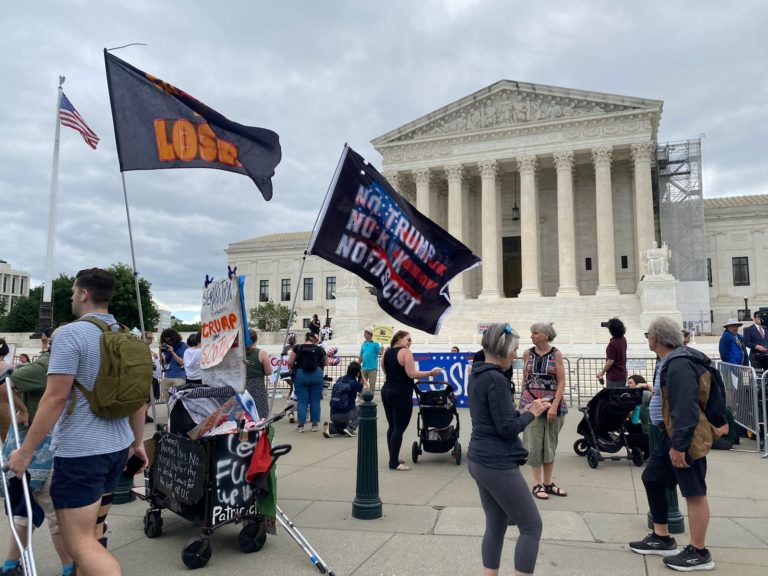
The court’s decision on Monday is likely to draw major protests as a result. Leftists have been pushing a barrage of smear campaigns in an effort to force conservative justices to recuse themselves, if not resign altogether.

A Trump exoneration would almost certainly mobilize activists to ramp up those attacks as part of a political push to justify packing the court with leftist judges.

Headline USA intends to provide on-the-scene updates via Twitter should any demonstrations or other newsworthy events break out in front of the court in the aftermath of the announcement.

The immunity decision was one of several high-impact rulings to drop in the court’s latest round. Others included Friday’s decision rejecting “obstruction” charges against Jan. 6 defendants after plaintiffs argued that the law used—written in response to Enron’s financial scandal during the Bush 43 administration— was never intended to apply to criminal proceedings.

The court also ruled that plaintiffs in a case about government-induced social-media censorship regarding the pandemic and several other significant issues lacked the standing to proceed on the basis they could not prove any ongoing harm or injury.

That case is likely to have a chilling effect on free speech via online platforms moving forward, emboldening agencies like the FBI to pressure left-wing tech companies to promote propagandist narratives and disinformation in the interest of their political imperatives.

In both of those and other cases, Justice Amy Coney Barrett—one of the three Trump appointees, who sparked leftist outrage when she replaced liberal icon Ruth Bader Ginbsberg on the court—sided with the court’s liberals, raising questions as to whether she should be considered a “conservative” justice.

In addition to the immunity decision, the court is expected to release three others, including another major case over social-media laws in Texas and Florida that could limit how platforms regulate content posted, according to the Associated Press.

Both states’ laws aimed to address conservative complaints that left-leaning companies censored users based on their viewpoints, especially on the political Right.

Ben Sellers is the editor of Headline USA. Follow him at twitter.com/realbensellers.

Headline USA’s Ken Silva contributed to this report.

Bannon Due to Report to Prison for J6 Committee’s Hypocritical Lawfare Attack

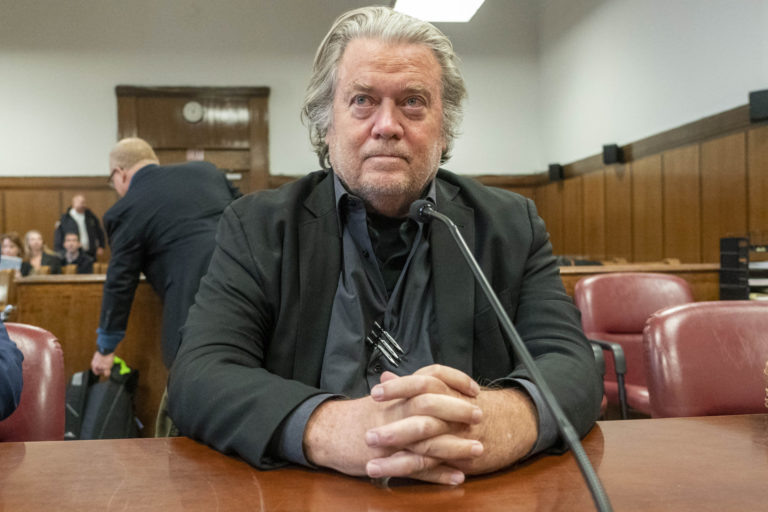
(Headline USA) Longtime Trump ally Steve Bannon is scheduled to report to a federal prison in Connecticut on Monday to serve a four-month sentence on contempt charges for defying a subpoena in the congressional investigation into the U.S. Capitol uprising.

The lawfare attack has been widely condemned, particularly after Attorney General Merrick Garland gave himself a free pass for committing the exact same crime and citing the same reason for doing so—that executive privilege prevented him from complying with a congressional subpoena as part of the ongoing Biden impeachment investigation.

A jury found Bannon guilty of two counts of contempt of Congress: one for refusing to sit for a deposition with then-House Speaker Nancy Pelosi’s hand-picked Jan. 6 committee and a second for refusing to provide documents.

However the Jan. 6 committee’s own work—as well as its partisan motives—have cast aspersions on its legitimacy and suggested that the attacks on Bannon and several other close Trump advisers were little more than a political witch hunt at best.

The committee was found to have hidden many of the exculpatory details from its final report while cherry-picking those that contributed to a bogus narrative in their effort to smear former President Donald Trump ahead of the 2022 midterm election.

While some Republican members of Congress have made cursory efforts to spare Bannon from serving his prison sentence through legislative means, others, such as House Judiciary Chair Jim Jordan, R-Ohio, were reluctant to get involved.

A judge had allowed Bannon to stay free for nearly two years while he appealed, but ordered him to report to prison Monday after an appeals court panel upheld his contempt of Congress convictions.

The Supreme Court rejected his last-minute appeal to stave off his sentence.

Defense attorneys have argued the case raises issues that should be examined by the Supreme Court, including Bannon’s previous lawyer’s belief that the subpoena was invalid because Trump had asserted executive privilege. Prosecutors, though, say Bannon had left the White House years before and Trump had never invoked executive privilege in front of the committee.

Bannon’s appeal will continue to play out, and Republican House leaders last week put their support behind stepping in to assert the Jan. 6 committee was improperly created, effectively trying to deem the subpoena Bannon received as illegitimate.

Another Trump aide, trade adviser Peter Navarro, has also been convicted of contempt of Congress. He reported to prison in March to serve his four-month sentence after the Supreme Court refused his bid to delay the sentence.

Bannon is also facing criminal charges in New York state court alleging he duped donors who gave money to build a wall along the U.S.-Mexico border. Bannon has pleaded not guilty to money laundering, conspiracy, fraud and other charges, and that trial has been postponed until at least the end of September.

Adapted from reporting by the Associated Press

Trump VP Hopeful JD Vance Calls Out Latest ‘Interference’ Amid 2024

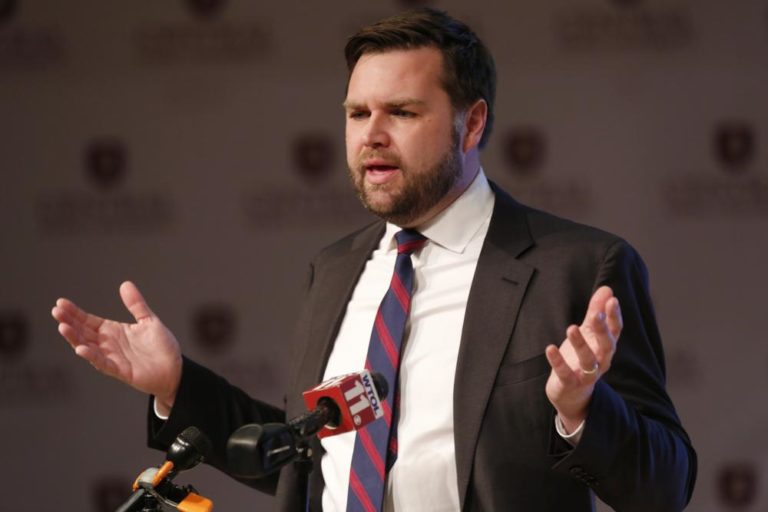
(Luis Cornelio, Headline USA) Sen. JD Vance, R-Ohio, on Sunday called out the leftist media for “running interference” ahead of the 2024 presidential election on the topic of Jan. 6. 

Vance appeared for an interview on CBS News’s Face the Nation where he did not mince words in response to questions from host Margaret Brennan.

Brennan claimed, without evidence, that Trump had lied during the Thursday debate about Nancy Pelosi’s responsibility for Jan. 6.

“Margaret, I think the media is running interference on a lot of this stuff,” Vance told the anchor, according to transcripts first cited by the Daily Caller. “We all know and Nancy Pelosi herself has admitted on camera that she could’ve requested more National Guard troops.” 

Vance’s remarks referenced Pelosi’s admission that she failed to secure the Capitol building on Jan. 6. Specifically, Pelosi said in a documentary filmed by her daughter that she takes “responsibility” for not having the National Guard at the Capitol.

Referencing these remarks, Vance reiterated: “She bears some responsibility for the fact that they weren’t there at the Capitol.” 

He added, “We know that the multiple Democratic governors and states and even some Democratic senators and congressmen have tried to pass laws to legalize abortion up until the moment of birth.” 

An overly defensive Brennan jumped in, claiming, “I’ve lost track, sir. I’ve been told the media is on every single side of this and everything’s our fault. But let’s get back to the candidate you’re here to talk about. [Former Acting Secretary of Defense] Chris Miller said 10,000 troops, he was never ordered by the president to send those to the Capitol that day.” 

In response, Vance retorted forcefully, adding, “Nancy Pelosi has said on camera, Margaret, that she bears some responsibility for the fact that the National Guard didn’t play a bigger role and of course we know the speaker of the House has an extraordinary amount of influence over the Capitol police. It’s not in dispute, Margaret.” 

He continued, “More importantly, Joe Biden said that no troops died on his watch even though 13 American service members died thanks to his botched withdrawal from Afghanistan.”