Humorless Leftists Come Unhinged Over Spoof Kamala Video Shared by Musk

(Headline USA) A video that uses an artificial intelligence voice-cloning tool to mimic the voice of Vice President Kamala Harris to talk about her failed policies and personality flaws outraged leftists, who, per usual, decried it as a “threat to democracy” ahead of the 2024 election.

The video gained attention after tech billionaire Elon Musk shared the video on his social media platform X on Friday.

By late Sunday, Musk had clarified that the video was a satirical post, known as a meme, pinning the original creator’s post to his profile, and making the point that parody is not a crime.

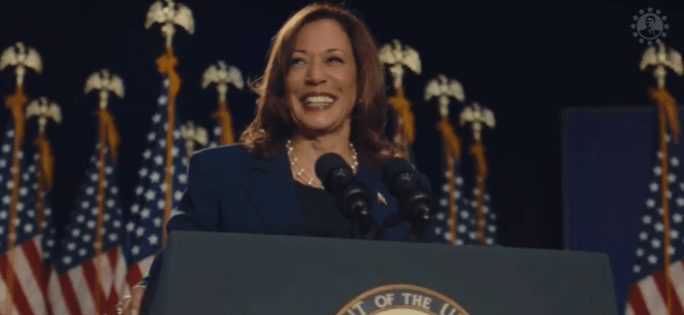
The video uses many of the same visuals as a real ad that Harris, the likely Democratic presidential nominee, released launching her campaign. But the meme swaps out Harris’ voice-over audio with an AI-generated voice that convincingly impersonates Harris.

“I, Kamala Harris, am your Democrat candidate for president because Joe Biden finally exposed his senility at the debate,” the AI voice says in the video. It claims Harris is a “diversity hire”, and it says she doesn’t know “the first thing about running the country.” The video retains “Harris for President” branding. It also adds in some authentic past clips of Harris.

Mia Ehrenberg, a Harris campaign spokesperson, said in an email to The Associated Press: “We believe the American people want the real freedom, opportunity and security Vice President Harris is offering; not the fake, manipulated lies of Elon Musk and Donald Trump.”

The widely shared video is an example of how lifelike AI-generated images, videos, or audio clips have been utilized both to poke fun and to mislead about politics as the United States draws closer to the presidential election. It exposes how, as high-quality AI tools have become far more accessible, there remains a lack of significant federal action to regulate their use, leaving rules guiding AI in politics largely to states and social media platforms.

The video also raises questions about how to best handle content that blurs the lines of what is considered an appropriate use of AI, particularly if it falls into the category of satire.

The original user who posted the video, a YouTuber known as Mr Reagan, disclosed from the beginning both on YouTube and on X that the manipulated video is a parody.

Over the weekend, before Musk clarified on his profile that the video was a joke, some participants in X’s “community note” feature suggested labeling his post as manipulated. No such label has been added to it, even as Musk has separately posted about the parody video.

Some users online have questioned whether his initial post might violate X’s policies, which say users “may not share synthetic, manipulated, or out-of-context media that may deceive or confuse people and lead to harm.”

The policy has an exception for memes and satire as long as they do not cause “significant confusion about the authenticity of the media.”

Chris Kohls, the man behind the Mr Reagan online persona, pointed an AP reporter to a YouTube video he posted early Monday responding to the ordeal. In the YouTube video, he confirmed he used AI to make the fake ad and argued that it was obviously parody, with or without a label.

Musk endorsed Trump, the Republican former president and current nominee, earlier this month.

Two experts who specialize in AI-generated media reviewed the fake ad’s audio and confirmed that much of it was generated using AI technology.

One of them, University of California, Berkeley, digital forensics expert Hany Farid, said the video shows the power of generative AI and deepfakes.

“The AI-generated voice is very good,” he said in an email. “Even though most people won’t believe it is VP Harris’ voice, the video is that much more powerful when the words are in her voice.”

He said generative AI companies that make voice-cloning tools and other AI tools available to the public should do better to ensure their services are not used in ways that could harm people or democracy.

Rob Weissman, co-president of the advocacy group Public Citizen, disagreed with Farid, saying he thought many people would be fooled by the video.

“I’m certain that most people looking at it don’t assume it’s a joke,” Weissman said in an interview. “The quality isn’t great, but it’s good enough. And precisely because it feeds into preexisting themes that have circulated around her, most people will believe it to be real.”

Weissman, whose organization has advocated for Congress, federal agencies and states to regulate generative AI, said the video is “the kind of thing that we’ve been warning about.”

Other generative AI deepfakes in the U.S. and elsewhere have tried to influence voters with misinformation, humor or both. In Slovakia in 2023, fake audio clips impersonated a candidate discussing plans to rig an election and raise the price of beer days before the vote. In Louisiana in 2022, a political action committee’s satirical ad superimposed a Louisiana mayoral candidate’s face onto an actor portraying him as an underachieving high school student.

Even more recently, a Huffington Post op-ed called for Democrats to utilize artificial intelligence to intentionally gaslight the American public by making him speak clearer, appear healthier and seem more youthful.

Congress has yet to pass legislation on AI in politics, and federal agencies have only taken limited steps, leaving most existing U.S. regulation to the states. More than one-third of states have created their own laws regulating the use of AI in campaigns and elections, according to the National Conference of State Legislatures.

Beyond X, other social media companies also have created policies regarding synthetic and manipulated media shared on their platforms. Users on the video platform YouTube, for example, must reveal whether they have used generative artificial intelligence to create videos or face suspension.

Adapted from reporting by the Associated Press
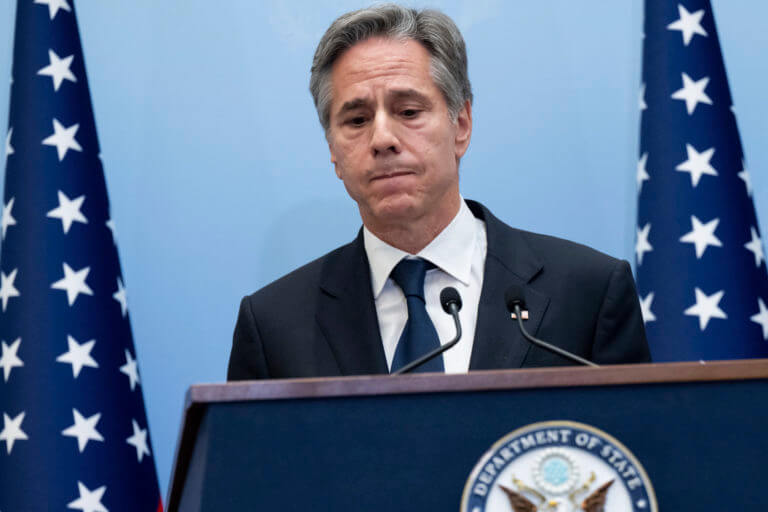
Even Blinken Conveys Concerns about Rigged Venezuelan Election

(Headline USA) U.S. Secretary of State Antony Blinken said the United States has ‘serious concerns’ about the announced result of Venezuela’s hotly contested presidential election that authorities say was won by incumbent Nicolas Maduro.

Speaking in Tokyo on Monday shortly after the announcement was made, Blinken said the U.S. was concerned that the result reflected neither the will nor the votes of the Venezuelan people. He called for election officials to publish the full results transparently and immediately and said the U.S. and the international community would respond accordingly.

“We have seen the announcement just a short while ago by the Venezuelan Electoral Commission,” he said. “We have serious concerns that the result announced does not reflect the will or the votes of the Venezuelan people.”

“It’s critical that every vote be counted fairly and transparently that the electoral authorities immediately share information with the opposition and independent observers without delay and that the electoral authorities publish the tabulation of votes. The international community is watching this very closely and will respond accordingly,” Blinken said.

In Venezuela, the announcement of Sunday’s election results was delayed by several hours, and the National Electoral Council, which is controlled by Maduro loyalists, said Maduro had secured a majority without releasing tallies from polling booths.

Opposition leader Maria Corina Machado was blocked from running. But she said after the council’s announcement that the margin of victory for the opposition’s candidate, Edmundo González, was “overwhelming” based on voting tallies it had received from campaign representatives from about 40% of ballot boxes nationwide.

Adapted from reporting by the Associated Press

After Bibi Debacle, Harris Pitches Herself to Michigan’s Muslim Population

(Headline USA) Osama Siblani’s phone won’t stop ringing.

Just days after President Joe Biden withdrew his bid for reelection and endorsed Vice President Kamala Harris for the Democratic presidential nomination, top officials from both major political parties have been asking the publisher of the Dearborn-based Arab American News if Harris can regain the support of the nation’s largest Muslim population located in metro Detroit.

His response: “We are in listening mode.”

Harris, who is moving to seize the Democratic nomination after Biden stepped down, appears to be pivoting quickly to the task of convincing Arab American voters in Michigan, a state Democrats believe she can’t afford to lose in November, that she is a leader they can unite behind.

Community leaders have expressed a willingness to listen, and some have had initial conversations with Harris’ team. Many had grown exasperated with Biden after they felt months of outreach had not yielded many results.

“The door is cracked open since Biden has stepped down,” said Dearborn Mayor Abdullah Hammoud. “There’s an opportunity for the Democratic nominee to coalesce the coalition that ushered in Biden’s presidency four years ago. But that responsibility will now fall on the vice president.”

Arab American leaders such as Hammoud and Siblani are watching closely for signals that Harris will be more vocal in pressing for a cease-fire. They’re excited by her candidacy but want to be sure she will be an advocate for peace and not an unequivocal supporter of Israel.

But Harris will need to walk a fine line not to publicly break with Biden’s position on the war in Gaza, where officials in his administration have been working diligently toward a cease-fire, mostly behind the scenes.

The divide within Harris’ own party was evident in Washington last week during Israeli Prime Minister Benjamin Netanyahu’s visit to address Congress. Some Democrats supported the visit, while others protested and refused to attend. Outside the Capitol, pro-Hamas rioters burned American flags and assaulted law enforcement.

Michigan Rep. Rashida Tlaib, the only Palestinian American in Congress whose district includes Dearborn, held up a sign that read “war criminal” during Netanyahu’s remarks.

Harris did not attend, opting to snub the foreign leader in favor of attending a sorority event.

Some Arab American leaders interpret her absence — she instead attended a campaign event in Indianapolis — as a sign of good faith with them, though they recognize her ongoing responsibilities as vice president, including a meeting Thursday with Netanyahu.

Her first test within the community will come when Harris chooses a running mate. One of the names on her short list, Pennsylvania Gov. Josh Shapiro, has been public in his criticism of pro-Palestinian protesters and is Jewish. Some Arab American leaders in Michigan say putting him on the ticket would ramp up their unease about the level of support they could expect from a Harris administration.

“Josh Shapiro was one of the first ones to criticize the students on campus. So it doesn’t differentiate Harris very much if she picks him. That just says I’m going to continue the same policies as Biden,” said Rima Meroueh, director of the National Network for Arab American Communities.

Arab Americans are betting that their vote holds enough electoral significance in pivotal swing states like Michigan to ensure that officials will listen to them. Michigan has the largest concentration of Arab Americans in the nation, and the state’s majority-Muslim cities overwhelmingly supported Biden in 2020. He won Dearborn, for example, by a roughly 3-to-1 margin over former President Donald Trump.

In February, over 100,000 Michigan Democratic primary voters chose “uncommitted,” securing two delegates to protest the Biden administration’s unequivocal support for Israel’s response to the Oct. 7 attacks by Hamas. Nationally, “uncommitted” garnered a total of 36 delegates in the primaries earlier this year.

The groups leading this effort have called for — at a minimum — an embargo on all weapons shipments to Israel and a permanent cease-fire.

“If Harris called for an arms embargo, I would work around the clock every day until the election to get her elected,” said Abbas Alawieh, an “uncommitted” Michigan delegate and national leader of the movement. “There’s a real opportunity right now to unite the coalition. It’s on her to deliver, but we are cautiously optimistic.”

Those divisions were on full display Wednesday night when the Michigan Democratic Party brought together over 100 delegates to pitch them on uniting behind Harris. During the meeting, Alawieh, one of three state delegates who did not commit to Harris, was speaking when another delegate interrupted him by unmuting and telling him to “shut up,” using an expletive, according to Alawieh.

The call could be a preview of tensions expected to surface again in August, when Democratic leaders, lawmakers, and delegates convene in Chicago for the Democratic National Convention. Mass protests are planned, and the “uncommitted” movement intends to ensure their voices are heard within the United Center, where the convention will be held.

Trump and his campaign, meanwhile, are keenly aware of the turmoil within the Democratic base and are actively seeking the support of Arab American voters.

A meeting between over a dozen Arab American leaders from across the country and several of Trump’s surrogates was convened in Dearborn last week. Among the surrogates was Massad Boulos, a Lebanese-born businessman whose son married Tiffany Trump, the former president’s younger daughter, two years ago. Boulos is leveraging his connections to rally support for Trump.

Part of the pitch that Boulos and Bishara Bahbah, chairman of Arab Americans for Trump, made in Dearborn was that Trump has shown an openness to a two-state solution. He posted a letter on social media from Palestinian President Mahmoud Abbas and pledged to work for peace in the Middle East.

“The three main points that were noted in the meeting were that Trump needs to state more clearly that he wants an immediate cease-fire in Gaza and that he supports the two-state solution, and that there is no such thing as a Muslim ban,” said Bahbah. “This is what the community wants to hear in a clear manner.”

Before a July 20 rally in Michigan, Trump also met with Bahbah, who pressed him about a two-state solution. According to Bahbah, Trump responded affirmatively, saying, “100%.”

“Whoever wins Michigan will win the presidency. We as Arab and Muslim Americans have the power to sway Michigan in Trump’s favor,” said Bahbah to AAN.

But any apparent political opportunity for Trump may be limited by criticism from many Arab Americans about the former president’s ban on immigration from several majority Muslim countries and remarks they felt were insulting.

“I have not heard any individuals saying I’m now rushing to Donald Trump,” said Hammoud, Dearborn’s Democratic mayor. “I have yet to hear that in any of the conversations I’ve had.”

Siblani, who organized Wednesday’s meeting with Trump surrogates, has spent months serving as an intermediary between his community and officials from all political parties and foreign dignitaries. Privately, he says, almost all express the need for a permanent cease-fire.

“Everybody wants our votes, but nobody wants to be seen as aligning with us publicly,” Siblani said.

Adapted from reporting by the Associated Press

Sound Money Advocacy & Precious Metals: Interview w/ Stefan Gleason

(Money Metals News Service) In a recent episode of The Morgan Report, host David Morgan interviewed Stefan Gleason, Chairman of the Sound Money Defense League and President and CEO of Money Metals Exchange.

The conversation explored the principles of sound money, the significance of precious metals in the financial system, and the ongoing legislative efforts to promote these ideals at both the state and federal levels.

Restoring Constitutional Money

Restoring Constitutional Money Silver Gold Sound Money

David Morgan introduced the Sound Money Defense League’s mission, emphasizing its focus on restoring gold and silver as America’s constitutional money.

Stefan Gleason elaborated on the League’s efforts to counteract the federal government’s and central banks’ policies that debase the currency. He highlighted the League’s work in rallying concerned Americans, collaborating with allies in elective office, and pushing for sound money legislation.

The U.S. Constitution addresses the use of gold and silver as money in Article I, Section 10. The relevant clause states:

Article I, Section 10, Clause 1:
“No State shall… make any Thing but gold and silver Coin a Tender in Payment of Debts…”

This clause restricts the states from making anything other than gold and silver coins a tender in payment of debts, essentially mandating that gold and silver be used as money for settling debts. This provision reflects the framers’ intent to ensure a stable and uniform currency system based on precious metals, which were widely recognized as having historical value.

The State of Sound Money Legislation

Gleason discussed the progress made in states like Utah, where legislation allows for gold and silver to be used in transactions if both parties agree. While acknowledging that the U.S. Constitution already permits states to coin money, he pointed out the practical challenges and the federal government’s role in moving away from the gold standard. Gleason stressed the importance of states like Utah, which have taken steps to encourage the use of gold and silver as money.

Gresham’s Law and Practical Barriers

One major obstacle to the widespread use of gold and silver as currency, according to Gleason, is Gresham’s Law, which states that bad money drives good money out of circulation. People are more inclined to hoard gold and silver as savings rather than spend them, particularly given the convenience of using Federal Reserve Notes and the tax implications of selling precious metals.

Tax Barriers to Gold and Silver

Tax Barriers to Gold and Silver

Gleason highlighted the Sound Money Defense League’s primary focus: removing tax barriers. He noted significant progress in eliminating sales taxes on gold and silver purchases in many states. Only five states still impose full sales tax on these transactions. Additionally, efforts are underway to remove state-level income taxes on gold and silver sales, with some successes already achieved.

What is the Sound Money Index?

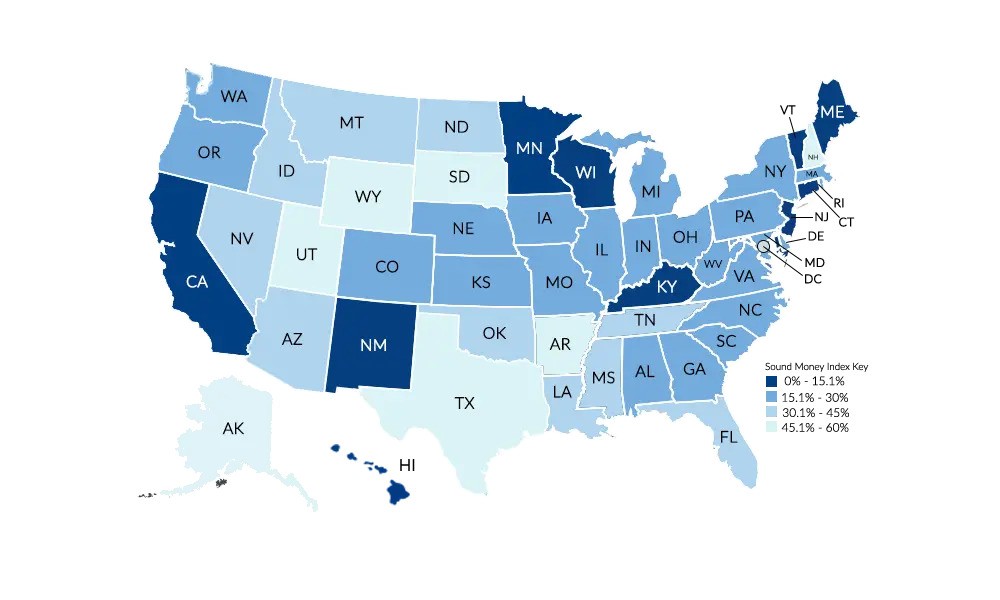
The Sound Money Index, developed by the Sound Money Defense League and Money Metals Exchange with Stefan Gleason and Jp Cortez, is a comprehensive assessment tool that ranks all 50 U.S. states based on their policies and practices related to sound money, particularly the use of gold and silver as legal tender and the elimination of taxes on precious metals.

The 2024 Sound Money Index, the first of its kind, uses fourteen different indicators to determine which states offer the most pro-sound money environment in the country. Key features include evaluating states’ tax policies, such as whether they impose sales taxes on the purchase of gold, silver, platinum, and palladium coins and bullion, and whether they tax capital gains on the sale of precious metals.

The Index also examines legislative efforts, analyzing if states have passed laws recognizing gold and silver as legal tender and considering other sound money policies like holding state reserves or pension funds in gold bullion, enforcing gold clause contracts, reaffirming gold as money, and limiting regulations on precious metals dealers and investors.

States are awarded points for each pro-sound money policy they enact, with forty percent of the possible points connected to sales and income taxes on monetary metals. The remaining points are awarded for other sound money policies.

The purpose of the Sound Money Index is to promote awareness of the importance of sound money and the role of precious metals in maintaining a stable economic system. By ranking states, the Index encourages policymakers to adopt and improve laws that support sound money principles, thereby reducing barriers to using gold and silver as currency. It also provides a framework for advocacy groups to push for legislative changes that enhance the use and acceptance of precious metals as money.

The Index highlights the significance of gold and silver as money, a principle embraced by the Framers of the Constitution who experienced the drawbacks of fiat paper money. Despite federal policies that have moved away from sound money principles, state-level actions can still promote the use of gold and silver, providing a hedge against inflation and the devaluation of currency.

In collaboration with Money Metals Exchange, the Sound Money Defense League presents the Sound Money Index as an authoritative ranking of all 50 U.S. states’ monetary policies, promoting the adoption of sound money principles through public awareness and legislative advocacy.

State-Level Gold Reserves

Another promising development is the move by some states to hold gold and silver as reserve assets. Gleason cited Utah’s recent legislation allowing the state treasury to hold precious metals, a move that could serve as a model for other states. This trend reflects a growing awareness of the need to hedge against the vulnerabilities of fiat currency and debt-based assets.

Challenges in Remonetizing Gold and Silver

Challenges in remonetizing gold and silver sound money

Morgan and Gleason discussed the practical challenges of using gold and silver in everyday transactions. Gleason acknowledged that while technology, such as blockchain and debit cards backed by precious metals, can facilitate this process, the demand for such solutions is currently limited. He expressed skepticism about the viability of private platforms promoting gold and silver transactions, emphasizing the need for long-term investment and state involvement.

Federal Efforts and Congressman Alex Mooney

Gleason praised Congressman Alex Mooney’s efforts to promote sound money at the federal level. Mooney has introduced bills to remove federal income taxes on gold and silver and to audit the U.S. gold reserves. Despite these efforts, Gleason noted that progress at the federal level remains slow, and state-level initiatives have been more successful.

Educating the Public and Financial Professionals

Educating the public and financial professionals about gold silver sound money Money Metals Exchange

The interview concluded with a discussion on how to better educate the public and financial professionals about the importance of diversifying with precious metals. Gleason emphasized the need for individuals to take control of their own financial decisions, highlighting the role of public policy in raising awareness and removing barriers to gold and silver ownership.

Key Questions and Answers:

Key questions and answers gold silver sound money

Why do we need legislation to use gold and silver as money if the U.S. Constitution already permits it?

While private parties don’t need legislation to transact in gold and silver, the primary issue is the federal level, including the Federal Reserve System and the US Treasury’s de-linking of gold from the Federal Reserve Note. The Constitution encourages states to use gold and silver, but many states have moved away from this practice. Legislation in states like Utah aims to encourage the use of gold and silver once again.

What are the main challenges to using gold and silver as money in commerce?

The primary challenge is Gresham’s Law, which states that bad money (Federal Reserve Notes) pushes good money (gold and silver) out of circulation. People prefer to hoard gold and silver rather than spend it. Additionally, practical barriers include taxes on precious metals, which the Sound Money Defense League aims to remove.

What progress has been made in removing taxes on gold and silver?

Significant progress has been made in removing sales taxes on gold and silver purchases. Currently, only five states fully tax these transactions, down from 32 states in 2014. Efforts are also underway to remove state-level income taxes on gold and silver sales, with some states already achieving this.

How are states incorporating gold and silver into their reserve assets?

Some states, like Utah and Tennessee, are considering or have passed legislation to hold gold and silver as reserve assets. Utah recently passed a bill to invest $150 million in gold and silver for state reserves. This reflects a growing awareness of the need to hedge against fiat currency and debt-based assets.

What is the role of technology in facilitating gold and silver transactions?

While technology like blockchain and debit cards can facilitate gold and silver transactions, the demand for these solutions is currently limited due to Gresham’s Law. Private platforms may struggle to finance themselves until there is a stronger business case for widespread use.

What efforts are being made at the federal level to promote sound money?

Congressman Alex Mooney has introduced several bills, including the Monetary Metals Tax Neutrality Act to remove federal income taxes on gold and silver and the Gold Reserves Transparency Act to audit the U.S. gold reserves. However, progress at the federal level remains slow.

How can the public be better educated about the importance of precious metals?

Public policy efforts and legislative successes at the state level can raise awareness. It’s essential for individuals to educate themselves and take control of their financial decisions. The crises in the financial system often act as wake-up calls for people to consider gold and silver as a hedge.

What is the impact of unscrupulous dealers on the precious metals industry?

Some dealers harm investors by selling overpriced or low-value coins and other products. It is crucial for buyers to focus on the melt value of their purchases and avoid high-premium items. This ensures they get fair value and can easily resell their investments.

How can investment professionals better understand the role of precious metals in a diversified portfolio?

Investment professionals often overlook precious metals due to systemic biases and conflicts of interest. Greater awareness and education about the benefits of holding a percentage of assets in gold and silver are necessary. Financial crises and losses may eventually push more professionals to recommend precious metals as part of a balanced portfolio.

These questions and answers highlight the significant topics covered in the interview, focusing on the legislative, practical, and educational aspects of promoting sound money principles and the role of precious metals in the financial system.

Conclusion

Stefan Gleason’s insights on David Morgan’s The Morgan Report underscored the vital role of sound money principles and the ongoing efforts to promote the use of gold and silver as constitutional money. While challenges remain, particularly at the federal level, the progress made in various states offers hope for the future. The conversation highlighted the importance of continued advocacy, education, and legislative action to ensure a stable and resilient financial system. Start investing in gold and silver today.

Volker vs. Voldemort: ‘Hermione’ Lookalike Gets an Early Inflation Lesson

(Mike Maharrey, Money Metals News Service) If you listen to politicians and pundits, you might think price inflation isn’t so bad.

If you have to buy stuff out there in the in the real world, you know better.

Heck, price inflation is so bad, even kids realize something is wrong.

@karislambert Cost of living really taking its toll on marnie🤣 #foryou #fyp ♬ original sound – Karis Lambert

A video of a young girl reacting after she tried to buy “just two ice creams with two chewing gums in it” tells you everything you need to know about price inflation.

The young lady informs us, the ice cream costs “nine bloody pounds!”

She’s having none of it.

And to add insult to injury, the ice cream man won’t take cash.

“He only does bloody card!”

She sums up the entire situation

“Bloody hell!”   

We feel your pain, young lady. We feel your pain!

She certainly gets it. But one has to wonder – where are the adults?

Many commenters observed that the young girl, named Marnie, bears a striking resemblance to Emma Watson, the actress who played “Hermione” in the popular Harry Potter franchise.

Perhaps after watching the viral video, J.K. Rowling will be inspired to write her next kids book about former Federal Reserve Chair Paul Volker’s storied battle against the inflation monster during the 1980s—the same way it undoubtedly played the muse for Connor Boyack while writing The Tuttle Twins and the Creature from Jekyll Island.

Some Things to Keep in Mind When It Comes to Price Inflation

Kids Understand Price Inflation Is Bad; Where Are the Adults?It is true that price inflation has cooled from its peak in June 2022, but that doesn’t mean the inflation dragon is dead. And it doesn’t mean prices are going down. They are still going up. They’re just not going up as quickly as they were a couple of years ago.

How much have prices really increased? 

A TikTocker recently reordered the exact same basket of groceries he bought online from Walmart. The basket cost him $127 in 2022. The same order cost $414 today. That’s a 226 percent increase. 

As the young lady in the video said, “Bloody ‘el!”

And prices will keep increasing because that’s the policy!

It’s not that government officials and central bankers want price inflation to go away. They just want it low enough that you don’t notice. The goal is to increase prices by 2 percent every year.

Price inflation doesn’t help you at all, but it helps government. The ability to increase the money supply makes excessive borrowing and spending possible. If we lived in a world with sound money and no central bank tinkering with interest rates and printing money, government would be much smaller and much less involved in the minutia of your life.

And that leads to the second thing you need to remember about inflation. The promise of rate cuts in the fall doesn’t mean inflation is dead and buried. It means the Federal Reserve is surrendering to inflation and is about to create more of it.

This becomes clear when you understand the correct definitions of inflation.

When government officials and pundits on TV talk about “inflation,” they almost always mean price inflation. This is what the CPI attempts to measure – how much prices have generally gone up in the economy. When you hear Federal Reserve Chairman Jerome Powell or some other government official talk about “cooling inflation,” they’re simply saying that prices are not rising as fast as measured by the CPI.

But historically, inflation didn’t mean “rising prices.” Inflation was defined more precisely as an increase in the amount of money and credit in the economy, or more succinctly, an expansion in the money supply.

Rising consumer prices is one of the effects of this monetary inflation.

Economist Henry Hazlitt explained it this way in “Inflation in One Page:“

“Inflation is an increase in the quantity of money and credit. Its chief consequence is soaring prices.

“Therefore inflation—if we misuse the term to mean the rising prices themselves—is caused solely by printing more money. For this the government’s monetary policies are entirely responsible.” [Emphasis added]

So, when the Fed people say they beat inflation and now they can ease monetary policy, they really mean they’re going to start inflating the money supply again.

In other words, they’re going right back to creating inflation again.

This “victory” over inflation is really a surrender.

So don’t be fooled into thinking prices are about to come down. They aren’t. In fact, they’ll keep going up. And in all likelihood, they’re going to start going up faster again when the Fed begins pumping more money into the economy with rate cuts.

So, you may want to think about preserving your wealth with an inflation hedge.


Mike Maharrey is a journalist and market analyst for MoneyMetals.com with over a decade of experience in precious metals. He holds a BS in accounting from the University of Kentucky and a BA in journalism from the University of South Florida.

Are Government Statistics Concealing the Truth About the Economy?

(Clint Siegner, Money Metals News Service) Americans are questioning all sorts of government functions these days. For example, the majority of people, according to polls, have doubts as to whether U.S. elections are free and fair.

Some believe the federal justice system has been weaponized and used against those in political opposition.

As of two weeks ago, a whole new group of people is wondering if the vaunted Secret Service can be trusted to protect the Republican candidate for president.

As long as people are questioning the credibility or motivations of government officials, they should remember to be skeptical of official economic data as well.

The U.S. Bureau of Economic Analysis (BEA) published the latest quarterly report on GDP Friday. It was a surprise. U.S. economic growth was much stronger than expected. The data showed growth at a healthy 2.8%, better than the 1.9% rate expected by economists and double the 1.4% growth reported in the first quarter.

Combine that with a couple of key data points from the Bureau of Labor Statistics (BLS), and the picture being painted of the U.S. economy is rosy indeed.

We’re told roughly a quarter million new jobs were created each month over the past few years, and the unemployment rate has held steady near record lows. The Consumer Price Index shows inflation is back under control.

The challenge to accepting this state of economic bliss for Americans is the growing piles of both public and private sector data which conflicts with what bureaucrats have to say.

Unfortunately, questioning the integrity of government statistics still appears taboo, at least at The Wall Street Journal and elsewhere in the corporate financial press.

The Journal recently published an article titled “American Borrowers Are on Shakier Ground.” The first two paragraphs reinforce the official line, which is that the U.S. economy is strong, and fears of a recession are fading. Then the authors lay out a whole lot of data which shows an economy that is in serious trouble.

Households are increasingly reliant on credit card debt, where interest rates have soared.

Average balances are much higher than two years ago, and credit card delinquencies are above 3% for the first time since 2011. The same is true for auto loans. Banks are writing them off at the highest rate since 2011.

Seventeen percent of Americans have a bill, whether it be a car payment, utility bill, or monthly rent/mortgage payment which went unpaid last month.

About 40% of people with student loans missed their first required payment after the hiatus on payments ended last fall.

The recession bullet hasn’t been dodged. The people making that claim all seem to work for the government, or in the unquestioning corporate press.


Clint Siegner is a Director at Money Metals Exchange, a precious metals dealer recently named “Best in the USA” by an independent global ratings group. A graduate of Linfield College in Oregon, Siegner puts his experience in business management along with his passion for personal liberty, limited government, and honest money into the development of Money Metals’ brand and reach. This includes writing extensively on the bullion markets and their intersection with policy and world affairs.

Going for Olympic … Silver?

(Mike Maharrey, Money Metals News Service) The 2024 Summer Olympics kicked off over the weekend. Thousands of athletes from all over the world have converged on Paris with one goal in mind.

Win silver!

Now, you’re probably thinking, ‘Umm…Mike, they’re going for gold.’ And technically, you’re correct. But did you know that gold medals are mostly made from silver?

True story.

Gold medals awarded at the 2024 Olympics contain only 6 grams (.21 ounces) of gold plate covering 523 grams (18.44 ounces) of silver. 

Silver medals are pure silver, weighing in at 525 grams. 

Bronze medals weigh 455 grams and are made of a composite of copper, tin, and zinc. 

The medals for the Paris Games have a unique feature – a piece of iron from the Eiffel Tower. 

According to the New York Times, “When the Eiffel Tower underwent renovations in the 20th century, they preserved pieces of the original iron and kept them in storage. Those chunks make up the hexagon figure in the middle of the Olympic gold medal.”

How Much Are Olympic Medals Worth?

Now that you know gold medals are mostly silver, you might think the winning athletes are getting ripped off. 

Don’t worry. They’ll be fine. After all, the real prize is the victory.

And even though gold medals are mostly silver, they’re still worth significantly more than the second-place prize.

According to Oxford Economics, a gold medal is worth about $1,027. (Not factoring in the fact that it’s hard to put a value on the iron from the Eiffel Tower.)

The silver medal is only valued at $535.

That’s because a little gold is worth a lot. Based on this morning’s spot price of gold ($2,403), that .21 grams of gold would cost $504.63, almost as much as an entire silver metal.

Oh, and what about the bronze medal? A paltry $4.60.

According to Olympic records, medals of pure gold were only handed out twice – the first time during the St. Louis Games in 1904 and then during the London Games in 1908. The medals were much smaller back then, and the average price of gold in 1904 was a mere $18.96 per ounce.

As Oxford Economics points out, the medals handed out in Paris over the next couple of weeks will probably be worth a lot more next year.

“The rising value of these medals can be attributed to the increase in precious and industrial metals. Forecasts from our Global Commodity Forecast Service reveal that both precious and industrial metal prices will rise considerably in the future, as their fundamentals look as bright as ever. We have been consistently vocal about gold’s upside potential this year due to its strong fundamentals. “

It’s also interesting to note that silver is significantly undervalued compared to gold from a historical perspective.

The gold-silver ratio is currently 85-1. That means it takes 85 ounces of silver to buy an ounce of gold. 

In the modern era, the gold-silver ratio has averaged between 40-1 and 60-1. When the gold-silver ratio gets far above the high end of that historical average, it tends to return to the mean with a vengeance. 

For instance, in 2020, the gold-silver ratio set a record of 123-1 as Covid hysteria gripped the world and then plunged to around 60-1 as central banks globally cranked up the money creation machine to cope with governments shutting down economies. 

In another example of this snap-back, the gold-silver ratio fell to 30-1 in 2011 after rising to over 80-1 during the money creation of the Great Recession in the wake of the 2008 financial crisis. 

All of this indicates silver has plenty of room to run higher, so winning silver might not be such a bad deal!

Photo courtesy of the Paris 2024 Olympics


Mike Maharrey is a journalist and market analyst for MoneyMetals.com with over a decade of experience in precious metals. He holds a BS in accounting from the University of Kentucky and a BA in journalism from the University of South Florida.

Lame-Duck Biden Rolls Out Controversial Court-Packing Plan as Final Insult

(Headline USA) President Joe Biden has unveiled a proposal for changes at the U.S. Supreme Court, calling on Congress to establish term limits and an enforceable ethics code for the court’s nine justices against the intentions of the founding fathers. He’s also pressing lawmakers to ratify a constitutional amendment limiting presidential immunity.

The White House on Monday detailed the contours of Biden’s court proposal, one that appears to have little chance of being approved by a closely divided Congress with just 99 days to go before Election Day.

Still, Democrats hope it’ll help focus voters as they consider their choices in a tight election. The likely Democratic nominee, Vice President Kamala Harris said the court’s fairness had been called into question following recent decisions that upset her party.

The White House is looking to pander to the growing outrage among Democrats about the court, which has a 6-3 conservative majority, issuing opinions that overturned decisions on abortion as a constitutional right and federal regulatory powers that permitted unelected bureaucrats to create laws.

“I have great respect for our institutions and separation of powers,” Biden argues in a Washington Post op-ed published Monday. “What is happening now is not normal, and it undermines the public’s confidence in the court’s decisions, including those impacting personal freedoms. We now stand in a breach.”

Harris later issued a statement saying the American people must have confidence in a Supreme Court. She said the reforms being proposed “will help to restore confidence in the Court, strengthen our democracy, and ensure no one is above the law.”

The president planned to speak about his proposal later Monday during an address at the LBJ Presidential Library in Austin, Texas, to mark the 60th anniversary of the Civil Rights Act.

Biden is calling for doing away with lifetime appointments to the court. He says Congress should pass legislation to establish a system in which the sitting president would appoint a justice every two years to spend 18 years in service on the court. He argues term limits would help ensure that court membership changes with some regularity and adds a measure of predictability to the judicial confirmation process.

He also wants Congress to pass legislation establishing a court code of ethics that would require justices to disclose gifts, refrain from public political activity and recuse themselves from cases in which they or their spouses have financial or other conflicts of interest.

Biden also is calling on Congress to pass a constitutional amendment reversing the Supreme Court’s recent landmark immunity ruling that determined former presidents have broad immunity from prosecution for official acts.

That decision extended the delay in the Washington criminal case against Trump on charges related to investigating the 2020 presidential election and all but ended prospects the former president could be tried before the November election.

Polls indicate Americans support limiting how long justices serve on the nation’s highest court. Last summer, a poll from The Associated Press-NORC Center for Public Affairs Research found 67% of Americans, including 82% of Democrats and 57% of Republicans, support a proposal to set a specific number of years that justices serve instead of life terms.

The first three justices who would potentially be affected by term limits are on the right. Justice Clarence Thomas has been on the court for nearly 33 years. Chief Justice John Roberts has served for 19 years, and Justice Samuel Alito has served for 18.

Supreme Court justices served an average of about 17 years from the founding until 1970, said Gabe Roth, executive director of the group Fix the Court. Since 1970, the average has been about 28 years.

An enforcement mechanism for the high court’s code of ethics, meanwhile, could bring the Supreme Court justices more in line with other federal judges, who are subject to a disciplinary system in which anyone can file a complaint and have it reviewed. An investigation can result in censure and reprimand. Last week, Justice Elena Kagan called publicly for creating a way to enforce the new ethics code, becoming the first justice to do so.

Still, when it comes to the Supreme Court, creating an ethics code enforcement mechanism isn’t as easy as it sounds.

The attorney general has always had the power to enforce violations of the financial and gift disclosure rules but has never apparently used that power against federal judges, said Stephen Gillers, a legal ethics expert at NYU School of Law.

The body that oversees lower court judges, meanwhile, is headed up by Roberts, “who might be reluctant to use whatever power the conference has against his colleagues,” Gillers wrote in an email.

The last time Congress ratified an amendment to the Constitution was 32 years ago. The 27th Amendment, ratified in 1992, states that Congress can pass a bill changing the pay for members of the House and the Senate, but such a change can’t take effect until after the next November elections are held for the House.

Trump has decried court reform as a desperate attempt by Democrats to “Play the Ref.”

“The Democrats are attempting to interfere in the Presidential Election, and destroy our Justice System, by attacking their Political Opponent, ME, and our Honorable Supreme Court. We have to fight for our Fair and Independent Courts, and protect our Country,” Trump posted on his Truth Social site this month.

Justice Sonia Sotomayor, who was appointed during the Obama administration, has faced scrutiny after it surfaced that her staff often pressured public institutions that hosted her to buy copies of her memoir or children’s books.

Alito rejected calls to step aside from Supreme Court cases involving Trump and Jan. 6, 2021, defendants after left-wing activists expressed outrage that he displayed a Revolutionary War era flag known as the “An Appeal to Heaven Flag” at his beach house because several protesters carried it on Jan. 6, 2021, leading leftists to claim he was biased.

The announcement marks a revenge plot from Biden. Throughout his presidency, he has become increasingly unhinged regarding the court’s interpretation of the U.S. Constitution, which often stands contrary to the left-wing agenda.

Last week, he announced during an Oval Office speech that he would pursue Supreme Court reform during his final months in office. If accomplished, the reforms would override over two centuries of judicial independence, eroding the intentions of the founding fathers in protecting the court from political pressure.

Adapted from reporting by the Associated Press

CIA Denies Trump Shooter Was MKUltra Victim

(Ken Silva, Headline USA) As conspiracy theories about the July 13 Trump assassination attempt continue to percolate, the CIA has taken the rare step of publicly responding to one of them—denying that the shooter, Thomas Crooks, was a victim of its mind control program.

“These claims are utterly false, absurd, and damaging,” a CIA spokesperson told Gizmodo on Thursday, referencing the agency’s infamous mind-control program “MKUltra.”

“The CIA had no relationship whatsoever with Thomas Crooks. Regarding MKULTRA, the CIA’s program was shut down more than 40 years ago, and declassified information about the program is publicly available on CIA.gov.”

Gizmodo and other outlets noted that the CIA usually doesn’t respond to public conspiracy theories. With the Trump shooting, conspiracy theorists are comparing it to the assassination of John F. Kennedy.

The JFK assassination had at least one direct link to MKUltra: A scientist involved in the CIA mind-control program, Dr. Jolyon West, “examined” Jack Ruby—the man who killed alleged assassin Lee Harvey Oswald—after Ruby alleged that the JFK shooting was a wider conspiracy.

And while the CIA claims to have ended MKUltra, the agency used similar torture tactics against prisoners at Guantanamo Bay.

“The history reveals that CIA doctors were hunting for a ‘truth serum’ to use on prisoners as part of a previously secret effort called Project Medication,” the ACLU revealed in 2018 after obtaining records about the torture at Gitmo.

“The CIA studied records of old Soviet drug experiments as well as the CIA’s notorious and discredited MK-Ultra program, which involved human experimentation with LSD and other drugs on unwitting subjects. The CIA doctors involved in Project Medication wanted to use Versed, a psychoactive drug similar to some of those used in MK-Ultra, on prisoners.”

Meanwhile, victims of MKUltra experiments in Canada recently lost a lawsuit over the matter. That litigation stemmed from CIA-sponsored experiments that took place at Montreal’s Allan Memorial Institute under psychiatrist Donald Ewen Cameron.

Court records from the lawsuit describe Dr. Cameron’s “Montreal Experiments” as consisting of extreme mind-control brainwashing experimentation on “unwitting” patients by methods of such as drug-induced comas, intensive electroconvulsive therapy, “psychic driving,” sensory deprivation, and the administration of a cocktail of drugs to suppress nerve functionality and activation.

Lawyers for the U.S. government have argued that the CIA should be immune for its actions. An appeals court sided with those lawyers last year, and Canada’s supreme court reportedly declined to hear the case earlier this year.

There doesn’t appear to be any evidence that Crooks was experimented on in a medical setting. Questions remain about who he may have been in contact with online.

Ken Silva is a staff writer at Headline USA. Follow him at twitter.com/jd_cashless.

Counter Sniper Text Messages Reveal Trump Shooter First Spotted 105 Minutes before Attack

(Ken Silva, Headline USA) Leaked text messages from local counter snipers show that Trump shooter Thomas Crooks was identified by 4:26 p.m.—more than 100 minutes before he opened fire on Trump and other attendees of the July 13 campaign rally in Butler, Pennsylvania.

The text messages were released by Sen. Chuck Grassley to the New York Times, and they purportedly come from the same Butler County ESU counter snipers who left their post to search for Crooks—leaving the rooftop wide open for him to take his shots. The texts are redacted to hide the names of the counter snipers. It’s not clear who redacted them.

At 4:26 p.m. on July 13, one of the local counter snipers warned his two colleagues about Crooks as the sniper was ending his shift and leaving the rally.

“Someone followed our lead and snuck in and parked by our cars just so you know. I’m just letting you know because you see me go out with my rifle and put it in my car so he knows you guys are up there he’s sitting to the direct right on a picnic table about 50 yards from the exit,” the counter sniper told his two colleagues inside the AGR building.

More than 40 minutes later, the remaining two Butler ESU counter snipers saw Crooks again, this time right beneath him. It was at this point when they photographed Crooks and let the Secret Service know about him.

“Kid [lurking] around building we are in. AGR I believe it is. I did see him with a range finder looking towards stage. FYI. If you wanna notify SS snipers to look out. I lost sight of him,” a counter sniper texted at 5:38 p.m., attaching two photos of Crooks.

“Call it in to command and have a uniform check it out.”

What happened between the time of those texts and when Crooks opened fire at 6:11 p.m. is still unclear. Pennsylvania State Police Commissioner Christopher L. Paris told Congress last week that the two counter snipers left their post to search for Crooks, while other reports have claimed that only one counter sniper left.

“I was told they began searching with local officers after Crooks had been identified as suspicious by them,” Paris said at last week’s congressional hearing.

It’s not clear what, if any, agency ordered the local counter snipers away from their posts. Paris said he didn’t know the answer to that question.

Lawmakers will have a chance to ask more questions about the incident Tuesday at a joint Senate hearing, where FBI Deputy Director Paul Abbate and Secret Service Acting Director Ronald L. Rowe are set to testify.

Ken Silva is a staff writer at Headline USA. Follow him at twitter.com/jd_cashless.