(Headline USA) Cisco Systems is planning to lay off 7% of its employees, its second round of job cuts this year, as the company shifts its focus to more rapidly growing areas in technology, such as artificial intelligence and cybersecurity.
The company based in San Jose, California, did not specify the number of jobs it is cutting. It had 84,900 employees as of July 2023. Based on that figure, the number of jobs cut would be about 5,900. In February, Cisco announced it would cut about 4,000 jobs.
The networking equipment maker said in June that it would invest $1 billion in tech startups like Cohere, Mistral and Scale to develop reliable AI products. It recently also announced a partnership with Nvidia to develop infrastructure for AI systems.
Cisco’s layoffs come just two weeks after chipmaker Intel Corp. announced it would cut about 15,000 jobs as it tries to turn its business around to compete with more successful rivals like Nvidia and AMD.
Intel’s quarterly earnings report disappointed investors, and its stock took a nosedive following the announcement. In contrast, Cisco’s shares were up about 6% after-hours on Wednesday.
In a foray into cybersecurity, Cisco launched a cybersecurity readiness index back in March to help businesses measure their resiliency against attacks.
Cisco Systems Inc. said Wednesday it earned $2.16 billion, or 54 cents per share, in its fiscal fourth quarter that ended on July 27, down 45% from $3.96 billion, or 97 cents per share, in the same period a year ago. Excluding special items, its adjusted earnings were 87 cents per share in the latest quarter.
Revenue fell 10% to $13.64 billion from $15.2 billion.
Analysts, on average, were expecting adjusted earnings of 85 cents per share on revenue of $13.54 billion, according to a poll by FactSet.
For the current quarter, Cisco is forecasting adjusted earnings of 86 cents to 88 cents per share on revenue of $13.65 billion to $13.85 billion. Analysts are expecting earnings of 85 cents per share on revenue of $13.74 billion.
Edward Jones analyst David Heger said Cisco is starting to see demand recover after it slowed over the past few quarters, noting that product orders were up 6% even when excluding those from its recent acquisition of cybersecurity firm Splunk.
He added that “the restructuring will help offset the earnings impact from interest expenses associated with financing the Splunk acquisition and will rationalize combined workforces.”
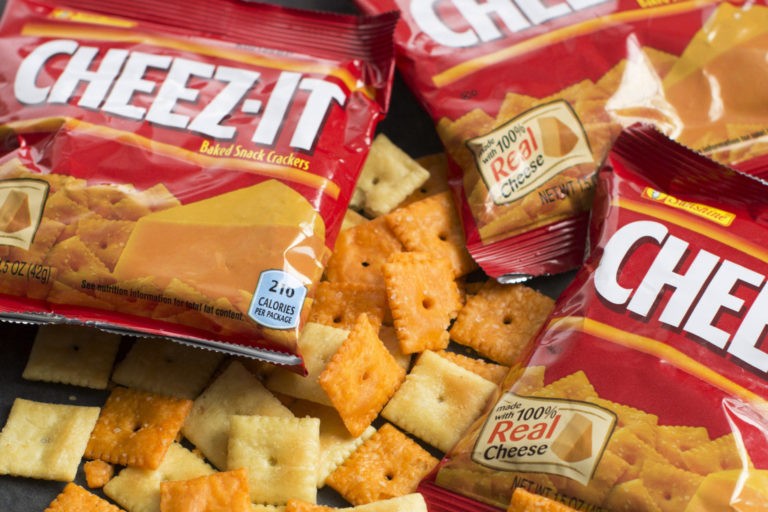
(Headline USA) M&M’s maker Mars is buying Kellanova, the maker of Cheez-Its and Pop-Tarts, for nearly $30 billion in an effort to broaden its snacking portfolio and expand globally.
Kellanova was created last year when the Kellogg Co. split into two companies. Chicago-based Kellanova sells many of the former company’s most profitable brands, including Pringles, Eggo, Town House, MorningStar Farms and Rice Krispies Treats. It had net sales of more than $13 billion last year and has about 23,000 employees.
The other company formed in the Kellogg split, WK Kellogg Co., retained cereal brands like Raisin Bran, Frosted Flakes and Froot Loops, which have struggled with slowing sales in recent years. It is not involved in the deal.
“Mars is getting the crown jewels in term of the spinoff components,” said Randal Kenworthy, a senior partner specializing in consumer products at the consulting firm West Monroe.
Mars Inc. said Wednesday that it will pay $83.50 per share in cash. The company put the total value of the transaction at $35.9 billion, including debt.
The deal will give Mars significantly more buying power from suppliers and selling power in negotiations with grocers and other retailers, Kenworthy said.
Mars and Kellanova combined would control around 8% of the U.S. snack market, he said, compared to a 9% share for PepsiCo, which owns Frito-Lay.
Kellanova also has a bigger international footprint, which will help Mars expand overseas, Kenworthy said. And Mars has made a lot of improvements in its organizational efficiency that it can apply to Kellanova, he said.
“Strategically it makes a lot of sense,” Kenworthy said.
It is the biggest deal in the sector since J.M. Smucker bought Hostess for $5.6 billion last year, and among the largest of 2024 behind Exxon Mobil’s $60 billion acquisition of Pioneer Natural Resources and Capital One Financial’s $35 billion acquisition of Discover Financial Services.
Steve Cahillane, Kellanova’s CEO, president and chairman, said Mars approached Kellanova a few months ago to discuss the deal. Cahillane noted that Kellanova posted higher-than-expected revenue in the last few quarters and reaffirmed its full-year guidance despite challenging economic conditions.
“I suspect that Mars—watching that momentum—led them to come forward and say, ‘You know, now’s the time, we ought to talk to these guys,’” Cahillane told the Associated Press in an interview. “So it was really that simple.”
Mars’s purchase of Kellanova is expected to close in the first half of next year. Once it’s complete, Kellanova will become part of Mars Snacking, which is also based in Chicago.
Cahillane said that while some corporate functions might be consolidated, he expects most Kellanova employees to be folded into Mars.
“They have chewing gum plants, they have pet food plants, we have Pringles plants and Cheez-It plants. You can’t make our food at their plants,” he said. Cahillane said he will run Kellanova until the deal closes.
Mars, headquartered in McLean, Virginia, is one of the largest privately held companies in the U.S. Mars said it had net sales of $50 billion last year and has 150,000 employees.
“The Kellanova brands significantly expand our snacking platform, allowing us to even more effectively meet consumer needs and drive profitable business growth,” Andrew Clarke, global president of Mars Snacking, said in a statement.
Arun Sundaram, an analyst with investment research company CFRA, said he expects U.S. anti-trust regulators to scrutinize the deal given the current backdrop of high food prices. He believes the deal will ultimately go through because there is so little overlap between the portfolios of the two companies.
Kenworthy said regulators might be concerned about the overlap in healthier snacks at the two companies. Kellanova owns the RxBar and NutriGrain brands while Mars owns Kind and Nature’s Bakery. But Cahillane said the overlap is very small in the large and fragmented health bar category.
The acquisition would expand Mars’s reach into the salty snack category. The company owns brands like Combos and Ben’s Original, but it’s primarily known for its chocolates, candies and pet food. Mars makes M&M’s, Lifesavers, Juicy Fruit gum and Skittles, as well as Pedigree and Royal Canin pet foods, among other products.
Sales of some of Mars’s products, like gum, have sputtered in recent years as snacking habits shift. And chocolate sales have been declining in the U.S. as younger customers look for other flavors, like sour candy. Unit sales of chocolate in the U.S. have fallen 5.5% over the last year, according to Nielsen IQ.
Other companies have also been adding salty snacks to their lineup in pursuit of changing American tastes. In 2017, candy bar maker Hershey acquired Amplify, the maker of Skinny Pop popcorn, for $1.2 billion. Four years later, Hershey spent another $1.2 billion for Dot’s Homestyle Pretzels.
The acquisition would also open the door to potentially lucrative product combinations like Skittles-flavored Pop-Tarts or Snickers-flavored Pringles. Such limited-time offers which have been showing up more frequently as food companies try to grab consumers’ attention and win space on store shelves.
Kenworthy said the timing is ideal because easing inflation and prices will make name-brand snacks more appealing to customers who have been migrating to cheaper store brands. Thus far, although inflation—or the rate of dollar devaluation—has returned to its pre-Biden levels, the impact of high prices remains, and is likely to prove a more complicated problem to solve.
Economists say that many consumers appear to be returning to pre-pandemic norms, when most companies felt they couldn’t raise prices very much without losing business. Kellanova lowered its prices by 1% in North America in the second quarter and saw its sales volumes rise 2%.
Mars got its start in 1911, when founder Frank Mars started making and selling butter cream candy from his home in Tacoma, Washington. The company moved to Chicago in 1929 and introduced the Snickers bar the following year.
Mars has steadily grown through acquisitions. It entered the pet food business in 1935 with the purchase of a U.K. dog food brand and bought the Dove ice cream brand in 1986. In 2008, it purchased the Wrigley chewing gum business for $23 billion.
Shares of Kellanova rose nearly 8% to close at $80.28 on Wednesday.
“During Shafik’s presidency, a disturbing wave of antisemitic harassment, discrimination, and disorder engulfed Columbia university’s campus,” Foxx said in a press release issued by the committee.
“Jewish students and faculty have been mocked, harassed, and assaulted simply for their identity,” she added. “Every student has the right to a safe learning environment. Period. Yet, flagrant violations of the law and the university rules went unpunished.”
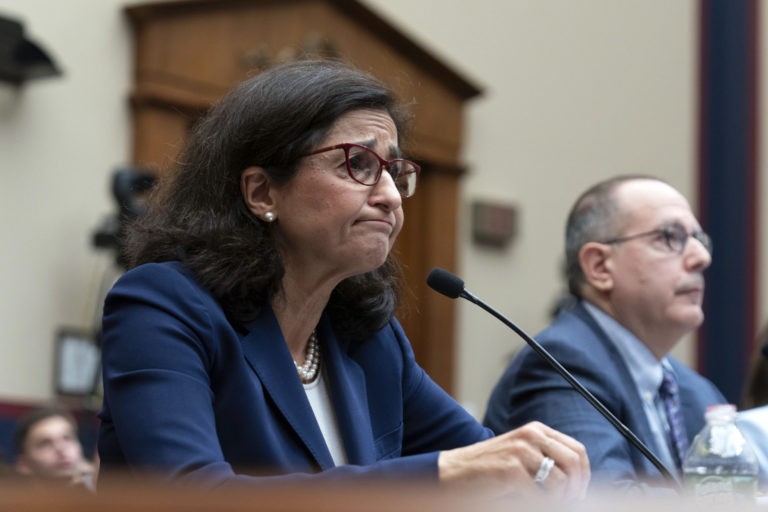
Shafik resigned after a brief, tumultuous tenure that saw the head of the prestigious New York university face heavy scrutiny for her handling of protests and campus divisions over the Israel–Hamas war.
The Ivy League school in upper Manhattan was roiled this year by student demonstrations, culminating in scenes of police officers carrying zip ties and riot shields storming a building that had been occupied by pro-Palestinian protesters. Similar protests swept college campuses nationwide, with many leading to violent clashes with police and thousands of arrests.
It is unlikely that the protests were organic, with strong evidence suggesting that activists were being bankrolled by far-left organizations, including those linked to notorious billionaire oligarch George Soros.
Several Arab nations supporting Hamas’s fight against the Israelis may also have helped to fund the protests—as well as making sizeable donations to the universities themselves.
Shafik’s announcement also comes just days after the school confirmed that three deans had resigned, amid allegations that they exchanged disparaging texts during a campus discussion about Jewish life and anti-Semitism.
In a statement reacting to those resignations, Foxx praised the outcome while questioning the delayed reaction.
“About time. Actions have consequences, and Columbia should have fired all four of these deans months ago. Instead, the University continues to send mixed signals,” she wrote in a committee press release.
“… These administrators had a responsibility to ensure Jewish students are able to thrive safely on Columbia’s campus, and they failed miserably, showing contempt for the Jewish community and engaging in antisemitic tropes” Foxx added. “I hope that Columbia continues to sever ties with anyone who has been complicit in the antisemitism that’s overrun the campus since October 7.”
Shafik, who began the role in July last year, announced her resignation in an emailed letter to the university community just weeks before the start of classes on Sept. 3. The university on Monday began restricting campus access to people with Columbia IDs and registered guests, saying it wanted to curb “potential disruptions” as the new semester nears.
In her letter, Shafik heralded “progress in a number of important areas” but lamented that during her tenure it was “difficult to overcome divergent views across our community.”
“This period has taken a considerable toll on my family, as it has for others in the community,” she wrote. “Over the summer, I have been able to reflect and have decided that my moving on at this point would best enable Columbia to traverse the challenges ahead.”
Columbia’s Board of Trustees meanwhile announced that Katrina Armstrong, the CEO of Columbia University Irving Medical Center, will serve as interim president.
“Challenging times present both the opportunity and the responsibility for serious leadership to emerge from every group and individual within a community,” said Armstrong, who is also the executive vice president for the university’s Health and Biomedical Sciences. “As I step into this role, I am acutely aware of the trials the University has faced over the past year.”
According to Foxx, it was incumbent upon Armstrong—and whomever the board appoints afterward—to do more than deliver platitudes and sweet nothings.
“Columbia’s next leader must take bold action to address the pervasive antisemitism, support for terrorism, and contempt for the university’s rules that have been allowed to flourish on its campus,” said the GOP lawmaker, herself a former university instructor and college president.
During Shafik’s congressional testimony in mid-April, as pro-Palestinian protesters first set up tent encampments on Columbia’s campus, she denounced anti-Semitism but faced criticism for how she’d responded to faculty and students accused of bias.
The school sent in police to clear the tents the following day, only for the activists to return and inspire a wave of similar protests at campuses across the country, with protesters calling for schools to cut financial ties to Israel and the companies supporting the war.
As the protest rolled on for weeks, the school was thrust into the national spotlight. House Speaker Mike Johnson, R-La., showed up to denounce the encampment, while Democratic Rep. Alexandria Ocasio-Cortez came to support it.
Foxx accompanied Johnson on his visit, where she declared, “Columbia University is in a freefall” and warned Shafik that “the inmates are running the asylum” while denouncing the suspension of two Jewish students over a “made-up ‘chemical attack.’”
Eventually, talks between the school and the protesters came to a standstill, and as the school set a deadline for the activists to clear out, a group instead took over Hamilton Hall.
Even after the protests were cleared, Columbia decided to cancel its university-wide commencement ceremony, instead opting for a series of smaller, school-based ceremonies.
The campus was mostly quiet this summer, until news broke in June revealing the series of text messages exchanged by administrators while attending the May 31 panel discussion “Jewish Life on Campus: Past, Present and Future.”
The officials were subsequently removed from their posts, with Shafik saying in a July 8 letter to the school community that the messages were unprofessional and “disturbingly touched on ancient antisemitic tropes.”
Many of Shafik’s critics on both sides of the debate were quick to cheer the end of her tenure, which is one of the shortest in school history.
Johnson said her resignation was “long overdue” and should serve as a cautionary example to other university administrators that “tolerating or protecting antisemites is unacceptable and will have consequences.”
The student group Columbia Students for Justice in Palestine wrote in a post on the social media platform X that Shafik “finally got the memo” after months of protests.
After months of chanting “Minouche Shafik you can’t hide” she finally got the memo. To be clear, any future president who does not pay heed to the Columbia student body’s overwhelming demand for divestment will end up exactly as President Shafik did.
— Columbia Students for Justice in Palestine (@ColumbiaSJP) August 15, 2024
The campus chapter of Jewish Voice for Peace wrote it will “not be placated by her removal as the university’s repression of the pro-Palestinian student movement continues.”
The students of Columbia will never forget the sheer violence unleashed upon us by Minouche Shafik, and we will not be placated by her removal as the university’s repression of the pro-Palestinian student movement continues. https://t.co/2KzgbzucA8
— BC/CU Jewish Voice for Peace (@JVPColumbia) August 15, 2024
Other prominent Ivy League leaders have stepped down in recent months, in large part due to their response to the volatile protests on campus.
University of Pennsylvania President Liz Magill resigned in December after less than two years on the job amid pressure from donors and criticism over testimony at a congressional hearing where she was unable to say under repeated questioning that calls on campus for the genocide of Jews would violate the school’s conduct policy.
Shafik said she will return to the United Kingdom to lead an effort by the foreign secretary’s office to review the government’s approach to international development.
“I am very pleased and appreciative that this will afford me the opportunity to return to work on fighting global poverty and promoting sustainable development, areas of lifelong interest to me,” she wrote.
Ironically, it comes at a precarious time for the U.K., where recent protests have broken out between working-class British citizens and Muslim immigrants following the brutal stabbings of three girls by a second-generation Rwandan transplant.
The Egyptian-born economist previously led the London School of Economics, but had made her mark largely outside academia with roles at the World Bank, the United Kingdom’s Department for International Development, the International Monetary Fund and the Bank of England.
At the time of Shafik’s appointment, Columbia Board of Trustees chair Jonathan Lavine had described her as a leader with an “unshakable confidence in the vital role institutions of higher education can and must play in solving the world’s most complex problems.”
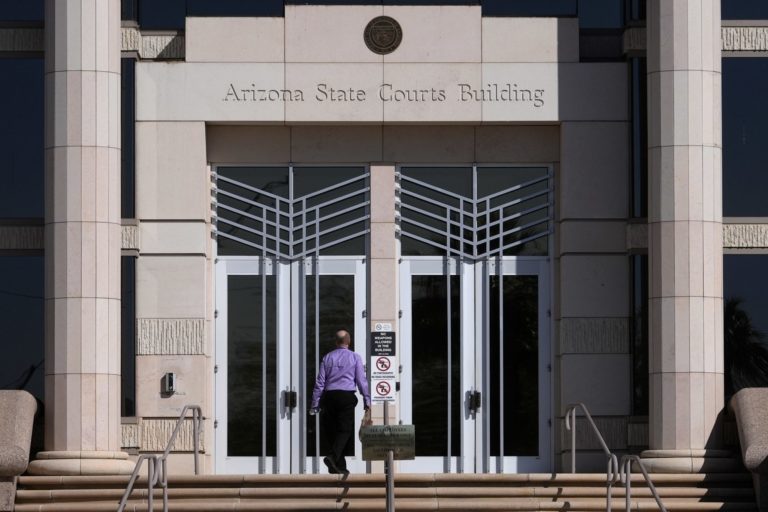
(Headline USA) As Arizona voters prepare to decide in the fall whether to enshrine abortion as a right in the state constitution, a pro-life informational pamphlet can refer to an embryo or fetus as an “unborn human being,” the state’s highest court ruled Wednesday.
The Arizona Supreme Court justices sided with Republican lawmakers, who drafted the language sent to all voters in the state, over protests from pro-abortion activists and Democrat officials.
The ruling comes as abortion foes have long worked to give pre-born children the same legal and constitutional protections as the mothers carrying them. It was highlighted recently when the Alabama Supreme Court ruled that frozen embryos are legally protected children, forcing lawmakers to scramble to enact protections for in vitro fertilization.
Democrats have made abortion a central message since the U.S. Supreme Court overturned Roe v. Wade in 2022, and it is a key part of their efforts in this year’s elections. They hope the ballot measure in Arizona, one of a handful of battleground states that will determine which party controls the presidency and the U.S. Senate, will drive sympathetic voters to cast a ballot.
The ruling drew swift criticism from the ballot measure’s backers, who argued the phrase “unborn human being” is neither impartial nor objective. They said they were concerned that Arizonans would be subjected to biased and politically charged words.
“We are deeply disappointed in this ruling, but will not be deterred from doing everything in our power to communicate to voters the truth of the Arizona Abortion Access Act and why it’s critical to vote YES to restore and protect access to abortion care this fall,” the abortion supporting organization, Arizona for Abortion Access, said in a statement.
The ballot measure would allow abortions until an embryo or fetus could survive outside the womb, typically around 24 weeks, with exceptions allowing later-term abortions to save the mother’s life or to protect her physical or mental health. It would restrict the state from adopting or enforcing any law that would prohibit the procedure.
Arizona House Speaker Ben Toma, a Republican who co-chairs the legislative council, the panel that drafted the disputed language, said it’s intended to help voters understand the current law.
“The Arizona Supreme Court’s ruling is correct,” Toma said.
Arizona for Abortion Access sued the majority-Republican legislative council for including what the group called politicized language. The Superior Court agreed, finding that the GOP-favored language was “packed with emotion and partisan meaning.” That ruling was overturned by the Supreme Court, whose seven justices were appointed by Republican governors.
The brief ruling, signed by Vice Chief Justice John Lopez, did not explain the justices’ rationale, saying a full opinion would be released later. Justice Clint Bolick, whose wife is a Republican lawmaker on the legislative council, recused himself from the case.
The language describing an embryo or fetus as an “unborn human being” will go in a pamphlet that gives voters information on candidates and ballot measures to help inform their choices. The secretary of state’s office, which determines what gets printed on the ballot itself, said “unborn human being” would not appear there.
The secretary of state’s office said Monday that it had certified 577,971 signatures, far above the number required to put the question before voters.
As pro-life groups and Republican allies reel from a string of defeats at the ballot box, many have used an array of strategies to keep abortion off the ballot, including through monthslong legal battles over ballot initiative language.
In Missouri, for example, Republican Attorney General Andrew Bailey stonewalled the pro-abortion campaign for months before the secretary of state, Republican Jay Ashcroft, tried to describe the proposal to voters as allowing “dangerous and unregulated abortions until live birth.” A state appeals court last year ruled that Ashcroft’s wording was politically partisan and tossed it out. In Florida, language was at the center of attempts by the state’s Republican attorney general to keep a proposed abortion amendment off the ballot. Many of these strategies build off of those seen last year in Ohio, where voters overwhelmingly passed a state constitutional amendment protecting abortion.
Other efforts to thwart abortion ballot measure efforts have included attempts to remove signatures from petitions, legislative pushes for competing ballot measures that could confuse voters, and attempts to raise the thresholds for ballot initiatives or ban residents from placing abortion initiatives on the statewide ballot altogether.
(Mike Maharrey, Money Metals News Service) Kamala Harris is going to fix price inflation. As she explains it, greedy corporations are arbitrarily raising prices and causing inflation. She will stop this “price gouging” and inflation will go away.
The problem with this plan is greedy corporations don’t cause price inflation. Greedy politicians do.
But Harris isn’t interested in fixing herself, so she will scapegoat the people who produce and distribute your food and empty shelves along the way.
Of course, if you look at it the right way, it’s a brilliant plan. You won’t pay as much for groceries because there won’t be anything on the shelves to buy.
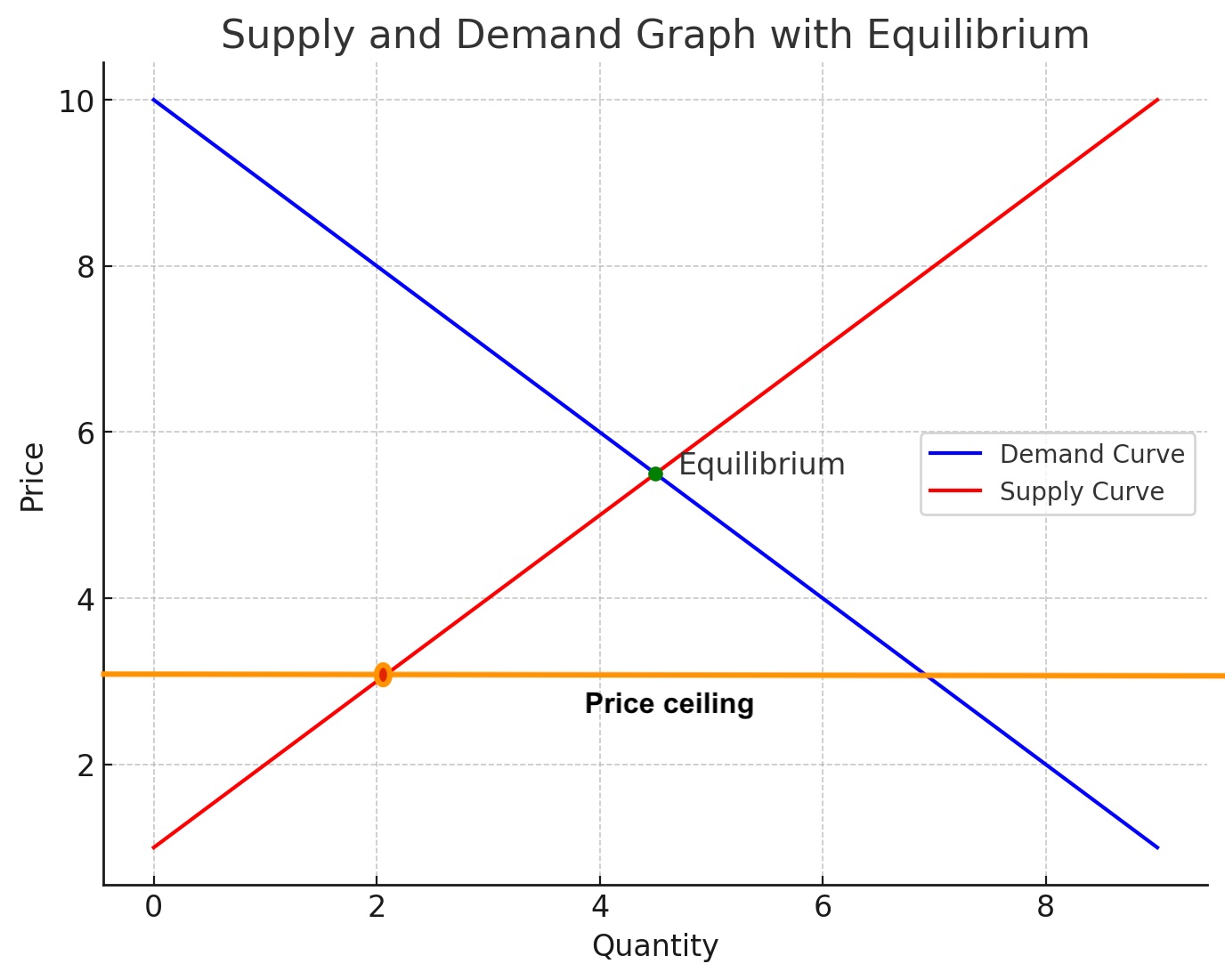
That’s what you get when government mandates price controls – shortages. And price controls are exactly what Kamala means when she says she’s going to stop “price gouging.”
This is basic economics. When you artificially hold the price of something lower than it otherwise would be, supply falls and demand increases. This causes shortages.
And it’s not like this is some untried theory. President Richard Nixon imposed price controls in the 1970s. Guess what. There were shortages!
Those of you who are old enough will remember the gas lines in the early 1970s.
Even the government admits this. In 1973, a Senate report concluded that price controls caused a breakdown in energy production and distribution and the shortages were “far more extensive than anticipated.”
“Frozen prices did not address the underlying cause of expansionary monetary policy. Nor did it override the market’s continually changing scarcity values. With demand artificially encouraged and supply discouraged, strife with an everyday, essential commodity resulted.”
You’ll notice I highlighted “expansionary monetary policy.” Keep that in mind. I’ll get to it in a moment.
“Price controls on food led to predictably disastrous results. Under Nixon’s price controls, farmers couldn’t sell chicken products at prices high enough to justify the cost of feeding the chickens. In the early 1970s, farmers killed over a million baby chicks. Similar problems occurred in the beef and pork industries with farmers sending pregnant sows to the slaughterhouse while dairy cows were butchered.”
The problem with the Harris plan – besides basic economics – is that it doesn’t address the cause of price inflation. It has nothing to do with “greedy corporations.”
Greedy government causes price inflation.
Remember what Bradley said about “expansionary monetary policy?”
That’s the root of the inflation problem.
Politicians want to spend more and more money so that can give you things. They know that if they give you enough stuff, you’ll vote for them. The problem is government doesn’t have any money of its own. It has to take money from you before it can spend it. People get upset when the government takes money from them, so they have to do it in a stealthy manner.
Governments and central banks create money out of thin air to sustain their borrowing and spending. That, my friends, is inflation.
Economist Milton Friedman hit the nail on the head –
“Inflation is always and everywhere a monetary phenomenon.”
There’s something you will never hear on CNBC or from a White House spokesperson.
A big part of the problem is that the powers that be managed to redefine inflation so it obscures the government’s culpability.
When government officials and pundits on TV talk about “inflation,” they almost always mean price inflation — rising prices. But historically, inflation didn’t mean “rising prices.” Inflation was defined more precisely as an increase in the amount of money and credit in the economy, or more succinctly, an expansion in the money supply.
Rising prices are one of the symptoms of monetary inflation. If you have more dollars chasing the same amount of goods and services, you will see a general rise in prices. Monetary inflation causes price inflation. They are two different things.
Do you see the sleight of hand?
Over the years, government officials, along with their apologists in the mainstream financial media and academia, intentionally shifted the definition of inflation to suit government purposes. The standard definition of inflation you hear during White House press conferences or a CNBC roundtable is basically just government propaganda that keeps you from realizing that it’s all the government and central bank’s fault.
Economist Ludwig von Mises explained it this way:
“People today use the term `inflation’ to refer to the phenomenon that is an inevitable consequence of inflation, that is the tendency of all prices and wage rates to rise.
“The result of this deplorable confusion is that there is no term left to signify the cause of this rise in prices and wages. There is no longer any word available to signify the phenomenon that has been, up to now, called inflation… As you cannot talk about something that has no name, you cannot fight it.
“Those who pretend to fight inflation are in fact only fighting what is the inevitable consequence of inflation, rising prices. Their ventures are doomed to failure because they do not attack the root of the evil. They try to keep prices low while firmly committed to a policy of increasing the quantity of money that must necessarily make them soar.
“As long as this terminological confusion is not entirely wiped out, there cannot be any question of stopping inflation.”
Since most people think inflation just means prices are going up, they believe all kinds of things cause it, from corporate greed to Putin’s price hikes.
This lets the real culprit off the hook.
And it makes dumb ideas such as Kamala price controls sound like a plausible solution.
Now, you might be tempted to think Harris is just economically illiterate, but I don’t think that’s the case. I think she knows price controls are a horrible idea, but she doesn’t care, because she also knows that it will play well with voters.
Harris is a greedy politician. She wants lots of votes. This is a way to get them.
Yes, basic economics tells us price controls would be a disaster. But most people don’t know basic economics. They only know about their feelings. Their feelings tell them big corporations are bad, and that their favorite politicians care about them. So, when Harris says the big bad corporations are causing prices to go up, it sounds plausible. And it makes them feel good that she’s going to help.
McMaken came to the same conclusion –
“At this point, it is beyond naive to think that the Harris campaign is only pushing for price controls because Harris and her advisors have ‘good intentions,’ but are “economically illiterate” and just don’t understand the ‘unintended consequences’ of this policy. It is absurd in the year 2024 to think that no one in the White House or Harris campaign is aware of the effects of price controls. They know. They just don’t care. Price controls are a political policy. The impoverishing economic effects are just ‘collateral damage’ that are an easy price to pay for the ruling class that will have no problem paying its grocery bills. It is likely that Nixon knew what would happen also, and he didn’t care. What mattered was the 1972 election.”
And that’s what matters to Harris. She doesn’t care that you have a high grocery bill. She doesn’t care that her plan would make things infinitely worse. All she cares about is getting enough votes to win the election.
Mike Maharrey is a journalist and market analyst for MoneyMetals.com with over a decade of experience in precious metals. He holds a BS in accounting from the University of Kentucky and a BA in journalism from the University of South Florida.
For a while, it was “Fight for $15,” but with rampant price inflation, a $15 an hour minimum wage isn’t sufficient. Now it’s “Fight for $20.” Heck, it might even be “Fight for $25” at this point.
I understand people’s frustration with wages. Their pay doesn’t keep up with rising prices.
But here’s the dirty little secret – we don’t have a wage problem.
We have a money problem!
What Have They Done to Our Money?
Before 1964, quarters were 90 percent silver.
That all changed in 1965 with the passage of the Coinage Act.
Under the law signed by President Lyndon B. Johnson, the U.S. Treasury removed all of the silver from dimes, quarters, and half-dollars. Instead, the government mints coins from “composites, with faces of the same alloy used in our 5-cent piece that is bonded to a core of pure copper.”
In reality, we should call modern American coins junk.
Johnson promised removing silver would have no impact on the value of US coinage, asserting that “[The] Treasury has a lot of silver on hand, and it can be, and it will be used to keep the price of silver in line with its value in our present silver coin.”
You’ll be shocked to learn he was lying.
The Minimum Wage Reveals the Ugly Truth
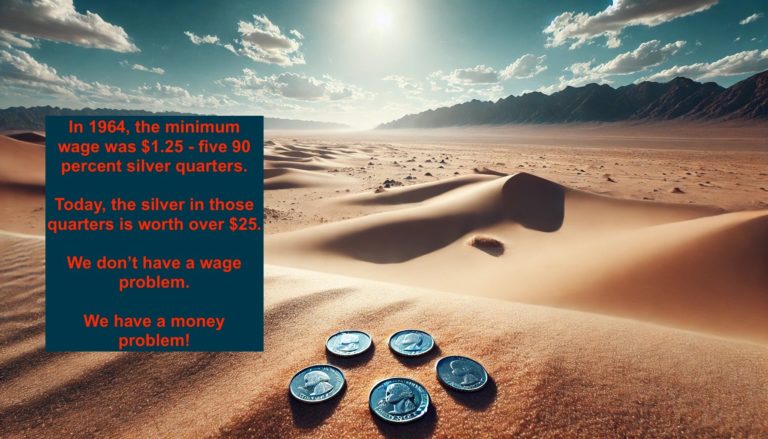
In 1964, the minimum wage stood at $1.25 per hour. That’s the equivalent of five silver U.S. quarters. Remember, they were 90 percent pure silver.
Today, the melt value of a 1964 silver quarter is $5.13.
That means if you got paid five pre-1965 quarters today, you would hold $25.65 in your hands.
There’s your living wage.
So no, we don’t have a wage problem. We have a money problem.
And the government caused it!
Mike Maharrey is a journalist and market analyst for MoneyMetals.com with over a decade of experience in precious metals. He holds a BS in accounting from the University of Kentucky and a BA in journalism from the University of South Florida.
(Ken Silva, Headline USA) Rep. Clay Higgins’s, R-La, preliminary findings on the Trump assassination attempt corroborate reports that it was a local cop—not the Secret Service—that initially stopped gunman Thomas Crooks’s shooting spree at the July 13 deadly rally in Butler, Pennsylvania.
TheWashington Postinitially revealed the unnamed local cop’s heroics on July 30. According to the Post, Crooks fired eight times before the local cop returned fire, which stopped Crooks’s spree. It wasn’t until about 10 seconds later when a Secret Service sniper fired the final shot at Crooks.
The Post’s reporting was called into question when the Butler County coroner said earlier this month that Crooks was only hit with one gunshot. How could both the local cop and the Secret Service have shot Crooks if he only had one entry and exit wound?
Higgins’s preliminary findings explain how: the local cop’s shot hit Crooks’s rifle.
“The 9th shot fired on J13 was from a Butler SWAT operator from the ground about 100 yards away from the AGR building. Shot 9 hit Crooks’ rifle stock and fragged his face/neck/right shoulder area from the stock breaking up,” Higgins said, calling the local cop a “total badass.”
Clay Higgins's report debunks a lot of bullshit artists. It also supports what I've been emphasizing for weeks: The 9th shot was from a local cop, and it stopped Crooks's shooting spree. Then, (another whole 10 seconds later!) the SS fired the last shot. pic.twitter.com/SCQ4JRwELS
“When he had sighted the shooter Crooks as a mostly obscured by foliage moving target on the AGR rooftop, he immediately left his assigned post and ran towards the threat, running to a clear shot position directly into the line of fire while Crooks was firing 8 rounds. On his own, this ESU SWAT operator took a very hard shot, one shot. He stopped Crooks and importantly, I believe the shot damaged the buffer tube on Crooks’ AR,” Higgins added.
The fight wasn’t over there. According to Higgins, who’s on the House Task Force to investigate the assassination attempt, Crooks “popped back up” a few seconds later and looked to continue shooting. Thankfully, his rifle was apparently damaged, explaining why he stopped firing even though he wasn’t hit.
Finally, 15 seconds after Crooks’s first shot, the Secret Service put the kill shot through his skull. Higgins said he believes it was the “southern” Secret Service team that shot Crooks, based on the alignment of the entry and exit wounds. Higgins said the bullet entered somewhere around the left mouth area and exited from the right ear area.
Higgins gave the Secret Service the benefit of the doubt, saying it was tough, though not impossible, to spot Crooks from their vantage points.
“Crooks’ firing position did NOT offer excellent concealment from the southern counter-sniper team. However, it should be noted that the would-be assassin perfectly positioned himself to minimize the threat of counter-fire from the ground or the USSS counter-sniper teams. Crooks’ firing position was also several feet back from the actual peak of the AGR rooftop,” he said.
“By choosing this position, Crooks effectively minimized the sky-lined profile of his head and upper body.”
(Ken Silva, Headline USA) Talk about a coincidence: The July 13 rally where Donald Trump was nearly assassinated may have been the first time Secret Service snipers were ever deployed to guard a former President.
As Headline USA reported earlier this month, Secret Service Acting Director Ronald Rowe said the July 13 deadly campaign rally in Butler, Pennsylvania was the first time his agency had snipers assigned to a 2024 campaign event for Donald Trump.
“It was the first time Secret Service counter snipers were deployed to support the former President’s detail,” Rowe said at a press conference, which only admitted mainstream media reporters.
It turns out that not only was July 13 the first time Secret Service snipers protected Trump this campaign; it was likely the first time they EVER were assigned to a former president, according to Rep. Clay Higgins https://t.co/f8ihMGxrk8pic.twitter.com/ZdPrEmduxn
According to Rep. Clay Higgins, R-La, not only was July 13 the first time Secret Service snipers protected Trump this campaign; it was likely the first time they ever were assigned to a former president.
“USSS had never, prior to J13, assigned a counter-sniper team to a former POTUS, including Trump,” Higgins, who’s on the House Task Force to investigate the shooting, said in his preliminary findings released Thursday.
“I will not be 100% certain of this assertion without further investigation into documented records, but USSS counter-sniper teams stated clearly to ESU Command that they had never been deployed to a former POTUS event, nor had they heard of a prior deployment by other USSS counter-sniper teams.”
Those Secret Service snipers didn’t seem to do much to protect Trump. In fact, their inaction nearly got the presidential frontrunner killed.
As has been widely documented, the Secret Service knew that a suspicious person—alleged shooter Thomas Crooks—was roaming the event sight with a range finder by at least 5:45 p.m., if not earlier. Despite that, the agency allowed Trump to take the stage at 6:03 p.m.
The shooting occurred at 6:11 p.m., and the Secret Service still insists that agents never knew there was a gunman on the nearby roof.
Perhaps just as egregiously, the Secret Service counter sniper waited 15 seconds after Crooks began shooting before returning fire. It was a local cop—not the Secret Service—who shot Crooks first, stopping his mass shooting spree.
Higgins’s report also detailed how the local cop, a Butler SWAT operator, stopped Crooks.
“On his own, this ESU SWAT operator took a very hard shot, one shot. He stopped Crooks and importantly, I believe the shot damaged the buffer tube on Crooks’ AR … This means that if his AR buffer tube was damaged, Crooks’ rifle wouldn’t fire after his 8th shot,” he said.
“Crooks ‘went down’ from his firing position when shot 9 was fired, and the SWAT officer was certain of his hit … The 10th (and, I believe, final) shot was fired from the [Secret Service] southern counter-sniper team.”
President Donald Trump is bringing back key aides from his past campaigns, including former 2016 campaign manager Corey Lewandowski, as he ramps up his 2024 presidential bid.
The move comes as the Trump campaign continues its battle against Vice President Kamala Harris ahead of the general election. Harris rose to the Democratic ticket after Trump beat President Joe Biden in a disastrous CNN debate.
Joining the team are Tim Murtaugh, the communications director from Trump’s 2020 campaign, and Alex Pfeiffer and Alex Bruesewitz, former officials at the MAGA Inc. Super PAC, Politicoreported.
“As we head into the home stretch of this election, we are continuing to add to our impressive campaign team,” Trump campaign managers Susie Wiles and Chris LaCivita said in a statement.
They labeled the new hires as “veterans” whose unmatched experience will help President Trump prosecute the case against Kamala Harris and Tim Walz, the most radical ticket in American history.”
Lewandowski led the 2016 campaign before being replaced by Kellyanne Conway during the primaries. Despite his departure, Lewandowski remained a close ally of Trump.
“It’ll be fun, but we’ve got a lot of work to do from now until November 5th,” Lewandoski commented on X. “American needs President Donald Trump back in the White House!”
Murtaugh, known for his strong pushback against liberal media, oversaw the communications department during the 2020 campaign, headquartered in Roslyn, Virginia. Some of his exchanges with the liberal media have gone viral.
He is the author of Amazon best-seller, Swing Hard in Case You Hit It. After the 2020 election, Murtaugh launched Line Drive Public Affairs, a consulting firm.
Pfeiffer and Bruesewitz led the MAGA Inc. Super PAC, which became a massive fundraising powerhouse after Trump left Washington in 2021.Bruesewitz is the head of X Strategies LLC, a consulting firm for America First conservatives.
When asked about Lewandowski’s role, Trump hinted that he might serve as a “personal envoy or he’ll be at some level.”
(Headline USA) Police in northern Virginia said Wednesday they were looking for a homeless man they suspect broke into an office of Donald Trump’s presidential campaign.
The Loudoun County Sheriff’s Office said it has issued an arrest warrant for Toby Shane Kessler, 39, of no fixed address, on a burglary charge in connection with the break-in.
The sheriff’s office says Kessler was captured on surveillance video Sunday night forcing his way through a back door into the office building in Ashburn. The office is being leased by the Trump campaign and serves as headquarters for the Virginia 10th District Republican Committee. The suspect’s face was captured clearly on the surveillance video.
According to the sheriff’s office, Kessler spent a brief time in the office and it’s unclear whether he took anything. They do not believe he left anything behind.
Thomas Julia, a spokesperson for the sheriff’s office, said Wednesday that it’s too early to say whether there was any political motivation to the break-in and that authorities will know more once Kessler is arrested.
The sheriff’s office said Kessler has a history of criminal behavior and appears to have been in the Washington, D.C., metropolitan area since at least 2018. He has a California driver’s license.
Last month, Kessler was charged in neighboring Fairfax County with entering property with intent to damage, a misdemeanor, according to online court records. The attorney representing him in the Fairfax case did not immediately return a call Wednesday evening seeking comment.
Kessler’s name does not appear as a defendant in Loudoun County court records.