Descendants of Iconic Ex-Redskins Mascot Call for Team to Restore Old Logo

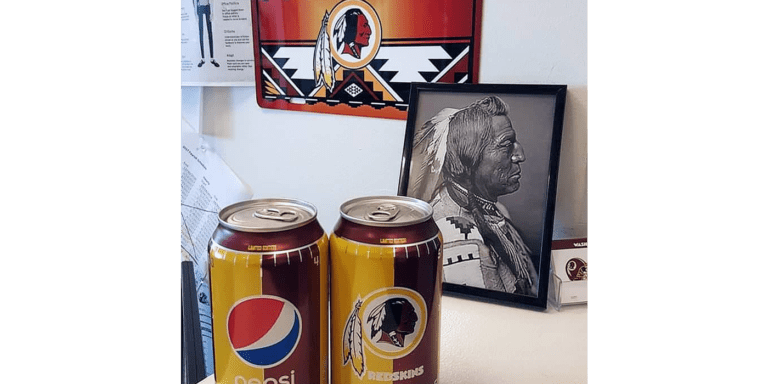
(Jacob Bruns, Headline USA) The family of the the Blackfeet chief who was long depicted as the logo for the football team formerly known as the Washington Redskins has asked that his likeness be added back to NFL fields, Fox News reported.

John Two Guns White Calf served as the face of the Washington Redskins football team for 48 years. However, his likeness was removed from the team’s logo when the franchise changed its name to the “Washington Football Team” in 2020, after corporate sponsors threatened to pull out during the cancel-culture panic that ensued in the wake of the George Floyd riots.

That team is now called the Washington Commanders, and both the team and the Blackfeet want to undo some of its previous anti-racist decisions.

“The fans want him back and we want him back,” Thomas White Calf, a great nephew of the John Two Guns White Calf, told the media.

Thomas White Calf and his family reportedly met with Sen. Steve Daines, R-Mont., to seek political support in pressing the issue.

“Our ancestor was the most famous and most photographed native in history,” said White Calf, who noted that his image is a source of pride for the Indian people.

He noted that his great uncle was also the model for the “Indian head” nickel, which preceded the current Jefferson nickels in the early 20th century.

“It’s a point of pride and represents the rich Native American history that helped make our nation great, and it should be enthusiastically celebrated across our culture,” he said.

According to Daines, “this is about righting a wrong,” the wrong being the hysterical Left’s partnership with the likes of Nike and Pepsi to strongarm the NFL franchise into changing its name and removing its logo.

Fortunately for the White Calf family, however, it appears that the Washington Commanders franchise is interested in bringing back the revered logo.

“We are collaborating with Sen. Daines to honor the legacy of our team’s heritage and the Native American community,” a Commanders spokesperson said in a statement.

FBI Received Tip on 2nd Trump Shooter in 2019

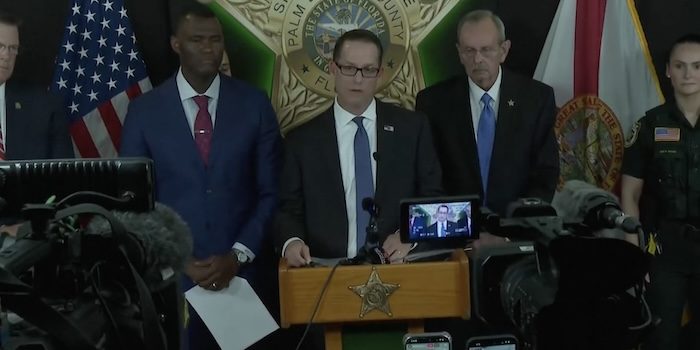
(Ken Silva, Headline USA) Jeff Veltri, the special agent in charge of the FBI’s Miami Field Office, told reporters Monday that the bureau received a tip on alleged failed Trump assassin Ryan Routh in 2019—but didn’t take any action.

“[Routh] was the subject of a previously closed 2019 tip to the FBI, where it was alleged that he was a felon in possession of a firearm,” Veltri said at a Monday press conference.

“In following up on the tip, the alleged complainant was interviewed and did not verify—I repeat, did not verify—providing the initial information. The FBI passed that info to local law enforcement in Honolulu.”

Routh has a criminal history dating back to at least 2002 that includes possession of stolen goods, concealed weapons and possession of weapons of mass destruction, resisting arrest and multiple traffic charges.

His federal charges announced Monday included possession of a firearm by a convicted felon and possession and receipt of a firearm with an obliterated serial number.

At Monday’s press conference, the FBI said it’s still investigating whether others were involved in the second assassination attempt against Trump in as many months.

Additionally, Secret Service Acting Director Ronald Rowe told reporters that Routh never fired at Trump. The Secret Service spotted him with a rifle along the tree line and fired at him—causing him to flee the scene. He was apprehended some 45 minutes later by Martin County Sheriff’s Officers.

Officials declined to say how Routh was able to escape the scene and make it to another county before his arrest.

Sunday’s assassination attempt on Trump was the latest case where a deranged gunman had already been on the FBI’s radar before.

Prominent examples of mass shooters who were on the FBI’s “radar” include Sandy Hook shooter Adam Lanza, Orlando Pulse nightclub shooter Omar Mateen and Parkland shooter Nikolas Cruz.

In Lanza’s case, FBI agents had reportedly previously questioned him for hacking computers.

With Orlando shooter Mateen, the FBI reportedly went as far as investigating him in direct relation to possibly being a terrorist threat—twice. “But the F.B.I. soon ended its examination of Mr. Mateen after finding no evidence that he posed a terrorist threat to his community,” the New York Times reported in June 2016.

Matteen’s father was also an FBI informant for more than a decade, as was reported by NPR in March 2018.

Then, there’s Parkland. In 2018, The New York Times report that “The F.B.I. received a tip last month from someone close to Nikolas Cruz that he owned a gun and had talked of committing a school shooting, the bureau revealed Friday, but it acknowledged that it had failed to investigate.”

Additionally, Buffalo shooter Payton Gendron was possibly communicating with a retired federal agent within as little as 30 minutes of his killing spree. Gendron’s possible links to a retired federal agent are more bizarre when coupled with a July 2019 story from the Buffalo News about FBI agents tracking potential mass shooters in the area.

Most recently, the 14-year-old student who opened fire at a Georgia high school and killed four people earlier this month was revealed to have been on the FBI’s radar since at least May 2023.

“In May 2023, the FBI’s National Threat Operations Center received several anonymous tips about online threats to commit a school shooting at an unidentified location and time. The online threats contained photographs of guns. Within 24 hours, the FBI determined the online post originated in Georgia, and the FBI’s Atlanta Field Office referred the information to the Jackson County Sheriff’s Office for action,” the FBI said in a statement earlier this month.

Ken Silva is a staff writer at Headline USA. Follow him at twitter.com/jd_cashless.

Gunman Waited at Golf Course for 12 Hours; Unclear How He Knew Trump Would Be There, Too

(Headline USA) Federal prosecutors’ complaint against alleged failed Trump assassin Ryan Routh has been filed in court.

According to the complaint, cell phone records show that Routh was in the area of the golf course tree line for about 12 hours, from approximately 1:59 a.m. until 1:31 p.m. on Sunday. The license plate on the Nissan SUV in which Routh was stopped was registered to a 2012 Ford truck that has been reported stolen, according to authorities.

But all that begs the question: How did Routh know Donald Trump would be golfing at his club in West Palm Beach in the first place?

While the Secret Service has grappled with how to keep Trump safe as he campaigns across the country, holding rallies that often draw thousands, less attention has focused on his protection when he is off the trail, often at his own clubs and properties.

The fact that there are places along the perimeter of the property where golfers — including Trump — are visible to those standing behind the fence has long been known to law enforcement. While Trump was president, news photographers were often able to capture images of him on the greens by finding gaps in the shrubbery.

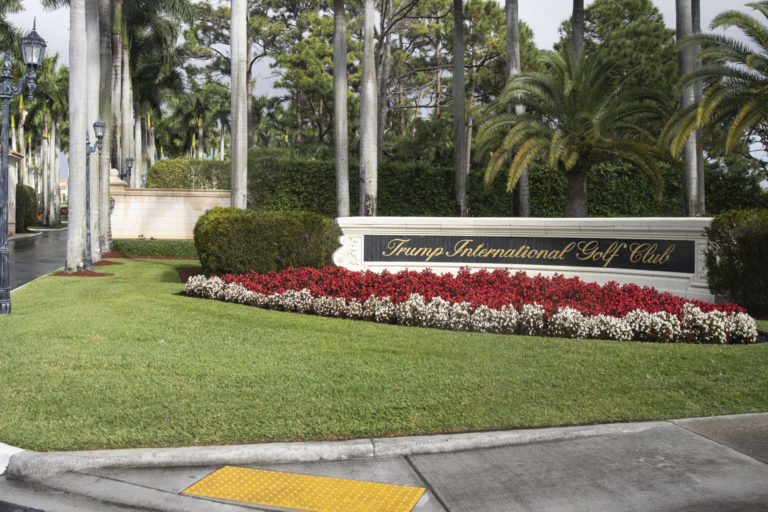
While Trump’s plans to golf Sunday were not part of any public schedule, on days he is not campaigning, he can often be found golfing at one of his courses. Trump International Golf Club, West Palm Beach, about a 10-minute drive from his Mar-a-Lago residence, is a favorite. One of three golf clubs he owns in Florida, it boasts 27 holes of championship golf, as well as event spaces. Trump often eats lunch and holds meetings in the clubhouse between rounds.

Trump had just returned from a West Coast swing that included stops in Las Vegas and Utah, and had announced on social media that he would be delivering remarks Monday from Mar-a-Lago about cryptocurrency as he launches a new crypto platform.

Palm Beach County Sheriff Ric Bradshaw noted at a briefing that because Trump is no longer in office, security protocols around the course had loosened.

“He’s not the sitting president. If he was, we would have had this entire golf course surrounded. But because he’s not, his security is limited to the areas that the Secret Service deems possible,” he told reporters.

Law enforcement officials praised the work of the agents assigned to protect Trump. One agent, tasked with jumping one hole ahead of the former president to scope out potential threats, managed to spot the gunman’s rifle barrel sticking out of the fence that surrounds the golf club and “immediately engaged that individual,” Bradshaw said.

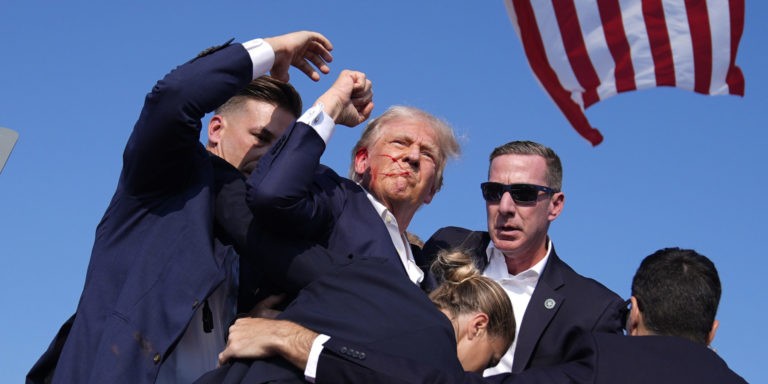
In an email to campaign staff Sunday night, senior campaign advisers Chris LaCivita and Susie Wiles credited the Secret Service for saving Trump, who has praised the agents in his own protective detail for their bravery as they rushed on stage to protect him in Butler, Pennsylvania.

“President Trump and everyone accompanying him are safe thanks to the great work of the United States Secret Service,” they wrote.

Unlike other past presidents and typical VIPs who live in private residences with tall fences or in gated communities, Trump has his official residence at his Mar-a-Lago club in Palm Beach. The club is open to dues-paying members, who mingle with the former president at meals and at events and can invite their own guests to the property.

Many nights, Trump holds court on the club’s patio, playing DJ with his iPad. While president, he once plotted a response to a North Korean missile launch from the candlelit terrace, the meeting captured and posted on social media by a club member.

The club is also a popular Palm Beach venue and hosts a constant stream of fundraisers, weddings and other events that sometimes see Trump drop by unannounced.

Secret Service spokesperson Anthony Guglielmi said in a social media post that the agency is working closely with the FBI, Palm Beach County Sheriff’s Office and other law enforcement to investigate what happened.

Trump will be briefed in person Monday by acting Secret Service director Ronald Rowe about the investigation, according to a person familiar with the plan who was not authorized to speak publicly.

The incident sparked immediate finger-pointing and calls for answers on Capitol Hill.

New York Rep. Elise Stefanik, the House Republican Conference chair and a close ally of the former president, said she was grateful Trump was safe. “However, we must ask ourselves how an assassin was allowed to get this close to President Trump again?” she asked in a statement.

The leaders of the bipartisan task force that has been investigating the security failures in Pennsylvania said they were monitoring the situation and had requested a briefing from the Secret Service.

“We are thankful that the former President was not harmed, but remain deeply concerned about political violence and condemn it in all of its forms,” said Rep. Mike Kelly, R-Pa., and Rep. Jason Crow, D-Colo., in a joint statement.

Meanwhile, Florida Gov. Ron DeSantis, one of Trump’s rivals in the GOP primary, said his state will conduct its own investigation.

“The people deserve the truth about the would be assassin and how he was able to get within 500 yards of the former president and current GOP nominee,” he wrote in a social media post.

Democratic Rep. Ro Khanna echoed that message. “Two assassination attempts in 60 days on a former President & the Republican nominee is unacceptable,” he wrote. “The Secret Service must come to Congress tomorrow, tell us what resources are needed to expand the protective perimeter, & lets allocate it in a bipartisan vote the same day.”

President Joe Biden said in a statement that he was “relieved” that Trump was unharmed and said “there is no place for political violence or for any violence ever in our country.” He said he had directed his staff “to continue to ensure that Secret Service has every resource, capability and protective measure necessary to ensure the former President’s continued safety.”

Would-Be Assassin Called for Iran to Kill Trump—and Himself—in Rambling Book

(Headline USA) Ryan Wesley Routh portrayed himself online as a man who built housing for homeless people in Hawaii, tried to recruit fighters for Ukraine to defend itself against Russia, and described his support and then disdain for Donald Trump — even urging Iran to kill him.

“You are free to assassinate Trump as well as me,” Routh wrote of Iran in an apparently self-published book in 2023, Ukraine’s Unwinnable War, which described the former president as a “fool” and “buffoon” for both the Jan. 6, 2021, Capitol Hill uprising and the “tremendous blunder” of leaving the Iran nuclear deal.

Routh wrote that he once voted for Trump and must take part of the blame for the “child that we elected for our next president that ended up being brainless.”

Routh, 58, was arrested Sunday and charged Monday after authorities say he stalked the GOP presidential nominee as he golfed in West Palm Beach, Florida, with an AK-47-style rifle in an apparent assassination attempt thwarted by the Secret Service.

Through his voluminous online footprint, public records, news interviews and videos, a picture emerged of Routh as a man with a criminal past, plenty of outrage and views ranging from the left to the right, including support for Bernie Sanders, Tulsi Gabbard, Nikki Haley and Trump.

Voter records show he registered as an unaffiliated voter in North Carolina in 2012, most recently voting in person during the state’s Democratic primary in March.

Routh also made 19 small donations totaling $140 since 2019 to ActBlue, a political action committee that supports Democratic candidates, according to federal campaign finance records.

In a tweet in June 2020, after the police killing of George Floyd, Routh said then-President Trump could win reelection by issuing an executive order to prosecute police misconduct. However, in recent years, his posts appear to have soured on Trump, and he expressed support for President Joe Biden and Vice President Kamala Harris, the Democratic presidential nominee.

“DEMOCRACY is on the ballot and we cannot lose,” he wrote on X in April in support of Biden.

In July, following the assassination attempt on Trump at a rally in Pennsylvania, a post on Routh’s account urged Biden and Harris to visit those wounded in the shooting and attend the funeral of the firefighter who was killed.

“Trump will never do anything for them,” Routh wrote.

In his book, listed on Amazon and viewed by the AP, Routh noted: “I get so tired of people asking me if I am a Democrat or Republican as I refuse to be put in a category.”

The world would be better it were run by women, he wrote in the book that has links to his website and X account, because “it seems that the totality of the world’s problems revolve around men with massive insecurity and childlike intelligence and behavior.”

He posted frequently on social media about Ukraine and other conflicts, and he had a website seeking to raise money and recruit volunteers to fight for Kyiv. A photo of the wiry, wild-haired Routh on his site shows him smiling, wearing a T-shirt and jacket adorned with U.S. flags.

“This is about good versus evil,” Routh said in a video circulating online. And in a tweet, he said, “I am going to fight and die for Ukraine.”

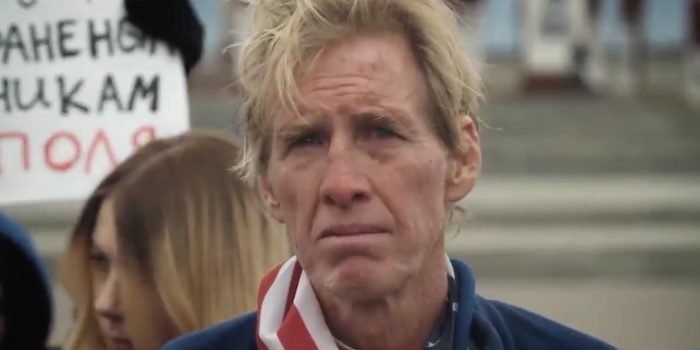
Video shot by the AP showed Routh at a small demonstration in Kyiv’s Independence Square in April 2022, two months after Russian President Vladimir Putin ordered an invasion of the country.

A placard he was holding said: “We cannot tolerate corruption and evil for another 50+ years. End Russia for our kids.”

That same day, he also visited a makeshift memorial to “Foreigners killed by Putin.”

But Routh never served in the Ukrainian army or worked with its military, said Oleksandr Shahuri of the Foreigners Coordination Department of the Ukrainian Ground Forces Command.

Shahuri told AP that Routh periodically contacted the International Legion of Ukraine with what he described as “nonsensical ideas” that “can best be described as delusional.”

Routh appeared in a video standing in front of the U.S. Capitol and expressing frustration that Ukraine wasn’t taking more of the Afghan commandos he tried to recruit.

“They’re afraid that anybody and everybody is a Russian spy,” he told news website Semafor in 2023.

Earlier this year, he even tweeted at singers Bruno Mars and Dave Matthews to organize a “We are the World”-style effort for Kyiv. “We need an emotional tribute song for Ukraine as support stalls,” he wrote. “I have lyrics and music.”

Routh also tweeted to former basketball star Dennis Rodman, asking for help lifting sanctions against North Korea to ease tension with the country. In another, he invites a dozen protesters in Hong Kong to stay at his Hawaii home to escape a Chinese crackdown.

Routh lived most of his life in Greensboro, North Carolina, where his run-ins with law enforcement included a 2002 felony conviction for reportedly possessing “a fully automatic machine gun.” While court records don’t give details about the case, the Greensboro News & Record reported the arrest came after Routh ran from a traffic stop and held off police for three hours with the weapon at a roofing business. State records listed him as the business owner.

Records also show Routh was convicted of a felony count of possession of stolen goods in 2010, as well as misdemeanors including illegally carrying a concealed weapon, a hit-and-run, speeding and driving with a revoked license.

Court records from the 2010 felony case say detectives determined Routh was storing stolen building supplies and other items at his roofing business warehouse, where he was living at the time. Money from the sale of the stolen goods was used to purchase crack cocaine, according to a police affidavit used to get a search warrant.

In both the felony cases, court records show judges sentenced Routh to either probation or a suspended sentence, allowing him to escape prison time.

It was not immediately clear how Routh was able to obtain a weapon. In most states, it is generally forbidden for a person convicted of a felony to purchase or possess a firearm.

In 2018, Routh moved to the small town of Kaaawa, Hawaii, about 45 minutes outside Honolulu, to go in business with his adult son building small wooden sheds. According to his LinkedIn page, the structures would “help address the highest homelessness rate in the United States due to unparalleled gentrification.”

“All of us are tired of seeing the homeless people all over the island with nowhere to go,” he told Honolulu’s Star-Advertiser in 2019.

No one answered the door Sunday at his blue stucco house near the beach that is colorfully painted with wooden cutouts of fish. A white pickup truck with a Biden-Harris bumper sticker and a flat tire was in the driveway.

Neighbor Christopher Tam said Routh kept to himself and was respectful, cordial and kind.

“It’s just been very surprising,” Tam said. “If he did have anything to do with it, it’s very shocking to us.”

Adapted from reporting by the Associated Press

‘Whistleblower Report’ Reveals Bombshell New Info on Butler Trump Shooting

(Ken Silva, Headline USA) Sen. Josh Hawley, R-Mo., revealed new information about the July 13 assassination attempt on Donald Trump in a “whistleblower report” his office released Monday.

Hawley’s report summarized the whistleblower disclosures his office has received since July 13, most of them which have been reported on by Headline USA. The report also includes new info, such as the fact that Trump was apparently taken to an unsecured hospital after he was grazed in the year by gunman Thomas Crooks.

“The hospital site where former President Trump received treatment after the shooting was poorly secured. The Secret Service site agent responsible for hospital security did not know what was going on and could not answer basic questions about site security,” Hawley’s report said of Butler Memorial Hospital.

The report also revealed that Secret Service intelligence units—teams of Secret Service agents paired with state and local law enforcement to handle reports of suspicious persons—were absent from the Butler rally.

“Deployment of these units would have mitigated poor communication between different law enforcement components, which has emerged as one of the core operational failures of the day,” Hawley said in his report.

Another revelation from Hawley was about the infamous unnamed Secret Service agent in charge of securing the Butler rally site. According to Hawley, that agent failed a key examination during her federal law enforcement training to become a Secret Service agent, and was “known to be a low-caliber agent.”

Hawley previously listed the lead agent’s terrible decisions, including allowing flags and other campaign materials around Trump’s podium—which obstructed the views of Secret Service agents, he said.

Furthermore, the Secret Service did not check IDs when issuing credentials that authorize access to restricted areas of the site, contrary to typical practice, according to Hawley.

Along with revealing new whistleblower disclosures, Hawley also said in his report that the Secret Service and DHS have refused to provide him with answers he and the public seek about July 13. In some cases, the Secret Service has outright refused to provide him with info, he said.

“Two months have now elapsed since former President Donald J. Trump was nearly assassinated. And the American people still know far too little about why this happened. The Secret Service, FBI, and Department of Homeland Security have not been forthcoming with the American people,” he said.

“Instead, it has been left to courageous whistleblowers to tell the story of what really happened.”

Ken Silva is a staff writer at Headline USA. Follow him at twitter.com/jd_cashless.

WATCH: 2nd Failed Trump Assassin Appeared in Ukrainian Neo-Nazi Propaganda Video

(Ken Silva, Headline USA) In March 2022, the Biden administration’s Department of Homeland Security warned that white supremacists in the U.S. were joining the neo-Nazi groups in Ukraine.

“Ukrainian nationalist groups including the Azov Movement are actively recruiting racially or ethnically motivated violent extremist-white supremacists to join various neo-Nazi volunteer battalions in the war against Russia,” the DHS bulletin said.

Two months later, Ryan Wesley Routh, the man who would go on to allegedly attempt to assassinate Donald Trump, appeared in a video promoting one of the groups the DHS warned about: the Azov Battalion. Routh reportedly went to Kyiv in early 2022 to protest the invasion. He later reportedly became a recruiter. It’s not clear how he wound up in a pro-Azov video.

“This video is a message to the world from the Mariupol defenders. They are grateful for our support and ask us to keep on fighting,” stated the May 2022 video, shared by the Twitter account “Save Azov.” The video shows Routh at the 1:50 mark.

The Azov Battalion’s allegiance to the neo-Nazi ideology is well- documented. Indeed, Azov’s former commander once called for Ukraine to “lead the White Races of the world in a final crusade for their survival,” and more recently its fighters were seen on a viral tweet from Ukraine’s national guard greasing their bullets with lard against the “Kadyrov orcs”— to be used against the Muslim Chechens fighting for Russia.

Arming Azov was once a cause for concern among U.S. lawmakers. In 2018, Congress inserted a provision in its defense spending bill that banned U.S. arms from going to Azov, which had already received U.S. training and weapons the year prior.

But after Russia’s invasion in early 2022, Azov again was embraced by the U.S. government. Earlier this year, the Biden administration lifted a ban on arming Ukraine’s infamous Azov Battalion after a review found “no evidence” that it’s involved in human-rights violations.

Ken Silva is a staff writer at Headline USA. Follow him at twitter.com/jd_cashless.

Don’t Forget About Silver

(Clint Siegner, Money Metals News Service) Silver exploded higher last week, gaining nearly $3/oz (over 10%). Despite the big move, the ratio of the gold price to the silver price is still around 84 to 1. The long-term average for the gold/silver ratio is under 50, but it has been ranging well above that level for a decade.

This persistent underperformance in silver is unprecedented in modern times. Silver bulls are forced to wonder if there has been some core shift in the value of silver relative to the benchmark represented by gold.

Before investors get to that question, however, they should first evaluate whether silver is appropriately and fairly priced.

The dirty truth is that silver prices are not set in a market between people who own actual silver and people who need or want the physical metal.

It is instead set in a derivatives market where paper contracts represent at least one hundred times more silver than there is sitting and ready to be delivered. These contracts are swapped at light speed between speculators, high-frequency trading machines, and bullion bankers.

Futures market participants, for the most part, neither produce nor have any use for silver bars.

When the silver price behaves erratically and seems disconnected from historical patterns and from fundamental drivers, the problematic, high-leverage mechanism for silver price discovery might be a better explanation than some core shift in silver’s value relative to gold.

A sound argument can be made that silver will get more valuable relative to gold.

Industrial demand for silver has been growing – particularly from manufacturers who produce solar panels. In total, manufacturers have increased their appetite for silver from 457 million ounces in 2015 to an estimated 711 million ounces this year, according to the Silver Institute.

The production of silver is not keeping up.

Mine output was greater in 2015, at nearly 897 million ounces, than it is now. The 2024 output is forecasted at 824 million ounces. It will be the 6th straight year of a supply deficit, and the above ground stockpiles backfilling that deficit are dwindling.

Meanwhile, the next big wave of silver investment demand may not be too far away.

The last big wave began in 2020 when COVID and the election of Joe Biden undermined confidence in the equity markets. Then Congress delivered $5 trillion in inflationary deficit spending.

Ahead of the 2024 election, the signs of a coming recession are proliferating. Should the U.S. economy stumble, Americans can count on Congress and the Fed to respond with even larger stimulus this time around.

Hedging against inflation will remain a primary investment thesis until Congress stops running multi-trillion-dollar deficits backed by our money printing central bank – the buyer of last resort for all of that debt. Investors will increasingly turn to the monetary metals as a hedge.

Silver looks cheap, given it remains far below its 2011 high at almost $50/oz. It also looks like a bargain when compared to other asset classes, including real estate and equities – which are at, or near, all-time highs.

Gold / Silver Ratio could Indicate Breakout

Silver prices sure seem lower than they ought to be relative to gold. That isn’t going to last forever. Silver can be mispriced in the highly leveraged futures market in the short, or even medium term. However, that is not possible in the long term.

The futures price will have to move significantly higher to balance real supply with real demand, or the market will break and the price will be set in the physical markets. The fact that silver has not kept up with gold should looks like a value opportunity that won’t last forever.


Clint Siegner is a Director at Money Metals Exchange, the national precious metals company named 2015 “Dealer of the Year” in the United States by an independent global ratings group. A graduate of Linfield College in Oregon, Siegner puts his experience in business management along with his passion for personal liberty, limited government, and honest money into the development of Money Metals’ brand and reach. This includes writing extensively on the bullion markets and their intersection with policy and world affairs.

The High Stakes of Silver: A Billy the Kid Poker Parable

(Jon Forrest Little, Money Metals News Service) An old Sunday school story may be the best metaphor for the risks of today’s high paper-to-silver ratio.

Let me take you back to the Old West, New Mexico specifically.

There are over 15,000 abandoned mining sites in New Mexico, a state which boasts vast mineral resources such as copper, gold, silver, and uranium (but is small in comparison to States like Colorado, Idaho, Nevada, Oregon, and Arizona.)

As a native New Mexican, one of my favorite parts of state history is connected with Billy the Kid, who was raised around Lincoln County, two hours South of Albuquerque and 1.5 hours north of El Paso.

Silver Shenanigans in Santa Fe

In the dusty saloons of Santa Fe, New Mexico, a clever merchant named Silvius often rubbed elbows with the infamous Billy the Kid and his gang of horse bandits.

One fateful evening, as Billy bought a round of drinks for his outlaws, the sharp ping of a silver coin hitting the bar counter caught Silvius’s ear.

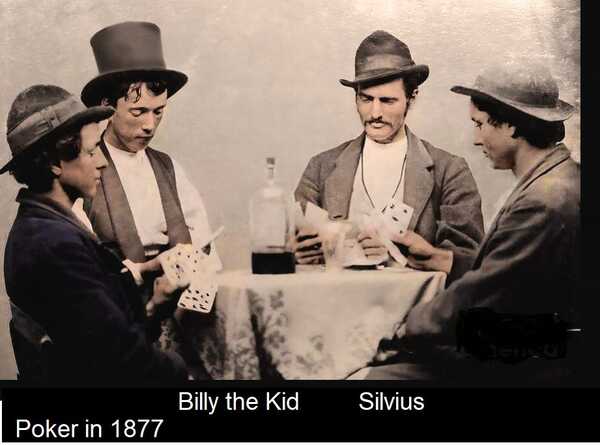
1877 Billy the Kid and Silvius play poker

Later that night, he watched intently as Billy and his gang engaged in a lively poker match, using paper slips and chips to represent silver ounces, dividing the precious metal into betting increments.

This scene sparked an idea in Silvius’s mind — a scheme to resell the same silver over and over again.

He took his show on the road and traveled on horse 65 miles south to Albuquerque. In the “old town” market square, Silvius put his plan into action.

He owned a single, gleaming silver coin that caught everyone’s eye. Seeing an opportunity, Silvius devised a plan.

He created 400 paper tickets, each claiming to represent his silver coin. He approached his marks individually. “Buy a ticket, and you’ll own a share of my precious silver! “

The townspeople, enticed by the low price of the tickets, eagerly bought them. Soon, all 400 tickets were sold, and Silvius’s pockets were full of money.

One day, a wise old woman approached Silvius. “May I see the silver coin my ticket represents?” she asked.

Silvius smiled nervously. “Of course, but you see, there are 399 other ticket holders. You’ll have to wait your turn.”

The woman frowned. “But how can one coin be in 400 places at once?”

Word spread quickly. Soon, a crowd gathered, all demanding to see the silver coin they believed they owned a piece of. Panic ensued as people realized the absurdity of the situation.

In the chaos, Silvius slipped away, leaving behind a valuable lesson: just because something is written on paper doesn’t make it real.

The Moral

This parable illustrates the disconnect between paper representations and physical assets in the silver market. Just as Silvius created 400 tickets for one coin, the paper silver market often trades at ratios far exceeding the available physical silver.

The lesson here is twofold:

  1. The power of perception: Silvius, like modern financial institutions, created value from thin air by leveraging people’s trust and desire for profit.
  2. The fragility of paper promises: When everyone tried to claim their share simultaneously, the illusion collapsed, much like how a run on paper silver could expose the market’s vulnerabilities.

In the real world, this situation allows for price manipulation and creates a disconnect between paper and physical silver prices. 

It’s a stark reminder that in financial markets, as in the parable, those who set the rules can create realities that may not align with physical constraints.


Jon Forrest Little graduated from the University of New Mexico and attended Georgetown University’s Institute for Comparative Political and Economic Systems. Jon began his career in mining industry and now publishes “The PickAxe” which covers topics surrounding precious metals, energy, history, and politics.

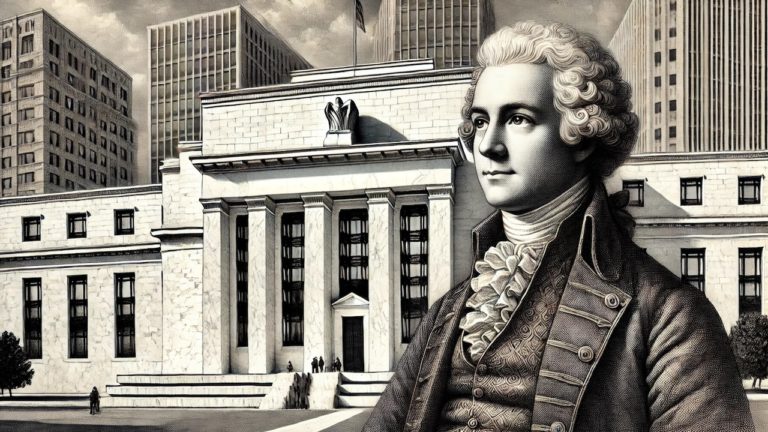
Founding Father Edmund Randolph vs. The Federal Reserve

(Mike Maharrey, Money Metals News Service) After Congress passed a bill to establish the first national bank — a forerunner of the modern Federal Reserve — President George Washington asked Attorney General Edmund Randolph to prepare an opinion on the bill’s constitutionality. Randolph came down firmly against the measure, arguing that the Constitution didn’t delegate to Congress the power to charter corporations.

Randolph was an attorney and statesman who played a crucial role in the early formation of the United States. He served as the seventh Governor of Virginia and was an influential delegate to the Philadelphia Convention that drafted the Constitution. He was one of four prominent lawyers who drafted the Constitution’s necessary and proper clause, along with John Rutledge, Oliver Ellsworth, and James Wilson, all three of whom were to later serve as Supreme Court justices. Although he initially refused to sign the Constitution, Randolph became a leading proponent of ratification during the Virginia ratifying convention. He later served as the first U.S. Attorney General under President George Washington and subsequently served as the second U.S. Secretary of State. 

Alexander Hamilton submitted a report to Congress recommending the establishment of the Bank of the United States in December 1790. In response, Sen. Caleb Strong introduced a bill to charter the bank. The bill passed the Senate on Jan. 20, 1791. The House passed the bill a month later, sending it to President Washington’s desk.

As Washington considered whether or not to sign the bill, he discussed it with Randolph on at least two occasions between Feb. 8 and Feb. 11, 1791. At Washington’s request, Randolph provided a written opinion. In a cover letter sent with his draft dated Feb. 12, Randolph wrote that the “substance of the dispute …  arises from an examination of the Constitution itself.”

Randolph was considered one of the top legal experts in the country at the time. When Thomas Jefferson was out of the country, Randolph took over his clients. He also represented Washington in his business affairs. 

Randolph wrote two documents discussing the Bank Bill, the first outlining his own legal analysis and opinion on the bill’s constitutionality, and the second highlighting several arguments made both for and against the bill that he didn’t find cogent. 

In Randolph’s view, the central constitutional question surrounding the bank was whether the federal government was delegated the power of incorporation.

“It must be acknowledged, that, if any part of the bill does either encounter the Constitution, or is not warranted by it, the clause of incorporation is the only one.”

Randolph asserted “that the power of creating Corporations is not expressly given to Congress, is obvious.” [Emphasis in original]

That being the case there were only three ways the federal government could legitimately exercise the power to charter a corporation.

1st because the nature of the Federal government implies it; or
2d because it is involved in some of the specified powers of Legislation: or
3. because it is necessary and proper to carry into execution some of the specified powers.

Randolph proceeded to dismantle all three rationales. 

He quickly dismissed the implied powers doctrine, noting that, “To be implied in the nature of the Federal government would beget a doctrine so indefinite, as to grasp every power.” 

In other words, this implied power doctrine would give the federal government unlimited authority. But the Constitution clearly limits the scope of federal power.

“Governments, having no written Constitution, may perhaps claim a latitude of power, not always easy to be determined. Those, which have written Constitutions, are circumscribed by a just interpretation of the words contained in them—nay farther.”

Randolph went on to point out that the pending 10th Amendment made it clear Congress possesses and claims “no powers which are not delegated to it.”

He continued on these lines, noting, “While, on the one hand it ought not to be denied that the federal government superintends the general welfare of the states, it ought not to be forgotten, on the other, that it superintends it according to the dictates of the constitution.”

But does the Federal government have a delegated power that could be construed to authorize chartering corporations?

“We ask then, in the second place, whether upon any principle of fair construction, the specified powers of legislation involve the power of granting charters of incorporation? We say charters of incorporation, without confining the question to the Bank; because the admission of it in that instance, is an admission of it in every other, in which Congress may think the use of it equally expedient.”

Randolph noted that supporters of the Bank Bill justified it by arguing that a national bank would facilitate the execution of several specific delegated powers.

The first was  “in the power to lay & collect taxes &c.; because it facilitates the payment of them.”

Similarly, the power to “borrow money” would be supported because a bank “creates an ability to lend.”

Supporters of the bill also argued that a national bank would support “regulating commerce” because “it increases the medium of circulation; and thus encourages activity & industry.”

Finally, advocates of a bank asserted that it would facilitate “disposing and regulating property” because “the contributions, and the interest of the United States in the Banks, are property of the United States.”

But Randolph argued that construing any of these powers in such a broad way would effectively annihilate reserved powers, and create an all-encompassing federal authority.

“If the laying and collecting of taxes brings with it every thing, which in the opinion of Congress, may facilitate the payment of taxes: if to borrow money sets political speculation loose, to conceive what may create an ability to lend: if to regulate commerce, is to range in the boundless mazes of projects for the apparently best scheme to invite from abroad, or to diffuse at home the precious metals—if to dispose of, or to regulate property of the United States, is to incorporate a bank, that stock may be subscribed to it by them; it may without exaggeration be affirmed, that a similar construction on every specified federal power will stretch the arm of Congress into the whole circle of State Legislation.” [Emphasis added]

In other words, the expansion of these four powers to justify a bank could be used to rationalize the expansion of every federal power to justify pretty much any federal action, leaving the states and the people no power at all.  

However, supporters of the Bank Bill argued that the necessary and proper clause justified a latitude of construction and provided the justification needed to charter a bank. 

Alexander Hamilton argued that necessary could be construed as “convenient.” In support of his bill, he wrote, “It is certain that neither the grammatical nor popular sense of the term requires [a strict] construction. According to both, necessary often means no more than needful, requisite, incidental, useful, or conducive to.”

He continued, justifying his interpretation based on his view of the common usage of the word necessary.

“It is a common mode of expression to say, that it is necessary for a government or a person to do this or that thing, when nothing more is intended or understood, than that the interests of the government or person require, or will be promoted by, the doing of this or that thing.”

Randolph insisted this took the clause too far.

As one of the primary drafters of the necessary and proper clause during the Philadelphia convention, Randolph was keenly aware of the fact that “necessary and proper” was based on the legal doctrine of “principles and incidents.” He explained this in a speech at the Virginia Ratifying Convention, arguing “that the incident is inseparable from the principal, is a maxim in the construction of laws.”

But Randolph also argued that “a Constitution differs from a law.—For a law only embraces one thing—But a Constitution embraces a number of things, and is to have a more liberal construction.”

In other words, the necessary and proper clause allowed for the exercise only of “incidental powers,” meaning a power that is necessary to achieve a specific purpose, even though it is not explicitly granted, but in a constitution, this should be construed more broadly than in a statute.

Randolph’s view of the clause wasn’t as narrow as other opponents of the Bank. Jefferson and Madison took the position, as Jefferson put it, that “the Constitution restrained them to the necessary means, that is to say, to those means without which the grant of power would be nugatory.”

Madison put it this way.

“Its meaning must, according to the natural and obvious force of the terms and the context, be limited to means necessary to the end and incident to the nature of the specified powers.”

In effect, Madison and Jefferson both argued the clause was merely declaratory, or as Randolph described their view, superfluous.

Randolph thought the clause offered more latitude than Jefferson and Madison claimed, but not nearly as much as Hamilton did. In his view, the exercise of “incidental” powers was broader than merely those which are absolutely necessary. He argued that “to be necessary is to be incidental, or in other words may be denominated the natural means of executing a power.”

During the Virginia Ratifying Convention, Randolph called his view the “intermediate explanation” of the clause between an interpretation, like Jefferson’s, that Randolph argued made the clause superfluous and those, like Hamilton’s that made it “sweeping.”

But despite his nuanced differences with Jefferson and Madison, Randolph insisted that supporters of the bank “ought not to claim any advantage from this clause.” 

And he warned a broad construction of incidental powers comes with great risk.

“However, let it be propounded as an eternal question to those, who build new powers on this clause, whether the latitude of construction which they arrogate, will not terminate in an unlimited power in Congress?”

Randolph summed up his analysis by declaring that “so far as it incorporates the bank, he is bound to declare his opinion to be against its constitutionality.”

While Randolph came down firmly against the Bank Bill on constitutional grounds, his position was more moderate and nuanced than more vocal opponents of the bank, including Madison and Jefferson. 

He allowed for somewhat more latitude in the exercise of federal power under the Necessary and Proper Clause, but not enough to justify incorporating a bank. Ultimately, he took a middle-ground position that still excluded the power to create a national bank.

Ultimately, Hamilton won the day. Washington disregarded Randolph, Madison, and Jefferson’s constitutional arguments and took the more pragmatic route. The First Bank of the United States got its charter and set the stage for the creation of the Federal Reserve more than a century later. 

But if Randolph and others who objected to a national bank on constitutional grounds were correct – and the weight of evidence says they were – then the Fed of today shouldn’t even exist.

The Tenth Amendment Center contributed to this article. 


Mike Maharrey is a journalist and market analyst for MoneyMetals.com with over a decade of experience in precious metals. He holds a BS in accounting from the University of Kentucky and a BA in journalism from the University of South Florida.


Nassim Taleb: People Aren’t Seeing the Real De-Dollarization

(Mike Maharrey, Money Metals News Service) It’s not a “black swan” event. In fact, it’s playing out right before our eyes and was entirely predictable. The world is slowly but surely spurning the dollar. 

But most people haven’t noticed.

De-dollarization might seem like a wild conspiracy theory, but it is happening. Countries worldwide are trying to limit their exposure to the greenback, and the dollar’s clout is slowly ebbing.

No, the dollar isn’t on the verge of collapse due to a major trauma. It’s more like death by a million papercuts.

Nassim Taleb, best known for his book The Black Swan, said in a post on X that “people are not seeing the real de-dollarization in progress.” He pointed out that global transactions are still generally labeled in dollars “as an anchor currency.”  

“But central banks (particularly BRICS) have been storing, that is putting their reserves, in Gold.”

In other words, the dollar still serves as the primary medium of exchange, but more and more countries are turning to gold as a store of value. As author Richard Turrin put it, “The US will tout the USD’s high percentage use in trade all the way to the bottom.”

Turrin pointed out that the “dollar’s high percentage in trade settlements is increasingly meaningless” for two reasons. 

  1. Gold holdings show reserve storage.
  2. Migration of trade to alternate currencies isn’t captured on SWIFT statistics.

This trend toward storing wealth in gold instead of dollars makes sense given the U.S. government’s persistent evaluation of its currency that seems to be accelerating.

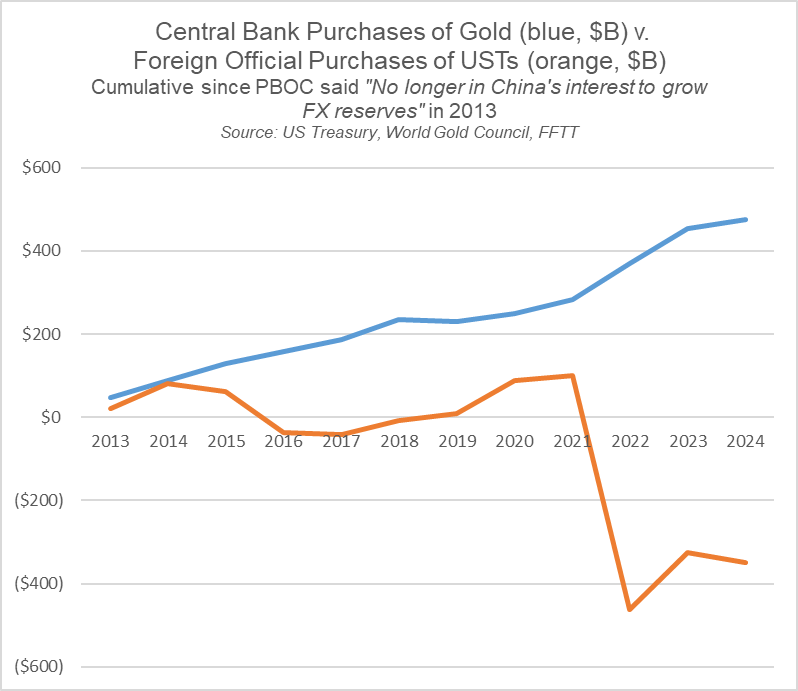
Luke Gorman, founder and president of Forest for the Trees confirmed Taleb’s point with a graph, noting that this de-dollarization trend has been in play for more than a decade and “got much louder post-2022 sanctioning of Russian FX reserves.”

In fact, dollar reserves globally have dropped by 14 percent since 2002. And as the graph shows, de-dollarization accelerated after the U.S. and her Western allies aggressively sanctioned Russia and froze the country’s assets after it invaded Ukraine.

Geopolitical and financial analyst Angelo Giuliano posted the same graph asserting, “De-dollarization is happening.”

“The US dollar Ponzi scheme is collapsing…the US exorbitant privilege to print endless amount of paper toilet currency is over.” 

He noted that gold hit yet another all-time high on Sept. 12, saying, “This is only the beginning.” 

Dollar Weaponization Undermining the Dollar

All of these experts confirm that the United States’s weaponization of the dollar is undermining its strength and role as a reserve currency.

A recent Atlantic Council report on the falling percentage of dollar reserves pointed out dollar weaponization was a factor behind this trend.

“In recent years, and especially since Russia’s invasion of Ukraine and the Group of Seven (G7)’s subsequent escalation in the use of financial sanctions, some countries have been signaling their intention to diversify away from dollars.”

The U.S. and its allies not only froze Russian assets, but they also locked the country out of the SWIFT financial system.

The Society for Worldwide Interbank Financial Telecommunication (SWIFT) system serves as the global economy’s superhighway. In effect, it operates as a global financial messaging service, facilitating cross-border payments. Since the dollar serves as the world reserve currency, SWIFT effectively facilitates an international dollar system.

This gives the U.S. a great deal of leverage, as the Russians discovered. 

This wasn’t the first time the U.S. used SWIFT and the dollar as a stick to advance its foreign policy goals. In 2014, the Obama administration locked several Russian financial institutions out of SWIFT as relations between the two countries deteriorated over Ukraine and Crimea. 

A few years later, the Trump administration threatened China in an attempt to force that country to join in sanctioning North Korea. 

Whether you think the sanctions were justified or not, it’s important to remember that other countries are watching. They realize that dependence on dollars makes them vulnerable to

U.S. manipulation and this is one of the reasons many countries are trying to diversify away from the USD. 

Think about it — if you are concerned that the U.S. could pull the “dollar rug” out from under you, why not pull out from the dollar system first?

This appears to be what is slowly happening. Again, it is death by 1 million paper cuts.

According to a 2023 Invesco survey, a “substantial percentage” of central banks expressed concern about how the U.S. and its allies froze nearly half of Russia’s $650 billion gold and forex reserves.

Central Banks Turning to Gold 

We see this shift toward gold in persistent central bank gold buying.

According to the most recent World Gold Council survey released in June, 29 percent of central banks plan to add more gold to their reserves in the next 12 months. The WGC said it was the highest level since the survey began in 2018.

Only 3 percent said they had plans to decrease gold reserves. 

Earlier this year, the World Gold Council said the continuation of gold buying supports its expectation that “2024 will be another solid year of central bank gold demand.”

“Last year central banks placed great emphasis on gold’s value in crisis response, diversification attributes, and store-of-value credentials. A few months into 2024 the world seems no less uncertain meaning those reasons for owning gold are as relevant as ever.”

Last year, central bank gold buying fell just 45 tons short of 2022’s multi-decade record.

According to the World Gold Council, central banks net gold purchases totaled 1,037 tons in 2023. It was the second straight year central banks added more than 1,000 tons to their total reserves.

Central bank gold buying in 2023 built on the prior record year. Total central bank gold buying in 2022 came in at 1,136 tons. It was the highest level of net purchases on record dating back to 1950, including since the suspension of dollar convertibility into gold in 1971.

The skyrocketing price of gold confirms the wisdom of these central bankers. And it is a tangible sign that the dollar is losing value – and status. 


Mike Maharrey is a journalist and market analyst for MoneyMetals.com with over a decade of experience in precious metals. He holds a BS in accounting from the University of Kentucky and a BA in journalism from the University of South Florida.