Ex-‘Shark Tank’ Star Mark Cuban Wants to be Head of SEC

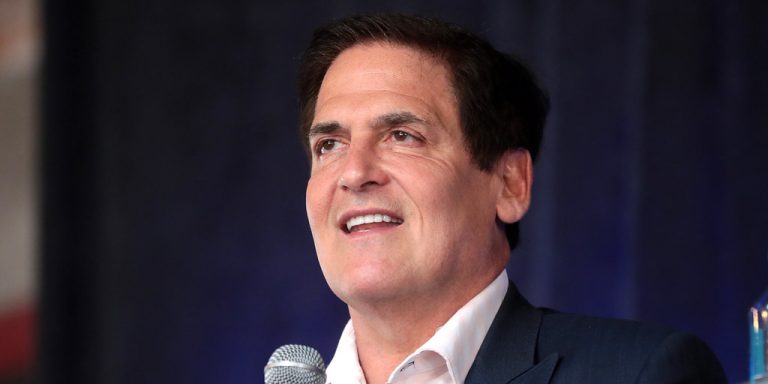
(Victoria Cook, Headline USA) Billionaire entrepreneur Mark Cuban endorsed Vice President Kamala Harris for president this week in what could be a bid to become the head of the Securities and Exchange Commission. 

Without hesitation, Cuban told Fox Business’s Neil Cavuto on Wednesday that he would choose to be the head of the SEC or would entertain the idea of becoming Health and Human Services secretary if offered a role in a hypothetical Harris administration. 

As an investor and a business owner of a pharmaceutical company, Cuban has a vested interest in both departments functioning favorably. 

After endorsing Harris and bashing former President Donald Trump’s economic policies, Cuban explained that the current head of the SEC, Gary Gensler, had to go.

“He’s awful for crypto and for businesses in general,” Cuban said. “We’ve seen the number for public companies just be decimated.”

Speculation about Cuban’s interest in political power arose last year when Cuban left Shark Tank as a featured investor and sold off his stake in the Dallas Mavericks. At the time, Cuban swore off interest in running for the presidency, Axios reported. 

Cuban has considered the presidency in the past, explaining that he had kept an open mind about the prospect amid the chaotic events of 2020.

Cuban has actively embraced his role as a staunch advocate for Harris’s economic policies—lending a small measure of cachet to a weak spot in which she desperately needs an assist, while arguing against Trump’s policies.

He has claimed that Harris will incorporate new technologies and insists that an artificial intelligence boom will commence with a Harris presidency.

Cuban owns and has stock in 23 blockchain and AI companies, according to his website. 

His presidential endorsement comes at a contrast to his original critiques of the U.S. two-party system and past praise for Trump.

Eric Adams Pleads Not Guilty to Taking Bribes and Illegal Campaign Contributions

0

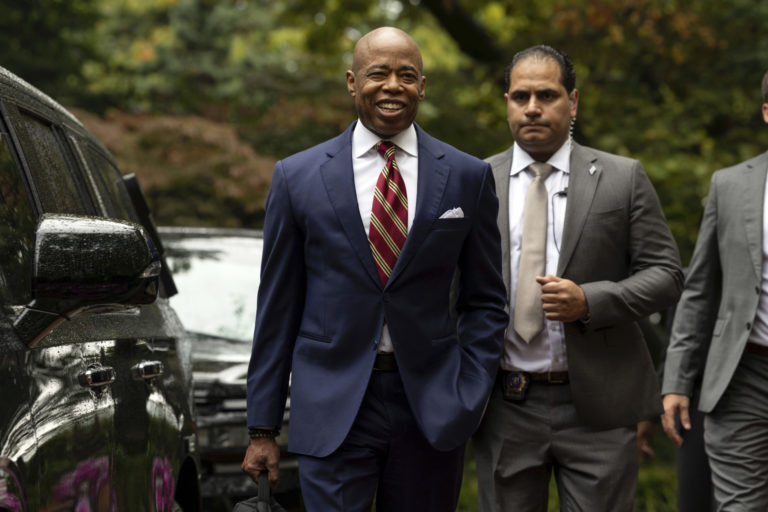
(Headline USA) New York City Mayor Eric Adams pleaded not guilty Friday to federal bribery charges, firmly rejecting allegations that he accepted luxury travel, campaign cash and other perks from foreign interests who then sought to harness his power and influence.

Adams’ lawyer told a judge that they would move next week to dismiss the case, which has roiled the biggest U.S. city after months of investigations, searches and subpoenas.

Adams, a Democrat, entered the plea in a packed Manhattan courtroom that’s just a short walk from City Hall, a day after prosecutors revealed an indictment alleging he accepted overseas travel and illegal campaign donations from people looking to buy his influence in city government.

“I am not guilty, your honor,” Adams said, looking solemnly at Magistrate Judge Katharine Parker.

Adams left the courthouse without commenting. He smiled at a court officer but ignored the rows of reporters he passed on his way out. Afterward, Adams stood silently as his lawyer, Alex Spiro, railed against the charges.

“This isn’t even a real case. This is the airline upgrade corruption case,” Spiro said.

Adams is accused of exploiting a yearslong relationship with people tied to Turkey, who gave him free flights, hotel stays—even a trip to a Turkish bath—and fueled his run for mayor with donations that helped him qualify for more than $10 million in public campaign funds.

People who aren’t U.S. citizens are banned by law from donating to U.S. political candidates.

He faces five counts in the indictment: wire fraud, bribery, two counts of receiving campaign contributions from a foreign national, and conspiracy. If convicted of the most serious charge, wire fraud, he faces up to 20 years in prison, federal prosecutors said.

Assistant U.S. Attorney Celia V. Cohen said prosecutors and Spiro came to an agreement that would allow Adams to be released “on his own signature,” with the condition that he not contact any witnesses or individuals in the indictment, with accommodations for him to speak with members of his family and staff—but not about anything pertaining to the allegations.

Prosecutors said they would provide Spiro with the names of people Adams must avoid.

Adams, 64, is due back in court Wednesday for a case conference.

Spiro told Parker, “We’ll be filing a motion to dismiss on Wednesday.”

Before the hearing, Adams gave a thumbs up but did not pause to speak to reporters as he headed into the courthouse flanked by his police security.

The indictment unsealed Thursday accused Adams of taking a variety of improper gifts from Turkish officials and businesspeople, including free hotel stays and deeply discounted airline tickets to destinations including France, China, Sri Lanka, India, Hungary, Ghana and Turkey.

In return, prosecutors said, Adams did favors for his patrons. That included helping Turkey get fire department approvals to open a new diplomatic tower in Manhattan, despite concerns about its fire safety system, prosecutors said.

Adams, a former police captain, says he is innocent. Spiro has said it was neither unusual nor improper for a government official to accept some travel perks.

The mayor has denied ever knowingly accepting an illegal campaign contribution and said any help he gave people navigating city bureaucracy was just part of doing his job.

In public remarks Thursday, Adams asked New Yorkers to avoid making any judgments until they heard his defense.

Spiro told reporters that the travel perks and seat upgrades Adams accepted were commonly offered to VIPs and members of Congress.

“That’s what airlines do,” he said, noting that many of the charges relate to trips Adams took years ago when he was Brooklyn borough president.

Adams has so far weathered calls to resign from his critics, some Republicans and the field of potential Democratic primary challengers he is expected to face in next June’s mayoral primary.

The New York Times editorial board, which did not endorse Adams when he was running for mayor in 2021, has also called on him to step down, arguing that he cannot continue to effectively govern the city while he fends off his criminal charges.

Notably, top Democrats such as Senate Majority Leader Chuck Schumer and House Democratic leader Hakeem Jeffries have not asked Adams to resign. Both issued statements after the indictment was unsealed saying the legal process should be allowed to play out.

The New York Post’s editorial board similarly said Adams should be allowed to defend himself against the charges and described some what is alleged in the indictment as “small potatoes.”

Gov. Kathy Hochul, a Democrat who has the power to remove Adams from office, also did not call on Adams to resign, but she appeared to issue a warning to a mayor she has often sought to portray as a close ally.

“While I review my options and obligations as the governor of New York, I expect the mayor to take the next few days to review the situation and find an appropriate path forward to ensure the people of New York City are being well-served by their leaders,” Hochul said.

“We must give New Yorkers confidence that there is steady, responsible leadership at every level of government.”

It is unclear whether Adams’ indictment is the last word on federal investigations involving the administration.

Federal prosecutors are believed to be leading multiple, separate inquiries involving Adams and his senior aides and relatives of those aides.

In early September, federal investigators seized devices from the police commissioner, schools chancellor, two deputy mayors and other trusted Adams confidants.

In the last two weeks alone, the police commissioner resigned and the schools chancellor announced he would retire. Neither has been charged with a crime or been publicly accused of wrongdoing.

Adapted from reporting by the Associated Press

Netanyahu Vows that Israel Will Keep ‘Degrading Hezbollah’ in UN Speech

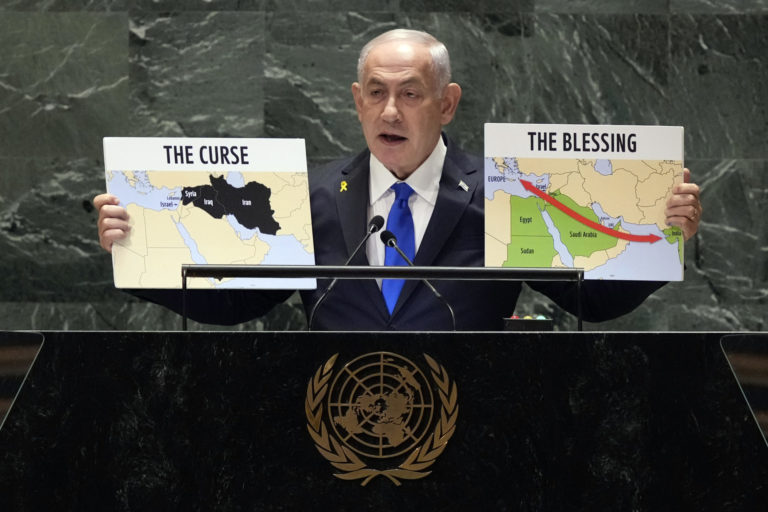
(Headline USA) Israeli Prime Minister Benjamin Netanyahu told world leaders at the United Nations on Friday that his nation will “continue degrading Hezbollah” until achieving its goals along the Lebanon border.

He said his government would no longer tolerate daily rocket fire from the area.

Shortly after Netanyahu wrapped up his speech, the Israeli military said it carried out a strike on Hezbollah’s headquarters in Beirut, which caused huge blasts in the city.

“Israel has every right to remove this threat and return our citizens to their home safely. And that’s exactly what we’re doing … we’ll continue degrading Hezbollah until all our objectives are met,” Netanyahu said.

“Just imagine if terrorists turned El Paso and San Diego into ghost towns … How long would the American government tolerate that?” he said, shaking his fist in emphasis. “Yet Israel has been tolerating this intolerable situation for almost a year. Well, I’ve come here today to say: Enough is enough.”

Netanyahu, armed with visual aids as he has been in the past, defended his nation’s response to the Oct. 7, 2023, attacks by Hamas on Israel that triggered an Israeli military operation on the Gaza Strip. He said he traveled to the United Nations to refute the untruths he had heard from other leaders on the same rostrum earlier in the week.

“I didn’t intend to come here this year. My country is at war fighting for its life,” Netanyahu said. “But after I heard the lies and slanders leveled at my country by many of the speakers at this podium, I decided to come here and set the record straight.”

He insisted that Israel wanted peace but said of Iran: “If you strike us, we will strike you.”

“For too long, the world has appeased Iran,” Netanyahu said. “That appeasement must end.”

“This war can come to an end now. All that has to happen is for Hamas to surrender, lay down its arms and release all the hostages,” Netanyahu added. “But if they don’t—if they don’t—we will fight until we achieve total victory. Total victory. There is no substitute for it.”

He said Israeli forces have destroyed “90%” of Hamas’ rockets and killed or captured half of its forces.

He stated he was pursuing peace. “Israel has made peace and will make peace again,” he said.

In recent days, Israel has turned its attention to the border with Lebanon, where it has stepped up strikes targeting Hezbollah. Hezbollah began firing rockets into Israel almost immediately after the Hamas attack, saying it was a show of support for the Palestinians.

That triggered Israeli counterfire and the two sides have traded fire almost daily for the 11 months since.

Israel vows to drive Hezbollah away from the border to allow its citizens to return safely to their homes. Hezbollah says it won’t stop firing rockets until the Gaza war ends.

Late Wednesday, the United States, France and other allies jointly called for an “immediate” 21-day cease-fire to allow for negotiations as fears grow that this week’s escalation could spiral into an all-out war. Hezbollah hasn’t officially responded to the ceasefire proposal.

Adapted from reporting by the Associated Press

SCOOP: Every MS-13 Inmate in Country Sent to the Same Understaffed, Unsecured Prison

(Ken Silva, Headline USA) Every U.S. prison inmate affiliated with the El Salvadoran gang, La Mara Salvatrucha, more commonly known as MS-13, has been moved to FCI Lewisburg—an understaffed, unsecured and decrepit facility in Pennsylvania, according to a new report from the DOJ-Inspector General’s Office.

“In March 2022, it received all La Mara Salvatrucha (MS-13) gang inmates who had been housed at other [Bureau of Prisons] institutions. The BOP made the decision to transfer all MS-13 inmates to one institution to prevent system-wide gang violence after MS-13 members murdered two rival gang members at USP Beaumont in January 2022,” states a Thursday report from the DOJ-OIG.

While there has been reporting over the last two years about “some” MS-13 members being moved to FCI Lewisburg, Thursday’s DOJ-OIG report appears to be the first official acknowledgment that every federal MS-13 inmate is being housed there.

Thursday’s report also detailed the numerous problems plaguing FCI Lewisburg, from inadequate staffing to decrepit facilities and failing security cameras—along with a seemingly abusive atmosphere for the employees.

According to the DOJ-OIG, FCI had only 191 of its 245 authorized positions in its Correctional Services Department filled as of January—meaning that the facility is short roughly 50 correctional officers. That understaffing has led to guards overly relying on solitary confinement—which, in turn, skyrockets the suicide risk for inmates, the report shows.

Of the facility’s 575 inmates, 71 were in “restrictive housing”—13 of those in solitary confinement. Some were kept there for their safety, the DOJ-OIG noted.

“The prison cannot safely house an inmate with a history of sex offense in a cell with an MS-13 gang member,” the DOJ-OIG remarked.

However, “From January 2022 through March 2024, FCI Lewisburg had 16 suicide attempts, of which 7 (44 percent) involved inmates who were single-celled at the time of their suicide attempt; 5 of these 7 attempts involved inmates who were in restrictive housing when they attempted suicide,” the DOJ-OIG report added.

The DOJ-OIG report also detailed the lack of cancer screening and other healthcare services for inmates, as well as FCI Lewisburg’s decrepit physical state, including its shoddy security cameras.

The prison’s problems aren’t confined to inmates, either. According to the DOJ-OIG report, some employees suffer verbal abuse and harassment from their colleagues—some of whom have hanged Nazi artwork around the employees-only areas.

Responding to the DOJ-OIG’s concerns about Nazi artwork and graffiti throughout the prison, the Bureau of Prisons Central Office Executive Staff and intelligence officials told the Inspector General that the artwork is related to the staffs’ work in disassociating inmates from gangs. That program appears to require inmates to become prison snitches—telling them to “provide intelligence to the BOP and outside law enforcement about gang operations.”

“In response to a draft of this report, BOP Central Office Executive Staff and intelligence officials stated that the SIS [ the prison’s Special Investigative Services] plays a vital role in managing gang-related activity and teaching employees to recognize, report, and monitor gang-related activity and membership,” the DOJ-OIG report said.

“They noted that such images are also displayed publicly in the same context on the Federal Bureau of Investigation’s public website, as well as several anti-hate organizations’ websites.”

The DOJ-OIG did not appear to accept the prison’s explanation.

“While we recognize the potential educational value of such displays for SIS employees, we are concerned that the prominent display of Nazi and white-supremacist iconography in the SIS hallway also could have a negative impact on employee morale, inmates’ willingness to provide information to the BOP during their gang disassociation, and potentially contribute to a hostile work environment.,” the DOJ-OIG said.

The BOP disagreed with the DOJ-OIG’s assessment of the Nazi artwork, but prison staffers did agree to the inspector general staff’s other recommendations, such as making sure that all guards carry tools to cut down inmates who try to hang themselves.

Ken Silva is a staff writer at Headline USA. Follow him at x.com/jd_cashless.

Kamala Slammed by Border Officials in 2nd Career Trip to Border

0

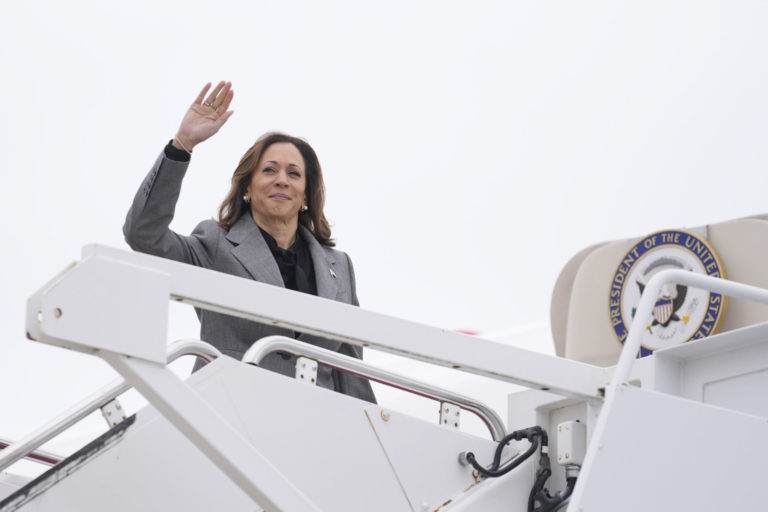
(Headline USA) Vice President Kamala Harris was criticized by the Border Patrol Union on Friday as she prepared to make her first visit to the U.S.-Mexico border since becoming the Democratic presidential nominee and only her second visit since becoming the official White House border czar.

“After years of not just ignoring the problem, but helping create it, Vice President Kamala Harris is finally headed down to the border,” said Art Del Cueto, vice president of the National Border Patrol Council.

“This is nothing more than for her to check the box, but what it is in reality is a slap in the face towards the men and women that put their lives on the line every day, and also a slap in the face to the American public,” he continued. “Where has she been?”

She is scheduled to appear in Douglas, Arizona, as former President Donald Trump and his fellow Republicans pound Harris over the Biden administration’s poor record on illegal immigration and fault the vice president for spending little time visiting the border during her time in the White House.

Immigration and border security are top issues in Arizona, the only battleground state that borders Mexico and one that contended with a record influx of asylum seekers last year.

On Thursday, Trump stated “anything [Harris] says tomorrow, you know is a fraud because she was the worst in history at protecting our country. So she’ll try and make herself look a little bit better. But it’s not possible.”

A day earlier, at a rally in North Carolina, Trump told voters that “when Kamala speaks about the border, her credibility is less than zero.”

The Trump campaign has also run TV ads deriding the vice president as a failed “border czar.”

“Under Harris, over 10 million illegally here,” said one spot.

Adapted from reporting by the Associated Press

Stock Slump Likely; Fed Floats Revaluation of Pennies

(Mike Gleason, Money Metals News Service) In the wake of the Federal Reserve’s oversized rate cut, gold is zooming to fresh new records.

The stellar run in gold and silver markets continues to be overshadowed by the stock market’s relentless gains. The S&P 500 rallied to yet another new record on Thursday while the Dow Jones Industrials surpassed 42,000.

Stock market bulls are riding a wave of euphoria on expectations that the Fed will continue lowering interest rates.  Central bankers delivered a hefty 50 basis point cut to kick off their easing campaign this month.  

Typically, the Fed doesn’t start cutting and doesn’t go that large unless it is alarmed by a major hit to the economy or fears the financial system is in trouble.  History shows that rate cutting campaigns coincide with recessions – and ultimately significant declines in the stock market. 

Maybe this time will be different. Maybe the Fed will pull off a soft landing without a hitch.

But perhaps in the process, the Fed will help reignite inflation pressures. Despite softening in recent months, inflation even by official measures never came all the way down to Jerome Powell’s 2% target. But he declared it was close enough.

Even throughout the Fed’s rate hiking campaign, massive injections of fiscal stimulus by the federal government give GDP, and in turn the stock market, an artificial boost. Washington runs on the spend now, pay later philosophy as it runs staggering annual deficits of $2 trillion. There are no plausible plans in sight to bring them down.

This week, Republican House Speaker Mike Johnson cut a deal with Congressional Democrats and the White House to kick the can down the road once again on spending. The deal averts a government shutdown by fully funding the Biden administration’s spending priorities for another three months.

One Republican who is unhappy with the latest bipartisan deficit spending scheme is Senator Rand Paul. He took to the Senate floor to excoriate his colleagues and warn Americans that they may ending up paying the price through the inflation tax.

Rand Paul: Our national debt now stands at $35 trillion and grows with each passing second. To put that in perspective, each taxpayer’s share of the debt is about $270,000. The government now spends more on interest to service our federal debt than it spends on our national defense. Right now, we spend nearly $2 trillion more per year than we bring in in revenue.

This level of spending imposes a tax on every American. This tax is called inflation. When we borrow $2 trillion, somebody’s got to buy it. Someone buys the debt. When the Federal Reserve buys the debt, they create currency, create new money out of thin air, which when it begins to circulate, causes your prices to rise. It isn’t that things are more precious, it’s that your dollar is losing its value.

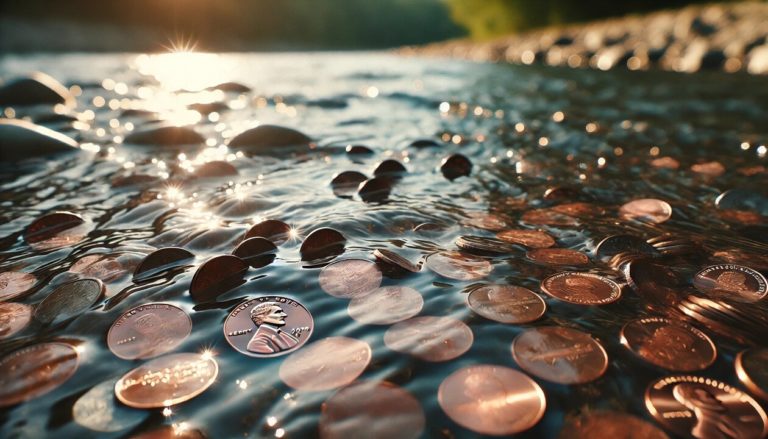
The U.S. dollar has lost more than 98% of its purchasing power over the past 100 years.  In the process, paper currency lost its gold backing, quarters and dimes got stripped of their silver, and pennies had their copper replaced with cheaper metals like zinc.

Pennies now cost three times more to produce than they are worth.  They cannot practically be debased any further to solve this problem.

So, some members of Congress want to formally get rid of them. Representative Brad Sherman has likened pennies to “litter.”

Meanwhile, Chicago Federal Reserve President Austan Goolsbee recently proposed a novel solution of his own to the problem of the near worthlessness the single cent.  Goolsbee says the government should just declare that pennies are now worth five cents each!

Others within the government have proposed minting a one-ounce platinum coin with a face value of $1 trillion, then selling it to the Fed for that price. Such a coin would cost just a little over $1,000 to produce. It would give the U.S. Treasury a massive windfall for funding its deficit spending without having to borrow or pay interest.

The keepers of the fiat currency regime are now entertaining absurd proposals such as these because they refuse to admit to the inherent absurdity of money that constantly depreciates in value. Real money retains value.

As gold makes new records in terms of Federal Reserve notes, it’s worth remembering that the value of gold hasn’t actually changed much since it sold for $20.67 per ounce a century ago.  

An ounce of gold still represents a similar level of purchasing power in the economy.  What’s changed dramatically over time is the value of the currency itself.

Smartmatic Caves in Lawsuit against Newmax over Vote Fraud Claims, Settles for $1B Less

(Headline USA) A settlement was reached Thursday in a defamation lawsuit brought by electronic voting machine manufacturer Smartmatic against conservative news outlet Newsmax for airing allegations of vote manipulation made by attorneys who were, at the time, representing former President Donald Trump in his challenges of the 2020 election results.

“Newsmax is pleased to announce it has resolved the litigation brought by Smartmatic through a confidential settlement,” Newsmax said in a prepared statement which was echoed in a similar statement by Smartmatic.

The terms of the settlement were not disclosed, but Newsmax has said Smartmatic recently dropped its damages claims by more than $1 billion.

The settlement assures that Smartmatic will not have to meet the burden of proving falsity in the election, which has long since become a moot point for many, with the next presidential election just weeks away.

Some might reasonably conclude, thus, that there was some validity to the claims leveled by Trump attorneys, including former New York City Mayor Rudy Giuliani and conservative attorney Sidney Powell.

However, there is no such burden of proof on the part of the defendant, particularly a media outlet protected under the First Amendment, to prove the claims are true in a defamation lawsuit—only that one acted in good faith and had cause to believe they were at the time.

That means, the company, through its litigation, successfuly stalled any further scrutiny of its voting machines and software just long enough to make it inconclusive as to whether they did or did not manipulate the election outcome, while creating a costly nuissance for conservative media in the process.

However, it is unclear whether states are continuing to use the Smartmatic equipment following the recent federal indictment of three top execitives for a corruption scandal stemming from the 2016 election.

The settlement was announced just a few hours after jury selection began in the lawsuit filed by Florida-based Smartmatic against Newsmax.

Smartmatic claimed that Newsmax program hosts and guests made false and defamatory statements in November and December 2020 implying that Smartmatic participated in rigging the results and that its software was used to switch votes.

Newsmax argued that it was simply reporting on newsworthy allegations and that the lawsuit, thus, represented a threat to freedom of speech and freedom of the press.

Howard Cooper, an attorney for Newsmax, told Judge Eric Davis at a pretrial hearing last week that Newmax planned to question Smartmatic witnesses about why the company had previously sought damages of $1.7 billion, but was now claiming only $400 million.

J. Erik Connolly, an attorney for Smartmatic, told the judge that the company was asserting lost revenue opportunities valued at $369.8 million, based on the purported damage to its reputation from the Newsmax reports.

Connolly also told the judge that Smartmatic would be seeking lost revenue damages only for the period from late 2020 to August of this year, when three current and former Smartmatic executives—including founder and president Roger Alejandro Pinate Martinez—were indicted on criminal charges in Florida.

The indictments involve an alleged scheme to pay more than $1 million in bribes to put Smartmatic voting machines in the Philippines.

Newsmax argued that the investigation and indictment should be presented to jurors as alternative reasons for any purported reputational harm or economic loss that Smartmatic blamed on Newsmax.

The Delaware lawsuit, which centered on Newsmax reports over a five-week period in late 2020, is one of several stemming from reports by conservative news outlets following the election.

Smartmatic also is suing Fox News for defamation in New York. The company recently settled a lawsuit in the District of Columbia against the One America News Network, another conservative outlet.

“We are now looking forward to our day in court against Fox Corp and Fox News for their disinformation campaign,” Smartmatic said in Thursday’s statement. “Lying to the American people has consequences. Smartmatic will not stop until the perpetrators are held accountable.”

In response to Smartmatic’s statement, Fox said Smartmatic chose to settle with Newsmax because of a series of pretrial setbacks, including the Florida indictments and the subsequent reduction in Smartmatic’s damage claims. Fox also noted Davis ruled that Smartmatic would not be allowed to seek punitive damages.

“Smartmatic’s claims against Fox are similarly impaired, unsupported by the facts and intended to chill First Amendment freedoms,” Fox said in a statement. “We look forward to defending this case when it goes to trial.”

Dominion Voting Systems similarly filed several defamation lawsuits against those who blamed its election equipment for Trump’s loss. Last year, in a case presided over by Davis, Fox News settled with Dominion for $787 million.

However, there were several mitigating circumstances in Fox’s decision to settle, which do not imply that the reporting itself was false.

Among those was the leak of embarrasing text messages obtained during the discovery process that showed top Fox News personalities criticizing Trump.

The network’s corporate side—including Rupert Murdoch and his sons—also may have been less inclined toward conservative, pro-Trump politics than many of its viewers and guests, and its shareholders and advertisers—including the multi-trillion-dollar BlackRock fund, may also have exerted pressure on the company to settle due to its own interests in Dominion-linked companies and in the Biden administration.

In short, a massive stock buyup from BlackRock just weeks before the settlement may have given Fox the money it needed to make the lawsuit go away, resulting in a win–win for both parties, with only America’s faith in democracy losing out.

Adapted from reporting by the Associated Press
Trump Cancels Wisconsin Rally after Secret Service Denied Campaign Resources

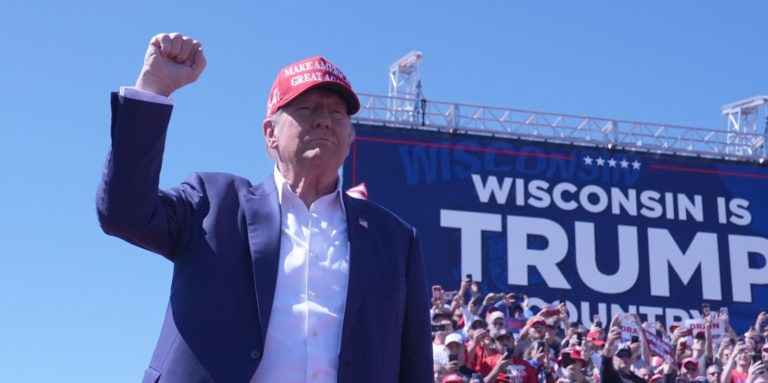
(Ken Silva, Headline USA) Former President Donald Trump’s campaign was forced to cancel an outdoor rally set for the key battleground state of Wisconsin on Saturday after the Secret Service denied him resources to secure the event. Instead, Trump will reportedly speak at a smaller indoor venue.

According to a Secret Service whistleblower, the agency recently told the Trump campaign that it lacked sufficient assets to secure a potential campaign rally in Wisconsin for the former president.

Other whistleblowers allege that failure to provide protection for a major public event is highly unusual, and that a sitting president would never be denied resources in this way, according to a Tuesday letter from Sen. Josh Hawley, R-Mo., to Secret Service Acting Director Ronald Rowe.

The cancellation follows Rowe’s press conference last week, where he told reporters that Trump is receiving “the highest level of Secret Service protection” and that “he’s getting everything” that “the current president has with respect to Secret Service assets.” On the same night of Rowe’s remarks, his Secret Service secured a rally for Vice President Kamala Harris in Madison, Wisconsin.

In his letter to Rowe, Hawley accused the Secret Service of election interference.

“Did the Secret Service ever tell former President Trump, his campaign, or any related business entities that the agency could not secure a rally event in Wisconsin? Has the Secret Service ever told President Biden or Vice President Harris that the agency could not secure a campaign event of their choosing?” Hawley asked Rowe.

After Hawley’s letter went public, the senator said Rowe called him.

“I just had an extraordinary conversation with Director Rowe at the Secret Service, who called me personally to dispute a whistleblower allegation—but refuses to respond in writing. Just as he has declined to respond substantively to ANY of the whistleblowers’ allegations,” Hawley said Thursday.

According to Hawley, Rowe complained about whistleblowers and about the senator’s requests for information based on whistleblower reports.

“I informed him it is his JOB to provide the facts to the public & Congress. Stonewalling must stop. And I reminded him whistleblowers are protected under federal law,” Hawley said.

“I emphasized to Rowe that it is indefensible that his agency has not cooperated fully with congressional investigators – to the point that today the Homeland Security Committee again adopted my legislation to COMPEL Secret Service & DHS to cooperate,” he said, referring to his legislation requiring the Department of Homeland Security to provide any and all info pertaining to both the July 13 and September 15 Trump assassination attempts.

Ken Silva is a staff writer at Headline USA. Follow him at x.com/jd_cashless.

The Dollar Is Smoke and Mirrors

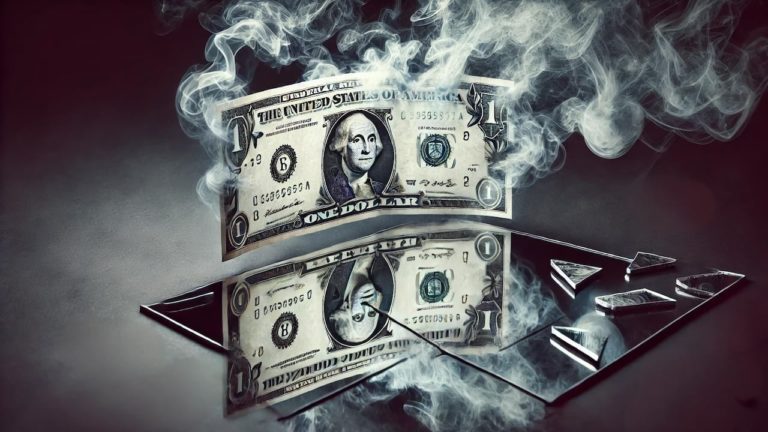
(Mike Maharrey, Money Metals News Service) At one time, the U.S. monetary system was backed by gold. Now, it’s not backed by anything.

It’s nothing but smoke and mirrors. 

But most Americans don’t realize this. In fact, nearly a third of respondents to a 2019 recent survey believed the U.S. dollar was still backed by gold. Only 7 percent of the people polled got the answer right – the dollar isn’t backed by anything.

Meanwhile, 29.3 percent said the dollar was backed by gold, 4.1 percent said it was backed by oil, 5.8 percent said it was backed by bonds, and 23.6 percent confessed that they simply didn’t know.

Thirty percent of those polled answered that the dollar is backed by the U.S. government. While technically correct, that’s a distinction without a difference. When you strip away the semantics, this still means it’s not backed by anything. I mean, do you trust the “full faith and credit” of Joe Biden et al.? 

The dollar is what is known as a fiat currency. That means it is not backed by a physical commodity such as gold or silver. Fiat currencies derive their value from the fact that the issuing governments say they have value. They sustain their value because the government maintains monopoly power over money – dictating that only its fiat currency can serve as “legal tender.”

Currency in the United States used to be backed by gold. You could exchange your dollars for a fixed weight of metal. But under Pres. Franklin D. Roosevelt, in the 1930s, the government began to move away from gold-backed currency. In 1971, President Richard Nixon severed the tie altogether.

Why?

Because gold or silver-backed money poses problems for governments, they cannot easily inflate the money supply. There always has to be a sufficient amount of metal to back the currency in circulation. But governments and central banks can print fiat currencies at will. In a nutshell, fiat currencies allow governments to create money out of thin air to fund their vast expenditures. The warfare and welfare state in America would be impossible without the fiat currency and the central bank facilitating debt monetization.

When he announced the closing of the gold window, Nixon said, “Let me lay to rest the bugaboo of what is called devaluation,” and promised, “Your dollar will be worth just as much as it is today.”

Liar. 

The dollar has lost well over 80 percent of its value since Nixon’s fateful decision. Meanwhile, the dollar value of gold has gone from $35 an ounce to nearly $2,700 an ounce, a 7614.3 percent increase.

The purchasing power of the dollar continues to diminish every day, but this is just a shadow cast by the real truth — the dollar is effectively valueless.

Paul Krugman stumbled on this truth in a rant against Bitcoin. The Keynesian economist said cryptocurrency was a step back in the evolution of money because its value isn’t “tethered to anything.” In other words, nothing underlies its value.

But as a fiat currency, the dollar isn’t tethered to anything either. It has value because people have faith that it has value. When you boil it all down, dollars are nothing more than pieces of paper and digits in computers.

When Krugman bashed Bitcoin because it isn’t “tethered to anything,” he must have realized he was backing himself into a corner because he went out of his way to emphasize dollars are backed by the “full faith and credit” of the U.S. government and we need dollars to pay our taxes.

The value of a dollar doesn’t come entirely from self-fulfilling expectations: ultimately, it’s backstopped by the fact that the U.S. government will accept dollars as payment of tax liabilities — liabilities it’s able to enforce because it’s a government. If you like, fiat currencies have underlying value because men with guns say they do. And this means that their value isn’t a bubble that can collapse if people lose faith.”

But this is demonstrably false, as the Germans learned during the hyperinflation of the Weimer Republic and more recently experienced by the people of Venezuela.

In effect, there is no floor on how weak the dollar can become in terms of purchasing power merely because the IRS insists on receiving dollars for its tax bills. Economist Robert Murphy explained why the value of fiat currencies can fall to near-zero in an episode of the Contra Krugman podcast.

If, by assumption, the dollar’s very weak, then that means you could sell one hour of your labor to get a trillion dollar bills. So, the fact that you need to hand over to the IRS a bunch of dollar bills, by itself does not tell me any information about the relative strength of the dollar. That’s consistent with the dollar being worth, you know, $1 gets you a loaf of bread or you need a quadrillion dollars to get a loaf of bread. That’s equally consistent with the fact that I have to pay my taxes in dollars.”

The “lack of tethering” argument Krugman makes against crypto applies equally to fiat dollars. Despite men with guns, the dollar’s value can still decline to virtually zero. Again, we just have to look at countries like Venezuela and Zimbabwe and their bouts of hyperinflation to see this truth. Government backing does not guarantee value.

And unlike government-created fiat money, a cryptocurrency has a limited supply built into its system. For instance, bitcoin has a maximum of 21 million coins, so its purchasing power cannot be reduced like the U.S. dollar by printing more. As Ron Paul once said, cryptocurrencies create more competition for government fiat currency.

“Governments aren’t very tolerant of competition, and they’re not even tolerant with using the Constitution to compete with the fiat dollar. Because gold and silver, you can’t use it.”

Financial guru Jim Grant wrote that the reason the gold standard is so often demeaned by modern economists and politicians is because “the modern sensibility quakes at the rigor of such a system.”

But those “rigors” are exactly what we need. Sound money forces governments to maintain fiscal discipline. It limits spending, and ultimately, the growth of government itself. It’s no wonder that the political class rejects any kind of commodity-based money.

Instead, politicians have replaced the gold standard with another standard. Grant calls it the “Ph.D. standard,” a system run by politicians and central planners.

That system features monetary oversight by former university economics faculty — the Ph.D. standard, let’s call it. The ex-professors buy bonds with money they whistle into existence (“quantitative easing”), tinker with interest rates, and give speeches about their intentions to buy bonds and tinker with interest rates (“forward guidance”).

This is exactly what politicians like Nixon, Ford, Carter, Reagan, Bush I, Clinton, Bush II, Obama, Trump, and Biden wanted — the ability to spend without restraint and grow government with no limits. The result: massive national debt and devalued currency that buys the average person less and less every year.

BRICS Nations Working on Internat’l Payment System; Gold Part of Plan

(Mike Maharrey, Money Metals News Service) The BRICS economic block is pushing forward with plans to develop a system that would facilitate international payments outside the dollar system, with gold serving an important role in the scheme.

According to the Russian news agency TASS, BRICS officials are “developing a wide range of instruments for creating an inclusive international financial system.” 

Andrey Mikhailishin heads up the BRICS Business Council task force on financial services. He told TASS parts of the plan will be presented at the Autumn BRICS summit at the end of October.

Several of the projects in development include a common unit of account (a currency), a platform for international payments using a BRICS digital currency, a payment system, a settlement depository, an insurance system, and a BRICS rating alliance.

According to TASS, the key to the new system with be “decentralization of international interaction.”  The settlement depository will rely on blockchain technology “to record securities and exchange them.”

Gold will play an important role in the system.

The common unit of account would be pegged by 40 percent to the price of gold. The other 60 percent would be pegged to a basket of BRICS currencies. According to Mikhailishin, this approach would make it “a convenient and universal instrument.” 

“When you have a unit of account that can be converted into any national currency, it is more convenient for you to hold it, since it is a more liquid instrument.” 

Using a common unit of account would solve the problem of exchange rate volatility when cash balances accumulate in national currencies.

This accumulation of dollars overseas is an important factor in propping up the greenback. Because it serves as the reserve currency, the world needs dollars. This demand for dollars powers the U.S. money printing machine. If the global demand for dollars falls, it would be disastrous for the U.S. economy. A glut of dollars would further devalue the currency and lead to rapidly increasing prices in the U.S. If de-dollarization went far enough, it could lead to hyperinflation.

While the dollar is still the primary global medium of exchange, its role as a store of value is already eroding. More and more countries are turning to gold as a store of value, as evidenced by aggressive central bank gold buying. 

Dollar reserves globally have dropped by 14 percent since 2002, and de-dollarization accelerated after the U.S. and her Western allies aggressively sanctioned Russia and froze the country’s assets after it invaded Ukraine with many countries wary of the U.S. weaponizing the dollar. 

The Atlantic Council identifies the rise of BRICS as a threat to long-term dollar dominance.

“The project identifies the BRICS as a potential challenge to the dollar’s status due to the individual members’ signal of intent to trade more in national currencies and the BRICS’ growing share of global GDP.” 

BRICS is an economic cooperation bloc originally made up of Brazil, Russia, India, China, and South Africa. As of Jan. 1, 2024, the bloc expanded to include Saudi Arabia, Egypt, the UAE, Iran, and Ethiopia.

More than 40 other nations, including NATO member Turkey, have expressed interest in BRICS membership.

The expanded BRICS has a combined population of about 3.5 billion people. The economies of the BRICS nations are worth over $28.5 trillion and make up roughly 28 percent of the global economy. BRICS nations also account for about 42 percent of global crude oil output.