

(Mark E. Johnson, Contributor) When companies compete for your business, that’s a usually good thing. Service improves and prices goes down in an effort to win your dollar.
Unless, of course, they’re lying to you.
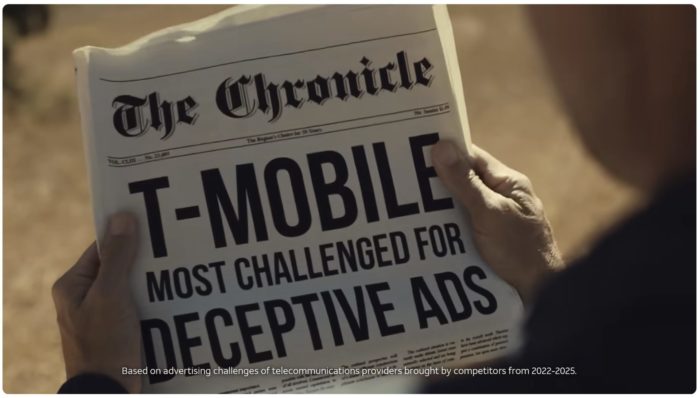
In between ads featuring cowboys driving pickup trucks and emus selling insurance, viewers of this weekend’s NFL playoff games were treated to an ad for AT&T featuring actor Luke Wilson saying, ‘T-Mobile is the master of breaking promises.’ Wilson holds up a replica newspaper headlined ‘T-MOBILE – MOST CHALLENGED FOR DECEPTIVE ADS’
The campaign is an apparent counterattack, as previous T-Mobile attack ads have gone after the integrity America’s first and oldest telecom, AT&T
“A slightly petty and therefore entertaining battle is brewing in the US, one that has led inevitably to the filing of a lawsuit” wrote industry news site telecoms.com in October.
T-Mobile hosts a discussion page where consumers can add fuel to the fire. One user posted an online screed against mobile service leader Verizon:
“I left verizon brought 4 lines 4 devices and was told I get two new devices with only paying llocal tax and activation. Now after I switched it’s lie after lie now you need to pay a deposit. That’s wasn’t what I was told I was told get 2 free phones. I left a good company for this stuff only to be lied to every time I turn around. 2 different stores 5 reps and I was told all I had to do was switch. I feel very mislead .? I feel lied too. I don’t think this is a very reputable company.”
Other social media users say it’s AT&T that’s the problem, so much so that there’s a Facebook page devoted entirely to the subject. On the public Facebook group “AT&T Sucks,” users vent the spleens over the carrier’s alleged pitfalls:
- “Have you seen the AT&T commercial where they accuse TMobile of lying and deceptive practices? I just about spit my drink across the room. Hey Pot! Kettle calling! AT&T sucks!!”
- “These guys always talks about TMobile, but between ATT and Spectrum, they are at a tie with being the worst with customer service.”
- “their word don’t mean shit.”
A 2024 settlement imposed by the Attorney General of California essentially put all these cellular carriers in the same scammy boat:
“California Attorney General Rob Bonta today, alongside a bipartisan, multistate coalition, announced a $10.25 million settlement with major U.S wireless carriers after an industry-wide investigation of misleading advertising practices. The settlement, which is subject to court approval, resolves the allegations that the carriers violated the Unfair Competition Law and False Advertising Law by engaging in deceptive and misleading advertising. Today’s settlement provides strong, industry-wide injunctive relief that applies to all major wireless carriers and includes a payment of $10.25 million to the states, with $1.2 million going to California.”
According to AG Bonta…
“We have all heard and seen advertisements announcing too good to be true cell phone deals, offering wireless devices for free or ‘unlimited’ data. Turns out, many of those deals are indeed too good to be true.
“Wireless carriers have exploited the fact that cell phones are now essential to our day-to-day lives … I am proud that this settlement requires industry-wide changes to the deceptive advertising practices which have become commonplace in the marketing of cell phones.”
The settlement requires that all cell service advertising be “truthful, accurate, and non-misleading.” In addition, carriers must comply with numerous specific requirements:
- Unlimited Claims: Whenever a Wireless Carrier makes an “unlimited” data claim, they are required to clearly and conspicuously explain all material restrictions on data speed, including any thresholds at which unlimited data speeds may be slowed. Wireless carriers are prohibited from claiming that plans which set numerical caps on the quantity of data available are unlimited.
- Switch-and-Save Offers: Whenever a Wireless Carrier makes an offer to pay a consumer’s cost to switch carriers, the Wireless Carrier must clearly and conspicuously explain all requirements a consumer must fulfill to take advantage of the offer.
- Discounted Services Claims: Whenever a Wireless Carrier makes a cost-comparison or discounted services offer, they must make comparisons between services that are similar rather than making misleading apples-to-oranges comparisons. Similarly, if a Wireless Carrier intends to provide a discount or a savings after-the-fact in the form of cash, credit, or a rebate, they must explain how the consumer will receive the funds and how long the consumer must wait to receive the funds.
- Free or Discounted Device Claims: Whenever a Wireless Carrier offers consumers a “free” device as part of a plan, they must explain everything a customer must do to obtain the “free” device, including any fees they must pay or other devices they are required to purchase. Wireless Carriers are also prohibited from increasing the price of the underlying service or other relevant devices to make up for the cost of the “free” device.
- Device Lease Claims: Whenever a Wireless Carrier offers a device on lease as opposed to for purchase, they must make that fact clear to a consumer. Wireless Carriers are prohibited from characterizing leases as purchases.
- Employee Training: The Wireless Carriers are required to train all employees responsible for advertising and all customer service representatives on the provisions of this settlement to ensure on-the-ground compliance.
- Complaint Representatives: The Wireless Carriers are required to designate a dedicated employee to work with the attorneys general to resolve complaints from everyday consumers.
The bottom line for consumers – age-old adage caveat emptor (‘let the buyer beware’) seems to apply now more than ever in the competitive, cutthroat, and confusing world of cellular service. Shop carefully.
Keep reading for some ways you may be able to reduce your cell phone bill, possibly in time for your next billing cycle.
Cut your cell phone bill up to 50% with these 4 tips
Cell phone bills continue to rise each year. Here’s several ways to cut your bill down.
By Brett Holzhauer, CNBC.com, Oct 2 2025
- Consider switching to a low-cost carrier
You don’t have stick with big names like Verizon or AT&T.
Mobile virtual network operators such as Mint Mobile or Consumer Cellular don’t have their own networks. They are middlemen, purchasing data in bulk from the large carriers and reselling it to consumers.
JD Power said the average low-cost carrier bill is $77, about half of the large carriers.
To get the cheapest plan possible, and try to utilize Wi-Fi networks so you can avoid using your cell data.
- Bundle with friends and family
If you’re not sharing data with family members, consider creating a group plan, or joining one.
The more people involved, the cheaper it gets. A single line on Verizon under the “Start Unlimited” plan is $70 per person. A plan with four people will run $35 per person.
- Use the right credit card
Many credit cards offer cash back or travel rewards when you pay for your bill with their card:
- Citi Double Cash® Card: Earn 2% cash back on your cell phone bill, 1% on all eligible purchases and an additional 1% after you pay your credit card bill.
- Ink Business Cash® Card: Earn 5% cash back on the first $25,000 spent in covered purchases including phone services each account anniversary year (then 1%).
- Capital One Venture Rewards Card: 2X miles on all eligible purchases.
- Analyze your current plan
Next time you receive your statement, take a look at your plan. You may be overpaying for services you don’t need.
For example, you could be paying for unlimited talk, text and data when a cheaper pro-rated option available. Or, if you are paying for a pro-rated plan, and you’re consistently going over each month, an unlimited plan may be a more cost-effective strategy …
Mark E. Johnson writes about taxes, finance, health, and other consumer topics for national publishers. He is the former editor of HeadlineHealth.com.
