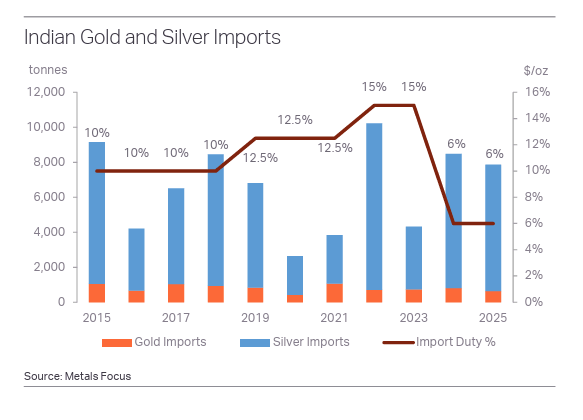
(Mike Maharrey, Money Metals News Service) In July 2024, India slashed its import tax on gold and silver from 15 percent to 6 percent. This week, the Indian government reversed course, hiking the customs duty back to 15 percent.
The 9 percent duty increase ranks as the largest on record.
The duty on doré (unrefined alloy generally containing 80 to 90 percent precious metal) was hiked from 5.35 percent to 14.35 percent, leaving the 0.65-percent differential between refined gold and doré unchanged.
The move comes as India struggles with a surging trade deficit that is pressuring its currency.
Gold and silver make up around 11 percent of India’s total imports. According to Metals Focus, the country typically imports around 800 tonnes of gold annually. Import volumes fell to 640 tonnes in 2025. However, higher gold prices meant that the total value still rose significantly.
Meanwhile, oil accounts for around 22 percent of the nation’s imports. The sudden spike in oil prices due to the U.S.-Iran war has hit India particularly hard. The country imports nearly 85 percent of its fuel, and about 50 percent of its crude imports flow through the Strait of Hormuz.
With both gold and oil prices spiking, India’s import bill has exploded. The country’s merchandise trade deficit topped $330 billion in the financial year ending March 2026. That was up from over $280 billion a year ago, a 17.9 percent increase.
The trade situation has put significant downward pressure on the rupee.
To buy oil, silver, and gold, Indian importers must sell rupees for dollars. Due to supply and demand dynamics, this causes the value of the rupee to fall against the dollar. In turn, the weakening rupee makes imports more expensive.
Along with the new duties, Indian Prime Minister Narendra Modi urged Indians to pause buying gold for a year and to limit their purchases of overseas goods. He also recommended using public transportation and carpooling to save fuel.
In an interview with CNBC, an Indian economist, Trinh Nguyen, pointed out that the Indian government has discouraged companies from raising prices at the pump, creating the potential for “demand destruction.”
“India is backtracking on liberalization of the market, which investors like about India.”
The Indian government took a similar approach in the previous decade when its trade deficit spiked. It raised the customs duty on precious metals from a flat ₹300 per gram to 15 percent by 2022.
The higher tax will undoubtedly put downward pressure on gold demand. Higher gold prices have already pushed gold jewelry demand down by 22 percent in 2025. Increasing investment demand helped offset the decline in jewelry offtake.
However, Metals Focus notes that Indian gold and silver demand have historically remained resilient in a higher tax environment. This reflects the fact that Indians have a deep cultural connection to precious metals, and they value them highly as a store of wealth. As the rupee depreciates, gold will become increasingly attractive.
According to Metals Focus analysts, “Consumers often delay purchases initially following sharp price increases but typically adjust to higher price levels over time. In addition, elevated duties could encourage a recovery in unofficial flows, which had collapsed following the 2024 duty reduction.”
A Bullish Angle on the Gold and Silver Import Duties
In an article published by Metals Daily, Ross Norman argued that the move by India is simultaneously bearish and bullish.
“At its core, however, gold is an asset of last resort — and Indians know that. So, when the government takes an action like this — effectively burning the lifeboats to keep warm — you know there is a real problem. There is a whiff of a real panic about this … and that makes it good and bad for gold simultaneously.”
He noted that the tax may put a damper on gold demand. But it could also spark demand. Ross noted, “The move also signals that conditions are so severe the Prime Minister felt compelled to ask people not to buy gold one day and impose punitive taxes the next — and in doing so reinforces the fundamental reason for owning gold.”
Ross said Indians are already treating gold as an asset of last resort, with coin and bar demand spiking even as jewelry demand cools.
“Modi’s actions have shades of a wartime appeal, where leaders request restraint and sacrifice from its people. India’s currency is falling and gold and oil bills are weighing heavily. The public appeal from Prime Minister Modi has a tone verging on panic, and if I had to bet, I’d say longer term the scales tip bullish.”
Mike Maharrey is a journalist and market analyst for Money Metals with over a decade of experience in precious metals. He holds a BS in accounting from the University of Kentucky and a BA in journalism from the University of South Florida.