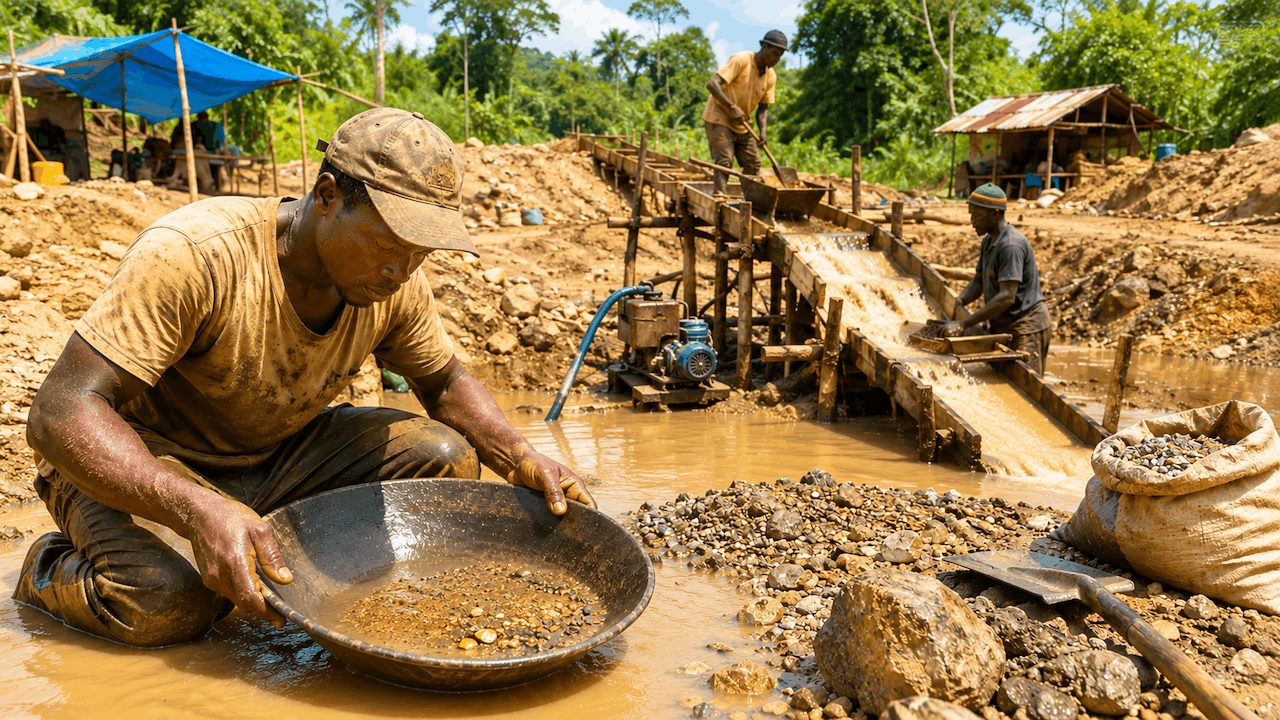
(Mike Maharrey, Money Metals News Service) Artisanal and small-scale mining (ASM) is becoming an increasingly important source of global gold supply.
Artisanal mines are small-scale operations generally run by individuals, families, or small groups using simple tools and minimal mechanization.
The sharply higher gold price has increased the profitability of small-scale mines over the last couple of years. The lack of employment opportunities in some countries has also driven people into mining out of necessity.
According to Metals Focus analysts, increasing technical expertise, wider access to equipment, and increasing demand from some refiners have also provided the ASM sector with a boost.
Meanwhile, several emerging market central banks have committed to buying gold from small-scale operations, securing a stable source of gold for the central banks and a reliable buyer for artisanal operators.
In 2016, ASM produced about 20 percent of the global gold output. In 2025, its share had increased to 24 percent.
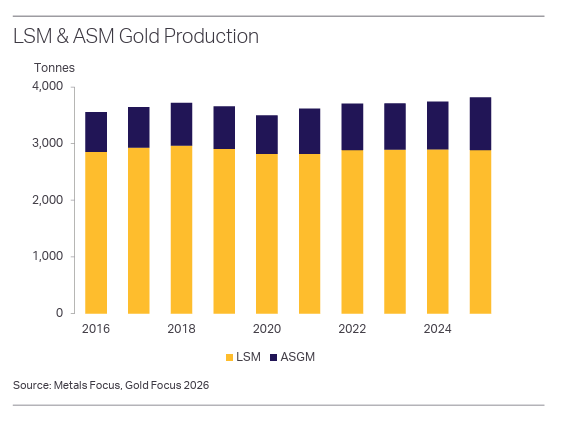
Based on preliminary data, ASM operations produced 932 tonnes of gold in 2025, a 10 percent year-on-year increase.
Where Are the Small-Scale Gold Mines?
ASM operations tend to be clustered in emerging market countries where mining provides a viable income in an economy otherwise lacking high-paying jobs.
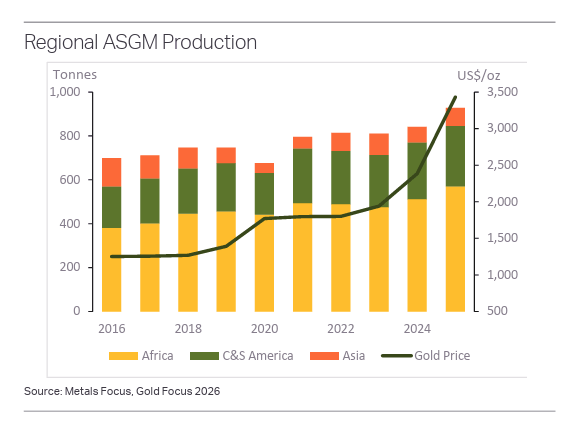
Small-scale and artisanal mines in Ghana lead the world in ASM production. Ghana ranks as Africa’s top gold producer and the world’s sixth-largest. In 2024, the country produced around 4.9 million ounces of the yellow metal.
Last year, small-scale mines in Ghana produced 102 tonnes of gold, outstripping the large-scale operations for the first time since 2010.
Small-scale mines operate with little oversight. The Ghanaian government is trying to change that. Earlier this year, the government announced a scheme to buy 127 tonnes of gold from “artisanal” and small-scale mining (ASM) every year.
Under the new government policy, the Ghana Gold Board (GoldBod) will purchase a minimum of 2.45 tonnes of ASM gold every week. According to Reuters, the government board will “consolidate purchases into a formal pipeline targeting more than $20 billion of annual inflows.”
Ghana’s Minister of Finance, Cassiel Ato Forson, said that under the new rules, GoldBod will negotiate offtake agreements and sell the gold it procures through official channels. The board will also be authorized to raise financing to hold three to four weeks of gold supply and deploy derivative and hedging tools to manage risk.
GoldBod was created last year to regulate the ASM sector. It serves as the sole legal aggregator, assayer, and exporter of domestically produced gold. According to Metals Focus, “GoldBod aims to strengthen oversight of the ASM market, improve traceability and reduce both smuggling and environmental degradation.”
Peru is the top ASM gold producer in South and Central America. According to Metals Focus, ASM output in Peru has surged by over 160 percent in the last decade.
“Growth has been driven by high prices and the provision of economic opportunities in low-income communities. Expansion into remote areas, such as Madre de Dios in the Amazon region, together with greater mechanization, has also supported production gains.”
Small-scale gold mining has a positive downstream economic impact. According to Metals Focus, “The rapid expansion of the sector has also supported the growth of industries servicing ASM. According to the Instituto Peruano de Economía, the number of registered gold trading and processing companies has increased by 250 percent since 2015.”
Unlike Ghana, the ASM sector remains largely unregulated in Peru.
Bolivia is another top ASM gold producer. In 2025, small-scale mines dug up an estimated 55 tonnes of gold.
Bolivia’s mining industry is dominated by mining co-ops. While legally recognized, the ASM sector remains relatively informal. According to Metals Focus, the dominance of big companies in Bolivian mining created limited incentive for formalization.
However, the country’s central bank is deeply involved in the sector. Last year, the central bank bought 17 tonnes of ASM gold, adding the metal to its reserves.
Indonesia has the largest ASM sector in Asia. Small-scale mines produced an estimated 50 tonnes of gold in 2025.
Many Indonesians turned to mining after the Asian financial crisis.
Like many countries, Indonesia is struggling to regulate small-scale mining operations. According to Metals Focus, the government recently cracked down on illegal mining operations, especially those backed by foreign investors.
“This has highlighted the scale of production occurring outside official channels. The government has introduced programs to formalize the sector and eliminate mercury use. However, most of the miners within the sector still lack key permits to operate.”
Mike Maharrey is a journalist and market analyst for Money Metals with over a decade of experience in precious metals. He holds a BS in accounting from the University of Kentucky and a BA in journalism from the University of South Florida.