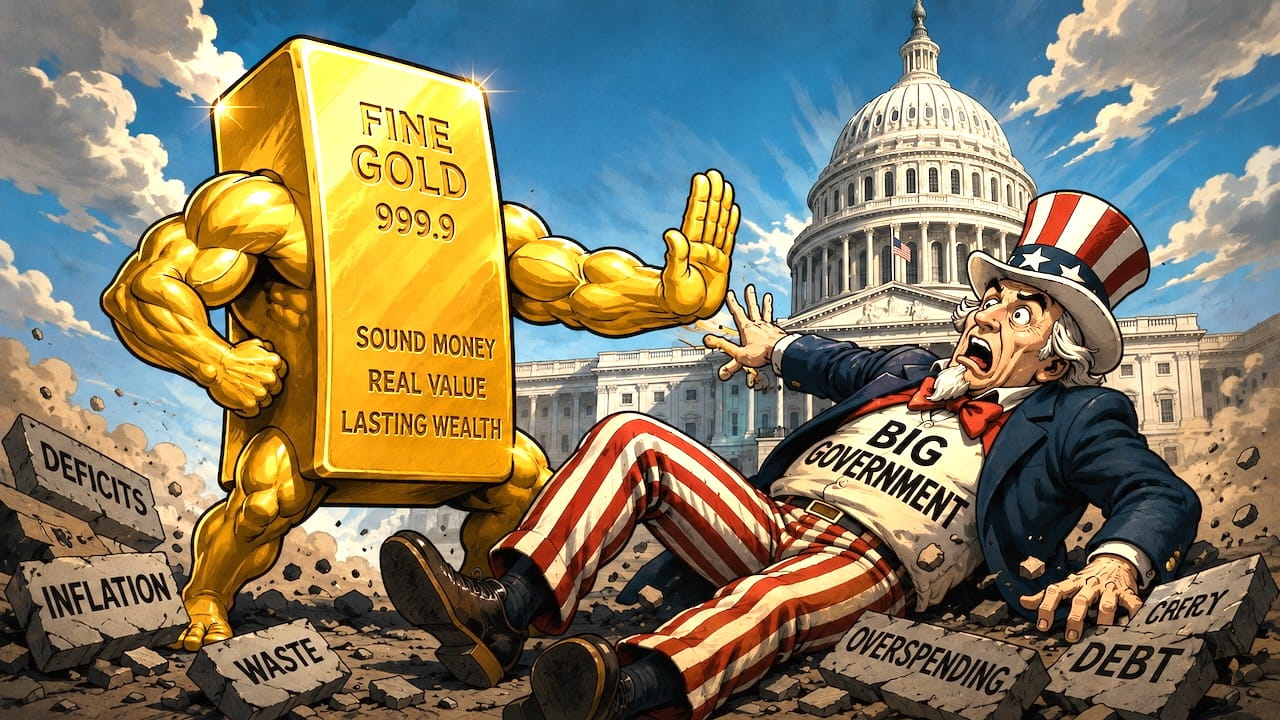
(Mike Maharrey, Money Metals News Service) We talk a lot about sound money around here. Primarily, we focus on the financial impacts of unsound fiat currency on the American people. It steals their wealth and robs them of purchasing power.
However, there is another pernicious aspect of fiat money that gets less attention.
It facilitates big government and erodes individual liberty.
Economist Ludwig von Mises believed it was imperative to understand this aspect of the fiat money regime. He said sound money is a bulwark for liberty in the same sense as constitutions and bills of rights.
“It is impossible to grasp the meaning of the idea of sound money if one does not realize that it was devised as an instrument for the protection of civil liberties against despotic inroads on the part of governments. Ideologically it belongs in the same class with political constitutions and bills of rights.”
In other words, sound money restrains governments. And without restraints, people will always use and grow government power for their own gain — to the detriment of the people.
Historian Tom Woods described how unsound money leads to a multitude of problems far beyond the realm of finances.
“The destruction of sound money around the world has laid the groundwork for the destruction of so much that is good and beautiful. There are so many bad trends — in fields as disparate as science, food, architecture, and family life, and a great many more besides — that can be traced back to bad money. And it is at the root of why no matter what we try, the world’s bloated regimes cannot be kept under control.”
This explains why inflation is so relentless.
Every once in a while, it becomes so bad that government policymakers have to make a show of bringing it down. But they don’t want to end inflation. In fact, inflation is the plan.
Simply put, the ability to print money is power.
I often say that the Federal Reserve is the engine that drives big government. That’s because in the U.S., the central bank facilitates money creation. Without the relentless money printing and its mechanizations within the bond market, the U.S. government wouldn’t be able to borrow and spend to the extent that it does. That means that without currency debasement, the government would be smaller and less intrusive.
The reality is, the American people wouldn’t accept the level of taxation necessary to maintain the warfare/welfare state. There would be a tax revolt. So, the government resorts to a less obvious tax.
The Inflation Tax!
Benjamin Franklin recognized inflation (or depreciation, as the founding generation called it) as a tax more than 200 years ago.
“The general Effect of the Depreciation among the Inhabitants of the States, has been this, that it has operated as a gradual Tax upon them. Their Business has been done and paid for by the Paper Money, and every Man has paid his Share of this Tax according to the Time he retain’d any of the Money in his Hands, and to the Depreciation within that Time. Thus it has proved a Tax on Money.”
Gouverneur Morris was another influential founding father, and he made a similar observation.
“The Resources of the Country may be drawn forth by our Paper at the same Time it must be confessed that this Paper will thereby be less valuable. After all the Debt does not increase for a certain Sterling Sum which would have paid it one Year ago will pay it now. The Depreciation in the Interim hath operated as a Tax.”
Of course, in modern America, the government doesn’t just print off $100 bills and spend them. The process is much more complex.
First, the government borrows money by issuing bonds.
The central bank can lower those borrowing costs by keeping interest rates artificially low. This also incentivizes private borrowing, which expands the money supply in a fractional reserve system. Keep in mind, inflation is not merely “rising prices.” It is the increase in money and credit. Rising prices are one symptom of this monetary inflation.
During a crisis, the Fed can get even more aggressive by launching quantitative easing (QE) operations. The central bank buys some of those bonds on the open market, creating artificial demand for U.S. debt (debt monetization). That allows the government to borrow more at a lower interest rate than it otherwise could.
Here’s the catch.
The Fed buys those bonds with money created out of thin air, increasing the money supply and effectively raising the inflation tax.
This is why government people love fiat currency. And it’s why they hate gold and silver.
If you want an example of how fiat money facilitates government spending, look no further than the pandemic era. The Federal Reserve monetized nearly all of the massive debt the federal government ran during that period, with nearly $5 trillion in QE. We paid for that stimulus a few years later at the grocery store and gas station.
This monetary malfeasance would have been impossible in a sound money system.
Simply put, sound money checks government growth by restraining borrowing and spending.
If you want limited government, freedom, and liberty, you have to support sound money. In a fiat system, government will inevitably grow, swallowing up more and more of the private economy, crowding out liberty, and grinding the citizenry into poverty. In an unbacked paper money system, the only check on the growth of government becomes the ultimate collapse of the currency.
This unholy union between big government and unsound money trickles into every area of society. As economist Saifedean Ammous argued, the incentives inherent in a fiat system drive significant societal shifts that are overwhelmingly negative.
In a letter to Jabez Bowen of Rhode Island, George Washington may have summed up the long-term impact of fiat systems best.
“Paper money has had the effect in your State that it ever will have, to ruin commerce – oppress the honest, and open a door to every species of fraud and injustice.”
Mike Maharrey is a journalist and market analyst for Money Metals with over a decade of experience in precious metals. He holds a BS in accounting from the University of Kentucky and a BA in journalism from the University of South Florida.