


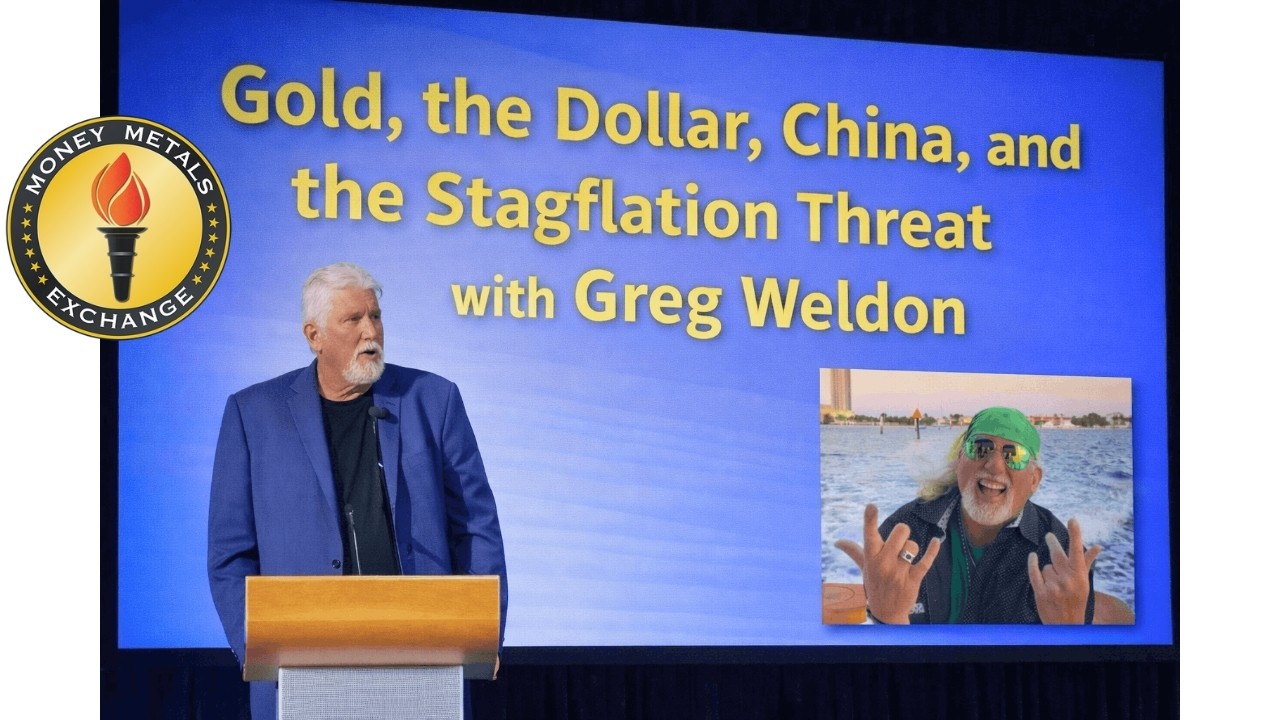
(Money Metals News Service) In the latest Money Metals podcast, host Mike Maharrey welcomed back veteran market analyst Gregory T. Weldon for a sweeping discussion on precious metals, the U.S. dollar, geopolitics, inflation, and the growing disconnect between financial markets and economic reality.
Although the two last spoke in January, Greg Weldon joked that the time since then had felt like “a whole year of trading,” thanks to relentless volatility and the speed of market-moving events.
A major focus of the episode was the recent correction in gold and silver, even as war fears involving Iran intensified. Maharrey pointed to gold trading in a rough range between $4,500 and $5,000, while silver had fluctuated between $70 and $80.
Weldon said he was not surprised by the metals’ behavior. In Weldon’s view, if military action against Iran became more than a one-off strike, the dollar was likely to rally, and that would pressure gold and silver because both markets were already technically set up for a pullback.
(Interview Starts Around 9:14 Mark)
Trading Is as Much Psychological as Technical
Weldon spent time emphasizing that trading success is not just about chart patterns or macro calls. It is also about mastering the psychological struggle that comes with taking profits and living with imperfection.
Drawing on 42 years in the markets, he said one of the hardest things any trader can do is exit a winning position. Nobody consistently sells at the exact top, and every decision carries the risk of regret.
He illustrated that point with silver. He said he got out around $98 and then watched it run to roughly $115, which naturally felt frustrating. But when silver then dropped to about $75 in a matter of days, that earlier sale suddenly looked smart.
For Weldon, that emotional back-and-forth is simply part of the business. Human nature, he said, never changes, even if markets, technology, and information flow do.
Why the Dollar Matters More Than the War
Technically, Weldon argued that both gold and silver had been tracing out classic ABC-style corrections. He said silver breaking below $65 marked what he had previously called a “back the truck up” moment, even though he admitted he had not expected it to trade under that level.
In hindsight, he said the move lined up with a double bottom, a Fibonacci target, and a broader corrective low.
Still, he repeatedly returned to the same core point: the real driver is the U.S. dollar. In his view, the war with Iran did not fundamentally change the larger setup. Instead, it temporarily bailed out the dollar at a critical technical point. He described the greenback as resting on a long-term trend line tied to the 2011 low, the 2008 double bottom, and the secular pattern that reaches back to the 1985 Plaza Accord era.
Weldon believes the dollar remains in a secular bear market. The war merely sparked a position-driven rally in a heavily shorted market.
Once investors become convinced that any ceasefire is real and likely to hold for a period of time, he expects a renewed selloff in the dollar and the beginning of the next bull leg higher in gold and silver.
The Bigger Geopolitical Shift Is Toward China
From there, Weldon broadened the conversation into a much larger geopolitical critique. He argued that the United States has alienated key allies, including NATO partners, the U.K., Canada, Spain, and Italy, while simultaneously pushing some countries into closer economic alignment with China. In his view, that has serious long-term consequences for the dollar’s role in the global system.
He tied that theme back to 2018, when China launched Shanghai crude oil futures. Weldon said he saw that moment as the start of the end for the petrodollar system. He argued that one of the biggest trades of the year remains long positions in the Chinese renminbi and in commodity-linked currencies connected to Chinese demand, including the South African rand, Brazilian real, Mexican peso, and Australian dollar.
Weldon also highlighted what he sees as an underreported political development in Taiwan. He pointed to opposition leader Cheng Li-wun, whom he described as highly educated, with ties to Wellesley, Temple Law School, and Cambridge.
According to Weldon, she helped block a move that would have expanded Taiwan’s budget deficit to 5% of GDP and enabled a major purchase of U.S. weapons. He then cited her remarks, stressing Taiwan’s deep cultural and historical ties to mainland China.
For Weldon, that development carries enormous implications because it could strengthen Beijing’s position without a shot being fired.
Stocks Look Strong, but the Disconnect Is Growing
Maharrey next turned to the stock market, posing a question from Mike Gleason: Can stocks just remain elevated forever?
Weldon said, “No,” even though markets often seem to act as though that is exactly what will happen. He compared the current environment to the periods before the 1987 crash and the 2008 financial crisis, two years he said were among the most profitable of his career because the warning signs were so obvious.
In the near term, Weldon still sees a path for stocks to rally if the dollar falls. A weaker dollar, he said, could lift equities along with gold, silver, Bitcoin, and Ethereum. He added that he sees value in both precious metals and crypto, dismissing the argument that investors must choose one or the other.
In his mind, there is room for both digital assets and tangible hard assets in a portfolio.
But beneath that possible rally, he sees a much deeper problem. He said the market’s optimism is detached from the condition of the consumer and from the broader economy. That disconnect, he believes, will eventually close.
Weldon’s Case That Stagflation Is Already Here
Weldon’s economic outlook was especially bleak when he turned to labor market data and inflation. He argued that stagflation is no longer a future risk but a present reality. He pointed to a March payroll gain of 170,000 jobs, which sounded solid at first glance, but said the internals told a far more troubling story.
The number of unemployed fell by 339,000, yet payrolls rose by only 170,000 because 488,000 people dropped out of the labor force in that same month. Over the last 12 months, Weldon said 2.4 million people have exited the labor force, while the 12-month rolling net gain in nonfarm payrolls was only 260,000. That pushed the labor force participation rate down to 61.9%, a level not seen outside the pandemic period since 1977.
He argued that if the 2.14 million people who effectively disappeared from the labor count were added back into official unemployment figures, the unemployment rate would be 5.6% instead of 4.3%. In his view, that would dramatically change how investors and policymakers think about labor market strength.
Consumers Are Getting Squeezed From Every Direction
Weldon said the consumer is already under major stress. Average hours worked fell. Earnings fell. Inflation-adjusted weekly take-home pay also fell for the month. At the same time, he said gasoline prices posted the largest single-month increase in CPI history, going back to 1967.
He added that credit card debt remains above personal savings, credit card delinquency rates are the second highest since 2008, and subprime auto loan delinquencies are at record highs. Even households earning more than $100,000, based on Fed survey data he cited, now expect income growth to only match inflation. More consumers are also saying they intend to cut spending, which he said is not something the Fed’s surveys typically show in normal times.
On the inflation front, Weldon argued that the Fed is nowhere near victory. He said that of the 81 services CPI indexes he tracks, 32% are still running above 5% year over year, and 26% are above 6%. Fully 65% are above 3%, leaving inflation far from the Fed’s 2% target.
Maharrey added that M2 money supply has been rising rapidly, while the Fed’s balance sheet is expanding again, reinforcing the concern that inflation pressures may intensify rather than fade.
A Personal Story About Silver
Toward the end of the interview, Maharrey shifted gears and asked Weldon about his first personal investment in gold or silver.
Weldon recalled that his father gave him a collection of silver bars from bullion banks in the 1970s when he was around 12 or 13 years old. He said that the gift left a lasting impression, especially because he had always been drawn to math, science, and big-picture systems.
Most of that collection was later stolen from his New Jersey home and never recovered. But one piece remains: a Bank of Ireland silver bar that he now uses as a card protector when he plays poker in World Series and World Poker Tour events.
The anecdote gave the conversation a more personal close and underscored how early exposure to hard assets can shape a person’s financial worldview for life.
The Overlooked Wild Card: Weather and Water
Before wrapping up, Weldon flagged one more major theme that he believes is being ignored: weather. He said western U.S. snow cover is at the lowest level on record, Arctic sea surface ice has fallen below the 2012 low, and NOAA sees a one-in-four chance of the worst El Niño ever. Those conditions, he warned, could have major implications for food crops and therefore for inflation.
He also mentioned water as an increasingly important issue, noting that AI data centers are heavy water users and that water-focused ETFs such as PHO and PIO have been performing well. In his telling, weather, water, and agriculture represent another powerful inflationary wildcard that is not yet fully priced into the broader market narrative.
The Bottom Line
Weldon’s message throughout the interview was consistent. He believes the next major move is a weaker dollar and higher prices for gold and silver. But that call sits within a much darker macro framework, one defined by consumer strain, sticky inflation, labor market weakness, and growing geopolitical realignment away from the United States.
For investors, the episode offered more than just a metals outlook. It was a warning that beneath the surface of strong stock indexes and resilient market sentiment, the economic foundation may be far shakier than it appears.
Stay connected with Greg Weldon on X (formerly Twitter) @WeldonLIVE.
Stay connected with Money Metals Exchange HERE.

 Veteran analyst Greg Weldon breaks down gold, the dollar, China’s rise, and why stagflation and economic stress could soon reshape markets.)