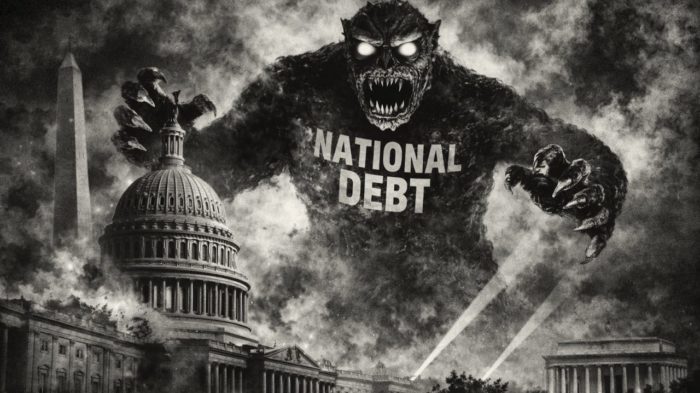
(Mike Maharrey, Money Metals News Service) On March 17, the U.S. national debt slipped above $39 trillion.
If you’re thinking, ‘Wow, it seems like we just crossed the $38 trillion threshold,’ you are correct. It was a mere 150 days ago on October 21.
As of March 17, the national debt stood at $39,016,762,910,245.14.
This happened despite a 294 percent increase in tariff revenue and the media relations program known as DOGE.
The pace of debt accumulation is staggering, and it’s accelerating
In 2020, the Congressional Budget Office (CBO) projected that the debt wouldn’t hit $37 trillion until 2030.
Oops.
Just how fast is Uncle Sam shoveling more debt into the Debt Black Hole?
Here’s some perspective. The national debt hit $34 trillion in January 2024 and $35 trillion in November 2024.
From there, it took 188 days for the debt to grow from $35 trillion to $36 trillion. It took another 265 days to reach $37 trillion. But don’t be fooled. The borrowing didn’t slow down between $36 and $37 trillion. It was just that the federal government ran up against the debt ceiling on January 1. As a result, it couldn’t borrow any money until the enactment of the “Big Beautiful Bill,” which raised the debt ceiling by $5 trillion as of July 1.
At that time, the national debt stood at $36.2 trillion. It took less than two months for the federal government to borrow more than $800 billion, pushing the debt over $37 trillion. Barely two months later, we were at $38 trillion, and here we are today, just 150 days later.
It’s hard to fathom $39 trillion. What does that even mean?
Here’s some perspective.
Every U.S. citizen would have to write a $113,615 check to pay off the debt.
Of course, a lot of people don’t pay taxes. That means the taxpayer burden is much higher. Every U.S. taxpayer would have to write a check for $357,068 to wipe out the debt. And that’s on top of the taxes we already pay!
Looking at it another way, $39 trillion is more than the annual GDP of China, Germany, India, Japan, and the UK combined.
If you’re wondering why the markets are so worried about the Federal Reserve holding interest rates higher for longer, look no further than the Debt Black Hole.
Uncle Sam must pay interest on the nearly $39 trillion debt. Interest expense has grown into the second-largest spending category in the federal budget behind only Social Security.
In February, the Treasury forked out $93.48 billion on interest expense alone. That pushed interest expense to $520 billion through the first five months of fiscal 2026. That was up 8.8 percent compared to the same period in fiscal ’25.
Interest on the national debt cost $1.2 trillion in fiscal 2025. That was up 7.3 percent over 2024.
Net interest (interest expense – interest receipts) was $79 billion in February.
Through the first five months of the fiscal year, the federal government spent more on interest on the debt than it did on national defense ($412 billion) or Medicare ($478 billion). The only higher spending category is Social Security ($678 billion).
Much of the debt currently on the books was financed at very low rates before the Federal Reserve started its hiking cycle. Every month, some of that super-low-yielding paper matures and must be replaced by bonds yielding much higher rates. And even after the Federal Reserve cut rates, Treasury yields have pushed upward as demand for U.S. debt sags.
When people say the spending is unsustainable, it feels like an understatement. However, very few people in the political class seem the least bit interested in tackling the problem. The bad news is that at some point, the problem is going to tackle them.
Mike Maharrey is a journalist and market analyst for Money Metals with over a decade of experience in precious metals. He holds a BS in accounting from the University of Kentucky and a BA in journalism from the University of South Florida.