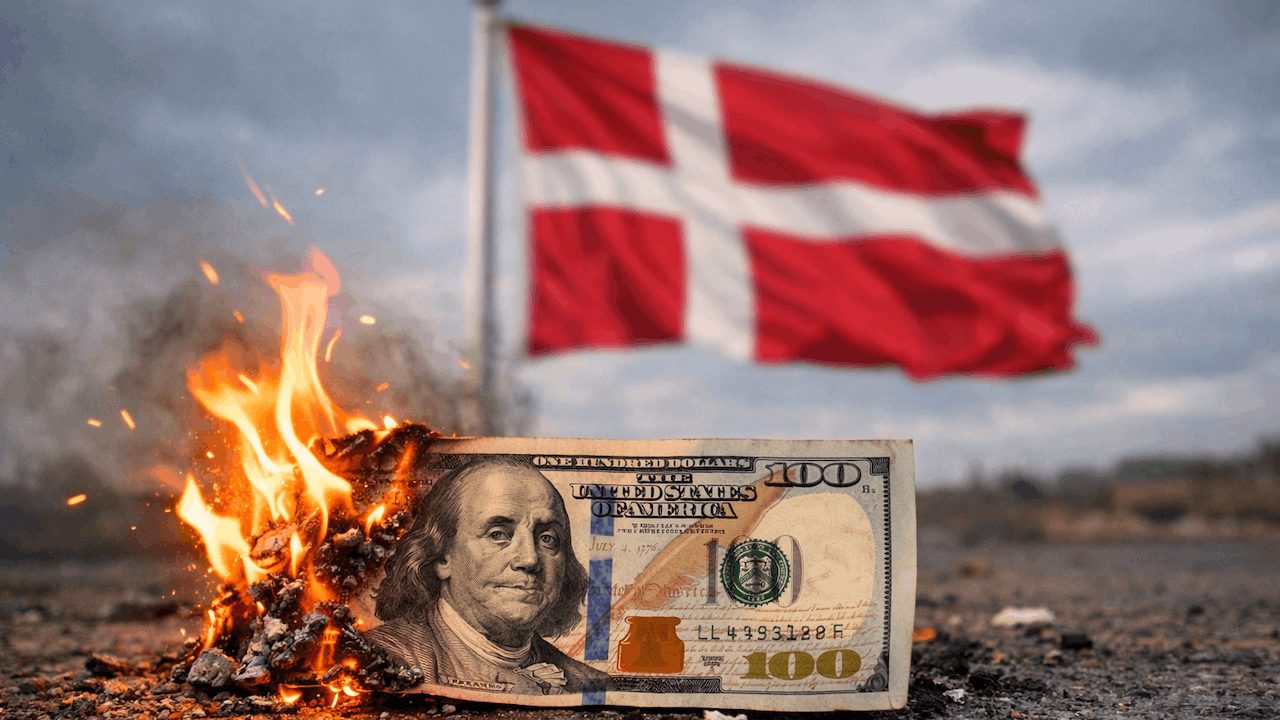
(Mike Maharrey, Money Metals News Service) This is how de-dollarization works.
Danish pension operator AkademikerPension said it is selling all of its U.S. Treasurys.
AkademikerPension investing chief Anders Schelde said the fund will divest its entire $100 million in U.S. Treasury holdings by the end of the month.
He cited concerns about the U.S. government’s fiscal malfeasance.
“The decision is rooted in the poor U.S. government finances.”
The move also comes along with increasing tensions between the U.S. and Danish governments over Greenland, but Schelde said that was not the primary motivator behind the decision.
“It is not directly related to the ongoing rift between the [U.S.] and Europe, but of course that didn’t make it more difficult to take the decision.”
Schelde said the driving concern is ever-increasing U.S. debt and decades of overspending. Last October, the national debt eclipsed $38 trillion, and despite record tariff revenue, the federal government continues to run large budget deficits.
Schelde said the U.S.′s finances made “us think that we need to make an effort to find an alternative way of conducting our liquidity and risk management.”
“Now we have found such a way and we [are] executing on that.”
The EU is trying to decide how to deal with Trump’s aggressive efforts to take Greenland as a U.S. territory. There has been talk about retaliatory tariffs, and some discussion about dumping U.S. asset holdings.
Treasury Secretary Scott Bessent downplayed threats about divestment, calling Denmark’s “irrelevant.”
“Denmark’s investment in U.S. Treasury bonds – like Denmark itself – is irrelevant.”
He noted that the divestment was less than 100 million.
“They’ve been selling Treasuries. They have for years. I’m not concerned at all.”
However, enough small amounts add up to large amounts.
Denmark currently holds just under $10 billion in U.S. debt. That’s down from about $18 billion as recently as 2021. This underscores that de-dollarization was ongoing even before the spat over Greenland.
Many countries began shifting away from the dollar when the U.S. weaponized the greenback and aggressively sanctioned Russia after it invaded Ukraine.
Collectively, the EU holds $8 trillion in Treasuries, making it the largest foreign financer of U.S. debt.
The dollar is in no danger of losing its status as the primary global reserve currency, but de-dollarization is chipping away at its dominance. It’s clear we’re moving toward a “multipolar” world where several currencies, along with gold, are making up a growing share of global reserves.
Central banks worldwide are diversifying away from dollars and buying gold. We’ve seen central bank gold buying eclipse 1,000 tonnes for three straight years. To put that into context, central bank gold reserves increased by an average of just 473 tonnes annually between 2010 and 2021.
We’ve also seen declining dollar reserves.
As of the end of last year, dollars made up 57.8 percent of global reserves. That is the lowest level since 1994, representing a 7.3 percent decline over the last decade. In 2002, dollars accounted for about 72 percent of total reserves.
Bessent’s dismissal notwithstanding, de-dollarization could cause significant problems for the U.S. government. As Bridgewater Associates founder Ray Dalio told CNBC, there is a risk to using the dollar and tariffs as a foreign policy tool (even if you think the policy is justified).
“On the other side of trade, deficits, and trade wars, there are capital and capital wars. If you take the conflicts, you can’t ignore the possibility of the capital wars. In other words, maybe there’s not the same inclination to buy … U.S. debt and so on.”
Even a modest de-dollarization spells trouble for the federal government and the U.S. economy.
In a nutshell, the United States needs the world to need dollars.
The U.S. depends on a global demand for dollars supported by its reserve status to underpin its massive government. The only reason Uncle Sam can borrow, spend, and run massive budget deficits to the extent that it does is the dollar’s role as the world’s reserve currency. It creates a built-in global demand for dollars and dollar-denominated assets. This absorbs the Federal Reserve’s money creation and helps maintain dollar strength despite the Federal Reserve’s inflationary policies.
If the world needs fewer dollars, they will begin to return to the U.S., causing a dollar glut. This will increase inflationary pressure domestically as the value of the U.S. currency further depreciates. In the worst-case scenario, the dollar could collapse completely, leading to hyperinflation.
Mike Maharrey is a journalist and market analyst for Money Metals with over a decade of experience in precious metals. He holds a BS in accounting from the University of Kentucky and a BA in journalism from the University of South Florida.