(Ben Sellers, Headline USA) America’s fleeting interest in soccer may once again have abated following a humiliating World Cup defeat to Belgium last Monday, in a game that saw President Donald Trump become personally involved over a red-card dispute.
But the high-profile flop in the first elimination round was not the only indignity that the U.S. athletes must endure.
A collective bargaining agreement means that the team will have to share its $16 million prize pot (minus a 20% cut for the U.S. Men’s Soccer organization) with the U.S. women’s team.
“The remaining 80 percent is split evenly between the men’s and women’s player pools, meaning each team is set to receive $6.4 million from the USMNT’s run,” the New York Post reported.
That puts the estimated takeaway for each player on the two teams’ 26-man -person rosters at $246,153. However, since there is no finalized roster for the women’s team, which will vie for its fifth World Cup championship next year in Brazil, those payouts will remain in escrow for now.
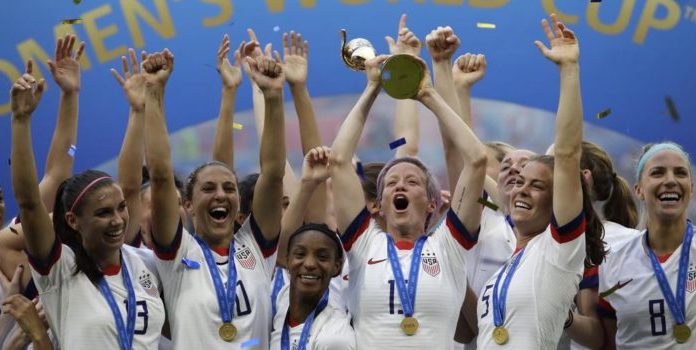
The women’s success in the quadrennial tournament gave them extra leverage to demand the pay gap be closed after their 2019 championship title. By contrast, the men’s team has never won the tournament and last made it to the round of 16 in 2002.
But the men’s matches historically have drawn greater viewership. The loss to Belgium saw a U.S. television audience exceeding 45 million viewers, while the highest-rated women’s game, the 2015 World Cup final, saw the audience peak at just 26.7 million.
For winning the entire tournament in 2019, the women’s team received a total of $4 million from the $30 million overall that the league took in.
Despite the attempt at pay parity, critics such as The Spectator’s Melissa Chen noted that the agreement flies in the face of one of capitalism’s central tenets — the importance of market value.
The US men's national soccer team is being subjected to the same kind of legalized plunder that defines too many divorce proceedings in this country.
After grinding through qualifiers, earning their spot in the World Cup, and generating the massive FIFA payout that only the… https://t.co/ZnSJjDHcbD
— Melissa Chen (@MsMelChen) July 9, 2026
“It disincentivizes excellence on the men’s side (why push harder if your windfall gets redistributed?) and removes pressure on the women’s side to grow their own commercial appeal,” Chen wrote. “Like divorce settlements that trap high-earners in perpetual support roles, this policy treats men’s soccer as a piggy bank for ‘fairness,’ not a business rewarding what fans and sponsors actually value.
Ben Sellers is a freelance writer and former editor of Headline USA. Follow him at x.com/realbensellers.