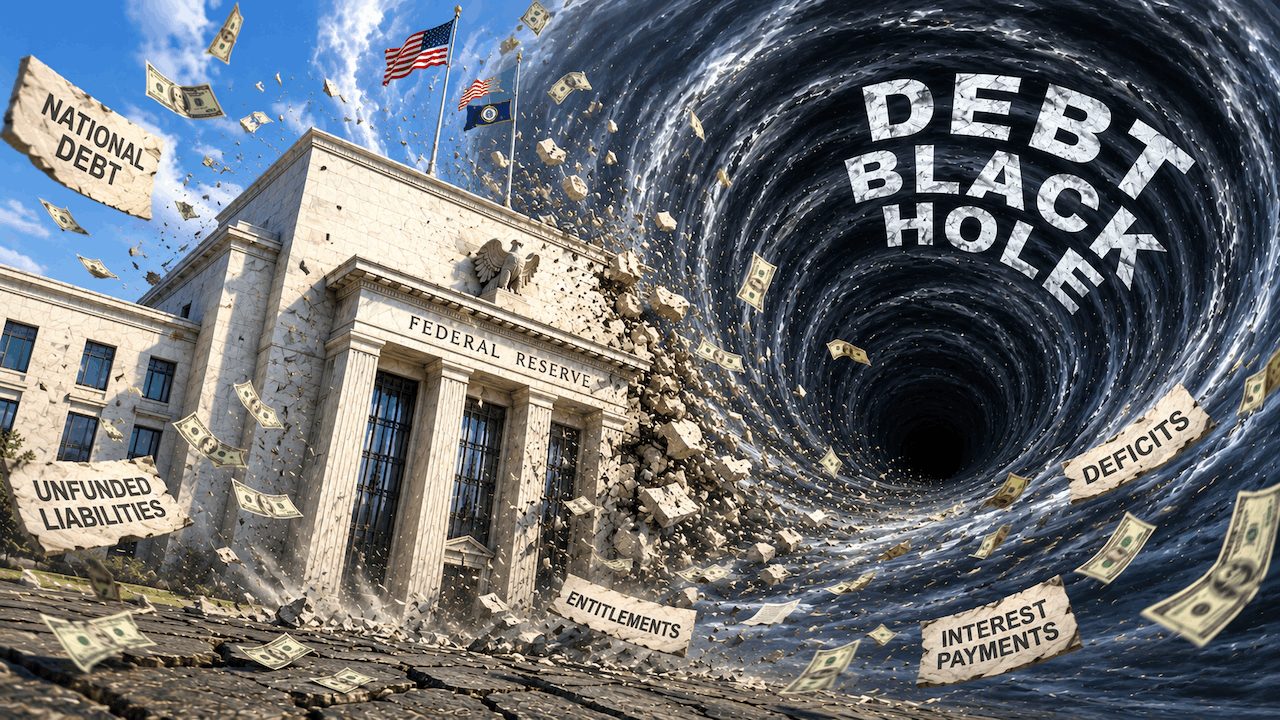
(Mike Maharrey, Money Metals News Service) Interest on the national debt set a record last year, costing $1.2 trillion. That was up 7.3 percent over 2024.
Through the first half of the current fiscal year, the federal government spent more on interest on the debt than it did on national defense ($558 billion) or Medicare ($590 billion). The only higher spending category is Social Security ($957 billion).
On top of that, American consumers are buried under record levels of debt, and corporations are leveraged to the hilt.
If the Federal Reserve follows through and hikes rates, or even if it simply holds rates higher for longer, it runs the risk of collapsing an economy that is addicted to easy money.
As I have said over and over again, the Fed is in a Catch-22. So, what they say isn’t relevant. The central bankers are limited in what they can do by the massive Debt Black Hole dominating society. They can inject the rate hike medicine and hope it doesn’t interact with the Debt Black Hole and hope it doesn’t kill the economy, or they can feed the Debt Black Hole with lower rates (and more inflation).
Conventional wisdom holds that higher rates will be bearish for gold. This is putting strong downward pressure on the yellow metal. But there is no guarantee that they will really be able to cut. And if they do, there is a high likelihood it will precipitate a recession and/or a financial crisis.
So, what’s a Fed member to do?
Talk about how policy is in the right place and crack the door open for a rate hike, apparently. But ultimately, they will have to choose. Will they give the rate-hike medicine and hope the interaction with the Debt Black Hole doesn’t kill the economy? Or do they forgo the medicine and pray inflation doesn’t kill it?
There is no good choice here. But historically, when push comes to shove, the Fed picks inflation.
The Debt Black Hole is just one dynamic that mainstream pundits are missing in their narrative surrounding gold. (The other is real interest rates.) That’s why you might be wise to stop and think hard about following the herd and selling your gold.
Mike Maharrey is a journalist and market analyst for Money Metals with over a decade of experience in precious metals. He holds a BS in accounting from the University of Kentucky and a BA in journalism from the University of South Florida.