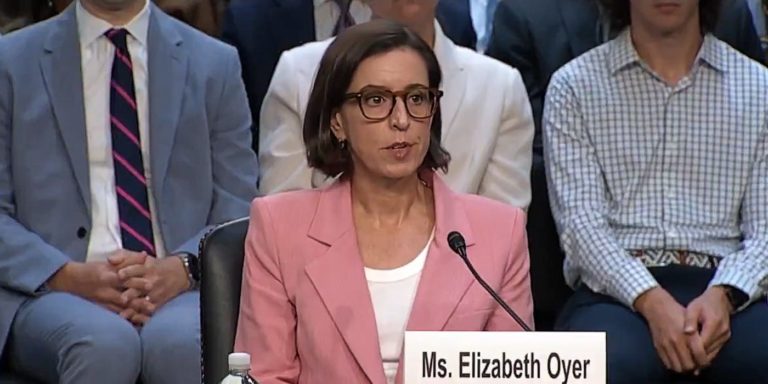
(Ben Sellers, Headline USA) Missouri’s two conservative senators both tore into former Biden administration attorney Elizabeth Oyer following after revealing that she advocated for some of the country’s most infamous death-row inmates to receive clemency.
Sen. Josh Hawley, R-Mo., grilled Oyer over the fact that she had recommended Biden reduce or commute the sentences of all 40 death row inmates, including:
Dylann Roof, who killed nine people at a black church in South Carolina
Robert Bowers, who killed 11 in a mass shooting at Pittsburgh’s Tree of Life synagogue
Dzhokhar Tsarnaev, the Boston Marathon bomber who killed three victims (including an 8-year-old boy) and two police officers.
“You went on to recommend … that the president of the United States grant clemency to murderers, rapists, and the most horrible offenders — all of them — clear death row completely out,” Hawley said. “I’m amazed you’ve been called here today.”
In a memo advocating for Roof’s release, she said the then-30-year-old killer was “not a compelling candidate” but should be freed anyway because he “suffered from anxiety.”
Roof was 21 when he shot up the prayer meeting at Charleston’s Emanuel African Methodist Episcopal Church. In a manifesto, he acknowledged as his primary motive that he was hoping to trigger a race war.
Eric Schmitt, Hawley’s fellow Missouri senator (and previously his successor as the state’s attorney general), continued the grilling, providing the receipts in the form of a 73-page memo that quoted Oyer, saying she endorsed a “categorical” commutation as the “simplest and most efficient approach” for emptying out federal prisons without facing criticism or political fallout for any one particular pardon.
On November 4, 2024, in a 73-page memorandum, Liz Oyer recommended that all 40 federal death row inmates receive commutations. A clean sweep. pic.twitter.com/0JidA93CAo
— Senator Eric Schmitt (@SenEricSchmitt) July 16, 2026
However, Biden himself has acknowledged that he did not personally sign many of the pardons, delegating the decision-making and authorization to others who used his autopen.
Some, including President Donald Trump, have argued that his failure to personally review the orders, allowing others to usurp his executive power, may invalidate the pardons.
Ben Sellers is a freelance writer and former editor of Headline USA. Follow him atx.com/realbensellers.
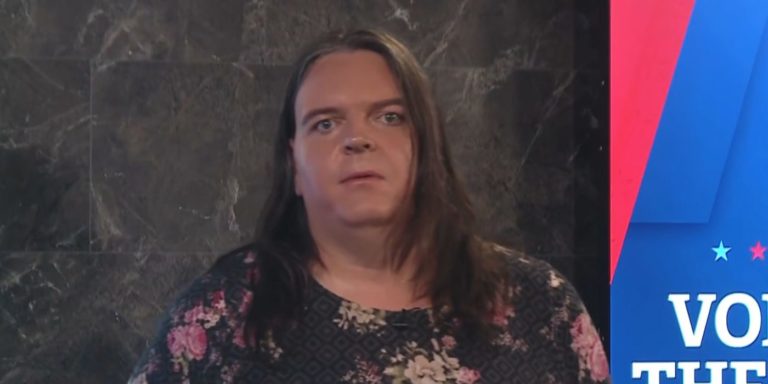
(Ben Sellers, Headline USA) Social media exploded following a Democratic debate for the special primary to replace disgraced Maine senatorial candidate Graham Platner.
MODERATOR: "What qualifications do you have to serve in the U.S. Senate?"
At least one candidate appeared to be a step backward from the alleged Nazi rapist, who was recently forced out by powerful elites within his own party after his poll numbers began to drop.
Office-seeker Ashley Webb cited prior failed campaigns as the top qualification for holding office.
“I ran for office several times. Didn’t win, but I did run,” Webb said. “And then, um, I’m a songwriter, and then I write my own books, and then, I suppose my transparency — I wouldn’t lie to the people, and I wouldn’t deceive the people like we’re being deceived right now.”
Many speculated, though, that that full-figured lady in a floral dress and husky voice might be deceiving the public on at least one important detail.
I can reveal the real identity of "Ashley" Webb, the Maine trans leftist running to replace Graham Platner as the Democrat nominee for U.S. Senate.
His real name is James Charles Webb, and he was born in August 1983.
In fact, some accused Webb of having touched up an author photo used to promote the memoir I Am Ashley with help from artificial intelligence.
A transgender Democrat vying to be the Senator for Maine in the wake of Graham Platner stepping down was caught out using an exceptionally flattering AI image of herself to promote her memoir. It was after the debate that social media users found that Webb has a memoir, titled… pic.twitter.com/6jScORiYBi
Webb subsequently acknowledged being a biological male, suggesting that, if elected as the second openly transgender lawmaker to Congress (and first in the U.S. Senate), the candidate would make the LGBT agenda a top priority.
“With the trans community, like, we’re being dehumanized,” Webb said. “They say we want to hurt people. I don’t want to hurt anybody; I just want to use the bathroom. And if they want me to use the men’s room, I will, but I don’t want to be assaulted.”
There is no evidence that Webb would be sexually assaulted while using the men’s restroom, unless perhaps Platner were in it.
However, Webb did cause many to salivate while addressing his plan to rein in the government’s profligate spending.
“I believe they called it pork bellying,” Webb said. “By cutting out the pork bellying from all the bills, sure that would save a lot of money as well…”
Checking in on the Maine Senate Debate:
“I believe they called it pork bellying by cutting out the pork belly from all the bills, sure that would save a lot of money as well…” pic.twitter.com/Gv66Ks43rh
Despite calling for “unity” at times — perhaps referring to the intra-party turmoil Democrats are experiencing amid the Platner fallout, Webb promised to be a strident voice in opposition to Trump administration policies.
“I suppose the biggest thing is, like, I’m just an angry citizen now, and if I got elected I’d be an angry senator,” Webb said.
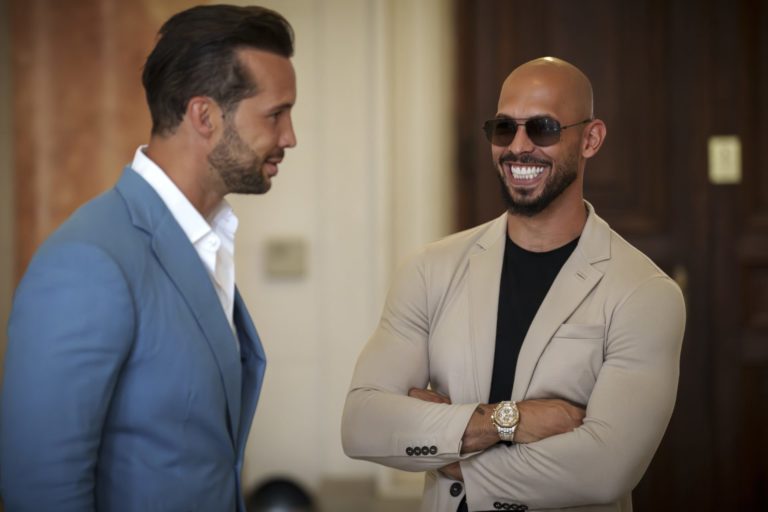
(Headline USA) Influencer brothers Andrew and Tristan Tate, whose social media empire promoting wealth, male dominance and misogyny has made them among the world’s most polarizing internet personalities, were arrested Saturday in Miami as British authorities sought their extradition on rape and sex trafficking charges.
The brothers were taken into custody by the U.S. Marshals Service on a sealed warrant, placing the United States at the center of an international legal saga that has stretched from Romania to Britain.
STATEMENT OF JOSEPH D. MCBRIDE, ATTORNEY FOR ANDREW AND TRISTAN TATE
The world knows Andrew and Tristan Tate are innocent. Their enemies know it best of all. That is exactly why they have been attacked.
Britain is seeking their extradition on rape and trafficking charges
British prosecutors announced Saturday that they were seeking the brothers’ extradition on charges alleging they raped and trafficked women between 2010 and 2017.
The dual U.S. and British citizens moved to Romania in 2016. They were arrested there in 2022, accused of participating in schemes to lure women for sexual exploitation. They denied those allegations and the Romanian case hasn’t gone forward because of legal and procedural problems.
Last year, they were allowed to leave Romania and flew to Florida on a private jet.
The brothers are expected to appear in Miami’s federal court early next week, according to a person familiar with the matter who spoke to on the condition of anonymity to discuss sensitive law enforcement operations.
The pending charges in the United Kingdom accused the brothers of abusing women in an area north of London, where they grew up. Their lawyers had said they denied the allegations.
Joseph McBride, an attorney representing the Tate brothers, said in a phone interview Saturday evening that he has not been able to speak with his clients but called the new charges out of the U.K. “filth and slander” intended to derail defamation lawsuits filed by the brothers in the U.S.
“They’re pulling out all the stops to make sure these guys never get their day in court,” McBride said.
“We are confident that once a competent judge sees the facts, and once the Department of Justice confronts this egregious abuse of its own authority, Andrew and Tristan Tate will walk free. America does not do Britain’s political dirty work.”
Tate has been banned from social media platforms for ‘hate speech’
Andrew Tate, 39, first reached a mainstream audience as a contestant on the U.K. reality television show “Big Brother” in 2016. He was removed from the show when a video surfaced that appeared to show Tate assaulting a woman. He and his brother Tristan Tate, 38, are vocal supporters of U.S. President Donald Trump.
Andrew Tate has amassed over 10 million followers on X but has been banned from platforms like YouTube, TikTok and Instagram for violating “hate speech” guidelines.
The Tate brothers have consistently denied allegations of abuse and human trafficking, claiming that violent and misogynistic statements have been taken out of context or were intended as jokes.
In a statement Saturday, the U.K.’s Crown Prosecution Services said that in addition to the charges publicly announced against the brothers in 2025, involving alleged crimes against three women, it was bringing a total of 38 new charges related to “four further victims.”
Both brothers are accused of rape and human trafficking. Andrew Tate faces an additional charge of profiting from prostitution, and 19 charges “for offences relating to indecent images of a child and extreme pornography,” according to U.K. authorities.
(Headline USA) The U.S. military on Saturday announced its first troop deaths due to direct Iranian fire since the opening days of the war, saying two were killed and another was missing in an attack on a base in Jordan.
They were killed Friday as the U.S. and partner forces defended against ballistic missile and drone attacks, a statement said. Four other service members were medically evacuated to Jordanian hospitals and later discharged. The dead were not identified.
Since the war began, 16 U.S. service members have been killed and over 430 wounded.
Minutes earlier, Iran’s supreme leader warned of “unforgettable lessons” if the U.S. keeps attacking the Islamic Republic. The remarks read out on state TV and attributed to Mojtaba Khamenei, still unseen since the war began, also called President Donald Trump’s signature “worthless and invalid.”
The comments came hours after a negotiator said Tehran was suspending its commitments to the interim deal signed about a month ago and aimed at permanently ending the fighting.
Tehran’s declarations snapped another fragile thread as the war shows no end in sight. Now Khamenei warns of “lessons” not only from Iran but its armed proxies in the region, calling them the “Axis of Resistance.”
The battle over the Strait of Hormuz has intensified in a conflict increasingly focused on control of the essential waterway that previously carried a fifth of the world’s crude oil. The strikes threaten civilians and infrastructure, including desalination plants for drinking water, while the global economy again is on alert.
The U.S. has violated its commitments under the deal that was signed about a month ago and now Iran is “no longer implementing them,” Kazem Gharibabadi, Iran’s deputy foreign minister, told state TV.
There was no new word on mediation efforts.
Kuwait sees the most striking damage
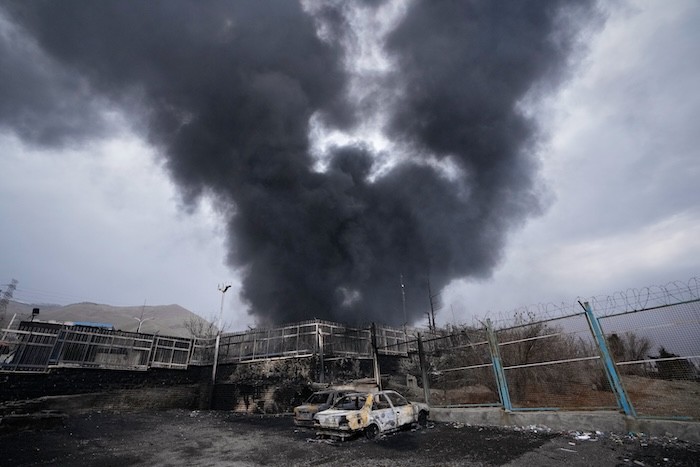
The most significant damage from Iranian strikes on Saturday occurred in Kuwait, where a water desalination plant and an oil facility were hit, according to the Kuwait authorities and the Kuwait Petroleum Corporation. Both declined to provide locations.
The strikes injured several people at the oil facility and caused a fire at the desalination plant, forcing several power generation units offline. It was the second attack against a desalination plant in two days in the tiny desert nation that depends on desalination for 90% of its drinking water.
Several firefighters and a worker were injured while battling two other blazes sparked by Iranian strikes, according to the Kuwait Fire Force. Kuwait briefly closed its airspace due to missile threats, and Kuwait Airways said it was rescheduling most flights to and from the capital.
Meanwhile, Iraq said it shot down attack drones over the city of Irbil. Jordan’s state-run Petra news agency said the kingdom’s air defense systems had downed Iranian missiles, while air sirens sounded multiple times in Bahrain throughout the day and in Saudi Arabia in the morning, according to their governments.
The secretary general of the six-nation Gulf Cooperation Council, Jasem Mohamed al-Budaiwi, accused Iran of war crimes for strikes on infrastructure and civilian facilities.
US strikes hit infrastructure in Iran
The U.S. Central Command said early Saturday that its seventh straight night of strikes hit “surveillance sites, military logistics infrastructure, underground weapons storage, and maritime capabilities.”
U.S. airstrikes hit an electricity and desalination plant in Iran’s southern Hormozgan province, Iranian state TV reported. IRNA said the Bonji desalination plant was destroyed, cutting off water supplies to about 10,000 people, and that a desalination plant on strategic Qeshm Island inside the strait was damaged.
Overnight strikes damaged two tunnels and a bridge, disrupting one of the main highways toward Bandar Abbas, Iran’s main port that sits near the narrowest part of the strait, according to Iran’s state-run news agency. IRNA said three bridges were hit Saturday, including one on a route to Bandar Abbas.
Iran acknowledged “attacks on power infrastructure” during the U.S. airstrikes for the first time Friday when its Energy Ministry issued a call for people to use less power in southern provinces “experiencing extreme heat.” It did not specify what was hit.
Iranian authorities said at least 50 people have been killed and more than 500 wounded in U.S. strikes in the past three weeks, including eight killed in a strike on a bridge Friday.
Iran and US vie for Strait of Hormuz
Iran effectively closed the strait to shipping traffic after the war started with U.S. and Israeli strikes on Feb. 28. That sent the price of oil soaring and has given Tehran significant leverage in negotiations.
Iran has said the strait must be under its sole control and that vessels should pay fees to Tehran, even though the world for decades has considered it an international waterway. It fired on ships on recent days. Crossings through the strait fell to a three-week low, according to an international shipping tracker.
Trump has resumed threats to target power stations and bridges to try to compel Iran to loosen its hold. The U.S. in the past week reimposed a naval blockade on Iranian ports to halt its shipments of crude oil.
A growing amount of the region’s energy is being shipped through pipelines, but not nearly enough to offset the decline in shipping.
Before the war began, the U.S. had been in talks with Iran over its nuclear program. Trump now faces political pressure to end the war and avoid the kind of prolonged Middle East conflict he had campaigned against.
(Headline USA) A father and son are expected to face federal kidnapping charges after they zip-tied two U.S. Forest Service employees and held them at gunpoint inside a trailer in Northern California near Mt. Shasta.
Forest Service Chief Tom Schultz said the two workers were conducting routine field operations in the Shasta-Trinity National Forest when they were taken Thursday. They were released early Friday morning after being held for more than 12 hours near Gunboot Lake.
“I want to say how profoundly grateful and relieved that we are, that our two employees were released safely. Their well-being continues to be our highest priority,” Schultz said.
The 49-year-old suspect and his adult son surrendered around 2:30 a.m. Friday and walked out of the trailer carrying an assault rifle and knives. He also told authorities he had grenades.
Yesterday and into the early morning hours of today, the FBI responded to a hostage situation in Shasta-Trinity National Forest in Redding, CA – where two individuals took two U.S. Forest Service biologists as hostages.
— FBI Director Kash Patel (@FBIDirectorKash) July 18, 2026
Shortly after deputies from the Siskiyou County Sheriff’s office reached the remote area around noon Thursday they deployed drones to help locate the trailer and started calling additional law enforcement agencies, including the FBI, for help.
FBI Sacramento acting Special Agent in Charge Brian Tosh said it’s fortunate no one was hurt during the standoff.
“Crisis situations like this don’t often result in everyone leaving the scene safely,” Tosh said.
U.S. Attorney Eric Grant said he plans to charge both men with kidnapping federal employees, but no charges were listed in online court records Saturday afternoon.
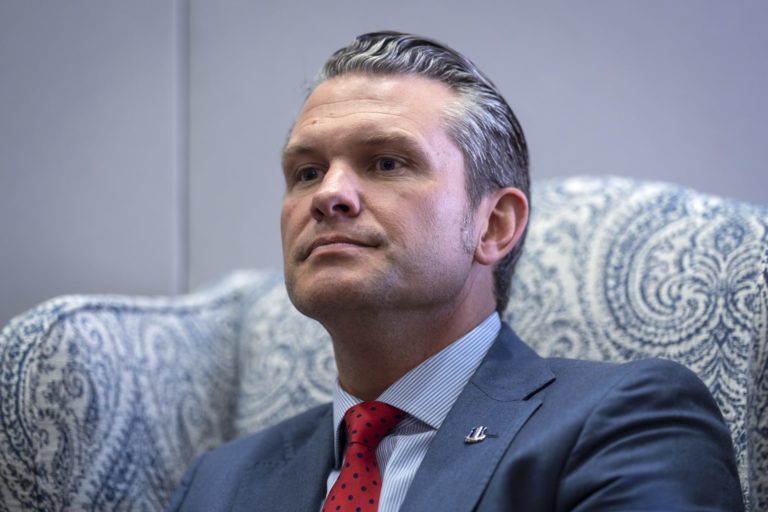
(Brett Rowland, The Center Square) The Department of War is mandating annual testosterone screening for every active-duty and reserve service member age 30 and older, a mandate affecting about 2 million troops. The Ddepartment declined to say how much the program will cost taxpayers or how it will determine whether the screening improves military readiness.
Secretary of War Pete Hegseth ordered the screening in a July 15 memo, citing research on “Operator Syndrome” among special operations forces as justification for expanding testosterone testing across the force. The Under Secretary of War for Personnel and Readiness has until Aug. 15 to update formal policy. Service members under 30 can request the screening voluntarily.
In a video message, Hegseth said the program is not “about artificial enhancement” and that any resulting treatment would be voluntary. The memo says the screening will let the department “establish a comprehensive baseline” and offer testosterone therapy to those diagnosed with testosterone deficiency.
Chief Pentagon Spokesman Sean Parnell said the effort will help the department “sustain a healthy, capable, and decisively dominant fighting force.”
Asked about cost and effectiveness metrics, a Department of War official said on background that the agency had “nothing additional to provide” beyond Hegseth’s video message and Parnell’s statement. The official also declined to say whether female service members would have access to hormone therapy if diagnosed with a deficiency.
Dr. Richard Auchus, an endocrinologist at the University of Michigan, said he saw no medical justification for the age-30 threshold.
“I can’t think of a medical one, so it must be a policy one,” he told The Center Square.
Pentagon data show roughly a third of active-duty personnel and about half of reservists are at least 31 years old, the closest age breakdown available in the department’s published demographics to the new mandate’s 30-and-older threshold.
Auchus said he was not aware of any research showing that testosterone therapy improves military readiness in men without a diagnosed medical condition.
“I fail to see how they’ll be a better fighting force,” he said.
The memo’s rationale draws on “Operator Syndrome,” a term coined in 2020 by psychologist Chris Frueh to describe a cluster of health problems in special operations forces, including brain injury, sleep disruption and hormonal dysfunction.
The concept was initially developed from informal consultations with more than 50 special operations personnel before later research sought to evaluate it further.
A follow-up study led by researchers at Stanford University and the VA Palo Alto Health Care System, published this year in The Lancet Regional Health, examined 222 special operations personnel with documented brain injuries, virtually all men. In that population, researchers found low testosterone in 27.9% of participants.
That study classified testosterone levels below 400 nanograms per deciliter as low, higher than the 250 to 270 ng/dL threshold commonly used to diagnose testosterone deficiency in clinical practice, Auchus said. Using a higher cutoff would classify more men as having low testosterone than standard testing.
Frueh said he could not answer questions about cost or effectiveness, deferring to endocrinologists.
He also cautioned against broadly prescribing testosterone.
“This shouldn’t be, and I don’t believe is, about just handing out testosterone like M&Ms to soldiers,” he told The Center Square.
Frueh said the policy could help service members and improve readiness, but only if paired with attention to sleep and pain management.
“I think if it’s done well, it absolutely could lead to an improvement,” he said.
The memo does not specify how positive screening results would be confirmed before treatment begins. In standard practice, Auchus said, an initial screening test is followed by confirmatory testing to rule out false positives before any diagnosis is made.
A 2022 study funded by the U.S. Army tested whether testosterone could offset performance losses during a simulated 20-day military operation. Soldiers who received a single testosterone dose preserved more muscle mass than those receiving placebo but showed no improvement in strength, power or aerobic capacity.
The Endocrine Society, a national group of physicians who specialize in hormone disorders, said in a statement there is “insufficient evidence to support a general recommendation to perform population-level screening for hypogonadism in asymptomatic men.”
Symptomatic testosterone deficiency affects an estimated 5.6% of men age 30 to 79 in the general population, according to a 2007 study published in the Journal of Clinical Endocrinology & Metabolism.
The Endocrine Society cited the TRAVERSE trials, involving more than 5,200 men, which found no increased heart attack or stroke risk from testosterone therapy, but showed about a 50% relative increase in pulmonary embolism and more bone fractures among men taking it.
The department has not identified outside experts advising the program, explained why it selected age 30 as the screening threshold, released a cost estimate or said how it will determine whether mandatory testing improves military readiness.
(José Niño, Headline USA) Congress got its housing overhaul across the line at 12 a.m. Saturday, and the president never touched it.CBS News reported that President Donald Trump kept his signature off the measure as leverage against the Senate, which has refused to move his elections bill, the SAVE America Act.
Lawmakers built the21st Century ROAD to Housing Act across party lines, and CBS News described it as the most far reaching housing legislation in a generation. The law pushes builders to add supply, pulls costs downward and blocks big institutional buyers from scooping up certain single family homes.
The White House originally planned a party. According to CBS, Trump had booked a Capitol Hill signing last month, days after theSenate and theHouse approved the package by lopsided bipartisan votes. CBS reported that hepulled the plug with just hours left on the clock and announced he would freeze the bill until Congress delivered his elections legislation, which would clamp down on voting and voter registration.
“I will not sign the Housing Bill, which has been fully approved by Congress and sent to the White House, in PROTEST over the fact that the United States Senate is not capable of passing THE SAVE AMERICA ACT, which is polling at 97% with the Republican Party, and very high with the non-politician Dumocrats,” he wrote.
His protest changed nothing. CBS noted that the Constitution turns a bill into law automatically once 10 days pass, Sundays not counted, if the president skips both the signature and the veto. Speaker Mike Johnson triggered that countdown on June 29.
Sen. Elizabeth Warren, D-Mass., who steered the bill through the Senate, went after him hard.
“At the stroke of midnight, a huge bipartisan bill to lower housing costs became law without the President’s signature. Why did President Trump sit on the landmark housing bill for more than 2 weeks? Maybe because there was nothing in it for him personally — no gold-encrusted ballroom, no Qatari jet, no $2 billion crypto deal. Nothing in the 21st Century ROAD to Housing except ways to make housing more affordable,” she said. “Donald Trump couldn’t pick up the pen because he just isn’t interested in lowering costs for American families.”
Trump brushed the housing law off as “a yawn” and told reporters, “I think it’s so unimportant” beside his campaign to end mail voting and require citizenship proof and photo ID.
Johnson tried to smooth it over, telling reporters Trump “has not read through every line of that piece of legislation.” He said he pressed Trump to sign using “the fattest black marker you have.”
“So I hope he does sign it. If he doesn’t, it’s still law; we’ll still celebrate it,” Johnson said. “But he’s trying to make a point and I think he’s making it very effectively.”
José Niño is the deputy editor of Headline USA. Follow him at x.com/JoseAlNino
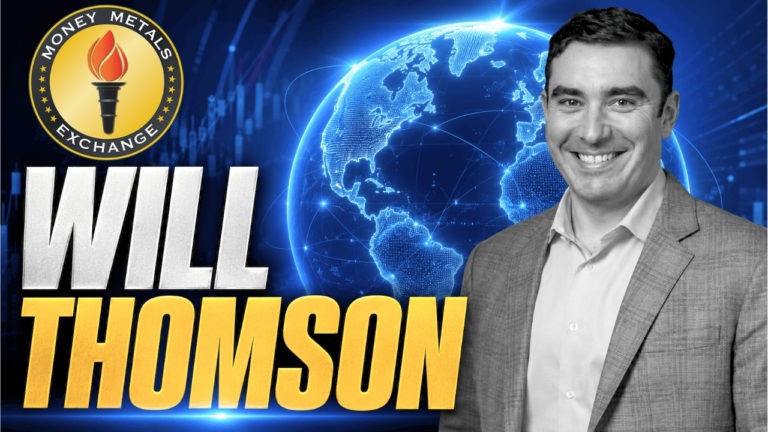
Joining Mike Maharrey on the Money Metals podcast, Thomson argued that investors are once again pricing bonds based on traditional fundamentals such as government debt, geopolitical conflict, political stability, inflation, and fiscal discipline. He believes these forces are fundamentally changing the global investment landscape, with important implications for bonds, stocks, gold, and portfolio construction.
(Interview Starts Around 8:05 Mark)
From Afghanistan to Global Markets
Before discussing financial markets, Thomson shared his unique professional background. As founder and portfolio manager of Massif Capital, he oversees a global long-short equity strategy focused on energy, materials, industrials, and infrastructure rather than the technology-heavy portfolios common today.
Before launching Massif Capital, Thomson worked in investment banking, private equity, and political risk insurance at Lloyd’s of London, and even served as a strategic advisor on economic issues in Afghanistan. His academic work also focused on integrating political risk into asset valuation, helping shape the framework he now applies to global financial markets.
Geography Is Once Again Pricing Money
Thomson’s central argument is that investors are entering a new financial regime.
Following the 2008 financial crisis, central banks largely dictated the price of money through monetary policy. Investors paid relatively little attention to government debt burdens, geopolitical conflict, or political stability because inflation remained subdued and globalization reduced many traditional risks.
Today, Thomson believes those assumptions no longer hold.
He argues that long-term interest rates are increasingly reflecting sovereign debt levels, fiscal quality, military conflicts, domestic politics, and inflationary pressures. Countries engaged in costly conflicts or carrying unsustainable debt loads are now seeing those risks reflected more directly in borrowing costs.
Rather than relying solely on central bank policy, investors are once again evaluating governments the same way they evaluate businesses—by assessing overall financial health and long-term stability.
Historically, bonds often appreciated when stocks declined, helping smooth portfolio volatility. Thomson argues that the relationship has weakened considerably.
Instead of moving in opposite directions, bonds and equities have increasingly moved together as higher long-term interest rates simultaneously pressure both markets.
This creates a more challenging investment environment because bonds may no longer provide the diversification investors have relied upon for decades.
Thomson explained that businesses whose expected profits lie far into the future—particularly many high-growth technology companies—become significantly more sensitive to rising discount rates.
As borrowing costs increase, those future earnings become less valuable in today’s dollars, reducing overall valuations.
Meanwhile, companies generating cash flow from productive real-world assets today may prove more resilient in this environment.
Gold’s Role Continues to Grow
The conversation also explored why central banks continue accumulating gold despite higher interest rates.
Traditionally, rising rates have often pressured gold prices because investors can earn greater returns on interest-bearing assets. Thomson acknowledged that relationship but argued today’s environment is far more complicated.
He noted that governments around the world increasingly recognize that U.S. Treasury securities carry geopolitical risks. The freezing of Russian assets demonstrated that sovereign reserves can become inaccessible during geopolitical disputes.
Gold, by contrast, carries no counterparty risk.
As Thomson explained, gold remains attractive because it is “no one’s liability.” Unlike government debt, physical gold cannot default, be diluted through additional issuance, or depend upon another country’s political decisions.
Can the Federal Reserve Control Long-Term Rates?
Mike Maharrey questioned whether the Federal Reserve still possesses meaningful control over long-term interest rates.
While acknowledging the Fed retains significant influence over short-term policy rates, Thomson questioned whether markets may increasingly determine longer-term borrowing costs independently.
Given the enormous size of global bond markets, he suggested that even aggressive Federal Reserve intervention could prove less effective than many investors assume.
As fiscal concerns grow, market participants—not policymakers—may increasingly determine where long-term yields settle.
America’s Growing Debt Burden
The discussion naturally turned toward the United States’ mounting fiscal challenges.
Thomson expressed skepticism that current political institutions possess the ability to implement meaningful long-term fiscal reforms. He pointed to recurring debt ceiling debates, continuing resolutions, and repeated budget standoffs as evidence that structural fiscal problems remain unresolved.
If borrowing costs continue climbing while debt levels expand, those pressures could increasingly influence both economic growth and financial markets.
Why Quality Matters More Than Ever
Rather than focusing solely on asset allocation, Thomson encouraged investors to think more broadly about investment quality.
That means evaluating management teams, balance sheets, political environments, regulatory stability, and operational execution—not simply buying assets because they fall within a particular sector.
Drawing from nearly two decades of analyzing mining companies, Thomson emphasized that outstanding management can often determine whether an otherwise ordinary asset becomes highly successful, while poor execution can undermine even attractive projects.
In his view, understanding leadership quality, geopolitical risk, and long-term fundamentals has become increasingly important as investors navigate a more complex global economy.
Looking Ahead
Throughout the interview, Thomson argued that investors should prepare for a world where geopolitics, fiscal discipline, inflation, and sovereign debt once again drive financial markets.
Rather than assuming central banks alone determine the cost of money, he believes investors must evaluate governments, companies, and assets through a broader lens that incorporates political and economic realities.
As bond markets evolve, portfolio construction, gold ownership, and the definition of investment quality may all need to evolve alongside them.
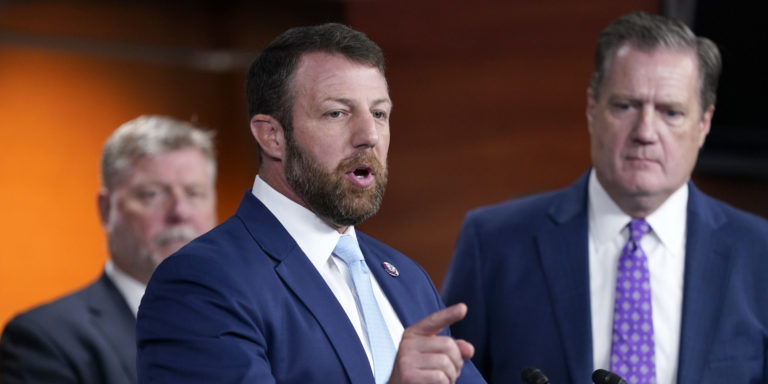
(Sarah Roderick-Fitch, The Center Square) Following allegations of foreign adversaries meddling in U.S. elections during a primetime address Thursday by President Donald Trump, Homeland Security Secretary Markwayne Mullin laid out a plan of action to secure American votes.
Mullin delivered remarks to the media Friday, equating election security to national security.
The secretary underscored that the investigations aren’t about “rehashing the 2020 election.”
“This is just exposing what took place, and to make sure it never happens again. And there’s some really easy steps that can be taken to secure our elections. And it shouldn’t be a partisan issue. This should be something that every American, regardless if you’re a Republican, you’re a Democrat, you’re an independent, you’re a Libertarian, regardless if you live in a blue state or you live in a red state, everybody should know that their vote counts,” Mullin said.
As part of the plan to secure elections, the Department of Homeland Security says it has identified 250,000 non-citizens who are registered to vote in four states: California, Pennsylvania, New Jersey and Nevada.
DHS has also worked with “proactive states” to identify 28,000 non-citizens on their voter rolls, in addition to another 400,000 deceased individuals still on voter rolls.
Mullin indicated nearly two dozen states are currently working with DHS on the Save Program to secure election integrity.
The secretary said that Iran “hacked” state voter files and “attempted to compromise” voter systems used by members of the military. He added that DHS is working with Secretary of War Pete Hegseth and the Department of War to “safeguard those systems.”
Echoing claims made by the president during his primetime address Thursday evening regarding allegations of election integrity, Mullin accused the intelligence community of withholding vital information on China’s possible involvement in meddling in elections from both Trump during his first administration and Congress, accusing the Biden administration of not disclosing the intelligence.
As part of DHS’s plan to deliver secure elections, its cybersecurity team will be releasing an “updated election infrastructure plan” to the public within 30 days. Mullin argues the 30 days will give states the necessary resources to assist on the “cyber side.”
The secretary emphasized that DHS and the Trump administration are not seeking to alter election outcomes, but rather to ensure trust in the voting system.
“DHS is well prepared to support all states, red states, blue states and local election officials ahead of the midterms. States must do their part to secure our election system, and we stand by to help. If you are an illegal or you’re voting illegally, we will hunt you down, we will find you, and we will prosecute you. The American people must have confidence in our elections. Election security is not a partisan issue,” the secretary told reporters.
Mullin also addressed concerns about whether individuals within the intelligence community under former President Joe Biden who have been accused of withholding information about elections will be held accountable.
“We are currently going through those lists. We will hold each one of them accountable,” Mullin told reporters, while underscoring they are not serving under Trump’s leadership.
During the president’s address, he announced the declassification of a trove of documents that he argues point to a massive voter data breach by China, vulnerabilities regarding electronic voting systems, and illegal voters on voter rolls.
Trump used the address to pressure Americans to contact their elected members of Congress to persuade them to vote for the Save American Act, which has become a flashpoint for Trump’s second administration.
Passage of the legislation hinges on the GOP-controlled Senate, which currently doesn’t have the 60 votes to break a filibuster. Trump has been urging Senate Republicans to tank the filibuster as the clock ticks down toward the midterm elections in November.
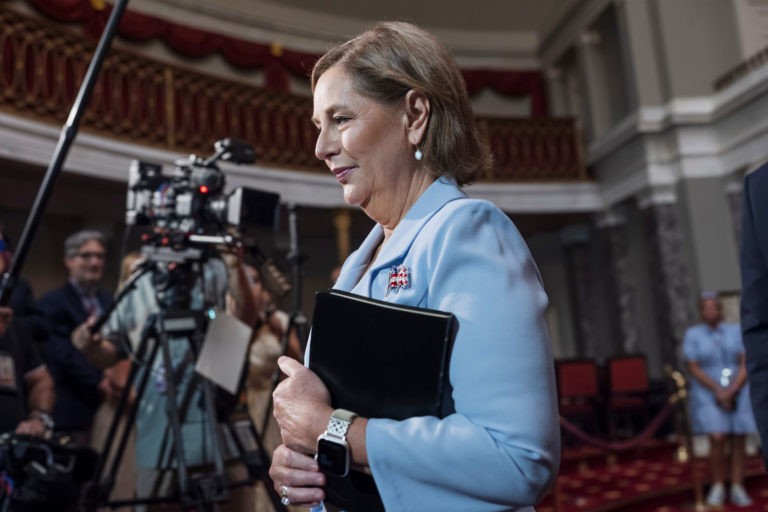
(Headline USA) President Donald Trump said Friday that Darline Graham, the sister of the late Lindsey Graham, has his support to run for a full term to replace her brother in the U.S. Senate.
He wrote on social media that she “has been a WINNER all of her life and, should she accept, has my Complete and Total Endorsement.”
“RUN, DARLINE, RUN!” Trump added.
The president said he had discussed a potential campaign with Darline Graham at the White House. Four people familiar with the deliberations, none of whom were authorized to speak publicly, had previously said that she privately expressed interest in running.
Trump’s endorsement dramatically reshapes the scramble to fill Lindsey Graham’s seat after he died last weekend. The president had previously suggested he could back a potential candidacy from Rep. Russell Fry. Several other noteworthy politicians — including Fry, Rep. Nancy Mace, Rep. Ralph Norman and Lt. Gov. Pamela Evette — have been eyeing a run.
The filing period for a special primary runs from July 21 to July 28, and the primary is scheduled for Aug. 11.
Plans for Lindsey Graham’s funeral were also announced Friday. There will be a service in Washington on July 28 and more in South Carolina on July 29.
South Carolina Gov. Henry McMaster appointed Darline Graham to serve the remainder of her brother’s term, which ends in January.
The first woman to represent the state in the Senate, Darline Graham called it “such an honor,” as dozens of her brother’s staffers and campaign advisers stood behind her, some with eyes glassy from welling tears.
“Lindsey has always been there for me. And now, I will be there for him,” she said.
Lindsey Graham died Saturday at age 71. A preliminary report from the medical examiner said he suffered a tear in his aorta.
He never married or had a family of his own, but his sister was often by his side for the political touch points of his career, speaking at events and appearing in some of his campaign ads. After both of their parents died when Darline Graham was only 13, her old brother became her legal guardian and later adopted her, to ensure his military benefits would flow to her.
In forging a relationship with Darline Graham — who is new to politics but was a constant in her brother’s political career — Trump could be angling to develop another ally to help steer his agenda through the Senate.
Although they had at times a tumultuous relationship, Lindsey Graham had been one of Trump’s top Senate confidants, and the day after his death, the president said he was “like a member of the family.”
In his announcement Monday, McMaster made no reference to Darline Graham as a placeholder or symbolic appointment.
However, a person familiar with McMaster’s thinking but unauthorized to speak publicly said the governor, in selecting Darline Graham, had never contemplated that she would run for the seat herself.
Sen. Tim Scott, another South Carolina Republican, said he would not endorse any candidate in the primary because he also serves as chairman of the National Republican Senatorial Committee.
But, he said, “as Tim Scott, the voter of South Carolina, I might indeed wade into the water at some point.”
“I think the truth of the matter is that Darline has so far been off to a remarkable start,” Scott told reporters, asking about her as a possible special primary contender. “‘Why not her?’ would be my question.”
When he died, Lindsey Graham had millions in his campaign account and was expected to raise much more heading into the general election. But those aren’t funds that Darline Graham could directly access, if she were to run, according to Bradley A. Smith, a former chairman of the Federal Election Commission.
Under federal rules, Lindsey Graham’s campaign would be limited to transferring just $2,000 to a potential Darline Graham candidacy. However, Smith said there is no limit on how much it could transfer to the National Republican Senatorial Committee, which could — thanks to a Supreme Court decision last month — “spend an unlimited amount in coordination with Darline’s campaign.”
“It can’t be earmarked for Darline’s campaign, but in those circumstances I’m sure that the party will make sure she’s not short of cash,” said Smith, now serving as a professor at Capital University Law School in Ohio.