Trump Administration Takes First Steps in Easing Sanctions On Syria

(Headline USA) The Trump administration granted Syria sweeping exemptions from sanctions Friday in a big first step toward fulfilling the president’s pledge to lift a half-century of penalties on a country shattered by 13 years of civil war.

While broad, the administration’s actions could possibly be reversed. Syrians say they need permanent relief to secure the tens of billions of dollars in investment needed to rebuild after a conflict that fragmented the country, displaced or killed millions of people, and left behind thousands of foreign fighters.

A measure by the State Department waived for six months a tough set of sanctions imposed by Congress in 2019. A Treasury Department action suspended enforcement of sanctions against anyone doing business with a range of Syrian individuals and entities, including Syria’s central bank.

Syria is now led by Ahmad al-Sharaa, a former militia commander who helped drive longtime leader Bashar Assad from power late last year.

President Donald Trump announced last week that the U.S. would roll back the heavy financial penalties in a bid to give the interim government a better chance of survival.

The Trump administration said businesses and investors are getting the protection against sanctions they need to come back to Syria, calling it “the opportunity for a fresh start.”

“The only other option was Syria becoming a failed state and civil war,” said Mouaz Moustafa, a Syrian American advocate who had campaigned for quick, broad relief. “Now there is hope for a future democratic Syria.”

The congressional sanctions, known as the Caesar Syria Civilian Protection Act, had aimed to isolate Syria’s previous rulers by effectively expelling those doing business with them from the global financial system. They specifically block postwar reconstruction, so while they can be waived for 180 days by executive order, investors are likely to be wary of reconstruction projects when sanctions could be reinstated after six months.

The Trump administration said Friday’s actions were “just one part of a broader U.S. government effort to remove the full architecture of sanctions.” Those penalties had been imposed on the Assad family for their support of Iranian-backed militias, their chemical weapons program and abuses of civilians.

Trump administration says it expects action from Syria

Secretary of State Marco Rubio said in a statement Friday that in return for sanctions relief, Trump expects “prompt action by the Syrian government on important policy priorities.”

Al-Sharaa’s own past has fueled doubts. The group that he led, Hayat Tahrir al-Sham, was originally affiliated with al-Qaida, although it later renounced ties and took a more moderate tone. It is still listed by the U.S. as a terrorist organization.

But if al-Sharaa’s government fails, the U.S. and others fear renewed conflict in Syria and a power vacuum that could allow a resurgence of the Islamic State and other extremist groups.

“If we engage them, it may work out, it may not work out. If we do not engage them, it was guaranteed to not work out,” Rubio told lawmakers this week.

Trump met al-Sharaa last week in Saudi Arabia, a day after announcing his intention to lift the sanctions: “We’re taking them all off. Good luck, Syria. Show us something special.”

Rubio said sanctions relief must start quickly because Syria’s transition government could be weeks from “collapse and a full-scale civil war of epic proportions.”

But asked by lawmakers this week what sanctions relief should look like overall, Rubio gave a one-word explanation: “Incremental.”

Moving toward permanent sanctions relief

While some sanctions can be quickly waived through executive actions like those taken Friday, Congress would have to permanently remove the penalties it imposed.

A proposal circulated among administration officials this week broadly emphasized taking all action possible, as fast as possible, according to U.S. officials familiar with the plan who were not authorized to comment publicly and spoke on condition of anonymity.

Last week, a State Department proposal laid out a three-phase road map with temporary, partial relief initially and setting sweeping conditions for Syrians to meet for any future phases of relief or permanent lifting of sanctions, one of the officials said.

Removing “Palestinian terror groups” from Syria is first on the list of conditions to get to the second phase. Supporters of sanctions relief say that might be impossible, given the subjectivity of determining which groups meet that definition and at what point they can be declared removed.

Other conditions for moving to the second phase are for the new government to take custody of detention facilities housing Islamic State fighters and to move forward on absorbing a U.S.-backed Kurdish force into the Syrian army.

To get to phase three, Syria would be required to join the Abraham Accords — normalized relations with Israel — and to prove that it had destroyed the previous government’s chemical weapons.

Israel has been suspicious of the new government, although Syrian officials have said publicly that they do not want a conflict with Israel. Since Assad fell, Israel has launched hundreds of airstrikes and seized a U.N.-patrolled buffer zone in Syria.

Adapted from reporting by the Associated Press.
MAHA Panel Unveils Root Causes of Childhood Chronic Disease

(Luis CornelioHeadline USA) The Trump administration released on Thursday a 72-page report exposing the presumed key drivers behind the childhood chronic disease crisis.

Led by the Department of Health and Human Services, the report identified poor diet, accumulation of environmental toxins, lack of physical activity, chronic stress and overmedicalization as the root causes driving the epidemic.

Its release follows Trump’s executive order creating the “Presidential Commission to Make America Healthy Again,” which was mandated to deliver a plan within 100 days.

“There is something wrong and we will not stop until we defeat the chronic disease epidemic,” Trump said at a Thursday event unveiling the commission’s findings.

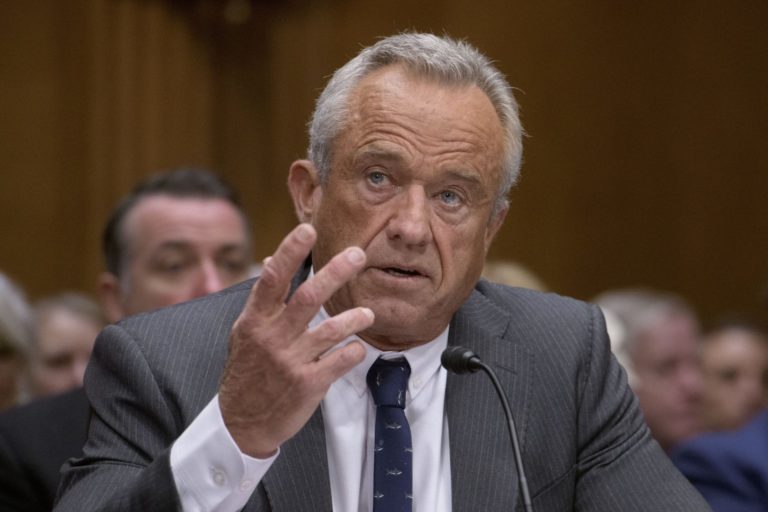
HHS Secretary Robert F. Kennedy echoed Trump’s pledge in a press statement, vowing to use science to develop “bold policies that put the health, development, and future of every child first.”

The report specifically faulted the American diet’s reliance on ultra-processed foods. This, the commission contended, has led to nutrient depletion, excess calories and exposure to harmful additives. It found that 70 percent of children’s calories come from such foods.

It also called out synthetic chemicals, as they are linked to developmental issues and chronic disease. The report calls for regulatory review to identify and eliminate potentially harmful substances.

The overmedicalization of children “often driven by conflicts of interest in medical research,” also posed a problem, the commission said, adding: “This has led to unnecessary treatments and long-term health risks.”

The commission, composed of cabinet and administration officials, now has 82 days to finish its “Make Our Children Healthy Again Strategy,” aimed at tackling the issues identified in the report.

The report’s release comes as one in five children aged six and older now struggles with obesity, a 270 percent increase since the 1970s.

Prediabetes prevalence among teens has doubled over the past two decades, while childhood cancer rates have skyrocketed by nearly 40 percent since 1975.

See the full report below.

Silver Institute: Silver Demand Surges Despite Market Headwinds

(Money Metals News Service) Amid rising geopolitical tensions, shifting energy policies, and ongoing economic uncertainty, silver remains a vital yet often underappreciated metal.

In a recent episode of the Money Metals Podcast, host Mike Maharrey spoke with Michael DiRienzo, President and CEO of the Silver Institute, to break down key insights from the 2025 World Silver Survey and examine the forces reshaping the global silver market.

(Interview Starts Around 6:26 Mark)

The Silver Institute’s Global Footprint

The Silver Institute was founded in 1971 and is now headquartered in Washington D.C. Although smaller than organizations like the World Gold Council, both in staff and funding, the Institute continues to play an outsized role in market research and silver advocacy.

Its members include major silver miners, refiners, and industrial users. Their mission centers on promoting silver through data publications, policy engagement, and educational outreach.

According to DiRienzo, the Institute has an active presence worldwide, including recent initiatives in China, India, Peru, and Mexico. It regularly participates in global conferences, with upcoming appearances scheduled for Singapore’s Asia Pacific Precious Metals Conference and October’s LBMA event.

Their research output in 2024 alone includes a report on above-ground silver stocks and upcoming studies on silver in batteries and bullion market dynamics. The Institute also stays active on social media and offers a bi-monthly newsletter to keep stakeholders informed.

2025 World Silver Survey: Persistent Deficits

This year’s World Silver Survey (2025) revealed that global demand exceeded supply for the fourth consecutive year, resulting in a market deficit of 148.9 million ounces.

While industrial demand nearly hit a new record—tallying 680.5 million ounces—overall silver demand dipped slightly. This was largely due to a decline in coin and bar sales in the U.S. and Europe, which offset the steady performance of exchange-traded products (ETPs).

China’s economic slowdown partially explains the shortfall in industrial demand. However, India’s appetite for silver has soared, with the country now leading the world in silver jewelry and silverware consumption.

India has also become a major player in silver investment, launching new ETPs almost monthly, a pace that signals a rapid deepening of market participation in the region.

The East Rises in Silver Demand

A noticeable shift from Western to Eastern silver demand is becoming more pronounced. DiRienzo highlighted how China—now the third-largest silver producer in the world (possibly second-largest)—has dramatically expanded its domestic silver market since lifting restrictions over two decades ago.

Key exchanges like the Shanghai Futures Exchange and the Shanghai Huong have bolstered Chinese silver trading.

Meanwhile, India is increasingly taking the lead in both retail and institutional demand.

This pivot mirrors similar trends in gold, where Asian markets—particularly China—have become dominant forces. The Silver Institute has cultivated strong relationships with Chinese and Indian silver stakeholders, recognizing these countries as essential to the future of global silver demand.

Understanding the Silver Deficit

The concept of a market deficit can be confusing, especially since silver remains available for industrial and investment use. DiRienzo explained that the deficit reflects the fact that annual demand has exceeded annual mine supply since 2021, creating an ongoing structural imbalance.

Above-ground silver reserves—held in the form of coins, bars, and ETPs—are helping fill the gap. The market hasn’t experienced an actual shortage, but it is drawing down inventory to satisfy rising demand.

Supply constraints have been worsened by geopolitical instability and labor disruptions in major mining regions. Meanwhile, silver demand continues to grow, particularly for electronics and solar applications.

DiRienzo emphasized that while mine output may increase in the future, no major new discoveries have been made, and the 2025 deficit will likely mark the fifth consecutive year of this trend.

Pricing Pressures and Investor Sentiment

Despite ongoing deficits and industrial growth, silver prices remain far below their 2011 peak near $50/oz. In contrast, gold continues to climb, breaking records thanks to strong central bank buying and institutional investment.

DiRienzo explained that silver lags behind due to multiple headwinds. These include less institutional interestEuropean VAT taxes on silver coins, and the psychological weight of large above-ground inventories that depress urgency among investors.

The gold-to-silver ratio hovers near 100:1, a historically high figure that suggests silver is undervalued. DiRienzo believes that as industrial demand tightens supplies, institutional investors may begin to take another look at silver.

To that end, the Silver Institute is planning a roadshow to major financial institutions. The goal is to highlight silver’s long-term value proposition—particularly its critical role in the global energy transition.

Green Energy as a Demand Anchor

Silver’s unique dual role—industrial material and monetary asset—positions it well for sustained demand growth. As governments around the world ramp up clean energy initiatives, silver is increasingly essential for solar panels, electric vehicles, and digital infrastructure.

DiRienzo pointed out that anything with an on/off switch contains silver. From circuit boards to battery systems, the metal’s high conductivity makes it irreplaceable in modern technology.

He acknowledged that U.S. lawmakers are currently rethinking green energy incentives, but emphasized that other countries are pushing ahead aggressively. That global momentum ensures a solid demand floor for silver, even during potential recessions.

National Defense and Hidden Demand

Silver’s use in defense is significant, though hard to quantify. DiRienzo noted that from World War II through the 1960s, the U.S. government published figures on silver’s military applications—but no longer.

Today, data on military silver consumption is sparse. However, guided missiles, drones, and modern communications systems all rely on silver components. These uses are bundled into the Institute’s “other” demand category, but are widely understood to be essential.

DiRienzo declined to estimate how much silver is used in defense, citing a lack of transparent data. Still, he underscored that its importance in the defense sector continues quietly in the background.

Resilience Through Uncertainty

Recent fears over U.S. tariffs on silver imports exposed both the market’s vulnerabilities and its resilience. When a 25% tariff loomed over imports from Canada and Mexico, banks and refiners acted swiftly, rushing physical metal into U.S. vaults.

Though bullion was ultimately exempted in the April 2, 2024, trade note, the event underscored how quickly policy shifts can ripple through global markets.

DiRienzo expressed skepticism about tariffs, favoring fair trade policies instead. Still, he applauded the silver industry’s ability to adapt under pressure, comparing it to how businesses adjusted during COVID-19. The takeaway: silver’s supply chain, while fragile, is also highly responsive.

Looking Ahead

The Silver Institute is set to publish an interim report in November, offering a mid-year update on the 2025 market. In the meantime, it continues to support global awareness through research, conferences, and digital outreach.

DiRienzo encouraged readers to stay informed through SilverInstitute.org, LinkedIn, and X, where the Institute posts twice weekly on topics ranging from electronics and investment trends to silver’s cultural role in championship trophies.

He closed with a memorable line that captures silver’s enduring value: “Silver is for champions.” As he noted, even Olympic gold medals are mostly made of silver—a fitting metaphor for a metal that remains underpriced but indispensable.

Democrats Invited Alleged Jew Killer’s Father to Trump’s Address

(Luis CornelioHeadline USAA Democratic member of Congress once invited the father of accused terrorist Elias Rodriguez to President Donald Trump’s joint address to Congress in March. 

Elias, a violent pro-Palestinian activist, now faces murder charges after allegedly gunning down Israeli embassy staffers Yaron Lischinsky and Sarah Milgrim on Wednesday. 

“Free, free Palestine,” he shouted shortly after opening fire. The victims had been planning a trip to Jerusalem, where Lischinsky intended to propose to Milgrim. 

His father, Eric Rodriguez, attended Trump’s address just months ago as Rep. Jesús “Chuy” García’s, D-Ill., special guest. 

As reported by the New York Post, García praised Eric at the time as “an outspoken advocate against attacks on veterans’ services and the rights of unionized federal employees.” 

Eric described himself as a Department of Veterans Affairs employee concerned about Trump’s plans to insert the newly created Department of Government Efficiency into VA systems. 

“Eric represents the very best of our community — someone who has served his country, continues to serve his fellow veterans and fights every day to protect the dignity of working people,” García said in March. 

On Thursday, however, García’s office attempted to distance him from Eric’s family ties. “Eric Rodriguez was our guest during the President’s Joint Speech to Congress, but we don’t know his family,” a García spokesperson told the New York Post. 

According to DOJ prosecutors, Elias approached Lischinsky and Milgrim as they exited the Capital Jewish Museum in D.C., brandished a firearm and opened fire several times. 

Elias is allegedly captured on video moving toward the Israeli diplomats shortly after they fell, extending his arm and firing several more times. 

Milgrim attempted to crawl away, but he followed behind her and shot her again. She briefly sat up, but Elias fired once more, ultimately killing her. 

Attorney General Pam Bondi condemned the attack in a press statement, saying such brutal, anti-Semitic violence has no place in our country or anywhere in civilization. 

“We will follow the facts and secure the most severe possible punishment for the perpetrator of this heinous crime, which robbed two wonderful young people of a bright future together,” Bondi added. 

Elias has been charged with murder of foreign officials, causing the death of a person with a firearm, discharge of a firearm during a crime of violence and two counts of first-degree murder. 

Iran Says It Will Hold US Accountable for Any Israeli Attack

(Dave DeCamp, Antiwar.com) .Iranian Foreign Minister Abbas Aragchi has said in a letter to the UN that Tehran would hold the US responsible for any Israeli attack on its nuclear facilities.

The letter was a response to recent media reports that said Israel was preparing for a strike on Iran’s nuclear facilities. Sources told CNN that the attack could come if Israel isn’t happy with a negotiated deal between the US and Iran or if Israel wants to sabotage an agreement from ever being reached.

“Iran strongly warns against any adventurism by the Zionist regime of Israel and will decisively respond to any threat or unlawful act by this regime,” Aragchi said in a letter to UN Secretary-General Antonio Guterres and International Atomic Energy Agency (IAEA) Director General Rafael Grossi.

“We are likewise of the firm conviction that — in the event of any attack against the nuclear facilities of the Islamic Republic of Iran by the Zionist regime — the government of the United States shall bear legal responsibility, having been complicit therein,” Aragchi said.

The Iranian diplomat called on the “international community to take effective preventive measures against the continuation of Israeli threats, which if unchecked, will compel Iran to take special measures in defense of our nuclear facilities and materials.”

Iranian officials have previously said Iran could suspend IAEA inspections of its civilian nuclear program or move enriched uranium to undisclosed locations in response to an attack on Iranian nuclear facilities.

Aragchi’s letter comes a day before the US and Iran are set to hold another round of nuclear talks in Rome. The two sides have been at odds over the US’s demands for Iran to eliminate its nuclear enrichment program altogether, which Iranian officials have made clear is a non-starter, but the negotiations have continued.

Despite all the hype about Iran’s nuclear program,  US intelligence agencies have recently reaffirmed there’s no evidence Iran is building a nuclear weapon or that Iranian Supreme Leader Ayatollah Ali Khamenei has reversed his 2003 ban on the development of weapons of mass destruction.

This article originally appeared at Antiwar.com.

LA Deputy Mayor Pleads Guilty to Calling in Fake, Anti-Israel Bomb Threat

(Kenneth Schrupp, The Center Square) Los Angeles’ deputy mayor for public safety has pleaded guilty to calling in a fake, anti-Israel bomb threat to himself in October.

Brian Williams, who was charged by federal prosecutors Thursday, faces up to 10 years in federal prison.

Mayor Karen Bass announced in December that Williams had been put on administrative leave, meaning he likely has been collecting his $245,143 combined salary and benefits without any official duties. As deputy mayor for public safety, Williams would have overseen the city’s fire and police response during the devastating January wildfires.

The Department of Justice reports that during an online government meeting, Williams used his personal cellphone’s Google Voice app to call his city cellphone, then left the meeting and placed a call to the Los Angeles Public Department, saying he received a call from an unknown man with a threat to bomb Los Angeles City Hall. 

“Williams received no such call and had made the bomb threat himself,” wrote the DOJ. “At no time did Williams intend to carry out the threat.”

Williams then texted Bass and other high-ranking officials to share the news. 

“Bomb threat: I received phone call on my city cell at 10:48 am this morning. The male caller stated that ‘he was tired of the city support of Israel, and he has decided to place a bomb in City Hall. It might be in the rotunda.’ I immediately contacted the chief of staff of LAPD, they are going to send a number of officers over to do a search of the building and to determine if anyone else received a threat,” texted Williams. 

LAPD then searched city hall for explosives or suspicious packages, finding none.

Williams then texted the mayor and high-ranking officials again, saying, “At this time, there is no need for us to evacuate the building, I’m meeting with the threat management officers within the next 10 minutes. In light of the Jewish holidays, we are taking this thread, a little more seriously.”

It’s unclear what government meeting Williams placed the bomb call during, or what Williams’ motive was for the false bomb threat. 

“In an era of heated political rhetoric that has sometimes escalated into violence, we cannot allow public officials to make bomb threats,” said U.S. Attorney Bill Essayli, whose office is overseeing federal prosecution of the case. “My office will continue its efforts to keep the public safe, including from those who violate their duty to uphold the law.”

Trump Threatens 50% Tariffs on EU, 25% Tariffs on iPhones

(Brett Rowland, The Center Square) President Donald Trump threatened fresh tariffs on the European Union and iPhone maker Apple on Friday, prompting a sell-off on Wall Street. 

Trump said trade talks with the European Union, which represents 27 nations, are “going nowhere.” The president said he was recommending a 50% tariff on imported goods from the EU starting June 1. 

“The European Union, which was formed for the primary purpose of taking advantage of the United States on TRADE, has been very difficult to deal with,” Trump wrote on Truth Social. “Their powerful Trade Barriers, Vat Taxes, ridiculous Corporate Penalties, Non-Monetary Trade Barriers, Monetary Manipulations, unfair and unjustified lawsuits against Americans Companies, and more, have led to a Trade Deficit with the U.S. of more than $250,000,000 a year, a number which is totally unacceptable.”

The U.S. is the EU’s largest trading partner, buying 21% of the bloc’s exports, according to EU data.

Trump announced a slate of higher reciprocal tariffs on dozens of nations April 2. Seven days later, he suspended those higher rates for 90 days to give his trade team time to make deals. Since then, Trump signed two deals, a starter deal with the United Kingdom and temporary truce with China. The president has kept a 10% baseline tariff on all imports as talks continue. Goods from China face 30% import duties.

Trump said Friday that talks with the EU had stalled.

“Our discussions with them are going nowhere! Therefore, I am recommending a straight 50% Tariff on the European Union, starting on June 1, 2025,” he wrote on Truth Social. “There is no Tariff if the product is built or manufactured in the United States.”

Trump also threatened 25% tariffs on Apple, calling out the company’s CEO in a Truth Social post.

“I have long ago informed Tim Cook of Apple that I expect their iPhone’s that will be sold in the United States of America will be manufactured and built in the United States, not India, or anyplace else,” Trump wrote. “If that is not the case, a Tariff of at least 25% must be paid by Apple to the U.S.”

Trump has made tariffs the centerpiece of his foreign policy agenda during his second term. His on-again, off-again approach has frequently sent markets up and down with little notice, to the chagrin of those looking for stability in stocks. 

Some business groups, including the U.S. Chamber of Commerce, have asked Trump to avoid tariff threats and work toward more free-trade agreements. 

Trump’s focus on tariffs comes after years of inflation that frustrated American consumers and helped bring Trump back to the White for a second term. However, economists have warned that tariffs could push up prices for consumers. 

Trump has said he wants to use tariffs to restore manufacturing jobs lost to lower-wage countries in decades past, shift the tax burden away from U.S. families, and pay down the national debt.

A tariff is a tax on imported goods. The importer pays the tax and can either absorb the cost or pass the cost on to consumers through higher prices.

Justice Department Reaches Deal to Allow Boeing to Avoid Prosecution Over 737 Max Crashes

(Headline USA) The has reached a deal with Boeing that will allow the airplane giant to avoid criminal prosecution for allegedly misleading U.S. regulators about the 737 Max jetliner before two of the planes crashed and killed 346 people, according to court papers filed Friday.

Under the “agreement in principle” that still needs to be finalized, 

Boeing would pay and invest more than $1.1 billion, including an additional $445 million for the crash victims’ families, the Justice Department said. In return, the department would dismiss the fraud charge in the criminal case against the aircraft manufacturer.

“Ultimately, in applying the facts, the law, and Department policy, we are confident that this resolution is the most just outcome with practical benefits,” a Justice Department spokesperson said in a statement.

“Nothing will diminish the victims’ losses, but this resolution holds Boeing financially accountable, provides finality and compensation for the families and makes an impact for the safety of future air travelers.”

Many relatives of the passengers who died in the crashes, which took place off the coast of Indonesia and in Ethiopia less than five months apart in 2018 and 2019, have spent years pushing for a public trial, the prosecution of former company officials, and more severe financial punishment for Boeing.

“Although the DOJ proposed a fine and financial restitution to the victims’ families, the families that I represent contend that it is more important for Boeing to be held accountable to the flying public,” Paul Cassell, an attorney for many of the families in the long-running case, said in a statement earlier this week.

Boeing was accused of misleading the Federal Aviation Administration about aspects of the Max before the agency certified the plane for flight. Boeing did not tell airlines and pilots about a new software system, called MCAS, that could turn the plane’s nose down without input from pilots if a sensor detected that the plane might go into an aerodynamic stall.

The Max planes crashed after a faulty reading from the sensor pushed the nose down and pilots were unable to regain control. 

After the second crash, Max jets were grounded worldwide until the company redesigned MCAS to make it less powerful and to use signals from two sensors, not just one.

Boeing avoided prosecution in 2021 by reaching a $2.5 billion settlement with the Justice Department that included a previous $243.6 million fine.

A year ago, prosecutors said Boeing violated the terms of the 2021 agreement by failing to make promised changes to detect and prevent violations of federal anti-fraud laws. Boeing agreed last July to plead guilty to the felony fraud charge instead of enduring a potentially lengthy public trial.

But in December, U.S. District Judge Reed O’Connor in Fort Worth rejected the plea deal. The judge said the diversity, inclusion and equity, or DEI, policies in the government and at Boeing could result in race being a factor in picking a monitor to oversee Boeing’s compliance with the agreement.

Adapted from reporting by the Associated Press.
Federal Investigators Comb Site of San Diego Plane Crash in Neighborhood of Military Housing

(Headline USA) Federal investigators on Friday were combing a San Diego neighborhood a day after a private jet carrying a music executive and five others crashed there and are presumed dead. 

Miraculously, everyone on the ground escaped safely, officials said, including a family of four who fled with their dogs after the aircraft tore off their home’s roof and engulfed it in flames.

Dave Shapiro, a groundbreaking music executive in the heavy metal and hard rock scene, and two unnamed employees of the music agency Sound Talent Group that Shapiro co-founded were among the dead. Daniel Williams, former drummer for metal band The Devil Wears Prada, posted on his Instagram on Wednesday afternoon that he was boarding the plane with Shapiro.

The band posted a tribute to Williams on their Instagram page.

“No words. We owe you everything. Love you forever,” the band wrote.

A representative for the band referred to their social post when asked about Williams’ death.

Shapiro, the 42-year-old talent agent, had a pilot’s license and was listed as the owner of the 1985 Cessna 550 Citation that plowed into the neighborhood of U.S. Navy housing shortly before 4 a.m. Thursday.

The crash added to a long list of aviation disasters this year. They include a midair collision that killed 67 people near Washington, D.C., in January, an airliner that clipped another plane in February while taxiing at the Seattle airport and a sightseeing helicopter that broke apart and crashed into the Hudson River between New York City and New Jersey last month, killing six people.

Federal officials have tried to reassure travelers that flying is the safest mode of transportation, which statistics support. But a cascade of aviation mishaps has drawing increasing attention.

Shapiro’s aircraft was trying to land in foggy weather at Montgomery-Gibbs Executive Airport when it struck power lines about 2 miles (3.2 kilometers) southeast of the airfield, Elliot Simpson of the National Transportation Safety Board.

The flight took off from Teterboro, New Jersey, near Manhattan, at about 11:15 p.m. Wednesday and made a fuel stop in Wichita, Kansas, before continuing on to San Diego, according to Simpson.

Fragments of the plane were found under power lines that are about a half block from the homes. It then lost a wing on the road directly behind the homes.

A neighborhood in ruins

The crash site shows more damage on the front side of those homes, including a smashed stone landscaping wall and an incinerated truck that was parked across the street and shoved into the living room of its owner’s home before catching fire.

Ben McCarty and his wife, who live in the home that was hit, said they felt heat all around them after being woken up by an explosion.

“All I could see was fire. The roof of the house was still on fire. You could see the night sky from our living room,” McCarty, who has served in the Navy for 13 years, told local ABC affiliate KGTV.

Flames blocked many of the exits so they grabbed their children and dogs and ran out the back but the burning debris blocked the gate so neighbors helped them climb over the fence to escape.

“We got the kids over the fence and then I jumped over the fence. They brought a ladder and we got the dogs,” McCarty said.

Meanwhile, fiery jet fuel rolled down the block igniting everything in its path from trees to plastic trash containers to car after car.

McCarty’s home was the only one destroyed, though another 10 residences suffered damage, authorities said. Eight residents were taken to the hospital for smoke inhalation and injuries that were not life-threatening, including a person who was hurt climbing out a window, police officer Anthony Carrasco said.

McCarty said his family used to enjoy living under the flight path so they could watch the planes pass overhead.

“Us and our kids would sit on our front porch and we’d look up and my sons would always be excited saying ‘plane plane’ watching the planes go by and ironically right where we were sitting is where that plane hit,” McCarty said.

Now, he wants to move.

“I’m not going to live over that flight line again — it’s going to be hard to sleep at night,” McCarty said.

It could have been much worse

NTSB investigators are gathering evidence to determine what happened.

“Given it happened in a densely populated suburban area and the time of day when most people are asleep at home, it is surprising there were no deaths on the ground,” Rod Sullivan, a transportation expert, said.

Planes do not typically drop from the sky and tumble about after colliding with something, Instead, they usually continue on the flight path even after breaking apart, which may have helped prevent it from smashing into more structures, Sullivan said.

“An object in motion remains in motion,” he said. “Even with the wing torn off or landing gear deposited at the site of initial impact, the rest of it will go in a straight line,” he said.

At least 100 residents were evacuated and officials said it was unclear when it would be safe for people to return. On Friday, some residents were escorted back to their homes to get essentials, like their military IDs to get back on bases after they left them in the rush to escape.

Thursday’s crash comes only weeks after a similar one in Southern California.

A small plane crashed into a neighborhood in Simi Valley on May 3 killing both people and a dog aboard the aircraft and igniting two homes, but no one was reported hurt on the ground despite residents being inside the residences at the time. The community is located nearly 50 miles (80 kilometers) northwest of Los Angeles.

In October 2021 a twin-engine plane plowed into a San Diego suburb, killing the pilot and a UPS delivery driver on the ground and burning homes.

Adapted from reporting by the Associated Press.

ATF Sued for Killing Bill and Hillary Clinton Airport Director

(Ken Silva, Headline USA) The wife of former Bill and Hillary Clinton National Airport Executive Director Bryan Malinowski has sued the ATF for killing her husband in a March 2024 predawn raid.

Maria Malinowski’s 236-page lawsuit names the ATF agents who killed Bryan over what amounted to a paperwork issue. Those agents include Timothy Boles, Troy Dillard, Clayton Merrill, Tyler Cowart, Matthew Sprinkles, James Bass, Shannon Hicks, and Amy Ness. Local cops Michael Gibbons and Chris Griggs, who were on an ATF task force, were also named as defendants.

Malinowski died days after he was shot when ATF agents, who weren’t wearing body cameras, raided his home on March 19, 2024, at his home in Little Rock. The ATF said agents returned fire after Malinowski shot at the agents, striking and injuring one of them.

An affidavit released after the shooting said Malinowski bought over 150 guns between May 2021 and February 2024 and that he resold many without a dealer’s license. Malinowski would only be required to have an FFL if selling guns were his principal livelihood. Since he made over $260,000 as the director of the Little Rock Airport, firearms sales obviously weren’t his principal livelihood, his wife said in her lawsuit.

For his infraction, the ATF had Malinowski under surveillance for days, installed a GPS tracker on his vehicle, and had undercover ATF agents had made several controlled buys from him at gun shows.

Maria Malinowski’s lawsuit noted the absurdity of ATF’s heavy-handed tactics, which were used to investigate a minor infraction.

“The carloads of agents and task force officers had assembled in the dark that morning to execute a search warrant on the Malinowski home. Bryan’s suspected crime? Failing to secure a $200 federal firearms license before selling firearms at local gun shows,” the lawsuit stated.

“ATF agents covered up the Malinowskis’ video doorbell camera with tape, and less than one minute later, the team leader ordered agents to pry open the locked, glass storm doors and break down the inner, wooden doors with a battering ram to breach the entry,” the lawsuit continued.

“Less than 20 seconds later, at 6:03:46 a.m., gunshots rang out, and Bryan Malinowski crumpled to the ground, shot in the head by an ATF agent following an exchange of gunfire.”

The lawsuit also describes how the ATF detained Maria for hours after killing her husband. They never found any evidence of a crime.

“This is a movie. It’s a movie. We didn’t do anything wrong … you’ve got the wrong house … Oh my God. Oh my God. Oh my God. Oh my God. Oh! Oh! Oh, no. This is no time for God. This is a nightmare,” she could be heard saying while in the back of a police car.

“When they shot my husband, I opened the door from the bedroom because he close it. We thought it was an intruder. So I opened the door, he closed it, and then I opened it again. That’s when they—he got shot,” she said.

Malinowski seeks damages that would be determined as her lawsuit develops.

An Arkansas prosecutor said last June that the state won’t be pursuing charges over the matter.

Ken Silva is the editor of Headline USA. Follow him at x.com/jd_cashless.