Agent Stable, New York City Mayor Says Hostile Immigrants Warrant Action

(Chris Wade, The Center Square)  New York City Mayor Eric Adams is calling for violent migrants in the city to be dealt with “quickly and swiftly” following Saturday’s shooting of an off-duty border patrol agent by an “illegal alien” with a lengthy criminal record.

Speaking to reporters on Sunday, Adams commended the U.S. Customs and Border Protection officer who was shot during a botched robbery in a Manhattan park and blasted the nation’s asylum system for allowing “violent migrants and asylum seekers” into the country. Adams said the suspect, 21 year-old Miguel Francisco Mora Nunez of the Dominican Republic, had entered the country illegally in 2023 through Arizona.

Homeland Security, in a release Sunday, said the agent was hospitalized in stable condition.

“We have to be quick and swift to deal with those who believe they want to inflict violence,” Adams, a Democrat, told reporters at a briefing. “The perpetrator – who entered the country illegally and at the time of the shooting had an outstanding bench warrant and was wanted for robbery, felony assault, kidnapping, and weapons possession across multiple states – should have never been on our streets.”

Adams said the suspect in the attack “is exactly who we are talking about when we say we need to work with our federal law enforcement partners to go after violent criminals.”

Homeland Security released a video showing two men on a scooter approaching the unidentified officer and a woman in an Upper Manhattan park. The officer drew his service weapon to defend himself and exchanged gunfire with Nunez, authorities said. Both were shot multiple times. Nunez walked into an area hospital after the shooting, police said. He is being held in custody as authorities search for the second suspect.

Police Commissioner Jessica Tisch told reporters Sunday there was no indication the officer was targeted because of his job. He was in stable condition as of Sunday and is expected to survive, she said.

The attack comes as Homeland Security says threats and assaults on border patrol agents and other federal authorities enforcing immigration law have skyrocketed by nearly 700% over the past year.

Francis Russo, director of field operations for U.S. Customs and Border Protection, called the officer a “hero” and said he helped apprehend a dangerous suspect before he committed other crimes.

“He did exactly what we ask of all of our officers under the circumstances,” Russo told reporters. “He executed our mission, which is to protect the country, and he did it by stopping a threat. If not for his efforts, this person of interest would have committed more armed robberies.”

President Donald Trump took to social media Sunday to praise the officer for his actions and slam former President Joe Biden and other Democrats for failing to crack down on immigration.

“The CBP Officer bravely fought off his attacker, despite his wounds, demonstrating enormous skill and courage,” Trump wrote on social media. “The Democrats have flooded our nation with criminal invaders, and now, they must all be thrown out or, in some cases, immediately prosecuted in that we cannot take a chance that they are able to come back. That’s how evil and dangerous they are!”

Bottom’s Up?

(Brien Lundin, Money Metals News Service) After a couple of weeks away from the markets on a much-needed vacation, I spent last week furiously digging into the metals markets to see if I had missed anything.

I didn’t.

In fact, the metals, aside from some periodic excitement in silver, had been performing just as they typically do during the mid-summer doldrums — simply marking time in anticipation of more interest and, hopefully, higher prices.

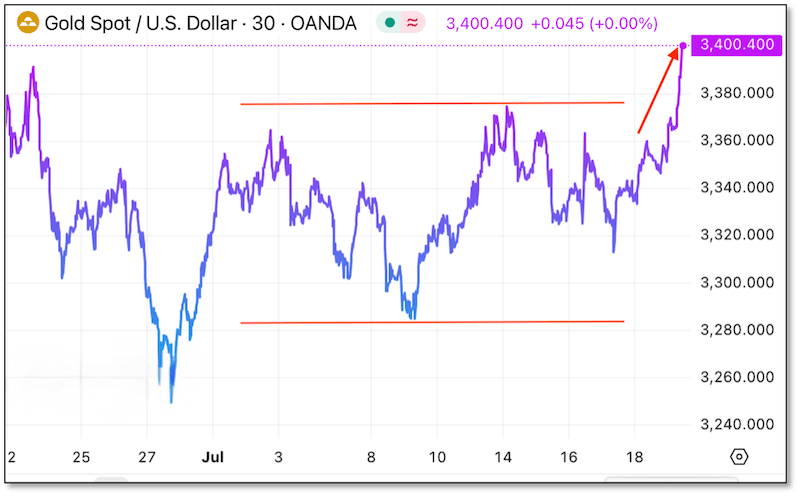
Through last week, gold’s sell-offs this summer had been mild with no follow-through. And it had been the same for the rallies, as they failed to spark any upside momentum.

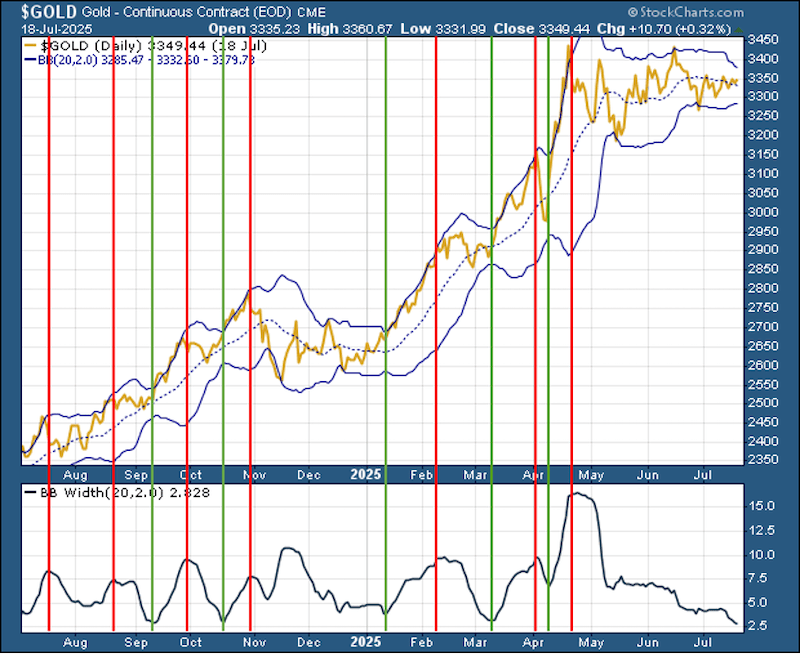
That tight trading range is evident in the one-month chart above. Obviously, this kind of range-trading would entail falling volatility, which prompted me to check in on our chart of gold’s Bollinger bands and their width:

The lower panel tracks the width of the bands and, therefore, the trading volatility. As you can see, the width has collapsed to levels that have previously marked bottoms and imminent rallies.

The timing would be right for another rally as well. In my experience spanning far too many years watching the metals, gold tends to bottom anywhere from mid-July to mid-August.

We’re smack dab in the middle of that time frame at the moment…so I told my subscribers that we would have anywhere from mere hours to a month to take advantage of this summertime lull.

Looks like it may have been just hours for the turn — because gold and silver are rocketing higher today.

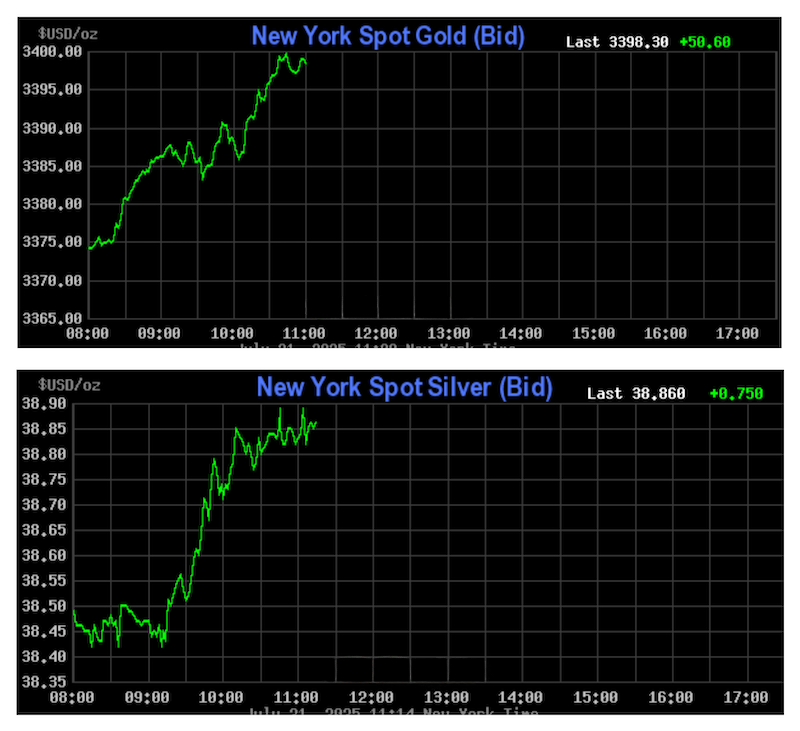
Today’s breakout is also clear on that one-month chart above. It’s even more impressive on these daily charts below, showing gold up over $50 and silver jumping $0.75 (apparently on its way to $40 soon).

In response, mining stocks are rocketing higher, with all of the major indices up well over 4% today.

It gets even better for investors in junior mining stocks — and particularly those who subscribe to our service. Many of our picks have more than doubled in value so far this year…and our most recent recommendations are heating up on the launching pad.

If you’re not already a subscriber to our free email newsletter, you can do that by clicking on this link.

I cannot stress it enough: This is the kind of chance we get only rarely in our lives — truly a generational opportunity. Absolute fortunes will be made in the months and years just ahead for those who are positioned for this historic metals and mining bull market.

To get Brien Lundin’s ongoing commentary on the markets at no charge, click here to subscribe to his free Golden Opportunities newsletter.


Brien Lundin is the publisher and editor of Gold Newsletter, the publication that has been the cornerstone of precious metals advisories since 1971. Mr. Lundin covers not only resource stocks but also the entire world of investing. He also hosts the annual New Orleans Investment Conference. To get Brien Lundin’s ongoing commentary on the markets at no charge, click here to subscribe to his free Golden Opportunities newsletter.

Gold Outperformed Every Major Asset Class in H1

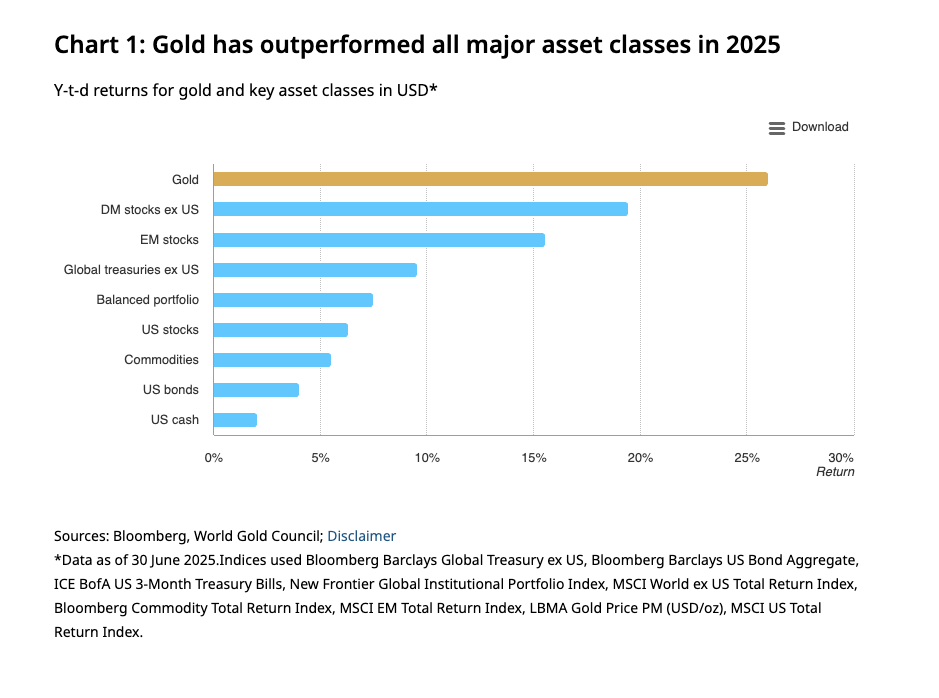
(Mike Maharrey, Money Metals News Service) Gold was up nearly 26 percent through the first six months of 2025, ranking as the top-performing asset class.

This booming performance continued the momentum built in 2024 when gold surged by 26.5 percent.

After recording 40 all-time highs in 2024, gold set another 26 all-time highs through the first six months of this year. In April, gold cracked the $3,500 level for the first time. It also set a record in inflation-adjusted terms.

Gold outperformed every other major asset class. Developed market stocks (excluding the U.S.) came in second place, rising by about 19 percent.

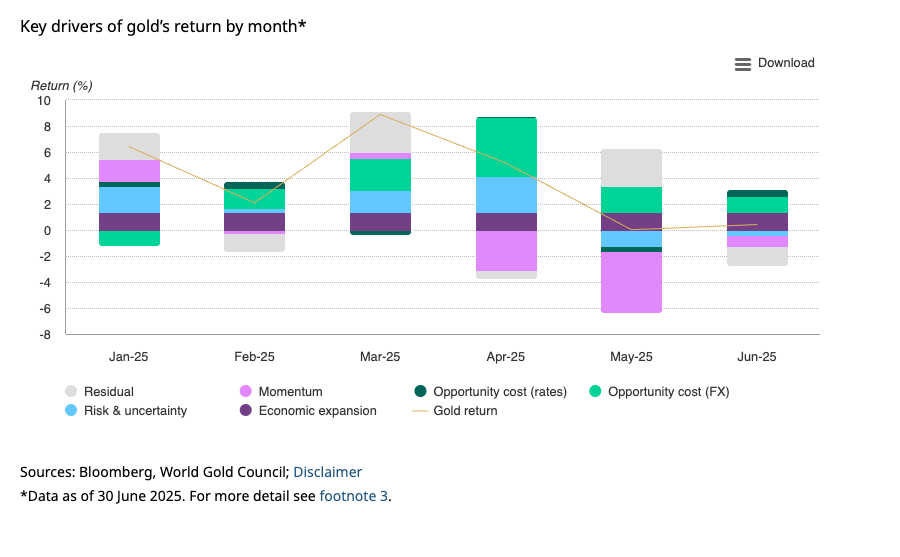
Several factors drove gold’s continued bull market through H1, including a weak U.S. dollar, rangebound yields with expectations of more Federal Reserve rate cuts by the end of the year, and heightened geopolitical tensions, including trade turmoil and several military conflicts.

Continued central bank gold buying and more general de-dollarization also supported gold through the first half of 2025.

The dollar charted its worst start to a year since 1973. In fact, one could argue that it’s not so much that the gold is going up but that the greenback is sagging. Gold is reflecting the devaluation of the U.S. currency.

There also appears to be a developing bear market in bonds. U.S. Treasuries have historically been a go-to safe-haven asset. However, Treasury yields increased as bonds sold off in April at the height of geopolitical uncertainty.

While the final numbers aren’t in, preliminary data indicates gold demand was strong in H1, spurred by and supporting the price rally.

The World Gold Council reported increased trading activity across over-the-counter markets, exchanges, and ETFs. Average trading volumes in H1 hit $329 billion per day, the highest semi-annual number on record.

Flows of gold into ETFs hit the highest semi-annual level since the pandemic. Through the first half of 2025, gold-backed funds globally increased their holdings by 397.1 tonnes, totaling $38 billion.

The World Gold Council has developed a Gold Return Attribution Model (GRAM) to evaluate the factors contributing to gold’s performance. Low opportunity cost, momentum, and a risk environment were significant factors through H1, contributing to about 16 percent of gold’s returns.

Gold has generally been trading sideways in a consolidation phase since April. Jordan Roy-Byrne is a renowned technical analyst who specializes in long-term trends. He recently said it appears the yellow metal is setting up for another run higher next year.

Through the second half of the year, the World Gold Council forecasts, “Gold may move sideways with some possible upside – increasing an additional 0 percent to 5 percent in the second half.” Of course, this could change based on possible economic scenarios.

“The economy rarely performs according to consensus. Should economic and financial conditions deteriorate, exacerbating stagflationary pressures and geoeconomic tensions, safe haven demand could significantly increase pushing gold 10%-15% higher from here. On the flipside, widespread and sustained conflict resolution – something that appears unlikely in the current environment – would see gold give back 12%-17% of this year’s gains.”


Mike Maharrey is a journalist and market analyst for Money Metals with over a decade of experience in precious metals. He holds a BS in accounting from the University of Kentucky and a BA in journalism from the University of South Florida.


Big Bank Note Highlights Accelerating Global De-Dollarization

(Mike Maharrey, Money Metals News Service) I’ve been talking about the de-dollarization trend for several years. Now, some of the world’s big financial players are starting to take notice.

In a recent note, JPMorgan Chase highlighted the de-dollarization trend, pointing out that dollar reserves have dipped to a 2-decade low below 60 percent.

Total holdings of dollar-denominated securities by central banks (excluding the Federal Reserve) fell by $59 billion in 2024.

As of the end of last year, dollars made up 57.8 percent of global reserves. That is the lowest level since 1994, representing a 7.3 percent decline in the last decade. In 2002, dollars accounted for about 72 percent of total reserves.

The JPMorgan note said the waning dependence on the U.S. dollar in trade is being reflected in the gold market as central banks pile up gold.

“The main de-dollarization trend in FX reserves, however, pertains to the growing demand for gold. … This increased demand has in turn partly driven the current bull market in gold, with prices forecast to climb toward $4,000/oz by mid-2026.”

The note highlighted the increased gold holdings by “competitor economies,” including China, Russia, and Turkey.

“Seen as an alternative to heavily indebted fiat currencies, the share of gold in FX reserves has increased, led by emerging market (EM) central banks — China, Russia and Türkiye have been the largest buyers in the last decade.”

The note pointed out that emerging market central bank gold holdings remain relatively low at 9 percent, but gold reserves have more than doubled from 4 percent 10 years ago.

The big bank also highlighted signs of de-dollarization in the bond market, noting that foreign holdings of U.S. debt have dropped continuously for 15 years. In early 2025, foreign Treasury holdings plunged to 30 percent, down from 50 percent during the Great Recession.

JPMorgan Chase head of rates strategy Jay Barry said that any acceleration in Treasury selling could create significant turmoil in the bond market.

“Although foreign demand has not kept pace with the growth of the Treasury market for more than a decade, we must consider what more aggressive action could mean. Japan is the largest foreign creditor and alone holds more than $1.1 trillion in Treasuries, or nearly 4 percent of the market. Accordingly, any significant foreign selling would be impactful, driving yields higher.”

The federal government is already struggling to cope with increased borrowing costs due to rising yields and tepid demand for Treasuries. Interest on the national debt cost $144.6 billion in June alone. That brought the total interest expense for the fiscal year to $921 billionup 6 percent over the same period in 2024.

Why Are Countries Spurning the Dollar?

There are several factors driving the de-dollarization trend.

First, many countries are concerned about the weaponization of the dollar.

De-dollarization has accelerated since the U.S. and other Western nations imposed heavy sanctions on Russia in the wake of its invasion of Ukraine.

According to a report by the Atlantic Council, “In recent years, and especially since Russia’s invasion of Ukraine and the Group of Seven (G7)’s subsequent escalation in the use of financial sanctions, some countries have been signaling their intention to diversify away from dollars.

Aggressive U.S. trade policy has also created some backlash against the U.S., leading to a selloff in American assets.

Finally, the federal government’s deteriorating fiscal position, with over $36 trillion in debt and no sign that the borrowing and spending will slow any time soon, has many wary of holding U.S. debt and devaluing dollars. This has been particularly evident in the Treasury market, where yields rose as bonds sold off during the height of geopolitical uncertainty in April. It appears Treasuries are losing their standing as a go-to safe-haven asset.

Ramifications

As the JPMorgan note pointed out, we’ve seen dollar reserves dip before. The dollar’s share of FX reserves was lower in the early 90s after the world fled the greenback during the 70s and 80s. The dollar’s status improved in the 1990s as price inflation cooled, and U.S. budget deficits narrowed thanks to the post-Cold War “peace dividend.”

The JPMorgan note called the dollar’s decline “significant but not yet unprecedented.”

In other words, the dollar isn’t in danger of collapsing or even losing its reserve status – at least not yet.

However, even a modest de-dollarization spells trouble for the federal government and the U.S. economy.

In a nutshell, the United States needs the world to need dollars.

The U.S. depends on this global demand for dollars supported by its reserve status to underpin its massive government. The only reason Uncle Sam can borrow, spend, and run massive budget deficits to the extent that it does is the dollar’s role as the world’s reserve currency. It creates a built-in global demand for dollars and dollar-denominated assets. This absorbs the Federal Reserve’s money creation and helps maintain dollar strength despite the Federal Reserve’s inflationary policies.

WolfStreet summed up the risk the U.S. faces as the dollar’s status continues to erode.

“The status of the U.S. dollar as the dominant global reserve currency has helped the U.S. fund its twin deficits and thereby has enabled them: the huge fiscal deficit every year and the massive trade deficit every year. The reserve currency status comes from other central banks (not the Fed) having purchased trillions of USD-denominated assets such as Treasury securities, other government securities, corporate bonds, and even stocks. The dollar’s status as the dominant reserve currency has been crucial for the U.S., and as that dominance declines ever so slowly, risks pile up ever so slowly.”

While the threat isn’t immediate, a slowly growing pile eventually turns into a giant pile.

But again, even a modest de-dollarization will have significant impacts. If the world needs fewer dollars, they will begin to return to the U.S., causing a dollar glut. This will increase inflationary pressure domestically as the value of the U.S. currency further depreciates. In the worst-case scenario, the dollar could collapse completely, leading to hyperinflation.


Mike Maharrey is a journalist and market analyst for Money Metals with over a decade of experience in precious metals. He holds a BS in accounting from the University of Kentucky and a BA in journalism from the University of South Florida.

WATCH: DHS Officials Blame ‘Sanctuary’ City Policies for Shooting of ICE Agent

(Morgan Sweeney, The Center Square)  A noncitizen in the U.S. illegally who previously had been arrested and released in New York City four times is accused of shooting the agent in the face and arm as the agent was enjoying an evening out in Manhattan Saturday.

New York City is a sanctuary city, meaning it is committed to limited cooperation with ICE when noncitizens are arrested on suspicion of having committed a crime or are charged with committing a crime. When ICE discovers that someone who has been apprehended by the police is in the country illegally, it may issue a detainer to the correctional facility to hold the individual until ICE can take custody. Institutions in sanctuary cities often defy ICE detainers so ICE is not able to obtain the individual from local law enforcement.

“Sanctuary cities are sanctuaries for criminals. Hard stop,” said Trump border czar Tom Homan.

The NYPD and the New York Department of Correction are “barred from honoring ‘detainer requests’ from ICE, UNLESS that person has been convicted of violent or serious crimes, is on the federal terrorist watch list, and when ICE officials have a judicial warrant,” as of March 1, 2025, according to Legal Services NYC.

“I’ve been doing this since 1984; I’ve never seen a situation where I see it today,” Homan said. “You see the polls. Everybody agrees we should be arresting public safety threats, illegal aliens, but the city council here has locked us out of Rikers Island. Are you kidding me?”

Homan reiterated his promise that ICE would “flood the zone” by sending more ICE agents to sanctuary cities. Noem promised they would continue to push to remove noncitizens from the country.

“We’re going to double down,” Noem said, “and make sure that… once again, America can be a country where the rule of law matters.”

Second Suspect Arrested in the Shooting of an Off-Duty US Customs Officer in a Manhattan Park

(Headline USA)  A second suspect has been arrested in connection with the shooting of an off-duty U.S. Customs and Border Protection officer in a New York City park, law enforcement officials said Monday.

Christhian Aybar-Berroa is the alleged getaway driver in the apparent robbery-gone-wrong Saturday, according to New York City Police Commissioner Jessica Tisch. He is expected to appear in federal court in Manhattan later Monday.

Aybar-Berroa’s alleged accomplice, Miguel Mora, was taken into custody Sunday after arriving at a Bronx hospital with gunshot wounds to the groin and leg.

The 42-year-old customs officer, who was not in uniform, had been sitting with a woman in a park beneath the George Washington Bridge in upper Manhattan when two men approached on a moped, according to police

When he realized he was being robbed, the officer drew his service weapon. He and the suspects fired at each other: The officer was shot in the face and arm while the suspect was shot before he and the moped driver fled, police said.

U.S. Secretary of Homeland Security Kristi Noem, in a separate announcement Monday, said the officer, who has not been identified by authorities, is recovering in a hospital and is expected to survive. He works for Customs and Border Protection, whose officers dress in blue and are stationed at airports and land crossings. Border Patrol agents in green uniforms patrol mountains and deserts for illegal crossings.

No lawyers were listed for Aybar-Berroa or Moro on the federal court case database and a spokesperson for the U.S. Attorney’s office in Manhattan didn’t immediately comment.

Authorities say both suspects entered the country illegally from the Dominican Republic and have extensive criminal histories in their short time in the U.S.

The police commissioner said Aybar-Berroa arrived in 2022 and he has been arrested eight times for grand larceny and other crimes, and is a suspect in at least four other cases.

The Homeland Security chief said Aybar-Berroa was ordered deported by a federal immigration judge in 2023, but immigration detainers were ignored. She blamed New York City authorities for releasing him before federal officials could take custody of him.

He was “arrested again and again and again,” Noem said. “What did we think was going to happen?”

Moro, she added, has a “rap sheet a mile long” that includes grand larceny, assault and kidnapping charges.

Police said Sunday he entered the country illegally through Arizona in 2023 and had two prior arrests for domestic violence in New York. He is also wanted in New York to face accusations of robbery and felony assault, and in Massachusetts over a stolen weapons case.

“There is absolutely zero reason that someone like this — that’s the scum of the earth — should be running loose on the streets of New York City,” Noem said at a press conference at CBP’s Manhattan office.

Mayor Eric Adams, at a separate press conference, distanced himself from the so-called sanctuary city policies that Noem and other federal officials on Monday blamed for the shooting.

New York and other cities have longstanding laws and policies that limit or restrict local government involvement in federal immigration matters.

“I’m not protecting them,” said the Democratic mayor, a former police captain who is running for reelection. “I’ve always been clear: stop the revolving door system. Go after the dangerous migrants and asylum seekers.”

Adapted from reporting by the Associated Press.

A Pilot Made Sharp Turn to Avoid a B-52 Bomber Over North Dakota, Then Took to the Mic to Explain

(Headline USA)  The pilot of a regional airliner flying over North Dakota carried out an unexpected sharp turn and later apologized to passengers, explaining that he made the move after spotting a military plane in his flight path.

The Friday incident is detailed in a video taken by a passenger and posted to social media as Delta Flight 3788 approached the Minot International Airport for landing. In the video, the SkyWest pilot can be heard over the plane’s intercom system explaining that he made the sharp turn after spotting a B-52 bomber in his flight path.

“Sorry about the aggressive maneuver. It caught me by surprise,” the pilot can be heard saying on the video. “This is not normal at all. I don’t know why they didn’t give us a heads up.”

SkyWest, a regional carrier for Delta and other large airlines, said the flight had departed from the Minneapolis-St. Paul International Airport and landed safely in Minot after performing a “go-around” maneuver when another aircraft became visible in the SkyWest plane’s flight path. Minot is 100 miles (160 kilometers) north of Bismarck, North Dakota’s capital city, and about 50 miles (80 kilometers) from the Canadian border.

The Federal Aviation Administration said in a statement that it’s investigating the incident. SkyWest said it is also investigating.

In the video, the pilot noted that Minot’s small airport does not operate radar and directs flights visually. When the airport instructed the SkyWest flight to make a right turn upon approach, the pilot said he looked in that direction and saw the bomber in his flight path. He informed the airport and made a hard turn to avoid the bomber, he said.

“I don’t know how fast they were going, but they were a lot faster than us,” the pilot said of the bomber.

The North Dakota incident comes nearly six months after a midair collision between an Army helicopter and a jetliner over Washington, D.C., that killed all 67 people aboard the two aircraft.

Minot Air Force Base is about 10 miles (16 kilometers) north of Minot, North Dakota’s fourth-largest city. The base is home to 26 B-52 bombers, intercontinental ballistic missile operations and more than 5,400 military personnel.

An Air Force spokesperson confirmed Monday that a B-52 bomber assigned to the base conducted a flyover of the North Dakota State Fair on Friday and that the Air Force is “looking into” the report of a bomber and a commercial airliner operating in the same airspace around the Minot airport.

The pilot’s frustration is evident in the video.

“The Air Force base does have radar, and nobody said, ‘Hey, there’s a B-52 in the pattern,’” the pilot told passengers.

Adapted from reporting by the Associated Press.

DOJ Charges Man for Threatening People on the ‘Epstein Client List’—Which the DOJ Says Doesn’t Exist

(Ken Silva, Headline USA) The Justice Department has filed charges against a Florida man who tweeted that he would “kill everyone on the [Epstein] list,” along with several other unnamed politicians.

The Florida man, Terell Bailey, apparently came on the FBI’s radar earlier this month, when his Twitter/X account @TDBailey posted about killing everyone on the Epstein client list—which the DOJ says doesn’t exist.

“Everyone involved if I see them in real life I will KILL. On sight. With a machete so everyone can see the blood and gore of the moment. You can’t fear death so you can’t understand. I will KILL EVERYONE ON THE LIST,” Bailey allegedly tweeted last week at Twitter’s AI bot, Grok.

Charging papers, which were first reported by CourtWatch, include a footnote, in which an FBI agent clarifies that Bailey indeed was speaking about the Epstein client list. “I believe the ‘LIST’ is a reference to a ‘client list’ that X user @TDBailey believes exists relating to the investigative holdings relating to Jeffrey Epstein,” FBI agent Justin Tennyson said in a sworn affidavit.

When FBI agents investigated further, they found that Bailey allegedly threatened other politicians, too. For example, he allegedly posted a Facebook video earlier this month where he’s shown threatening a former government official that the DOJ refers to as “FORMER GOVERNMENT OFFICIAL 4.”

Law enforcement interviewed Bailey last Thursday at the Palmetto Police Department, where he told officers that he had a knife, a machete, and a bow-and-arrow.

He faces one count of transmitting an interstate threat.

Earlier this month, the DOJ issued a memo declaring that Epstein had no clients, he didn’t blackmail anyone, and his mysterious prison death was a suicide. The memo also revealed that Epstein had over 1,000 victims.

The revelation about the number of Epstein victims is a big deal because it contradicts earlier figures. In February, Attorney General Pam Bondi said there were just 250 Epstein victims, while just 36 girls were cited in the 2019 indictment against Epstein. Furthermore, various civil lawsuits against Epstein’s estate list around 200 plaintiffs.

In other words, there could be 800 or more Epstein victims that are unaccounted for.

Ken Silva is the editor of Headline USA. Follow him at x.com/jd_cashless.

Only 6 Reps Vote to Cut $500 Million in Military Aid to Israel

(Kyle Anzalone, Libertarian Institute) An amendment that would have cut $500 million in military aid to Israel failed in the House. Tel Aviv is conducting a genocide that is largely funded by Washington.

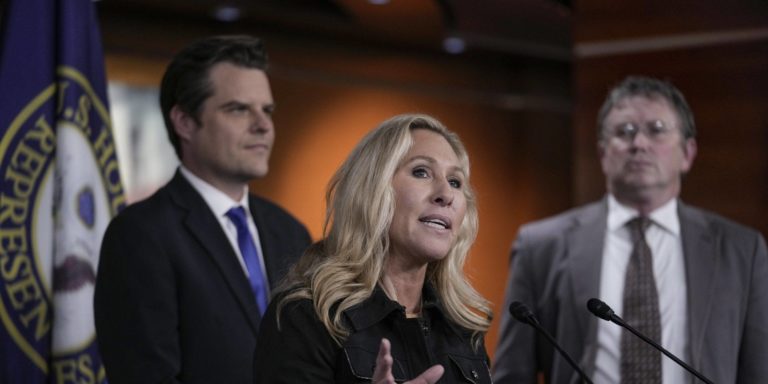
The amendment was introduced by Rep. Marjorie Taylor Greene (R-GA), who argued that Israel should receive less funding from the US as Tel Aviv possesses nuclear weapons. “I’m entering amendments to strike $500 million more for nuclear-armed Israel. And it’s important to say nuclear-armed Israel, because they do have nuclear weapons,” Greene told Steve Bannon on his podcast.

“And we already give them $3.4 billion every single year in the state, from the State Department. $3.4 billion every single year. They don’t need another $500 million in our defense budget. That’s for the American people’s defense,” she added.

Greene’s amendment received support from Republican Thomas Massie and four progressive Democrats, Al Green, Summer Lee, Rashida Tlaib, and Ilhan Omar. The vote was 422-6. The amendment would have removed the $500 million in military assistance to Israel that is approved through the defense spending bill.

In her speech on the House floor, Greene argued that Israel is providing welfare for its citizens because the US is covering 15-20% of its military spending. “Israel is a nuclear-armed nation. They can defend themselves. They have universal healthcare and subsidized college. Meanwhile, Americans are $37 trillion in debt,” she said.

New York Congresswoman Alexandria Ocasio-Cortez received criticism for voting against the administration. In a statement on her vote, she wrote on X, “Marjorie Taylor Greene’s amendment does nothing to cut off offensive aid to Israel nor end the flow of US munitions being used in Gaza. Of course I voted against it.”

The US funding Israel’s air and missile defenses helps to insulate Tel Aviv from the repercussions of its belligerence. After Tel Aviv launched an aggressive war on Iran last month, the US used up to 20% of its THAAD interceptors to defend Israel from Iranian retaliation.

The US provides Israel with $3.8 billion in military aid each year. Washington surged security assistance to Tel Aviv following the October 7 Hamas attack. The US has financed roughly 70% of Israel’s war-related military spending since then.

This article originally appeared at The Libertarian Institute.


U.S. Official Calls Netanyahu a ‘Madman’

(Dave DeCamp, Antiwar.comAxios reported on Sunday that White House officials were frustrated with Israeli Prime Minister Benjamin Netanyahu due to Israel’s recent airstrikes on Damascus, which came as the US was urging Israel not to bomb Syria.

“Bibi acted like a madman. He bombs everything all the time,” one White House official told the outlet. “This could undermine what Trump is trying to do.”

The Trump administration has been pushing for a normalization deal between Israel and the new Syrian government, which is led by Ahmed al-Sharaa, the founder of al-Qaeda in Syria, who took over Damascus in December 2024 with his rebranded group of jihadists, known as Hayat Tahrir al-Sham (HTS).

Another White House official pointed to the Israeli tank shelling of the sole Catholic church in Gaza, which killed three Christians. “The feeling is that every day there is something new. What the f***?” the official said. A third official said that Netanyahu is “sometimes like a child who just doesn’t behave.”

The report noted that it was unclear whether President Trump shared the officials’ frustration with Netanyahu. Trump has recently shown strong support for Netanyahu by calling for an end to his corruption trial and hosting the Israeli leader at the White House for the third time within six months.

A senior Israeli official said that Tel Aviv was surprised by the US’s unhappiness over the Syria strikes since Trump had encouraged Israel to hold Syrian territory it had captured and hadn’t previously criticized Israel’s interventions in the country. Israel celebrated the regime change that ousted former Syrian President Bashar al-Assad, but used the HTS takeover as a pretext to invade southern Syria.

The Axios report didn’t indicate that US officials were frustrated by Israel’s genocidal war on Gaza and the daily massacres of women, children, and unarmed Palestinian civilians seeking aid. There was also no indication that the US was considering ending or leveraging military aid to Israel, which Israel relies on to sustain its military operations across the region.

This article originally appeared at Antiwar.com.