DC Police Will Now Work w/ Feds on Immigration after Pressure from Trump

(Headline USAThe Washington, D.C., police chief stepped up cooperation between her officers and federal immigration officials as President Donald Trump’s law enforcement takeover of the nation’s capital took root Thursday. National Guard troops watched over some of the world’s most renowned landmarks and Humvees took up position in front of the busy main train station.

The police chief’s order establishes that Metropolitan Police Department officers may now share information with immigration agencies regarding people not in custody — such as someone involved in a traffic stop or checkpoint. MPD officers may also provide “transportation for federal immigration employees and detained subject,” the order states.

The changes, which raise collaboration between the two forces in notable ways, is a marked change to the district’s long-standing policy against cooperating with civil immigration enforcement. They are effective immediately.

Mayor Muriel Bowser, walking a tightrope between the Republican White House and the constituency of her largely Democratic city, was out of town Thursday for a family commitment in Martha’s Vineyard but would be back Friday, her office said.

In a city tense from days of ramp-up toward federal law enforcement intervention, volunteers helped homeless people leave long-standing encampments — to where, exactly, was often unclear. Trump told reporters that he was pleased at how the operation — and, now, its direct link with his immigration-control efforts — was unfolding.

“That’s a very positive thing, I have heard that just happened,” Trump said of Police Chief Pamela Smith’s order. “That’s a great step. That’s a great step if they’re doing that.”

Adapted from reporting by the Associated Press

Man Who Threw Sandwich at the Feds Was a DOJ Specialist

(Headline USAA man charged with a felony for hurling a sandwich at a federal law-enforcement official in the nation’s capital has been fired from his job at the Justice Department, Attorney General Pam Bondi said in a social media post Thursday.

A video of Sean Charles Dunn berating a group of federal agents late Sunday went viral online. Dunn was arrested on an assault charge after he threw a “sub-style” sandwich at a Customs and Border Protection agent, a court filing said.

Dunn, 37, of Washington, was an international affairs specialist in the Justice Department’s criminal division, according to a department official who spoke on the condition of anonymity to discuss a personnel matter.

“This is an example of the Deep State we have been up against for seven months as we work to refocus DOJ,” Bondi wrote. “You will NOT work in this administration while disrespecting our government and law enforcement.”

A multiagency flood of uniformed federal law enforcement officers had fanned out across the city over the weekend after the White House had announced stepped-up measures to combat crime. That was before President Donald Trump’s announcement Monday that he was taking over Washington’s police department and activating 800 members of the National Guard.

Around 11 p.m. on Sunday, Dunn approached a group of CBP agents, pointed a finger in an agent’s face and swore at him, calling him a “fascist,” a police affidavit says. An observer’s video captured Dunn throwing a sandwich at the agent’s chest, the affidavit says.

“Why are you here? I don’t want you in my city!” Dunn shouted, according to police.

Dunn tried to run away but was apprehended, police said.

An attorney for Dunn didn’t immediately respond to a request for comment on Dunn’s charge.

The incident coincided with Trump’s push to flood the city with National Guard troops and federal officers. Trump claims crime in the city has reached emergency levels, but city leaders point to statistics showing violent crime at a 30-year low.

Adapted from reporting by the Associated Press

After PBS Defunding, PragerU Moves to Fill the Gap

(José Niño, Headline USA) ​​ Congressional defunding of the Corporation for Public Broadcasting (CPB) in 2025 delivered a historic blow to public media in the United States, which has now allowed conservative non-profit organization PragerU to fill in the void. 

Signed into law by President Donald Trump, the rescission package cut $1.1 billion in federal support to CPB, which functions as the funding pipeline for PBS, NPR, and over 1,500 stations. 

The rescission marks a culmination of long-standing conservative criticism of PBS and NPR for alleged liberal bias and ushers in what many see as the end of non-commercial educational broadcasting as a national project.

Patricia Harrison, president and CEO of CPB, acknowledged, “Despite the extraordinary efforts of millions of Americans who wrote, called, and petitioned Congress to preserve federal support, we now face the difficult reality of closing our operations.” She added, “Public media has been one of the most trusted institutions in American life, providing educational content, emergency information, civil discourse, and cultural touchstones to every corner of the country.” 

This legislative move spells an uncertain future for local stations, especially those in rural and tribal areas. NPR CEO Katherine Maher described the action as an “irreversible loss,” arguing that it constitutes “an unwarranted dismantling of beloved local civic institutions, and an act of Congress that disregards the public will.”

Into this vacuum, PragerU has emerged as the White House’s favored supplier of educational materials. 

Earlier this year, the Trump administration partnered with PragerU for a “Founders Museum” exhibit, unveiling AI-generated videos of historical figures pitching modern conservative themes. One controversial clip featured John Adams citing Ben Shapiro’s phrase: “Facts do not care about our feelings.”

In late June, Education Secretary Linda McMahon announced the Trump administration-Prager collaboration, followed by remarks from PragerU CEO Marissa Streit.

Founded in 2009 by conservative commentator Dennis Prager, PragerU has grown into a dominant force in conservative educational media. 

This is not PragerU’s first government collaboration. In recent years, it has partnered with multiple states and school officials nationwide to make its content available to public school students and teachers.

José Niño is the deputy editor of Headline USA. Follow him at x.com/JoseAlNino 


DC Caught Cooking the Books on Crime Stats

(Luis CornelioHeadline USA) The local government of the District of Columbia has settled a lawsuit filed by a police sergeant who accused her superiors of misclassifying offense records to deflate crime statistics, the Washington Free Beacon reported Thursday.

Charlotte Djossou, a former sergeant at the Metropolitan Police Department, sued the department in 2020 over alleged retaliation after she condemned the reported scheme.

According to the Free Beacon, Djossou accused MPD brass of trying to “distort crime statistics” by “downgrading a number of felonies to misdemeanors, so that there will be ‘fewer’ felonies in the statistics.”

The outlet noted that her attorneys filed records exposing police officials “explicitly instructed their subordinates to underclassify certain instances of theft to keep them out of the crime stats the city reports to the public.”

The settlement comes as President Donald Trump continues expanding federal law enforcement’s presence in the DC area, including deploying the National Guard, in response to what Republicans have called out as rampant lawlessness.

Leftist media outlets—including The Washington Post and Politico—have repeatedly dismissed Trump’s claims that crime is soaring in the district, citing the same internal MPD data now under scrutiny.

It is unclear how far this crime-deflating scheme spread through various precincts, but the settlement and deposition records had remained private until Thursday.

In a 2022 deposition, MPD commander Randy Griffin admitted that in 2018, he ordered police captain Franklin Porter to find “a solution for the theft problem, which was driving up the district’s statistics.”

It gets worse. Porter allegedly worked with former MPD lieutenant Andrew Zabavsky to classify felonies such as “shoplifting” and “theft” under the vague “Taking Property Without Right” (TPWOR) category.

The case records showed that Zabavsky “acknowledged this was done because TPWOR reports are not tracked in the D.C. Crime Report.“

Announcing the 2025 Sound Money Legislators of the Year

(Sound Money Defense League, Money Metals News Service) One of America’s largest national precious metals dealers and the nation’s leading sound money public policy group today recognized two outstanding state lawmakers for their leadership in advancing sound money policies in 2025.

Money Metals ExchangeSound Money Defense League, and Sound Money Foundation are excited to announce Kentucky Rep. TJ Roberts (R) and Wyoming Sen. Bob Ide (R) as “2025 Sound Money Legislators of the Year.”

Last year, Kentucky Gov. Andy Beshear illegitimately line-item vetoed a sales tax exemption on purchases of gold and silver, despite the state Constitution not permitting him this power. Still, Gov. Beshear directed his offices to continue collecting this tax, with fines and penalties for non-compliance.

In response, freshman legislator TJ Roberts introduced House Bill 2 and spearheaded an effort in 2025 to not only eliminate the sales tax on gold and silver purchases retroactive to Gov. Beshear’s unconstitutional veto in August 2024, but also to enable taxpayers to sue the governor and his departments for wrongful taxation.

“We’ve been working in Kentucky since 2020 and thought we’d successfully eliminated the sales tax on gold and silver before Gov. Beshear’s unconstitutional veto. A freshman legislator, Rep. Roberts was instrumental in establishing the sound money issue as a priority for lawmakers in the state,” said Sound Money Defense League executive director Jp Cortez.

“I am honored to be named a Sound Money Defense League’s 2025 Legislator of the Year. Inflation is a silent thief and a sinister, regressive tax that no one voted for; it is a plague inflicted by reckless spending and senseless money printing of the unaccountable Federal Reserve that erode the hard-earned savings of Kentuckians and undermine our economic freedom,” said sponsor Rep. Roberts.

“As State Representative, I am actively working in Frankfort to advance sound money reforms, collaborating with fellow legislators to protect our state’s financial stability.  I pledge to continue this fight, protecting the rights and prosperity of every Kentuckian against the dangers of fiat currency and government overreach.

“America needs sound money, and I will always fight for the Constitution’s true money: gold and silver,” he concluded.

Kentucky became the 44th state in the U.S. to have partially or fully removed sales taxes on constitutional sound money (i.e., gold and silver) and the passage of this measure will move the Bluegrass State up the rankings on the Sound Money Index, from its embarrassing place at the bottom of the Index tied for 46th place out of 50.

In Wyoming, the Sound Money Defense League worked closely with lawmakers in 2018 to ensure enactment of the Wyoming Legal Tender Act into law. This bill eliminated all tax liability on precious metals, reaffirmed their status as specie legal tender, and created a foundation for more pro-sound money legislation to come.

Building on this 2018 law, Sen. Bob Ide carried S.F. 96 to enactment in 2025, ensuring the Cowboy state will establish a minimum $10 million physical gold reserve for the state. The fledgling gold reserve begins the process of securing the state’s investments, helping it to insure against inflation, debt defaults, and other risks. The measure also gives the state treasurer the authority to contract for services with established precious metals firms and other industry experts to assist with these duties.

Upon receiving the award, Sen. Bob Ide said, “I am truly grateful for your recognition of my efforts to champion sound money principles in the Wyoming legislature, and I will continue advocating for economic integrity and financial freedom with unwavering commitment.

“With Sound Money Defense League’s support and testimony, I’m thrilled to celebrate the Wyoming Gold Act’s passage, a game changer for our citizens, securing our financial future with a $10 million physical gold reserve/constitutional money to shield against inflation and economic uncertainty, ensuring stability and prosperity for every Wyomingite.”

In 2025, legislators in more than 30 states across the U.S. introduced dozens of bills seeking to eliminate taxation on buying, selling, and using precious metals, bolstering state taxpayer funds with physical gold and silver, reaffirming precious metals as Constitutional money, and more.

Only 6 states still impose a sales tax on all purchases of precious metals – Maryland, Washington, Hawaii, New Mexico, Maine, and Vermont. Sound money forces expect exemption bills to be introduced in the majority of these states in the upcoming legislative session, including Washington and Maryland, after they controversially repealed sales tax exemptions on gold and silver purchases this year.

Other states have reimposed sales tax on precious metals in the past – only to swiftly reverse course after businesses, conventions, and tax revenue left the state for jurisdictions with more favorable laws pertaining to sound money.

Several other lawmakers also made key contributions to the national movement to advance sound money policies, thereby earning honorable mention as part of this year’s award.

Alabama state Sen. Tim Melson (R), a two-time Sound Money Legislator of the Year award recipient, sponsored yet another sound money bill that was signed into law by the governor, this time to reaffirm gold and silver as legal tender.

Connecticut state Sen. John Fonfara (D) championed a measure to end the $500 sales tax threshold required to qualify for the sales tax exemption on purchases of precious metals.

Fonfara’s bill also creates a working group to monitor economic conditions, inflation expectations, precious metals prices and activities, including the market activities of leading commodities exchanges and bullion market associations, and precious metals legislation proposed in or enacted by other states.

And finally, Florida House Speaker pro tempore Rep. Wyman Duggan (R) worked to address the state’s $500 sales tax threshold as part of a comprehensive tax package, while Idaho House Speaker Mike Moyle (R) secured passage of a capital gains tax exemption on all sales of gold and silver.


Sound Money Defense League is a non-partisan public policy group working nationally since 2014 to restore gold and silver as sound money – America’s constitutional money. The League, in partnership with Money Metals, also publishes the annual Sound Money Index.


Silver Market Update – $50 then MUCH higher…

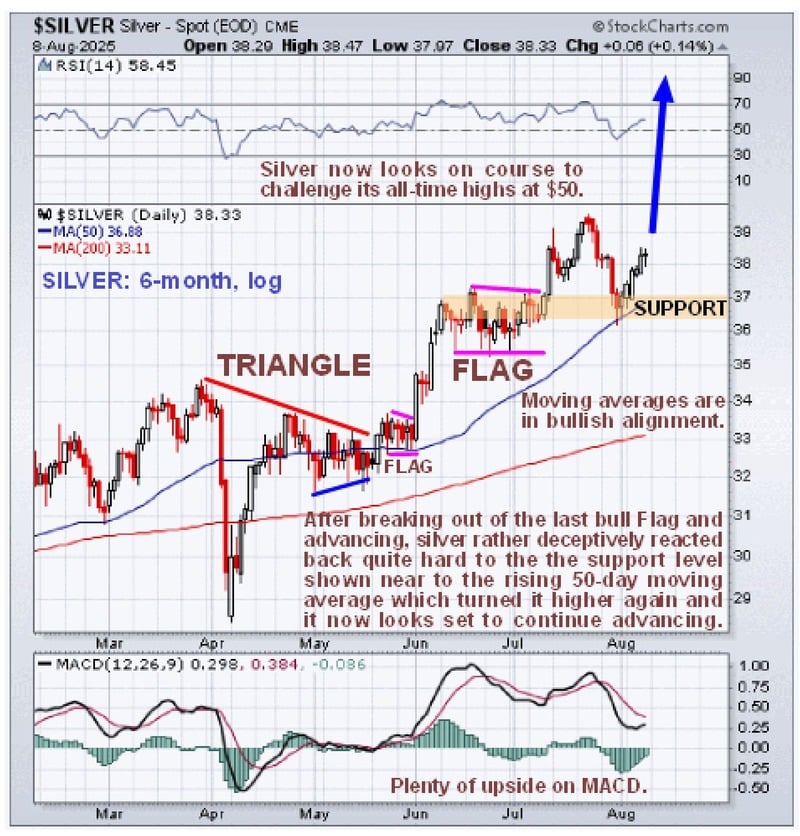
(Clive Maund, Money Metals News Service) We got the upside breakout from the Bull Flag that was predicted in the last update posted on July 6th.

But then, rather like Apollo 12, which got struck by lightning twice in quick succession on the way up, the ride got bumpy for a while with it reacting back quite sharply to support within the Flag and at the rising 50-day moving average.

But then it stabilized and started higher again last week, as we can see on the latest 6-month chart below.

And it is worth noting that the rather unexpectedly large reaction brought the MACD back to a very modest reading, which means that upside potential has been almost fully restored, and given the overall strongly bullish tenor of this chart, silver has big upside potential from here.

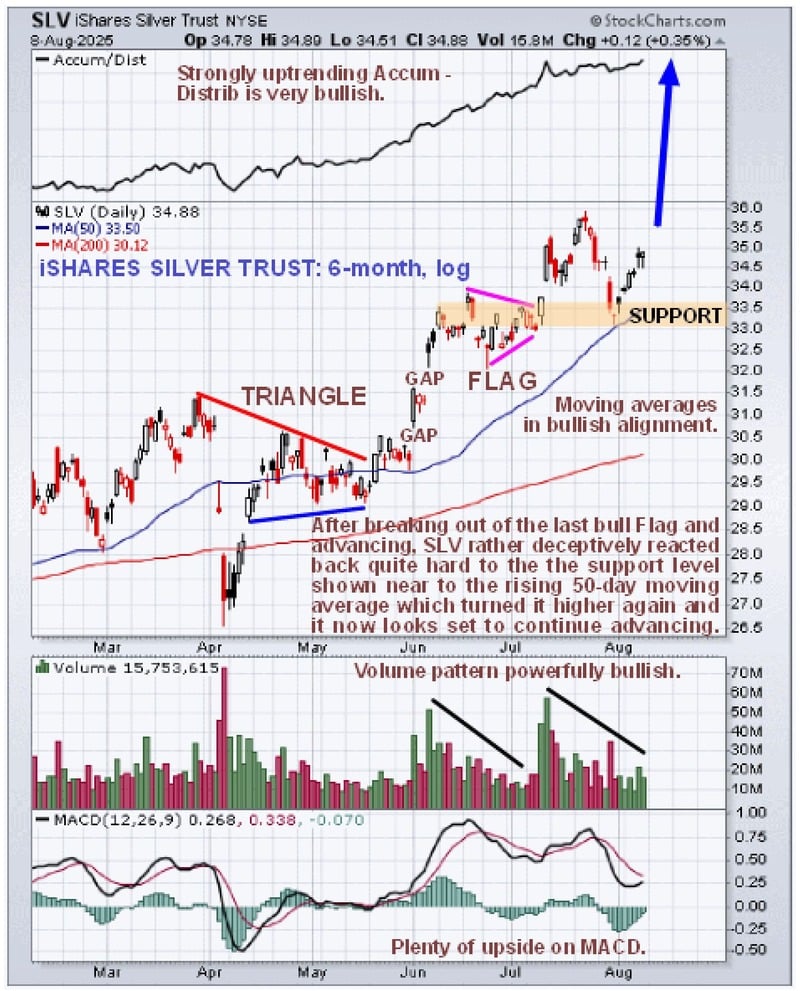
We are somewhat hampered looking at the silver chart in Stockwatch because volume and volume indicators are not available, but we can easily get around this obstacle by looking at the chart for iShares Silver Trust, which is a reliable proxy for silver itself.

Thus, on the 6-month chart for SLV we see that the volume pattern is strongly bullish, with big volume on rallies that dies back on the reactions that follow which is why the Accumulation line shown at the top of the chart is trending strongly higher.

And the fact that it is already making new highs is certainly a propitious indication that points to a strong advance whose first target will be the 2011 all-time highs at $50 that, once cleared, can be expected to lead to rapid upside acceleration.

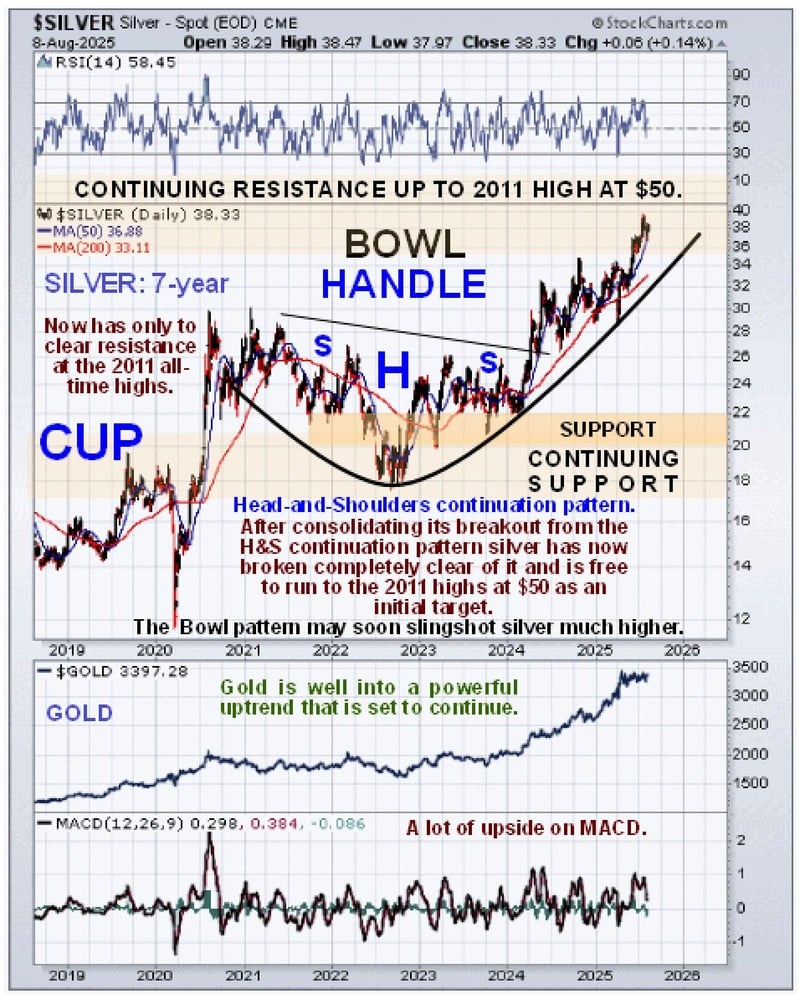
Zooming out via the 7-year chart we see that the major bull market in silver is now becoming established and is poised to accelerate with the price now advancing away from the giant Head-and-Shoulders continuation pattern that formed following the 2020 and 2021 highs.

With the price also being projected higher at an accelerating rate by the boundary of the giant Bowl pattern shown that is shepherding the price ever more rapidly towards a breakout above the resistance approaching and at the 2011 highs at $50.

The next two paragraphs are the same as in the last update because they have the same relevance…

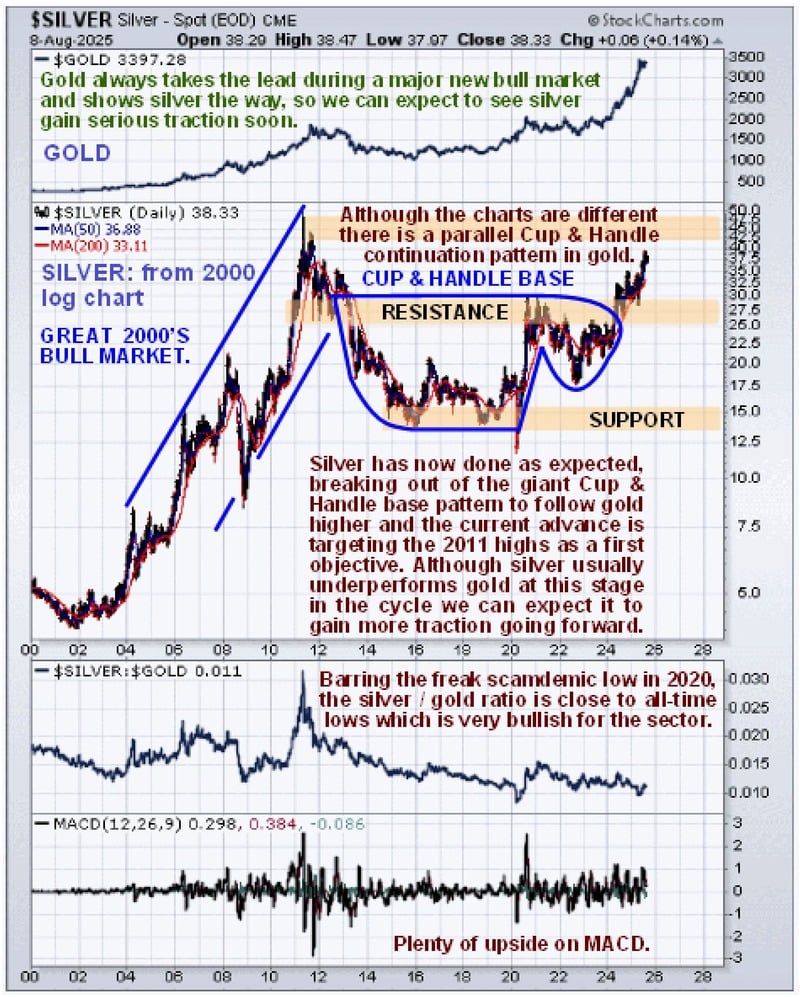
On the long-term chart going back to the start of the millennium, i.e., to the start of 2000, we can see the origins of the resistance that silver is currently working its way through, which is the top that formed in 2011 – 2012.

Once it breaks clear above the high point of this, which is at $50, it will be in new high ground and free to accelerate away to the upside.

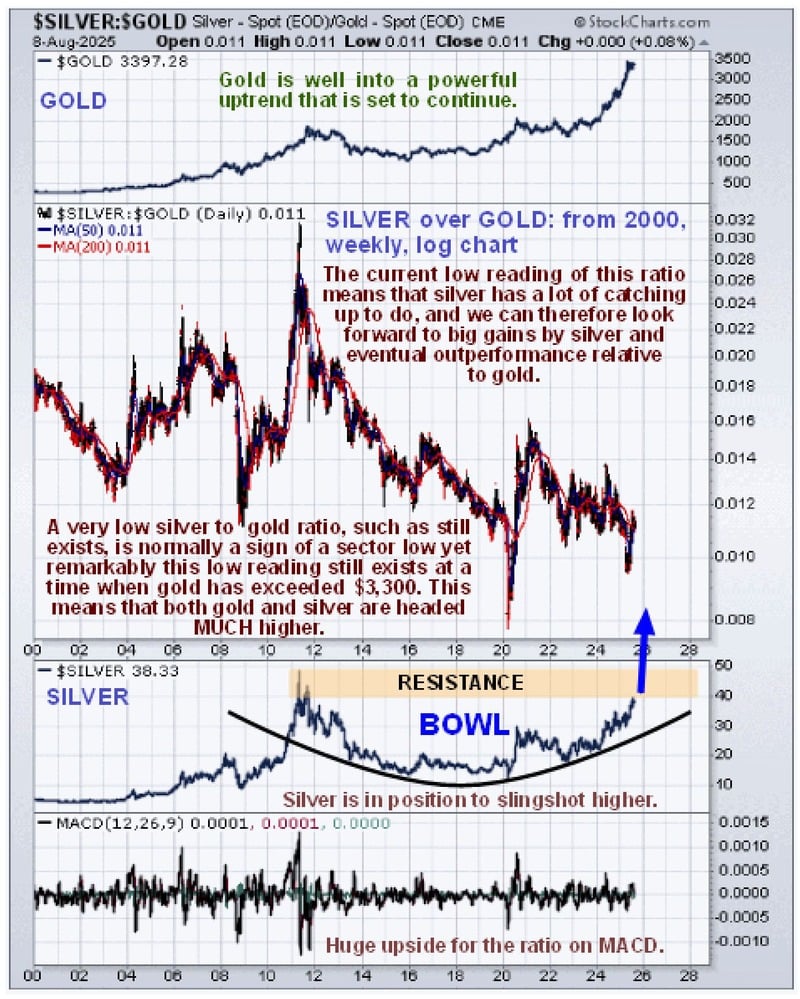
Lastly, it’s worth taking a look at the silver over gold ratio chart for the same time period, from 2000, which shows that despite gold’s big gains from early last year.

This ratio is still at a very low level, which means that this sector bull market has much further to go.

This sort of low reading means that there remains very little retail interest in the sector – this is very bullish for the sector and for silver in particular, which is regarded as a “steal” at these prices.

The rationale behind interpreting this chart is this: when there is a lot of speculative interest in the PM sector, investors favor silver over gold, because it has the capacity to make bigger percentage gains faster. This is what we saw when the sector peaked in 2011, with silver hitting $50 in the late Spring of that year and gold topping out later in the year in September, which is why the silver over gold ratio hit a peak.

When, on the other hand, the silver over gold ratio is at a low level, it means that speculative interest in the sector is at a low ebb, investors have no interest in it, which is very bullish as it means that there is the potential for it to go much higher.

This is what we saw at the ratio lows in 2003 before the sector headed much higher, at the lows of the 2008 broad market crash which dragged the PMs down with it, and at the time of the Covid Crash in the Spring of 2020 when we saw a freak low due to the orchestrated mass psychosis that existed at that time.

Finally, an important point to make in closing is that the “window of opportunity” to buy silver and silver-related investments before the big breakout above $50 that is expected to lead to potentially dramatic acceleration is believed to be rapidly closing up, as a breakout above $50 is looking increasingly likely soon.

End of update.


Clive P. Maund is a longtime trader who has provided professional chart analysis for over a decade, covering a wide range of markets with a special focus on the resource sector. In addition to his decades of trading experience and financial research, Clive obtained a UK Society of Technical Analysts diploma.

Feds Runs Another Massive Budget Deficit in July Despite Surge in Tariff Revenue

(Mike Maharrey, Money Metals News Service) Uncle Sam is cashing in on tariff revenue, but it’s not keeping up with his out-of-control spending habits.

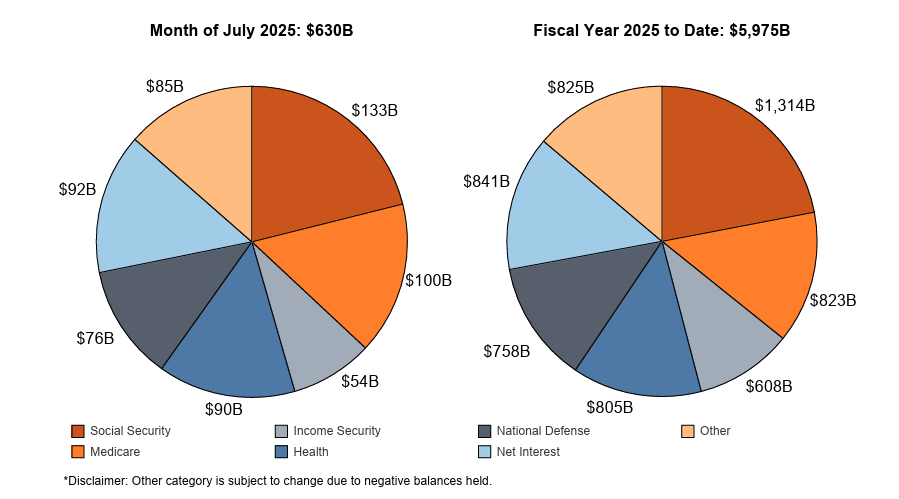
Despite triple the amount of tariff income, the July budget deficit surged to $294.14 billion, 19 percent higher than a year ago, according to the Monthly Treasury Statement.

Meanwhile, the national debt officially eclipsed $37 trillion on Aug. 11.

The fiscal 2025 budget deficit stands at $1.63 trillion with two months remaining.

Federal revenues were up about 2 percent year-on-year in July thanks to a surge in tariff receipts. The government collected $22.7 billion in customs receipts. That compares to $7.1 billion in July ’24.

Through the first 10 months of fiscal 2025, the U.S. government brought in $135.7 billion in customs duties. That’s up $73 billion, or 116 percent, from the same period in fiscal ’24.

In total, the federal government has collected $4.35 trillion so far in fiscal 2025. That’s 6.6 percent higher than through the same period last year.

However, the healthy boost in income isn’t keeping pace with the incessant government spending.

The Trump administration blew through $629.64 billion in July. That was 10 percent higher than last year.

So far in fiscal 2025, the federal government has spent $5.98 trillion, a 6.8 percent increase over the same period last year.

There is no indication that spending will slow down any time soon. The Big Beautiful Bill “cut” some spending but increased it in other areas. Furthermore, those “cuts” were from projected spending increases. Actual spending will still go up, just not as fast as originally planned. The bottom line is that even with the Big Beautiful Bill, spending will increase on an absolute basis.

This is par for the course.

You might recall that President Biden promised that the [pretend] spending cuts would save “hundreds of billions” with the debt ceiling deal (aka the [misnamed] Fiscal Responsibility Act).

That never happened.

Supporters of the Big Beautiful Bill expect economic growth stimulated by tax cuts to boost revenue and narrow the deficit. However, history casts significant doubt on this claim.

The ugly truth is the government isn’t committed to cutting spending in any meaningful way, and it always finds new reasons to spend even more, whether for “crises” at home or wars overseas.

The Interest Problem

The federal government is being increasingly burdened by its skyrocketing interest expense. This is one of the reasons President Trump and others in the administration are pressuring the Federal Reserve to slash interest rates.

Interest on the national debt cost $91.9 billion in July. That brought the total interest expense for the fiscal year to $1.01 trillionup 6 percent over the same period in 2024.

Net interest (interest expense – interest receipts) stands at $841 billion through the first 10 months of this fiscal year.

So far, in fiscal 2025, the federal government has spent more on interest on the debt than it has on national defense ($758 billion) or Medicare ($823 billion). The only higher spending category is Social Security ($1.31 trillion).

Uncle Sam paid $1.13 trillion in interest expenses in fiscal 2024. It was the first time interest expense had ever eclipsed $1 trillion. We’re close to that number already, with two months remaining in the fiscal year.

Much of the debt currently on the books was financed at very low rates before the Federal Reserve started its hiking cycle. Every month, some of that super-low-yielding paper matures and must be replaced by bonds yielding much higher rates. And even after the Federal Reserve cut rates, Treasury yields have pushed upward as demand for U.S. debt sags.

Ramifications

Some people claim that borrowing, spending, and big national debts don’t matter.

They do.

According to the national debt clock, the current debt level represents 123.3 percent of the GDP. Studies have shown a debt-to-GDP ratio of over 90 percent retards economic growth by about 30 percent.

And as the Bipartisan Policy Center points out, the growing national debt and the mounting fiscal irresponsibility undermine the dollar.

“Confidence in U.S. creditworthiness may be undermined by a rapidly deteriorating fiscal situation, an increasing concern with federal debt set to grow substantially in the coming years.”

This could lead to lower economic growth, higher unemployment, and less investment wealth.

Lack of confidence in the U.S. fiscal situation could also lower demand for U.S. debt. This would force interest rates on U.S. Treasuries even higher to attract investors, exacerbating the interest payment problem. As already mentioned, we saw a big spike in Treasury yields despite Fed rate cuts. Yields increased again in the wake of the trade war. There is growing evidence that Treasuries are already losing their safe-haven appeal.

Biden ran the debt higher at a dizzying pace, but to be fair, this isn’t just a Biden problem. Every president since Calvin Coolidge has left the U.S. with a bigger national debt than when he took office.

It’s going to take more than DOGE rooting out waste to get the borrowing and spending under control. Even if the Trump administration manages to slash discretionary outlays as promised, that only accounts for 27 percent of total spending. The vast majority is for entitlements, and there is little political will to take the scissors to Social Security or Medicare.

And the sad fact is that, given the political incentives, people in power will always kick the debt can down the road. It is a long-term problem that will require painful measures to fix. Politicians don’t want to create pain. That’s a quick path out of office. So, they will punt the debt problem and spend more to make constituents happy.

This is all well and good, but the problem with playing kick the can down the road is that you eventually run out of road.


Mike Maharrey is a journalist and market analyst for Money Metals with over a decade of experience in precious metals. He holds a BS in accounting from the University of Kentucky and a BA in journalism from the University of South Florida.

Economics Professor: The Gold Price Could Double in the Next Decade

(Mike Maharrey, Money Metals News Service) Since hitting a record high of $3,500 an ounce in April, gold has consolidated and generally traded sideways over the last several months. Some have speculated that the rally might be over, but economist Thorsten Polleit believes the rally is far from over.

In a recent interview, the Honorary Professor of Economics at the University of Bayreuth and publisher of the BOOM & BUST REPORT said gold and silver are setting up for “important structural breakouts,” and that the price could double in the next five to 10 years.

What is driving gold higher?

Polleit said people are losing faith in the paper money system with its massive levels of debt and relentless inflation.

“There is a desperate attempt to secure safe haven assets. People are becoming skeptical of the purchasing power of all fiat currencies, and we can see this in the global gold market.”

While there is some perception that the gold market has cooled over the last few months, TheGoldAdvisor.com editor Jeff Clark told Money Metals News that every bull market includes corrections, and this one has been historically shallow.

“There are always ebbs and flows. There are always corrections – any asset, not just gold. What’s interesting is that the correction in gold since the high, we haven’t even had a 6 percent correction, and that’s not normal. The normal correction, at least from the bull market in 2001 to 2011. The average correction was 10.1 percent. … So, this correction in gold has been more in time than it has been in price.”

Polleit noted that gold is not only holding ground around $3,300 an ounce, but it is also trading at or near record highs in the Japanese yen, the British pound, the euro, the Canadian dollar, and many other fiat currencies. This represents the weakness of the fiat money system.

Fiat money is defined as a government-issued currency not backed by a physical commodity such as gold or silver.

So, what is fiat backed by?

“The full faith and credit” of the issuing government.

In other words – nothing.

The problem with fiat is that the government can expand the money supply with virtually no restraint. This supports and incentivizes government borrowing and spending, driving inflation.

The U.S. national debt recently eclipsed $37 trillion, but Polleit pointed out that Uncle Sam isn’t the only one with a debt problem.

“Global debt is rising everywhere, and this is driving inflation. It’s not just in the U.S. Government debt is rising in Canada, it’s rising in the UK, and it’s rising in Europe.”

This puts central banks in a Catch-22. They need to keep rates artificially low to keep government borrowing costs low. On the other side of the coin, loose monetary policy drives inflation.

Polleit said the debt environment makes it impossible for central banks to raise rates because it increases the government’s debt-servicing cost, putting a drag on economic growth. He said he thinks central banks will not only aggressively cut rates this year, but they will also be forced to return to “financial repression and potentially yield curve controls.”

In other words, the central banks will partner up with governments to inflate away some of that debt. At the same time, they will inflate away even more of your purchasing power.

Polleit said that if interest rates fail to bring down yields on the long end of the curve, the Fed will have to return to quantitative easing (QE).

“ If that [rate cuts] doesn’t work, if you don’t get the long-term interest rate down, I think it’s very plausible to assume that central banks will start purchasing once again. Once yields come down, you will see a further appreciation of the gold price. There is so much potential and momentum in gold that I expect we will see higher prices before the end of the year.”

It’s notable that when the Fed cut rates at the end of 2023, yields on the long end of the curve went up – not down, and the weakness in the Treasury market has continued ever since.

In a 2023 interview, analyst Jim Grant said he believes we are in the early stages of a secular bear market in bonds, meaning yields will likely remain elevated despite the best efforts of central banks.

“I speculate that we are embarked on a long cycle of rising rates. And I say that first of all, for reasons of pattern recognition, there’s no theory behind it. But I observe that in 2020 and ‘21, some unimaginably large number of debt securities were priced to yield less than nothing. Bloomberg keeps this particular figure. And I bet still, perhaps you could check me on this, I bet still, there’s like a hundred billion of bonds priced to yield less than nothing worldwide. But there were $18 trillion, I think, at the peak.

“[It was] the most extraordinary expression of unqualified bullishness on an asset class because it had the name of ‘bonds’ which had been falling in yield, rising in price. So no, it would not surprise me at all if we were embarked on something resembling a generation-length bear market in bonds, meaning rising yields and falling prices that would fit the form.”

When you boil it all down, we could be entering into a prolonged period of stagflation with weak economic growth and hot inflation. This is why Polleit and many others are bullish on gold and silver.


Mike Maharrey is a journalist and market analyst for Money Metals with over a decade of experience in precious metals. He holds a BS in accounting from the University of Kentucky and a BA in journalism from the University of South Florida.

Federal Bureaucrat Teleworked from 10 Different Countries, Including Mexico and Lebanon

(Ken Silva, Headline USA) A newly released inspector general’s report shows that a U.S. Commodity Futures Trading Commission analyst teleworked from at least 10 different countries during the COVID era, when the Biden administration allowed bureaucrats to work remotely.

The CFTC analyst, Malcolm Alexander-Neal, also filed to run for U.S. president last year—a violation of the Hatch Act, which restricts federal workers from participating in partisan political activities.

According to the CFTC inspector general, Alexander-Neal certified that his residence was near his office in Chicago. However, that “residence” turned out to be a mailbox in a UPS store.

Instead, Alexander-Neal was mostly in Mexico, using a VPN to make it seem like he was working in America. The analyst reportedly spent 90% of his time in Mexico, while also working stints in Argentina, Australia, Bali, Chile, Dominican Republic, Mexico, Spain, Uruguay, Lebanon and “possibly New Zealand.”

His fraud was only caught because he talked about it last October in his self-published book, Verses of Life: Through Chapters of Love.

“In the initial version of his book, Mr. Alexander-Neal described his relocation from the United States to Mexico in 2022 and how he used a commercial virtual private network (VPN) to ‘work and live in Mexico’ while employed by the CFTC. His account details specific boroughs, neighborhoods, and streets in Mexico City where he resided,” the inspector general’s report says.

When his co-workers confronted him about the telework last year, Alexander-Neal edited his Kindle book to take out the damning info. But he later admitted to his telework when pressed by the inspector general.

“Alexander-Neal admitted in his responses that he resided in Mexico City between March 2022 and February 2025, and was present in Mexico about 90% of the time during that period. In addition, Mr. Alexander-Neal admitted that he teleworked with government-furnished devices from the following countries: Argentina, Australia, Bali, Chile, Dominican Republic, Lebanon, Mexico, Spain, Uruguay, and ‘possibly New Zealand,’” the inspector general’s report says.

The inspector general further found that he violated the Hatch Act by declaring his candidacy for president last year.

“In his signed form, Mr. Alexander-Neal stated his candidacy for the 2024 presidential election under the Taxpayers Party,” the inspector general’s report says. “The Hatch Act generally permits federal employees to actively participate in partisan political management and partisan political campaigns. However, covered employees are prohibited from being candidates in a partisan election.”

To top it off, Alexander-Neal barely worked while abroad. For instance, he only worked a total of 575 of the 1,419 hours of official time he certified during one 148-workday period. The inspector general found that he “fraudulently certified” his timesheet and was paid for 1,419 hours during this period.

In a Wednesday letter to the CFTC, Sen. Chuck Grassley, R-Iowa, raised grave concerns about Alexander-Neal’s activity. Grassley expressed particular concerns about his travels to Lebanon, which is designated by the State Department as a “Level 4: Do Not Travel” country.

“Why and when did Mr. Alexander-Neal travel to Lebanon? How long and where did he reside and travel while there? Did Mr. Alexander-Neal travel to Lebanon to meet any particular individuals or groups? Explain, in detail, what Mr. Alexander-Neal did while in Lebanon and provide records,” Grassley wrote in his letter.

“Has there been any investigations into Mr. Alexander-Neal’s supervisors’ failure to detect his world tour, unacceptable level of work effort, and violation of the administrative leave agreement? If yes, provide all records. If not, why not?” the senator added, demanding answers by Aug. 27.

Alexander-Neal, who was placed on administrative leave last December, could not be reached for comment. While on administrative leave, he was supposed to remain within an hour of Chicago. But the report further found that he was still in Mexico for much of early 2025.

The Trump administration ordered federal bureaucrats back to their offices earlier this year.

Ken Silva is the editor of Headline USA. Follow him at x.com/jd_cashless.

Black Bear Hunting Legalized

(The Center Square) Black bear hunting is now legal in Florida, after a state commission on Wednesday approved a limited program in response to a rising population of the animals in the state as a result of conservation programs.

The Florida Fish and Wildlife Conservation Commission voted to allow hunting in four of the state’s seven bear management areas.

The number of permits will be limited to 187 and each permit only allows hunters to kill one bear. Permits will be issued in a random drawing with hunters 18 and older eligible to enter.

“I am proud that Florida is joining the majority of states that manage black bears with regulated hunting,” commission chairman Rodney Baretto said in a statement. “The components of the hunt are conservative and prioritize conservation, with a limited number of permits only being issued in the areas of the state with the largest bear populations.”

Regulated hunting of bears in Florida started in the 1930s, but was halted in 1994. It reopened in the fall of 2015 for one season and has been illegal since then.

A limited hunting program will help the state manage the bear population and keep it from becoming too large, the state said.

“Slowing population growth will help balance population numbers with suitable habitat, and hunting is an important and effective tool that is used to manage wildlife populations across the world,” the state said on its website.

Wednesday’s decision was criticized by some environmental groups, including the Sierra Club Florida.

“Today – in direct defiance of public opinion, science, and its own wildlife data – the Florida Fish and Wildlife Conservation Commission voted to reinstate black bear hunting in Florida,” the Sierra Club said in a statement.

The last legal hunt in 2015 resulted in the killing of 300 bears in two days, according to the Sierra Club.

“Sierra Club Florida has opposed the hunt as cruel, unnecessary, and ineffective, with FWC’s own research confirming that protecting and restoring habitat – not trophy hunting – is the proven way to support healthy bear populations,” the organization said.