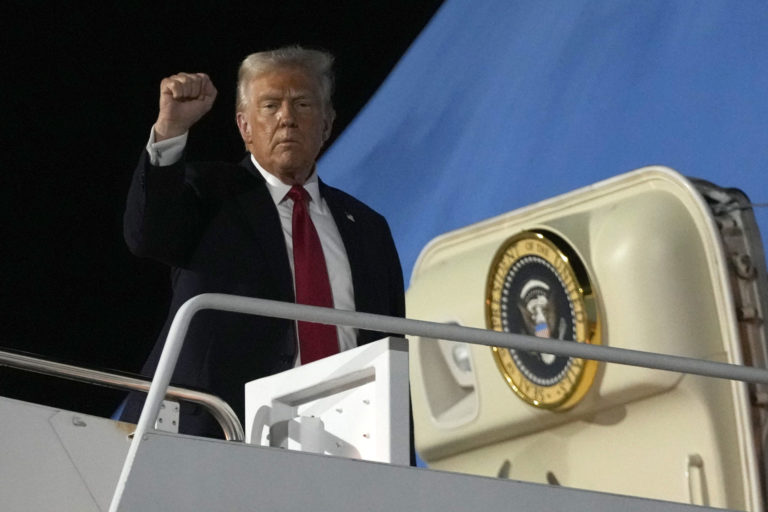
(Ken Silva, Headline USA) Ryan Routh, the man who allegedly tried assassinating President Donald Trump at his Palm Beach golf course last September, is set to stand trial next week. But he apparently wants trial by combat—or, failing that, a game of golf.
In an unhinged motion to Judge Aileen Cannon, Routh, who is representing himself, said Tuesday that he’d like to fight Trump.
“I think a beatdown session would be more fun and entertaining for everyone,” he said. “Give me shackles and cuffs and let the old fat man give it his worst.”
Routh’s bizarre motion also challenged Trump to a game of golf.
“A round of golf with the racist pig. He wins he can execute me,” he said. “I win I get his job (sorry hillbilly Vance).”
Ryan Routh just filed an unhinged motion, in which he challenges Trump to a fight. "Give me shackles and cuffs and let the old fat man give it his worst." Then he asks for strippers before challenging Trump to golf. "He wins he can execute me. I win I get his job." pic.twitter.com/kymSjPtrcd
To any reasonable observer, Routh’s latest motion raises questions about his competency to stand trial. However, two doctors have deemed him fit to proceed.
“Drs. Buigas and Holmes conducted psychological evaluations of Defendant; Dr. Buigas completed a competency evaluation in February 2025, concluding that Defendant was competent to proceed and not eligible for an insanity defense; Dr. Holmes completed an evaluation for potential sentencing purposes in July 2025, finding Defendant competent to proceed and ineligible for an insanity or diminished capacity defense,” Judge Cannon said in an order last week.
“Beyond these top-line conclusions, Dr. Holmes’s report states that Defendant meets the criteria for ‘a narcissistic personality disorder,’ while Dr. Buigas more broadly concludes that Defendant has ‘mixed personality features including schizotypal, narcissistic, and antisocial features.’ The Court considered Dr. Buigas’s evaluation in determining whether Defendant’s waiver of appointed counsel was both knowing and voluntary.”
Routh’s lawyers, which he recently fired, initially contemplated an insanity defense, but they later decided against that.
Jury selection begins on Monday.
Ken Silva is the editor of Headline USA. Follow him at x.com/jd_cashless.
“So, Israel is amazing, because, you know, I have good support from Israel,” the president told the Daily Caller. “Look, nobody has done more for Israel than I have, including the recent attacks with Iran, wiping that thing out. We, that plane, wiped them out like nobody ever saw before.”
Trump made the comments when asked if he was worried about the growing skepticism among young Republicans when it comes to the US relationship with Israel, and he noted the Israel lobby’s control over Congress, saying it has waned in recent years.
“But when, if you go back 20 years. I mean, I will tell you, Israel had the strongest lobby in Congress of anything or body, or of any company or corporation or state that I’ve ever seen. Israel was the strongest. Today, it doesn’t have that strong a lobby. It’s amazing,” Trump said.
“There was a time where you couldn’t speak bad, if you wanted to be a politician, you couldn’t speak badly. But today, you have, you know, AOC plus three, and you have all these lunatics, and they’ve really, they’ve changed it,” he added.
The criticism of Israel among a small number of members of Congress is no longer limited to Democrats, as Rep. Marjorie Taylor Greene (R-GA), who is considered a strong supporter of President Trump, has recently come out strongly against Israel’s campaign in Gaza and became the first Republican in Congress to label it a genocide. Rep. Thomas Massie (R-KY) is also known for his opposition to US aid to Israel and the pro-Israel lobby group AIPAC.
“Israel, you would understand this very much, Israel was the strongest lobby I’ve ever seen. They had total control over Congress, and now they don’t, you know, I’m a little surprised to see that,” Trump said.
The president, who is strongly backing Israel’s genocidal assault in Gaza, said the military campaign is not good for Israel’s public image. “They may be winning the war, but they’re not winning the world of public relations, you know, and it is hurting them. But Israel was the strongest lobby 15 years ago that there has ever been, and now it’s, it’s been hurt, especially in Congress,” he said.
Trump made similar comments while on the campaign trail last year, both about the Israel lobby and Israel’s public image being damaged by the destruction of Gaza. “Some 15 years ago, Israel had the strongest lobby. If you were a politician, you couldn’t say anything bad about Israel, that would be like the end of your political career. Today, it’s almost the opposite,” he told Israel Hayom in March 2024.
(Headline USA) Eight people were killed and 50 others were wounded in dozens of shootings in Chicago over the Labor Day weekend, according to police.
Between Friday night and Monday night, a total of 58 people were shot in 37 separate shootings in the nation’s third-largest city, according to preliminary information from police. Most involved one victim, but multiple people were injured in three of the shootings. Most victims were in good or fair condition, but several were listed in serious or critical condition. In a handful of cases, police said a person of interest was being questioned, but in most, no suspect was in custody.
Over Labor Day weekend last year, seven people were killed, six of them by gunfire, and more than 20 others were wounded in shootings over the holiday weekend, police said.
The number of shootings reflects a common occurrence in Chicago, particularly over long holiday weekends in summer, when some areas on the city’s West and South sides, in particular, experience localized gun violence with higher crime rates. The city’s police department and other agencies frequently increase their own street presence ahead of these summer weekends, along with community groups that aim to decrease the risk of gun violence.
Late Saturday, seven people were shot along South State Street, and police said the preliminary investigation indicated that a person in a passing vehicle opened fire into a crowd. The victims, two women and five men, were listed in good condition.
About two hours later, around 1 a.m. Sunday, four people were shot along West Haddon Avenue, a few miles away, and police said their preliminary investigation indicated that people in two passing vehicles opened fire on people standing outside. The victims, a man and three women, were all listed in good condition, police said.
Early Monday, officers responding to a report of a large disturbance heard gunshots a short distance away, then found five people shot on South Cottage Grove Avenue, about a mile from Saturday night’s shooting. A 17-year-old boy was listed in critical condition, police said. The other victims, all adults, were listed in good or fair condition. Four firearms were recovered from the shooting scene, and a person of interest was being questioned.
Violent crime has dropped in recent years in Chicago, but it remains a persistent localized problem for the city with a population of 2.75 million. Some neighborhoods with the highest homicide rates have 68 times more homicides than those with the lowest rates, according to the University of Chicago Crime Lab.
Last year, the city reported 573 homicides, the most of any U.S. city that year, according to the Rochester Institute of Technology.
So far this year, homicides and shootings are down when compared to the same period last year, according to police. There were 404 homicides from Jan. 1 to Sept. 1 last year, but 279 so far this year. There were 1,586 shootings from Jan. 1 to Sept. 1 in 2024, but 1,026 so far this year.
(Mike Maharrey, Money Metals News Service) Government regulators in India are considering easing restrictions on the inclusion of gold ETFs in the country’s pension funds. This could supercharge India’s already surging gold investment market.
India ranks as the world’s second-largest gold market behind China.
Gold-backed ETFs are currently treated as “alternative assets” in Indian pension funds. Alternative assets can’t make up more than 5 percent of the fund’s total value. The proposed rule change would eliminate that limit.
Indian pension funds collectively manage around $177 billion, and they are seeking new ways to drive returns as the pool of retirement savings expands. The total value of assets in the country’s pension system has more than tripled since the pandemic.
According to a Bloomberg report, retirement fund managers met multiple times with officials from the Pension Fund Regulatory and Development Authority. In addition to the request to lift limits on gold ETFs, managers also requested changes to rules governing real estate investment trusts and infrastructure trusts, also considered alternative assets.
According to the report, “In the last few months, managers have asked through an industry group for easier rules on the tenor and rating of securities they can buy, though the regulator hasn’t yet decided on the changes the pensions are seeking.”
Officials are reportedly considering the changes and have drafted language for the new rules.
Indians have traditionally held physical gold. They valued the yellow metal as a store of wealth, especially in poorer rural regions. Many Indians use gold jewelry not only as an adornment but to preserve their wealth.
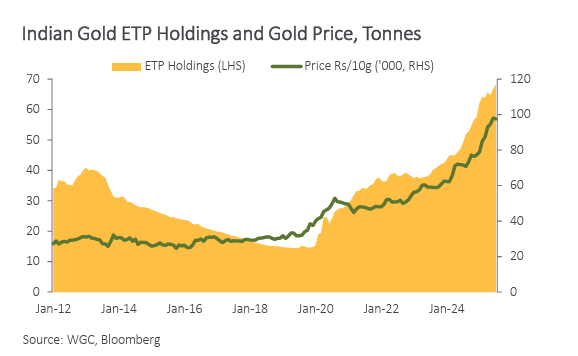
Over the last several years, there has been a growing interest in ETF investment as the economy has grown and more people have access to investment platforms.
A gold ETF is backed by a trust company that holds metal owned and stored by the trust. In most cases, investing in an ETF does not entitle you to any amount of physical gold. You own a share of the ETF, not gold itself. ETFs are a convenient way for investors to play the gold market, but owning ETF shares is not the same as holding physical gold.
Indian ETF gold holdings have nearly doubled since 2021. As of the end of July, Indian gold ETFs reported assets under management (AUM) of ₹676 billion ($7.85 billion), a 96 percent year-on-year increase.
According to Bloomberg, the appeal of gold investment in pensions is clear.
“This year – some of India’s largest gold ETFs – such as Nippon India ETF Gold, SBI ETF Gold, and HDFC Gold ETF have logged price increases of close to 30 percent so far in 2025.”
If the new rules are approved, it will likely drive a further surge of gold into Indian gold-backed funds.
Mike Maharrey is a journalist and market analyst for Money Metals with over a decade of experience in precious metals. He holds a BS in accounting from the University of Kentucky and a BA in journalism from the University of South Florida.
(José Niño,Headline USA) House Republicans have launched an investigation into whether coordinated groups are manipulating Wikipedia articles on sensitive geopolitical topics, including narratives about conflicts dealing with Israel-Palestine and Russia-Ukraine.
James Comer, R-K.y., who is Chairman of the House Committee on Oversight and Government Reform, and Nancy Mace, R-S.C., Chairwoman of the Subcommittee on Cybersecurity, Information Technology, and Government Innovation, are leading the probe into potential violations of Wikipedia’s internal rules. The areas of focus include articles about the Israel-Palestine conflict and Russian narratives about the war in Ukraine.
Lawmakers cite findings from the Anti-Defamation League. A March 2025 ADL report alleged that about 30 Wikipedia editors systematically worked to inject antisemitic and anti-Israel bias into more than 10,000 articles related to Israel and Palestine.
The ADL report noted that compared with similar groups, these editors maintained twice the level of activity across the past ten years and communicated internally up to eighteen times as frequently.
The report further claims editors consistently deleted references to credible sources while amplifying critiques of Israel and that their activity surged after the October 7, 2023, Hamas attack.
The lawmakers also cited an Atlantic Council report showing that pro-Kremlin actors have allegedly leveraged artificial intelligence tools to sanitize and reshape narratives about Russia’s war in Ukraine.
The committee sent a letter to Wikimedia Foundation CEO Maryana Iskander requesting documents and records about editor disputes, account characteristics such as activity logs and IP addresses, and analysis regarding manipulation or bias patterns from January 1, 2023, to the present.
“Multiple studies and reports have highlighted efforts to manipulate information on the Wikipedia platform for propaganda aimed at Western audiences. One recent report raised troubling questions about potentially systematic efforts to advance antisemitic and anti-Israel information in Wikipedia articles related to conflicts with the State of Israel,” Mace and Comer wrote. “A second investigation detailed actions by hostile nation-state actors to expose Western audiences to pro-Kremlin and anti-Western messaging by manipulating Wikipedia articles and other news outlets relied on for training AI chatbots.”
“[The Wikimedia] foundation, which hosts the Wikipedia platform, has acknowledged taking actions responding to misconduct by volunteer editors who effectively create Wikipedia’s encyclopedic articles. The Committee recognizes that virtually all web-based information platforms must contend with bad actors and their efforts to manipulate. Our inquiry seeks information to help our examination of how Wikipedia responds to such threats and how frequently it creates accountability when intentional, egregious, or highly suspicious patterns of conduct on topics of sensitive public interest are brought to attention,” the elected officials said in a concluding remark.
José Niño is the deputy editor of Headline USA. Follow him at x.com/JoseAlNino
(Mike Maharrey, Money Metals News Service) With the price of silver up 25 percent through the first six months of 2025, investment demand has surged. However, U.S. investors have not hopped on the bandwagon – yet.
The increase in investment demand is reflected by a big jump in ETF silver holdings. Through the first six months of the year, 95 million ounces of silver flowed into silver-backed funds globally. That’s more than the silver inflows for the totality of 2024.
Currently, global silver ETF holdings stand at 1.13 billion ounces, about 7 percent below the all-time high set during the pandemic.
While holdings are still below all-time highs, the total value of silver ETFs is at record levels, eclipsing $40 billion for the first time in June.
Physical silver investment demand is a mixed bag with strong offtake in Asia and recovering demand in Europe, as American investors remain on the sidelines.
According to data compiled by the Silver Institute, Indian silver demand has been particularly strong, with a 7 percent year-on-year increase through the first half of ’25.
Europe has seen a recovery in silver demand, although the Silver Institute notes that it is from “a relatively low base.”
“Retail investment (in volume terms) still lags behind the elevated levels seen during 2020–2022. Nevertheless, the market has benefited from a slowdown in secondary market liquidations, which has lifted demand for newly-minted bars and coins.”
However, in the U.S., we’ve seen investors taking advantage of higher prices and selling to take a dollar profit. This is similar to the dynamic in the gold market, where U.S. investors have also remained on the sidelines.
According to the Silver Institute, retail silver investment is down about 30 percent in the U.S.
Silver Institute analysts say a price over $40 could drive more American investors into the market, but this could still be offset to some degree by profit-taking.
“People will start looking at silver as a bargain, and even though it’s at $45 or $50 or $55, I think it’s going to gain momentum, and especially if it gets over that $50 price, I do think that we’re going to be challenging the $50 level by next year. So, we’ll see. And then if it breaks – and I think it breaks through that – it’s going to go quite a bit higher from there.”
Silver Demand: The Big Picture
According to the Silver Institute, physical silver investment has ranged between a low of 157.2 million ounces in 2017 and a record high of 337.6 million ounces, set in 2022.
The Silver Institute recently commissioned Metals Focus to create a report on trends in the physical silver investment market. The report examines the leading global physical silver markets: the United States, India, Germany, and Australia.
Here are some key findings in the report. You can download it HERE.
The United States
The scale of US buying has been astounding, with a combined total of 1.5 billion ounces (Boz) of silver purchased by retail investors between 2010 and 2024.
The value of US silver physical investment has averaged around 70% of the value of gold investment purchases, compared to just 6% in the rest of the world.
Investment in Individual Retirement Accounts (IRAs) remains a significant part of US physical silver investment. However, precious metals account for a small share of the total IRA market, offering considerable room for IRA silver demand to grow further.
Through late 2023, there was an exceptionally low level of retail liquidations, but these have increased since then. Even so, US investors still hold much of the 1.5 Boz acquired over the last 15 years.
India
India is the second-largest physical silver investment market, but it has occasionally eclipsed the US, which has traditionally been the largest physical silver market.
The country has a long-standing tradition of owning physical silver, typically in the form of silver bars, which in 2024 comprised 70% of total retail demand.
Attractive local prices helped boost retail silver investment up 21% in 2024
Between 2010 and 2024, the cumulative demand for Indian bars and coins totaled 840 million ounces. Even at today’s higher and sometimes record-setting rupee prices, the scale of selling back has been surprisingly modest.
Germany
Germany has long held the position of the third-largest market for retail silver bar and coin investment, a market that has been volatile in recent years, with physical investment averaging 48.5 million ounces (Moz) from 2020 to 2022.
The German physical silver market has long been dominated by bullion coins, accounting for roughly 80% of the market.
However, the end of favorable tax treatment at the end of 2022 has weighed on the German physical silver market, with German net silver demand slumping by 39 million ounces (Moz) since 2023, and the gold market also seeing a sharp decline.
This year has seen a partial recovery supported by ongoing economic and geopolitical uncertainties, with a forecasted 25 percent year-over-year increase in physical silver investment demand in Germany.
Australia
Australia has emerged as the world’s fourth-largest physical silver market in recent years.
As recently as 2019, Australian silver coin and bar demand stood at just under 3.5 million ounces. By 2022, it had surged to a record high of 20.7 Moz.
Two factors have contributed to the growth of the Australian market: the increasing popularity of investing in silver in retirement accounts and the favorable tax structure applicable to physical silver investment products.
Australian physical silver demand is forecast to rise by 11 percent this year as cost-of-living-related selling of precious metals eases, with inflation edging lower and interest rates falling.
Mike Maharrey is a journalist and market analyst for Money Metals with over a decade of experience in precious metals. He holds a BS in accounting from the University of Kentucky and a BA in journalism from the University of South Florida.
(Joshua D Glawson, Money Metals News Service) The global currency reserve numbers are in for 2025 Q1!
The research has been compiled by gold analyst Jan Nieuwenhuijs of Money Metals, who is widely recognized for his deep research on central bank gold reserves and global monetary trends.
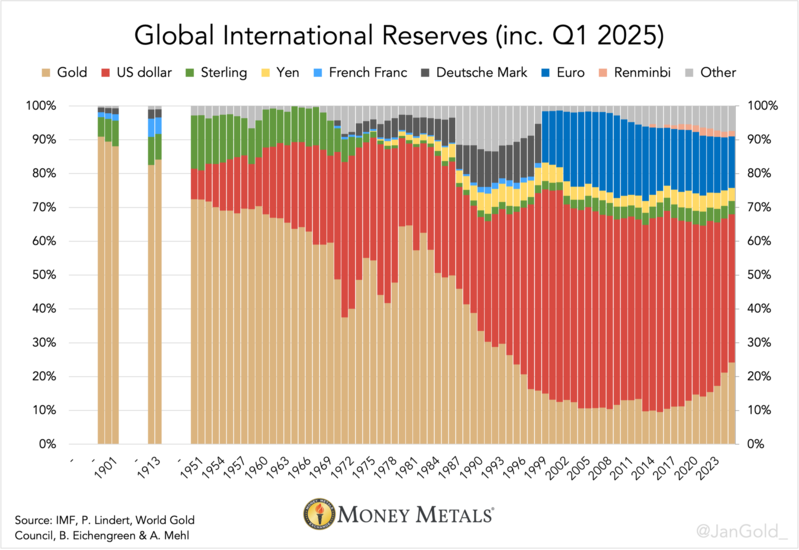
As of the end of 2024 Q4, the Federal Reserve Note dollar remained the number one reserve currency in central banks around the world at 45.55%, with gold firmly in second place at 21.20%, the euro in third place at 15.63%, and all other currencies making up the remaining 17.62%.
At the end of 2024 Q4, December 31, 2024, the spot price of gold was around $2,606.72, and by the closing of 2025 Q1, March 31, 2025, the gold spot price was around $3,089.58, indicating an increase of 18.52%.
This indicates that gold continued to see healthy global demand on the free market, while much of the gold price has been directly influenced by international central bank purchases.
Since 2024 Q4, central banks have continued to demand more gold while trading their U.S. Treasuries for the shiny metal.
With uneasiness about US monetary policy, insurmountable national debt, Trump’s vacillating tariffs, Federal Reserve induced inflation, unpredictable interest rates, metastasizing consumer debt, and growing military tensions, many countries are choosing to de-dollarize through the process of selling their fiat U.S. Treasuries for more gold sound money.
This has been exacerbated by the even simpler fact that gold is outperforming Treasuries, S&P 500, NASDAQ, and most other currencies, including popular cryptocurrencies such as Bitcoin and Ethereum, year-to-date.
So, central banks are choosing less risky options than U.S. Treasuries for their reserves, while often choosing the more stable and sound option of gold.
According to research by Jan Nieuwenhuijs, since 2024 Q4 and the closing of 2025 Q1, USD still remains as the number one reserve currency in the world at 43.79%, gold in second place at 24.16%, the euro in third at 15.21%, and other currencies making up around 16.84%.
This demonstrates a 1.76% decrease in USD’s share of global reserves and an increase of 2.96% in gold’s relative holdings by central banks around the world.
Since March 31, 2025, the price of gold has continued to increase, making up about an 11% boost. Many leading banks, investors, gurus, and experts around the world are predicting that the price of gold will continue to rise through 2026 Q2.
This suggests that if things continue in the same direction, central banks are likely to be enticed to continue to de-dollarize by selling their U.S. Treasuries for more gold, pressuring for further accelerated de-dollarization. The consequence of such would imply a weakening U.S. dollar and a strengthening gold price.
Will gold reclaim its historic seat as the number one reserve currency in the world?
We will have to wait and see.
In the meantime, it does not appear as though the USD will strengthen anytime soon against other fiat currencies, and the price of gold will likely continue to rise, especially in relation to the USD’s purchasing power.
Joshua D. Glawson is Content Manager for Money Metals and is writer on such topics as politics, economics, philosophy, finance, and personal development. He has a Bachelor’s in Political Science from the University of California Irvine.
(Money Metals News Service) In a recent episode of the Money Metals podcast, host Mike Maharrey sat down with veteran trader and market analyst Greg Weldon, founder of Weldon Financial, to discuss the accelerating bull market in gold and silver, Federal Reserve policy, global de-dollarization, and what it all means for investors.
(Interview Starts Around 7:30 Mark)
Precious Metals at Multi-Year Highs
Greg Weldon opened the discussion by calling the moment a “victory lap.”
Gold, silver, and major mining ETFs like GDX, SIL, and SALJ are all at multi-year or all-time weekly highs. Mining shares such as Kinross, Pan American, Newmont, and IAMGOLD are all surging.
Silver in particular has been the most volatile. Weldon noted that key price levels have been defended in the past through interventions—whether by bullion banks or other players—but now the market looks primed to break free. He compared today’s setup to currency interventions in the 1990s, where central banks could only delay the inevitable.
He argued that if silver pushes and closes above $40, it would make headlines and spark a new wave of demand. In his view, the gold-to-silver ratio is likely headed back toward 60, which would imply silver prices above $50 an ounce.
Gold’s Low Open Interest Signals Room to Run
While silver has been choppy, Weldon described gold as “parabolic.” What makes the move more powerful is that open interest in COMEX gold futures remains historically low. This rally is not being driven by speculators. It’s being driven by central bank and BRICS accumulation.
Weldon emphasized that institutional investors are still largely absent. Even if Wall Street portfolios shifted to a modest 3 percent allocation in gold, it would barely scratch the surface of potential demand.
Inflation, Fed Policy, and the Dollar
Weldon highlighted that inflation remains entrenched, particularly in services. Roughly 42 percent of CPI service components are running above 4 percent year over year. More than 60 percent are above 3 percent, and over 20 percent are above 5 percent. Only 12 percent are at or below the Fed’s target.
Electricity is back up to 5 percent, and base effects in energy prices are about to flip deflation into strong positive contributions. Inflation pressures are far from gone.
At the same time, the consumer is showing signs of stress. Revolving credit is contracting for the first time since 2008–09 and the pandemic. Auto loan delinquencies are now above 5 percent, worse than during the financial crisis. Lower-income households expect real incomes to shrink by as much as 2 percent over the next year.
Despite this, Jerome Powell and the Fed are talking about rate cuts. Weldon believes Powell knows the “strong consumer” and “strong labor market” narratives are faulty. With Fed Funds at 4.25 percent and $535 billion in quantitative tightening still rolling, policy is overly restrictive. In his words, the Fed will be forced to “acquiesce” to higher inflation in order to protect growth and service debt. That path is dollar bearish, and metals bullish.
The larger forces remain geopolitical. China has reduced its U.S. Treasury holdings from $1.35 trillion to below $800 billion. For the first time since 1996, foreign central banks now hold more gold than Treasuries.
Weldon noted that the BRICS initiative to move away from the dollar is advancing, even if it draws little attention in mainstream headlines. Sanctions, tariffs, and asset seizures have only strengthened the urgency among nations to seek alternatives. In his view, these are long-term dollar bearish forces that reinforce the bull case for precious metals.
Investment Takeaways
Weldon’s message to investors was blunt: just be long. Precious metals are in a buy-and-hold phase. Those already positioned should stay patient despite volatility.
He acknowledged that new entrants face a tricky question about when to buy, given how far prices have already moved. But he maintained that long-term upside remains significant.
For those who are not yet involved, he suggested working with professional commodity trading advisors who can manage risk across metals, currencies, bonds, and equities.
About Greg Weldon
Greg Weldon publishes the Global Macro Strategy Report and manages money as a registered Series 3 CTA. He can be reached at [email protected].
The conversation painted a clear picture of a pivotal moment. Precious metals are breaking out to new highs. Inflation pressures remain sticky. The Fed is preparing to cut rates despite prices still running above target. De-dollarization is gaining momentum.
Weldon summed it up simply: the purchasing power of money is eroding, and gold and silver are the ultimate hedge.
(Headline USA) A man charged with trying to assassinate President Donald Trump last year in South Florida is set to represent himself during a pretrial conference on Tuesday, as final preparations are made for trial.
Barring any delays, jury selection is scheduled to begin Sept. 8 in Fort Pierce federal court for the case against Ryan Routh. U.S. District Judge Aileen Cannon signed off on Routh’s request to represent himself in July but said court-appointed attorneys need to remain as standby counsel.
The trial will begin nearly a year after prosecutors say a U.S. Secret Service agent thwarted Routh’s attempt to shoot Trump as he played golf. Routh, 59, has pleaded not guilty to charges of attempting to assassinate a major presidential candidate, assaulting a federal officer and several firearm violations.
Prosecutors have said Routh methodically plotted to kill Trump for weeks before aiming a rifle through the shrubbery as Trump played golf on Sept. 15, 2024, at his West Palm Beach country club. A Secret Service agent spotted Routh before Trump came into view. Officials said Routh aimed his rifle at the agent, who opened fire, causing Routh to drop his weapon and flee without firing a shot.
Law enforcement obtained help from a witness who prosecutors said informed officers that he saw a person fleeing. The witness was then flown in a police helicopter to a nearby interstate where Routh was arrested, and the witnesses confirmed it was the person he had seen, prosecutors have said.
The judge on Tuesday unsealed prosecutor’s 33-page list of exhibits that could be introduced as evidence at the trial. It says prosecutors have photos of Routh holding the same model of semi-automatic rifle found at Trump’s club.
The document also lists numerous electronic messages sent from a cellphone investigators found in Routh’s car. One message dated about two months before his arrest is described as Routh requesting a “missile launcher.” It says that in August 2024, the month before his arrest, Routh sent messages seeking “help ensuring that (Trump) does not get elected” and offering to pay an unnamed person to use flight tracking apps to check the whereabouts of Trump’s airplane.
The exhibit list cites evidence from Routh’s phone of an electronic “chat about sniper concealment” during President John F. Kennedy’s assassination. And it lists internet searches for how long gunpower residue stays on clothing and articles on U.S. Secret Service responses to assassination plots.
Routh was a North Carolina construction worker who in recent years had moved to Hawaii. A self-styled mercenary leader, Routh spoke out to anyone who would listen about his dangerous, sometimes violent plans to insert himself into conflicts around the world, witnesses have told The Associated Press.
In the early days of the war in Ukraine, Routh tried to recruit soldiers from Afghanistan, Moldova and Taiwan to fight the Russians. In his native Greensboro, North Carolina, he had a 2002 arrest for eluding a traffic stop and barricading himself from officers with a fully automatic machine gun and a “weapon of mass destruction,” which turned out to be an explosive with a 10-inch-long fuse.
In 2010, police searched a warehouse Routh owned and found more than 100 stolen items, from power tools and building supplies to kayaks and spa tubs. In both felony cases, judges gave Routh either probation or a suspended sentence.
In addition to the federal charges, Routh also has pleaded not guilty to state charges of terrorism and attempted murder.
(Ken Silva, Headline USA) The DHS Inspector General has issued a report on the Secret Service’s counter-sniper team, finding that they’re overworked and not properly qualified.
The DHS OIG study was commissioned after President Donald Trump was nearly assassinated at his July 13, 2024, campaign rally in Butler, Pennsylvania. In that incident, Secret Service counter-sniper David King waited 15 seconds before returning fire. It was a local cop, Butler ESU operator Aaron Zaliponi, who shot at the would-be assassin first—likely incapacitating him.
The DHS OIG report doesn’t address the specifics of what happened at Butler. Instead, it details how the counter-snipers are overworked and undertrained.
Every quarter, Secret Service snipers are supposed to demonstrate that they can hit a target while standing, sitting, kneeling, and prone. But the DHS OIG has revealed in a new report that NONE of the Secret Service snipers met that requirement last year. pic.twitter.com/RMcTlaoTWA
According to the report, Secret Service counter-snipers “must maintain their ability to shoot accurately during the daytime and at night.” To do so, they’re supposed to undergo a requalification process—quarterly for daytime shooting and annually for nighttime shooting. That process entails using their government-issued weapons to hit a target in a prescribed area while standing, sitting, kneeling, and prone.
Last year, all the counter-snipers met their annual nighttime requalification requirement. However, only 17% of them met the daytime requalification requirement in the first quarter of last year, while none of them did in the second quarter.
“Additionally, none of the counter snipers who missed mandatory requalification sessions submitted Form 4438, Failure to Attend Firearms Qualification, detailing the circumstances that prevented them from attending to their supervisor as Secret Service guidance requires,” the report added.
The snipers who didn’t requalify worked at 47 out of the 426 protective events last year, including at least three attended by former President Joe Biden: a Jan. 8, 2024, memorial for former Rep. Eddie Bernice Johnson, a campaign reception in New York City on Feb. 7, and an event in Manchester, New Hampshire on March 11.
The report also reveals that the Secret Service was so overworked and understaffed that it had to rely on help from ICE and CBP snipers, as well as the "HSI special response team." The ICE snipers guarded Trump and Biden's houses, which allowed the SS snipers to attend events. https://t.co/lwKw1KDMfKpic.twitter.com/Tjd4b48ewO
The counter-snipers may not have had the time to undergo requalification in the busy campaign season. According to the DHS-OIG report, counter-snipers worked a combined 59,828 of overtime last year, and 247,887 hours of overtime since 2020.
The DHS OIG report also said the Secret Service had to rely on snipers from other agencies, including Immigration and Customs Enforcement. The ICE snipers were used to protect Biden and Trump’s respective houses in Delaware and Florida, which allowed the Secret Service gunmen to attend events, the report explained.
The report doesn’t say how many snipers work for the Secret Service, but it does say that the agency is running “73% below operational needs.” The inspector general interviewed 28 counter-snipers for its report.
In response to the inspector general’s findings, the Secret Service said it’s in the process of hiring more snipers, and that it will make sure they’re better trained. However, the inspector general noted that the agency didn’t promise to make sure they meet their quarterly requalification requirements.
“Secret Service did not address the deficiency we found, namely, counter snipers who did not meet their weapon requalification and were assigned to protective operations,” the OIG said.
Ken Silva is the editor of Headline USA. Follow him at x.com/jd_cashless.