Kentucky Congressman Thomas Massie Marries Former Senate Staffer After Loss of Wife

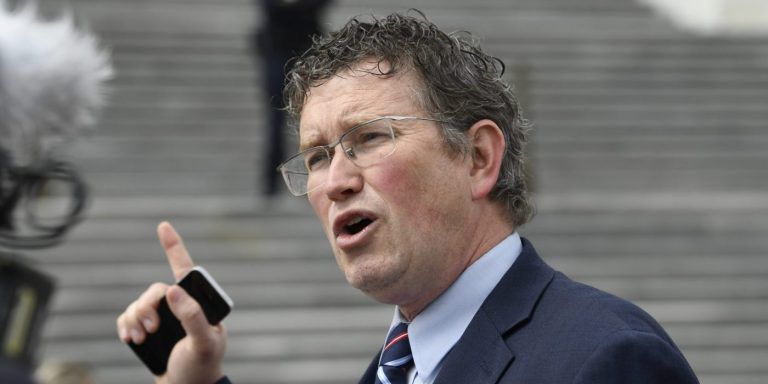
(José Niño, Headline USA) Kentucky Representative Thomas Massie announced Sunday that he has married Carolyn Grace Moffa, a former agriculture policy aide to Senator Rand Paul, more than a year after the death of his wife of 31 years.

The Republican congressman, who represents Kentucky’s 4th Congressional District, legally married Moffa on October 19 in Kentucky, per a report by WLWT 5 News. The couple celebrated with a Christian wedding ceremony in Pennsylvania over the weekend, surrounded by close friends, family and several prominent congressional colleagues.

According to a Daily Mail report, Massie, 53, and Moffa, 36, first met professionally more than a decade ago when she worked as an agriculture policy staffer for Senator Paul from 2011 to 2016. She even visited Massie and his late wife Rhonda on their grass-fed cattle farm several years ago. The relationship developed after Rhonda Massie died suddenly in June 2024 at age 51.

“Carolyn and I would like to announce our recent marriage,” Massie wrote in a statement posted on social media. “We were legally married in Kentucky on October 19th by the pastor of the church we have been attending for several months.”

The congressman proposed to Moffa on the steps of the Library of Congress, the location of their first date. Moffa, who has never been married before, has recently been helping Massie reestablish ducks and chickens on his Kentucky farm, which also raises beef cattle. 

According to Massie, she “was a very early proponent and practitioner of Making America Healthy Again” during her time working on agriculture policy.The wedding reflected the couple’s commitment to their farming lifestyle and conservative values. 

Raw milk was served alongside the wedding cake, and the couple offered margaritas made with frozen peaches from their farm. Among the guests were Senator Rand Paul and Representatives Jim Jordan, Warren Davidson, Marjorie Taylor Greene and Victoria Spartz.

Despite the political star power in attendance, Massie said “the real VIPs were my three grandkids,” with his oldest grandson serving as ring bearer. Massie has four adult children from his first marriage, all now married themselves.

The congressman acknowledged the bittersweet nature of moving forward while still grieving his first wife. “I have four adult children, who are all married to wonderful people, and three grandchildren from my blessed 31 year marriage to Rhonda who I still miss every day,” he said.

The couple plans to divide their time between the Kentucky farm and Washington as Massie’s congressional responsibilities require. 

He concluded his announcement with a request for support as they begin this new chapter together. “Please pray for us as Carolyn steps into the arena with me,” Massie wrote. “With her support, I look forward to continuing my fight for freedom for the great people of Kentucky.”

José Niño is the deputy editor of Headline USA. Follow him at x.com/JoseAlNino 

Duffy: We are Going to Go After the CDL Mills

(Alan Wooten, The Center Square) Safety concerns, two triple-fatals involving 18-wheelers and a closer look at commercial driver’s licenses has led the U.S. Department of Transportation to say, “We are going to go after the CDL mills.”

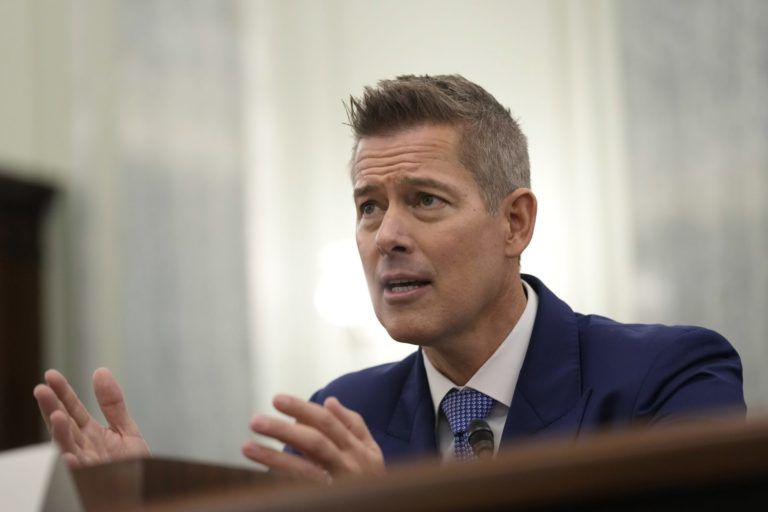
Transportation Secretary Sean Duffy at a news conference said some schools for CDLs throughout the country are saying applicants can operate a tractor-trailer rig when in fact they cannot. Also, he said, many do not check citizenship or proficiency in the English language.

“A lot of these students are coming through these schools,” Duffy said. “They can’t speak the language, and many of them are not proficient in the English language. Many of them don’t have the skills to operate big rigs on the roads, but nonetheless, the schools are certifying that they are qualified.

“They don’t have documentation that they are citizens. So we’re going to go after the CDL mills that are issuing licenses across the country, sending certification into our state DOTs saying that you have a qualified individual to drive a big rig, licensed in your state. Truth is, they are not.”

Duffy promised serious consequences. Along with that, he said companies hiring the drivers from the CDL mills will also be investigated.

In an email to The Center Square, the Owner-Operator Independent Drivers Association said the move is positive.

“Years of misguided ‘driver shortage’ policies have flooded America’s roadways with poorly trained newcomers operating 80,000-pound trucks and innocent motorists are paying the price,” said Todd Spencer, the trade association’s president. “Trucking is a skilled profession, not cheap labor. We applaud the Trump administration’s commitment to restoring standards in trucking that will not only save lives, but help improve professionalism in our industry.”

Federal law requires proficient enough in the English language to speak with the public in general, respond to inquiries, and comprehend highway traffic signs and signals.

Regarding citizenship, an employment-based visa like H2A, H2B or E2 is required for a noncitizen to get a CDL. The license generally will expire when work authorization expires. Lawful permanent residents with a green card can get a CDL.

“We’re using every tool in our toolbox to make sure states comply,” Duffy said.

Crashes involving 18-wheelers are under greater scrutiny in part because of two triple-fatals, one in Florida and another in California.

Prosecutors say on Aug. 12 that Harjinder Singh was driving an 18-wheeler and tried to U-turn on the Florida Turnpike through a point in the divided highway marked “official use only.” The speed limit at mile marker 171 is 70 mph.

Homeland Security’s link to video from Breaking911, shot from inside the truck, shows the graphic collision that followed. Three people in a minivan were killed when the trailer suddenly was crossing their lanes.

Florida Attorney General James Uthmeier said Singh failed the written portion of the CDL 10 times. He had correct responses to two of 12 verbal questions on an English language proficiency assessment and correctly identified only one of four highway traffic signs during an interview with the Motor Carrier Administration after he had been taken into custody.

On Oct. 21 on the 10 Freeway in Ontario, Calif., 21-year-old Jashanpreet Singh of India was driving an 18-wheeler that never braked before instigating a rear-end collision with eight vehicles, said the California Highway Patrol. In addition to three dead, four others were hospitalized.

Homeland Security filed an arrest detainer for Jashanpreet Singh, saying he entered the country through the southern border in 2022 and was released into the United States by the Biden administration.

Harjinder Singh is believed to have come to America in 2018 and gained his CDL despite no documentation for being in the country.

Neither man named Singh is related, according to published reports.

94% of Sanctioned Scholars Suffered from Free Speech Attacks

(Tate Miller, The Center Square) A Foundation for Individual Rights and Expression survey shows that 94% of sanctioned university scholars have experienced a negative impact following the attacks on their free speech, with conservative scholars receiving much less public support from their university colleagues or faculty union compared to liberals.

Foundation for Individual Rights and Expression (FIRE) research fellow and manager of polling and analytics Nathan Honeycutt told The Center Square: “What we heard from scholars about their experiences further reinforces how the academy needs courageous faculty willing to stand up for their colleagues, even when doing so is difficult or unpopular.

“It takes courage to seek, to listen, and to defend,” Honeycutt said. “But standing up for others is a test of integrity for higher education, and it’s a test the academy can’t afford to fail any longer.”

Senior Counsel Tyson Langhofer from legal organization Alliance Defending Freedom told The Center Square that FIRE’s poll “highlights a dangerous erosion of open inquiry in higher education.”

“When scholars fear speaking freely, universities cease to be places of learning and become echo chambers of conformity,” Langhofer said.

“The lack of support for conservative scholars, in particular, reveals an ideological imbalance on campuses that undermines intellectual diversity,” Langhofer said.

For its survey, FIRE talked with scholars “targeted for sanction because of their speech between 2020 and 2024.”

The results showed that 94% of these scholars have experienced a negative impact from attacks on their free speech.

Forty seven percent of the scholars said they lost professional relationships, 40% said they were shunned at work, 29% said their friends and family suffered collateral damage, and 20% said they lost employment.

Sixty eight percent of these scholars said they did not receive public support from their union, with a “noticeable partisan gap” found in the levels of support.

For instance, 40% of liberal scholars received “a moderate amount” of public support from university colleagues, versus 19% of conservatives. Additionally, 29% of liberal scholars received public support from their faculty union versus 7% of conservatives.

Interestingly, the general public outside of the academy gave more support to conservatives than liberals at 55% and 37%, respectively.

FIRE’s Nathan Honeycutt told The Center Square he believes “the responses from these scholars and their experiences further demonstrates that [the] cost of speaking freely can carry professional and personal risk.”

“Particularly given that those who should be speaking up in defense of speech and expression (at least for the scholars we heard from) have largely stayed silent,” Honeycutt said.

“Another implication that I think this survey speaks to is how the lack of support these scholars reported is reflective of a climate of isolation,” Honeycutt said.

Honeycutt explained this“will only further erode trust and narrow the scope of what is ‘acceptable’ or ‘safe’ to teach, discuss, or research.”

“Additionally, the experiences of these scholars likely creates a chilled climate for speech and expression,” Honeycutt said.

“When other scholars – including faculty or graduate students – witness the sanctions, terminations, isolation, and reputational collapse of those being targeted, and see nobody else speaking up, it likely becomes quite clear that silence is probably the best course of action,” Honeycutt said.

Langhofer told The Center Square that “universities must recommit to protecting all speech, even when it’s unpopular or controversial.”

“That means hiring faculty with diverse viewpoints, hosting civil debates, and enforcing rules against disruptive protests,” Langhofer said. “Most importantly, they must reject the false idea that words are ‘violence,’ which only fuels real hostility.”

“The growing tendency to label speech as ‘violence’ is dangerous and undermines the principles that make free societies thrive,” Langhofer said.

“Students must learn that disagreement is not an attack but an opportunity to think critically,” Langhofer said. “Protecting free expression on campus is crucial to ensuring that future generations choose dialogue over violence.

When asked how college campuses can become places that uphold freedom of speech, Nathan Honeycutt replied that “there are many ways.”

“Extending from this report one of the primary ways colleges and universities can better uphold the freedom of speech is by making the defense of speech and expression predictable, principled, and public,” Honeycutt said.

“Others do not have to agree with the speech or expression of every scholar being targeted, but there should be no question whether an institution will defend a scholar’s expression or work, or whether a scholar’s colleagues will speak up in defense,” Honeycutt said.

When reached, the ACLU was not able to provide comment in time for publishing.

Trump Administration Says SNAP will be Partially Funded in November

(Headline USA) President Donald Trump’s administration said Monday that it will partially fund SNAP after two judges issued rulings requiring it to keep the nation’s largest food aid program running.

The U.S. Department of Agriculture, which oversees the Supplemental Nutrition Assistance Program, had planned to freeze payments starting Nov. 1 because it said it could no longer keep funding it during the federal government shutdown. The program serves about 1 in 8 Americans and is a major piece of the nation’s social safety net. It costs more than $8 billion per month nationally. The government says an emergency fund it will use has $4.65 billion — enough to cover about half the normal benefits.

Exhausting the fund potentially sets the stage for a similar situation in December if the shutdown isn’t resolved by then.

It’s not clear exactly how much beneficiaries will receive, nor how quickly they will see value show up on the debit cards they use to buy groceries. November payments have already been delayed for millions of people.

“The Trump Administration has the means to fund this program in full, and their decision not to will leave millions of Americans hungry and waiting even longer for relief as government takes the additional steps needed to partially fund this program,” Massachusetts Attorney General Andrea Joy Campbell, who led a coalition of Democratic state officials in one of the lawsuits that forced the funding, said in a statement.

People who receive the benefits are trying to figure out how to stretch their grocery money further.

Corina Betancourt, who’s 40 and lives in Glendale, Arizona, already uses a food bank sometimes to get groceries for herself and her three kids, ages 8 through 11. With her SNAP benefits reduced and delayed, she’s expecting to use the food bank more and find ways to stretch what she has further.

But she is worried that there won’t be enough for her children to eat with about $400 this month instead of around $800. “We always make things work somehow, some way,” she said.

In Camden, New Jersey, 41-year-old Jamal Brown, who is paralyzed after a series of strokes and on a fixed income, said family members asked him for a list of groceries he needs so they can stock him up.

But not everyone has that help.

“How did you expect to live a healthy life if you’re not eating the right stuff?” he asked. “If you don’t have the access to the food stamps, you’re going to go to the cheapest thing that you can afford.”

The administration said it would provide details to states on Monday on calculating the per-household partial benefit. The process of loading the SNAP cards, which involves steps by state and federal government agencies and vendors, can take up to two weeks in some states. But the USDA warned in a court filing that it could take weeks or even months for states to make all the system changes to send out reduced benefits. The average monthly benefit is usually about $190 per person.

California Attorney General Rob Bonta said at a news conference that it would take his state about a week to load benefit cards once the funding is made available.

“These are folks who are hungry, and every day matters,” Bonta said.

The USDA said last month that benefits for November wouldn’t be paid due to the federal government shutdown. That set off a scramble by food banks, state governments and the nearly 42 million Americans who receive the aid to find ways to ensure access to groceries.

Democratic state attorneys general or governors from 25 states, as well as the District of Columbia, challenged the plan to pause the program, contending that the administration has a legal obligation to keep it running in their jurisdictions. Cities and nonprofits also filed a lawsuit.

Trump posted on social media Friday that he does “NOT want Americans to go hungry just because the Radical Democrats refuse to do the right thing and REOPEN THE GOVERNMENT.” He said he was telling government lawyers to prepare SNAP payments as soon as possible.

Most states have boosted aid to food banks, and some are setting up systems to reload benefit cards with state taxpayer dollars. The threat of a delay also spurred lawsuits.

Federal judges in Massachusetts and Rhode Island ruled separately but similarly Friday, telling the government that it was required to use one emergency fund to pay for the program, at least in part. They gave the government the option to use additional money to fully fund the program and a deadline of Monday to decide.

Patrick Penn, Deputy Under Secretary Food Nutrition and Consumer Services for USDA, said in a court filing Monday that the department chose not to tap other emergency funds to ensure there’s not a gap in child nutrition programs for the rest of this fiscal year, which runs through September 2026.

Advocates and beneficiaries say halting the food aid would force people to choose between buying groceries and paying other bills. The majority of states have announced more or expedited funding for food banks or novel ways to load at least some benefits onto the SNAP debit cards.

Rhode Island officials said Monday that under their program, SNAP beneficiaries who also receive benefits from another federal program, Temporary Assistance for Needy Families, received payments Saturday equal to one-fourth of what they typically get from SNAP. Officials in Delaware are telling recipients that benefits there won’t be available until at least Nov. 7.

To qualify for SNAP in 2025, a household’s net income after certain expenses can’t exceed the federal poverty line. For a family of four, that’s about $32,000 per year.

Adapted from reporting by the Associated Press


Venezuela’s Nobel Prize Winner Says US ‘Escalation’ Is Needed To Overthrow Maduro

(Dave DeCamp, Antiwar.com) Maria Corina Machado, the Venezuelan opposition leader who recently won the Nobel Peace Prize, said in an interview with Bloomberg that US military “escalation” is the only way to oust Venezuelan President Nicolas Maduro and confirmed that she is in contact with Trump administration officials.

When asked if she supports the idea of the US bombing Venezuela, Machado said, “I believe the escalation that’s taken place is the only way to force Maduro to understand that it’s time to go.”

She added, “I believe that this escalation is the last opportunity for those that still support Maduro to understand that they need to take all support away from him — and Maduro himself to understand that this is the last chance to truly facilitate a peaceful and orderly transition, which is what we want, which is what we fought for.”

Machado also said that she supported the US bombing campaign against alleged drug-running boats in the region, which the US military has been conducting without providing evidence to back up its claims about what the boats are carrying. The Pentagon has also admitted to Congress that it doesn’t know the identities of the people it has been killing.

When asked if she viewed the boat strikes as justified or as extra-judicial executions, Machado blamed the deaths on Maduro. “This is about saving lives. Maduro is absolutely conscious and has been warned what not to do. These deaths are the responsibility of Nicolás Maduro,” she said.

Machado was then asked about the rights to due process for the people on the boats, and said, “I certainly defend the rights of everyone, but you need to understand that this is a very cruel war. It was Maduro who turned this into an international conflict. Maduro is not a conventional dictator. We’re facing a narcoterrorist structure that has turned Venezuelan territory.”

Machado said that she has been in touch with US Secretary of State Marco Rubio, who has been leading US Venezuela policy and the push toward regime change. “I have been in touch with him, of course, and with his team and even further, in Congress. [In] both parties, we have really good friends and champions of our cause. This goes beyond ideological issues,” she said.

Machado was barred from running in last year’s presidential election and backed Edmundo Gonzalez, whom she and the opposition claim actually won, a position adopted by the US government, which hasn’t recognized Maduro as Venezuela’s president since 2019. The first Trump administration backed a failed coup against Maduro at the time, which involved recognizing opposition figure Juan Guaido as the “interim president,” imposing harsh economic sanctions, and covert CIA operations.

US officials have made clear that the real goal of the current military campaign in the Caribbean is regime change in Venezuela, and the Trump administration is considering bombing the country. Machado and other opposition figures insist that once Maduro is gone, a “peaceful transition” can happen, but a war would likely destabilize the country.

This article originally appeared at Antiwar.com.

Report: US Preparing Mexico Mission Against Cartels That Would Include Troops and Drone Strikes

(Dave DeCamp, Antiwar.com) The Trump administration has begun developing detailed plans to send US troops and intelligence officers into Mexico to target cartels in operations that would include drone strikes, NBC News reported on Monday, citing current and former US officials.

The report said that US military personnel have already begun training for the potential mission, though a deployment is not imminent. Many of the troops would come from Joint Special Operations Command (JSOC) and would operate under the authority of US intelligence agencies, with involvement from CIA officers.

Unlike the current US bombing campaign against alleged drug boats in the waters of Latin America, which the Trump administration is conducting without legal authority, the idea of the campaign in Mexico would be to keep it secret and not publicize attacks.

The NBC report said the administration wanted to operate in coordination with the Mexican government but was also considering conducting the campaign without Mexico’s approval, which would mark a significant violation of the country’s sovereignty. Mexican President Claudia Sheinbaum has increased law enforcement cooperation with the US and has allowed the CIA to ramp up surveillance flights along the border, but she has repeatedly ruled out US military intervention in her country.

“The United States is not going to come to Mexico with the military,” Sheinbaum said in August. “We cooperate, we collaborate, but there is not going to be an invasion. That is ruled out, absolutely ruled out.”

The Mexican leader has also condemned US strikes on boats in the region, saying she “doesn’t agree” with the policy. The US recently bombed several alleged drug vessels in the Eastern Pacific, and in one case, the Mexican Navy had to rescue a survivor.

The Trump administration has not provided any evidence to back up its claims that the boats it has been targeting were carrying drugs and has admitted to Congress that it doesn’t know the identities of the people it has killed. Since the bombing campaign began on September 2, the US military has extra-judicially executed 64 people at sea.

The strikes on boats and the push toward regime change in Venezuela have come under increasing scrutiny from both Democrats and Republicans in Congress due to the lack of transparency and lack of legal authority.

“People were very frustrated in the information that was being provided. It was a bipartisan briefing, but people were not happy with the level information that was provided, and certainly the level of legal justification that was provided,” Rep. Mike Turner (R-OH) said after a briefing on the military campaign.

The NBC report signals that the potential US bombing campaign in Mexico, which would target alleged cartel targets, would have even less transparency since the idea is to do it in secret.

In response to the report, a senior administration official told NBC, “The Trump administration is committed to utilizing an all-of-government approach to address the threats cartels pose to American citizens.”

This article originally appeared at Antiwar.com.

2 Men Charged in Alleged Halloween Terrorist Plot That Involved at Least 10 People, Including Undercover Feds

(Ken Silva, Headline USA) FBI Director Kashyap Patel said on Friday that agents in Michigan foiled an ISIS-inspired plot to commit a mass shooting on Halloween. Newly unsealed court records show that the truth is more complicated than what Patel would have the public believe.

A criminal complaint filed Saturday and unsealed Monday shows that at least 10 people were involved in the alleged plot, but only two were charged. The other eight players included five unnamed and uncharged “co-conspirators”—some of them located overseas—an unnamed juvenile, an FBI informant, and an undercover agent.

The two defendants, Mohmed Ali and Majed Mohmoud, weren’t charged with conspiracy to commit murder or plotting an act of terrorism. Rather, they were charged “for having firearms that would be used in a conspiracy to provide material support to ISIS,” the Justice Department said in a Monday press release.

The DOJ’s case is underpinned by conversations between other co-conspirators and undercover FBI informants—conversations in which Ali and Mohmoud weren’t even involved.

For example, on June 27 someone identified as “co-conspirator 2” said that he tried to convince Ali and Mohmoud to travel to Syria to join ISIS, but that they were going to stay in the U.S. to do the “same thing as France”—a reference to the 2015 ISIS mass shooting in Paris. In the same conversation, which was recorded by an FBI informant, co-conspirator 2 said the defendants would carry out their shooting “at like a club, a disco.”

The criminal complaint does show that the defendants were talking with the unnamed juvenile in code, repeatedly referencing “pumpkins.” The criminal complaint also says that the defendants allegedly conducted surveillance at clubs around Ferndale, Michigan.

Additionally, Ali and Mohmoud had been acquiring firearms, stockpiling ammo, and visiting shooting ranges earlier this year—though they did all that legally. During at least two of their trips to the range, plainclothes FBI agents were there, too, observing them.

It appears that the defendants have been on the FBI’s radar for over a year. According to the criminal complaint, agents interviewed the unnamed juvenile in September 2024. The juvenile admitted to belonging to Discord chatrooms that shared ISIS propaganda, and said that he was being recruited as a “potential mujahid”—a holy warrior engaged in violent jihad.

Based on that information, the FBI said in an affidavit that there’s probable cause to believe that Ali and Mohmoud committed a crime. It’s unclear why the other co-conspirators weren’t charged.

Defense lawyer Amir Makled, who represents one of the men detained, said that “there was never any planned mass-casualty event or terrorism plot of any kind that I’m aware of.”

“They might have been on some websites or online chat groups that they shouldn’t have been, but nothing that is illegal,” he added.

Manufactured Terror Plots

The FBI has a long history of using undercover agents to provoke or bait young men into criminal acts—one of the most prominent examples occurring in Michigan with the 2020 purported militia plot to kidnap Gov. Gretchen Whitmer. In that case, there were at least 12 informants and several undercover agents, some of whom organized militia training exercises, drove some the defendants to various locations, and supplied them with copious amounts of alcohol and cannabis.

Of the 12 men arrested in the Whitmer case, four took plea deals, five were eventually acquitted, and five were found guilty—two of them in federal court and three in state court. Two separate courts have upheld the convictions, despite the fact that judges admitted the FBI had provoked the accused.

More recently in that state, the feds arrested a 19-year-old former Michigan Army National Guardsman for allegedly attempting to carry out a mass shooting at a U.S. military base in Warren, Michigan. The DOJ’s charging papers against Ammar Abdulmajid-Mohamed Said show that at least two undercover FBI agents and an informant were used against him. Records also show that Said suspected the undercover agents of entrapment in December, before he eventually changed his mind and decided to proceed with the purported plan.

Said’s case is still pending.

Ken Silva is the editor of Headline USA. Follow him at x.com/jd_cashless.

Don’t Let the Precious Metals Bull Shake You Off

(Clint Siegner, Money Metals News Service) Investors have to manage their emotions and deal with surprises in order to succeed. This is particularly true for bullion investors, who can expect more than their share of volatility and unexpected price action.

Gold and silver don’t enjoy genuine support on Wall Street or in Washington, DC. And the metals have few friends among the central planners at the Federal Reserve or other central banks in the Western World.

Gold and silver are not favored assets, unlike real estate, Treasuries, or U.S. equities.

Regulators have turned a blind eye or have given a slap on the wrist to banks caught red-handed rigging prices. People betting on higher prices have been punished, including the Hunt brothers, who were brutalized by a COMEX move to limit investors to sell orders only.

In fact, the system for price discovery in U.S. futures markets may have been “purpose built” to discourage broad ownership of physical gold and silver.

The following is a quote from a memo sent from the U.S. Embassy in London to the Treasury Department in 1974. It outlines what was expected to happen following the creation of a futures market for gold.

EACH OF THE DEALERS EXPRESSED THE BELIEF THAT THE FUTURES MARKET WOULD BE OF SIGNIFICANT PROPORTION AND PHYSICAL TRADING WOULD BE MINUSCULE BY COMPARISON. ALSO EXPRESSED WAS THE EXPECTATION THAT LARGE VOLUME FUTURES DEALING WOULD CREATE A HIGHLY VOLATILE MARKET.

IN TURN, THE VOLATILE PRICE MOVEMENTS WOULD DIMINISH THE INITIAL DEMAND FOR PHYSICAL HOLDING AND MOST LIKELY NEGATE LONG-TERM HOARDING BY U.S. CITIZENS.

Coming back to the present, it’s fair to question whether or not precious metals have put in a top, at least for the short term. But before deciding whether now is the right time to sell, investors should consider a few things.

Avoiding volatility might be hard to do. There was a time in America when putting cash in the bank or buying Treasuries was a relatively safe option. Today, even those options carry more risk than many people realize.

The Federal Reserve Note “dollar” has fallen precipitously in terms of purchasing power over the past five years. Official inflation data indicates the dollar buys about 20% less. The real decline, according to www.shadowstats.com, is closer to double that.

And recent years have been among the most volatile ever in the Treasury markets. The U.S. government has been flooding the market with trillions of dollars worth of new bonds each year.

Unless Congress does something unprecedented, that is going to continue – and probably even accelerate.

The best reason to sell metal is because you have identified another asset you expect will outperform gold and silver. In other words, investors should ask themselves what has changed since they made the decision to buy metal in the first place.

Are you more optimistic about where the U.S. dollar is headed?

Does real estate look cheap? Are the valuations on stocks more reasonable now?

Does it make sense to buy fixed-rate, dollar-denominated Treasury bonds even though they are backed by the most profligate government in the history of the world?

There has been a run-up in metals prices. Does that mean they are now expensive relative to the alternatives?

We don’t think so. In our view, the real bubbles aren’t in gold and silver. Investors can find those somewhere else. However, whether you are buying OR selling, Money Metals is here to help you facilitate that.


Clint Siegner is a Director at Money Metals Exchange, a precious metals dealer recently named “Best in the USA” by an independent global ratings group. A graduate of Linfield College in Oregon, Siegner puts his experience in business management along with his passion for personal liberty, limited government, and honest money into the development of Money Metals’ brand and reach. This includes writing extensively on the bullion markets and their intersection with policy and world affairs.

Is the Fed About to Restart Quantitative Easing?

(Mike Maharrey, Money Metals News Service) While the rate cut got most of the attention, the Federal Reserve made another move during its October meeting that is arguably more consequential. The central bank announced it will end balance sheet reduction (quantitative tightening, or QT) in December.

In practice, this means the central bank will stop reducing its holdings of Treasuries and mortgage-backed securities, maintaining the size of its balance sheet at the current level.

Could this be setting the stage for a return to quantitative easing (QE)?

I think it is.

Fed Balance Sheet Operations: An Overview

When the Fed buys assets – primarily U.S. Treasuries and mortgage-backed securities – it does so with money created out of thin air. Those assets go on the balance sheet, and the new money gets injected into the financial system and ultimately the broader economy.

This process is known as QE.

When the Fed reverses the process and shrinks its balance sheet (QT), it pulls liquidity out of the financial system by reducing bank reserves and shifting government debt financing to the private sector. This tightens funding conditions and market debt. It is effectively deflationary.

While Powell & Company would never admit it, the central bank has no choice but to end balance sheet reduction due to the federal government’s borrowing and spending problem.

In effect, the Fed supports the government’s borrowing by creating artificial demand for Treasuries by purchasing bonds and holding them on the balance sheet. This drives prices higher and yields lower, lowering the U.S. government’s borrowing costs.

If the Fed weren’t holding so much U.S. debt, Treasury interest rates would be substantially higher.

An end to QT makes sense given that the federal government is paying more than $1 trillion in interest expense right now.

Why QE?

While an end to balance sheet reduction won’t inject newly created money into the economy, it will reduce the number of bonds the government has to sell on the open market, thereby easing supply, raising Treasury prices, and putting downward pressure on yields.

Simply ending balance sheet reduction might not be enough. Given falling global demand for Treasuries and persistently high yields, the central bank may well have to relaunch quantitative easing in the near future to press its thumb harder on the Treasury market. In effect, this would be a return to money printing.

I’m not the only person who thinks QE will resume in the near future.

The Telegraph World Economy Editor Ambrose Evans-Pritchard recently wrote an op-ed warning that the U.S. central bank “is preparing the ground for a rapid return to net bond purchases, deeming it necessary to ensure sufficient liquidity for the financial system.

Of course, they won’t call it “quantitative easing.” Evans-Pritchard said they will call it “open market operations,” and they will sell it as “a technical adjustment to manage bank reserves and the plumbing of the credit markets.”

This has happened before.

When the Fed tried to raise rates and shrink its balance sheet in the wake of the Great Recession, the economy got shaky, the stock market sold off, and liquidity problems started popping up in the financial system.

The Fed cut rates three times in 2019 and initiated open market operations similar to those Evans-Pritchard describes. The pandemic bailed the central bank out, allowing it to slash rates to zero and put QE into overdrive, effectively kicking the can down the road.

We still haven’t dealt with the malinvestments and debt bubble created by the monetary malfeasance in the wake of the 2008 financial crisis. And then the Fed doubled down with pandemic stimulus.

Evans-Pritchard cites a former QE manager at the New York Fed who says, “liquidity has dried up, and the Fed will soon have to buy $150 billion of debt to stabilize the money markets.

Evercore ISI analysts Krishna Guha and Marco Casiraghi say the Fed will likely start mopping up a net $35 billion in Treasury debt each month beginning as early as January.

This is debt monetization, pure and simple. Professor Tim Congdon from the Institute of International Monetary Research said the Fed is “aiding and abetting” monetization of America’s deficits.

What on earth do they think they are doing?” he asked.

Debt Monetization and Inflation

When Ben Bernanke launched the first round of QE at the onset of the Great Recession, he assured Congress that the Fed was not monetizing the debt (When the Fed buys a bond with money created out of thin air, it is effectively turning that debt into money — thus the term “debt monetization.”). He said the difference between debt monetization and the Fed’s policy was that the central bank was not providing a permanent source of financing. He said the Treasuries would only remain on the Fed’s balance sheet temporarily. He assured Congress that once the crisis was over, the Federal Reserve would sell the bonds it bought during the emergency.

That never happened.

And then the Fed doubled down, expanding the balance sheet by nearly $5 trillion during the pandemic.

This is, by definition, inflation.

Congdon said about two-thirds of the U.S. national debt is being monetized in one form or another.

This is why prices keep going up.

“The U.S. authorities are incubating another spasm of inflation a year or two hence, risking a repeat of the great monetary error made during the early phase of Covid. They seem to have learned nothing.”

Evans-Pritchard compared the situation to the roaring ‘20s. Of course, we know how that turned out.

“Forgive me for being an old cynic, but I would suggest that America is heading into an irresponsible financial boom akin to the final blow-off of the Roaring Twenties and the Roaring Nineties. The debasement trade is young yet.”


Mike Maharrey is a journalist and market analyst for Money Metals with over a decade of experience in precious metals. He holds a BS in accounting from the University of Kentucky and a BA in journalism from the University of South Florida.

Is the Silver Bull Market Over?

(Mike Maharrey, Money Metals News Service) Silver has been on a wild roller coaster ride.

Is the recent selloff a temporary correction or have we reached the end of the rally?

While the supply displacement that pushed silver to a new record high has moderated somewhat, the underlying dynamics that have been driving both silver and gold higher over the last two years remain in place.

Silver gained nearly 40 percent in two months. This is the definition of overbought, and a correction was inevitable.

Correct it did.

After charting a new record high of $54.48 in mid-October, silver suffered the largest single-day selloff in years just 11 days later, plunging 16 percent to a low of $45.57 on October 28. Since then, silver seems to have found support in the $48 range.

It’s important to remember that even with the sharp correction, silver is still up over 65 percent this year and ranks among the best-performing assets.

Silver’s selloff corresponded with a similar correction in the gold market. Metals Focus called the correction “long overdue.”

“Following an exceptional rally since late August, all technical indicators suggest that both silver and gold had entered overbought territory. Given growing concerns over the sustainability of the rally, some technical profit-taking was to be expected.”

The Silver Squeeze

One of the factors that pushed silver higher so quickly was a silver squeeze.

A convergence of factors from market dynamics to logistical problems led to this unprecedented silver shortage in London. While the market dynamics that got us here might be difficult to untangle, the situation is about as basic as it gets.

There’s not enough silver.

The movement of silver to New York earlier this year, as tariff worries intensified, depleted London vaults. Meanwhile, silver demand in India surged, putting more pressure on the London market.

According to Bloomberg, the amount of free float silver available in London dropped from a high of 850 million ounces to just 200 million ounces, a 75 percent decline. Metals Focus estimates that the available metal fell closer to 150 million ounces.

According to Metals Focus, supply displacement has moderated.

After peaking at just over 530 million ounces at the end of September, silver holdings in COMEX-approved vaults have declined by more than 44 million ounces, putting October on track for the largest monthly outflows on record. According to Metals Focus, “A substantial portion of these outflows is believed to have been redirected to London.

Meanwhile, silver demand in India cooled as the Diwali festival came and went. This is evidenced by a sharp decrease in local premiums.

Additionally, profit-taking in silver ETFs freed up some metal, easing the physical tightness in the market.

These factors combined have helped ease the market pressure, at least for the time being. But the entire drama signals more structural problems in the silver market.

Fundamental Supply Issues

The root of the problem is simple: there isn’t enough metal to meet demand. And there is way too much paper silver floating around without any metal backing it. While shuffling silver between London, New York, and India took the immediate pressure off the market, it didn’t magically create new silver.

Silver demand has outstripped supply for four straight years. The structural market deficit came in at 148.9 million ounces last year. That drove the four-year market shortfall to 678 million ounces, the equivalent of 10 months of mining supply in 2024.

The Silver Institute projects a fifth straight supply deficit this year.
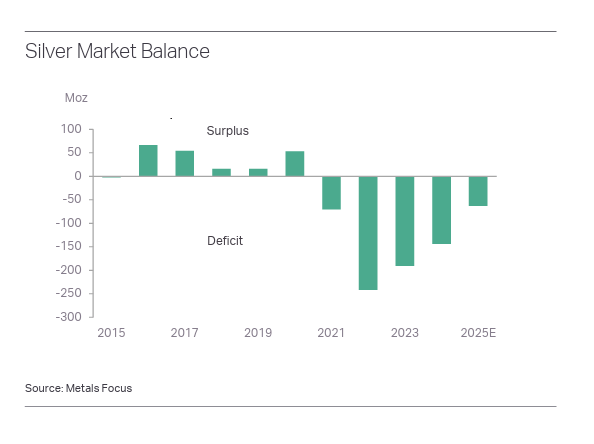
Industrial demand has been at record levels for the last two years. Now we’ve added significant investment demand to the equation. We will likely see more supply squeezes in the future.

Part of the problem is that silver mines can’t keep up with demand, and mine output has generally sagged since peaking in 2016.

Metals Focus forecasts that while we will see record silver prices over the next five years, “mine supply growth is likely to remain modest, with only minimal increases globally.”

Why won’t silver production ramp up to meet the demand and take advantage of these higher prices?

Metals Focus blames the price inelasticity on the fact that more than half of silver is mined as a byproduct of base metal operations.

“Although silver can be a significant revenue stream, the economics and production plans of these mines are primarily driven by the markets for copper, lead and zinc. Consequently, even significant increases in silver prices are unlikely to influence production plans that are dependent on other metals.”

About 28 percent of the silver supply is derived from primary silver mines, where production is more tightly tied to price. But silver mines face their own challenges, including declining ore grades and rapidly rising mining costs.

The bottom line is we can’t expect a sudden surge in mine production to solve this fundamental supply problem.

As Metals Focus summarized it:

“A continued deficit in the silver market, coupled with refining capacity bottlenecks for silver scrap, will also help keep physical supply relatively tight. This leaves the market vulnerable to further liquidity squeezes.”

Other Bullish Dynamics in the Silver Market

According to Metals Focus, “The factors that have driven significant investment inflows into the precious metals complex are expected to remain intact well into 2026.”

These factors include the likelihood of a lower interest rate environment. Despite persistently sticky price inflation, the Fed seems intent on easing monetary policy. It cut rates by another quarter-percent at the October meeting and announced it will end balance sheet reduction.

Metals Focus pointed out that even if the Fed ends up easing less aggressively than anticipated, the lower real interest rate environment will still reduce the opportunity cost inherent in holding precious metals.

“During this period of declining interest rates, tariff-induced inflation may initially strengthen before easing, potentially leading to a more rapid decline in real interest rates.”

According to Metals Focus, growing concerns about global government debt will also support silver in the longer term. The U.S. national debt recently eclipsed $38 trillion. The fact that nobody seems inclined to address the U.S. government’s borrowing and spending problem continues to undermine faith in the dollar.

“Questions surrounding the long-term viability of the U.S. dollar as the dominant reserve currency, and ongoing geopolitical tensions, are all likely to support silver, albeit indirectly, through its close relationship with gold.”

We can expect continued volatility in the silver market in the coming weeks, but given the underlying fundamentals, it seems unlikely that the bull market has run its course, and price drops could be viewed as buying opportunities.