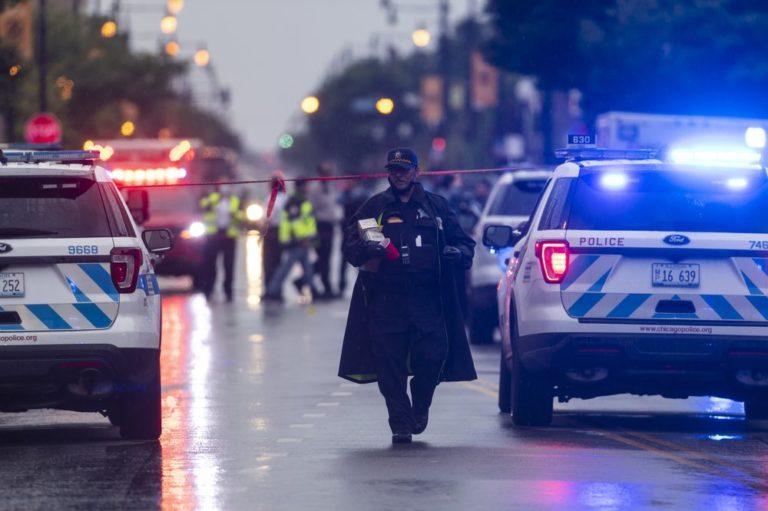
(Headline USA) An officer at St. Louis’ busiest airport fatally shot a man who wielded a knife early Friday morning outside the doors of a terminal, police said. No one else was injured.
The shooting at St. Louis Lambert International Airport happened around 1 a.m., St. Louis County Police spokesperson Vera Clay said.
The area is located near the light rail line that transports travelers to the terminal and isn’t behind a security checkpoint, according to maps of the airport posted on its website.
The rail line to Terminal 1 was closed for about three hours, with shuttles taking people from other drop-off points, but was reopened later Friday morning. The airport remained open, Rhonda Hamm-Niebruegge, the airport director, said in statement.
Clay said officers had noticed the man, who was not identified, in an area where he should not have been and refused to leave.
Clay said the man showed officers a knife when they tried to get him to move. Officers used Tasers but the man continued to advance toward the officers and one of them fired their gun, fatally wounding the man, Clay said.
“We don’t believe this was an individual trying to catch an airplane or coming into town,” Clay said.
She said part of the investigation will be focused on determining why the person was there and needed to be removed.
The two officers were part of the airport’s police department and had six months and one year of service on the force respectively, as well as earlier law enforcement experience, St. Louis County police said in an emailed statement.
(Ken Silva, Headline USA) A Rhode Island store owner helped stop foreign scammers from swindling $240,000 worth of gold bars from an elderly victim, according to federal court records.
The attempted gold scam was revealed by the Justice Department on Monday in a criminal complaint against Chinese national Ka Hin Lam, who’s charged with wire fraud and conspiracy to commit wire fraud.
According to court records, a scammer called the victim in the case on Oct. 27 and said he was under Federal Exchange Commission investigation for numerous charges, including money laundering. The scammer convinced the victim to withdraw a total of $54,000 and hand it to a courier described as a 5’10” Asian male.
The scammers then became more audacious, telling their victim to purchase $240,000 worth of gold. Luckily for the victim, a store owner stopped him from being fleeced further. Instead of processing the victim’s transaction, the unnamed owner called the authorities.
“The owner of the store reported that a male party (Victim #1) had called his store twice on that day inquiring about buying $200,000 worth of gold bars. The store owner immediately recognized this as suspicious, especially because the same store owner was involved in a prior case heard in Federal Court last year involving the same type of scam,” states the criminal complaint, which was first reported by CourtWatch.
“The store owner denied the customer’s request. As Newport Police Officers were on the phone with the store owner, Victim #1 entered the store and inquired again about purchasing now $240,000 worth of gold. The store owner again denied his request and directed him to the Newport Police Department.”
Once the victim realized what was going on, he helped police catch the scammers.
First, the victim withdrew another $45,000 and went to meet the courier, who turned out to be a man named Samyag Uday Doshi. As Doshi pulled up in his Toyota Corolla to pick up the $45,000, he was confronted by Newport Police Officers and immediately began sobbing.
“Sir, I am just a student,” he said, according to court records.
An investigation into Doshi found that he helped pull off at least four other similar scams, receiving about $500 each time for his work. Doshi told police he answers to a man named Siad, who resides in Gujarat, India.
Doshi was charged with two state counts of obtaining property under false pretenses and two state counts of conspiracy, both felonies.
The investigation didn’t end there. Instead, the feds became involved. Police told Homeland Security Investigations—the DHS’s investigatory arm—that the victim was sending a package to Chicago for another scammer, Lam, to pick him.
That’s what happened on Nov. 13, when Lam went to a Chicago UPS store to pick up what the victim sent to him. Instead, Lam was met by HSI agents.
“LAM was interviewed and subsequently released. However during his interview, he provided consent to preview his cellular phones,” the criminal complaint states.
“Found inside of the phones was a considerable amount of evidentiary material, including videos of LAM opening packages containing proceeds from money pick-ups, identical to the one found so far in DOSHI’s phone.”
Along with being charged with wire fraud and conspiracy to commit wire fraud, Lam is subject to deportation. He was released on his own recognizance and has a preliminary hearing set for Dec. 4.
Ken Silva is the editor of Headline USA. Follow him at x.com/jd_cashless.
(Stuart Englert, Money Metals News Service) When it comes to U.S. gold reserves, secrecy prevails over transparency.
Attempts to authorize a comprehensive, independent audit of the nation’s gold reserves have proven elusive and futile for decades.
The last two prominent audits, conducted 72 and 51 years ago, respectively, were far from thorough or free of government influence.
The 1953 gold audit was commissioned by Treasury Secretary George M. Humphrey shortly after President Dwight D. Eisenhower took office. While often cited as an independent undertaking supervised by representatives of the presumably nonpartisan General Accounting Office (GAO), the audit’s Treasury-appointed advisory committee was composed of three bankers and a Federal Reserve board member, who undoubtedly had personal and political opinions about gold.
Contrary to some artificial intelligence (AI) and media claims, the audit wasn’t comprehensive either. In fact, it was very limited in scope. Only three of 22 sealed vaults at Fort Knox (KY) Bullion Depository were opened for verification purposes, and only 26 gold bars among some 88,000 in the unsealed vaults were assayed for purity.
“On the basis of assays, your committee can positively report that the gold represented, according to assay, is at the depository,” the audit’s oversight committee concluded. “We have no reason, whatsoever, to believe other than, should all melts be assayed, the results would be the same.”
Despite the convoluted—and seemingly contradictory—assurance, the audit was based mostly on assumptions and not completely assayed and inventoried evidence. The U.S. government reportedly held about 20,000 tons of gold in 1953.
Two decades later, the nation’s gold stocks underwent another partial examination that began with a congressional, media-covered inspection of a single Fort Knox vault on Sept. 23, 1974. The ensuing audit involved—once again—inventorying gold bars in three of the depository’s 13 sealed vaults, weighing a small percentage of the bars, and assaying an even smaller sampling of those bars.
Fort Knox presumably had fewer sealed vaults in 1974 and less gold to audit because U.S. gold holdings by the early 1970s fell to 8,300 tons due to growing balance-of-payment deficits and foreign conversion of dollars into gold.
Thereafter, gold audits devolved into a bewildering bureaucratic morass of unreliability spearheaded by the Committee for Continuing Audit of the U.S. Government-owned Gold, which consisted of personnel from the U.S. Treasury, Federal Reserve Bank of New York, and U.S. Mint. Read all about the auditing anomalies and problems in an open letter to President Trump HERE.
Legislative Efforts Have Repeatedly Failed
Efforts to get Congress to authorize a comprehensive, independent audit of the nation’s gold reserves have proven futile ever since. But that hasn’t stopped a handful of Constitution-supporting lawmakers from trying.
Former Rep. Ron Paul, R-Texas, a sound money stalwart, sponsored the Gold Reserve Transparency Act of 2011. The measure directed the U.S. Treasury to conduct “a full assay, inventory, and audit of gold reserves of the United States.”
“For far too long, the U.S. government has been less than transparent in releasing information relating to its gold holdings,” said Paul, chairman of the Subcommittee on Domestic Monetary Policy and Technology, during a hearing on oversight of the nation’s gold holdings.
Paul garnered no co-sponsors for his legislation.
In 2019, Rep. Alex Mooney (R-WV) picked up the audit torch. He introduced the Gold Reserve Transparency Act of 2019, which required the GAO to audit the nation’s gold holdings and to conduct subsequent audits every five years.
“The U.S. Treasury has neglected to give the American people an understanding and inventory of our nation’s gold holdings,” Mooney said. “After 65 years since the last audit, this legislation would lead to necessary transparency in accounting for our gold reserves.”
Importantly, Mooney’s bill (and in all the versions that followed) included a requirement that any encumbrances, such as pledges, swaps, and leases, placed against America’s gold must also be disclosed. After all, verifying the gold is all there is not the same as determining who has claims on it.
Still, no legislative co-sponsors stepped forward.
“Given the dramatic levels of debt-financed spending by the federal government and the potential this could trigger an inflationary nightmare, ensuring America’s gold reserves are both secure and fully accounted for has never been more important,” he wrote in a letter to his fellow lawmakers.
Once again, Mooney received no congressional support for his bill.
Renewed Calls for a Gold Transparency
Dollar devaluation, price inflation, and rising gold prices have renewed calls for transparency from the U.S. Treasury, the Federal Reserve, and a complete accounting of U.S. gold holdings.
On Feb. 15, Sen. Rand Paul (R-KY), the son of Ron Paul, supported the idea of a Fort Knox audit in an online exchange with Elon Musk, then administrator of the Department of Government Efficiency (DOGE), on X.
Six days later, President Donald Trump suggested an audit was in the offing. “We’re going to go into Fort Knox to make sure the gold is there. Do you know about that?” the President asked a reporter aboard Air Force One.
“We hope everything is fine with Fort Knox, but we’re going to go into Fort Knox, the fabled Fort Knox, to make sure the gold is there,” he added. “If the gold isn’t there, we’re going to be very upset.”
Trump, for undetermined reasons, has been publicly silent on the subject ever since.
In June, Rep. Thomas Massie (R-KY) introduced the Gold Transparency Act of 2025. The legislation has four co-sponsors.
Earlier this week, Sen. Mike Lee (R-Utah), citing Trump’s transparency agenda, introduced a similar measure in the upper legislative body. The bill calls for “a full assay, inventory, and audit of all gold reserves of the United States by a “qualified, independent, third-party, external auditor” contracted by the U.S. Comptroller General.
“For over half a century, there has not been a comprehensive audit of America’s gold reserves,” Lee said. “Americans should know whether their literal national treasure is safe and accurately accounted for.”
Lee also wants to know if any outstanding claims exist on the nation’s gold, which, according to the U.S. Treasury, totals 261.5 million troy ounces or 8,133 tons. The draft legislation requires a full accounting of all encumbrances of the nation’s bullion holdings, including those due to leases, swaps, or similar transactions over the last 50 years, as well as a disclosure of gold sales, purchases, disbursements, or receipts during the same period.
In addition, the Treasury would have five years to refine and upgrade the nation’s gold bars to meet market standards. Many of the gold bars stored at Fort Knox are 90 percent fine, whereas international bullion exchanges require gold of 99.5 to 99.99 percent purity.
Sen. Lee’s bill is a credible attempt to achieve a comprehensive, impartial audit. Based on a news release on his congressional website, a number of pro-gold proponents and sound money advocates endorse his proposed solution for accounting openness.
The question remains: Will his proposal, unlike its predecessors, amass sufficient political and public support for passage, lifting the veil on government secrecy and shedding light on gold transparency?
A veteran journalist, Stuart Englert is the author of Rigged: Exposing the Largest Financial Fraud in History, which documents precious metals market manipulation and price suppression. You can visit his Substack HERE.
(Mike Maharrey, Money Metals News Service) If I travel to another country, I’ll generally need to make a currency exchange before I can go shopping. I’ll have to swap my dollars for euros if I’m in Europe, or yuan if I’m in China, or perhaps lira if I’m in Turkey. However, in ancient times, a currency exchange wasn’t necessary because the money had intrinsic value that was recognized worldwide.
The amount of Islamic silver that found its way into Scandinavia attests to the portability of money in the ancient world.
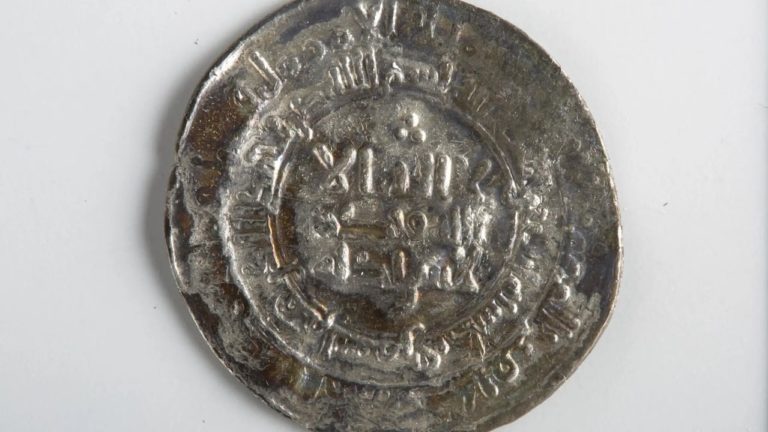
In 1844, a farmer discovered a large trove of silver in a field. A Viking likely buried the treasure. It included jewelry along with a large number of silver coins with Arabic inscriptions.
The dates on the coins, known as dirhams, indicate that they were minted during the Abbasid Caliphate.
You might think the find was some kind of anomaly, but it wasn’t. As it turns out, people have discovered a large number of Arabic coins scattered across Viking lands. Swedish archaeology professor Martin Rundkvist described the phenomenon in a 2024 article.
“It seems that if you send 25 [metal] detectorists onto the land of a farm in agricultural southern Sweden for three days and keep them from moving around too much, they always find a few dirham coins.”
One scientist said perhaps 1 billion dirham coins found their way into Scandinavia between 800 and 950 AD.
According to an article in Science Norway, these coins “have been found in settlements, marketplaces, buried treasures, and scattered around where people lived. The Norse must have been well acquainted with these coins with mysterious inscriptions.”
So, how did Islamic silver end up in Scandinavia?
Trade.
The Vikings traded furs, slaves, animal hides, and reindeer antlers for silver.
It appears the coins were then circulated locally. Some of the coins were cut. This was a primitive way of making change, as the value of a coin was determined by its weight. There is also evidence that some of the coins were melted into small bars suitable for trade.
We see another indication of daily use in the tiny notches found in many of the coins, indicating people took small shavings to test the purity of the metal.
Historians say the allure of silver flowing into the area may have motivated young Viking men to strike out seeking riches.
The use of Islamic silver in the Viking economy underscores an important point. Silver is money, and it is recognized as such, no matter where you are (in space and time). People may not take your dollars, or your euros, or your yuan, but virtually everybody will accept silver as payment.
In fact, you could take the 1,100-year-old silver coins dug up in a Norwegian garden over 100 years ago and spend them around the world today.
Try to do that with a paper dollar bill in 1,000 years from now!
Mike Maharrey is a journalist and market analyst for Money Metals with over a decade of experience in precious metals. He holds a BS in accounting from the University of Kentucky and a BA in journalism from the University of South Florida.
(Mike Maharrey, Money Metals News Service) After rebounding in September, wholesale gold demand in China increased again, defying seasonal weakness.
China ranks as the world’s largest gold market.
Gold prices surged in early October, setting several records before correcting later in the month. Even with the selloff, the Shanghai benchmark price was up 5.5 percent on the month.
After the correction, gold bounced higher in the first half of November, supported by rising risks and improving gold ETF inflows. The Shanghai price (in yuan terms) rose 3.3 percent during the first two weeks of November.
October is typically a down month for Chinese gold demand. However, this year defied that tendency.
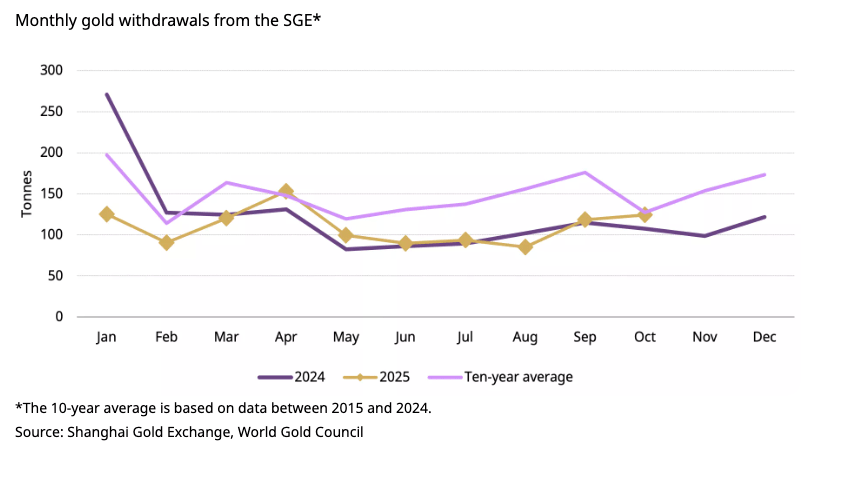
Withdrawals from the Shanghai Gold Exchange rose 6 tonnes month-on-month to 124 tonnes. That was 17 tonnes higher than October 2024, and nearly at the 10-year average of 127 tonnes.
According to the World Gold Council, investment buying is supporting Chinese gold demand even as higher prices put a damper on the jewelry market.
Chinese physical gold demand was a primary driver during the early stages of this gold bull market, with bar and coin demand growing by 44 percent year-on-year in H1. Chinese investors snapped up 115 tonnes of gold bars and coins in the second quarter alone. It was the strongest H1 for physical gold buying since 2013.
There was a slowdown in investment demand in July and August as gold was essentially trading sideways, but it rebounded in September.
Gold and coin buying remained strong in October, and there is growing Chinese investor interest in gold ETFs.
Chinese gold ETFs reported gold inflows of ¥32 billion, the highest level since April. That represented 33 tonnes of gold.
Total assets under management (AUM) by China-based gold-backed funds rose 24 percent to ¥210 billion ($29 billion).
While investment demand is booming, higher prices have created headwinds for the Chinese gold jewelry market. According to the World Gold Council, anecdotal evidence suggests purchases were “robust” during the early October nine-day National Day and the Mid-Autumn Day holiday. Even so, “retailers remained cautious in restocking amid the amplified gold price volatility earlier in the month.”
Chinese gold imports at 93 tonnes in October reflected strong demand. That was a 5-tonne increase over September’s imports and 36 tonnes more than October 2024.
Mike Maharrey is a journalist and market analyst for Money Metals with over a decade of experience in precious metals. He holds a BS in accounting from the University of Kentucky and a BA in journalism from the University of South Florida.
(Dave DeCamp, Antiwar.com) Ukrainian President Volodymyr Zelensky met with US Army Secretary Daniel Driscoll on Thursday and told him that he’s willing to work with the Trump administration on a new plan to end the war with Russia, Axios reported, citing US and Ukrainian officials.
The Trump administration has drafted a new 28-point peace plan with input from Russia that would require Ukraine to cede what territory it still controls in the Donbas and accept limits on its military.
“Our teams – of Ukraine and the United States – will work on the provisions of the plan to end the war. We are ready for constructive, honest and swift work,” Zelensky wrote on X following his meeting with Driscoll.
A US official told Axios that Zelensky and Driscoll “agreed on an aggressive timeline for signature,” signaling the Trump administration wants to get the deal done quickly. But the report also said that the US would take Ukrainian concerns into account and potentially alter the plan.
Driscoll’s meeting with Zelensky followed Reuters reporting that Keith Kellogg, Trump’s special envoy to Ukraine, had told associates he planned to leave the administration in January. Kellogg is known for his maximalist positions on the war, always insisting that Ukraine could win, and has reportedly clashed with Steve Witkoff, President Trump’s Middle East envoy, who has also been working on Ukraine and drafted the peace plan after holding talks with Russian envoy Kirill Dmitriev.
The Axios report said that Driscoll didn’t know until last week that he would serve as a peace envoy to Ukraine, an unusual role for the Army secretary. “He’s taking policy briefs. He’s taking backgrounds, history of the war, all sorts of things all the way through the weekend, and then they scream out of here,” a US official said, describing what Driscoll did in the days leading up to his meeting with Zelensky.
The White House said on Thursday that Witkoff and Secretary of State Marco Rubio are in contact with Russian and Ukrainian officials about the potential peace plan.
“Special Envoy Witkoff and Marco Rubio have been working on a plan, quietly, for about the last month. They have been engaging with both sides, Russia and Ukraine equally, to understand what these countries would commit to in order to see a lasting and durable peace,” said White House Press Secretary Karoline Leavitt.
(Headline USA) In the summer of 2021, when the delta variant of COVID-19 was filling hospitals throughout the country, U.S. Rep. Sheila Cherfilus-McCormick was conspiring to steal $5 million in federal disaster funds that were meant to slow the spread of the pandemic, prosecutors allege.
The Florida Democrat has been charged with 15 federal counts, accusing her of stealing funds that had been mistakenly overpaid to the health care company owned by her family. Within two months of receiving the funds, more than $100,000 had been spent to buy the congresswoman a 3-carat yellow diamond ring, prosecutors alleged in a recently released federal indictment.
Cherfilus-McCormick’s brother, former chief of staff and accountant were also charged in the alleged scheme. As of Thursday, no attorneys were listed for the codefendants.
Federal prosecutors accused the congresswoman of stealing Federal Emergency Management Agency overpayments that her family health care company received through a COVID-19 vaccination staffing contract. Cherfilus-McCormick has denied the charges and has no plans to resign, according to a statement shared by her chief of staff.
“This is an unjust, baseless, sham indictment — and I am innocent. The timing alone is curious and clearly meant to distract from far more pressing national issues,” Cherfilus-McCormick’s statement reads in part. “I look forward to my day in court. Until then, I will continue fighting for my constituents.”
Here’s what to know:
What’s in the indictment?
The indictment returned by a federal grand jury in Miami on Wednesday accuses Cherfilus-McCormick and several co-defendants of conspiring to steal $5 million in overpayments to her family’s health care company, Trinity Healthcare Services, under a 2021 contract to register people for COVID-19 vaccinations.
Prosecutors say the funds were distributed to various accounts, including to friends and relatives who in turn donated to the campaign that got her elected to Congress. A “substantial portion” of the misappropriated funds were used for the campaign or for the “personal benefit” of Cherfilus-McCormick and others accused, prosecutors claim.
Cherfilus-McCormick has been charged with theft of government funds; making and receiving straw donor contributions; aiding and assisting a false and fraudulent statement on a tax return; and money laundering, as well as conspiracy charges associated with each of those counts.
How has she responded?
Cherfilus-McCormick maintains her innocence. She also said she’s cooperated with “every lawful request,” and will continue to do so “until this matter is resolved,” according to a statement provided by her chief of staff.
“Congresswoman Cherfilus-McCormick is a committed public servant, who is dedicated to her constituents. We will fight to clear her good name,” wrote her attorneys David Oscar Markus, Margot Moss and Melissa Madrigal.
Cherfilus-McCormick won a special election in January 2022 to represent Florida’s 20th District in parts of Broward and Palm Beach counties after Rep. Alcee Hastings died in 2021.
What about her seat in Congress?
While Cherfilus-McCormick intends to continue representing her South Florida district, she is stepping down from her position as ranking member of the Foreign Affairs Committee’s Subcommittee on the Middle East and North Africa, House Minority Leader Hakeem Jeffries announced Thursday.
“Consistent with the United States Constitution, she is entitled to her day in court and the presumption of innocence,” Jeffries said in a statement, adding that the move to step down is in line with the rules of the House Democratic Caucus.
U.S. Rep. Greg Steube, a Republican who represents parts of Sarasota and Charlotte Counties in southwest Florida, called Thursday for her resignation. If the congresswoman doesn’t resign, Steube said he’d bring a resolution to the floor to expel her.
“Defrauding the federal government and disaster victims of $5 million is an automatic disqualifier from serving in elected office,” Steube posted on X.
The last member of Congress to be expelled was scandal-plagued Rep. George Santos of New York. Santos had not yet been convicted of federal charges, and House Speaker Mike Johnson voted against it at the time, expressing concern about setting a precedent of expelling members based on untried allegations.
What did previous investigations find?
In December 2024, a Florida state agency sued Trinity Healthcare Services, saying the company owned by Cherfilus-McCormick’s family had overcharged the state by nearly $5.8 million for work done during the pandemic and wouldn’t give the money back.
The Florida Division of Emergency Management said it discovered the problem after a single $5 million overpayment drew attention. Cherfilus-McCormick was the CEO of Trinity at the time.
The House Ethics Committee unanimously voted in July to reauthorize an investigative subcommittee to examine the allegations involving the congresswoman.
The Office of Congressional Ethics said in a January report that Cherfilus-McCormick’s income in 2021 was more than $6 million higher than in 2020, driven by nearly $5.75 million in consulting and profit-sharing fees received from Trinity Healthcare Services.
The indictment charges Cherfilus-McCormick and her 2021 tax preparer with conspiring to file a false federal tax return by falsely claiming political spending and other personal expenses as business deductions and inflated charitable contributions.
(Dave DeCamp, Antiwar.com) A new Reuters/Ipsos poll has found just 21% of Americans support the idea of using the US military to oust Venezuelan President Nicolas Maduro, results that come amid a series of reports that the Trump administration is considering a regime change war in Venezuela.
The results are similar to a YouGov poll conducted in September that found just 18% of Americans supported using the military to carry out regime change in Venezuela. The Reuters/Ipsos poll found that 31% of respondents would favor ousting Maduro through other means, but sanctions and US-backed coups in recent years have failed to remove the Venezuelan leader.
The Reuters/Ipsos poll also found that the majority of Americans, 51%, oppose using the military to conduct executions of suspected drug traffickers without a judge or a court being involved, a rejection of the Trump administration’s bombing campaign against alleged drug boats in the Caribbean and the Eastern Pacific Ocean.
Just 29% of respondents said they support the US military conducting the extrajudicial executions. The policy had more support among Republicans, with 58% favoring the executions and 27% of GOP members opposed. Three-quarters of Democrats said they opposed the killings.
The US has continued to significantly build up its forces in the Caribbean, including the deployment of an aircraft carrier, as President Trump has been briefed on options for attacking Venezuela, ranging from limited strikes on military targets to sending troops to capture airfields and oil fields.
Secretary of State Marco Rubio, who is leading the push toward war with Venezuela, is creating the pretext for attacks targeting Maduro by declaring that he is the leader of the so-called Cartel de los Soles, or Cartel of the Suns, a group that doesn’t actually exist.
The term “Cartel of the Suns” was first used in the 1990s to describe two Venezuelan military generals with sun insignias on their uniforms who were involved in the drug trade. One of the generals was working with the CIA at the time, according to a 1993 60 Minutes report. Today, the term is used to describe Venezuelan military and government officials who allegedly profit from drug trafficking, but the Cartel of the Suns doesn’t exist as a structured organization.
Rubio has said that his State Department will label the Cartel of the Suns as a “Foreign Terrorist Organization” on November 24. President Trump has said that he believes that designation gives him the authorization to launch strikes on the Maduro government, but any attack without congressional authorization would be illegal under the US Constitution.
The Times said it first learned of the meeting from three US officials and that when asked about it, Pollard confirmed that it took place. Pollard said it was the first time a US official hosted him at a US government office building since he was released from prison after serving 30 years for spying.
Pollard was initially given a life sentence for his espionage, but he was released on parole in 2015. In 2020, Pollard’s parole ended, and he was able to move to Israel, where Israeli Prime Minister Benjamin Netanyahu gave him a hero’s welcome on the tarmac.
The Times report said that the CIA’s station chief in Israel and senior officials at the White House were “alarmed” when they heard that Huckabee hosted Pollard at the US Embassy. Pollard described the meeting as “friendly” but declined to say what they discussed.
Pollard recently announced he planned on running for the Israeli Knesset and suggested in an interview that Israel should threaten to use nuclear weapons as a way to continue receiving unconditional military aid from the US. “If they think we’re bluffing, I think we should go forward with it,” he said.
In response to the report about Pollard’s meeting with Huckabee, the US Embassy in Jerusalem said that the US ambassador has “meetings with numerous people, and as a matter of general policy, we do not comment as to the content of conversations.” It also claimed that the Times’s reporting was “filled with inaccuracies” but did not elaborate.
Huckabee, a Christian Zionist who believes God gave historic Palestine to the modern state of Israel, is known for his staunch support of Israel and has repeatedly described the US-Israel relationship as a marriage.
“It may sound a little bit this afternoon as if I’m almost speaking on behalf of Israel rather than the US,” Huckabee told a group of hundreds of US state lawmakers at the 50 States, One Israel conference in Israel back in September.
“If you came to my house tonight for dinner and you came in and you said, ‘Oh, Mike, we like you. We really think the world of you. We just enjoy being with you. So excited to be here with you and have dinner with you. But your wife, we can’t stand her. We don’t like her a bit. I hope she’s not going to be at the table.’ I would say, ‘Well, she will be. You won’t be. Get out.’ Because if you were to insult my partner, you have insulted me,” Huckabee said.
The US ambassador added that the US has “a lot of friends” across the world but only has “one partner,” which he says is Israel. “The one partner we have, which is Israel, is a relationship like no other,” he said.
(Headline USA) President Donald Trump on Thursday accused half a dozen Democratic lawmakers of sedition “punishable by DEATH” after the lawmakers — all veterans of the armed services and intelligence community — called on U.S. military members to uphold the Constitution and defy “illegal orders.”
The 90-second video was first posted early Tuesday from Sen. Elissa Slotkin’s X account. In it, the six lawmakers — Slotkin, Arizona Sen. Mark Kelly, and Reps. Jason Crow, Chris Deluzio, Maggie Goodlander and Chrissy Houlahan — speak directly to U.S. service members, whom Slotkin acknowledges are “under enormous stress and pressure right now.”
“The American people need you to stand up for our laws and our Constitution,” Slotkin wrote in the X post.
Trump on Thursday reposted messages from others about the video, amplifying it with his own words. It marked another flashpoint in the political rhetoric that at times has been thematic in his administrations, as well as among some in his MAGA base. Some Democrats accused him of acting like a king and trying to distract from the soon-to-be-released files about disgraced financier and sexual abuser Jeffrey Epstein.
With pieces of dialogue spliced together from different members, the lawmakers introduce themselves and their background. They go on to say the Trump administration “is pitting our uniformed military against American citizens. They call for service members to “refuse illegal orders” and “stand up for our laws.”
The lawmakers conclude the video by encouraging service members, “Don’t give up the ship,” a War of 1812-era phrase attributed to a U.S. Navy captain’s dying command to his crew.
Although the lawmakers didn’t mention specific circumstances in the video, its release comes as the Trump administration continues attempts at deployment of National Guard troops into U.S. cities for various roles, although some have been pulled back, and others held up in court.
Troops, especially uniformed commanders, have a specific obligation to reject an order that’s unlawful, if they make that determination.
However, while commanders have military lawyers on their staffs to consult with in helping make such a determination, rank-and-file troops who are tasked with carrying out those orders are rarely in a similar position.
Broad legal precedence holds that just following orders, colloquially known as the “Nuremberg defense” as it was used unsuccessfully by senior Nazi officials to justify their actions under Adolf Hitler, doesn’t absolve troops.
However, the U.S. military legal code, known as the Uniform Code of Military Justice or UCMJ, will punish troops for failing to follow an order should it turn out to be lawful. Troops can be criminally charged with Article 90 of the UCMJ, willfully disobeying a superior commissioned officer, and Article 92, failure to obey an order.
On Thursday, Trump reposted to social media an article about the video, adding his own commentary that it was “really bad, and Dangerous to our Country.”
“SEDITIOUS BEHAVIOR FROM TRAITORS!!!” Trump went on. “LOCK THEM UP???” He also called for the lawmakers’ arrest and trial, adding in a separate post that it was “SEDITIOUS BEHAVIOR, punishable by DEATH.”
Asked during a White House briefing on Thursday about the intent of Trump’s messages, press secretary Karoline Leavitt instead honed in on the Democrats’ message, which she posited “perhaps is punishable by law.” Leavitt went on to say that any incitement to “defy the chain of command, not to follow lawful orders” is “a very dangerous thing for sitting members of Congress to do, and they should be held accountable, and that’s what the president wants to see.”
Democrats were swift to react to Trump’s words, with Senate Democratic Leader Chuck Schumer warning in a floor speech that the president was “lighting a match in a country soaked with political gasoline.”
Speaker Mike Johnson said he did not believe Trump was calling for violence in the social media posts, saying Trump was merely “defining a crime,” and calling the Democrats’ video “wildly inappropriate.”
“Think of the threat that is to our national security and what it means for our institution,” Johnson added.
Trump’s allies balked at the video. On Wednesday on Fox News, White House deputy chief of staff Stephen Miller called the messaging “insurrection — plainly, directly, without question” and said it represented “a general call for rebellion from the CIA and the armed services of the United States, by Democrat lawmakers.”
On X, Defense Secretary Pete Hegseth commented on the video Tuesday as “Stage 4 TDS,” referring to “Trump Derangement Syndrome” — a term used by Trump to describe voters so angry and opposed to him that they are incapable of seeing any good in what he does.
The Steady State, which describes itself as “a network of 300+ national and homeland security experts standing for strong and principled policy, rule of law, and democracy,” wrote in a Substack post on Thursday that the lawmakers’ call was “only a restatement of what every officer and enlisted servicemember already knows: illegal orders can and should be refused. This is not a political opinion. It is doctrine.”
Pentagon spokesperson Sean Parnell challenged the theory that illegal orders were being issued.
“Our military follows orders, and our civilians give legal orders,” Parnell told The Associated Press on Thursday. “We love the Constitution. These politicians are out of their minds.”