Woke ‘Union Soldier Campaign’ Pushes UNC to Abandon ‘Tar Heels’ Name

Woke protestors are calling on the University of North Carolina to abandon its longstanding nickname, the Tar Heels.

According to a group called the Union Soldier Campaign, the term “tar heels” is a reference to Confederate soldiers who bravely stood their ground against marauding Northern troops during the Civil War.

“They stood their ground as if they had tar on their heels…if you call yourself a Tar Heel…you’re cheering for the essence of white supremacy,” William Thorpe, director of the Union Soldier Campaign told the News & Observer of Raleigh.

The group wants UNC to change its name to the Rams and has offered to accept the school’s traditional Carolina-blue and white color scheme.

Left-wing professors are supporting the proposal.

UNC history professor Jim Leloudis claims the term “tar heel” was meant to demean slaves and poor white people.

“It’s hard to untangle,” Leloudis said. “The term, at first, is derogatory in terms of race and class, then gets turned into a symbol of Confederate pride and loyalty.”

Despite the post-modern interpretation, the school’s nickname has been widely embraced since it was adopted 140 years ago.

The Union Soldier Campaign marched to the UNC campus on Tuesday after starting at Bennett Place in Durham, the site of the last surrender of Confederate troops in the Civil War.

The group wants the school’s chancellor, Kevin Guskiewicz, to change the name “immediately.”

Videos of the march show protestors wearing all-black clothes and COVID masks, while Thorpe dawns a union soldier costume.

During a speech, protestors standing behind Thorpe can be seen holding a Union Soldier Campaign placard, a UNC flag, a Washington Redskins poster, an Aunt Jemima syrup bottle and a box of Uncle Ben’s rice.

Another video on the group’s website is a low-production protest song called “Impeach the President, Convict the President.”

Voters to Get Say in Dropping ‘Plantations’ from R.I.’s Name

0

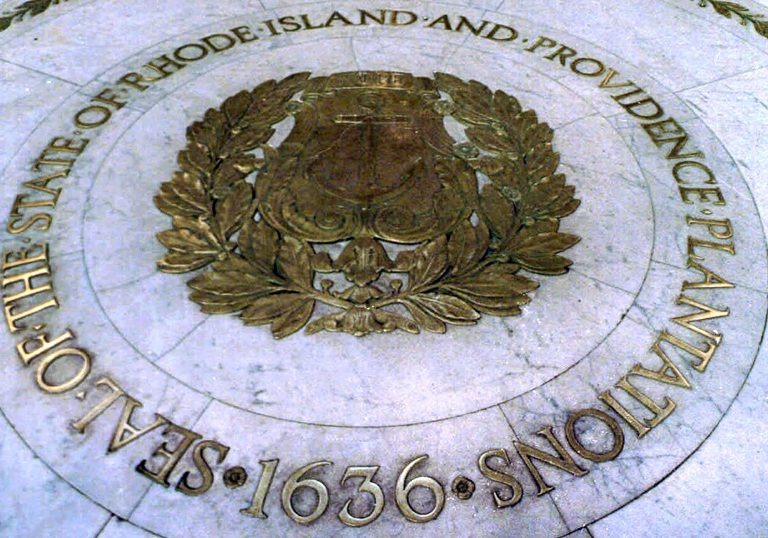
Voters will get another chance to strip the words “and Providence Plantations” from Rhode Island‘s formal name after lawmakers approved a joint resolution to put the question on the November ballot.

Although the word “plantations” in Rhode Island’s name does not specifically refer to a place where slaves labored, it elicits such imagery, say sponsors of the bill approved Thursday.

“The images that come to mind when I hear the word ‘plantations’ are the inhuman and degrading treatment of the African Americans who came before me, families ripped apart by slave sales, rapes, castrations and lynchings. It is a hurtful term to so many of us,” state Sen. Harold Metts, D-Providence, one of the bill’s sponsors, said in a statement.

Metts, who traces his own family history to a Virginia plantation, points out that Rhode Island built its colonial economy on being a leader in the slave trade.

Rhode Island was incorporated as The State of Rhode Island and Providence Plantations when it ratified the Constitution in 1790, but the name dates to pre-Revolutionary times.

A similar effort a decade ago failed overwhelmingly.

But calls to drop the word “plantations” from the state name have intensified recently as protesters nationwide demand racial justice in the aftermath of the May 25 death of George Floyd at the hands of Minneapolis police.

“When you have more than 10,000 Rhode Islanders showing up in a pandemic for a march calling for an end to police brutality and to affirm that Black Lives Matter, we can take this ugly, painful word out of the name of our beautiful state,” state Rep. Anastasia Williams, D-Providence, said in a statement.

Democratic Gov. Gina Raimondo last month signed an executive order to remove the phrase “and Providence Plantations” from some official documents and executive agency websites.

General Treasurer Seth Magaziner also said he would remove the words from the state’s checks, letterhead, citations and other correspondence, and Providence Mayor Jorge Elorza ordered the word “plantations” deleted from the state name on official city documents.

The ballot question would make the change official in the state’s constitution if approved by a simple majority of voters.

NeverTrump Rep. Amash Officially Won’t Seek Reelection to Congress

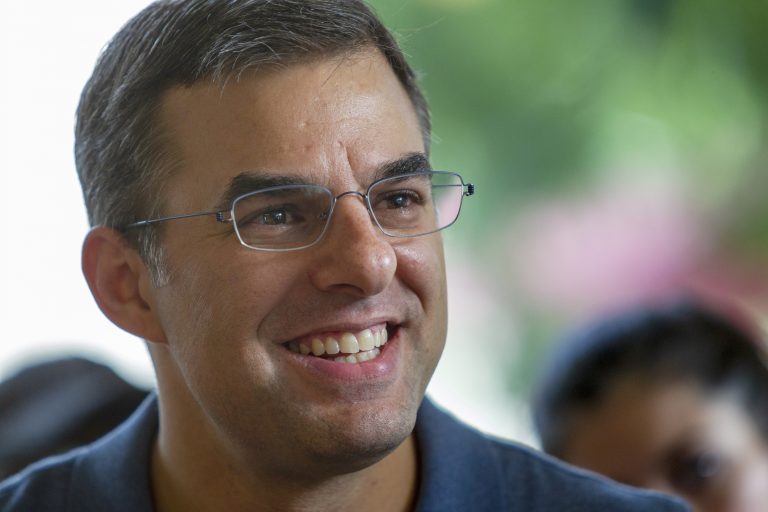
U.S. Rep. Justin Amash of Michigan, a former Republican who backed the impeachment of President Donald Trump, is officially not running for reelection.

Amash had suspended his congressional campaign in February and later explored seeking the Libertarian Party’s nomination for president.

Thursday was Michigan’s deadline to run as an independent, though some were also holding out hope he might seek the Libertarians’ nomination at a state convention Saturday.

“I love representing our community in Congress. I always will,” Amash tweeted. “This is my choice, but I’m still going to miss it.”

Amash, 40, initially became an independent a year ago after becoming disenchanted with partisan politics.

In April he blasted President Trump’s claim of “total authority” over states’ ability to reopen the country in the wake of the coronavirus, declaring that he is “flat-out wrong.”

“Americans who believe in limited government deserve another option,” Amash tweeted.

He has represented Michigan’s 3rd Congressional district in the western part of the state since 2011.

Defense Secretary Bans Confederate Flag w/out Mentioning It

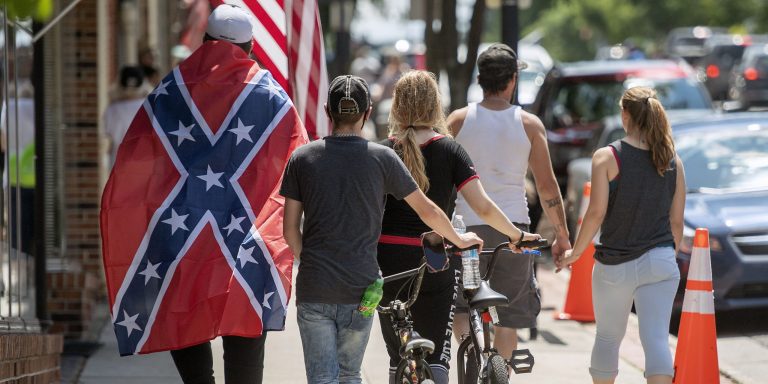
UPDATE: After weeks of wrangling, the Pentagon on Friday will ban displays of the Confederate flag on military installations, in a carefully worded policy that doesn’t mention the word ban or that specific flag. The policy, laid out in a memo obtained by The Associated Press, was described by officials as a creative way to bar the flag’s display without openly contradicting or angering President Donald Trump, who has defended people’s rights to display it. 

Signed by Defense Secretary Mark Esper on Thursday night, the memo lists the types of flags that may be displayed at military installations. The Confederate flag is not among them — thus barring its display without singling it out in a “ban.” Details of the policy, which is expected to be released Friday, were first reported by the AP.

ORIGINAL ARTICLE: (Headline USA) Defense leaders, who for weeks have been tied in knots over the incendiary issue of banning the Confederate flag, are weighing a new policy that would bar its display at department facilities without actually mentioning its name, several U.S. officials said Thursday.

No final decisions have been made, but officials said the new plan presents a creative way to ban the Confederate flag in a manner that may not raise the ire of President Donald Trump, who has defended people’s rights to display it. The officials, of unknown authority, allegedly spoke to Associated Press on condition of anonymity to discuss ongoing internal deliberations.

Defense Secretary Mark Esper discussed the new plan with senior leaders this week.

The Marine Corp has already banned the Confederate flag saying it can inflame division and weaken unit cohesion. Military commands in South Korea and Japan quickly followed suit and the other three military services were all moving to do the same when they were stopped by Esper, who wanted a more uniform, consistent policy across the whole department.

An early version of the Defense Department plan banned display of the Confederate flag, saying the prohibition would preserve “the morale of our personnel, good order and discipline within the military ranks and unit cohesion.”

That policy was never finalized, and a new version floating around the Pentagon this week takes a different tack, simply listing the types of flags that may be displayed at military installations. The Confederate flag is not among them – thus barring its display without singling it out in a “ban.” 

Acceptable flags would include the U.S. and state banners and the widely displayed POW/MIA flag. Official military division and unit flags are also likely to be allowed. 

The move is an attempt at finding compromise, as Esper tries to enact a ban that passes legal muster and gives military leaders what they want.

An apparent sticking point is whether the military services will be allowed to develop their own more stringent policies on what they consider to be divisive symbols, and whether the policy will state that or leave it unsaid.

Army Secretary Ryan McCarthy told reporters on Thursday that he is still working on a policy that would remove all divisive symbols from Army installations.

He specifically didn’t mention the flag, but said, “we would have any divisive symbols on a no-fly list.”

Confederate flags, monuments and military base names have become a national flashpoint in the weeks since the death of George Floyd. Rioters decrying racism have targeted Confederate monuments in multiple cities, as well as memorials of historical figures that had nothing to do with defending slavery. Some state officials are considering taking them down, but they face vehement opposition in some areas.

Trump has flatly rejected any notion of changing base names, and has defended the personal flying of the Confederate flag, saying it’s a freedom of speech issue.

Adapted from reporting by Associated Press.

Ga. Gov. Sues to End Its Cities’ Defiance on Mask Rules

0

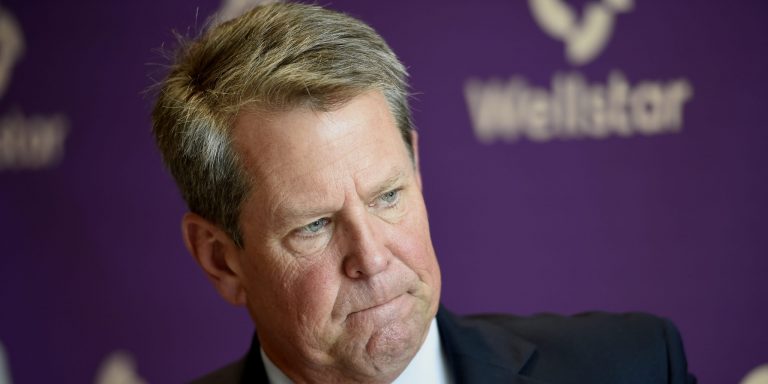
(Headline USA) Georgia Gov. Brian Kemp is suing Atlanta‘s mayor and city council to block the city from enforcing its mandate to wear a mask in public and other rules related to the COVID-19 pandemic.

Kemp and Georgia Attorney General Chris Carr, in a suit filed in state court late Thursday in Atlanta, argue that Atlanta Mayor Keisha Lance Bottoms has overstepped her authority and must obey Kemp’s executive orders under state law.

“Governor Kemp must be allowed, as the chief executive of this state, to manage the public health emergency without Mayor Bottoms issuing void and unenforceable orders which only serve to confuse the public,” the lawsuit states.

Kemp on Wednesday clarified his executive orders to expressly block Atlanta and at least 14 other local governments across the state from requiring people to wear face coverings.

Kemp’s order was met with defiance Thursday by Bottoms and some other mayors, who said they would continue enforcing the order. The lawsuit forces that showdown, resolving an ambiguous situation with Kemp denying local governments could order masks, but local governments arguing it was within their power.

Bottoms said Thursday during a video news conference that the city’s order is still in effect.

“As of today, 3,104 Georgians have died and I and my family are amongst the 106,000 who have tested positive for COVID-19,” Bottoms said in a statement after the lawsuit was filed. “A better use of taxpayer money would be to expand testing and contact tracing. If being sued by the state is what it takes to save lives in Atlanta, then we will see them in court.”

The state asks a judge to overturn Bottoms’s orders that are more restrictive than Kemp’s, block her from issuing any more such orders, instruct the City Council not to ratify Bottoms’s actions or adopt any ordinances inconsistent with Kemp, to force Bottoms not to make any public statements claiming she has authority that exceeds Kemp’s, and to require city officials to enforce “all provisions” of Kemp’s existing orders.

In filing the lawsuit, Kemp combined a previous dispute with Bottoms over policing in the city with coronavirus control. He said he was suing to protect business owners and employees in the same way he called out the National Guard last week to protect state office buildings and the governor’s mansion after an 8-year-old girl was fatally shot July 4 by armed men at a site where a white Atlanta police officer shot and killed a Black man who had grabbed a stun gun and ran.

The shooting of Rayshard Brooks prompted unrest, including the burning of the fast food restaurant at the site, and complaints that armed people were blocking traffic with no police intervention. The city struggled at times to provide officers after many called in sick when a prosecutor, over Bottoms’s objection, criminally charged the officers involved.

Kemp also alleged in his lawsuit that Bottoms has forbidden police from enforcing Kemp’s earlier orders against gatherings of more than 50 people.

Officials in at least 15 Georgia cities and counties had ordered masks during the coronavirus pandemic, and many were angry at Kemp for swatting down their efforts.

“How can we take care of our local needs when our state ties our hands behind our back and then says ‘Ignore the advice of experts?’” Savannah Mayor Van Johnson asked in a news conference.

Bottoms last week made statements that people had to return to sheltering at home and forcing restaurants to return to only offering takeout and delivery. Kemp quickly swatted those claims down, and Bottoms on Thursday described them as guidelines. But Kemp’s lawsuit says the court should set Bottoms straight on those statements as well, and forbid her from making more claims about her power to reporters.

Kemp says he strongly supports mask-wearing to combat the spread of COVID-19 infections. He traveled the state this month to encourage face coverings. But he has maintained for weeks that cities and counties can’t require masks in public places, saying local actions can’t be more or less restrictive than his statewide orders.

Adapted from reporting by Associated Press.

DHS Sec. Visits Portland, Shames Local Leaders for Letting Anarchists Reign

0

(Headline USA) The head of the Department of Homeland Security visited Portland, Oregon, on Thursday, just hours after issuing a scathing statement that called the protesters who have taken to the streets every night for nearly two months “violent anarchists” and a “violent mob” that have kept the liberal Northwest city under siege.

Acting Secretary Chad Wolf, whose visit was met with anger from local officials, said state and city authorities are to blame for not putting an end to 47 days of protests in Portland that have increasingly targeted the federal courthouse.

The lawless riots in Oregon’s largest city following the police killing of George Floyd in Minneapolis have often turned into violent clashes with the police. The unrest has caused deep divisions in a city that prides itself on its activism and progressive reputation.

“Each night, lawless anarchists destroy and desecrate property, including the federal courthouse, and attack the brave law enforcement officers protecting it,” Wolf wrote.

“Instead of addressing violent criminals in their communities, local and state leaders are instead focusing on placing blame on law enforcement and requesting fewer officers in their community. This failed response has only emboldened the violent mob as it escalates violence day after day,” his statement said.

Mayor Ted Wheeler and other local officials have said they didn’t ask for help from federal law enforcement and have asked them to leave.

“A number of people have asked if I know DHS leadership is in town, and if I’m going to meet with them. We’re aware that they’re here. We wish they weren’t. We haven’t been invited to meet with them, and if we were, we would decline,” Wheeler tweeted Thursday.

Democratic Gov. Kate Brown called Wolf’s visit “political theater from President Trump” and said he “is looking for a confrontation in Oregon in the hopes of winning political points in Ohio or Iowa.”

The state’s four Democratic federal lawmakers also sent a letter this week to Wolf and U.S. Attorney General William Barr to oppose the federal deployment in Portland.

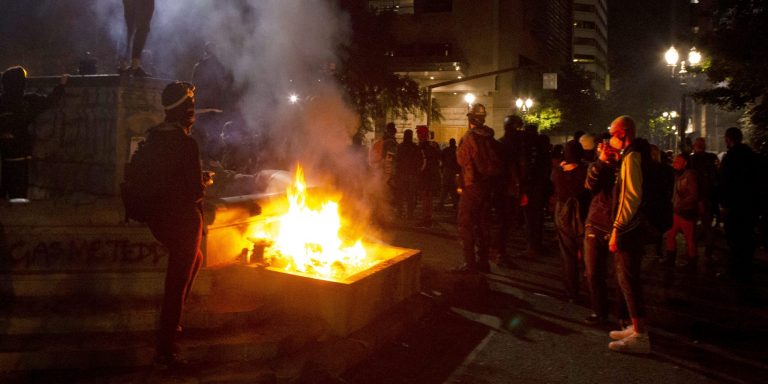
Demonstrators have set fires, launched fireworks and sprayed graffiti on public buildings, including police precincts and the U.S. courthouse. Federal and local authorities have responded with tear gas and dozens of arrests.

A temporary federal court order banned Portland police from using tear gas unless a riot was declared after officers fired it multiple times to dispel crowds. Federal agents have used tear gas at least twice since their arrival over the Fourth of July weekend, prompting concerns that they are being used to circumvent the court order.

Before Wolf arrived, Portland police arrested nine people early Thursday as they cleared protesters from two parks near the courthouse. It wasn’t immediately clear if the parks were cleared because of the visit.

Adapted from reporting by Associated Press.

POMPEO: US Should Limit Which Human Rights It Defends

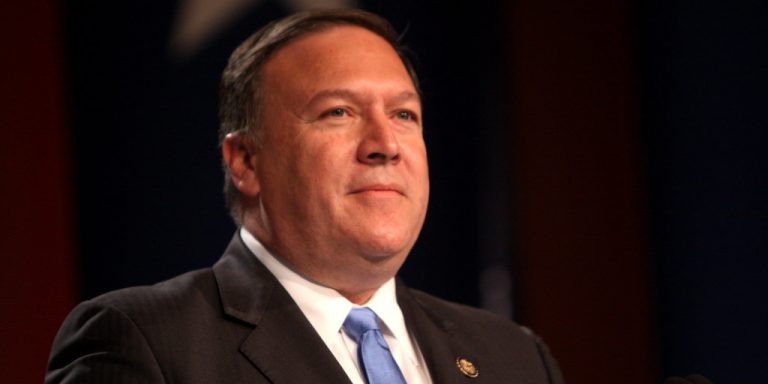
(Associated Press)Secretary of State Mike Pompeo argued Thursday for a more limited U.S. view of global human rights advocacy based on the principals laid out by America’s Founding Fathers, a suggestion critics assumed meant stepping away from more modern concepts such as support for women and the LGBQT communities around the world.

Pompeo, speaking in Philadelphia, singled out property rights and religious freedom as “foremost” principals in a speech that elsewhere complained about the “proliferation” of protections in international agreements related to human rights.

“We are forced to grapple with tough choices about which rights to promote and how to think about this,” he said. “Americans have not only unalienable rights, but also positive rights granted by governments, courts and multilateral bodies. Many are worth defending in light of our founding; others aren’t.”

Pompeo on Thursday released a report produced by the Commission on Unalienable Rights, which he tasked last year with conducting a broad review of U.S. human rights policy, arguing at the time that it had “lost its bearings.”

Before its release, many human rights groups were skeptical of the commission, whose chairwoman was conservative legal scholar Mary Ann Glendon, a former U.S. ambassador to the Holy See.

Pompeo noted that the report emphasizes property rights and religious liberty. “No one can enjoy the pursuit of happiness if you cannot own the fruits of your own labor. And no society can retain its legitimacy or a virtuous character without religious freedom,” he said.

The report did not produce any specific recommendations and steered clear of endorsing policy proposals. But experts who parsed it for direction noted, for example, that it referred to abortion and same-sex marriage not as rights but “divisive social and political controversies.”

Critics such as Sen. Bob Menendez, the ranking member of the Senate Foreign Relations Committee, said the report would damage the United States’ reputation as a champion of human rights around the world by narrowing the scope of who deserves protection.

“As feared, Secretary Pompeo used his speech to insinuate a hierarchy of rights where property rights and religious liberty are ‘foremost’ rights and some rights are not ‘worth defending,’’’ said the New Jersey Democrat.

Critics also faulted the makeup of the commission, saying it was weighted with conservatives, and the public did not have sufficient opportunity to weigh in on its findings before the report’s release.

“As was clear from the start, Secretary Pompeo’s Commission on Unalienable Rights was designed to challenge the international consensus with a narrow view of human rights, that among other things would leave LGBTQ people even more vulnerable to violence and discrimination,” said David Stacy, government affairs director of Human Rights Campaign.

Pompeo also took aim in his speech at demonstrators “pulling down statues” and “desecrating monuments,” in echoes of President Donald Trump’s recent speech at Mount Rushmore. The secretary of state said it was an attack on the people who fought for the rights laid out in the Declaration of Independence.

He also criticized The New York Times for its 1619 Project, an award-winning explanation of the persistent legacy of slavery in the United States.

“America is fundamentally good and has much to offer the world because our founders recognized the existence of God-given unalienable rights and designed a durable system to protect them,” he said. “But these days I must say even saying America is fundamentally good has become controversial.”

COVID: 5 Reasons Public Health Experts Have Lost Credibility

0

(Alex Berezow, PhD and Josh Bloom, American Council on Science & Health) Of all the things we have lost this year due to the COVID-19 pandemic – from the people we love to the jobs that put food on the table – one of the more pernicious is the loss of faith and confidence that Americans have in their public health institutions.

How did it happen?

It’s not simply a matter of being wrong. It’s okay to be wrong, especially when confronted by a situation in which confusing and contradictory evidence changes on a daily basis. As long as experts admit to being wrong and can explain why, trust can actually increase because the public appreciates transparency.

A loss of credibility, therefore, happens for other reasons. In the case of coronavirus, we believe there are five reasons: Incompetence, waffling, moving the goalposts, disregarding unintended consequences, and being political.

Incompetence. Incompetence is far worse than being wrong. It puts on full display that the people in charge don’t actually know what they’re doing.

The CDC displayed incompetence when it sent out diagnostic tests that didn’t work because they were tainted with the coronavirus. Later, it was revealed that the agency was conflating two different types of COVID-19 tests, one that detects active infections and the other that detects past infections. Undergraduate biology students know that you cannot add the numbers from two very different tests. This was not a case of adding apples to oranges; it’s more like adding apples to cheeseburgers. This absurd error nullified precious data that other officials were using to make decisions about lockdowns.

Likewise, the FDA displayed incompetence by failing to approve new coronavirus tests in a timely manner, setting back our country’s ability to track infections by several critical weeks.

Photo by https://www.vperemen.com (CC)

Waffling. As data change, we should expect public health advice to evolve (slowly) over time; this is the nature of science. What is unacceptable is waffling, that is, giving one answer one day and a completely different answer another day. The WHO did that when it announced that asymptomatic carriers only rarely transmitted coronavirus infections, only to retract the statement 24 hours later.

Moving the goalposts. At the beginning of the pandemic, public health officials urged the need to “flatten the curve,” the goal of which is to prevent a spike in infections that overwhelms healthcare systems. This is an achievable and necessary goal.

Over time, however, “flatten the curve” took on a new meaning. Instead of slowing the spread of the disease – to decrease the burden on overloaded hospitals and buy time for the development of drugs or vaccines – the goal became to stop disease transmission entirely. This is a ludicrous goal because – like stopping the spread of the common cold or influenza – it is nearly impossible. Similarly, “finding a cure” became a common refrain, despite the fact that there may never be a good vaccine or antiviral for coronavirus.

Disregarding unintended consequences. Like the side effects of a drug, all policies have unintended consequences. The lockdown caused major damage to the economy, prevented cancer patients from receiving treatment, and increased the prevalence of mental illness. For these and other reasons, some experts believe that the lockdown cost more lives than it saved. Regardless if that is ultimately true, at the very least, uniform shutdown policies imposed without regard for differences in population density and local infection rates were deeply flawed.

Being political. The absolute worst way to damage credibility is to choose sides in our toxic culture war. Yet, public health experts did precisely that, too.

Many of the same experts who endorsed strict lockdowns in order to “stay home, stay safe” then endorsed anti-racism protests in which thousands of individuals crammed together on city streets. Public health advice is supposed to be apolitical and evidence-based. Such blatant political advocacy did not go unnoticed. A damning headline in Politico noted, “Suddenly, public health officials say social justice matters more than social distance.

Exacerbating all of these problems is extreme partisanship, in which point-scoring and blame-shifting are seen as more important than creating a unified front. This failure of leadership stretches from the White House down to Governors’ Mansions and City Halls across the nation.

At their best, public health experts deserve credit for eradicating smallpox and turning fatal diseases like HIV into manageable chronic illnesses. At their worst, they act like bureaucrats and political partisans. The resulting loss of credibility makes us all worse off…Original Source

BARR: US Overly Reliant on Chinese Goods, Incl. COVID Supplies

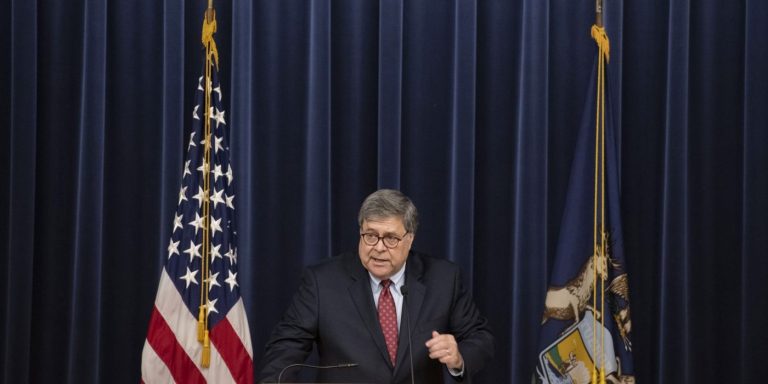
(Headline USA) The United States has become overly reliant on Chinese goods and services, including face masks, medical gowns and other protective equipment designed to curb the spread of the coronavirus, Attorney General William Barr said Thursday as he also cautioned American business leaders against promoting policies favorable to Beijing.

The attorney general directly asserted that China had not only dominated the market on protective gear, exposing American dependence on Beijing, but also hoarded supplies and blocked producers from exporting to them to countries in need.

In Barr’s address at the Gerald R. Ford Presidential Museum in Grand Rapids, Michigan, he  accused hackers linked to the Chinese government of targeting American universities and businesses to steal research related to vaccine development, leveling the allegation against Beijing hours after Western agencies made similar charges against Russia.

“The People’s Republic of China is now engaged in an economic blitzkrieg — an aggressive, orchestrated, whole-of-government (indeed, whole-of-society) campaign to seize the commanding heights of the global economy and to surpass the United States as the world’s preeminent technological superpower,” Barr said.

Administration officials in recent weeks have stepped up their criticism of China lately.

A New York Post opinion piece by national security adviser Robert O’Brien and a speech last week in which FBI Director Chris Wray detailed efforts by Beijing to steal American research and innovation.

Wray said the FBI was opening a counterintelligence investigation related to China about every 10 hours.

Barr’s speech amounted to a wide-ranging condemnation of what he said were Beijing’s tactics to gain an economic upper hand in the 21st century, and to engage in influence campaigns touching diverse corners of American life, including business, politics and even entertainment.

He specifically warned American corporate leaders against pushing policies favorable to the communist government, saying they could run afoul of federal foreign lobbying laws if they don’t disclose their relationship with China.

“As China’s government loses credibility around the world, the Department of Justice has seen more and more PRC officials and their proxies reaching out to corporate leaders and inveighing them to favor policies and actions favored by the Chinese Communist Party,” Barr said.

“Their objective varies, but their pitch is generally the same: the businessperson has economic interests in China, and there is a suggestion that things will go better—or worse—for them depending on their response to the PRC’s request,” he added.

Similarly, he warned, universities that welcome Chinese-funded initiatives could unwittingly lose control of academic research.

And he said that Hollywood had fallen influence to Beijing, too, accusing filmmakers of censoring themselves in line with Chinese propaganda.

“Globalization does not always point in the direction of greater freedom,” Barr said.

“A world marching to the beat of Communist China’s drums will not be a hospitable one for institutions that depend on free markets, free trade, or the free exchange of ideas,” he added.

Adapted from reporting by the Associated Press

Prosecutor Drops Case Against Ex-NC Candidate Mark Harris

0

(Headline USA) A former North Carolina congressional candidate won’t face state charges in an absentee ballot fraud investigation that’s already led to indictments against his hired political operative and a new election, a local prosecutor said on Wednesday.

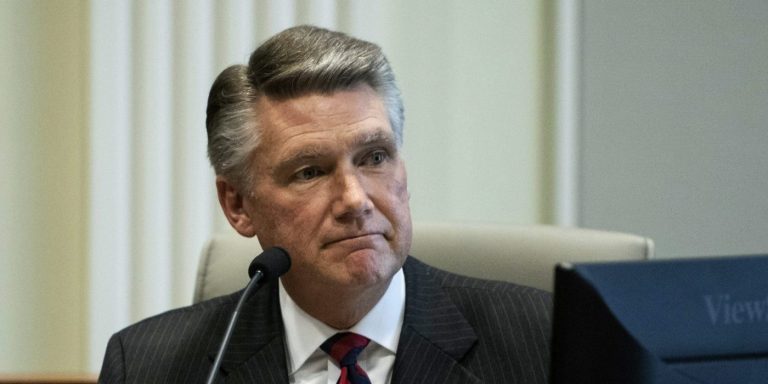
Wake County District Attorney Lorrin Freeman said her office “is closing the matter” involving the Rev. Mark Harris, who ran for the 9th Congressional District seat in 2018.

State and federal agencies spent more than a year investigating the involvement of Harris and his campaign in absentee ballot operations in Bladen County.

Freeman told The Associated Press that her office decided against charging Harris after speaking last week with a key witness she declined to identify.

Harris told the AP in a phone interview that he’s grateful for the opportunity “to finally restore my reputation,” and didn’t rule out running for political office again someday.

Harris, a Baptist minister, got the most votes in the November 2018 election, but an investigation soon began into allegations centering around McCrae Dowless, who was hired for Harris’ campaign in Bladen County.

Harris didn’t run in a state-ordered new election, which Republican Dan Bishop won in September 2019.

Dowless and some of his workers, meanwhile, have been indicted on election-related charges in state court for activities in the 2016 and 2018 elections.

These cases are pending, and Freeman’s statement says “investigators continue probing other areas of evidence.”

Dowless also was indicted in April on federal charges of fraudulently receiving Social Security benefits while getting paid for political work.

Witnesses told state election officials that Dowless gathered hundreds of absentee ballots from Bladen County voters with the help of his assistants.

Dowless’ workers testified at a state board hearing that they were directed to collect blank or incomplete ballots, forge signatures on them and even fill in votes for local candidates.

Harris testified during the hearing and denied any knowledge of illegal practices by those working for his campaign, but he also asked for a new election, acknowledging the taint the evidence had on his 900-vote lead.

“Candidates for elected office have a duty to uphold the public’s faith by not only following the law, but by exercising sound judgment,” Freeman said in her statement, adding that “Harris’ decision to relinquish his seat and call for a new election in which he did not participate were important steps in restoring the confidence of the voters in District 9.”

Harris told the AP he’s grateful for Freeman’s thorough investigation.

“I told the voters on the 9th District that my campaign would fully cooperate with the process and that it would ultimately reveal insufficient evidence to overturn an election,” Harris said, adding he’s not been interviewed by any law enforcement. “I trust the investigators will continue to work so that North Carolina voters can be assured that their vote counts.”

In testimony during the 2019 board hearing, Harris’ son said he warned his parents about Dowless and didn’t trust him or his methods. John Harris said he thought Dowless lied and his parents believed him.

Mark Harris said Wednesday a number of elected officials who recommended Dowless to him also were apparently misled.

Harris, 54, was previously president of the North Carolina Baptist State Convention and chief pastor at First Baptist Church in Charlotte.

Now the pastor at a Baptist church in Mooresville, north of Charlotte, Harris said he’s not cut off the idea of running for political office again someday because “I love this country too much.”

He ran unsuccessfully for the U.S. Senate in 2014 and for Congress in 2016.

Adapted from reporting by the Associated Press