Sunday, April 19, 2026

Rush Limbaugh Praises Trump’s Tireless Defense of America at Missouri Rally

0

‘We are defending an America that has strayed from our founding…’

(Ben Sellers, Liberty Headlines) In one of the key battleground fronts of the 2018 midterm elections, Missouri, President Donald Trump got an extra boost of support at a rally on the eve of Election Day from conservative heavy-hitter Rush Limbaugh in his hometown of Cape Girardeau.

The radio talk-show host rebuked the accusations that the right-wing had created a “divisive” culture by demanding strong immigration and law-enforcement.

“They say we’re divisive, but we are not divisive,” he said. “We are defending an America that has strayed from our founding.”

Limbaugh, who joked that Trump had imposed a 10-minute time limit on him, began by encouraging the “electric” audience to start a chant “Lock her up” against Hillary Clinton, who has refused to concede her 2016 election defeat and gracefully exit the spotlight.

“Hillary Clinton colluded with Russia. Hillary Clinton rigged that election,” he said.

Limbaugh said that career politicians like the Clintons and Obamas were jealous that Trump had stirred up the conservative base in ways that they had not.

“This isn’t supposed to happen. You people are supposed to love them, not Trump. So guess what? They want to get in on it.”

But he said few had bothered understanding what motivated Trump’s supporters and that there was “much to learn.”

“The bond that exists between you and everybody else that has been to a Trump rally is something that politicians envy, and the people in Washington have not taken the time to understand why you voted for Trump. They just think you are stupid for doing so,” he said.

Some, he said, resented Trump for giving voice to voters that they would rather ignore. “You weren’t being listened to. You weren’t being paid any attention to. Even now, the real anger at Trump is actually at you for having elected him.”

However, Limbaugh dismissed the oft-floated media talking point that fear and anger were what had driven massive conservative turnouts in recent elections. “You’re not angry. You love people! You want your country to be the greatest it can be and you finally got someone willing to help you do it,” he said.

Limbaugh said that Trump—who bucked convention by taking an active role in the midterm campaigns and embracing it as a mandate on his performance rather than distancing himself—had been “indefatigable” his goal of fixing the country. “Donald Trump wants America to be great again—and, it’s not a slogan, it is an objective.”

He observed that while other politicians may have personal gain at stake, Trump had no other motivations for entering the political arena.

“He is one of the most successful people in America and he doesn’t need this. He doesn’t need to put up with the abuse … He does because he sincerely believes that America is headed in the wrong track and it needs to be put back on the right track.”

Forget the Pundits: Data Foretells a Midterm Win for Trump Either Way

0

‘My whole life, you know what I say? “Don’t worry about it, I’ll just figure it out.”’

Trump Claims 'Clear Victory' After Supreme Court Allows Travel Ban
Donald Trump/Photo by Gage Skidmore (CC)

(Ben Sellers, Liberty Headlines) If President Donald Trump loses a single seat in the House of Representatives during Tuesday’s midterm election, you can be certain some media outlets will be touting it as an unequivocal victory and mandate for “the resistance”—a blue wave, thumpin and shellacking all rolled into one.

But if history is the judge, based on the projected gains and losses at nonpartisan sites such as RealClear Politics, Trump already can declare a victory of sorts.

Although the Democrats need to pick up only 23 seats, the average number of seats lost in a midterm election dating back to Franklin D. Roosevelt’s presidency is 26, according to UC Santa Barbara’s American Presidency Project. Thus, Trump could still be ahead of the curve even if the House GOP does lose the majority, provided he keeps it below that. On the eve of Election Day, RCP had the average gains projected by its polls at exactly 26.

Considering only the number of seats being contested and Trump’s average approval rating around 44 percent, UCSB’s historical data suggests the president would lose between 26 and 33 seats as the norm. Recent Democrat-led redistricting efforts might also factor into the calculation.

Interestingly, the UCSB data shows that Trump is the Republican with the highest number of House seats to be contested in the 84-year span (21 midterm elections total, excluding the current one). The president’s combative rhetorical style and populist appeals to “drain the swamp” may be attributable for some of the electoral map difficulty.

Trump’s unwillingness to abide by political norms has resulted in a number of high-profile departures leaving open seats with no incumbent advantage. This includes four retiring GOP senators and more than double the number of GOP congressmen leaving the House as their Democratic colleagues.

However, the Left’s cashflow has also played a huge part in the increased number of contested races. In an election that is on pace to break spending records for congressional elections by around $800 million, according to estimates by the Center for Responsive Politics, Democrats have held a clear advantage in fundraising.

State Dept., USAID Sued for Docs on Funding to Soros’s Foreign Campaigns
George Soros/Photo by boellstiftung (CC)

While some have interpreted this as a sign of voter enthusiasm and momentum for the progressive movement, others see it as an indicator of the tremendous amounts of dark money that special-interest groups and billionaire plutocrats such as George Soros, Michael Bloomberg and Tom Steyer have been willing into invest in flipping the electoral map.

By contrast, the relatively low number of contested seats in the Senate has opened the possibility of what might—under different circumstances and with a different media—be considered a routing in Trump’s favor. Only five of the 21 elections included in the UCSB midterm data showed a gain in the upper chamber, as Trump is poised to achieve. All of those chief executives, with the exception of Ronald Reagan in 1982, were enjoying sky-high enthusiasm and popular support when they built on their leads.

If the GOP were to pick up the seats of struggling Democrat incumbents Heidi Heitkamp (N.D.) and Claire McCaskill (Missouri)—and to clinch one of the other tightly contested battleground states that went for Trump two years ago (Indiana, Montana, West Virginia and Florida are the main candidates)—then a three-seat net gain would put Trump at a tie with John F. Kennedy in 1960 for the No. 2 spot in midterm Senate increases, behind only Franklin D. Roosevelt with nine seats in 1934.

As history shows, extraordinary circumstances can also impact the result. In addition to his nine-seat Senate pickup in the 1934 midterm, three years after the start of the Great Depression, Roosevelt gained nine House seats. Likewise, George W. Bush gained eight seats in the House and two in the Senate in 2002, the year after the Sept. 11 terrorist attacks.

Trump’s economic successes, and his focus on national defense and security issues, both play to his advantage. But even one of his potential liabilities—the likelihood of a partisan impeachment push—could wind up yielding favorable results.

BOOK: Bill Sought Monica After Hillary's Health Care Fail
Bill Clinton & Monica Lewinsky/IMAGE: YouTube

Former President Bill Clinton picked up seats in his second midterm, in 1998, amid the looming Starr investigation for perjury and obstruction of justice. However, his net gain of five also was far eclipsed by his loss of 52 seats during his prior 1994 midterm. That election had handed control of the House to Republicans.

The GOP maintained a strong enough majority to proceed with Clinton’s impeachment in December 1998, despite the prior month’s mild losses, but it did so at a heavy cost in its own public standing that ultimately proved unsuccessful in removing Clinton from office.

Trump currently faces a similar situation, with House Democrats threatening to use subpoena powers to stymie his legislative agenda and some saying that they would extend a harmful and unfounded investigation into Russia collusion, regardless of special counsel Robert Mueller’s findings.

Some Democrats also have hinted at launching an impeachment investigation into Justice Brett Kavanaugh, despite an extensive report by Senate Judiciary Chair Chuck Grassley, R-Iowa, that found no credible evidence of sexual assault.

Trump has said that the defining issues of the election will be Kavanaugh and the caravan of thousands of migrants threatening to cross the border in coming weeks.

Democrats have pushed health care as the definitive election issue—but that has proven toxic in the past, with voters having punished Clinton in 1994 for an attempted health care overhaul and delivering a 63-seat loss to Barack Obama in 2010 following passage of the Affordable Care Act. Senate Majority Leader Mitch McConnell is hopeful of repealing Obamacare should the GOP retain control of Congress, though Trump and other Republicans have said changes to ACA protections for pre-existing conditions are off the table.

Trump, Congressional Republicans Celebrate Tax Victory 1
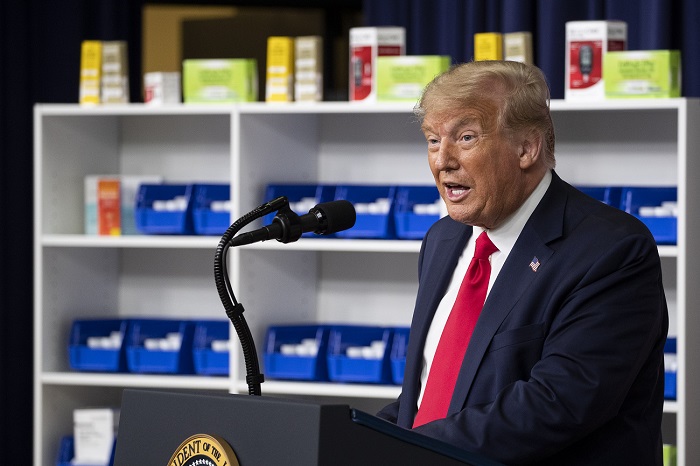
Donald Trump/IMAGE: YouTube

While Trump’s numbers will likely shine by historical standards, barring any surprises, there remains the possibility—as he proved in 2016—that Trump could also surpass pollsters’ expectations due to oversampling and other surveying tricks that falsely inflated the Democratic “momentum” prior to Election Day.

The higher the number of people sampled, the more difficult such anomalies become, and Trafalgar Group, which often sampled considerably more people, showed leads for the Republican candidate in tightly contested Senate races in Nevada, Florida and Arizona, whereas in other surveys they remained toss-ups or projected a narrow Democrat win.

A huge victory for Trump and Republicans, of course, could pose just as many challenges as a loss, making desperate Democrats, who already have amped up the heated political rhetoric, turn even more vicious than a coalition government. Nancy Pelosi, poised to resume her role as speaker of the House, has promised collateral damage in that event. At a rally on Monday, Pelosi urged her liberal base “to be ready take a punch and throw a punch,” Breitbart reported.

Echoing Hillary Clinton, Pelosi said that the heated rhetoric on the Left would only cool once they were in power. When responding to a question on The Late Show with Stephen Colbert about lowering the temperature of political discourse, she said, ““Well, I think when we win, you will see evidence of that.”

But while considering the prospective outcomes at a recent campaign event, Trump was characteristically confident in his ability to manage. “My whole life, you know what I say? ‘Don’t worry about it, I’ll just figure it out,’” he said.

Dems, Media Rage After Trump Uses Cop-Killing Illegal in Attack Ad

‘I will break out soon, and I will kill more…’

(Ben Sellers, Liberty Headlines) In the closing week of the midterm election campaign, President Donald Trump left liberals seething over a simple ad, which he shared on Twitter.

The ad, running only 53 seconds, featured unrepentant, cop-killing illegal immigrant Luis Bracamontes in his own words with no voice-over.

“I will break out soon, and I will kill more,” Bracamontes said.

The Bracamontes case was one of several high-profile murders Trump has highlighted involving illegal immigrants, who disproportionately commit dangerous crimes. Entire organizations are dedicated simply to documenting the reported cases of violent assaults and rapes among illegals, aided and abetted by the liberal policies of sanctuary cities that defy federal rule of law in providing safe harbor.

Following the August murder of Mollie Tibbetts, Sen. Elizabeth Warren deflected on the scourge of non-citizen crime by saying Americans needed to refocus on “real problems,” like releasing into the population those whom immigration authorities had succeeded in detaining at the border.

Nonetheless, in a campaign season fraught with finger-pointing over the escalation of tension, fear-mongering, heated rhetoric and violence from every angle, Trump’s ad ignited yet another firestorm in the liberal media.

CNN anchor Chris Cuomo—brother of current New York governor and likely presidential contender Andrew—devoted a segment 9.5 times the length of the actual ad to discussing it with Democratic National Committee chair Tom Perez.

The segment doubled as a campaign spot for Perez, who made sure to squeeze in talking points about the Left’s cause célèbre, the preservation of Obamacare entitlements, before circling back around to addressing the immigration issue.

Perez said it was typical of Trump’s divisiveness and distraction. “His dog whistle of all dog whistles is immigration. This has been Donald Trump’s playbook for so long—and you know what, when they go low, we go vote.”

The outrage followed a week in which Democrats attempted to paint Trump and his voter base as unhinged lunatics and relate them to two acts of terrorism pinned on right-wing extremists, all while many prominent party leaders on the Left egged on violence and promised further instances of incivility and collateral damage.

Two days earlier, in a discussion with Cuomo, fellow CNN anchor Don Lemon said, “We have to stop demonizing people and realize the biggest terror threat in this country is white men, most of them radicalized to the right, and we have to start doing something about them.”

Perez seemed to take it a step farther, even blaming Trump for the crimes committed by illegal immigrants, which he suggested were part and parcel with the previous week’s headlines.

“When you create a climate—as this president has created—that invites violent acts, you should never be surprised when you have violent acts.”

Perez bragged about having been involved with creating immigration reform under President Barack Obama, whose divisive rhetoric led to race riots and police killings in cities like Ferguson, Mo.; Baltimore, Md.; Baton Rouge, La.; and Dallas, Texas—along with perennial riots in places like Berkeley and Oakland, Calif.

Noting that Republicans had wrested control of all branches of government from the Obama-era Democrats in 2016, Perez said any immigration problems were the GOP’s fault. “They own any failure in these policies right now.”

However, it was 2014, on Obama’s watch, when Bracamontes killed two Sacramento, Calif. sheriff’s deputies in cold blood, shooting Deputy Danny Oliver in the head and driving over his body in an attempt to flee, and later killing Detective Michael Davis after a rampage that included carjacking and shooting an innocent bystander five times—three in the face.

Ironically, after trying to pin immigration problems on Trump, Perez tried to downplay the current immigration threat by pointing out that under Trump’s watch, in fiscal year 2016-17, illegal border crossings had dropped to their lowest level since the 1970s.

Following Cuomo’s show, Lemon also weighed in on his program, calling the ad a “blatantly racist appeal … that shows you just how willing [Trump] is to use lies and scare tactics to terrify his base.”

Other anti-Trumpists also attacked it, with departing Arizona Sen. Jeff Flake calling it a “new low in campaigning” and Clinton-era Treasury Secretary Robert Reich saying “This may be the most desperate and vile ad since Willie Horton.”

Many in the media echo chamber picked up on the Horton comparison, referencing the attack ad used by then-Vice President George H.W. Bush in 1988 to portray opponent Michael Dukakis as being soft on crime.

Four years later, in Bush’s losing campaign to Bill Clinton, future First Lady Hillary Clinton, referred to violent black criminals as “super predators,” drawing criticism from some during her own presidential run.

Indiana Sen. Donnelly in Hot Water over Debate Racial Remark

0

‘Our state director is Indian American, but he does an amazing job…’

(Ben Sellers, Liberty Headlines) President Donald Trump has faced plenty of attacks in the left-wing media for what they characterize as inflammatory, xenophobic remarks.

Now, as Sen. Joe Donnelly faces the prospect of losing his seat in the battleground state of Indiana, the incumbent Democrat seems to be asking himself, “What would Donald do?”

Like other red-state Democrats, Donnelly is paying for his polarizing vote against Supreme Court Justice Brett Kavanaugh and frantically trying to backpedal on his more liberal positions.

His Republican challenger, businessman Mike Braun, has surged ahead after running behind for the past several months, according to RealClearPolitics.

But while many of Indiana’s conservative voters may applaud Donnelly’s working with Trump to address issues like illegal immigration, his cavalier attitudes toward race may raise some eyebrows.

At a debate Tuesday night, in response to a question about the diversity of his staff, Donnelly seemed to imply that his minority workers were excelling in spite of their racial identity.

“Our state director is Indian American, but he does an amazing job,” he said. “Our director of all constituent services, she’s African American. But she does an even more incredible job than you could ever imagine.”

In context, Donnelly seemed to be making the broader point that their race was irrelevant.

But others, like U.S. News & World Report writer David Catanese, certainly took note of the awkward phrasing.

Donnelly isn’t the only Democrat this week to face heat over a potentially racist, insensitive remark.

Hillary Clinton, who some have speculated may be gearing up for a 2020 presidential run, made an apparent racial joke during an interview with tech website Recode.

In response to interviewer Kara Swisher mixing up the violent rhetoric of Sen. Cory Booker and former Attorney General Eric Holder, Clinton quipped, “I know they all look alike.”

“No they don’t,” Swisher replied.

Stelter’s Portrayal of Trump Rally as ‘Hate Movement’ Is Fake News

0

‘When you’re in that pen, you really do feel like a zoo animal…’

CNN’s Brian Stelter checks his phone before going on camera at a Trump rally in Charlotte, N.C. on Oct. 26./PHOTO: Ben Sellers/Liberty Headlines

(Ben Sellers, Liberty Headlines) For someone whose title is “chief media correspondent,” CNN’s Brian Stelter raises a lot of questions about how much he really understands the media.

On Friday, as his colleague, frequent White House antagonist Jim Acosta, headed to California to receive a press award, Stelter took the reins covering a rally in Charlotte by President Donald Trump.

I was there, as well.

On Sunday, Stelter posted what might best be described as a firsthand anthropological study of what he said was his first Trump rally.

“I was two years too late,” he said. “I should have gone to a rally in 2016. I’m a media reporter, after all, and Trump is putting on a show at these campaign events, complete with a booming soundtrack and a grand finale that regular rallygoers know by heart.”

The details he included in his rehashing of it—my first Trump rally as well—were familiar, but the experience was far from it.

“When you’re in that pen, you really do feel like a zoo animal,” Stelter said. “Rallygoers gawk at you, take pictures of you, and sometimes sneer while they walk by, saying things like, ‘You’re fake news’ and ‘enemy of the people.'”

In some ways, CNN was the star of its own side-show. Fewer people recognized Stelter than would have Acosta, although many scanned the “press pen” for signs of the network, which had its place-marker—right beside Fox News at the specially designated network table—turned over backward.

 1
CNN’s Brian Stelter goes largely unnoticed during a live shot./PHOTO: Ben Sellers, Liberty Headlines

What perhaps Stelter and other members of the press found jarring was that it was an inversion of the usual situation, for journalists accustomed to pointing the lens at other people to have the tables turned. But as possibly the second most “famous” guy in the room (arguably of higher profile than Sen. Thom Tillis and other North Carolina politicians, as well as a NASCAR driver or two) Stelter of all people should not have found the fishbowl to be anything out of the ordinary.

Stelter noted that during the rally, a handful of friendly campaign staffers ushered the media to and from the bathrooms upstairs, presumably to ensure they were granted access back into the secure press area, where cameras and tables were set up.

However, the experience in no way seemed unusual for those who frequent press events. And it hardly felt restrictive—if anything, the metal barriers were there for the media’s convenience, allowing journalists and cameramen to move about and do their jobs with relative freedom—although it was still a tight squeeze at times.

The biggest amenity, by far, was bypassing the entry line on the cold and rainy afternoon, but otherwise, the press were treated no differently than the commoners who surrounded them.

 1
CNN’s Brian Stelter interacts cordially with rally-goers at a Trump event in Charlotte, N.C. Oct. 26./PHOTO: Ben Sellers, Liberty Headlines

I met a student reporter from Elon University who said she had been given media credentials and then subsequently got booted from the “pen.” We both agreed that there was little advantage in where I stood from where she was.

As far as I know, nobody kept Stelter, either, from going into the audience if the media “zoo” grew to claustrophobic.

For the most part, Stelter got right the fact that many of the people,  there for the spectacle above all, were more curious than hostile. They were genuinely interested in being a part of that moment in history—and maybe getting on TV to boot, whether it was the real news or the “fake news.” Just as with a professional wrestling event, the line between fact and fiction was sort of blurry, but that didn’t seem to matter.

By the following day, however, Stelter’s tone seemed to have changed. He unleashed on Twitter, saying, “I left the rally in Charlotte even more certain that Trump is leading a hate movement against the media.”

I, for one, stood in the same place, met and interacted with the same people, and saw the heart and soul of America represented in the crowd’s passion.

Although I had the benefit of identifying myself as local media instead of a major network, I felt far more simpatico with the gawking crowd than with the camera-laden platform of media tourists applying makeup before their stand-ups.

I am fairly confident to say that the way Brian Stelter left the rally (before the speech was over) was with the same biases and assumptions he entered it with—but for a brief, fleeting moment, maybe even he was moved by the cameraderie.

FBI Unconvincing in Defusing Democrat Mailer ‘Bomb’ Theories

‘This is nearly the same as a bundle of road flares wrapped together with an old-timey alarm clock ticking away….’

(Ben Sellers, Liberty Headlines) At a press conference Friday afternoon, Attorney General Jeff Sessions and FBI Director Christopher Wray addressed the suspicious packages allegedly sent by right-wing extremist Cesar Sayoc to prominent Democrats.

In addition to providing details of Sayoc’s arrest, which the FBI said came about with the help of a fingerprint, one of the main objectives was attempting to bring closure to the speculation that it may have been a hoax or a false-flag stunt so close to the midterm election.

In the conference and a follow-up press release, Wray reiterated in no uncertain terms that the improvised explosive devices were real. “Though we’re still analyzing the devices in our Laboratory, these are not hoax devices,” he said.

Wray said the devices each contained about six inches of PVC pipe, a small clock, a battery, wiring and ‘energetic material,’ which, he explained, “is essentially potential explosives and material that gives off heat and energy through a reaction to heat, shock, or friction.”

But despite the FBI’s explanation, many doubts still lingered.

To begin with, as conservative radio pundit Rush Limbaugh had observed prior to the arrest, it didn’t add up that someone on the Right would seek to slow the tremendous momentum that Republicans nationwide were feeling.  At best, it was a distraction; at worst, negative optics that would undermine the GOP’s valid criticism of violent rhetoric on the Left—largely driven by many of the purported bombing “victims.”

Many in the media also observed that Wray’s statement was a direct contradiction, of sorts, to a tweet that President Donald Trump had issued at 7:30 Friday morning, putting the word “Bomb” in quotation marks.

With the FBI’s credibility already strained under the scandals surrounding top officials James Comey, Andrew McCabe, Peter Strzok, Lisa Page, Bruce Ohr and others, it didn’t seem a far stretch to wonder if any members of the “deep state” resistance still lingered in the agency’s upper echelon.

However, even among those less inclined toward the conspiratorial, several pieces of information simply didn’t seem to pass the smell test.

To begin with, some noted that the bombs themselves were so amateurishly designed that even if the ingredients were correct, they seemed highly unlikely to detonate.

A story from Twitchy compiled the tweets of former bomb-disposal officer Tom Sauer, who questioned their cartoonish appearance.

Many also puzzled over the fact that images of the packaging itself, provided both by CNN and by the FBI, showed that the suspicious-looking parcels not only failed to raise any red flags at USPS processing centers up and down the East Coast, but the stamps weren’t canceled.

Although the package sent to CNN appeared to show only $3 in postage, the lowest price for a 1-pound package from Aventura, Florida to New York City would be more than double that.

Moreover, others pointed out that the postal service would not have delivered packages to the addresses of former presidents Obama and Clinton due to Secret Service screening policies. Even left-wing “fact checking site” Snopes, in dutifully attempting to debunk the hoax claim, could not explain how they would have gotten there, only that they did.

Fla. Man Arrested in Case of Suspicious Package Mailings
Cesar Sayoc/PHOTO: Twitter

Details about Sayoc also were a bit over-the-top, including his van, which seemed glaringly obvious for someone engaged in a one-man conspiracy to murder top politicians and intelligence officials. “I thought he looked like a shooter,” Paul Bilodeau told the Sun Sentinel.

Not only did Sayoc’s behavior attract the attention of common-folk, but also professional photographers, filmmakers and even liberal activist Michael Moore, who conveniently released footage of Sayoc at a rally, which Moore said was an outtake from his new anti-Trump documentary.

Although several social media accounts that were purported to belong to Sayoc quickly went dark on Friday, inaccessible even via Archive.org, his Facebook page, when active, appeared to show very little except for pro-Trump messages and rally photos—and yet those close to him said his personality had only recently changed under the influence of steroids.

Some online sleuths—such as Shad Olson, who was able to capture screenshots of Sayoc’s accounts—said a deeper investigation revealed him to have been rabidly anti-Bush and that key details online about his political leanings changed shortly after his arrest.

Tragically, a real example of violence from an anti-Trump, anti-Semitic neo-Nazi in a Pittsburgh synagogue on Saturday made skepticism of the FBI’s bombing explanation seem both tasteless and irrelevant.

It is hard to question the slaughter of 11 innocent people in what should have been their sanctuary from the evils of the world—even while callous liberal media and politicians spun the massacre as confirmation of a right-wing undercurrent of violence propelled by Trump.

But the thread throughout all of the conspiracy speculation seems to be that, despite the many unanswered questions, the very implausibility of such a politically motivated stunt—the ridiculous and audacious quality of it—are precisely what might make it an effective smear campaign and/or cover-up.

Desperate Sen. McCaskill Tries to Halt Campaign Tailspin w/ Fox Interview

0

‘My mouth gets me in trouble with some regularity. I am not afraid to tell people where I stand…’

 1
Sen. Claire McCaskill/IMAGE: Project Veritas

(Ben Sellers, Liberty Headlines) As polls showed GOP candidate Josh Hawley beginning to pull ahead in Missouri’s Senate race, incumbent Democrat Claire McCaskill took to Fox News in an apparent effort at damage control.

McCaskill took direct aim at “crazy Democrats” who have promoted incivility, as well as obstructionist politicians like her Senate colleagues Elizabeth Warren, D-Mass., and Bernie Sanders, I-Vt., who resist the efforts of Congressional Republicans and President Donald Trump under any circumstances.

“Some of my colleagues are knee-jerk against the president,” she said. “I don’t get up every day figuring out how I can fight the president. I get up every day figuring out how I can fight for Missourians.”

McCaskill hoped to counter claims from a recent video produced by James O’Keefe’s Project Veritas that she attempted to conceal a radical liberal agenda from conservative voters. In it, she acknowledged having voted for Draconian gun control measures, while staff members in her campaign said she would support impeachment, oppose a border wall and had quietly accepted funds from Planned Parenthood.

But while she was forceful in some areas, she hedged in others, making it unclear whether the message might resonate with her constituents or backfire against her.

On the surge of illegal immigration, McCaskill said, “I do not want our borders overrun. And I support the president’s efforts to make sure they’re not.”

However, she stopped short of mentioning the funding of the wall, focusing instead on using technology to streamline the asylum process.

McCaskill also did not refute her positions on gun control, although she said she had never attempted to mislead.

“My mouth gets me in trouble with some regularity. I am not afraid to tell people where I stand—and Missourians know that,” she said. “The NRA’s come after me in every single election—this isn’t like some state secret.”

She implied that she was at odds with some of her fellow Democrats, such as Warren and Sanders.

“I would not call my colleagues crazy, but Elizabeth Warren sure went after me when I advocated tooling back some of the regulations for small banks,” she said. “… I certainly disagree with Bernie Sanders on a bunch of stuff.”

However, when questioned by Fox’s Bret Baier about how she had only supported Trump about 45 percent of the time while voting with Senate Minority Leader Chuck Schumer, D-N.Y., 80 percent of the time, McCaskill said it was because there had not been enough votes on the Senate Floor since Trump took office.

And despite Missouri having gone for Trump by a margin of more than 20 percent, McCaskill stopped short of repudiating Hillary Clinton. “I thought she certainly had the breadth and depth of experience that qualified her, but I’d rather look forward and not backward.”

She also took to the spin zone to explain her costly vote against Supreme Court nominee Brett Kavanaugh, saying it was his position on campaign funding and not the uncorroborated sexual assault allegations against him that caused her to oppose.

“I’m watching this tsunami of dark money that is drowning our process,” she said.

McCaskill touched on the Project Veritas video also. In its immediate aftermath, she called on her opponent Hawley, who is currently the state attorney general, to investigate it as fraudulent under a law that regulates deceptive business practices.

Unable to get in front of the narrative, however, she told Baier it was not what was said in the video itself that was at issue so much as the devious way it was produced.

“The thing about those films that bothered me is not what was on them … it was that they had embedded themselves into our office for weeks on end and that guy had accessed our computers. He wasn’t in our computers to help me,” she said. “There was fraud, and I think that’s a ‘new normal’ that we’ve gotta do something about.”

Media Play Blame Game on Trump While Obama Got a Pass

0

‘After past tragedies, the president has been wary of arriving too quickly for fear of diverting resources from the local investigations…’

Tree of Life synagogue in Pittsburgh/IMAGE: CBS Sunday Morning via Youtube

(Ben Sellers, Liberty Headlines) In a scurry to point fingers and deflect blame, liberal groups found themselves delivering mixed messages after the horrific murder of 11 people by an anti-Semitic extremist at a Pittsburgh synagogue Saturday.

In addition to glossing over their own troubled relationship with anti-Semitism, Democrats savaged President Donald Trump for issuing precisely the same type of response they had heaped effusive praise on former President Barack Obama for in the aftermath of the 2015 Charleston church shooting.

Following months of brushing aside anti-Semitism within their own ranks— including Twitter giving Louis Farrakhan a pass on hateful remarks and left-wing leaders openly associating with the Nation of Islam leader—the Left’s efforts to bring Jewish voters back into the fold by evoking Nazi fearmongering already had begun on Friday, before the synagogue shooting.

In what seemed like a non-sequitur at the time, Alexander Soros, the son of pipe bomb “victim” George Soros (who has frequently been a supporter and benefactor of violent mob demonstrations) was already levying charges of anti-Semitism related to Trump’s criticisms of the Federal Reserve and Goldman Sachs, accusing him of using “dog whistle language” for opposing “global special interests.”

Trump, at his rallies, meanwhile, continued to tout the many ways he had supported the Jewish community—gushing with pride at an event Friday in Charlotte, N.C., over his successes in building a brand-new embassy in the Israeli capital and Jewish holy city of Jerusalem.

 1
Trump supporters embrace at a rally in Charlotte, N.C., Oct. 26./PHOTO: Ben Sellers/Liberty Headlines

The former builder spent considerable time at the Friday rally beaming over the successes in the embassy’s construction process, including the use of local materials like Jerusalem stone.

But as news broke of the Pittsburgh shooting, left-wing opportunists saw their opening to link the president to it. The Huffington Post quoted a progressive activist group, Bend the Arc,  which refers to itself as the “Jewish Resistance,” effectively dis-inviting Trump from visiting Pittsburgh before the president even released details about his plans to go.

Meanwhile, others in the liberal media, including the Associated Press, criticized him for not clearing his schedule of commitments to go immediately to Pittsburgh.

“[F]aced with another national tragedy, he did not long turn his focus away from the midterm elections or himself,” said AP editorialist-reporter Catherine Lucey.

Although many noted that Trump sharply condemned the “evil, anti-Semitic attack,” repeatedly expressed his sympathy to victims and families of the shootings throughout the day, and promised swift and severe justice for the alleged perpetrator, it was not enough to placate disingenuous politicos and journalists seeking a smear to any cost.

The irony was especially pronounced given the media’s rush only three years ago to lay cover for Obama, who following the shooting at an African-American church in Charleston, S.C., decided his priority was to do a humorous podcast and then attend several fundraising events with big California donors, including one at the San Francisco home of billionaire Tom Steyer.

“Time and again, Obama has carried on business as usual — with only brief interruptions — in the face of crisis or tragedy,” The Washington Post dotingly wrote at the time. “He often makes a statement to the public , as he did Thursday at the White House, speaking emotionally about the Charleston killings, but soon resumes his regularly scheduled programming.”

It went on to explain that Obama, respectfully, didn’t want to get in the way of authorities. “After past tragedies, the president has been wary of arriving too quickly for fear of diverting resources from the local investigations.”

The Charleston massacre, by 21-year-old white supremacist Dylann Roof, came a mere week after Trump had announced his candidacy for president. Although the alleged second coming of Hitler had hardly hit the campaign trail, already racial tensions were peaking amid violent riots in cities like Baltimore, St. Louis, Dallas and Baton Rouge, all of which Obama’s divisive rhetoric helped to exacerbate.

Polls by major outlets, including Rasmussen, CNN and The New York Times/CBS revealed strong public perceptions that race relations worsened considerably under Obama, with some indicating that they had reached an all-time low. By contrast, the strong economy and record unemployment have helped improve voter perceptions of race relations under Trump.

Charlottesville/IMAGE: Journalism 101 via Youtube

The Democrats, in response to the Charleston shooting, waged an all-out war on Confederate symbols and statues—including those in Charlottesville, Virginia, which in turn triggered yet another violent protest, organized by a former Obama supporter, in April 2017.

Although Antifa protestors responded to the presence of demonstrators wearing Nazi and KKK regalia by hurling bricks and newspaper racks, and using homemade flamethrowers, Trump was roundly criticized for pinning blame for the violence on both sides.

Unsurprisingly, forgetting that past is prologue, leftist fearmongers, including Steyer, found ways of pinning the most recent violence on Trump’s campaign speeches.

“There’s something much bigger than [the synagogue shooting] going on here,” Steyer said, “which is the atmosphere that he’s created and that the Republican Party has created in terms of political violence.”

As Trump Tries Dialing Back Attacks at N.C. Rally, CNN’s Acosta a No-Show

0

‘I want them to say, “He was so nice tonight…”‘

(Ben Sellers, Liberty Headlines) CHARLOTTE—President Donald Trump was the main attraction at a rally Friday supporting two North Carolina Congressional candidates, Mark Harris and Ted Budd, but the main question on the minds of rally-goers like George Prisco was “Where’s Jim Acosta?”

Some tried in vain to scour the press bullpen at the Bojangles Coliseum, but the long-suffering—and often equally antagonizing—CNN White House correspondent was not to be found on the cold and rainy afternoon.

Acosta’s Twitter account placed him on the opposite end of the country, receiving a journalism award from San Jose State University.

Pinch-hitting for Acosta was CNN’s chief media correspondent, Brian Stelter, who took the heckles in stride with a sheepish smile as a “CNN Sucks” jeer from the crowd broke out several times.

Tension at the network may have been even more elevated than usual as suspicious packages were delivered to prominent liberal public figures—including CNN, which received one addressed to contributor and former CIA Director John Brennan.

Perhaps as an extra layer of precaution, CNN had its name card turned over at a table reserved for network news correspondents, and Stelter appeared to take advantage of his relative anonymity in an audience that, for the most part, had probably never seen his Sunday morning show “Reliable Sources” on television.

As Stelter himself said, however, despite all the ribbing his network received, many in the audience were eager to shake hands and engage with the media that were present, welcoming the opportunity to have their voices included in the national dialogue.

For Brooke Guidebeck, a North Carolina native now living in Atlanta, who drove four hours to attend the rally, the Trump phenomenon truly is about having an elected leader who speaks for the common man—or woman.

“People are just fired up about having their constitutional rights stay intact,” said Guidebeck. “… We’ve never had a president who was one of us.”

But Guidebeck, a military veteran covered with tattoos, including one of Carolina Panthers quarterback Cam Newton on her left hand, did not seem like a ‘typical’ Republican.

Brooke Guidebeck moves in to embrace a fellow nontraditional Trump supporter at a rally in Charlotte, N.C., Oct. 26. PHOTO: Ben Sellers/Liberty Headlines

As other nontraditional GOP voters walked by, she eagerly high-fived and embraced them. Spotting one who wore a shirt that said “Proud Gay Trump Supporter,” she chased him down to give him a hug.

It was a far different reception than gay Trump supporters received last year at a Charlotte “Pride” celebration, where they were denied entry over their political beliefs.

Guidebeck said the collegial feeling within the audience was “like going to your next-door neighbor’s house and having dinner.”

Trump, for his part, seemed mostly to resist the siren call of trolling the media, a few days after he took criticism for making light of an incident in which Montana congressional candidate Greg Gianforte body-slammed a reporter.

However, he managed a few underhanded digs while calling on the media to share in the accountability for a more civil discourse.

“We must unify as a nation in peace, love and in harmony,” Trump said. “The media has a major role to play… as far as tone and as far as everything. And we all say this in all sincerity, but the media’s constant unfair coverage, deep hostility…… and negative attacks only serve to drive people apart and to undermine healthy debate.”

Trump cited an unspecified source saying that 94 percent of the press he receives is negative. “Even when I do something wonderful, it’s negative,” he said.

Despite teeing up the audience on several occasions to boo political adversaries like House Minority Leader Nancy Pelosi and Rep. Maxine Waters while discussing Budd’s opponent, Kathy Manning, as an “extreme liberal,” he claimed to be holding back on Waters, a perennial target due to her bombastic rhetoric—and also one of the suspicious package recipients.

“Maxine Waters,” Trump said. “I’m going to be nice tonight, so I won’t say it. I won’t say it. I won’t say it. I’m going to be nice. I want them to say, ‘he was so nice tonight.’”

Trump rally - Charlotte
President Donald Trump speaks at a campaign rally in Charlotte, N.C. Oct. 26. PHOTO: Ben Sellers/Liberty Headlines

His wide-ranging talk did cover a few hot topics, such as the prompt arrest of the pipe-bomb suspect, for which Trump commended law enforcement.

However, it was North Carolina Sen. Thom Tillis in his opening remarks who had the strongest words for alleged right-wing extremist Cesar Sayoc, calling him an “animal” in a statement that echoed Trump’s description of MS-13 gang members, widely excoriated by the Left.

Whether Democrat leaders would respond the same to Sayoc’s ‘de-humanization’ by Tillis remained to be seen.

Trump spent more time in his speech, which ran slightly past an hour, covering policy details, such as the improvements he implemented to the health-care system after falling one vote short in repealing the controversial Obamacare.

“Think of it. One Democrat would have repealed and replaced, but we’re essentially doing the same thing anyway. It’s been decimated by us,” he said, touting among his accomplishments lower premiums and the repeal of the individual mandate penalty for those who do not have insurance.

In a throwback to his days as a builder, Trump fawned over the construction of a brand new embassy in Jerusalem. “We ended up spending $400,000, and we opened it four months after I agreed to do it in the first place.”

Trump also touched on other issues, including the confirmation of Supreme Court Justice Brett Kavanaugh, that he has said would define the midterm election, 11 days from Friday.

“Nobody has ever been treated more unfairly than Brett Kavanaugh,” he said. “What happened to him and his family was an absolute disgrace… We have many women—and as I’m saying how unfairly he’s been treated, they’re all nodding.”

On cue, Guidebeck and others vociferously affirmed the statement.

Guidebeck said her own experiences as a woman had helped inform her perception of the contentious confirmation hearings and the he-said/she-said testimony of Kavanaugh versus sexual-assault accuser Christine Blasey Ford.

“Sometimes, when women don’t get what they want, they lie,” Guidebeck said. “Sometimes, when men don’t get what they want, they lie. This is definitely a case of not getting what they want.”

Former McCain Adviser Roots for Dems to Sweep Congress

0

‘The time when Republicans and Democrats went on TV and fought about taxes is dead…’

(Ben Sellers, Liberty Headlines) In the years after losing a primary battle to George W. Bush, Sen. John McCain is said to have considered switching political parties and to have openly courted liberal running mates.

Now, those close to the late Arizona senator are working overtime to finally fulfill that legacy.

The latest is Nicolle Wallace, a former McCain campaign adviser and current MSNBC host, who visited Seth Meyers’s talk show to explain why Democrats must win Congress.

“I think that any White House is improved by having a check and a balance—this White House more than any other,” she said.

Wallace made clear what sort of checks and balances she meant: “I think it’s really important that Democrats take over the House and/or the Senate,” she said.

It marked just the latest example of what some have seen as the mercurial and vindictive McCain trying to settle scores with Trump from beyond the grave.

What began with McCain’s melodramatic, “thumbs down” vote on Obamacare repeal continued with the parade of left-wingers schmoozing at his funeral, which McCain meticulously planned, according to daughter Meghan, a co-host on “The View.”

Another pet project of McCain’s, Arizona State University’s McCain Institute, now appears to have crossed the threshold from academic thinktank into political action committee with a series of “Mavericks Needed” billboards it plans to run in battleground states, mostly where Republicans are ahead, prior to the Nov. 6 midterm election and leading up to the 2020 presidential election.

Wallace told Meyers that—apart from a staff mutiny invoking the 25th amendment, which she also advocated—the only way to check Trump was by empowering Democrats, who have threatened to bring the president’s agenda to a halt using subpoenas, investigations and possibly even impeachment proceedings.

“More often than not, people that have seen American presidents up close and know what the conduct is supposed to be like will ultimately decide that a check on this administration is urgent,” she said.

A UC-Berkeley graduate who was communications chief for George W. Bush before becoming a senior adviser for McCain’s 2008 campaign, Wallace now considers herself a “nonpracticing Republican”—but she told Meyer she has no intention of returning.

“The time when Republicans and Democrats went on TV and fought about taxes is dead,” she said.

Apparently, such policy debates have been replaced with former Republicans instead getting invited to schmooze liberal hosts with wistful discussions of how best to thwart the president.

Wallace’s interview with Meyers, lacking considerably in self-awareness of her own contributions to the partisan rancor and to Trump’s ascension within GOP ranks, left no doubt that while working for a left-leaning cable outlet, she has gone full-native.

She cast the recent string of Democrats who had received homemade “explosive devices” in the mail as “victims” even though many have publicly endorsed the incivility and political violence on the Left.

Wallace also condescendingly claimed that the current conservative movement was the result of a “grievance” culture (appropriating a popular buzzword often used to criticize the Left) that began when former McCain running mate Sarah Palin started pandering to the baser instincts of her audience.

“I saw that her crowds were bigger and louder and more animated by her speaking to their grievance, speaking to their nativisms, speaking to their feeling about being angry about immigration and other issues, but John McCain didn’t embrace any of those. That’s probably why, ultimately, the two of them ended up not on the same page.”