(Dave DeCamp, Antiwar.com) The US military blew up another boat in the waters of Latin America on Wednesday, an attack that comes amid growing congressional scrutiny of the bombing campaign.
US Southern Command said in a statement on X that its forces conducted a “lethal kinetic strike” on a vessel in the Eastern Pacific Ocean. The command claimed, without providing any evidence, that the boat was carrying “illicit narcotics.”
SOUTHCOM said the strike killed four male “narcoterrorists,” a term used to justify the extrajudicial executions at sea. The Pentagon has previously admitted to Congress that it doesn’t know the identities of all the people it has killed in the boat strikes.
According to numbers released by the Trump administration, the attack brings the total number of people killed in the bombing campaign to 87 and marks the 22nd strike and 23rd boat that has been destroyed. Eleven of the boats have been struck in the Caribbean near Venezuela, where the bombing campaign started, and 12 have been hit in the Eastern Pacific.
The strike came after a small group of US lawmakers saw the video of the September 2 boat bombing, the opening salvo of the campaign, which involved multiple strikes to kill survivors.
“What I saw in that room is one of the most troubling scenes I’ve ever seen in my time in public service,” Rep. Jim Himes (D-CT) told The Intercept. “You have two individuals in clear distress without any means of locomotion with a destroyed vessel who were killed by the United States.”
Members of Congress intend to investigate the strike to see if a war crime was committed, though the entire bombing campaign is clearly illegal under US and international law. The Trump administration has also continued its military buildup in the Caribbean and its push toward war with Venezuela to oust President Nicolas Maduro.
The Israeli leader told The New York Times’ Dealbook Summit, “We won this war. But it’s never ending. It’s like if you have cancer and you take it out, it can still come back in certain types of cancer.“ Netanyahu claimed Israel has scored major military victories in Lebanon, Iran, Iraq, Yemen, and Syria.
Over the past two years, Tel Aviv has waged war across the Middle East and against Palestinians living under Israeli occupation. Israel has invaded and bombed Lebanon, even after reaching a ceasefire agreement with Hezbollah. Israeli forces have also seized a large swath of Syria and have bombed the country hundreds of times after the fall of the Bashar al-Assad government.
While Tel Aviv was able to remove Assad in Damascus and weaken Hezbollah in Lebanon, Israel has been unable to deter Ansar Allah in Yemen. Yemen has imposed a blockade of Israeli-linked shipping in the Red Sea and conducted direct attacks against Israel.
Large-scale bombing operations by the US and Israel in Yemen were unable to break Ansar Allah’s blockade. Yemen has allowed Israeli shipping and paused strikes due to the ongoing ceasefire between Tel Aviv and Hamas.
Netanyahu claimed that Israel’s war on Iran significantly set back the Islamic Republic’s nuclear program. However, there is no evidence that Tehran was attempting to build a nuclear weapon.
This article originally appeared at The Libertarian Institute.
(Morgan Sweeney, The Center Square) Secretary of War Pete Hegseth violated multiple protocols and federal law in the “Signalgate” affair in March, according to Pentagon watchdog the Office of Inspector General of the Department of Defense.
In a report commissioned by Congress, the office concluded that Hegseth stepped outside his authority as war secretary when he used his personal phone and an unapproved commercial messaging app to communicate attack plans with other government officials; he also didn’t keep a record of all of the chat’s messaging, some of which auto-deleted after a set time, violating both federal law and department policy. Finally, putting the information in the Signal group chat posed additional threats to American forces and missions, according to the office.
Though Hegseth as war secretary does have the authority to determine the classification level of any information he shares (how sensitive the information is), the report affirmed, the methods of communication are a separate matter governed by federal cybersecurity, record-keeping and communications rules.
In March, Hegseth sent a “team update” to a Signal group chat with 18 other government officials, listing the planned times and assets to be used in strikes against the Yemeni Houthi rebel group later that day.
F-18s would launch at 12:15 Eastern time, and their first strike window would start at 1:45 PM.
“Target Terrorist is @ his Known Location so SHOULD BE ON TIME,” Hegseth noted.
He went on to include launch and strike times for the second group of F-18s, when the first bombs would “definitely drop” and when sea-based Tomahawks would be launched.
Hegseth has described this information as an “unclassified summary” of “non-specific, general details” that wouldn’t endanger anyone or anything on their own.
“There was nothing classified in this text. There were no locations or targets identified. There were no details that would endanger our troops or the mission. The details which were included would be useless without also knowing the undisclosed details,” Hegseth wrote in a statement to the office in July.
But the office disagreed, instead describing the texted information as “sensitive, nonpublic, operational information” that the War Department prohibits from being sent on a personal device or an unapproved messaging app like Signal, even though it is encrypted.
The office also determined that the Houthis could have acted preemptively based on the information in the messaging thread.
“If this information had fallen into the hands of U.S. adversaries, Houthi forces might have been able to counter U.S. forces or reposition personnel and assets to avoid planned U.S. strikes,” the report reads. “Even though these events did not ultimately occur, the Secretary’s actions created a risk to operational security that could have resulted in failed U.S. mission objectives and potential harm to U.S. pilots.”
Despite its conclusions, the office did not make recommendations about the use of commercially available messaging apps like Signal in its report because the event was “only one instance of a larger, DoD-wide issue.” Instead, it recommended in another report that “the DoD improve training for senior DoD officials on the proper use of electronic devices.”
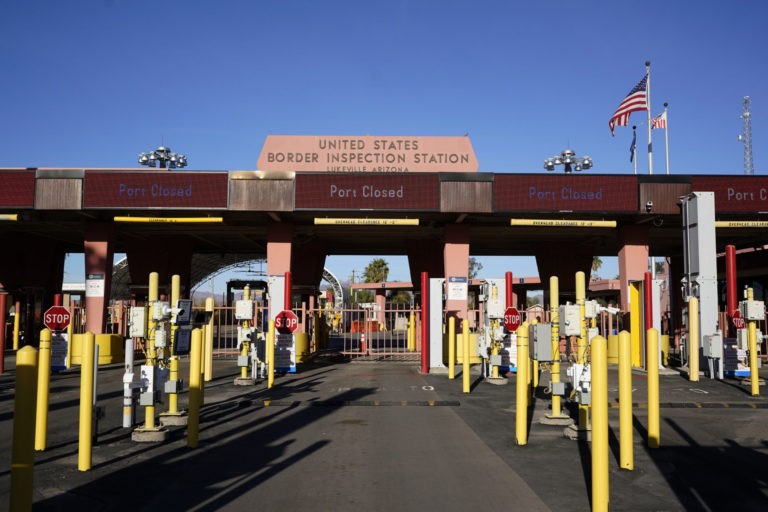
(Bethany Blankley, The Center Square) Under the Biden administration, the greatest number of illegal border crossers at the U.S.-Canada border were reported in U.S. history, breaking records nearly every month for four years, The Center Square first reported.
While record high numbers dropped under the Trump administration, illegal entries still remain high in northern border states, with some states reporting more apprehensions in 2025 than during the Biden years.
Fourteen U.S. states share the longest international border in the world with Canada, totaling 5,525 miles across land and water.
The majority of illegal border crossers were apprehended and encountered in five northern border states, according to U.S. Customs and Border Protection data analyzed by The Center Square. Nearly half were reported in New York. Washington, Vermont, Maine and Montana recorded the next greatest numbers.
The majority of northern border states reported the greatest number of illegal entries in U.S. history in 2024, the last year of the Biden administration, according to CBP data. At the height of the border crisis, illegal entries reached nearly 200,000 at the northern border in 2024 and in 2023, first reported by The Center Square.
For fiscal years 2022 through 2025, 754,928 illegal border crossers were reported in 14 northern border states, according to the latest available CBP data.
From west to east, illegal entries at the northern border totaled:
Alaska: 7,380
Washington: 135,116
Idaho: 620
Montana: 32,036
North Dakota: 14,818
Minnesota: 8,315
Wisconsin: 118
Michigan: 50,321
Ohio: 1,546
Pennsylvania: 19,145
New York: 363,910
Vermont: 61,790
New Hampshire: 82
Maine: 59,731
Notably, Alaska, Idaho, New York, Pennsylvania and Wisconsin reported record high illegal crossings in 2023. Although Montana and North Dakota saw a drop in 2025 from record highs in 2024, the number of illegal border crossers apprehended in the two states in 2025 were greater than they were in 2022; in Montana they were more than double.
The data only includes nine months of the Trump administration. The CBP fiscal year goes from Oct. 1 through Sept. 30. Biden administration data includes the first three months of fiscal 2025, nine months of fiscal 2021, and all of fiscal years 2022, 2023 and 2024. Combined, illegal northern border crosser apprehensions totaled roughly one million under the Biden administration, according to CBP data.
The data excludes “gotaways,” the official term used by CBP to describe foreign nationals who illegally enter between ports of entry to evade capture, don’t make immigration claims and don’t return to their country of origin. CBP does not publicly report gotaway data. The Center Square exclusively obtained it from Border Patrol agents. More than two million gotaways were identified by Border Patrol agents under the Biden administration, although the figure is expected to be much higher, The Center Square first reported.
For decades, the northern border has been largely unmanned and unprotected with increased threats of terrorism and lack of operational control, The Center Square reported.
Unlike the 1,954-mile U.S.-Mexico border, there is no border wall, significantly less technological equipment exists and far fewer agents are stationed there.
Officials have explained that the data represents a fraction of illegal border crossers – it remains unclear how many really came through largely remote areas where one Border Patrol agent may be responsible for patrolling several hundred miles, The Center Square has reported.
Despite being understaffed and having far less resources, Border Patrol and CBP agents at the U.S.-Canada border apprehended the greatest number of known or suspected terrorists (KSTs) in U.S. history during the Biden administration – 1,216, or 64% of the KSTs apprehended nationwide, The Center Square exclusively reported.
In February, President Donald Trump for the first time in U.S. history declared a national emergency at the northern border, also ordering the U.S. military to implement border security measures there. After shutting down illegal entries at the southwest border, the administration acknowledged the majority of fentanyl and KSTs were coming through the northern border, The Center Square reported.
The Trump administration has also prioritized increased funding, recruitment and hiring and investment in technological capabilities at the northern border.
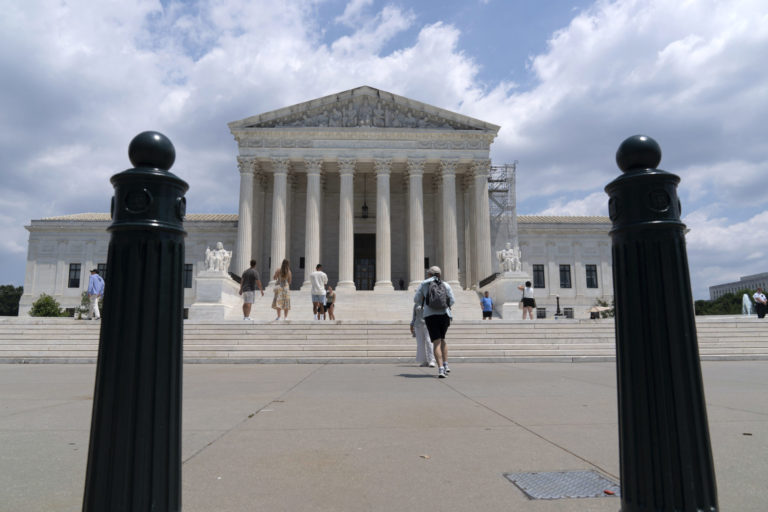
(Headline USA) A divided Supreme Court on Thursday came to the rescue of Texas Republicans, allowing next year’s elections to be held under the state’s congressional redistricting plan favorable to the GOP and pushed by President Donald Trump.
With conservative justices in the majority, the court acted on an emergency request from Texas for quick action because qualifying in the new districts already has begun, with primary elections in March.
The Supreme Court’s order puts the 2-1 ruling blocking the map on hold at least until after the high court issues a final decision in the case. Justice Samuel Alito had previously temporarily blocked the order while the full court considered the Texas appeal.
The justices cast doubt on the lower-court finding that race played a role in the new map, saying in an unsigned statement that Texas lawmakers had “avowedly partisan goals.”
In dissent, Justice Elena Kagan wrote for the three liberal justices that her colleagues should not have intervened at this point. Doing so, she wrote, “ensures that many Texas citizens, for no good reason, will be placed in electoral districts because of their race. And that result, as this Court has pronounced year in and year out, is a violation of the Constitution.”
The Texas congressional map enacted last summer was engineered to give Republicans five additional House seats.
The effort to preserve a slim Republican majority in the House in next year’s elections touched off a nationwide redistricting battle.
Texas was the first state to meet Trump’s demands in what has become an expanding national battle over redistricting. Republicans drew the state’s new map to give the GOP five additional seats, and Missouri and North Carolina followed with new maps adding an additional Republican seat each. To counter those moves, California voters approved a ballot initiative to give Democrats an additional five seats there.
The redrawn maps are facing court challenges in California and Missouri. A three-judge panel allowed the new North Carolina map to be used in the 2026 elections.
The justices are separately considering a case from Louisiana that could further limit race-based districts under Section 2 of the Voting Rights Act. It’s unclear how the current round of redistricting would be affected by the outcome in the Louisiana case.
Texas Attorney General Ken Paxton said the Supreme Court’s order “defended Texas’s fundamental right to draw a map that ensures we are represented by Republicans.” He called the redistricting law “the Big Beautiful Map.”
“Texas is paving the way as we take our country back, district by district, state by state,” Paxton said in a statement. “This map reflects the political climate of our state and is a massive win for Texas and every conservative who is tired of watching the left try to upend the political system with bogus lawsuits.”
Texas Gov. Greg Abbott issued a statement saying: “We won! Texas is officially — and legally — more red.”
U.S. Attorney General Pam Bondi hailed Thursday’s Supreme Court stay, posting on X, “Federal courts have no right to interfere with a State’s decision to redraw legislative maps for partisan reasons.”
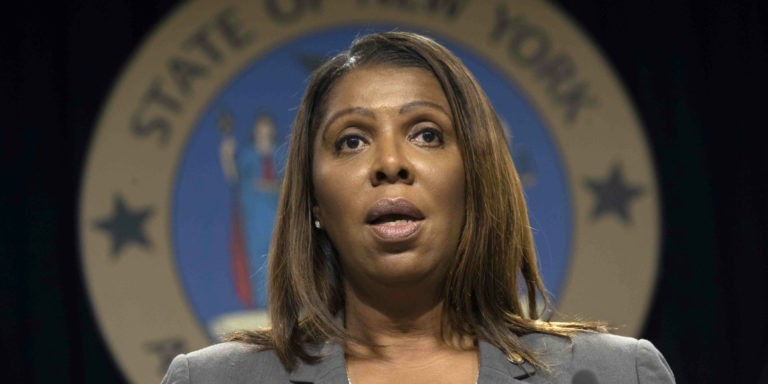
Prosecutors went back to a grand jury in Virginia after a judge’s ruling halting the prosecution of James and former FBI Director James Comey, on the grounds that the U.S. attorney who presented the cases was illegally appointed. But grand jurors rejected prosecutors’ request to bring charges.
Prosecutors are expected to try again for an indictment, according to one person familiar with the matter who spoke on the condition of anonymity because they were not authorized to publicly discuss the case.
James was initially charged with bank fraud and making false statements to a financial institution in connection with a home purchase in Norfolk, Virginia, in 2020. Lindsey Halligan, a former White House aide and lawyer for Donald Trump, personally presented the case to the grand jury in October after being installed as U.S. attorney for the Eastern District of Virginia amid pressure from Trump to charge Comey and James.
James has denied any wrongdoing and accused the administration of using the justice system to seek revenge against Trump’s political opponents. In a statement Thursday, James said: “It is time for this unchecked weaponization of our justice system to stop.”
“This should be the end of this case,” her attorney, Abbe Lowell, said in a statement. “If they continue, undeterred by a court ruling and a grand jury’s rejection of the charges, it will be a shocking assault on the rule of law and a devastating blow to the integrity of our justice system.”
The allegations related to James’ purchase of a house in Norfolk, where she has family. During the sale, she signed a standard document called a “second home rider” in which she agreed to keep the property primarily for her “personal use and enjoyment for at least one year,” unless the lender agreed otherwise.
Rather than using the home as a second residence, James rented it out to a family of three, allowing her to obtain favorable loan terms not available for investment properties, prosecutors alleged.
Even if the charges against James are resurrected, the Justice Department could face obstacles in securing a conviction against James.
(Dave DeCamp, Antiwar.com) Venezuelan President Nicolas Maduro has confirmed that he held a phone call with President Trump amid a major US military buildup in the Caribbean and the threats of an attack on his country.
Maduro said the call, which occurred last month, was “cordial” and that he decided to comment on the conversation because it was reported by US media.
“During my six years as foreign minister, I learned diplomatic prudence, and then, in these years as president, with the experience of being foreign minister and having been mentored by our Commander Chavez, I value prudence,” Maduro told Venezuelan TV on Wednesday, according to Al Jazeera.
“I don’t like diplomacy with microphones; when there are important matters, they must be handled quietly until they are resolved!” the Venezuelan leader added.
According to unconfirmed US media reports, Secretary of State Marco Rubio, who has been leading the push toward war with Venezuela, joined Trump and Maduro on the call, and Trump demanded that Maduro flee the country, but the Venezuelan leader rejected his terms.
Maduro declined to say what he discussed with Trump, but said he thought it could be a step toward “respectful dialogue” and that Venezuela seeks peace. “With the favor of God and our Commander of Commanders, Our Lord Jesus Christ, everything will go well for the peace, independence, dignity, and future of Venezuela,” Maduro said.
Amid the threats from the US, the Venezuelan government has continued to cooperate with the Trump administration on deportation flights bringing Venezuelan nationals from the US to Venezuela. Caracas agreed to allow the flights to resume after President Trump declared that Venezuela’s airspace was closed.
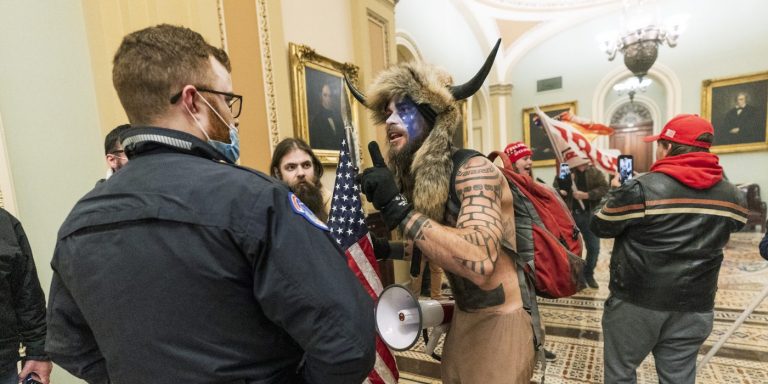
(Luis Cornelio, Headline USA) New details have emerged about Brian Cole Jr., the man accused by the DOJ and FBI of planting pipe bombs outside the Democratic and Republican National Committees on Jan. 5, 2021.
The now-detained suspect is a 30-year-old black man who lives in a $700,000 home in Woodridge, Va, about 20 to 25 miles from Washington, D.C., Headline USA can confirm.
According to neighbors and family, Cole is “autistic-like” and has an affinity for Chihuahuas and Crocs, as reported by the New York Post.
He reportedly mostly kept to himself and was regularly seen walking to and from a local 7-Eleven.
“He would wear shorts all winter long, no matter how cold it was, he would be outside in shorts, walking — and he would wear red Crocs,” a neighbor said. “We would always just comment, ‘Like, how is he in shorts? It’s 20 degrees out in his red Crocs, walking his dog all winter long?’”
The neighbor added that locals knew Cole as “the guy that walked the Chihuahua.”
Headline USA was able to identify the Instagram profile of Cole’s mother, Delicia, who on National Son Day, shared a smiling photo of Cole.
The photo shows him wearing sunglasses, a tie and a shirt.
Cole was arrested Thursday after a grand jury indicted him on bomb-related charges.
According to the DOJ, Cole was charged with transporting an explosive device in interstate commerce and attempted malicious destruction by means of an explosive.
Meanwhile, Cole’s grandmother, Loretta, dismissed the scathing accusations, telling the New York Post that Cole is “almost autistic-like,” without specifying what that meant.
“I don’t believe this at all. He’s not a terrorist,” she said. “He’s almost autistic-like because he doesn’t understand a lot of stuff.”
According to Loretta, Cole works as Brian Cole Bail Bonds, a family-run bail bons company based in Richmond, Va., about15 miles from Woodridge.
Delicia Cole is a real estate agent who works at Red Charm Properties in Lake Ridge, Virginia.
The family and neighbors paint a much rosier picture than the DOJ’s allegations of premeditation suggest.
Cole began purchasing bomb components as early as October 2019, according to an FBI affidavit released on X by journalist Catherine Herridge.
In November 2020, Cole accelerated the plot by buying equipment to construct the bombs he allegedly planned outside the DNC and RNC headquarters in January 2021.
His initial court appearance is set for Dec. 5, and he faces a combined maximum sentence of 30 years if convicted.
(Mike Maharrey, Money Metals News Service) A regulatory change in India could give silver another boost.
Beginning in April 2026, Indians will be able to use silver assets as collateral for loans from banks, non-banking financial companies, and household finance firms. Under the current law, only gold is allowable a collateral.
India consistently ranks among the top three silver markets in the world.
Silver jewelry and coins will be allowable as collateral. Bullion, including bars, and financial products such as ETPs and mutual funds will remain ineligible.
According to Metals Focus, the move could “help mobilize India’s vast household silver holdings, broaden access to formal credit, and formally recognize silver as a mainstream collateral asset.”
It could also further increase the appeal of silver in India, especially in light of record-high gold prices.
“While loans against silver have existed informally for decades, the RBI’s framework marks the first formal recognition of silver within the regulated collateral ecosystem. Metals Focus believes that rather than displacing gold loans or traditional credit channels, silver-backed lending is likely to emerge as a complementary product.”
Indians have traditionally used gold as collateral of last resort in times of crisis. For instance, many Indians leveraged gold during the pandemic when government lockdowns put people in a tight financial predicament.
Indian households hold an estimated 25,000 tonnes of gold. They often leverage their gold holding through both formal and informal lending channels. This is particularly true of poorer rural households.
However, Indians also hold a lot of silver.
According to Metals Focus, Indians have purchased an estimated 29,000 tonnes of silver jewelry and 4,000 tonnes of silver coins since 2010. Purchasers have primarily been from rural areas and among lower-income groups.
As Metals Focus points out, loans backed by gold (and now silver) are a lifeline for poor rural Indians who depend on agriculture to make a living.
“This widespread rural ownership of gold and silver underscores the importance of understanding the socioeconomic realities facing these communities. Around 63 percent of India’s population still live in rural areas, where over half of households depend on agriculture, despite the sector contributing just 16–18 percent of national output. The latest survey by the National Bank for Agriculture and Rural Development shows rising expenses leave rural households with a monthly surplus of only Rs.1,500–Rs.2,000 ($16–$22) for savings and debt servicing. At the same time, the proportion of indebted households has climbed from 47 percent to 52 percent, increasing leverage on already thin cash flows.”
Metals Focus estimates that the formal gold loan market in India stands at around 700 tonnes, with the informal segment roughly 1,000–1,500 tonnes.
The new lending framework for silver will establish clearly defined loan-to-value (LTV) ratios and eligibility thresholds.
Metals Focus anticipates the new regulations will “significantly broaden access to formal finance,” especially for first-time borrowers and those seeking small loans.
The ability to leverage silver as an emergency fund could also boost the demand for silver even higher, especially as the price of gold climbs and prices many poor people out of the market.
Using silver as loan collateral is not a new concept, though. Since 2019, Money Metals has been lending against all precious metals held as collateral for borrowers at Money Metals Depository. For more information about accessing the liquidity of your precious metals without selling them, visit this page.
Mike Maharrey is a journalist and market analyst for Money Metals with over a decade of experience in precious metals. He holds a BS in accounting from the University of Kentucky and a BA in journalism from the University of South Florida.
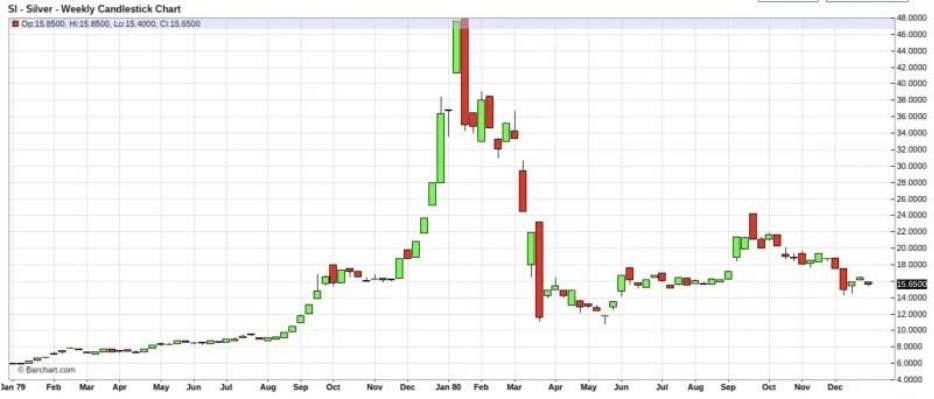
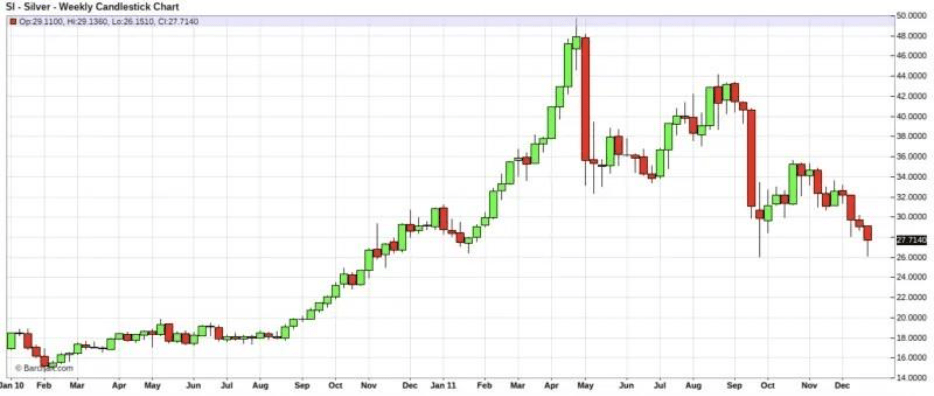
(Mike Maharrey, Money Metals News Service) Silver has taken us on a wild ride, nearly doubling in price this year. However, some analysts worry that silver is taking us down a path of disappointment. They base their bearish sentiment on history. After all, silver teased us with twin records in 1980 and 2011 before quickly selling off both times.
As such, there is a lot of jitteriness out there, reflected in silver’s current price volatility. Some traders are concerned that we will see a rapid selloff of silver as we did after the metal broke $48 an ounce in 1980 and 2011.
Will history repeat?
Sprott Money analyst Craig Hemke doesn’t think so. He says this time is different.
“The situation economically, monetarily, and physically is entirely different from 1980 and 2011.”
Hemke doesn’t expect silver to follow Grandfather’s path in the 80s or Pappa’s path in 2011. He thinks the setup looks more like Uncle Gold’s trajectory over the last couple of years.
A Silver History Lesson
So, what happened in 1980 and 2011?
In both cases, silver soared quickly over $48 and then fell back to earth even faster.
In 1980, the silver price moved from $10 an ounce to $48 in just four months. Two months later, it was back at $10.
Starting in late 2010, silver rallied again, hitting $48 in eight months. But again, it quickly gave up those gains, falling to $26 in just a few months.
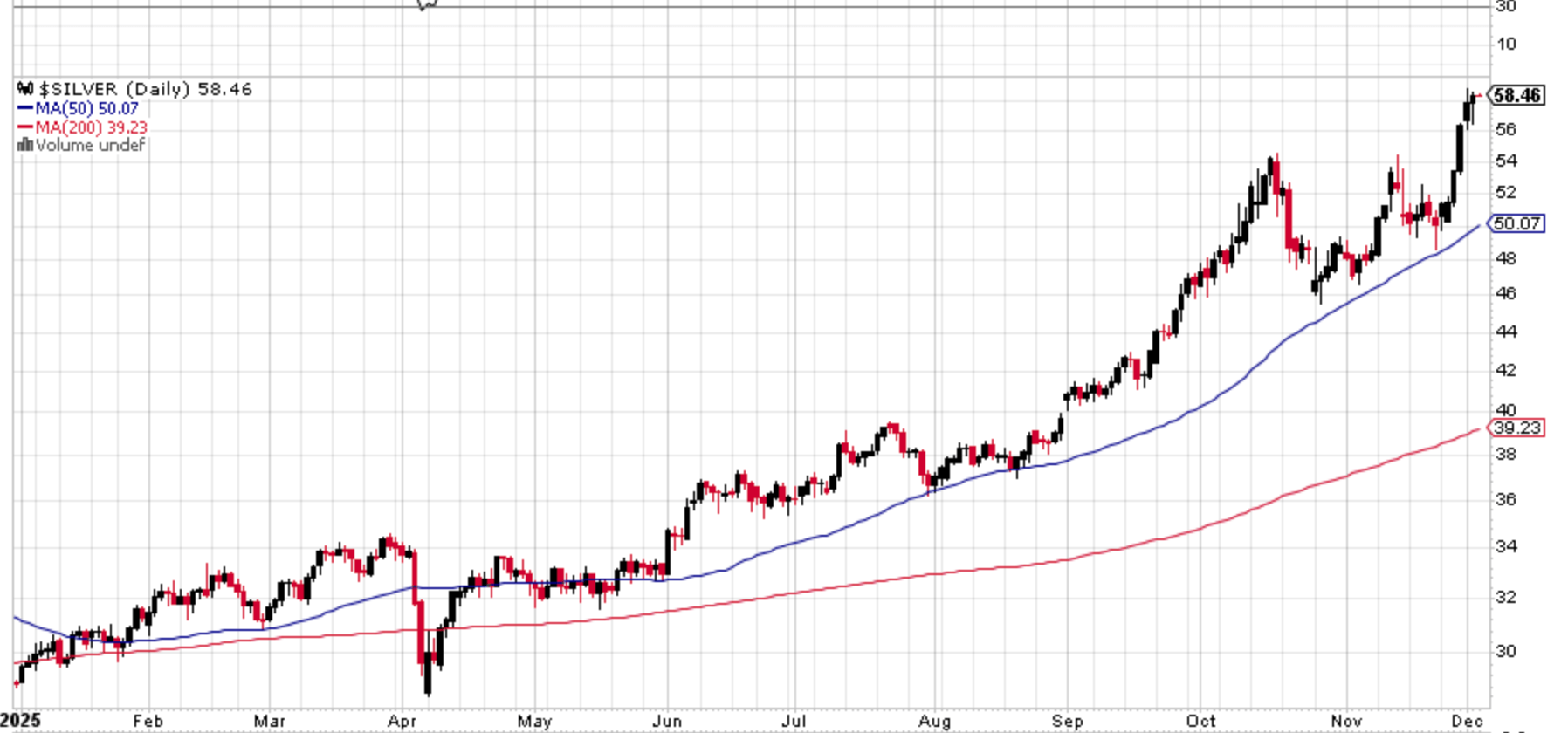
This time does look different. Silver hit $48 on October 3 and closed above $50 for the first time the following week. It consolidated briefly around $48, testing the level several times before taking off again in recent weeks.
The fact that silver has held $48 this long differentiates this rally from those in 1980 and 2011.
Some have declared that silver has charted a double top this year, a bearish indicator. But Hemke points out that to confirm a double top, silver would need to fall through $46.
“Until then, two peaks at the same level denote a trading range and consolidation—nothing more.”
Look at Gold
Hemke believes the price pattern playing out is similar to gold’s breakout in 2023 and 2024 than the silver bull markets in 1980 and 2011.
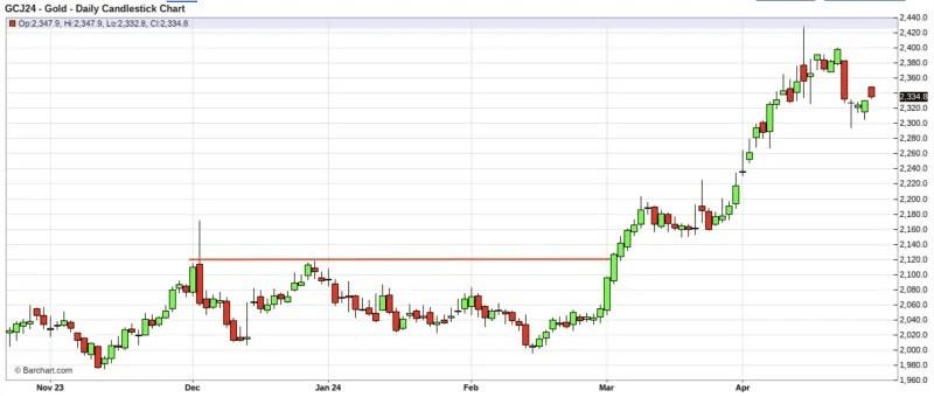
As you might recall, gold finally cracked strong resistance at $2,000 an ounce in December 2023 and surged to $2,100. Then we saw a sharp reversal. Just 17 days later, gold eclipsed $2,100 again before once again selling off. Over the next several months, gold was rangebound in the $2,000 an ounce range before breaking out and surging higher again in March 2024.
When gold bounced off $2,100 twice in a matter of weeks, a lot of experts declared it a double top and false breakout. As Hemke pointed out, these experts were proven wrong. It was merely a period of consolidation and range-bound trading.
“The gold price had not topped and, instead, was simply basing in a consolidation range. The true breakout came 90 days later in early March of 2024.”
Hemke believes there is a similar technical setup for silver. He wrote this in late September.
“I expect the price action in silver over the next few weeks to somewhat mirror the gold price action seen in late December 2023 into early 2024. A rally to the $48-50 all-time highs, a sharp reversal, and a few more failed attempts at a breakout before the final and official breakout occurs. Let’s refer to that gold chart from late 2023 as our silver analog.”
Looking ahead, we may well see further consolidation and a period of sideways trading. But Hemke believes the true breakout for silver remains in the future.
“t is not 1980 and it’s not 2011 either. The silver price is not about to collapse, and it did not just paint a double top. Instead, just like gold two years ago, the silver price is consolidating and basing near and just above its old all-time highs with the true breakout pending for early 2026.”
Hemke says a breakout next year will likely push silver to new all-time highs.
“The gold price has doubled since it broke out in March of 2024, and a similar move in silver will take price to $100/ounce by mid-late 2027.”
Not Enough Silver!
The fundamentals support Hemke’s technical analysis. Supply and demand dynamics remain extremely bullish for silver.
Many analysts claim the movement of silver from London to New York last spring, due to tariff worries, set the stage for the record run by silver in October. As demand picked up, particularly in India, traders scrambled to find available metal. A rapid shift of silver from New York to London eased the squeeze, but it didn’t solve the underlying problem.
This isn’t a problem that can be solved by moving metal from one warehouse to another. The issue is that demand has outstripped supply for several years.
According to Metals Focus, silver is on track for its fifth straight structural market deficit.
Metals Focus projects demand will outstrip supply by 95 million ounces this year. That would bring the cumulative 5-year market deficit to 820 million ounces, an entire year of average mine output.
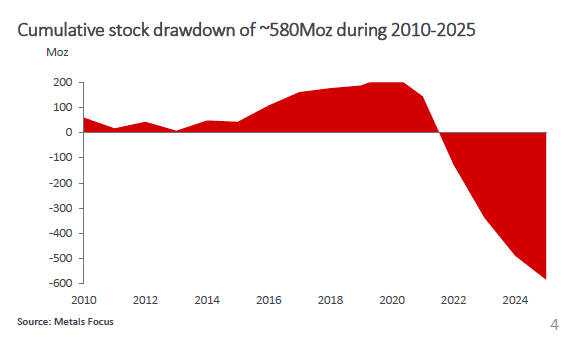
Since 2010, the silver market has accumulated a supply deficit of over 580 million ounces.
To make up the supply deficit, silver users will have to draw from existing above-ground stocks. That will likely require higher prices.
The Federal Reserve’s pivot to easy money and lower interest rates will also likely support silver in the year ahead.
When you put the technicals and fundamentals together, there is no reason to turn bearish on silver, 1980 and 2011 notwithstanding.
Mike Maharrey is a journalist and market analyst for Money Metals with over a decade of experience in precious metals. He holds a BS in accounting from the University of Kentucky and a BA in journalism from the University of South Florida.