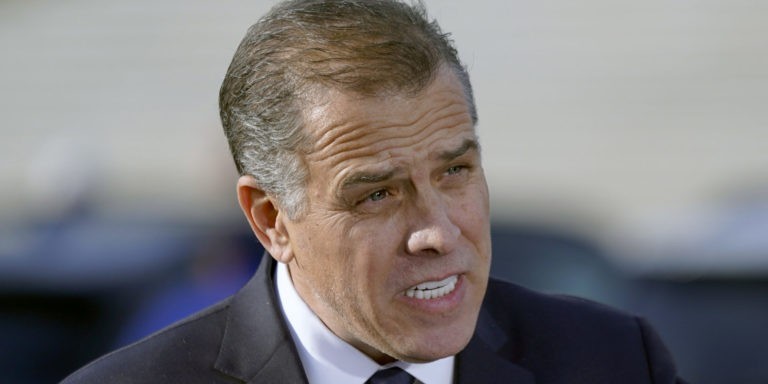
(Luis Cornelio, Headline USA) A Connecticut judge disbarred Hunter Biden on Monday, citing the disgraced former first son’s violations of state rules of professional conduct.
The disbarment order, signed by Judge Patrick Carroll III, followed a complaint filed in September by the Office of Chief Disciplinary Counsel and came nearly five years after Hunter’s tax affairs came under federal scrutiny.
In 2023, then-President Joe Biden’s own DOJ secured a grand jury indictment charging Hunter with tax violations and lying on a federal gun purchase form.
Prosecutors alleged that Hunter failed to pay millions in taxes and falsely checked “no” on the gun purchase form when asked whether he used or was addicted to illegal drugs.
Hunter was ultimately convicted on the gun-related charge and later pleaded guilty to the tax offenses. He faced up to 17 years in federal prison before being pardoned by his father.
According to state records reviewed by Headline USA, Hunter was admitted to the Connecticut bar on April 25, 1997, one year after graduating from Yale Law School.
His law license was previously suspended over the years for administrative failures, including unpaid fees.
Politico reported that Biden and his attorney, Ross Garber, agreed to the suspension while admitting no wrongdoing.
It also follows similar action by the Washington, D.C., bar, which previously suspended Biden’s law license over the same conduct for which Hunter was convicted.
(Luis Cornelio, Headline USA) President Donald Trump refused to walk back his contentious reaction to the fatal stabbing of Rob Reiner, the leftist Hollywood actor who had previously called him “evil” and likened him to Hitler.
Reiner and his wife, Michele Singer Reiner, were reportedly found dead inside their California mansion on Sunday. Their 32-year-old son, Nick Reiner, was “booked” on suspicion of murder, police claimed.
In response, Trump wrote Monday on Truth Social that Reiner’s death was “reportedly due to the anger he caused others through his massive, unyielding, and incurable affliction with a mind crippling disease known as TRUMP DERANGEMENT SYNDROME.”
Trump’s post drew mixed reactions from both critics and supporters, who called the comments unfortunate and cruel.
A reporter asked Trump later on Monday whether he stood by his post despite the condemnation. To this, Trump replied that he “wasn’t a fan of” Reiner.
“He was a deranged person as far as Trump is concerned,” the president added, pointing to Reiner’s public attacks against him.
Trump noted the Hollywood director had accused him of being a “friend of Russia, controlled by Russia.”
Reiner “was one of the people behind” the Russian hoax, Trump said, referring to the conspiracy theory that he colluded with Russia to win the 2016 presidential election.
“He became like a deranged person. Trump derangement syndrome. So, I was not a fan of Rob Reiner at all in any way, shape, or form. I thought he was very bad for our country,” Trump added.
Before his death, Reiner was viewed as a polarizing figure in politics, repeatedly appearing on cable news to smear Trump as racist, authoritarian or fascist.
Trump has long argued that this type of rhetoric led to two assassination attempts during the 2024 presidential election.
(Dave DeCamp, Antiwar.com) A US War Department official said on Monday that the Pentagon has no planned “force posture changes” regarding the US military presence in Syria following a deadly attack in the country over the weekend that killed three Americans, including two members of the Iowa National Guard and a civilian interpreter.
“Currently, we have no force posture changes to announce,” a War Department official told Antiwar.com when asked if the Trump administration was planning to withdraw from Syria.
The US withdrew a few hundred soldiers from Syria earlier this year, but the comment signals a full withdrawal isn’t on the table. There are currently around 1,000 US troops in the country, a Pentagon official told The New York Times.
Also on Monday, the US Army identified the two members of the Iowa National Guard who were killed: Sgt. Edgar Brian Torres-Tovar, 25, of Des Moines, Iowa, and Sgt. William Nathaniel Howard, 29, of Marshalltown, Iowa.
The attack on Saturday was carried out by a member of the Syrian government’s own security forces, something that’s been confirmed by the Interior Ministry, but President Trump has blamed the incident on ISIS.
“We had three great patriots terminated by bad people. It was not the Syrian government, it was ISIS. The Syrian government fought by our side,” President Trump said on Sunday.
Trump has embraced the new Syrian president, Ahmed al-Sharaa, despite his al-Qaeda past, and recently hosted him in the Oval Office. Sharaa’s government has officially joined the US-led anti-ISIS coalition even though Sharaa himself was once an ally of Abu Bakr al-Baghdadi, the founder of ISIS.
According to reports from Syria, the attacker who killed three Americans has been identified as Tariq Satouf al-Hamd, who was previously a member of ISIS but joined the government’s security forces after the fall of former President Bashar al-Assad. Wael Essam, a Palestinian journalist who covers the conflict in Syria, said there are likely “hundreds like him” within Syria’s security forces.
The Syrian government is led by Hayat Tahrir al-Sham (HTS), an al-Qaeda offshoot with an ideology similar to ISIS, meaning there is fluidity between members of the two groups. Sharaa could face a rebellion from the more ideological members of his security forces, who are unhappy with his ties with the US and deference toward Israel, and US troops operating alongside Syrian forces could face more insider attacks.
After the attack on Saturday, the Syrian government announced that it would step up its operations against ISIS. On Sunday evening, ISIS launched an attack on Syrian forces in the northwestern Idlib province, killing four.
“The soldiers of the caliphate attacked a patrol of the apostate Syrian government on the Maarat al-Naaman road yesterday with machine gun weapons, which led to the killing of four and the wounding of one and the destruction of their vehicle,” ISIS said in a statement, according to The Cradle.
(Dave DeCamp, Antiwar.com) The House is expected to vote on Thursday on a bipartisan War Powers Resolution aimed at blocking President Donald Trump from launching an attack on Venezuela amid a major US military buildup in the Caribbean and threats of a regime change war to oust Venezuelan President Nicolas Maduro.
Contact your House Representative and tell them to support H.Con.Res.64, which directs the president to remove “United States Armed Forces from hostilities within or against Venezuela that have not been authorized by Congress.”
The bill was introduced by Rep. Jim McGovern (D-MA) and has received 31 co-sponsors, including three Republicans: Reps. Thomas Massie (KY), Marjorie Taylor Greene (GA), and Don Bacon (NE).
“The Constitution does not permit the executive branch to unilaterally commit an act of war against a sovereign nation that hasn’t attacked the United States,” Massie said in a statement when the bill was introduced. “Congress has the sole power to declare war against Venezuela. Congress must decide such matters according to our Constitution.”
Another War Powers Resolution that was introduced in the House by Rep. Gregory Meeks (D-NY) aims to stop President Trump’s bombing campaign against alleged drug boats in Latin America and is expected to be brought to the floor for a vote on Wednesday.
Meeks’s bill, H.Con.Res.61, also has 31 cosponsors, but no Republicans have signed on despite the growing criticism over the September 2 attack on a boat that involved multiple strikes to kill survivors.
“The Trump Administration has not provided a credible rationale for its 21 unauthorized military strikes on vessels in the Western Hemisphere, which have resulted in the extrajudicial killings of dozens of individuals,” Meeks and other high-ranking Democrats in the House said in a statement when the legislation was introduced on November 18.
(Johnny Edwards, The Center Square) The governors of Texas and Florida have declared the nation’s largest Muslim advocacy group a foreign terrorist organization, but they may stand alone. None of their Republican counterparts in other states seem ready to follow suit.
The Center Square reached out to every other Republican governor whose state has offices of the nonprofit Council on American-Islamic Relations. Not one – from Alabama, Georgia, Missouri, Ohio, Oklahoma or Virginia – responded to inquiries about whether they plan to slap a terror label on the group, too.
“I don’t know why anyone wouldn’t want to designate CAIR a foreign terror organization,” Florida Republican Congressman Randy Fine, a fierce critic of the group, told The Center Square.
The 31-year-old, Washington-based civil rights organization strongly denies supporting terrorism, saying on its website it has “specifically opposed unjust violence perpetrated in the name of Islam.”
The U.S. State Department does not consider CAIR a foreign terrorist organization, though U.S. Rep. Fine introduced a bill this year that would direct Secretary of State Marco Rubio to review if it meets the criteria.
“Maybe other states are waiting to see how it goes,” Fine said of the governors’ non-responses. “CAIR is threatening litigation, which I think we all hope happens because that will require them to disclose the dark web of relationships that they have.”
Last month, Texas Gov. Greg Abbott issued a proclamation accusing the group of ties to Hamas and the Muslim Brotherhood, an international organization bent on establishing Islam’s “mastership of the world.” The designation prohibits CAIR from buying or acquiring land in Texas.
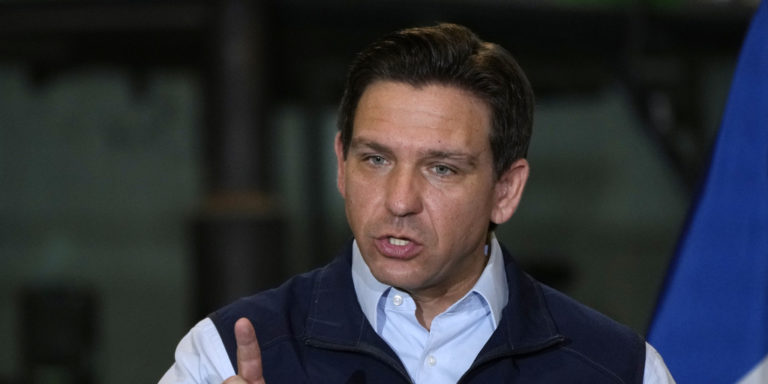
Florida Gov. Ron DeSantis issued his own executive order last week, also designating both CAIR and the Muslim Brotherhood terrorist groups. He called on state agencies to deny resources to them and directed the Florida Department of Law Enforcement and Florida Highway Patrol to keep tabs.
“CAIR was founded by persons connected to the Muslim Brotherhood,” DeSantis’ order says, “and was created, in the words of persons affiliated with CAIR, as ‘an official U.S. cover representing the Islamic community’ to conceal ties to Islamic extremist groups.”
CAIR and the Muslim Legal Fund of America have already sued in Texas, asking a federal judge to strike down Abbott’s order. CAIR has threatened to sue DeSantis, as well. The group says its pro-Palestinian stance has attracted the ire of “Israel-first” politicians.
“It seems to be a coordinated campaign to push back against anyone who spoke out against the genocide effectively,” CAIR spokesman Ibrahim Hooper told The Center Square.
In a letter to DeSantis last week, CAIR National Deputy Director Edward Ahmed Mitchell called the executive order “defamatory” with “no basis in law or fact.” The organization has never been an affiliate, offshoot, or subsidiary of any foreign group, he said.
“You do not have the constitutional authority to unilaterally declare any Americans or American institutions foreign terrorist groups, nor is there any basis to level this smear against our organization.” Mitchell told the governor. “We look forward to seeing you in a court of law, where facts and the law still matter.”
DeSantis said in an X post last week, “I look forward to discovery – especially the CAIR finances. Should be illuminating!”
According to its website, CAIR has chapters in Austin, Dallas and Houston. In Florida, it has a Tampa chapter.
At least 21 other states have chapters and satellite offices, six of which have Republican governors. There are branches in Birmingham, Ala.; Duluth, Ga.; St. Louis; Cincinnati, Cleveland and Columbus, Ohio; Oklahoma City; and Herndon, Va., the website says.
The Center Square contacted the offices of Alabama Gov. Kay Ivey, Georgia Gov. Brian Kemp, Missouri Gov. Mike Kehoe, Ohio Gov. Mike DeWine, Oklahoma Gov. Kevin Stitt, and outgoing Virginia Gov. Glenn Youngkin – asking if they’re planning to do anything similar to Texas or Florida or to comment on what Abbott and DeSantis did.
None answered.
“Most Americans recognize that Ron DeSantis is a failed politician,” Mitchell, of CAIR, told The Center Square, “who prioritizes the Israeli government over the people of Florida and is always looking for publicity stunts to stay relevant. I would not be surprised if other governors do not decide to take the leap with him and Governor Abbott, given they don’t want to end up in court and embarrassed.”
The Texas proclamation and the Florida order delve deep into the organization’s history to accuse it of ties to Hamas and the Muslim Brotherhood, a transnational Sunni Islamist network with no centralized leader that pushes for Sharia law in all aspects of life. The Muslim Brotherhood also has not been designated a foreign terrorist organization by the State Department, though President Trump issued an executive order last month launching a formal process that could see some of its chapters labeled as such.
The Texas and Florida actions both cited CAIR’s role as an unindicted co-conspirator in the 2007-2008 federal trial of the Holy Land Foundation, Its leaders were found guilty of funneling funds to Hamas.
“Internal documents plainly identified CAIR as a subsidiary of the Muslim Brotherhood and a federal court eventually found ‘ample evidence to establish’ that CAIR was associated ‘with Hamas,'” Abbott’s proclamation says.
The Texas document also lists a half dozen staffers and associates as being criminally convicted or deported for financing or supporting terrorist causes, including Al Qaeda, the Taliban and Saddam Hussein’s government.
Anti-Muslim activist Amy Mekelburg, founder of RAIR (Rise Align Ignite Reclaim) Foundation USA, has been urging other states to join Texas and Florida with designations of their own.
“ALL Red states with CAIR offices must act NOW – before CAIR’s influence becomes irreversible,” Mekelburg said in an X post last week. “Every red governor. Every red AG. Every red legislature.” She did not respond to The Center Square’s attempts to reach her, and CAIR has labeled RAIR a“hate group.”
While no governors have gone as far as Abbott and DeSantis, other state legislatures passed non-binding resolutions introduced over the past decade telling law enforcement and other state agencies to stop cooperating with CAIR.
When he was still a state representative last year, Fine introduced a resolution passed in the Florida House encouraging state and local governments to cut off contacts with the group, just as the FBI did more than a decade ago citing alleged ties to Hamas.
“They’ve made themselves out to be the NAACP for Muslims,” Fine said. “And I think it’s a very interesting thing, because if they’re the NAACP for Muslims, what does that say about Muslims?”
Last week CAIR called for Fine’s resignation over an X post where he said of mainstream Muslims, “I don’t know how you make peace with those who seek your destruction, I think you destroy them first.”
And Mitchell said the tactics being used against CAIR do hearken back to the NAACP, when southern states tried to shut it down in the 1960s by accusing its members of plotting with communists and seeking access to finance records and membership lists. He called the allegations in the Texas and Florida orders either factually inaccurate, or “a true fact that has been manipulated to sound nefarious and much worse than it is.”
The Holy Land Foundation trial was “one of the most notoriously-flawed and widely-criticized excesses of the post-9/11, War on Terror, Bush era,” he said. And of Abbott’s list of criminal convicts, “Some of those people did not work for CAIR at all whatsoever. None of them did anything criminal in relation to CAIR at all. And some of them were wrongly convicted of things they did not do.”
“CAIR is probably target number one for anti-Muslim bigots. They absolutely hate us because we defend the Muslim community, and we’re very, very good at it,” Mitchell said. “The NAACP was not a communist agent. We do not have any connection with any foreign entity. We’re an independent American organization, and Ron DeSantis is going to find that out.
(Brett Rowland, The Center Square) President Donald Trump’s tariffs are expected to cost U.S. consumers an extra $1,400 in 2026, according to an analysis from the Tax Foundation.
Trump made tariffs the centerpiece of his domestic and foreign agenda at the start of his second term in the White House. The U.S. president hit all foreign nations with import taxes above 10%, with some country-specific above 40%.
Americans have paid at least part of the price this year. Those tariffs amounted to an average tax increase per U.S. household of $1,100 in 2025. Next year could be even more expensive, with the Tax Foundation estimating the same tariffs will cost about $1,400 in 2026.
Last month, the U.S. Supreme Court heard oral arguments in a case challenging Trump’s authority to implement tariffs without Congressional approval under the International Emergency Economic Powers Act. That law, from 1977, doesn’t mention the word “tariff” and has never been used to impose tariffs.
If the high court tosses Trump’s tariffs, Americans would still pay more, in part because Trump has used multiple laws to implement tariffs, not all of which fall under the challenged 1977 law.
“If the IEEPA tariffs are permanently enjoined, the tax increases will be smaller at $300 in 2025 and $400 in 2026,” according to the nonprofit’s analysis. “Notably, these averages do not capture additional costs to U.S. households stemming from higher-priced alternative goods and loss of consumer choice.”
When the Supreme Court heard oral arguments in the tariff challenge in November, even conservative justices seemed skeptical. Chief Justice John Roberts called the tariffs “taxes on Americans,” which he said had long been a “core power of Congress,” not the president.
Two lower courts had rejected Trump’s tariffs before the Supreme Court took up the case.
In August, the U.S. Court of Appeals for the Federal Circuit affirmed a previous lower court ruling saying Trump did not have the authority. In the 7-4 decision, the majority of the Federal Circuit said that tariff authority rests with Congress.
In November, the Congressional Budget Office slashed its tariff revenue forecast to reflect new data on the highest import duties the U.S. has seen in nearly a century.
The CBO said the new projections show tariff changes will reduce deficits by $3 trillion over the next decade. That’s down from the CBO’s earlier estimate of $4 trillion in August.
The new projections assume that foreign businesses will bear a greater share of the costs than initially expected.
“We had previously projected that foreign exporters would not reduce their prices to offset increased tariff rates. We now project that foreign exporters will reduce their prices by an amount equivalent to 5% of the increase in tariff rate,” according to the CBO report.
That 5% assumption is “consistent with evidence from increases in tariff rates on China that were implemented in 2018 and 2019.”
A recent Goldman Sachs report found that U.S. consumers will pay 55% of the costs resulting from Trump’s tariffs, U.S. businesses will pay 22%, and foreign exporters will pay 18%. That report said that most tariffs will be passed on to American consumers as businesses adjust prices in the coming months.
Trump has said he wants to use tariffs to restore manufacturing jobs lost to lower-wage countries in decades past, shift the tax burden away from U.S. families and pay down the national debt.
Economists, businesses and some public companies have warned that tariffs will raise prices on a wide range of consumer products.
(Dave Mason, The Center Square) Four alleged members of a pro-Palestine terror group were arrested in connection with alleged plans for New Year’s Eve bombings across Southern California.
Authorities announced the arrests during a news conference Monday with First Assistant U.S. Attorney Bill Essayli, FBI Assistant Director in Charge Akil Davis and Los Angeles County Sheriff Robert Luna.
Essayli said all four suspects are from the Los Angeles area. He said one suspect created a plan to bomb five or more locations across Los Angeles and Orange County, with step-by-step instructions on building improvised explosive devices.
The arrests were made last week in Lucerne Valley, which is east of Los Angeles.
U.S. Attorney General Pam Bondi said the U.S. Department of Justice and the FBI prevented the bombings.
“The Turtle Island Liberation Front — a far-left, pro-Palestine, anti-government, and anti-capitalist group — was preparing to conduct a series of bombings against multiple targets in California beginning on New Year’s Eve,” Bondi posted on X. “The group also planned to target ICE agents and vehicles.”
Bondi credited “an incredible effort” and “intense investigation” by the FBI and the U.S, Attorney’s Offices for foiling the plot.
“We will continue to pursue these terror groups and bring them to justice,” Bondi said.
(Mike Maharrey, Money Metals News Service) Regulators in India have revised rules to allow pension funds to invest in gold and silver ETFs. This could further boost already booming investment demand in India.
India ranks as the world’s second-largest gold market and consistently falls in the top four silver-consuming nations.
For the government sector, the Pension Fund Regulatory and Development Authority (PFRDA) created a new investment subcategory called ‘Asset Backed, Trust Structured and Miscellaneous Investments’ that opens the door to gold and silver ETF investments. Aggregate investment in gold and silver in public pension funds is limited to 1 percent of total assets under management (AUM).
For private sector pension programs, pension fund managers will be able to include gold and silver ETFs totaling up to 5 percent of the fund’s AUM.
According to Bloomberg, the new rules could unlock up to $1.7 billion in precious metals demand.
World Gold Council India research head Kavita Chacko said the move “reinforces gold’s fundamental qualities as an effective portfolio diversifier.”
The Bloomberg report proclaimed, “The move by the Indian watchdog is an indication of the growing acceptance of the precious metals as a mainstream investment asset.”
Gold and silver investment is already booming in India.
In Q3, physical gold investment rose by 20 percent year-on-year, topping 91 tonnes, according to World Gold Council data. In value terms, gold bar and coin demand increased by 67 percent to $10.2 billion.
Historically, Indians have preferred physical gold and silver, but ETFs have grown in popularity since they were first introduced in the country in 2007.
A gold ETF is backed by a trust company that holds metal owned and stored by the trust. In most cases, investing in an ETF does not entitle you to any amount of physical gold. You own a share of the ETF, not gold itself. ETFs are a convenient way for investors to play the gold market, but owning ETF shares is not the same as holding physical gold.
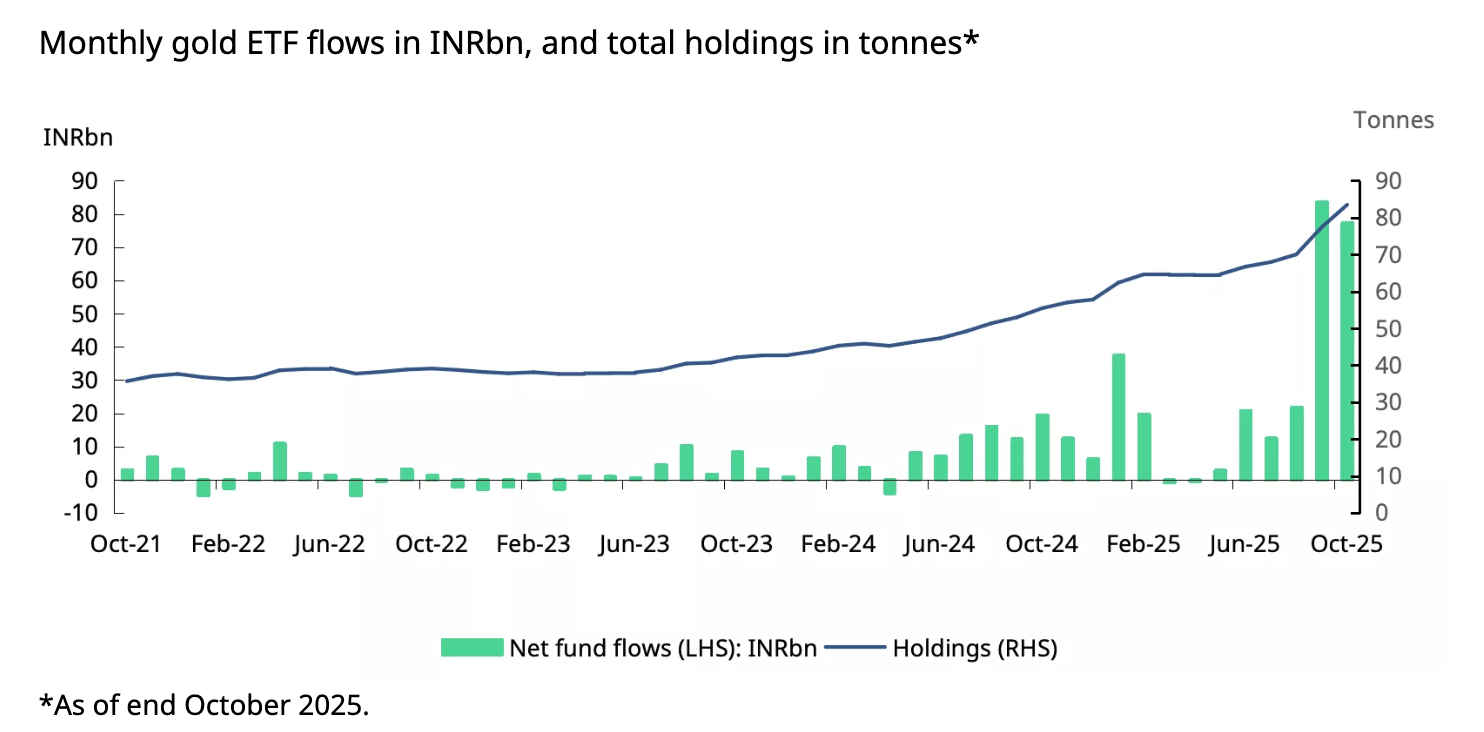
So far in 2025, cumulative inflows of gold into ETFs total ₹276 billion ($3.1 billion), the highest annual inflows on record.
According to World Gold Council data, there are currently 9.57 million gold ETF accounts in India.
Allowing pensions to invest in gold and silver could further boost demand.
Indians have a longstanding love affair with gold.
The yellow metal is deeply interwoven into the country’s marriage ceremonies, along with its religious and cultural rituals. Festival seasons typically boost gold demand.
Indians have long valued the yellow metal as a store of wealth, especially in poorer rural regions. Around two-thirds of India’s gold demand comes from beyond the urban centers, where large numbers of people operate outside the tax system. Many Indians use gold jewelry not only as an adornment but as a way to preserve wealth.
In the West, gold is generally viewed as a luxury item.
Not in India. Even poor Indians buy gold.
According to a 2018 ICE360 survey, one in every two households in India had purchased gold within the last five years. Overall, 87 percent of Indian households own some gold. Even households at the lowest income levels in India hold some of the yellow metal. According to the survey, more than 75 percent of families in the bottom 10 percent of income managed to buy some gold.
The yellow metal was a lifeline for Indians buffeted by the economic storm caused by the government’s response to COVID-19. After the Indian government locked down the country, banks tightened credit to mitigate the default risk. Unable to secure traditional loans, Indians used gold to secure financing. As Indians endured a second wave of lockdowns, many Indians resorted to selling gold outright to make ends meet.
Mike Maharrey is a journalist and market analyst for Money Metals with over a decade of experience in precious metals. He holds a BS in accounting from the University of Kentucky and a BA in journalism from the University of South Florida.
(Mike Maharrey, Money Metals News Service) Gold and silver have hogged the spotlight; however, the platinum group metals (PGMs) have had a breakout year as well.
Platinum has surged by 92 percent in 2025, and palladium has gained 65 percent. Meanwhile, the price of rhodium (A rarer PGM used in catalytic converters and in anticorrosion applications) surged by 79 percent.
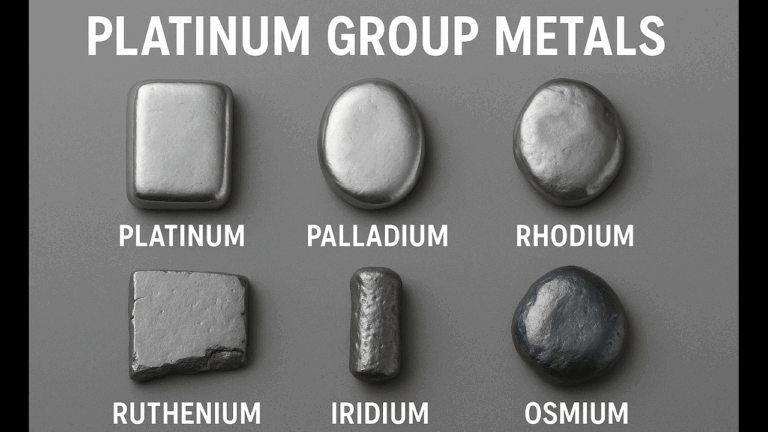
Six rare metals make up the platinum group:platinum, palladium, rhodium, ruthenium, iridium, and osmium. The metals share similar chemical properties, including high melting points, strong corrosion resistance, and catalytic power.
PGM demand primarily flows from industrial applications. Platinum and palladium are integral inputs in the production of catalytic converters for both gasoline and diesel-powered engines. They are also used in chemical and petroleum processing, electronics, and specialized medical and industrial equipment. Platinum is popular in jewelry, and both platinum and palladium garner physical investment demand.
What is behind the meteoric rise in the price of PGMs in 2025?
Many of the supply and demand dynamics that have driven silver higher are also at play in the PGM markets. They are in structural deficits with very tight supplies.
For instance, the global platinum market charted its third straight significant structural deficit last year, and we should expect these supply shortfalls to continue into the foreseeable future, according to the World Platinum Investment Council (WPIC).
Platinum demand outpaced supply by 995,000 ounces last year. That was 46 percent higher than forecast.
The WPIC expects a market deficit of around 848,000 ounces in 2025.
Like silver and gold, the PGM markets also experienced a displacement of metal due to tariff worries. They are also getting a boost from looser monetary policy and dollar devaluation.
The 2025 PGM market played out in two distinct phases.
PGMs began the year with range-bound trading, continuing a multi-year trend. As Metals Focus described it, platinum, palladium, and their cousins traded in “narrow, orderly ranges.”
“Persistent deficits, thinning liquidity and muted secondary supply shaped conditions.”
During the first quarter, platinum’s 30-day annualized volatility hit the lowest level since 2018, reflecting the sense of stability in the PGM market.
However, underlying market tightness already existed, and pressure was building.
Flooding in South Africa disrupted mining operations and added to the supply pressure. The country supplies more than 70 percent of global primary platinum and over 80 percent of rhodium, ruthenium, and iridium.
Russia is another significant supplier of PGMs. Its economy has been crippled by sanctions.
Supply disruptions were combined with persistent weakness in secondary supply, driven by subdued recycling activity.
This supply pressure began to manifest first in rising prices for two PGMs. Rhodium rose by 25 percent through Q1.25 to $5,700. Ruthenium gained roughly 35 percent to $630, aided by improving chemical and electronics demand and strong speculative interest in China.
However, despite tightening fundamentals, the platinum and palladium markets remained relatively subdued, with both gaining about 8 percent by the end of March.
Tariff worries set off the breakout for the other PGMs.
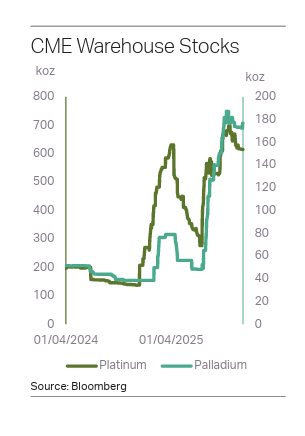
As was the case with silver, large amounts of metal moved from overseas into CME vaults in New York in an effort to get ahead of potential tariffs. Both platinum and palladium stocks in CME warehouses surged.
As Metals Focus explained, “Once it became clear that the tariffs would not apply to platinum and palladium, and as the outlook for the auto sector weakened, metal began to leave CME warehouses and inventories declined through April and May. While these shifts did not initially drive price action, they framed the volatility that followed.”
Gold’s spring rally created further tailwinds for the PGMs. A series of all-time highs incentivized some investment rotation into platinum and palladium, particularly in China. Rising gold jewelry prices also sparked renewed interest in platinum jewelry.
PGM imports into China and Hong Kong rose sharply, and prices responded accordingly. Platinum surged by 47 percent to around $1,335. Palladium approached $1,100, a 20 percent gain, and ruthenium climbed by close to 50 percent.
Prices got another boost in July when tariffs levied on copper reignited worries that the PGMs would also fall under the tariff axe. This restarted the movement of metal to the U.S.
Regime uncertainty created by unpredictable tariff policy was exacerbated by a Section 232 investigation involving PGMs. The U.S. Department of Commerce runs these investigations to determine whether imports of a specific product are entering the U.S. “in such quantities or under such circumstances” that they threaten national security.
Metals Focus explained the implications.
“As the inquiry includes PGMs under the U.S. Geological Survey (USGS) critical-minerals framework, it introduced a durable uncertainty premium. Aside from COVID, PGM flows have never redirected so sharply, and this shift stemmed from policy rather than fundamentals.”
While gold was hogging the headlines, platinum ended H1 as the best-performing commodity, rising by almost 50 percent through the first six months of 2025.
The metals got another boost early in the third quarter when petitions were filed against Russian palladium imports into the U.S. The U.S. International Trade Commission (USITC) issued a preliminary injury finding in late August, and prices rose accordingly. Platinum surged to $1,563, and palladium climbed to $1,255.
The launch of physically delivered platinum and palladium futures on the Guangzhou Futures Exchange in late November provided Chinese industrials and traders with an onshore hedging mechanism and strengthened China’s role in price discovery. This, coupled with more monetary easing, further boosted demand as we headed into the final months of the year.
Looking ahead, Metals Focus sees a continuing bullish setup.
“As 2025 closes, the PGM complex remains shaped by structural deficits, constrained recycling, geopolitical risk and increasingly regionalized liquidity. Liberation Day acted as the catalyst for some of the year’s most abrupt moves, but deeper supply and investment forces sustained the rally.”
Metals Focus projects prices will likely hold around current levels with some upside still possible, “supported by ongoing tightness and the behavioral imprint of a year in which market rules briefly shifted, and their consequences echoed long after the events.”
Mike Maharrey is a journalist and market analyst for Money Metals with over a decade of experience in precious metals. He holds a BS in accounting from the University of Kentucky and a BA in journalism from the University of South Florida.
(Money Metals News Service) In a recent interview on the Money Metals podcast, host Mike Maharrey welcomed Edward Sterck, Director of Research at the World Platinum Investment Council, to help gold and silver investors understand why platinum and palladium are suddenly demanding attention.
Maharrey framed the conversation as a deliberate shift away from the usual focus on gold and silver, aiming to introduce listeners to another precious metal with real investment relevance and unusual market mechanics.
Sterck’s message was simple but pointed. Platinum is not moving in a vacuum. It is being pulled by tightening physical availability, policy, and geopolitics, and a longer-term demand story that looks different from what most investors assume.
(Interview Starts Around 6:24 Mark)
The First Hidden Force: A Deficit Market Colliding With Vanishing Aboveground Stocks
Sterck says both platinum and palladium are in deficit on WPIC estimates, and that shortfall is one of the foundational supports under prices. But he also explains why platinum’s price response appeared delayed, despite what he calls the third year of significant deficits.
In any commodity market, aboveground stocks matter as much as the annual balance. Those inventories provide liquidity and cushion the impact of deficits. Sterck says platinum entered this period with excess aboveground stocks, and over the last three years, those buffers have been drawn down.
He argues the market reached an inflection point around May of this year, when aboveground stocks had fallen to what he describes as unsustainably low levels. In his view, the tightening in the physical safety net is a major reason platinum began responding so strongly, helping turn a slow-burning deficit into a market that suddenly feels tight.
Sterck also notes that platinum investment demand is adding pressure. He points to robust demand for platinum investment products and highlights China’s bar and coin buying, which he says has grown dramatically since 2019 and has now made China the largest platinum bar and coin market in the world, overtaking the United States. He adds that ETF activity has also remained supportive, and he stresses that ETF flows can meaningfully swing net investment demand, even turning negative during profit taking.
The Second Hidden Force: Geographic Metal Shortages and a Three-Way Tug of War
Maharrey asks whether platinum has experienced the kind of regional dislocation that has hit silver, with tariff fears pulling metal into the United States and leaving London short. Sterck says the answer is yes, very much so.
He describes London as very short metal. One signal, he says, is the over-the-counter forward curve in London being in strong backwardation, which reflects tightness in prompt availability. Sterck ties that directly to inventory building in the United States, which has drawn metal away from traditional hubs.
Because platinum is a much smaller market than silver, Sterck says the flow numbers can look modest even when they are market-moving. He estimates the platinum market is about one hundredth the size of the silver market by volume. Against that backdrop, he cites about 400,000 ounces flowing into the United States into visible exchange warehouses, with additional, undisclosed metal likely also moving.
He adds a second competitor. China is not just passively consuming platinum through industry and jewelry. It is also pulling on physical supply through a new trading infrastructure. Sterck points to physically settled platinum and palladium contracts launched on the Guang Futures Exchange in China, saying this has increased demand.
The result, in his telling, is a three-way geographic contest for physical metal. London is tight. The United States is building inventories. China is ramping up physical engagement. That tug of war keeps tension elevated and reduces the likelihood that the market relaxes quickly.
The Third Hidden Force: Policy, Geopolitics, and the Palladium Ripple Effect
Maharrey notes that palladium has also performed strongly, estimating it is up about 63 percent this year, while platinum is up almost 80 percent. Sterck explains that platinum and palladium are linked through shared catalytic roles and substitution dynamics, but he also stresses that each metal has its own risks and catalysts.
For palladium, Sterck says the longer-term outlook had weighed on prices as electrification threatened catalytic converter demand, especially since he estimates a little more than 80 percent of palladium end use is tied to catalytic converters. Platinum, by contrast, has more diverse demand, with catalytic converters representing about 40 to 46 percent of platinum demand and jewelry around 26 percent.
Still, palladium has rebounded. Sterck cites two key drivers. One is the reciprocal substitution relationship with platinum, where a platinum move higher can help pull palladium along. The second is policy uncertainty in the United States.
Sterck references the Section 232 investigation into critical mineral supply and national security concerns. He also points to a separate anti-dumping investigation in which some US market participants alleged Russia was dumping palladium into global markets below market rates. Sterck says the anti-dumping investigation concluded there is harm being done to the US domestic palladium supply and that action will be taken.
He emphasizes the uncertainty. The market does not yet know the outcome of Section 232, and it does not yet know what specific action will follow from the anti-dumping case. But he argues that the risk of future constraints is enough to create market tension, since buyers worry that platinum and palladium may not be available in the United States at current prices in the future.
Geopolitics also shows up through supply concentration. Sterck says Russia accounts for about 40 percent of global palladium supply, with South Africa also about 40 percent. Platinum is more dominated by South Africa, with about 70 percent coming from South Africa and only about 11 percent from Russia. He suggests this matters to automakers because increasing palladium loadings can increase exposure to Russian supply chain risk.
Platinum and Palladium Demand: Why Autos Matter, and Why Platinum Has More Options
Maharrey asks how platinum and palladium differ in automotive applications, including the gasoline versus diesel split. Sterck says catalytic converters typically rely on platinum, palladium, and rhodium.
Historically, diesel has been much richer in platinum and rhodium, while gasoline has used a palladium-heavy mix. Sterck says technological innovation has enabled more substitution, especially in gasoline engines, allowing automakers to alter the balance of metals when relative prices change.
He gives a clean example. When palladium ran to well over $3,500 per ounce while platinum traded close to $1,000 per ounce, automakers shifted toward more platinum and less palladium. He notes that today platinum is trading at a premium to palladium, meaning substitution could potentially reverse over time, even if supply chain risk makes that decision more complicated.
On longer-run demand, Sterck says WPIC expects electrification to continue, but more slowly than many commentators anticipated. He attributes that to consumer reluctance beyond early adopters and to some governments rowing back on decarbonization commitments, including the United States.
Even so, he argues the drop in catalytic converter demand is not as steep as many assume. Emissions legislation continues to tighten, and any vehicle with an internal combustion engine, including hybrids, needs higher PGM loadings to comply. Sterck says platinum plus palladium demand is relatively flat through 2030 in WPIC numbers, with a negative 1.7 percent CAGR through 2030.
Where platinum separates itself is what comes next. Sterck highlights green hydrogen and fuel cells as demand channels tied to decarbonization, where platinum is a critical catalyst. He explains that platinum catalysts can be used to produce green hydrogen using renewable electricity, and platinum catalysts are also used in fuel cells that recombine hydrogen with oxygen to generate electricity and create water.
Sterck argues that hydrogen can displace natural gas in many applications and help decarbonize sectors like aviation. That energy transition narrative, he suggests, can offset long-run erosion in catalytic converter demand more effectively for platinum than for palladium, which he says remains more dependent on internal combustion engines unless new end uses emerge.
A Quick Note on Rhodium: A Tiny Market With Outsized Importance
Maharrey asks for a basic explanation of rhodium, a metal many investors only hear about in headlines. Sterck says rhodium is much scarcer than platinum and palladium, with a market of about 750,000 ounces per year.
Like the other PGMs, rhodium is used in catalytic converters. Sterck also notes it is used in industrial processes such as glass fiber production, where molten silica is highly corrosive and requires materials that can withstand extreme conditions. He adds that rhodium is used in jewelry as well, often as plating for white gold because the underlying alloy is not naturally white.
The broader takeaway is that these metals are not easily replaced. Their catalytic properties are unique, and Sterck argues there is little that can substitute for them at scale in several critical industrial processes.
Why Gold Investors Are Paying Attention Again
Maharrey recalls that platinum used to trade above gold and asks whether platinum could regain parity. Sterck responds with a long view. Since 1880, he says that platinum has, on average, traded at twice the price of gold.
He argues that a return toward that relationship is possible, especially given platinum’s small, less liquid market structure and the fact that many end uses are highly price inelastic. But he also explains why gold is so dominant today. Gold is about 30 times larger than platinum as a market, far more liquid, and has a millennia-long role as a currency-like metal outside government control.
Sterck points to central bank accumulation as a major gold driver, and he makes a striking claim that central bank gold holdings are now higher than Treasury holdings in value terms for the first time since the late 1980s. He adds that US asset managers are shifting portfolios toward more gold, and he argues the world does not have enough gold for that transition, pushing spillover demand into other precious metals like silver, platinum, and palladium.
Where WPIC Fits and Where Investors Can Learn More
Edward Sterck closes by describing WPIC’s dual role. One part of the organization supports the investment product ecosystem by helping bullion fabricators, coin dealers, and partners like the Royal Mint and the Royal Canadian Mint design, produce, market, and sell platinum investment products.
The other part is research. Sterck says WPIC provides free research aimed at an investment community that is not well served with quality information on platinum group metals. He points listeners to platinuminvestment.com, notes that WPIC publishes a quick research product called 60 Seconds in Platinum, and encourages investors to follow WPIC on LinkedIn and watch webinars for additional insights.