SCOTUS Flips Ban Preventing Religious Schools from Receiving State Funding

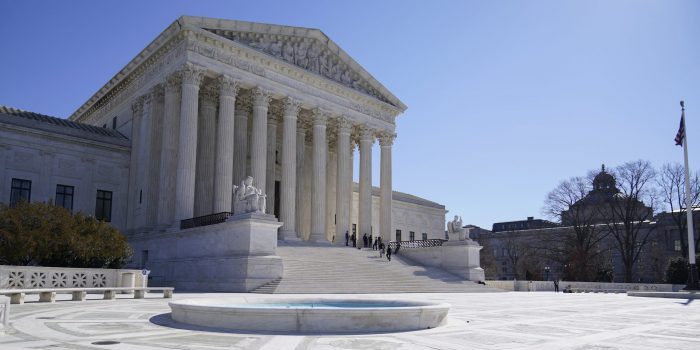
(The Center Square) – The U.S. Supreme Court on Tuesday overturned Maine’s ban on state tuition assistance to students attending religious schools in an education case that could have big implications for schools around the country.

The Supreme Court ruled 6-3 in Carson v. Makin.

The dispute began when the state of Maine created a tuition assistance program for rural areas without public schools. The program, though, explicitly said that state funds could not be used at religious private schools, only secular schools.

A family sued the state of Maine saying they should be able to use the state funding at a religious school if they desired. They argued the program discriminates against religious schools and violates the Free Exercise Clause of the Constitution.
The Supreme Court sided with the challengers to Maine’s law Tuesday.

“Maine’s program cannot survive strict scrutiny,” the court’s ruling says. “A neutral benefit program in which public funds flow to religious organizations through the independent choices of private benefit recipients does not offend the Establishment Clause.

“Maine’s decision to continue excluding religious schools from its tuition assistance program after Zelman thus promotes stricter separation of church and state than the Federal Constitution requires. But a State’s antiestablishment interest does not justify enactments that exclude some members of the community from an otherwise generally available public benefit because of their religious exercise.”

The high court pointed to Trinity Lutheran Church of Columbia v. Comer, a 2016 ruling where the court sided with a religious school that was denied state grant funding assistance for a playground improvement because it was religious.

“The Department’s policy violated the rights of Trinity Lutheran under the Free Exercise Clause of the First Amendment by denying the Church an otherwise available public benefit on account of its religious status,” the court ruled in that case. “This Court has repeatedly confirmed that denying a generally available benefit solely on account of religious identity imposes a penalty on the free exercise of religion.”

Critics of Maine’s anti-religious school provision also pointed to Espinoza v. Montana Dept. of Revenue, a Supreme Court case in 2020 in which the high court ruled in favor of a similar Montana program, saying students could receive state funds for education at a religious school.

Chief Justice John Roberts wrote the majority opinion, and Justice Stephen Breyer wrote the dissent. In the dissent, Breyer said the majority gave too little credence to the establishment clause and too much to the free exercise clause.

“The Court today pays almost no attention to the words in the first Clause while giving almost exclusive attention to the words in the second. The majority also fails to recognize the ‘play in the joints’ between the two Clauses,” Breyer wrote.

Religious liberty advocates celebrated the ruling.

“We are thrilled that the Court affirmed once again that religious discrimination will not be tolerated in this country,” said Kelly Shackelford, Liberty Counsel’s president and chief Counsel. “Parents in Maine, and all over the country, can now choose the best education for their kids without fearing retribution from the government. This is a great day for religious liberty in America.”

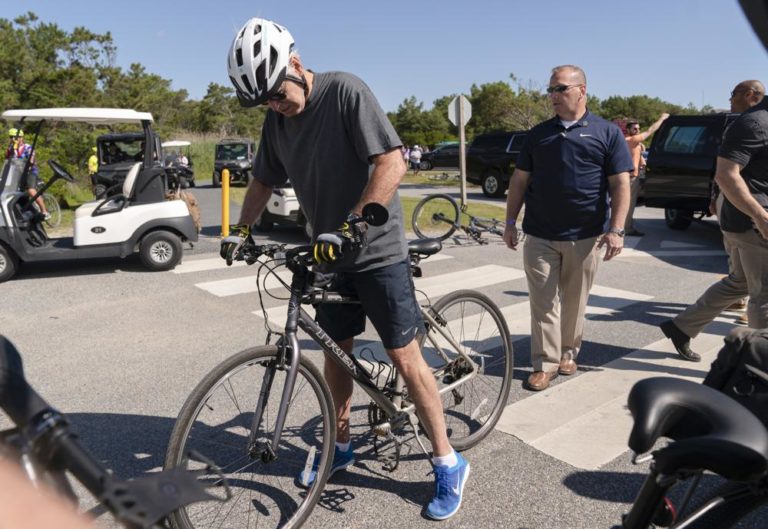
Trump Vows to ‘Never, Ever’ Ride a Bike as Theory Emerges on Biden’s Fall

(Jacob Bruns, Headline USA) During a rally in Tennessee, former President Donald Trump trolled his successor, Joe Biden, about an embarrassing spill from his bicycle while vacationing in Delaware over the weekend.

“I hope [Biden] has recovered, because as you know, he fell off his bicycle,” Trump said, according to the Gateway Pundit.

“No, I’m serious. I hope he’s OK. Fell off a bicycle. I make this pledge to you today – I will never, ever ride a bicycle,” Trump added.

Conservative pundit Jordan Schachtel floated an alarming theory as to what could have caused the spill, Becker News reported.

Schachtel speculated that the president with a penchant for seeking out the presence of children was excited to speak to a young girl in the crowd.

“By now you may have seen this clip of Joe Biden falling off of his bicycle, rather unceremoniously,” the narrator said in the video. “And if you guess that the reason was because a small child was in the crowd, you’d be right.”

“Now, yesterday, I actually put out a tweet about that before any of this other footage came out wondering why exactly was Joe stopping,” he added. “And it turns out that I was correct. There was a kid in the crowd.”

In order to head off such thoughts, the 79-year-old and his administration attempted to blame his shoes for the fall, claiming that they got stuck to the pedals of his bike.

“As the President said, his foot got caught on the pedal while dismounting and he is fine,” an administration official said. “No medical attention is needed. The President looks forward to spending the rest of the day with his family.”

Mo Brooks Faces Moment of Truth, Va. Dems Try to Defend Seats in Tuesday Primaries

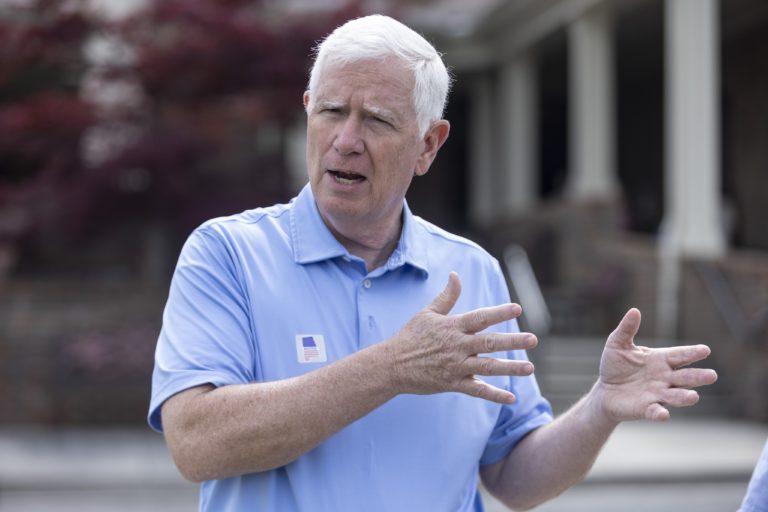
(Headline USA) Alabama Rep. Mo Brooks has run his race for Senate as a strong supporter of former President Donald Trump, refusing to accept the widely disputed outcome of the 2020 contest in the face of a preponderance of evidence that indicates widespread vote fraud.

Brooks has campaigned alongside the organizers of the ill-fated “Save America Rally” on Jan. 6, 2021—during which he became a top target of the Left after telling the crowd it was time to start “kicking ass.”

“I was proud to stand with Mo Brooks on that stage that day,” said Amy Kremer, chair of Women for America First. “Mo has the truth on his side.”

But Brooks’ efforts weren’t enough to keep him in Trump’s favor.

The former president rescinded his early Brooks endorsement back in March and then snubbed him a second time, endorsing his rival Katie Britt ahead of Tuesday’s Republican runoff election for the U.S. Senate seat being vacated by Britt’s former boss, retiring GOP Sen. Richard Shelby.

Alabama is one of a handful of states holding contests Tuesday at the midpoint of a primary season that has been shaped by Trump’s effort to influence the GOP.

In Virginia, Republicans are choosing between Trump-aligned congressional candidates to take on some of the most vulnerable Democrats in the fall.

And in Georgia, Democrats will settle several close races, including deciding which Democrat will challenge Brad Raffensperger, the Republican secretary of state who overcame a Trump-backed challenge last month.

In Washington, D.C., meanwhile, Democrat Mayor Muriel Bowser is seeking reelection amid concerns over homelessness and rising crime.

But the Alabama Senate runoff has drawn particular attention both because of the drama surrounding Trump’s endorsement and the fact that the winner will likely prevail in November in a state Trump won twice by more than 25 percentage points.

Trump initially endorsed Brooks in the spring of 2021, rewarding an ardent champion of his efforts to challenge Democrat Joe Biden’s claims of a presidential election victory.

Brooks had voted against certifying Biden and delivered a fiery speech at the rally before the U.S. Capitol uprising, telling the crowd, “Today is the day that American patriots start taking down names and kicking ass.”

But nearly a year later, Trump rescinded his support after the pair’s relationship soured and as the conservative firebrand languished in the polls.

Trump blamed his decision on comments Brooks had made months earlier, at an August rally, when he said it was time for the party to move on from the 2020 presidential race—comments Trump claimed showed Brooks, one of the most conservative members of Congress, had gone “woke.”

But the move was widely seen as an effort by Trump to save face amid other losses, and Brooks alleged that it came after he informed Trump that there was no way to “rescind” the 2020 election, remove Biden from power, or hold a new special election for the presidency.

Trump’s un-endorsement was widely expected to end Brooks’ campaign. Instead, Brooks managed to finish second in the state’s May 24 primary, earning 29% of the vote to Britt’s 45% and forcing a runoff.

Brooks tried once again to get Trump to endorse him, but Trump, who has had a mixed record in backing winning candidates, instead chose Britt, Shelby’s former chief of staff, calling her a “fearless America First Warrior.”

While Brooks and Britt have similar views, their race represents a clash between two wings of the party and different generations. Shelby for decades epitomized the old-guard political style, using his clout and relationships to quietly steer federal projects and funding to his home state.

Britt, 40, has the endorsement of Shelby and other establishment Republicans, as well as deep ties to the state’s business community, reflected in her 2-1 fundraising advantage over Brooks.

Brooks, 68, is known for his fiery oratorical style. The six-term congressman was a founding member of the conservative House Freedom Caucus and has made his opposition to Senate Minority Leader Mitch McConnell a pillar of his campaign, embarking on a “Fire McConnell Tour” of town halls. A super PAC affiliated with McConnell contributed $2 million to a PAC opposing Brooks.

Brooks also has the backing of Texas Sen. Ted Cruz and Kentucky Sen. Rand Paul, who say he would be a valuable addition to the Senate.

“This is a race about conservatives versus the establishment,” Paul said Friday in north Alabama. “We need a fighter. We’re not going to get it if you send us any old Republican. We need a fighter like Mo Brooks.”

Britt, meanwhile, stresses her own social conservative beliefs and has tried to paint Brooks as a career politician, saying Alabamians want “new blood.”

“President Trump knows that Alabamians are sick and tired of failed, do-nothing career politicians,” she said after Trump’s endorsement. “It’s time for the next generation of conservatives to step up and shake things up in Washington.”

Brooks has disparaged Britt as a RINO and maintained he is the only one with a proven conservative record.

Turnout in the race is expected to be low, with fewer than 15% of registered voters likely to cast ballots, according to Secretary of State John Merrill.

Elsewhere, in the nation’s capital, where Democratic primaries effectively decide winners, Bowser is trying to fend off challenges from a pair of City Council members as the city contends with a rash of crime, including a shooting Sunday in one of the city’s busiest nightlife destinations that left a 15-year-old dead and a police officer and at least two others wounded.

In Virginia, voters are set to pick Republican nominees for what is expected to be a pair of the year’s most competitive U.S. House races.

In the coastal 2nd District, state Sen. Jen Kiggans is widely seen as the GOP front-runner in the Republican race to take on Democrat Elaine Luria, a member of the House Jan. 6 committee, in the general election.

In central Virginia’s 7th District, six candidates are in a competitive race to face Democratic Rep. Abigail Spanberger, a former CIA officer. The eventual victor will face an uphill battle in what is considered one of the most at-play seats in Congress.

During the 2018 midterm, Spanberger was able to capitalize on a court-ordered redrawing of the congressional districts to flip the seat, long held by Republicans including former House Whip Eric Cantor. But the competitive district along the I-95 corridor between Fredericksburg and Richmond is likely to be one of many that the GOP can reclaim in what is anticipated to be a red-wave midterm election.

In Georgia, Democratic state Rep. Bee Nguyen is trying to defeat former state Rep. Dee Dawkins–Haigler in the secretary of state’s race. The winner will face Republican Raffensperger, a NeverTrump RINO who beat back Trump-endorsed challenger Jody Hice in his May 24 primary after many Democrat voters opted to participate in the rival primary.

In congressional runoffs, Republican Vernon Jones, a Trump-backed candidate and former Democrat, is competing against trucking company owner Mike Collins for the Republican nomination for the 10th Congressional District seat, east of Atlanta.

Republicans also have high hopes of knocking off 30-year Democratic Rep. Sanford Bishop in southwest Georgia’s 2nd District. The GOP is choosing between former Army officer Jeremy Hunt and real estate developer Chris West.

Adapted from reporting by the Associated Press

Biden Economy Forcing Public Pools to Close as Temps Boil

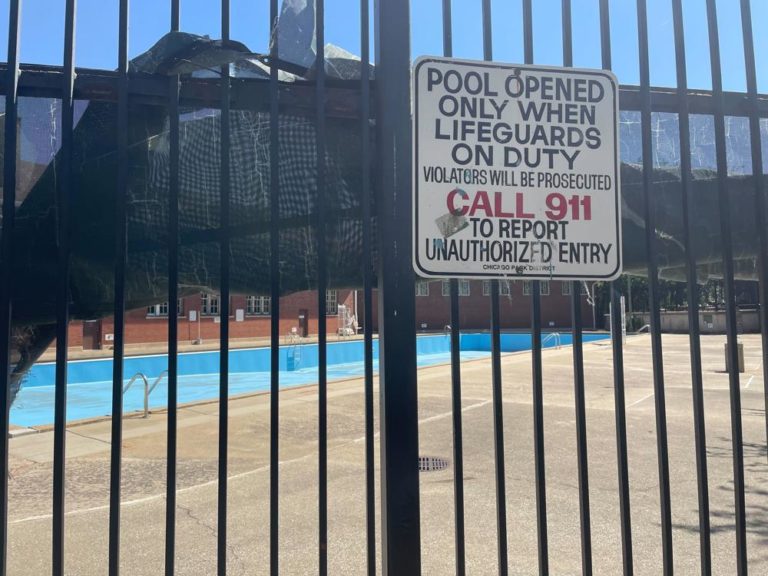
(Headline USA) Unable to deal with a labor shortage triggered by the Biden administration’s economic ruin and post-pandemic response, public pools across the country are being forced to close because of a lifeguard shortage, even as summer temperatures soar on pace with skyrocketing gas prices.

Manager Ashley Ford strode the perimeter of one of Indianapolis’ five open swimming pools, monitoring kids as they jumped off a diving board or careened into the water from a curved slide. Four lifeguards, whistles at the ready, watched from their tall chairs stationed around the water.

With a dozen of the city’s pools shuttered due to a lifeguard shortage, families sometimes line up more than an hour before the one at Frederick Douglass Park opens, Ford said. Many days, it reaches capacity.

A national lifeguard shortage exacerbated by the COVID-19 pandemic and a flailing economy has prompted communities such as Indianapolis to cut back on pools and hours. In other spots around the United States, swimming areas go without attendants.

That’s left some Americans with fewer or riskier options, even as a significant part of the nation endures a second heat wave in as many weeks. Public health experts say the risk of drowning decreases significantly when lifeguards are present.

“That’s my biggest thing, is making everybody safe,” Ford said.

The American Lifeguard Association estimates the shortage impacts one-third of U.S. pools. Bernard J. Fisher II, director of health and safety at the association, expects that to grow to half of all pools by August, when many teenage lifeguards return to school.

“It is a disaster,” Fisher said.

Summer shortages aren’t unusual, but U.S. pools are also dealing with the fallout from earlier in the pandemic, when they closed and lifeguard certification stopped, Fisher said. Starting pay lags behind many other jobs, though some cities are ramping up incentives.

Indy Parks and Recreation has 100 lifeguards on staff this year when normally it would have double that, said Ford, who was worked for the agency for 20 years. Even as lifeguards from closed neighboring pools bulk up the open facilities, pools in Indianapolis must still close for an hourlong lunch and cleaning break each day.

When a local pool is not open, young people may go swimming in places without lifeguards, Fisher said. That can result in more drownings, which disproportionately affect people of color. In the U.S., black people under 29 are 1.5 times more likely to drown compared with white Americans of the same age, according to the Centers for Disease Control and Prevention.

About 330,000 people enroll the American Red Cross’ lifeguarding course annually. That figure shrank, as many pools shuttered due to the pandemic, but is now rising, Jenelle Eli, senior director of media relations for the American Red Cross said in a statement to The Associated Press.

Indy Parks requires its lifeguards to pass a course in which they swim 100 yards, tread water for a minute without using their hands and retrieve a 10-pound object from the bottom of a pool. Starting pay is $15 per hour, up from $13 an hour earlier this year. Those who stay through the season will receive a $100 retention bonus, Boyd said.

“I’ve tried to get some of my friends that want to get a summer job and want to have money in their pockets,” said second-year lifeguard Donald Harris, 17. “They’ve just said lifeguarding isn’t for them.”

At Indiana’s state parks, lifeguards are paid $11 an hour. All of the state’s 37 facilities remain open, but some operate on limited hours, said Terry Coleman, director of the Division of Indiana State Parks. Many Indiana state parks additionally have shallow swimming areas without lifeguards, Coleman said.

“We’re looking at potential incentives for maybe the 2023 recreation season, but nothing in stone yet,” he said.

In Maine, several state parks started the season without lifeguards, and visitors are informed at the park entrance when no lifeguard is on duty, said Jim Britt, spokesperson for the Maine Department of Agriculture, Conservation and Forestry. The state pays lifeguards about $16 an hour.

“It’s a concern,” Britt said. “There’s no two ways about it. We want lifeguards to be there and to be on duty.”

Chicago, which boasts one of the nation’s largest aquatic programs — 77 public pools and 22 beaches that serve a population of nearly 2.75 million — pushed opening day for pools back to July 5 from June 24.

“Chicago families rely on our park programs during the summer, so we are not giving up,” Chicago Park District Superintendent Rosa Escareño said in a news release.

Adapted from reporting by the Associated Press

Nuclear Industry Hopes to Expand Output w/ New Reactors

(Headline USA) As the Biden administration’s disastrous domestic policies continue to drive massive spikes in energy prices, the U.S. nuclear industry is generating less electricity as reactors retire, but now plant operators are hoping to nearly double their output over the next three decades, according to the industry’s trade association.

The massive scaling-up envisioned by the utilities hangs on the functionality of a new type of nuclear reactor that’s far smaller than traditional reactors. About two dozen U.S. companies are developing advanced reactors, with some that could come online by the end of the decade if the technology succeeds and federal regulators approve.

Utilities that are members of the Nuclear Energy Institute project they could add 90 gigawatts of nuclear power, combined, to the U.S. grid, with the bulk of that coming online by 2050, according to the association. That translates to about 300 new small modular reactors, estimated Maria Korsnick, president and chief executive officer of the institute.

“We have the innovation, we have the capability, we have the American ingenuity,” she said. “There’s no reason that we shouldn’t be able to to bring these products to market.”

U.S. nuclear electricity generation capacity peaked at 102 gigawatts in 2012, when there were 104 operating nuclear reactors, according to the U.S. Energy Information Administration. The nation’s current 92 operating reactors have nearly 95 gigawatts of capacity.

Their output totaled 778 million megawatt hours in 2021, which was 1.5% less than the previous year and 19% of the nation’s electricity, the information administration said. That’s enough to power more than 70 million homes.

It’s costly and time consuming to build huge conventional nuclear plants. A project in Georgia — the only nuclear plant under construction in the United States — is now projected to cost its owners more than $30 billion. When approved in 2012, the first new nuclear reactors to be built in decades were estimated to cost $14 billion.

Korsnick talked about the possibility of doubling U.S. nuclear output in a speech to industry leaders and policymakers Tuesday in Washington for the NEI’s Nuclear Energy Assembly conference, telling them that “we’re at a crossroads for our industry and the planet” and the response to the climate crisis is intrinsically tied to the electrical grid, economy and energy security. The group applauded when she said 90 gigawatts of nuclear power could be added.

Kathryn Huff, assistant secretary for nuclear energy, spoke about U.S. priorities for nuclear energy and goals for a low-carbon economy. She said the only way to address the climate crisis is by working together.

Korsnick, who spoke with The Associated Press exclusively before the conference, said it isn’t wishful thinking; there’s a demand for that much nuclear power as companies strive to meet customer expectations and fulfill pledges to cut carbon, there’s significant interest at the federal and state level, and small reactors can be built largely in a factory setting, unlike traditional reactors.

She acknowledged there are challenges, such as a regulatory process that would have to speed up to license the reactors, the supply chain that needs to be developed, and the need for more financial incentives, as the federal government did to scale up renewable projects over the past decade.

The largest public power company in the U.S., the Tennessee Valley Authority, launched a program in February to develop and fund new small modular nuclear reactors as part of its strategy to dramatically reduce greenhouse gas emissions.

And an AP survey of the energy policies in all 50 states and the District of Columbia found that a strong majority — about two-thirds — say nuclear, in one fashion or another, will help take the place of fossil fuels.

Korsnick said the more people are concerned about carbon-free electricity, “the better off nuclear power is.”

The Union of Concerned Scientists has cautioned that nuclear technology still comes with significant risks that other low-carbon energy sources don’t, including the danger of accidents or targeted attacks for both the radioactive waste and the reactors, and the unresolved question of how to store hazardous nuclear waste. The group does not oppose using nuclear power, but wants to make sure it’s safe.

The Environmental Working Group has said small reactors are going to be a “total financial debacle” because the cost of nuclear power never comes down, with costs and risks shifted to ratepayers.

And the Ohio-based Institute for Energy Economics and Financial Analysis analyzed a small modular nuclear reactor being developed by NuScale Power in Oregon, concluding that it’s “too expensive, too risky and too uncertain.” The company said that report mischaracterizes NuScale’s costs, does not accurately reflect or examine schedule timeframes, and even fails to understand the output.

Korsnick said that when companies show the test reactors can be built on budget and on time, they’re going to “sell like hotcakes.” She pointed to Wyoming, where communities competed to get the demonstration project by Bill Gates’ company. TerraPower chose Kemmerer, which has relied on coal for over a century.

Korsnick said she’s bullish about the future opportunities for nuclear power.

“Any way you slice and dice it, it comes back to nuclear being a large part of the solution,” she said.

Adapted from reporting by the Associated Press

Dems Strategize over How to Turn Abortion into Top Campaign Distraction

(Tony Sifert, Headline USA) The increasingly desperate Democratic party, facing landslide defeat in the 2022 midterms, has been conducting extensive research into the American people’s likely response to the overturning of Roe v. Wade, according to a report in Politico.

With its previous plan to push the Jan. 6 hearings crumbling underfoot, the Democratic Congressional Campaign Committee is now hoping that the abortion issue can be used to distract voters from the Biden administration’s disastrous policy failures regarding inflation, energy and foreign policy.

“The question … is how to make abortion a top issue for voters in November while facing a range of challenges, especially gas prices averaging $5 a gallon and inflation ticking up,” Politico reported.

Democrat strategists told Politico that their aim is “to put a lot of money on paid advertising” that would target specific states contemplating pro-life legislation.

“We will be using every tool in the toolbox to tell this story,” said Heather Williams, executive director at the Democratic Legislative Campaign Committee. “We know that Roe is not the only issue [in the midterms], but Roe is a motivator.”

Money has poured in from the likes of EMILY’s List, Planned Parenthood and NARAL to assist in the program, but some strategists remain concerned that the issue cannot motivate voters more than inflation and gas prices.

“The decision [in Roe] will help motivate our base,” pollster Josh Ulibarri told Politico. “We win [on abortion] handily, but is that more powerful than when a voter looks at their receipt when they check out at Target?”

Pro-abortion extremists like Ruth Sent Us and Jane’s Revenge, however, are doing their best to convert Americans to the pro-life cause.

The domestic terrorist groups—which have already threatened the family of Supreme Court Justice Amy Coney Barrett and vandalized dozens of pro-life clinics since the leak of the Dobbs opinion, are planning a “Night of Rage” to commemorate the opinion’s official release.

“To our oppressors: if abortions aren’t safe, you’re not either,” Jane’s Revenge wrote in flyers advertising the riot.

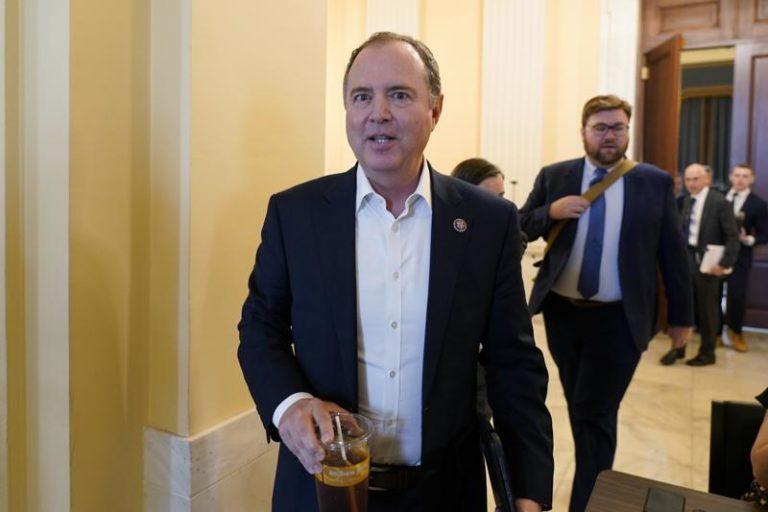
Ex-Schiff Staffer Caught Defacing Poster Outside MTG’s Office

(Jacob Bruns, Headline USA) A former staffer for Rep. Adam Schiff, D-Calif., was caught on camera defacing a poster put up by Rep. Marjorie Taylor Greene, R-Ga., insisting upon two biological genders.

Timothy Hysom, 51, a longtime Democrat congressional staffer, and now top aide to Massachusetts Democrat Rep. Jake Auchincloss, was seen putting stickers and other religious messages on Greene’s posters, Just the News reported.

Though he was caught on camera, Hysom declined a “non-custodial interview,” instead opting to retain counsel. In response, the Capitol Police issued an arrest warrant.

“Based on the aforementioned, it is your affiant’s belief that the defendant, Timothy Duane Hysom … did violate DC Code § 22–3312.01 Defacing Public or Private Property,” the arrest warrant stated.

But despite the warrant for arrest, President Joe Biden’s J6-witch-hunt-preoccupied Department of Justice will not prosecute. Democrats, in fact, did their best to suggest that Greene was truly at fault for putting the poster up in the first place.

Auchincloss’ spokesman Matt Corridoni said that MTG was “bullying” by putting up the posters, suggesting that the real victims were those who had to see her mean message.

“While Members of Congress have great latitude in what they do on the inside of their office, they do not own the exterior walls of their office,” Corridoni said.

According to the spokesman, no crime was actually committed, and therefore Hysom should not be prosecuted.

“Regulations published by the House Buildings Commission prohibit ‘posters’ from being posted in the hallways outside of Members’ House offices in the House Office Buildings. Adhering a sticker – to a poster that shouldn’t be there in the first place – is hardly a federal crime.”

“What Tim did was to adhere a series of stickers to foul, mean spirited, bullying posters outside the Congresswoman’s office,” he added. “These stickers were never threatening and always respectful.”

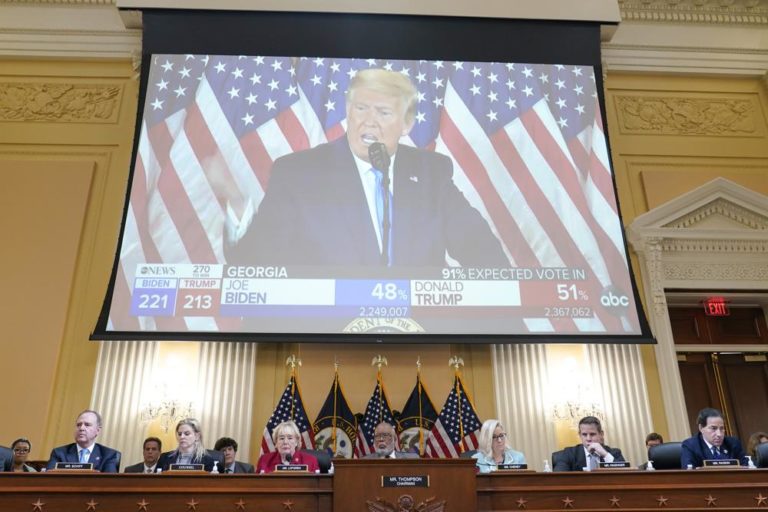
NBC News: J6 Show Trial Helping to ‘Deepen Fealty’ to Trump

(Jacob Bruns, Headline USA) The show trial that has been ongoing in the Capitol for several weeks now has only served to entrench Donald Trump‘s supporters’ love of the former president.

Republican voters who have supported Trump for the past six years have a deep skepticism of Washington politicians, and they have from the start, NBC news reported.

Why Washington politicians believe the J6 Tribunal TV mini-series is some adequate solution, therefore, is hard to explain.

Judy Cameron, a Reno retiree who recently voted in the Nevada Republican primaries suggested that the J6 Committee’s infatuation with the former president stems from their previous two attempts to impeach him. In her view, this is another such attempt.

“It might as well be impeachment No. 3 for Donald Trump,” said Cameron. “This is their big push to get Donald Trump off the ballot.”

Tom Berenato, a two-time Trump voter and Clark County, Nevada, resident, seconded that opinion.

“It’s all political and designed to try to prevent Donald Trump from running for president again,” he said.

Berenato also suggested that the J6 Committee is illegitimate because it has “nobody on it with opposing views” to the Democrat majority.

Even the Republicans on the Committee are, in his view, simply “anti-Trumpers” like RINO Liz Cheney.

When asked why he continues to hold his ground, Berenato said that “there were a lot of irregularities and shenanigans going on in several swing states” during the hotly disputed 2020 election.

Donald Fossum, a supporter rallying outside Reno High School for the Nevada Senate GOP candidate Sam Brown, also suggested that the mainstream media is not telling the whole story, or even part of it.

“You’ve got the liberal mass media, completely controlled with a narrative that’s sent out to all of them at about 4 a.m. in the morning,” he said. “That’s why you can read their lips on your screen; they’re all saying the same thing.”

Twitter Board Unanimously Recommends Approval of Musk Buyout

(Headline USA) Twitter’s board has recommended unanimously that shareholders approve the proposed $44 billion sale of the company to billionaire and Tesla CEO Elon Musk, according to a regulatory filing Tuesday.

Musk reiterated his desire to move forward with the acquisition last week during a virtual meeting with Twitter employees, though shares of Twitter remain far below his offering price, signaling considerable doubt that it will happen.

On Tuesday at the Qatar Economic Forum in an interview with Bloomberg, Musk listed the approval of the deal by shareholders as one of several “unresolved matters” related to the Twitter deal.

Shares of Twitter Inc. were essentially flat just before the opening bell Tuesday and far short of the $54.20 per-share that Musk has offered to pay for each.

The company’s stock last reached that level on April 5 when it offered Musk a seat on the board before he had offered to buy all of Twitter.

In a filing with the U.S. Securities and Exchange Commission detailing on Tuesday detailing a litter to investors, Twitter’s board of directors said that it “unanimously recommends that you vote [for] the adoption of the merger agreement.”

If the deal were to close now, investors in the company would pocket a profit of $15.22 for each share they own.

Adapted from reporting by the Associated Press
Court Rules Minneapolis Mayor Failed to Hire Minimum Number of Police

(Headline USA) The Minnesota Supreme Court has ruled that the mayor of Minneapolis hasn’t met a legal duty to hire more police officers or demonstrate why he hasn’t done so.

In a Monday ruling, Chief Justice Lorie Gildea said Mayor Jacob Frey has a “clear legal duty” under the city’s charter to staff the department with at least 731 sworn officers, a number based on the population of Minneapolis.

Interim City Attorney Peter Ginder said the city has about 300 fewer officers than it did before George Floyd died while in police custody in May 2020.

While the prosecution of four officers involved in Floyd’s death alone may have discouraged many in law enforcement by raising concerns about qualified immunity, leftist politicians in Minneapolis further inflamed tensions by leading the charge in what became a national “defund the police” movement.

The city’s former police chief had attributed the departures to retirements and officers who filed disability claims, some citing symptoms of post-traumatic stress disorder linked to the protests over Floyd’s killing.

Ginder called it “an unprecedented loss of personnel that is not easily corrected,” but noted that the city has provided funding for additional recruit classes and hiring bonuses.

“Mayor Jacob Frey, the Minneapolis Police Department and city are working in good faith to recruit and hire more community-oriented peace officers as quickly as reasonably possible,” Ginder said.

The ruling sends the case back to district court in Hennepin County.

Eight residents concerned about crime sought the court order to force the city to hire more police as required by the charter.

The state Supreme Court heard arguments earlier this month from them that the current staffing is about 120 officers less than they believed was required.

Minneapolis attorneys argued that the charter requirement relates only to funding, but the mayor still may determine how the money may be used within the department.

Adapted from reporting by the Associated Press