SCOTUS to Hear Colo. Case Pitting Speech Rights vs. Minority Groups’ Rights

(The U.S. Supreme Court will hear oral arguments starting next week in what could be a landmark case centered on a Colorado small business owner’s free speech rights.

Lorie Smith, owner of graphic design company 303 Creative in Littleton, Colo., is challenging the state’s public-accommodation law, which she argues is compelling her speech. Smith wishes to create wedding websites only for straight couples, citing her religious beliefs.

Colorado argues this would violate the state’s public-accommodation law, which prevents sales discrimination but does not regulate speech.

The case also mirrors another high-profile case from Colorado that worked its way up to the Supreme Court but ended with a narrow ruling. In Masterpiece Cakeshop v. Colorado Civil Rights Commission, the court determined that the commission discriminated against the shop’s owner, Jack Phillips, who refused to make a cake for a same-sex marriage wedding. However, its ruling did not specifically address free-speech rights.

Smith says Colorado’s law compels her speech as an artist to create messages that go against her traditional beliefs on marriage.

State law reads in part: “It is a discriminatory practice and unlawful for a person, directly or indirectly, to refuse, withhold from, or deny to an individual or a group, because of disability, race, creed, color, sex, sexual orientation, gender identity, gender expression, marital status … the full and equal enjoyment of the goods, services, facilities, privileges, advantages, or accommodations of a place of public accommodation…”

According to Smith, the artwork she creates with her business is custom, “but Colorado is … compelling my speech and forcing me to use my artwork to design and create and celebrate messages that violate my beliefs.”

The Colorado attorney general’s office says giving Smith an exemption from state law would pave the way for businesses to discriminate against prospective customers.

“The nation and the state of Colorado have long required businesses open to the public to serve all customers,” Lawrence Pacheco, the office’s communications director, told The Center Square.

“The U.S. Supreme Court has repeatedly affirmed the state’s ability to prevent sales discrimination,” he continued. “Abandoning this important and longstanding principle now would allow businesses to discriminate based on who customers are, including on the basis of gender, race, and religion. The Court should protect these important civil rights.”

Smith’s attorney with Alliance Defending Freedom, the conservative law firm that also represented Phillips in his case, argues a ruling in Smith’s favor would mean LGBT graphic designers wouldn’t be forced to create websites against their beliefs, such as one criticizing same-sex marriage.

“A ruling in Lorie’s case would protect the LGBT graphic designer who doesn’t want to be forced to criticize same sex marriage just as much as it would protect Lorie,” ADF attorney Kellie Fiedorek said.

The Colorado attorney general’s office maintains the state’s anti-discrimination law “regulates sales, not speech.”

“What a business chooses to sell to the public remains entirely up to the business,” Pacheco added. “Therefore, a public business that designs and offers LGBTQ-themed websites must offer those LGBTQ-themed websites to all customers, even if those customers are opposed to same-sex marriage because of their religion.”

The case, 303 Creative LLC v. Elenis, has drawn dozens of amicus briefs on both sides of the issue.

Rob Natelson, a senior fellow in constitutional jurisprudence with the Denver-based Independence Institute, told The Center Square that it will be interesting to see if the court goes the route of the U.S. Constitution’s original meaning or balancing.

“In the 303 Creative case the Court of Appeals said [Lorie] has a free speech right in making websites but the state has a compelling interest in protecting marginalized groups, and the law is narrowly drafted to promote that interest, and therefore her right is outweighed,” he told The Center Square.

“Now that doesn’t really work very well with the First Amendment,” Natelson added. “The First Amendment says the right to free speech shall not be infringed, right?

“I think she will win because the implications of allowing the state to force her to say things are really grave and, from a constitutional standpoint, the real interesting question is whether they use this 20th Century methodology that’s really divorced from the real meaning of the constitution, or whether they do what they did in the New York State Rifle Association case and go back to the original meaning of the constitution and decide it on that ground,” he said.

Smith described in an interview the 6-year-old case as a “rollercoaster ride”—from lower courts siding with the state to being harassed, doxxed and even facing death threats.

“I think the hardest part for me is that those who oppose my view on marriage may not really understand that what I’m standing to protect—the right to speak freely protects all of us,” she said. “Not only does it protect me but it protects the LGBT web designer who shouldn’t be forced to promote messages opposing same-sex marriages.”

Smith and her attorney are hopeful the Supreme Court will rule in her favor.

“The Constitution is very clear that the government cannot compel speech, it cannot compel expression,” Fiedorek said. “Every single one of the justices has taken an oath to uphold that Constitution, so we’re very hopeful that they will rule in favor of free speech and not force artists to say something they don’t want to.”

Oral arguments in the case are scheduled for Monday, Dec. 5.

House Democrat Blasts Biden over ‘Fancy Dinner’ that Includes Maine Lobster

(The Center Square) A U.S. House Democrat blasted President Joe Biden for his planned ritzy dinner with France’s leader Emmanuel Macron.

Rep. Jared Golden, D-Maine, called out Biden on Twitter, suggesting the president is a hypocrite for crushing the lobster industry with strict regulations while purchasing 200 lobsters from Maine for the state dinner with Macron.

Golden has spoken against regulations limiting lobster harvesting for environmental reasons.

“If the Biden White House can prioritize purchasing 200 Maine lobsters for a fancy dinner, @POTUS should also take the time to meet with the Maine lobstermen his administration is currently regulating out of business,” Golden wrote on Twitter.

The criticism comes as Maine’s lobster industry is under fire from environmental groups over concerns about its impact on north Atlantic right whales.

As The Center Square previously reported, Whole Foods will stop selling lobster caught in the Gulf of Maine at hundreds of its retail stores across the country.

The company cited concerns raised by sustainability groups, including the Marine Stewardship Council, which has withdrawn its endorsement of the U.S. lobster industry.

Oceana, an international advocacy group focused on ocean conservation, objected to the use of Maine lobster, which recently was declared unsustainable by the Monterey Bay Aquarium’s Seafood Watch and the Marine Stewardship Council.

The sustainability organizations cited concerns about risks to rare North Atlantic right whales from fishing gear. Entanglement in gear is one of the biggest threats to the whales.

Biden is scheduled to spend Thursday with Macron, including a morning bilateral meeting, a press conference around noon, as well as the dinner, which features the butter-poached Maine lobster, beef with shallot marmalade, an American cheese trio and orange chiffon cake.

“The design of this dinner was inspired by the shared colors of our flags, red white and blue, and our common values, liberty and democracy, equality and fellowship,” first lady Jill Biden said. “These form the bedrock upon which our enduring friendship was built.”

The first lady said she was handling the dinner the way that her mother handled family dinners when she was growing up. Her mother brought out the china, fresh flowers and lit candles “even if we were only having fish sticks from the freezer.”

“I learned that setting a table can be an act of love,” she said, before journalists were permitted to see the tablescapes for the dinner, which is part of a broader state visit to the United States by Macron and his wife, Brigitte.

Biden said the first White House state dinner since 2019 will be “an expression of welcome and friendship, a way to connect through a language that transcends words.” She did not take questions from reporters and left the preview room after her brief remarks.

White House social secretary Carlos Elizondo, who has worked for the Bidens for more than a decade, said “making people feel comfortable and at home” matters most to the couple.

The glitzy, black-tie dinner party will be held in a heated pavilion on the South Lawn with an expected 300 or so guests. They will be seated at a mix of square and rectangular tables, covered with dark blue silk cloths and decorated with red candles and arrangements of red, white and blue flowers, including roses and irises, the official flower of France.

China from the White House collection will not be used since it is not allowed outside of the executive mansion. Guests will dine on outside tableware.

An image of the Statue of Liberty, a gift to the U.S. from France in the 1800s, will be the backdrop for toasts by the presidents. American sparkling wine poured into silver French champagne vessels will be served for the toasts.

Dinner guests, who typically are supporters and friends of both presidents, government officials, business people and some celebrities, will have the added bonus of arriving at a White House that has been decked out for the holidays with Christmas trees, wreaths and garland. Trolley cars will ride them down to the see-through pavilion on the South Lawn.

Music will be provided by Jon Batiste, a Grammy Award-winning New Orleans native who most recently was bandleader and musical director of The Late Show with Stephen Colbert. Joining Batiste will be his father, Michael Batiste, the U.S. Marine Band and the Army and Air Force Strolling Strings.

The event was produced with help from Fete, an event planning company based in New York City.

Jill Biden recalled that, when she flew to Japan to support Team USA in the Olympics, she ended up cheering alongside Macron during a three-on-three basketball game. Although they were rooting for opposing teams, “there was a comradery that we shared,” she said.

With the state dinner, she said “our hope is that the end result will be a night that balances the beauty of our friendship with a seriousness of purpose, and we hope that French citizens everywhere feel the warmth of our welcome.”

Wednesday night, the Bidens and the Macrons dined at Fiola Mare, an Italian seafood restaurant on the Georgetown waterfront. They spent about two hours at the restaurant before heading their separate ways.

Thursday’s dinner, the first in three years, largely due to the COVID-19 pandemic, will not be a new experience for Macron. The French president was invited to the U.S. on a state visit by then-President Donald Trump in 2018.

Trump and his wife, Melania, took Macron and his wife on a helicopter ride over Washington—a city designed by Frenchman Pierre L’Enfant—and the Potomac River to Mount Vernon, the estate of George Washington, America’s first president. Macron was also recognized at a state dinner.

The first state dinner of a new administration always attracts a lot of attention and sets the bar for how the president and first lady approach entertaining, said Anita McBride, who worked for three presidents and was chief of staff to Laura Bush when she was first lady.

“In terms of the public, most visible event that any White House or any president and first lady could have entertaining on the global stage that is the White House, this is it,” McBride said.

The Associated Press contributed to this report.

Judicial Watch Sues DHS for Documents on Alleged Campaign to Censor Americans

(Molly Bruns, Headline USA) Conservative watchdog group Judicial Watch filed a lawsuit against the Department of Homeland Security after it ignored the deadline in a Freedom of Information Act request for communication records detailing an online censorship campaign during the 2020 presidential election.

According to the Daily Caller, the group was seeking emails between the Cybersecurity and Infrastructure Security Agency and the Election Integrity Partnership, a deceptively named left-wing organization with ties to the George Soros-linked Poynter Institute.

The groups likely have an “information exchange” on record between researchers, election officials and government agencies, which collaborated to identify misinformation on social media and flag particular posts for platforms to address.

“We’ve had these disclosures essentially over the last year that federal agencies, especially DHS, have been working to censor Americans… either directly or indirectly,” Judicial Watch President Tom Fitton said.

Through the EIP, leftist groups like the Democratic National Committee and the NAACP were able to report possible election information, which the EIP then investigated and sent along to social-media platforms to address.

A 2021 report compiled by the EIP showed that its efforts to address misinformation in the 2020 election resulted in “35% of the URLS shared with Facebook, Instagram, Twitter, TikTok, and YouTube … [being] either labeled, removed or soft blocked.”

The Judicial Watch lawsuit was written to confirm and address this backchannel policing of people’s speech.

“There’s these federal frauds that colluded to come up with a system of censorship for social media, and it looks like this agency [DHS] participated in it and we want to figure out what was going on,” Fitton said.

The watchdog group also requested communications records from discussions between the CISA and the University of Washington’s Center for an Informed Public, as well as the Stanford Internet Observatory. Both of the latter groups are part of the EIP.

However, because DHS unlawfully missed the Nov. 3 FOIA deadline, they are now facing a lawsuit.

“When an agency unlawfully refuses to comply with FOIA, we have the option of suing the federal court, which is what we did,” Fitton explained. “This is a threat to the first Amendment like we’ve never seen in modern history.”

EPA Quadruples Regulatory Cost of Carbon Emissions

(Molly Bruns, Headline USA) The Environmental Protection Agency is quadrupling the payments for damages allegedly caused by carbon emissions, in the latest attack on American energy independence.

An Obama-era policy, known as the Social Cost of Carbon, was first set in 2009 when the EPA first estimated the damage costs at $51 per metric ton. Recently, the EPA revised its calculation raising the damage estimate to $190, and estimating that it could reach $410 by the year 2080.

According to Just the News, the figure may boost the cost of methane regulations and tailpipe emissions in order to make up for “climate reparations,” which President Joe Biden committed to paying to poor countries.

The new estimate is under scrutiny within the legal system; many Republican attorneys general are challenging the Biden administration on the Social Cost of Carbon rule.

Key litigators said that if the rule stands, the influx in prices would effect consumers down the line.

“If you think about the fact that they would impose this damage factor, let’s say on farmers, because it applies to fertilizer,” Louisiana Solicitor General Liz Muiller said. “Fertilizer emits nitrous oxide. So fertilizer is a big contributor.”

“If every family farmer now is going to have to pay more to obtain fertilizer to fertilize crops that feed us, well, what’s that going to do to the price of food?” she concluded.

If this rule is implemented, the cost of plastic items would also increase and cascade down to consumers.

The Social Cost of Carbon concept was initially implemented in 2009. An emergency working group calculated the cost, which originally sat at $51. The Trump administration lessened the estimate to $1-7 per metric ton, a figure which the Biden administration promptly increased when he took office.

The figure is generally loathed by the energy industry, but is pushed by environmental groups.

The Sierra Club published an article calling the figure the “most important climate policy lever you’ve never heard about.”

“Right-wing free-market fundamentalists hate it. Progressive policy wonks love it,” the article reads. “Some climate advocates say that without it the United States has little chance of getting a grip on our greenhouse gas problem.”

Senate Democrat Pressured IRS to Target Conservatives

(Jacob Bruns, Headline USA) The freshly-militarized Internal Revenue Service will now predictably be used by the Left to target conservatives, and the process has already started.

After adding 87,000 new armed “agents” this past summer, the tax-collecting bureaucracy is poised to target political dissidents and small business owners who are seen to be enemies to the regime.

Now, Sen. Sheldon Whitehouse, D-R.I., has demanded that tax exemptions be taken away from conservative groups who ignored masking orders and social distancing guidelines during the pandemic, the Daily Signal reported.

The news has broken amidst the recovery of a 176-page document containing correspondence between Whitehouse and the IRS.

According to Tom Jones, president and founder of the American Accountability Foundation, this constitutes a clear example of a politicized IRS being used as a political bludgeon.

“It’s abundantly clear that [Whitehouse] is trying to take the 87,000 new IRS agents and put them to work investigating me and my friends because he doesn’t like their politics,”  he said earlier this week.

“It’s Lois Lerner on steroids,” Jones said of what’s in the Whitehouse correspondence, alluding to the Obama-era IRS targeting Tea Party groups with tax exempt status.

“The Lois Lerner stuff was a mid-level bureaucrat abusing [her] power to investigate conservative groups,” he said. “This is a U.S. senator basically trying to turn the heat up on investigations by the Internal Revenue Service.”

Jones noted, however, that the Lerner situation was light stuff compared to what lies ahead.

“So, if Sheldon Whitehouse had his way, Lois Lerner would just look like a test run of what Sheldon Whitehouse has in mind,” Jones said,

Among those targeted by Whitehouse include Turning Point USA.

The IRS bloating took place in the wake of the so-called “Inflation Reduction Act,” an attempt by the Left last summer to save Biden and the Democrats from midterm obliteration, while handing out prizes to their friends.

White House Press Sec. Claims Biden Has Visited Southern Border

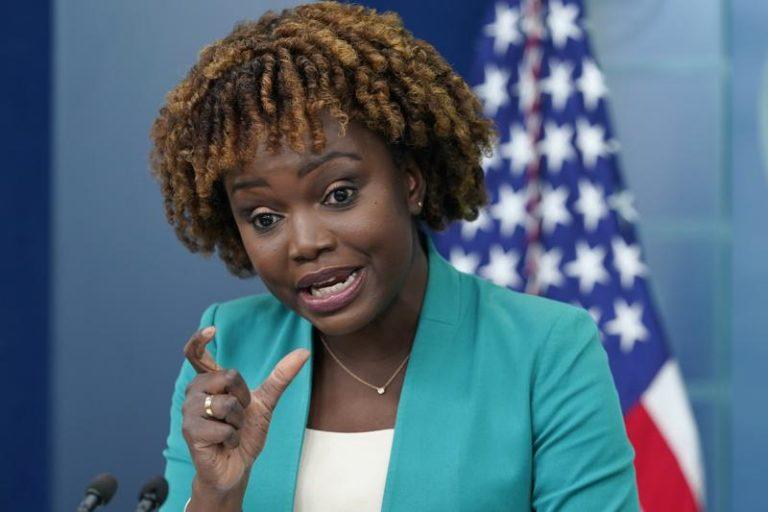
(Molly Bruns, Headline USA) During a media briefing Wednesday, White House press secretary Karine Jean–Pierre falsely claimed that President Joe Biden had visited America’s southern border.

According to the Daily Wire, Jean-Pierre made the assertion when responding to Fox News White House correspondent Peter Doocy, who asked about the potential of Biden visiting the border with potential future House Speaker Kevin McCarthy, R-Calif.

“So, look, he’s been there. He’s been to the border,” Jean-Pierre claimed, without evidence.

“And since he took office—” she said before trailing off.

In his nearly five decades in public service, Biden went to the border only once on “a brief drive-by” while “on a campaign swing in 2008.”

Despite Biden’s having far eclipsed his recent predecessors in the number of vacations he has taken—including regular visits to his Rehoboth Beach vacation home, an opulent stay on South Carolina’s Kiawah Island at the home of a Democrat donor, and a recent Thanksgiving trip to Nantucket—he maintains that he has been too busy during his presidency to visit the border.

The closest he has come since assuming the presidency was a visit to Uvalde. The town an hour’s drive from the border, was the site of a mass shooting earlier this year involving an outcast Hispanic teenager who mysteriously was able to obtain thousands of dollars worth of guns and ammunition that he reportedly purchased himself.

After Doocy attempted to clarify Jean–Pierre’s misstatement, who responded that Biden was “taking action to fix our immigration system and secure our border.”

She then proceeded to deflect blame onto Republicans for calling attention to the border crisis.

“But, you know, that—we’re not seeing that from Republicans,” she claimed.

“We’re not seeing a willingness to work with us on—on, you know, fixing a situation that’s been around for decades now,” she continued. “Instead, they’re—they’re doing political stunts. That’s what they want to do. That’s how they want to take care of this situation.”

Biden’s first act as president was to roll back many of the border-security reforms made by former President Donald Trump, which had helped reduce the number of illegals at the border dramatically.

In contrast, Biden’s own policy has resulted in unprecedented numbers of illegal crossings, with considerably fewer deportations than any of his recent presidential predecessors. In 2022 alone, officials report that there have been an estimated 2 million encounters between border agents and illegal immigrants.

Jean–Pierre continued to boast about how the president has diverted funding to the Department of Homeland Security and assigned 23,000 agents to the area—although those agents were redirected from other critical-need areas, such as air marshals, and have been tasked not with maintaining border security but conducting welfare checks.

Jean–Pierre also neglected to mention that the suicide rate among Border Patrol officers has been rising since Biden took office.

In a statement via his MAGA PAC, Trump responding to Jean–Pierre’s comments, calling them “egregious lies” and saying the White House was putting on a show.

“America is being destroyed by the invasion of our southern border,” he said. “Lives are being lost, drugs are flooding our streets, and Joe Biden and the Radical Left would rather lie than address the problem.”

Headline USA’s Ben Sellers contributed to this report.

NYTimes Throws Pity Party for FTX’s Disgraced CEO: ‘I’ve Had a Bad Month’

(Headline USA) The former CEO of the failed cryptocurrency exchange FTX said Wednesday that he did not “knowingly” misuse customers’ funds, and said he believes his millions of angry customers will eventually be made whole.

The comments from Sam Bankman–Fried came during an interview with Andrew Ross Sorkin at a conference put on by the New York Times.

FTX failed in the cryptocurrency version of a bank run, when customers tried to withdraw their assets all at once because of growing doubts about the financial strength of the company and its affiliated trading arm, Alameda Research. Since its collapse, FTX’s new management has called the cryptocurrency exchange’s management a “complete failure of corporate controls.”

The 30something ex-financial wunderkind may be at the heart of one of the most notorious financial scandals—and political corruption scandals—since Bernie Madoff’s failed Ponzi scheme helped fuel the 2008 financial meltdown colloquially known as the “Great Recession.”

In the aftermath of FTX’s crash, subsequent reports detailed how he funneled billions of dollars to candidates, becoming the second biggest donor for Democrats (after George Soros) in the 2022 midterm cycle. The Democrats in power, meanwhile, were redirecting nearly a $100 billion in funding to support the corrupt Ukrainian government, which was revealed to have partnered with FTX as a source for cryptocurrency donations.

Despite the deep layers of corruption involved—including links between his girlfriend and Gary Gensler, the chair of the Securities and Exchange Commission, which was charged with regulating FTX—the Times’s interview came off as something of a pity party for the disgraced CEO.

Bankman–Fried has done a handful of media interviews since FTX collapsed in mid-November, but Wednesday’s was his first video interview since it filed for bankruptcy protection on Nov. 11.

“I didn’t ever want to commit fraud on anyone. I was shocked at what happened this month,” Bankman–Fried said.

Bankman–Fried said that he took responsibility for FTX’s collapse and said he failed to grasp the amount of risk FTX and Alameda were taking on across both businesses. One of the accusations made against Bankman–Fried is that he arranged for Alameda to use customers’ assets in FTX to place bets in the market.

Bankman–Fried told Sorkin he did not “knowingly” co-mingle customers’ assets with Alameda.

But some social-media users expressed their skepticism.

Exchanges like FTX are supposed to segregate customers’ deposits from any bets they place in the markets.

ther financial companies have gotten into legal hot water for misusing customers deposits, one example being MF Global roughly 10 years ago.

“Whatever happened, why it happened, I had a duty to our stakeholders, our customers, our investors, the regulators of the world, to do right by them,” Bankman–Fried said.

Sorkin pushed Bankman–Fried on how and when investors will get their money back, to which Bankman–Fried said he largely believed the U.S. affiliate of FTX was entirely solvent and could start processing withdrawals at once.

As for the rest of FTX, which was significantly larger than the U.S. division, he said the fate of customers’ funds were largely out of his control at this point.

Bankman–Fried, who was once one of the richest people in the world on paper, now says he likely has less than $100,000 to his name after FTX’s failure. He’s getting by on one credit card while still in the Bahamas.

Adapted from reporting by the Associated Press

Chinese Users Play Cat-and-Mouse w/ Censors amid Protests

(Headline USA) Videos of hundreds protesting in Shanghai started to appear on WeChat on Saturday night. Showing chants about removing COVID-19 restrictions and demanding freedom, they would stay up only a few minutes before being censored.

Elliot Wang, a 26-year-old in Beijing, was amazed.

“I started refreshing constantly, and saving videos, and taking screenshots of what I could before it got censored,” said Wang, who only agreed to be quoted using his English name, in fear of government retaliation. “A lot of my friends were sharing the videos of the protests in Shanghai. I shared them too, but they would get taken down quickly.”

That Wang was able to glimpse the extraordinary outpouring of grievances highlights the cat-and-mouse game that goes on between millions of Chinese internet users and the country’s gargantuan censorship machine.

Chinese authorities maintain a tight grip on the country’s internet via a complex, multi-layered censorship operation that blocks access to almost all foreign news and social media, and blocks topics and keywords considered politically sensitive or detrimental to the Chinese Communist Party’s rule. Videos of or calls to protest are usually deleted immediately.

But images of protests began to spread on WeChat, a ubiquitous Chinese social networking platform used by over 1 billion, in the wake of a deadly fire Nov. 24 in the northwestern city of Urumqi. Many suspected that lockdown measures prevented residents from escaping the flames, something the government denies.

The sheer number of unhappy Chinese users who took to the Chinese internet to express their frustration, together with the methods they used to evade censors, led to a brief period of time in which government censors were overwhelmed, according to Han Rongbin, an associate professor at the University of Georgia’s International Affairs department.

“It takes censors some time to study what is happening and to add that to their portfolio in terms of censorship, so it’s a learning process for the government on how to conduct censorship effectively,” Han said.

In 2020, the death from COVID-19 of Li Wenliang, a doctor who was arrested for allegedly spreading rumors following an attempt to alert others about a “SARS-like” virus, sparked widespread outrage and an outpouring of anger against the Chinese censorship system. Users posted criticism for hours before censors moved to delete posts.

As censors took down posts related to the fire, Chinese internet users often used humor and metaphor to spread critical messages.

“Chinese netizens have always been very creative because every idea used successfully once will be discovered by censors the next time,” said Liu Lipeng, a censor-turned-critic of China’s censorship practices.

Chinese users started posting images of blank sheets of white paper, said Liu, in a silent reminder of words they weren’t allowed to post.

Others posted sarcastic messages like “Good good good sure sure sure right right right yes yes yes,” or used Chinese homonyms to evoke calls for President Xi Jinping to resign, such as “shrimp moss,” which sounds like the words for “step down,” and “banana peel,” which has the same initials as Xi’s name.

But within days, censors moved to contain images of white paper. They would have used a range of tools, said Chauncey Jung, a policy analyst who previously worked for several Chinese internet companies based in Beijing.

Most content censorship is not done by the state, Jung said, but outsourced to content moderation operations at private social media platforms, who use a mix of humans and AI. Some censored posts are not deleted, but may be made visible only to the author, or removed from search results. In some cases, posts with sensitive key phrases may be published after review.

A search on Weibo on Thursday for the term “white paper” mostly turned up posts that were critical of the protests, with no images of a single sheet of blank paper, or of people holding white papers at protests.

It’s possible to access the global internet from China by using virtual private networks that disguise internet traffic, but these systems are illegal, and many Chinese internet users access only the domestic internet. Wang does not use a VPN.

“I think I can say for all the mainlanders in my generation that we are really excited,” said Wang. “But we’re also really disappointed because we can’t do anything. … They just keep censoring, keep deleting, and even releasing fake accounts to praise the cops.”

But the system works well enough to stop many users from ever seeing them. When protests broke out across China over the weekend, Carmen Ou, who lives in Beijing, initially didn’t notice.

Ou learned of the protests only later, after using a VPN service to access Instagram.

“I tried looking at my feed on WeChat, but there was no mention of any protests,” she said. “If not for a VPN and access to Instagram, I might not have found out that such a monumental event had taken place.”

Han, the international affairs professor, said censorship “doesn’t have to be perfect to be effective.”

“Censorship might be functioning to prevent a big enough size of the population from accessing the critical information to be mobilized,” he said.

China’s opaque approach to tamping down the spread of online dissent also makes it difficult to distinguish government campaigns from ordinary spam.

Searching Twitter using the Chinese words for Shanghai or other Chinese cities reveals protest videos, but also a near-constant flood of new posts showing racy photos of young women.

Some researchers proposed that a state-backed campaign could be seeking to drown out news of the protests with “not safe for work” content.

A preliminary analysis by the Stanford Internet Observatory found lots of spam but no “compelling evidence” that it was specifically intended to suppress information or dissent, said Stanford data architect David Thiel.

“I’d be skeptical of anyone claiming clear evidence of government attribution,” Thiel said in an email.

Twitter searches for more specific protest-related terms, such as “Urumqi Middle Road, Shanghai,” produced mainly posts related to the protests.

Israeli data analysis firm Cyabra and another research group that shared analysis with the AP said it was hard to distinguish between a deliberate attempt to drown out protest information sought by the Chinese diaspora and a run-of-the-mill commercial spam campaign.

Adapted from reporting by the Associated Press

U.S. House Votes on Bill to Avert Rail Strike

(The Center Square) The U.S. House of Representatives voted Wednesday on an agreement between rail companies and workers to prevent a strike that could have major economic consequences.

Lawmakers voted 290 to 137 to back a deal between unions and rail companies that includes pay increases. Now, the Senate must consider the issue.

In a separate, more partisan vote, House Democrats and a few Republicans narrowly voted to increase the number of sick days for employees to seven.

The deal came in response to a threatened Dec. 9 strike.

“I’m grateful to Speaker [Nancy] Pelosi and bipartisan House members for acting to prevent a rail shutdown, making clear it would devastate our economy and families everywhere,” President Joe Biden said. “But without more action, supply chain disruptions will begin. The Senate must urgently send a bill to my desk.”

Some Republicans blamed Biden for his role in those negotiations.

“I’m relieved that we are a step closer to preventing a rail strike,” said U.S. Rep. Rick Crawford, R-Ark., ranking member on the House Railroads, Pipelines, and Hazardous Materials subcommittee.

“We were forced to act because the Biden Administration, despite its claims to the contrary, couldn’t get buy-in from its Big Labor allies to avoid a strike that would cripple large parts of the economy,” he continued. “A rail strike would worsen our continuing supply chain woes, hammering our agriculture industry and giving us empty store shelves. It would also fuel further inflation at a time when American families can least afford it.”

The bill comes after months of negotiations between labor unions and rail companies with President Joe Biden often mediating between the two.

In order to delay the issue until after the midterm elections, Biden claimed to have brokered a deal in September, but four out of the 12 labor unions involved were not willing to back the deal.

A report from the Association of American Railroads said that the shutdown would cost $2 billion per day and “would immediately harm every economic sector served by rail.”

The group said 7,000 trains per day would be affected and would “trigger retail product shortages, widespread manufacturing shutdowns, job losses and disruptions to hundreds of thousands of passenger rail customers.” Rail moves about 28% of U.S. freight.

One union group, the Brotherhood of Maintenance of Way Employees Division-International Brotherhood of Teamsters, praised the deal after its passage Wednesday.

However, the Teamsters maintained that “additional legislation needs to pass so that Railroad Workers will have basic protections against illness, and protection from punishment from the railroads when Workers are most vulnerable,” according to the group’s website.

“This should not be a political issue; this is an issue about protecting our Workers who ensure the nation’s rail infrastructure and supply chain function as best as possible,” it added.

Swamp Rot Media Shedding Staff, Slashing Budgets at CNN, NPR, WaPo

(Mark Pellin, Headline USA) After years of aggressively partisan and openly biased cheerleading for Democrats and their far-leftist agendas, several legacy mainstream media regime collaborators are falling victim to economic calamity created by the political policies they’ve endorsed and promoted.

The Washington Post, NPR and CNN announced this week that they were cutting staff and budgets in the face of falling audience shares and plunging revenues.

The heavily taxpayer-funded NPR reported on Wednesday that it needs to cut at least $10 million from its budget, with tanking ad revenue from sponsors. NPR staffers were told in a memo from CEO John Lansing that he hoped to avoid layoffs, but would be implementing what he described as “close to a total hiring freeze.”

A flock of folks at the Washington Post weren’t able to avoid the axe, when it was announced Wednesday that the paper will stop production of its Sunday magazine and “eliminate a number of editorial positions associated with the product,” reported The Hill.

The staffers being fired were told the decision was “no reflection on the quality of your work,” but rather part of a broader move in line with the Post’s “global and digital transformation,” but Executive Editor Sally Buzbee acknowledged the cuts came as a result of “economic headwinds”.

Similar conditions befell CNN, which announced Wednesday that it had started the process of cutting hundreds of jobs in the midst of Bidenflation run wild and heading into the holiday season.

Chris Licht, who took over the helm at CNN in May in the face of multiple scandals and wretched ratings, described the cuts as a “gut punch,” which marked the deepest cuts to the network in years.

“It is incredibly hard to say goodbye to any one member of the CNN team, much less many,” Licht wrote in a company-wide memo that informed the job cuts were “part of a recalibrated reporting strategy” and that CNN’s paid contributors, usually highly partisan talking heads, were first in line for the chopping block.

“Bye bye, legacy media,” tweeted Dr. Jordan B. Peterson.

CNN has already jettisoned or demoted a slew of personnel once thought untouchable, including Chris Cuomo, Brian Stelter, John Harwood, Jeffrey Toobin, Jake Tapper and Don Lemon.

The cuts come as CNN ratings tumble to new lows, particularly in prime time, which saw viewership in the key 25-54 demographic collapse by nearly 70%, according to Forbes.