Top Hospital Pushes to Get Medicaid Coverage for Trans Surgeries

(Molly Bruns, Headline USA) John Hopkins Medicine is lobbying in the state of Maryland to include cosmetic transgender surgeries in their Medicaid coverage.

If passed, the Trans Health Equality Act would allow the state’s Medicaid to cover cosmetic surgeries such as covering up surgical scars; making changes to the voice, hair, face and neck; and providing fertility preservation.

According to the Daily Caller, several top-ranking medical officials are slated to give oral testimony at the hearing for the bill.

“If enacted, the law would expand the types of medically necessary gender-affirming treatments that will be covered by Maryland Medicaid MCOs to include, inter alia, hair removal, body contouring, facial gender surgery, tracheal shave, vocal surgery, speech pathology, and fertility preservation,” an internal email explaining the bill read.

“Additionally, the law would ensure that gender-diverse people, such as those who identify as nonbinary, intersex, or two-spirit, are included in coverage,” it said.

If the bill passes, it will also cover hormone therapy, hormone blockers and puberty blockers.

John Hopkins already offers many of these procedures, and can provide care via Medicaid, Maryland Children’s Health Program and Primary Adult Care.

The hospital lobbied for a similar bill in 2022, also called the Trans Health Equity Act.

Helene Hedian, director of clinical education at Johns Hopkins’s Center for Transgender Health, submitted written testimony in favor of the act in 2022 and will speak in favor of the bill in 2023.

“Hair removal and hair transplantation, speech therapy and voice surgery, facial feminization surgery, body contouring, and fertility preservation are all excluded from the current coverage,” Hedian wrote in her 2022 testimony.

“You might ask yourself—why are these procedures medically necessary?” she continued. “Especially given that patients may take hormones which are covered by their current plans.”

She claimed the procedures were not cosmetic or elective, and that “when people are not immediately identifiable as transgender by their appearance or the sound of their voice by a malicious stranger on the street, they are safer.”

Hedian also claimed the already-covered hormonal treatments were inadequate for many patients as they did not alter bone structure, hair growth or voice.

The push to subsidize trans treatments with federal tax dollars comes as congressional Democrats and President Joe Biden have spuriously claimed that their Republican counterparts were trying to end entitlement programs like Social Security and Medicare due to their calls for all federal spending programs to be reapproved every five years.

At its current pace, the Left’s profligate spending on Medicaid without additional revenues is likely to bankrupt the program by as early as 2026, Healthline reported.

John Hopkins is not the only prominent institution fighting to push transgender medical treatments into the mainstream healthcare system, as many hospitals and medical institutions stand to gain millions of dollars from the practice.


Soros Stooge Laments that ‘MAGA’ Can’t Be Re-Programmed by Propaganda

(Molly Bruns, Headline USA) A high ranking official of the Global Disinformation Index—a group funded by one of George Soros’s many foundations, asserted that supporters of former President Donald Trump are not apt to accept lefitst re-education.

Dr Daniel Rogers, co-founder and executive director of GDI, made the statements in a presentation at Princeton University’s Center for Information Technology Policy.

“Obviously, there’s the category of people who are going to put hashtag ‘MAGA‘ on their headstones, and we’re not ever going to reach them,” Rogers said. “But there’s a whole category of people kind of in the middle coming to the fact that these attention driving news feeds naturally serve as more adversarial and angry content and having to fight back with buying up that pace to counteract that tailwind and the opposition.”

According to Breitbart, GDI is in trouble with companies such as Microsoft for working with their ad network, Xandr, and blacklisting conservative media outlets using GDI’s Dynamic Exclusion List. Their relationship with the Big Tech giant is currently under review.

Rogers worked consistently with American intelligence officials on another start up he founded, known as Terbium Labs, which focused on information security and dark web intelligence.

He also serves as an adjunct professor at New York University, and is a fellow at the Truman National Security project, where Jake Sullivan—one of the leaders of the Trump/Russia disinformation narrative and current Biden National Security Advisor—is a board member.

GDI is funded by the Open Society Foundations—founded by Soros—to blacklist media outlets, stymie their ad revenue and ultimately destroy them.

Their Dynamic Exclusion List takes sites they deem as disinformation and sells the data to ad tech companies “to defund and downrank these worst offenders, thus disrupting the ad-funded disinformation business model.”

Rogers has a record of going after conservative news sites, calling the narratives on these sites “anti-immigrant, mysogyny, anti-vax,” and more.

Despite his insistence that GDI is a politically neutral organization, he has called it a “data-driven advocacy organization.”

Dem. Touts Abortion Because it Kills Babies w/ Disabilities, Saves School Costs

(Ezekiel Loseke, Headline USA) A Massachusetts Democratic Committee Chair argued that killing disabled children in the womb is good because it saves tax dollars, echoing the eugenic arguments of past abortion supporters.

Michael Hugo, the chair in question, made the argument on Feb. 7 as he was attacking pro-life pregnancy centers at a City Council meeting in Framingham, Mass., according to LifeNews.

Hugo claimed to be speaking on behalf of the Framingham Democratic Committee when he spoke on the issue.

“Our fear is that if an unqualified sonographer misdiagnoses a heart defect, an organ defect, spina bifida, that becomes a very local issue because our school budget will have to absorb the cost of a child in special education, supplying lots and lots of special services to children who were born with the defect,” he said.

Hugo had thought about these comments thoroughly, as he had sent an email outline his position to other council members and a news outlet.

“As for those who say that our council has no business dealing with a ‘state issue,’ we ask if the state is going to cover the medical costs for a fetus that had sound medical reason to be terminated?” his email read.

“Is the state going to cover the costs of special education for a down’s syndrome affected child? Is the state going to pay for the extraordinary medical expense of a child with an atrial septal defect? How much does Framingham’s Public School Department pay for unreimbursed special needs school transportation, specialized education and durable supplies?”

Hugo, apparently, was afraid of the implications of his statement, as he begged reporters to not cover it.

“To publish this would be compounding the mistake I made and would be hurting additional people by calling additional attention to my regretful statement,” he said to sources covering the event.

Hugo’s eugenic comments fit well within the progressive political thought. Progressive Supreme Court Justice Oliver Wendall Holmes sounded just like Hugo in his infamous Supreme Court Decision of Buck v. Bell.

Holmes justified forcibly sterilizing an intellectually disabled woman in that case.

“It is better for all the world if, instead of waiting to execute degenerate offspring for crime or to let them starve for their imbecility, society can prevent those who are manifestly unfit from continuing their kind,” he wrote. “The principle that sustains compulsory vaccination is broad enough to cover cutting the Fallopian tubes. Three generations of imbeciles are enough.”

Margaret Sanger, the founder of Planned Parenthood, agreed with Hugo and Holmes.

“Their lives are hopeless repetitions,” she wrote. “All that they have said has been said before; all that they have done has been done better before. Such human weeds clog up the path, drain up the energies and the resources of this little earth. We must clear the way for a better world; we must cultivate our garden.”

Rep. Biggs Signals GOP Hesitance to Renew FISA after FBI Abuse

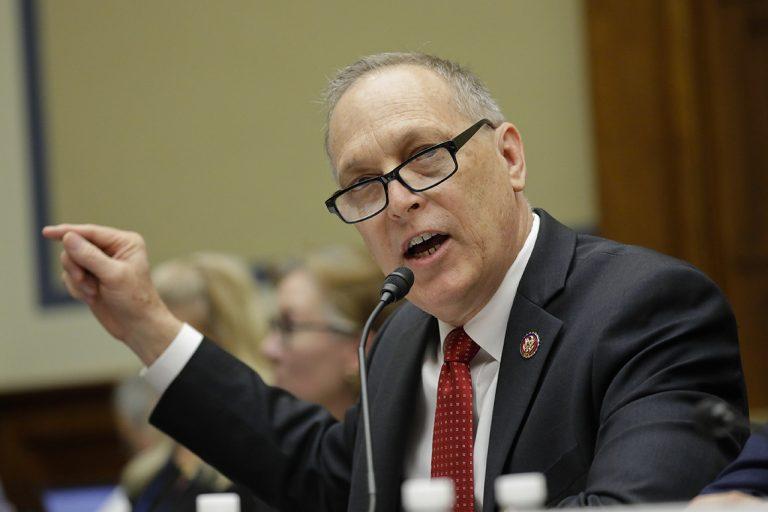
(Headline USA) Rep. Andy Biggs, R-Ariz., warned FBI leadership this week that House Republicans might vote against reauthorizing the Foreign Intelligence Surveillance Act because of the agency’s repeated abuses of the law.

FISA’s surveillance powers under Section 702 are set to expire this year, which means Congress will have to vote to reauthorize them. Biggs said he is reluctant to do so, in large part because of a recent report issued by the Office of the Director of National Intelligence, which found that the FBI used “backdoor searches” to access FISA data on U.S. citizens and lawmakers.

 “In one query incident, FBI queried the names of a local political party to determine if the party had connections to foreign intelligence. This query was not reasonably likely to retrieve foreign intelligence information,” the DNI report said.

The FBI also conducted an unknown number of FISA queries using only the name of a U.S. congressman, according to the report.

In total, the FBI may have conducted as many as 3.4 million warrantless searches of U.S. citizens’ data in 2021 alone.

“During the last reauthorization of Section 702, Congress considered an amendment to require a warrant for access to 702 data relating to U.S. persons,” Biggs wrote in a letter to the FBI. 

“However, federal intelligence agencies used scare tactics to convince legislators that unchecked use of this information is the only way to keep our nation safe from harm. The Fourth Amendment to the U.S. Constitution is clear— Americans have the right to be free from warrantless surveillance by government bureaucrats,” he continued.

In his letter, Biggs asked FBI Director Christopher Wray to respond to several questions about the DNI report, including whether the U.S. congressman whose name was used by FBI agents was made aware that his name appeared in the 702 database and whether any steps were taken to discipline the intelligence analyst responsible for the query.

China Sanctions Lockheed Martin, Raytheon for Taiwan Sales

(Headline USA) China on Thursday imposed trade and investment sanctions on Lockheed Martin and a unit of Raytheon for supplying weapons to Taiwan, stepping up efforts to isolate the island democracy claimed by the ruling Communist Party as part of its territory.

Lockheed Martin Corp. and Raytheon Technologies Corp.’s Raytheon Missiles and Defense are barred from importing goods into China or making new investments in the country, the Ministry of Commerce announced.

It said they were added to the “unreliable entity” list of companies whose activities are restricted because they might endanger national sovereignty, security or development interests.

It wasn’t clear what impact the penalties might have. The United States bars most sales of weapons-related technology to China, but some military contractors also have civilian businesses in aerospace and other markets.

Taiwan and China split in 1949 after a civil war. The island of 22 million people never has been part of the People’s Republic of China, but the Communist Party says it is obliged to unite with the mainland, by force if necessary.

President Xi Jinping’s government has stepped up efforts to intimidate Taiwan by flying fighter jets and bombers near the island and firing missiles into the sea.

The United States has no official relations with Taiwan but maintains extensive commercial and informal contacts. Washington is obligated by federal law to make sure the island’s government has the means to defend itself.

The United States is Taiwan’s main supplier of military equipment.

Raytheon Missiles and Defense, part of Raytheon Technologies Corp., was awarded a $412 million contract in September to upgrade Taiwanese military radar as part of a $1.1 billion package of U.S. arms sales to the island. Boeing Defense received a $355 million contract to supply Harpoon missiles.

Beijing responded to that sale by announcing sanctions against the CEOs of Raytheon and of Boeing Defense but gave no details of what they were.

Lockheed Martin has supplied Taiwan’s military with radar, helicopters and air traffic control equipment. It plays a role in the island’s development of its own fighter jet and navy frigates.

In China, Lockheed Martin has sold air traffic control equipment for civilian airports and helicopters for commercial use.

Beijing announced plans for the “unreliable entity” list in 2019 in response to U.S. restrictions imposed on Huawei Technologies Ltd., a Chinese maker of telecom equipment.

Adapted from reporting by the Associated Press

Oregon Appeals Court Blocks Right to Establish 2nd Amendment Sanctuaries

0

(Headline USA) Local governments in Oregon can’t declare themselves Second Amendment sanctuaries and ban police from enforcing certain gun laws, a state appeals court decided Wednesday, in the first court case filed over a concept that hundreds of U.S. counties have adopted in recent years.

It is unclear whether the ruling against gun-rights, which are protected under the U.S. Constitution, might also have broader implications concerning the implementation of other laws that defy federal authority.

The “sanctuary” idea stemmed from a separate effort by left-leaning cities and states to obstruct immigration enforcement during the Trump presidency. Oregon touts itself as the first so-called sanctuary state, saying its law has been in effect since the Ronald Reagan administration.

The measure currently in question, which was approved in Columbia County, forbids local officials from enforcing most federal and state gun laws and would impose thousands of dollars in fines on those who try.

The state Court of Appeals ruled that it violates a law giving the state the power to regulate firearms.

The ordinance would effectively, it found, “create a ‘patchwork quilt’ of firearms laws in Oregon, where firearms regulations that applied in some counties would not apply in Columbia County,” something lawmakers specifically wanted to avoid.

Second Amendment sanctuary resolutions have been adopted by some 1,200 local governments around the U.S., including in Virginia, Colorado, New Mexico, Kansas, Illinois and Florida, experts say.

Many are symbolic, but some carry legal force like the one in Columbia County—a conservative, rural logging area in deep-blue Oregon.

The Oregon case was filed in 2021 under a provision in state law that allows a judge to examine a measure before it goes into effect. A trial court judge originally declined to rule, a decision that was appealed to the higher court.

The ordinance’s supporters included the Oregon Firearms Federation, which said in a statement Wednesday that the ruling “calls into question the legitimacy of the court and the likelihood of getting fair rulings from it.”

Opponents included the legal arm of the Michael Bloomberg-funded group Everytown for Gun Safety, which, ironically, had argued that the ordinance violated the U.S. Constitution.

“Opponents of gun safety laws have every right to advocate for change at the ballot box, statehouse, or Congress, but claiming to nullify them at the local level is both unconstitutional and dangerous,” said Eric Tirschwell, executive director of Everytown Law.

Adapted from reporting by the Associated Press

A-List Actor Loses Fight Against Amazon Encroachment in Rural Va. County

(Headline USA) Actor Robert Duvall was one of more than 100 speakers at a northern Virginia town’s council meeting opposing a proposed $550 million data center from Amazon.

In a meeting that began early Tuesday evening and concluded well after midnight early Wednesday morning, the Town of Warrenton voted 4-3 to approve a special use permit for Amazon, despite Duvall’s opposition.

The 92-year-old Godfather and Great Santini actor lives on a farm in Fauquier County, which surrounds the town.

“We must all work to preserve the character of this town,” Duvall said. “The vast majority of town and county residents agree that this is a bad use of this site.”

He received a standing ovation from attendees at the meeting in Fauquier High School at the conclusion of his remarks.

The northern Virginia region, outside the nation’s capital, is home to the world’s largest concentration of data centers, which house the computer servers and hardware required to support modern internet use.

As data centers have expanded, community opposition has increased, and neighbors have expressed concern over noise from the fans required to keep the machines cool.

Others express concerns about the data centers’ need for electricity and the requirement to build high-voltage transmission lines to support them.

Data centers have also been a revenue boon to local governments, and last month Virginia Gov. Glenn Youngkin announced a plan for Amazon Web Services to invest $35 billion in new data centers across the state.

In Warrenton, Amazon projects that about 50 workers will be employed at the data center. Supporters said the data center will generate about $900,000 in tax revenue for the town annually.

The permit approved by the town includes noise restrictions and bans construction of an electric substation on the site. Distribution lines from the off-site substation that will serve the data center must be constructed underground, according to the permit.

The NIMBYism directed at Amazon is not the first time wealthy residents of the bucolic county have risen up in opposition to urban sprawl.

In the early 1990s, Duvall and other millionaires, including candy heiress Jacqueline Mars, bitterly fought Disney’s efforts to create a history-themed amusement park in the area, which is near several prominent Civil War battlefields.

A group called Citizens for Fauquier County, which led those efforts, also fought to prevent a Walmert supercenter from opening on the edge of town, reported the Washington Post, which is owned by Amazon founder Jeff Bezos.

Although it was successful at the time, Warrenton eventually did wind up with a Walmart.

Adapted from reporting by the Associated Press

NCAA Asks U.S. Appeals Court to Block Pay for Student–Athletes

(Headline USA) The NCAA asked a federal appeals court on Wednesday to reject a legal effort to make colleges treat Division I athletes like employees and start paying them an hourly wage.

Lawyers for the student-athletes said that weekly, they often spend 30 hours or more on their sport and often need money for expenses, even if they are on full scholarship. And they believe the athletes deserve a share in the millions that are spent on coaches, college administrators and facilities—and the billions that networks pay to televise college sports.

They are not seeking pay equivalent to their market value, but only a modest across-the-board pay rate similar to those earned by work-study students, the lawyers said.

“This does not open up a circumstance in which there’s a bidding war [for top talent],” lawyer Michael Willemin said.

The NCAA urged the court to uphold the tradition of college athletes being unpaid amateurs.

Critics of the pay-for-play scheme also fear the cost could lead schools to cut sports that don’t generate as much or any revenue while sending more resources to their profitable football and basketball programs.

Lawyer Steven B. Katz, arguing for the NCAA, said a finding that athletes are employees “launches you on the edge of a slippery slope that rapidly takes you to someplace that you don’t want to go.”

As an example, he said that the cost to attend some of the private colleges involved in the case exceed $70,000 a year. The value of a full scholarship would far outweigh the $10,000 to $15,000 the athletes might earn if they were paid a modest hourly wage, he argued.

Katz also said the scholarships could become taxable if the students are deemed employees. And he questioned how teams would function if some students were “paid employees” on scholarship while walk-ons without a scholarship were not.

At least one person on the panel, U.S. Circuit Judge Theodore McKee, seemed to think at least some student–athletes may be employees under the Fair Labor Standards Act—while acknowledging such a finding would create “so many practical problems.”

Would football players at powerhouse schools earn more than swimmers at small schools? What about Division II athletes?

“Maybe that’s where we end up—that the quarterback at the SEC school is an employee and the woman who’s running cross-country track at Alabama, they’re not an employee,” McKee said.

When Katz raised the potential risk of back taxes being owed, McKee cut him off, saying “the case is complicated enough without us going down that” rabbit hole.

A lower court judge had declined to dismiss the lawsuit before it went to trial, prompting the NCAA to appeal. The three-judge panel did not indicate when it would rule.

Willemin, arguing for the students, said the NCAA burdens athletes with rigid rules on gambling, earning outside income and free speech while their school teams further restrict their choices by controlling their class schedule, study halls and at times even their college major. The NCAA could loosen its grip on student–athletes and the case might go away, he suggested.

“The NCAA has turned the idea of student–athlete on its head, even in non-revenue generating sports,” he said. “These are regulations the NCAA can change. They’ve chosen not to change them.”

The case is just the latest one to test the NCAA’s traditional amateurism model—and comes as the organization already faces complicated issues stemming from the advent of name, image and likeness deals that can top $1 million for the most popular college athletes.

The NCAA also hopes that Congress might weigh in, given a series of setbacks in the courts. They include the unanimous U.S. Supreme Court decision last year that lifted the ban on compensation beyond full scholarships, and let colleges give athletes education-related benefits such as computers and study abroad program fees.

Adapted from reporting by the Associated Press

Brandonville: Federal Gov’t Clears Hobo Tent City 3 Blocks from White House

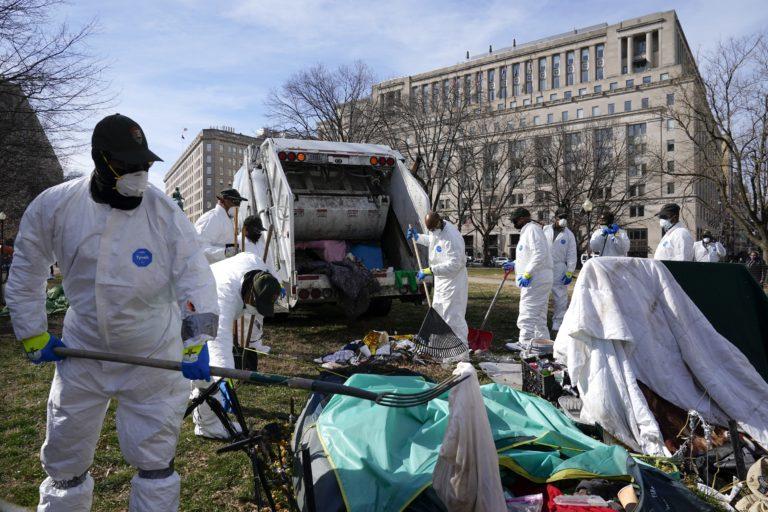
(Headline USA) National Park Service employees on Wednesday swept through a large homeless encampment three blocks from the White House, tearing down dozens of tents and warning that people who resisted would be subject to arrest.

Workers in white jumpsuits used rakes, shovels and pitchforks to clear McPherson Square, tossing the remnants of the tent city into a pair of garbage trucks.

The action was the latest development in a long-running saga involving the District of Columbia government, the Park Service and homeless people, whose advocates claim the city hasn’t done enough to help them find safe shelter.

“There are people living here who don’t know where they’re going to sleep tonight. The entire purpose of this is to displace people and to ‘invisiblize’ and criminalize homelessness,” said Jesse Rabinowitz, of Miriam’s Kitchen, one of a collection of charitable organizations that has been working with those who have made the park their home.

The encampment in McPherson Square has grown steadily over the past year, to about 50 tents as of Wednesday. Many people said they came after encampments in other parts of downtown were cleared by either the federal agency or the city government.

“Any time people were forced out of somewhere else, they would see the tents here and figure it was safe for a while,” said Daniel Kingery, who has lived in the park for three years.

While the majority of the estimated 70 people live in the park complied without incident, Kingery, 61, cheerfully said authorities “would have to carry or drag me away.”

The National Park Service, which has jurisdiction over McPherson Square and large swaths of other green space across the city, had originally announced plans to clear the square in April. But the deputy mayor for health and human services, Wayne Turnage, requested that the date be moved up by two months, saying the encampment was an imminent public health hazard.

NPS spokesman Mike Litterst said that despite the accelerated timeline, there still was notice of about two weeks. “The District’s social service providers intensified their efforts to connect people with housing and other services,” he said.

In the morning, police sealed off the park and repeatedly announced over a loudspeaker that the space would be closed down and those who refused to leave would risk arrest.

As the 10 a.m. deadline approached, a group of representatives from a coalition of charitable groups helped to gather up and label people’s belongings and haul them off in a rental truck.

Representatives from Pathways to Housing, a charity that contracts with the D.C. government as a liaison to the downtown unhoused population, went tent to tent, making sure each person was aware of what was coming.

“Brandon, they are going to come here and take this down,” one worker shouted outside a closed tent. “They’re coming, you have about 10 minutes!”

The issue of Washington’s robust homeless population has been a long-term puzzle for Mayor Muriel Bowser’s government. The tent clusters frequently move between city and Park Service land to take advantage of the district’s specific jurisdictional complexities.

City officials say they have offered consistent outreach services and shelter for all who were willing to engage with the system. But those who live in the park dismissed the short-term shelter system as unsafe and undignified.

“The shelters are infested with mice and there’s mold on the walls. And they’re not safe,” said a woman named Umi, who declined to give her last name. She said Bowser and Turnage “need to go sleep one night in one of these shelters and see what we experience.”

Housing activists say most of those who are unhoused would happily take part in a government program that offers vouchers for subsidized apartments. But that program has been plagued by delays and a bottleneck partially caused by staffing shortages.

“One of the things that makes this so appalling is that the city does have ample resources,” said Diane Yentel, president of the National Low Income Housing Coalition, whose office overlooks the park.

Yentel said case workers “needed more time” to work with the McPherson Square residents, but those efforts were cut short when the federal government agreed to accelerate the deadline.

Adapted from reporting by the Associated Press

Ohio Town’s Residents Demand Answers over Toxic Spill, Federal Gov’t Inaction

(Headline USA) Residents of the Ohio village upended by a freight train derailment packed a school gym to seek answers about whether they were safe from toxic chemicals that spilled or were burned off.

Hundreds of worried people gathered Wednesday in East Palestine, near the Pennsylvania state line, to hear state officials insist yet again that testing shows local air is safe to breathe so far and promise that air and water monitoring would continue.

However, skepticism continued to mount, with the hashtag #OhioChernobyl and others like it trending on Twitter.

With the community in the national spotlight, U.S. Environmental Protection Agency Administrator Michael Regan is slated to visit Thursday to assess the ongoing response and hear from impacted residents.

Much of the current criticism stems from what appeared to be a disinterest among other top government officials—including Transportation Secretary Pete Buttigieg, who has developed a reputation for his leaves of absence during a string of critical inflection points related to the nation’s infrastructure.

Those attending Wednesday’s informational session, which was originally billed as a town hall meeting, had many questions over health hazards, and they demanded more transparency from railroad operator Norfolk Southern, which did not attend, citing safety concerns for its staff.

“They just danced around the questions a lot,” said Danielle Deal, who lives a few miles from the derailment site. “Norfolk needed to be here.”

In a statement, Norfolk Southern said it didn’t attend alongside local, state and federal officials because of a “growing physical threat to our employees and members of the community around this event.”

Deal called that a “copout” and noted the seriousness of the incident.

Deal and her two children left home to stay with her mother, 13 miles away “and we could still see the mushroom cloud, plain as day,” she said.

Nearly two weeks after the derailment, people in the area have many concerns about the huge plumes of smoke they saw, persisting odors, risks to pets and wild animals, potential effects on drinking water and what’s happening with the cleanup.

Even as school resumed and trains were rolling again, people were worried.

“Why are they being hush-hush?” Kathy Dyke said of the railroad. “They’re not out here supporting, they’re not out here answering questions. For three days we didn’t even know what was on the train.”

“I have three grandbabies,” she said. “Are they going to grow up here in five years and have cancer? So those are all factors that play on my mind.”

In and around East Palestine, residents said they wanted assistance navigating the financial help the railroad has offered hundreds of families who evacuated, and they want to know whether it will be held responsible for what happened.

Ohio’s Republican attorney general, Dave Yost, advised Norfolk Southern on Wednesday that his office is considering legal action against the rail operator.

“The pollution, which continues to contaminate the area around East Palestine, created a nuisance, damage to natural resources and caused environmental harm,” Yost said in a letter to the company.

The state’s Environmental Protection Agency said the latest tests show five wells supplying the village’s drinking water are free from contaminants. But the EPA also recommends testing for private water wells because they are closer to the surface.

The Ohio Department of Natural Resources estimates spilled contaminants affected more than 7 miles of streams and killed some 3,500 fish, mostly small ones such as minnows and darters.

There have been anecdotal reports that pets or livestock have been sickened. No related animal deaths have been confirmed, state officials said, but that confirmation would require necropsies and lab work to determine the connection to the incident.

Norfolk Southern announced Tuesday that it is creating a $1 million fund to help the community of some 4,700 people while continuing remediation work, including removing spilled contaminants from the ground and streams and monitoring air quality.

It also will expand how many residents can be reimbursed for their evacuation costs, covering the entire village and surrounding area.

“We will be judged by our actions,” Norfolk Southern President and CEO Alan Shaw said in a statement that the company is “cleaning up the site in an environmentally responsible way.”

No one was injured when about 50 cars derailed in a fiery, mangled mess on the outskirts of East Palestine on Feb. 3. As fears grew about a potential explosion, officials seeking to avoid an uncontrolled blast had the area evacuated and opted to release and burn toxic vinyl chloride from five rail cars, sending flames and black smoke billowing into the sky again.

A mechanical issue with a rail car axle is suspected to be the cause of the derailment, and the National Transportation Safety Board said it has video appearing to show a wheel bearing overheating just beforehand. The NTSB said it expects its preliminary report in about two weeks.

State and federal officials have repeatedly offered assurances that air monitoring hasn’t detected any remaining concerns. Even low levels of contaminants that aren’t considered hazardous can create lingering odors or symptoms such as headaches, Ohio’s health director said Tuesday.

They claimed precautions also were being taken to ensure contaminants that reached the Ohio River don’t make it into drinking water for a watershed that covers multiple surrounding states.

Adapted from reporting by the Associated Press