Blinken Draws Fire over Afghanistan Blame Game, ‘Stonewalling’

(Susan Crabtree, RealClear Wire) Former Ambassador Thomas Boyatt, a highly decorated foreign service officer who served in multiple senior U.S. foreign service roles in the 1970s and 80s, has a bone to pick with Secretary of State Antony Blinken.

Since the chaotic and deadly U.S. exit from Afghanistan, Blinken has refused to turn over to Congress a key internal State Department dissent document signed by 23 U.S. diplomats at the embassy in Kabul. The classified cable was sent to Blinken and top leadership at State in July 2021, one month before the evacuation descended into chaos.

The classified memo reportedly urged the administration to accelerate evacuation plans because the Afghan government was on the brink of collapse as the Taliban swept the country. Its existence was leaked to the Wall Street Journal after the Taliban took control of the country and the U.S. withdrawal quickly went sideways.

What’s worse, in Boyatt’s view, is that the State Department is now using a misleading precedent surrounding a dissent cable he sent nearly 50 years ago as its rationale for withholding the Afghanistan dissent document from Congress.

When Boyatt learned about Blinken’s refusal and his reasons –  that he was trying to protect future dissent cables from a chilling effect – “It was like tearing off the scab of an old wound of mine,” Boyatt, now 90, told RealClearPolitics Tuesday.

Blinken had cited the 1975 precedent of the department’s refusal to provide Congress the dissent cable written by Boyatt before Turkey invaded Cyprus just a year before. Boyatt recently provided a statement to Rep. Mike McCaul, slamming Blinken’s stated concerns about protecting the integrity of the dissent cable system as “bullshit.”

McCaul, a Texas Republican who now chairs the House Foreign Affairs Committee, has been requesting the cable since first learning about it in late August of 2021 while events were unraveling in Kabul. Last week, a deadline passed for McCaul’s subpoena for the cable, with Blinken still resisting.

While serving as the State Department’s director for Cyprus affairs, Boyatt used the official dissent channel to warn then-Secretary of State Henry Kissinger and the Nixon administration that the Greek army was planning to overthrow the Cypriot president and install a puppet Cypriot government.

If this were to occur, his cable warned, Turkey’s armed forces would invade Cyprus and establish a Turk-Cypriot mini-state on Cyprus, leading to the displacement of Cyprus’s ethnic communities and fueling Turkey’s expansionist objectives. Boyatt says he decided to utilize the dissent cable process to alert the Nixon administration about the impending invasion after exhausting normal State Department channels.

Instead of attempting to stop the invasion, however, Kissinger removed Boyatt from his position in Cyprus five days after he sent the cable. Boyatt went on to serve as counselor in the U.S. embassy in Chile while events in Cyprus unfolded just as he had warned.

Boyatt notes that his friend, Rodger Davies, who was serving as ambassador to Cyprus at the time, was shot dead during a Greek Cypriot protest outside the U.S. embassy. It was just a week after Turkey’s invasion, and roughly 300 people were protesting against the United States’ failure to prevent the Turkish invasion.

After the Nixon administration, Boyatt served as ambassador to Upper Volta in 1978 and ambassador to Colombia in 1980. Even before Kissinger punished him for airing opposition through the classified dissent cable process, Boyatt was already a hero within the agency – lauded for his bravery demonstrated during a 1969 TWA flight he was on that was hijacked by Palestinian terrorists. That year, the State Department honored him with its Meritorious Honor Award for helping injured passengers to safety and negotiating the passengers’ release with the Syrian government.

Roughly a year after Turkey invaded Cyprus, a Democratic-controlled House committee decided to scrutinize the Nixon administration’s foreign policies in Cambodia, Chile, and Cyprus. It demanded that Kissinger hand over Boyatt’s dissent cable on Cyprus. Kissinger refused, arguing that he wanted to protect Boyatt from retaliation.

“That was a joke at the time,” Boyatt recalled, explaining that back then, “everybody in my world” was well aware of Kissinger’s penchant for punishing those who challenged his judgment and the administration’s prevailing foreign policies.

State Department officials across the agency were on edge because Kissinger had recently retaliated against another U.S. diplomat, Archer Blood, for sending what was considered one of the most strongly worded cables in the history of the U.S. foreign service while serving as U.S. consul general to Dhaka, East Pakistan (now Bangladesh). Signed by 20 members of the diplomatic staff. the “Blood Telegram” protested the atrocities being committed in the Bangladesh Liberation War.

The dissent memo angered Kissinger, who recalled Blood from the position and assigned him to the State Department personnel office, retribution for airing his views contradicting Kissinger’s and Nixon’s hopes of using the support of West Pakistan for diplomatic openings with China.

Even though the demotion severely harmed Blood’s career, his telegram became the precursor to the creation of the official State Department “dissent channel” that formed in the following years, the same system Boyatt used to air his warnings. The State Department agreed to establish the channel partly in response to concerns that contrary opinions were suppressed or ignored during the Vietnam War. In 1971, Blood received a prestigious Christian Herter Award for “extraordinary accomplishment involving initiative, integrity, intellectual courage, and creative dissent.” The Herter Award was established by the American Foreign Service Association, AFSA, the U.S. foreign service labor union, to honor senior diplomats who challenge the status quo.

“The point is that nobody in Washington or the State Department or anyone else believed that Kissinger’s concern was for the well-being of the dissenters,” Boyatt recalled. “His concern was that he did not want a series of mistakes in the public record with respect to the Cyprus crisis. I strongly suspect that that is the same motive with Blinken.”

The State Department has vigorously defended its decision to fight McCaul’s subpoena. The agency also denied a request for the cable by Rep. Gregory Meeks, a New York Democrat who chaired the panel before Republicans won the majority last year.

Instead, State has offered to provide a closed-door briefing, proposed for later this week, for McCaul and other members of Congress about the “concerns raised and the challenges identified” by U.S. embassy staff in Kabul before and during the withdrawal, State Department spokesperson Vedant Patel told RCP.

“Secretary Blinken has continued to make clear his and the State Department’s commitment to working with the House Foreign Affairs committee to provide relevant information while also upholding his responsibility to protect the integrity of the Department’s dissent channel,” Patel said in an emailed statement. “We continue to believe that our offers can satisfactorily provide the committee with the information it needs to conduct its oversight function while still protecting the dissent channel.”

McCaul has repeatedly dismissed Blinken’s justification for withholding the Afghanistan dissent cable and has pledged to pursue legal recourse if Blinken continues to ignore his subpoena. While McCaul has accepted State’s offer for a briefing, he has told the agency that it in no way satisfies the subpoena.

“I am currently discussing next steps with my staff and House legal counsels to decide on what action to take if the State Department continues to refuse to comply with the subpoena despite their legal obligation to do so,” McCaul said in a statement last week.

Boyatt also rejects the State Department’s rationale that it’s simply protecting dissenters from retaliation and trying to prevent a chilling effect on future dissent.

“The reality is that if a dissent cable or dissent memorandum for one reason or another reaches public purview, it’s good for a variety of national security reasons because it forces the bureaucracy to confront its mistakes and to concentrate on not repeating them,” Boyatt said.

The dissenters themselves are applauded by their peers, Boyatt said, and rightly so because all foreign service officers take an oath to support and defend the Constitution against all enemies, foreign and domestic, and to do their best to support U.S. foreign policy interests.

“They instantly become heroes to some 15,000 foreign service officers serving all over the world,” he added. “They become eligible for, and many do receive, awards from the American Foreign Service Association for creative dissent.”

Underscoring his point, two diplomats stationed in Kabul who signed the July 2021 dissent cable recently received AFSA’s William R. Rivkin Award for Constructive Dissent by a Mid-Level Foreign Service Officer. The union publicly recognized the pair for their “courage” in using the classified dissent channel to “speak an unpopular truth to power.”

Elisabeth Zenos and Anton Cooper, foreign service officers who served in Kabul in 2020 and 2021, embody “the best traditions of the Foreign Service and constructive dissent in a uniquely difficult moment, bringing their intellectual courage, astute analysis and willingness to speak an unpopular truth to power,” AFSA wrote about the pair on its website.

“Using the appropriate internal embassy channels, Ms. Zentos and Mr. Cooper presented their concerns and a proposed course of action,” the organization said, adding that Zentos and Cooper turned to the dissent channel when their positions differed from the “established views of decision-makers.”

AFSA also noted that the cable received the “required response from the secretary of state’s policy planning staff, and preparations reportedly sped up – but unfortunately, not quickly enough to avoid the events that transpired in Kabul.”

Despite choosing Zentos and Cooper for the award, one of several the union handed out in 2022, AFSA has defended Blinken’s decision to withhold the dissent cable from Congress. In March, Eric Rubin, the union’s president, said the dissent channel must be protected under the executive branch or risk undermining the privileged purposes the secure communication line provides.

“AFSA maintains that constructive dissent can only thrive and be successful if it remains confidential and confined to internal discussion within the executive branch,” Rubin said in the statement.

Boyatt strongly disagrees and says he’s hardly alone among his State Department colleagues, current and retired. “I think they’re wrong, and the next time I see [Rubin], the current president, I’m going to tell him that,” Boyatt told RCP.

Republicans over the last week have hammered the Biden administration for what they characterized as more than a year of stonewalling their oversight requests for key Afghanistan documents. McCaul on Tuesday sent a separate letter to Blinken asking for the public release of key parts of its after-action review of the Afghanistan withdrawal. The Texas Republican stressed that some of the information in the report that he’s reviewed “stands directly at odds with the administration’s public narratives.”

The 87-page report was completed more than a year ago and was only provided to Congress recently after a subpoena threat from Republicans. McCaul also took issue with State’s decision to withhold parts of the after-action review from the public even though the vast majority of its contents are marked as either “sensitive but unclassified” or “unclassified.” The unclassified sections of the review, including the executive summary, findings, and recommendations, should be released “immediately,” and an unclassified version of the complete document within 60 days, McCaul argued.

State Department spokesman Vedant Patel on Tuesday said there are “no plans” at the moment to declassify the after-action review and release it publicly.

On April 6, while Congress was out of town and two days before Easter weekend, the Biden administration released a 12-page unclassified document claiming to summarize the findings of the after-action review. John Kirby, the National Security Council spokesman, released the summary 10 minutes before appearing at a White House press conference. The move drew criticism from several reporters who publicly complained of being blind-sided by the report.

While the summary acknowledged mistakes in evaluating the risks of a Taliban takeover of the Afghan government, the Biden administration defended its decision to end the war and blamed the Trump administration for leaving them with few options and even less planning capability.

When RealClearPolitics’ Phil Wegmann asked if the after-action review summary included information about the dissent cable, Kirby referred him to the State Department. During the briefing, reporters also repeatedly questioned Kirby for denying that the Afghanistan evacuation was chaotic despite disturbing photos and videos that emerged amid the final days of the withdrawal.

“For all this talk of chaos, I just didn’t see it,” Kirby told reporters during the White House briefing, adding, “I just don’t buy the whole argument of chaos.”

The shocking images from the final days of the Afghanistan withdrawal showed desperate Afghans clinging to the wings and wheels of U.S. military planes taking off from Kabul, including images of several Afghans falling to their deaths. On August 26, a suicide bomber killed 13 U.S. servicemen and women, injured 45 others, and killed 170 Afghans after the Taliban took control of the country and panicked Afghans, along with U.S. citizens, jammed into the Kabul airport in a desperate attempt to flee.

Last month, Sgt. Tyler Vargas-Andrews, a Marine sniper, told a House hearing convened by McCaul that his military leaders ignored his warnings about the suicide bomber’s movements. Several minutes later, the bomber detonated his vest in a blast that cost Vargas-Andrews a leg, an arm, and a kidney. Vargas-Andrews has undergone 44 surgeries over the last year and a half.

After the Biden administration released the 12-page summary report, a former U.S. ambassador to Afghanistan called the document “shameful” and “a White House whitewash.”

Retired Ambassador Ryan Crocker, who capped a four-decade foreign service career as the top U.S. diplomat in Kabul in 2011 and 2012, said the Trump administration bears blame for adhering to a pre-determined end date for the exit of U.S. and NATO forces, but that doesn’t absolve Biden for carrying out the Trump policy without setting conditions or considering shifting dynamics on the ground.

“Frankly, it’s dishonest,” Crocker said of the Biden administration’s repeated blaming of Trump and his senior foreign policy leaders. “This administration – ably and amply assisted by the previous administration, of course – were the ones who set the stage for that incredibly swift Taliban takeover.”

Crocker also blasted the summary for touting the Biden administration’s work to ramp up the processing of special immigrant visas for Afghans who aided Americans as interpreters and in other roles that makes them Taliban targets while failing to mention that hundreds of thousands of Afghan allies are still trying to flee the country.

The absence of any mention of our broken promises to Afghan allies is “as shameful and as egregious to me as anything in that document,” Crocker said. More than 150,000 special immigrant visa applicants are still trying to escape Afghanistan, according to internal Biden administration estimates, Foreign Policy reported in March. Other advocates say the numbers could be twice as high.

Crocker says he believes Blinken should provide the dissent cable to Congress without the names of those who signed it to protect their identities and prevent any possible harm to their careers “down the line,” especially when it comes to younger foreign service officers.

“I certainly believe that with an issue of this magnitude, Congress has an obligation to seek, and the executive has an obligation to provide, access to reports that have a direct bearing on a huge foreign-policy issue,” he told RCP.

It was appropriate to keep the document classified in the weeks after it was first generated amid a quickly deteriorating situation in Afghanistan, Crocker said, but those reasons no longer apply.

“That’s not what you would want to have out on the street available to our adversaries in the middle of this whole thing, but my guess is now that we are way, way past that … the classification has to be re-looked in light of the current situation,” he said.

Crocker also has a personal experience of voicing dissent, although there was no time to put his views into writing or to get a cable out. In the fall of 1983, several months after the deadly bombing of the U.S. embassy in Beirut, Crocker said the Reagan White House envoy for Lebanon, Robert “Bud” McFarlane, “got himself panicked by a Lebanese brigade commander that the forces of darkness were sweeping all the forests and unless we did something, they would have seized the presidential palace complex within a matter of hours.”

Crocker said he received a call from David Mack, a former ambassador to the United Arab Emirates who was serving as the director of Syria, Lebanon, and Jordan back at the State Department at the time. Mack told him what the recommendation was and asked for his thoughts.

“I thought it was a catastrophic mistake, and then dictated to him over a secure phone my opposition to it and why – [That it was] essentially dragging us as a participant into the Lebanese civil war,” Crocker recalled. “Like most messages, it was basically ignored.”

McFarlane has been criticized for his decision to order the USS New Jersey to bombard Lebanese opposition forces, which may have led to the 1983 Beirut barracks bombing where 241 U.S. servicemen, 58 French military personnel, and six civilians were killed. After that assignment, McFarlane returned to Washington and became President Reagan’s national security adviser and a central figure in the Iran-Contra affair.

A year or so later after formally objecting, Crocker received an award by AFSA for creative dissent for choosing to voice his opposition to the prevailing foreign policy opinion.

“Again, it had no impact whatsoever, but I would have been perfectly fine if that message was released or the transcription was released and my name was attached to it,” he said. “It would not have bothered me in the slightest. I would have been happy.”

The White House also has tried to defend itself against searing criticism from Special Inspector General for Afghanistan Reconstruction John Sopko, who accused the administration last week of unprecedented obstruction of his oversight of the chaotic withdrawal from Kabul.

The morning before Sopko testified to the House Oversight Committee, the administration, in a memo to reporters, argued that it had provided “thousands of pages of documents, analyses, spreadsheets, and written responses to questions, as well as hundreds of briefings to bipartisan members and staff and public congressional testimony by senior officials, all while consistently providing updates and information to numerous inspectors general.”

White House press secretary Karine Jean-Pierre repeated the claim in tense exchanges with reporters during her daily briefing. There was no mention, however, of Blinken’s refusal to provide a copy of the dissent cable.
On Economy, Biden Reelection Faces Challenges

(Philip Wegmann, RealClear Wire) As President Biden embarks on his reelection campaign, a majority of American voters are dissatisfied with his stewardship of the U.S. economy. Aware of the general angst among the electorate, Biden is threading the needle by saying he’s running on the strength of his overall record, while vowing to “finish the job” that he started when he stepped into the Oval Office.

It’s a daunting task, with an overwhelming majority of registered voters expressing deep pessimism about the economy: 40.2% say the United States is currently in a recession, 17% call it a general state of stagnation, and 10.4% believe the country is in an outright depression.

The dour assessment comes from a new joint survey by RealClear Opinion Research and Emerson College Polling Institute. The political takeaway could very well be defined by a single word: opportunity.

Independent voters are consistently aligned with the Republican Party when it comes to economic questions such as the federal deficit and free trade. According to pollster Spencer Kimball, associate professor at Emerson College, the general dissatisfaction with the economy, and independent voter sympathy for the GOP point of view, “could present an opportunity for Republicans in 2024.”

Across demographic and political divides, inflation remains top of mind with 70% of voters identifying the now persistent phenomenon and the cost of living as the single most important economic challenge facing the economy. Biden agrees. He has for some time now.

For more than a year, the president has called combatting inflation his “top domestic priority.” But as his administration and federal regulators struggle through a variety of controls to achieve a soft landing, a scenario where inflation is throttled down without stalling markets, the president has not abandoned his push to transform the system from “the so-called trickle-down economy” to one “that works for working families.”

The rubber will likely meet the road on that question this summer, or whenever Treasury Secretary Janet Yellen can calculate an “X-date,” the moment when revenues run out and the federal government can no longer pay its bills. The debate is over raising the debt ceiling, the legal amount the Department of the Treasury can borrow. House Republicans want spending cuts in exchange for a borrowing limit increase. The White House refuses to negotiate. The consequence of an unresolved stalemate? A historic default.

This fight unsurprisingly divides partisans along party lines. A majority of Democrats (50%) agree with Biden that the debt ceiling should be raised. A larger majority of Republicans, 62%, do not want an increase in federal borrowing authority.

But while there is no consensus on the wonky but critical question, a closer look at the numbers suggests an advantage for House Speaker Kevin McCarthy over federal spending. “An issue for Democrats is that independents align with Republicans on not raising the debt ceiling,” Kimball explained, adding that their hesitation could stem from “their concern about inflation.”

More independent voters, 46%, believe that the debt ceiling should not be raised than those who say that it should be (29%) – a finding that may pique the attention of lawmakers as the borrowing debate rages on Capitol Hill, especially now as a record number of Americans identify not as Republican or Democrat but as independent of either party.

Last month, Biden released his proposed annual budget, an aspirational document with little hope in Congress, and touted his plan to reduce the deficit by nearly $3 trillion over the next decade. “Don’t tell me what you value,” the president is fond of saying. “Show me your budget, and I’ll tell you what you value.” A majority of Americans, if they have even seen that document, don’t believe Biden values fiscal responsibility.

Fifty-one percent of voters disapprove of how Biden has handled the federal budget deficit while just 32% approve. Another 17% are unsure on the question. Kimball reported that conservatives were most uniform in their opposition, noting that “Republicans most strongly disapprove of Biden’s handling of the federal budget deficit, with 84% disapprove, 11% unsure, and just 5% approve.”

The finding that could raise the alarm inside the administration? According to the survey, 52% of independent voters disapprove of the way Biden has handled national finances. Of course, that spending story can’t be told without an account of the once-in-a-century pandemic. The same is true of Biden himself: His presidency and the pandemic are inextricably linked.

Earlier this month, the president signed legislation passed by Congress to end the national emergency in response to the COVID-19 pandemic. The Government Accountability Office reported previously that there is about $90 billion remaining from the more than $4.6 trillion in emergency money that Congress appropriated to ease the economic effects of the pandemic, spending that both Republican and Democratic economists warned could overheat the economy.

Even as they name inflation their top concern, a majority of voters still believe that spending was necessary and a good idea. For instance, 63% report that the CARES Act which former President Trump signed into law was “a good idea.” A similar-sized majority, 59%, said the same about Biden’s American Rescue Plan. With the pandemic in the rearview mirror, 34% report that there wasn’t enough, 28% say the right amount was spent, and 38% believe too much was distributed from the government.

The pollsters gauged approval of the spending legislation with and without the names of the presidents who signed them into law.

Tell a voter that Trump was behind the CARES Act, Kimball said, and it “helps him among Republicans, hurts him with Democrats but has little impact on independent voters and their attitudes toward the legislation.” The same cannot be said for Biden and his American Rescue Plan, however. According to the pollster, “Biden’s name attached to a policy does not help the president; instead, his name on legislation hurts its support, particularly among independents.”

Regardless of which president signed what COVID relief package, an overwhelming majority of Americans report concern that the money was mismanaged or abused. All told, 86% said that abuse of COVID relief programs was a “serious” problem.

Looking back before the pandemic, when asked about the Trump-era tax cuts, 56% replied that the 2017 Tax Cuts and Jobs Act was “a good idea” compared to 44% who said it was not. A majority of Republicans, 63%, supported the move, and so did a 56% majority of independents. Democrats, however, were split 50% to 50% on the marquee achievement of the previous administration, which Biden has blasted as a giveaway to the wealthy.

When asked about persistent inflation, the administration points to both the pandemic as well as the war in Ukraine as a result. The conservative electorate has started to sour on U.S. involvement in the conflict, but a majority of Americans share Biden’s concerns about Russian President Vladimir Putin. Some 60% believe that Putin will not stop at Kyiv and intends to invade other countries.

Thousands of miles away, the war still concerns Americans at home with 55% reporting that they believe Putin presents a “major threat” to the United States and 36% saying he is “a minor threat.” Just 9% replied that the dictator was no threat at all.

And yet the poll reflects a public mixed on the question of just how much aid the United States should supply to Ukrainian allies. When asked about the $79 billion in military aid and financial support sent to Kyiv, 32% of voters reply that the United States has given the right amount while 25% say the current support is not enough. A plurality, 42%, say the United States has sent too much already.

Two factors seem determinative of how a voter sees the war in Ukraine and U.S. involvement: age and education. According to Kimball, those with a college degree “are about 10 points more likely to say the U.S. has given the right amount of support or not enough support” than those without a college degree, 63% to 53%.

The survey was conducted between April 10 and 12, polling 1,000 registered voters.

Minnesota Dems Push ‘Bias Registry’ to Track Thoughtcrimes

(Headline USA) Minnesota Democrats admitted this week that their proposed “bias registry” might include the names of citizens who oppose transgenderism or argue that COVID-19 originated in a Chinese lab.

State lawmakers are considering revising a state law, House File 181, to log alleged bias incidents even if they are not considered hate crimes. The bill would allow people to report alleged bias-related incidents so that the state could keep track of them.

However, Democrats admitted that there is no limit to what might qualify as a “bias.”

Republican state Rep. Harry Niska pressed his colleagues on how the registry would define “bias,” and asked them whether the definition would include speech that is critical of gender ideology or COVID-19 restrictions.

“If a Minnesotan writes an article claiming or arguing that COVID-19 is a Chinese bio-weapon that leaked from a lab in Wuhan, and someone reports that article to the Department of Human Rights, is that something that the Department of Human Rights should put in their bias registry under your bill?” Niska asked during a legislative session. 

Fellow state Rep. Samantha Vang, a Democrat, admitted that such rhetoric, since it is “bias motivated,” could be “considered a bias incident.”

Niska continued: “If a Minnesotan is wearing a t-shirt that says ‘I love J.K. Rowling’ and someone sees that and reports them to the Minnesota Department of Human Rights as an example of gender identity or gender expression bias, is that something that the Minnesota Department of Human Rights should put in this bias database?” he asked. 

Vang suggested this question would be better answered by lawyers and added, “I’m not going to say yes or no to that question.”

Other state Republicans warned that Democrats would use the “bias registry” to crack down on free speech and religious liberty.

“It seems very clear, based upon their focus on motivation, that they’re more concerned about what’s going on in people’s heads, which is protected speech, and that’s thoughtcrime,” said Republican state Rep. Walter Hudson.

Privacy Groups: Defund Dystopian DHS ‘Pre-Crime’ Program

(Ken Silva, Headline USA) A coalition of 40 pro-privacy groups have sent a letter to the U.S. Senate and House appropriations committees, urging them to defund the Department of Homeland Security’s Center for Prevention Programs and Partnerships, or CP3—a controversial initiative described by activists as a pre-crime program.

First announced in May 2021, CP3 is touted by DHS officials as a way to expand the department’s ability to prevent terrorism and targeted violence “through the development of local prevention frameworks.” In practice, this has resulted in the DHS distributing tens of millions of dollars in grants to local universities, healthcare organization, non-profits and law enforcement centers.

The DHS’s new initiative came on the heels of a March intelligence community report, which deemed white supremacy and violent domestic extremism as the most dangerous terror threat to the country.

To their credit, left-leaning privacy activists have opposed CP3, even when the DHS unveiled it as an ostensible way to combat “white supremacy.” According to those privacy activists, the DHS’s initiative amounts to a pre-crime program.

“CP3’s attempts to predict future crimes are to be based on behavioral patterns— i.e., profiling—and on encouraging members of the public to inform on their families, friends, and classmates,” Ed Hasbrouck, a consultant to the nonprofit Identity Project, wrote when CP3 was first announced.

“The problem, of course, is that the law does not permit prosecution based solely on patterns of lawful behavior. With good reason: ‘precrime’ prediction is a figment of the imagination of the creators of a dystopian fantasy movie, Minority Report.”

In their Wednesday letter to the House and Senate appropriations committees, the 40 pro-privacy groups agreed with Hasbrouck. The groups—which included the ACLU, Electronic Privacy Information Center and Muslims for Liberty—said CP3 is “wasteful, providing no security benefits and actively undermining civil rights, civil liberties, and privacy.”

The groups explained that the DHS’s initiative is relying on the discredited “radicalization” theory—the false idea that there are reliable predictive risk indicators demonstrating that someone is on a path to violence.

“Government-identified behavioral indicators have included communicating that one is in distress, deviating from one’s routine, isolation, economic stress, paying off debts, or being preoccupied with a person, place, belief, or cause. They are often commonplace, innocuous, or otherwise easily explained,” the groups said.

The privacy groups also raised concerns about the DHS’s venture into a nebulous “public health” behavioral threat assessment model.

“This new model has grantees train mental health professionals to carry out law enforcement functions such as identifying and reporting perceived threats, and turning clinics and medical assessments into sites of surveillance,” the groups said.

“Roping health and welfare groups into performing policing functions also compromises the willingness of patients, especially those coming from vulnerable populations, to seek crucial health care for fear of being surveilled by or reported to law enforcement.”

Additionally, the groups flagged the DHS’s new category of crime called “targeted violence.” The department has apparently created this category because the term “terrorism” doesn’t cover events such as mass shootings.

“The scope of targeted violence would cover crimes as disparate as school shootings, mass shootings, sabotaging oil pipelines and hate crimes in the same category, applying to these different behaviors the same debunked framework,” the groups warned.

“CP3 stigmatizes and delegitimizes innocent people based on what they think or who they know. Expansive criteria for who might be considered dangerous invites easily abused discretion into violence prevention,” the groups concluded. “The program is antithetical to the rights of all Americans to worship, associate, and believe freely as secured by the First Amendment.”

Ken Silva is a staff writer at Headline USA. Follow him at twitter.com/jd_cashless.

Bipartisan Bill Would Restrict Social Media for Minors, Ban for Young Children

(Molly Bruns, Headline USA) Four senators introduced the Protecting Kids on Social Media Act on Wednesday, which, if passed, would ban minors under the age of 13 from accessing social media and require parental consent for kids under 18.

Senators Brian Schatz, D-Hawaii, Tom Cotton, R-Ark, Chris Murphy, D-Conn., and Katie Britt, R-Ala., all sponsored the bill, which would also prohibit algorithmic recommendations for minors to reduce social media addiction.

According to the Daily Wire, the act would require companies to “take reasonable steps beyond merely requiring attestation, taking into account age verification technologies, to verify the age of individuals who are account holders.”

Verification technology and hard copies of documentation would likely be necessary to confirm the minor’s age, along with parent’s explicit consent for them to use the platform.

“The growing evidence is clear: social media is making kids more depressed and wreaking havoc on their mental health. While kids are suffering, social media companies are profiting,” Schatz said in a statement. “Our bill will help us stop the growing social media health crisis among kids by setting a minimum age and preventing companies from using algorithms to automatically feed them addictive content based on their personal information.”

Attempts to ban video platform TikTok, owned by Chinese tech company ByteDance, continue to make their way through Congress.

The app, often called “digital fentanyl” by lawmakers trying to ban or limit the platform, is the most widely used among minors. A recent study revealed that children and teenagers spent an average of 99 minutes on the application per day in 2021. Companies such as YouTube and Facebook tried to implement vertical video streaming components to their platforms in order to compete.

“There is no doubt that our country is facing a growing mental health crisis and a deteriorating culture of violence. Children and teenagers across our nation are dying, families are being devastated and our society is withering,” Britt added in the statement. “The only beneficiaries of the status quo are social media companies’ bottom lines and the foreign adversaries cheering them on.”

The TikTok ban drew bipartisan criticism as a sequel to the Patriot Act. Lawmakers appear to be trying to find a middle ground for the sake of children addicted to social media and national security.

“I look forward to working with my colleagues on both sides of the aisle to enact the commonsense, age-appropriate solutions needed to tackle this generational challenge,” Britt said.

Ex-Fox Staffer Suing Tucker Carlson for Toxic Workplace Never Met Him

(Jacob Bruns, Headline USA) Former staffer for Fox News Abby Grossberg recently filed suit against the network and former prime-time host Tucker Carlson for fostering a toxic work environment.

However, Grossberg, who was a senior booking producer for Carlson’s show from July 2022 until March 2023, never met the host in person—nor did they even work in the same state, the Spectator reported.

Grossberg’s own lawyer, Kimberly A. Catala, acknowledged the problematic detail when pressed by Spectator reporter Amber Athey.

“Like many on the staff, Abby never met Tucker Carlson in person because he taped the show from his personal studios in Maine and Florida, and he did not visit Fox’s NY HQ during her time there,” Catala said.

Despite never meeting Carlson or sharing an environment with him, Grossberg alleged that Carlson created a hostile and sexist workplace.

“Tucker and his executive producer Justin Wells, who was also fired, really were responsible for breaking me and making my life a living hell,” Grossberg said in a Tuesday MSNBC interview.

Her lawsuit, which also named the network as a defendant, accused Carlson of “aiding and abetting” the “toxic work environment.”

Specifically, Grossberg attempted to report her concerns to senior producer Thomas Fox, complaining about the treatment that she received.

“We’re all under stress,” Fox reportedly replied. “This is Tucker’s tone and just the pace of the show.”

The suit took Fox’s reply to mean that Carlson was the mastermind behind the allegedly-toxic work environment.

“Mr. Fox was admitting that the misogynistic fish rots from the head down — i.e. Mr. McCaskill behaved towards her in a deplorably discriminatory matter because he was inspired, permitted and enabled to do so by Mr. Carlson himself,” it said.

Catala confirmed this accusation, suggesting that Carlson exercised sexism via his subordinates, one of whom, Justin Wells, was fired alongside Carlson on Monday for reasons that remain unspecified.

It is not believed that Grossberg’s suit was the primary catalyst for the network’s decision to oust its top-rated host, who drew an estimated 3.5 million nightly viewers.

But Wells’s departure suggests that the office culture may, at least, have factored into the Murdoch family’s grievances with the show and its beloved front-man.

“Since Tucker did not come to the Fox office, he relied on Justin Wells, his executive producer, and others like Alexander McCaskill, senior producer, who were present in the office every day to be his eyes, ears and mouthpiece, and to convey his ‘tone,’ as they threateningly reminded Ms. Grossberg,” Catala said.

Al Sharpton Demands Explanation from CNN for Don Lemon Firing

(Headline USA) Rev. Al Sharpton released a statement this week demanding that CNN explain why it fired longtime anchor Don Lemon.

“We are completely stunned at the termination of Don Lemon,” Sharpton, an MSNBC host and head of the National Action Network, said in a statement with National Urban League CEO Marc Morial.

“Throughout his career, Don has been a superb journalist who was very open to the civil rights community on issues others wouldn’t touch… With the health of our democracy undergoing perhaps its greatest test, we cannot afford to silence his voice,” Sharpton added.

Lemon revealed on Monday that he had been fired by the network and claimed there were “larger issues at play.”

“I was informed this morning by my agent that I have been terminated by CNN. I am stunned,” he wrote in a post on Twitter. “After 17 years at CNN I would have thought that someone in management would have had the decency to tell me directly. At no time was I ever given any indication that I would not be able to continue to do the work I have loved at the network.”

CNN released its own statement denying Lemon’s version of events, saying Lemon had the opportunity to speak with management but decided to tweet out his own announcement instead.

However, Sharpton suggested that there is more to Lemon’s ouster than CNN is willing to admit.

“We would like to know what he alludes to when he said there are greater things at play, which is why we urge for a full explanation as to why he was let go in such a fashion,” he and Morial said.

Lemon had been the subject of controversy within the network for months due to his behavior on and off the air, according to reports. But the final straw for CNN executives was his on-air interview with GOP presidential candidate Vivek Ramaswamy, during which he insulted Ramaswamy repeatedly.

GOP Sen. Tim Scott Pushes Bill Redirecting $15B from IRS to Border Security

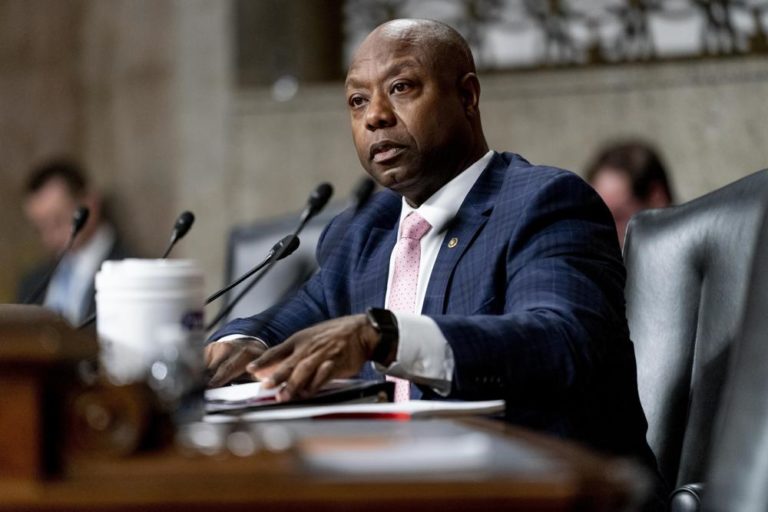
(Corine Gatti, Headline USA) Sen. Tim Scott, R-S.C., introduced legislation on Wednesday that will redirect $15 billion to bolster security along the southern border instead of hiring 87,000 new Internal Revenue Service employees.

The legislation, dubbed the Securing Our Border Act, would increase patrols, provide state-of-the-art technology to Customs and Border Protection officers and improve border inspections with the resources they need to track down illegal substances, including fentanyl, the Daily Caller reported.

Scott introduced the bill as an answer to the Left’s $740-billion Inflation Reduction Act, passed by Senate Democrats, which included a whopping $15 billion for the IRS, and $370 billion going towards green energy subsidies and tax credits.

“We have a crisis on our southern border,” Scott said, who noted in the bill that CBP agents had 199,976 migrant encounters at the southern border during July 2022 — 13,299 were unaccompanied minors.

“Rather than putting resources in place to address this major national security and humanitarian catastrophe, the Biden administration and congressional Democrats chose instead to spend $45 billion of taxpayer money to hire an army of IRS agents to audit the middle class,” Scott told the news outlet.

Democrats have argued that better IRS enforcement will yield more loot to fund their pet projects and government in general, while Republicans have warned that middle-class and low-income citizens will face a surge of IRS audits as a result.

“While President Biden continues to drop the ball, I’m introducing legislation to fund border infrastructure and give our Border Patrol agents the tools they need to help stop the unaddressed flows of illicit goods and persons into this country,” Scott added. “Americans need more border agents keeping them safe – not thousands more IRS agents looking over their shoulder.”

Scott’s bill, which has gained endorsement from the National Border Patrol Council, had original cosponsors of Republican senators including Bill Cassidy of Louisiana, Steve Daines of Montana, Joni Ernst of Iowa, Cynthia Lummis of Wyoming, Mike Rounds of South Dakota and James Lankford of Oklahoma.

Conservative Businessman Launches Ultra Right Beer to Replace Bud Light

(Jacob Bruns, Headline USA) Seth Weathers, a conservative businessman, has announced the launch of an alternative beer brand that will not mock its customers like Bud Light, Fox Business reported.

Weathers, also known as Conservative Dad, announced the new beer, Ultra Right, in a recent video via Twitter.

Despite efforts by some conservatives—including Donald Trump Jr.—to rally in its defense, Bud Light, an offshoot of Anheuser–Busch, has seen an estimated 17% drop in sales after the company’s decision to name transgender social-media personality Dylan Mulvaney as a brand ambassador.

Weathers described his product, created in partnership with Big Kettle Brewing in Gwinnett County, Georgia, as “100 percent woke-free American beer.”

Currently, the price of a six-pack is a steep $19.99. Weathers, however, promised that costs would be cut soon, leading to lower prices.

Despite the cost, Ultra Right Beer is expected to reach $1 million in sales by the end of the week, amounting to 20,000 six packs.

Weathers also said that Ultra Right Beer, though interested in brewing beer, is more broadly an attempt to put a nail in the coffin of woke organizations that have embraced the controversial ESG movement, valuing a company’s social agenda ahead of its profits.

“This is more than a beer company, it’s a movement of people who are speaking up and saying no. We’re done. This is our line in the sand,” Weathers said in a Tuesday interview.

He later added that the Right must be opportunistic when the Left slips up, as Bud Light appears to have done.

“Conservatives: We only get one shot, do not miss your chance to blow up Big Corporate’s hold on us. This opportunity comes once in a lifetime,” Weathers said, encouraging beer drinkers to continue to boycott all Anheuser-Busch products.

The beer CEO is also the man behind the Freedom Speaks Up apparel and gift company, which sold “Let’s Go Brandon” Christmas wrapping paper among other gag gifts last December.

He reported that Freedom Speaks Up had sold 1,000,000 square feet, or 12,000 pounds, of the wrapping paper, which was sold for $20 per roll plus shipping costs.

Dem. Lawmaker Caught Swiping Bibles from State House

(Ezekiel Loseke, Headline USA) Arizona state Rep. Stephanie Stahl Hamilton was caught on video removing Bibles from the state’s members-only lounge.

Hamilton was caught removing Bibles from the body’s lounge because the capital police had set up surveillance cameras to determine why all the Bibles had gone missing, according to Arizona’s Family 3 TV.

Hamilton was caught burying one Bible in furniture and hiding another in the member’s fridge.

Arizona’s Family 3 reported that “sources” informed them that Hamilton had made no complaints about the presence of bibles in the lounge to leadership in the legislature.

Hamilton was difficult to reach for comment, according to the Blaze.

A news station tried to contact Hamilton over the videotapes, but could not make contact. When a reporter and cameraman attempted to confront Hamilton about her treatment of the Bible, she walked away without answering.

Hamilton did eventually give a statement on her behavior.

“Just a little playful commentary on the separation of church and state,” she said.  “I am a Presbyterian minister so I obviously don’t have a problem with the Bible.”

Travis Grantham, Republican speaker pro tempore, expressed less amusement regarding Hamilton’s behavior.

“When I’m watching that, I’m thinking, ‘Well, this is obviously someone who’s got some purpose and some intent, and they know they’re doing something bad,’” he said. “For an ordained minister to do that, again, it’s nonsensical. I have no clarity as to why it happened.”

Though less violent, Hamilton’s attack on Christianity is just one of several assaults on the faithful in recent memory.

  • Catholic Churches have been attacked almost 300 times since 2020.
  • A transgender murdered children because they were Christian in a school shooting.
  • As of April, the rate of attacks on Churches has tripled in 2023.
  • A Virginia County Public School District forbade a teacher from having a bible verse in her email signature.
  • Congresswoman AOC accused Christians running Superbowl ads of being fascists.
  • In December of 2022 The Atlantic proclaimed that the war on Christmas was winning.
  • Famous Hollywood actor, Rainn Wilson, accused Hollywood of hating Christianity.
  • A Virginia restaurant refuses to serve Christians.
  • Libraries prefer children’s books about drag queens over Christian books.
  • The COVID lock downs decimated the rate of church attendance in America.
  • A documentary entitled Enemies Within the Church demonstrated an attack on Christianity by communists who have infiltrated and corrupted the faith.
  • It took a Washington State school 7 years to rehire a coach it fired because he practiced Christianity, despite a court order.