Dem., Ind. Senators: Biden ‘Shortchanged Border Communities’

(By Tom Joyce, The Center Square) United States Senators from states that border Mexico issued a statement criticizing President Joe Biden’s administration this week for its handling of immigration and the border.

U.S. Senators Kyrsten Sinema, I-Ariz., Mark Kelly, D-Ariz., Martin Heinrich, D-N.M., Alex Padilla, D-Calif., Ben Ray Luján, D-Calif., and Dianne Feinstein, D-Calif., said in their statement that the administration is not providing adequate funding to Southwest Border communities through the Shelter and Services Program, which was, “specifically authorized by Congress to assist border communities that are directly affected by the border crisis,” according to a press release from Heinrich’s office.

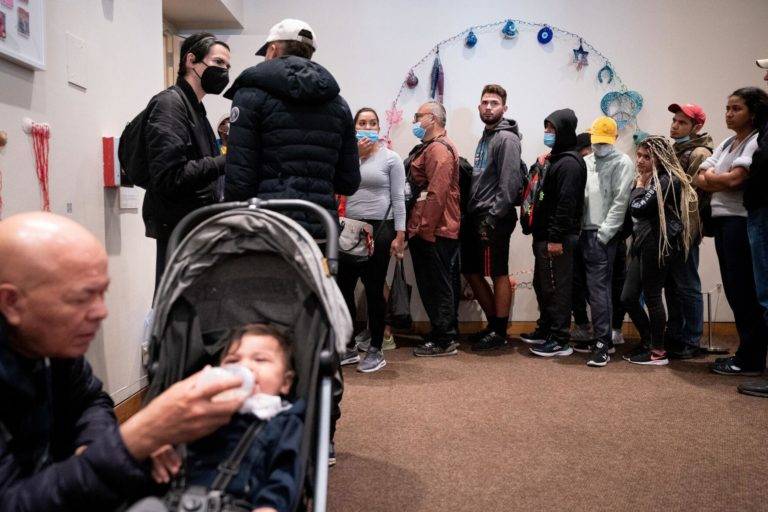
The Senators say that the administration is ignoring “the will of Congress” by providing coastal cities, like New York, more than $100 million to deal with migrants, according to the release.

“Border communities across our states are on the front lines of the border crisis, and we worked hard to secure critical resources to help them increase shelter capacity, emergency services, and transportation to alleviate the strain they face every day,” the senators wrote in their letter.

“The Biden Administration shortchanged border communities when they need support the most. Instead of prioritizing Shelter and Services Program funding to border communities as primarily intended by Congress, they’ve awarded New York City over $100 million without transparency or oversight of how funding levels were determined. This failure puts the future of this program at risk and hurts our communities’ abilities to secure the border, keep communities safe, and ensure the fair and humane treatment of migrants.”

The lawmakers who wrote the letter helped secure $800 million for the Shelter and Services Program in hopes that it would support the border amid the ongoing crisis at the U.S.-Mexico border.

The Joint Committee Report for FY23 Appropriations says, “The agreement provides $800,000,000 for a Shelter and Services Program (SSP) to support CBP in effectively managing noncitizen processing and preventing the overcrowding of short-term CBP holding facilities.”

The program was created by Heinrich and and Senator John Cornyn, R-Texas, in a law known as the Emergency Appropriations by Humanitarian Assistance and Security at the Southern Border Act.

Arizona got $45.4 million in the first funding round, and expects to receive $23.9 million in the second allocation. California got $44 million in the first funding round, and is set to receive $15 million in this allocation. New Mexico obtained $29 million in the first round of funding, and is expected to receive a higher amount in the second allocation. Yet, Heinrich’s office notes that

New York City got about $30 million in the first round, and will get $104.6 million in the second allocation.

“New York’s allocation constitutes about a third of the total funding in the second allocation,” the release said.

New Poll: Majority Say Feds Spend Tax Dollars Poorly

(By Glenn Minnis, The Center Square) Precisely half the respondents polled in a new State Policy Network survey of 2,041 registered voters say the federal government is “failing or doing a poor job” at preventing internal corruption. That’s compared to only 23% of respondents who say the federal government is good or excellent at preventing corruption.

At the same time, well over half of all voters also give lawmakers in Washington D.C. an unsatisfactory mark when it comes to their handling of taxpayer dollars, with 54% agreeing the government deserves a poor or failing mark on the issue. Just 22% of respondents say the federal government does a good or excellent job at spending tax dollars.

By comparison, only 36% of voters said they see state governments faring as poorly, with just 32% of respondents agreeing that they would give them a poor or failing grade.

“Very little of what happens at the federal level is focused on tangible benefits to people so voters rightly assume that the government is not working for them,” SPN messaging strategist Erin Norman told The Center Square in explaining how so many have come to have such varying views about branches of government.

“People also have experience watching government struggle to respond to urgent needs,” she added. “COVID-19 is a great example and spanned two very different administrations showing it’s more than political – it is problems with the very nature of the federal government.”

In addition, only 27% of voters feel the federal government is good or excellent at effectively getting things done, compared to 34% who say the same about their state government. Only 25% of those surveyed say the federal government is good or excellent at “serving people like me rather than special interest groups.” That’s compared to 37% who say the same about state government.

With just 45% of voters saying they feel the federal government’s performance is responsive to the needs of their community, Norman said lawmakers have much work to do to make more voters feel like government is truly at work for them.

“Work should be pushed down to the most local level of government possible where people are more likely to know people from their community involved in the work and see the tangible benefits to policy,” she said. “It is going to be very hard in today’s environment for people to see the federal government as serving them directly or for the federal government to pivot to more personal service.”

The poll, conducted in partnership with Morning Consult, had a margin of error of 2%.

Churches Appease LGBT Mob by Hosting Drag Story Hours and ‘Youth Queer Prom’

(Ezekiel Loseke, Headline USA) Several Protestant churches across the country have affirmed homosexuality during Pride month.

First Presbyterian Church in Columbia, Maryland, for example, hosted its second annual drag queen story hour on Sunday. The drag queen’s stage name was “Mama Bella,” and the story time was designed for children of all ages, according to the event page, which explained that the church was pandering to homosexuals with this event.

“We intentionally make space for DQSH  [drag queen story hour] as a means of grace and reconciliation between the church and the LGBTQ+ community,” it read.

The church also explained that it hoped to inspire children to question sexuality and gender.

“By breaking down barriers of traditional gender norms, drag queens help to create an atmosphere that is both open, accepting, and free of anything that could inhibit imagination,” the church said, according to The Daily Caller.  “If even, drag queens provoke questions, that in of itself is evidence that they are opening the gateway to wonder and engagement.”

Trinity Church Wall Street in New York City hosted a “Youth Queer Prom,” on June 8, and the church’s website described the target audience for its prom.

“Trinity’s Queer Prom is a welcoming space for teens in grades 9-12 who identify as LGBTQ+, it reported.

All Saints Church in Pasadena, Calif., also hosted a queer prom. This one was on June 2 and bore the title, “Somewhere Over the Rainbow Queer Prom.”

All Saints Church also hosted an event called “But the Bible Says,” on Sunday. This event, hosted by Susan Russell, “explore[d] what the Bible says — and doesn’t say — about LGBTQ people and how to dismantle the misuse of our sacred texts as weapons of mass discrimination,” according to the church’s website.

All Saints is also scheduled to host “Pride Movie Night” on June 16.

U.S. Gov’t Thinks it’s Bad that Taliban is Curtailing Opium Production

(Ken Silva, Headline USA) Afghanistan was once the source of some 90% of the world’s black-market opium, but that supply has been drastically curtailed under the Taliban’s rule, according to recent research.

The U.S. government apparently thinks this is a negative development.

The U.S. Institute of Peace, which receives $55 million a year from Congress, published a paper last week that laments the Taliban’s successful war on drugs. The Institute of Peace argued that the short-term harms against Afghan farmers will outweigh the benefits of reduced opium production.

“Phasing out Afghanistan’s problematic drug economy will be essential over the longer term—not least to contain widespread addiction within the country,” wrote the institute’s “senior expert” on Afghanistan, William Byrd.

“But this ban, lacking any development strategy and especially at a time when the economy is so weak that displaced opium poppy farmers and workers have no viable alternative sources of income, is not the right way to start on that path.”

Byrd argued that the opium ban will hit Afghan farmers especially hard, given the billions of dollars of U.S. aid that are on longer available to them. He also argued that the opium ban won’t immediately result in a reduction of the world heroin supply, since many farmers are still selling their supplies from before the ban went fully into effect.

“The impact of the opium ban on drug supplies and prices in other countries, and ultimately in Europe, will not be immediate,” he said.

“After the 2000 Taliban ban, it took about 18 months to two years for the impacts to play out in Europe … in the form of effective price increases through adulteration of the purity of heroin on markets, which exacerbated risks to problem drug users from overdoses.”

However, others disagree with Byrd and the Institute of Peace—including those who did the actual research.

When presenting their findings, lead researcher David Mansfield called the opium reduction “unprecedented,” while former UK Drug Tzar and UN official Mike Trace said the long-term effects on the global drug market will be “significant.”

“A sustained reduction in poppy cultivation on this scale will have significant long-term impacts on the patterns of heroin trafficking and organized crime around the world, and also on patterns of consumption and addiction in the UK,” Trace said.

The U.S. spent more than $9 billion trying to abolish poppy farming during its 20-year occupation of Afghanistan. But the country’s share of global opium production rose from 70% to 90% during that time, thanks to the fact that America’s allies were drug lords.

Those drug lords included CIA asset Ahmed Wali Karzai, the half brother of U.S.-backed former Afghanistan President Hamid Karzai.

Then-Colonel Michael Flynn reportedly compared Ahmed Wali Karzai with Al Capone and said his removal from power would be necessary for the country—but Flynn was rebuked by U.S. generals, according to antiwar.com editor Scott Horton’s book on the subject, Fool’s Errand: Time to End the War in Afghanistan.

U.S. soldiers and marines reportedly said they had “no choice” but to guard poppy fields for local warlords.

Byrd and the U.S. Institute of Peace think those drug lords might fight back against the Taliban’s current opium ban.

“The political blowback within the Taliban from the ban, limited and manageable so far, thus may intensify if the ban continues to be seriously implemented into 2024,” Byrd concluded. “In addition to influential landowners, Taliban figures associated with the drug industry may increasingly weigh in or actively try to subvert the ban, at least locally.”

Ken Silva is a staff writer at Headline USA. Follow him at twitter.com/jd_cashless.

New York Senate OKs Healthcare Coverage for Illegal Aliens

(By Christian Wade, The Center Square) The New York Senate has approved a controversial plan to divert federal money to provide low-cost health care coverage for “undocumented individuals.”

The Democratic-proposed legislation, which cleared the Senate Thursday on a 41 to 21 vote, would extend coverage under the state’s Essential Plan to undocumented individuals with a household income below 250% of the federal poverty line.

“We are already spending over a billion dollars without giving any type of regular care to these folks,” state Sen. Gustavo Rivera, D-Bronx, the bill’s primary sponsor, said in remarks from the Senate floor ahead of its passage. “What we’re suggesting here is that we have a way to get federal money so it does not cost the state anything.”

Backers say the plan would cost $1 billion per year, and coverage would be capped at 240,000 individuals, depending on federal funding available.

Senate Republicans strongly objected to the plan, pointing out during last week’s debate on the bill that even though the money would be coming from the federal government, it still comes out of New York taxpayers’ pockets. They argued the state should focus on caring for people living in the U.S. legally.

“We should be taking care of those individuals,” state Sen. Steven Rhoads, R-Nassau, said in remarks on the Senate floor. “If we have surplus funds. If there are additional funds coming from the federal government, those are the individuals that we should be taking care of first.”

Passage of the measure, which the state Assembly must still approve, comes amid a contentious debate over immigration, with tens of thousands of migrants arriving in New York over the past year following a surge of crossings along the U.S-Mexico border.

Gov. Kathy Hochul, a Democrat, had previously pitched a plan to seek federal funds for extending coverage to migrants but later walked the plan back, citing uncertainties about the cost and whether the federal government would allow it.

But a recent letter from the federal Centers for Medicare and Medicaid Services to the bill’s supporters suggested that New York could use a provision of the Affordable Care Act to request federal dollars to fund the expansion.

The letter noted that two other states, Colorado and Washington, have used the section 1332 provision to offer coverage for undocumented individuals.

The bill’s supporters said that New York has drastically reduced the number of uninsured individuals from 3 million to 1 million. But more than 400,000 immigrants don’t qualify for coverage options or public coverage through the New York State of Health Marketplace because of their immigration status.

Supporters suggest the state and local governments would save roughly $400 million per year by reducing the number of uninsured people seeking emergency care.

“The lack of coverage for significant numbers of New Yorkers causes problems for the broader health care system because payers and providers charge more to the insured population to offset their losses related to providing care to the uninsured,” a summary of the bill reads.

“Even with this cost shifting, the costs associated with uncompensated care threaten the financial sustainability of many safety net hospitals and clinics,” it continues.

Under current state law, health care coverage is offered to undocumented children through age 19, pregnant women and individuals 64 and older.

The proposal must still pass the state Assembly before landing on Hochul’s desk for consideration.

The High Cost of Poverty in Town and Village Courts

(By Jaimie Cavanaugh & Daryl James, RealClear Wire) Poverty can be a jailable offense in Whitehall Village Court, a judicial outpost in upstate New York. Brandon Wood learned the hard way after pleading guilty to two misdemeanors in 2015.

His sentence included no incarceration, but he faced $555 in fines and fees. A wealthier defendant could have settled the tab on the spot and walked free, but Wood lacked the money. After failing to pay—for no reason other than insufficient funds—he found himself behind bars until his wife could appear in court and confirm his financial straits.

The judge who presided in the case was disciplined and removed from the bench in 2022, but not for criminalizing poverty. New York allows jail time for overdue municipal debts, giving courts powerful leverage to collect fines and fees from struggling families.

If nothing else had happened to Wood, his case would have been unremarkable in a system designed to maximize revenue. The New York Commission on Judicial Conduct got involved for an entirely different reason. During a post-sentencing hearing, the judge took a loaded semiautomatic handgun stored under his desk and brandished it at Wood.

Initially, the judge said he felt threatened when he saw a “big black man” approaching the bench. But the judge later acknowledged that Wood, who is 6-foot-0 and weighed 165 pounds at the time, did nothing to justify the brandishing of a weapon.

The case highlights multiple problems at town and village courts, called justice courts in New York. Lack of professionalism is one issue. Judges do not need a law degree to serve, and they sometimes make mistakes.

Complaints range from sexual harassment to blatant bias. Yet even when judges follow proper procedures and maintain decorum, justice courts suffer from a second issue: Lack of accountability.

Unlike all other state courts, which must answer to the Office of Court Administration, these tiny operations are functionally independent. State lawmakers give them power to impose fines and fees, and then turn them loose to generate revenue.

Newly available data show 1,189 justice courts across New York collected more than $189 million in 2022 with about half the proceeds staying local. Many communities grow addicted to the revenue and look for ways to expand it through aggressive traffic, parking and misdemeanor enforcement.

Southampton Village Court on Long Island collected more than $489 per resident in 2022. Verona Town Court in Oneida County collected $228 per resident. And Camillus Town Court in Onondaga County pulled in $204 per resident.

Similar numbers across the state suggest widespread “taxation by citation,” which occurs when local governments use police power to raise revenue rather than solely to protect the public. A 2020 report from our public interest law firm, the Institute for Justice, measures the potential for this type of abuse.

The analysis examines dozens of legal factors and ranks states according to how likely their laws are to enable and even encourage taxation by citation. New York placed 18th worst in the nation, largely due to the lack of justice court oversight.

Conditions have improved since then. Significantly, state lawmakers passed a 2021 reform that prohibits the suspension of driver’s licenses for unpaid traffic fines and fees. The next step for New York would be passage of Senate Bill S313/Assembly Bill 4183, dubbed the End Predatory Court Fees Act.

The measure would prohibit incarceration for failure to pay court debts, while protecting criminal convicts from financial exploitation. The act also would require courts to evaluate a person’s ability to pay before imposing fines and fees.

Some justice courts already hold ability-to-pay hearings for debtors who claim indigence. Wood experienced something like this in Whitehall. Once the judge released him from jail, he was able to substitute community service for cash.

Other justice courts refuse to budge. They impose fines and fees without regard for income, and then punish people for missing payments. A 2019 report from the Office of the New York City Comptroller finds that communities of color suffer disproportionately.

The result is cycle of debt and obligation, as justice courts extract wealth from low-income families. No matter what these courts call themselves, that is not justice.

Why Do Countries Buy Defective Chinese Military Equipment?

(By Cindy Zheng, RealClear Wire) China’s defense industry has exported malfunctioning and defective military equipment in recent years — leaving countries short of what’s needed for their security while also draining military budgets.

Nigeria’s military reported several technical problems with the Chinese-made F-7 aircraft delivered starting in 2009. A handful were lost in crashes or accidents. By 2020, of the nine remaining, seven had to be sent back to China for deep maintenance and repair.

The military junta ruling Myanmar found that the Chinese-made radar on its JF-17 aircraft have poor accuracy, and the aircraft itself lacks beyond-visual-range missile and airborne interception radar. Bangladesh reported problems with firing the ammunition loaded into its Chinese-built K-8W aircraft just shortly after their delivery.

Pakistan, the largest importer of Chinese military equipment, expressed dissatisfaction with Chinese-produced F-22P frigates, including technical issues, engine degradation, and poor overall performance. Pakistan also found that the onboard imaging device of the FM90 (N) missile system had a defective infrared sensor (IR17) system and SR-60 radars. As a result, the missile system was unable to lock onto targets. The IR17 sensors had to be discarded completely.

China attracts customers for its military equipment with cut-rate pricing and financing, but there are hidden costs — especially when gear malfunctions. A lack of technological compatibility with the Chinese military equipment can prove particularly expensive. Countries often do not have the personnel with the expertise and training to resolve issues. They also can have difficulty acquiring replacement parts.

Chinese suppliers have demonstrated little accountability for maintenance or repair. That has pushed some countries to recruit help from third countries. For instance, the Myanmar military forged partnerships with Pakistani technicians to solve its technical problems with the JF-17. Delays in getting equipment working can significantly slow down recipient countries’ military modernization timeline.

So why do countries continue to order military equipment from China?

A RAND report tracking China’s military exports shows that its customers are primarily developing countries. Its largest customers are in South Asia and Africa, though it has also made a push into South America. China has also benefited as countries in the Middle East and North Africa have sought to reduce their dependency on Western military suppliers. Soft power and image-building are China’s major motivators in these regions, setting the foundation for ties in the same way that its Belt and Road infrastructure projects do.

China also isn’t particularly discerning in who it will or won’t sell to.

Its arms deals have few political contingencies involved. In Africa, sales appear driven by profit and trying to grab market share from Russia. If a country worries its human rights records, financial credibility, or regime stability might harm its eligibility to purchase military equipment from Western suppliers, China is always an option.

In addition, China is a major player in the “value arms” market such as light training and fighter aircraft, armored personnel carriers, and unmanned aerial vehicles. Such equipment meets the affordability and the minimum functionality criteria that developing countries look for to use in counterterrorism operations and fighting rebel groups.

The question now is whether a subpar reputation for quality will harm Beijing’s position in the global arms market. Data that the Stockholm International Peace Research Institute released in March showed a 23% decrease in China’s arms exports between the four-year periods of 2013–17 and 2018-22.

Affordability will remain an issue for developing countries looking to bolster their hardware and supplies. They also may have few alternatives. But if recipient countries continue to view Chinese military equipment as unreliable long-term, or find training and maintenance contracts lacking, they may not want to become completely dependent on Chinese suppliers.

New York Ready to Hop on Reparations Bandwagon

(Mark Pellin, Headline USA) With crime soaring, illegals overrunning the Big Apple and a fiscal calamity looming, New York lawmakers have approved legislation to join the reparations bonanza.

Democrats with majority control of the state legislature approved a bill last week to create a commission to concoct a way to fund reparations to address what leftist lawmakers said was the lingering, negative effects of slavery. The bill was sent to Gov. Kathy Hochul, a Democrat who is widely expected to sign it into law.

When New York lawmakers were previously sniffing around the reparations trough, Democrats howled that it would be a “slap in the face” to the black community if Hochul refused to rubber-stamp an exploratory commission.

The approved reparations bill was part and parcel of a flurry of legislation that would, among other initiatives, “compel the city’s Commission on Racial Equity to create a ‘truth, healing and reconciliation commission’ – reminiscent of the restorative justice commission formed in South Africa after apartheid,” reported The Gothamist.

“As a result, reparations and remedies will be studied and established for African American communities who have felt the brutal and unjust generational impacts of the institution of slavery,” according to state Democrat Sen. James Sanders Jr., who co-sponsored the bill.

Republican state lawmaker Andy Gooddell said he “supports existing efforts to bring equal opportunity to all” and would like to “continue on that path rather than focus on reparations,” reported the Associated Press.

“I’m concerned we’re opening a door that was closed in New York State almost 200 years ago,” Gooddell said.

The commission is tasked to reveal “the City’s historic involvement in slavery” and “to establish historical facts about slavery in the City of New York; to protect, acknowledge, and empower affected persons and communities; and to recommend changes for government and institutions to prevent recurrence and perpetuation of harm.”

The legislation does not make clear if the aim “to establish historical facts about slavery in the City of New York” would include mention of the nearly 500,000 Union soldiers from New York who fought to end slavery, or the 50,000 from New York who died for the cause.

Along with studying “reparations and remedies,” Democrats approved a New York City measure to plot the removal of public art works that depict individuals “who participated in the institution of slavery or other crimes against humanity.” 

The Gothamist reported that, “Plaques would go up alongside works that could not be removed, describing their connection to enslavement or other dark history.”

George Soros Gives Control of His Global Empire to Trump-Hating Leftist Son

(Mark Pellin, Headline USA) After years of funding a sprawling slate of far-leftist groups, activist politicians and radically woke district attorneys, globalist billionaire George Soros is ceding control of his $25-billion empire to his son, Alex, who will also retain reign over the Soros’s notorious Open Society Foundation.

The line of succession came as a surprise, as Soros had previously said he “didn’t want the foundation to be taken over by one of my children, as a matter of principle,” according to the Wall Street Journal. In breaking news that the 37-year-old Alex had been chosen, the WSJ reported that many speculated his older half-brother, Johnathon, would take the helm.

“I expected Jonathan to be the one,” said Aryeh Neier, president of OSF from 1993 to 2012, and he wasn’t alone. Jonathan Soros also thought he was the frontrunner, but said “he understood his father’s predilection for reversing course,” telling the WSJ that, “I always knew he could change his mind. As a trader, it’s the thing he’s most famous for.”

As a political agitator, Soros is infamous for bankrolling far-leftist causes that critics claim have led to disastrous results from eroding election integrity to creating criminal chaos. The new Soros junta jefe, Alex, is self-professed “more political” than his father. Indeed, Alex has become a frequent guest at the Biden White House and has a keen loathing of former President Donald Trump.

Despite declaring his intent to champion aggressively radical LGTB and pro-abortion agendas, the public gaslighting has already started in earnest, with the WSJ piece painting Alex Soros as a ‘self-described center-left thinker.”

Elected chairman of the OPS last year, the thinker Alex has used its considerable resources in the past to help Democrats rig elections, bringing into the fold Clinton Cabal lawfare weasel Marc Elias and Priorities USA to challenge election integrity and Voter ID laws in swing states across the country.

In that vein, Alex Soros claimed to the WSJ that “As much as I would love to get money out of politics, as long as the other side is doing it, we will have to do it, too.”

That holds especially true for efforts to sabotage Trump. The younger Soros said “he was concerned about the prospect of Donald Trump’s return to the White House, suggesting a significant financial role for the Soros organization in the 2024 presidential race,” reported the WSJ.

Alex Soros also claimed to be a big supporter of free speech, fretting that college campuses were becoming too cancel culture friendly.

“I have some differences with my generation in regard to free speech and other things—I grew up watching Bill Maher before bed, after all,” he told the WSJ.

Twitter chief Elon Musk, who said that Alex Soros “has been de facto in charge for several years,” remained skeptical.

Christian Protester Arrested at Pride Event May Sue Officers After Charges Dropped

(Luis Cornelio, Headline USA) David Atkins, a Christian man who was detained for reading a Bible verse at a Pride event, may pursue legal action against the police officers who wrongfully detained him.

The disturbing arrest, captured on video by a bystander, took place in Reading, Pennsylvania. It involved a police officer aggressively arresting and throwing Atkins, a peaceful protester. The charges against Atkins were later dismissed by the Berks County District Attorney.

In a press release, the Berks County District Attorney stated, “After a review of the incident which took place on June 3, 2023, in the 800 block of Washington Street in the City of Reading, the District Attorney’s Office has withdrawn the charges of disorderly conduct filed against Damon Atkins.”

Berks County Commissioner Christian Leinbach commented that the dismissed charges could potentially expose the Reading police department to legal action from Atkins. In an email obtained by The Lancaster Patriot, Leinbach, expressed his belief that the arrest was unlawful, stating, “From what I have seen thus far I believe this was an unlawful arrest and could open the City of Reading and their police department to legal action.”

Officer Bradley T. McClure’s affidavit, which led to Atkins’ arrest for alleged “disorderly conduct,” was contradicted by video footage of the incident. The footage, which has since gone viral, shows Atkins attempting to recite a Bible verse, 1 Corinthians 14:33, to LGBTQ community members attending the pride event.

In the video, three officers can be seen forcefully apprehend Atkins, pushing him against a wall and escorting him away while chants and shouts from the crowd filled the air. Prior to the arrest, Officer McClure had demanded Atkins to leave the scene and let the LGBTQ members have their day.

In a recent interview with Dan Andros, managing editor for the Christian Broadcasting Network, Atkins expressed his shock and disappointment over the incident. He recalled the officer approaching him and demanding that he be silent, despite his belief that he had the constitutional right to be there and spread his religious message.

Atkins remains resolute in his belief, now backed by the dismissed charges, that he was not being disrespectful or disruptive, but merely sharing the gospel of Jesus Christ.

It is currently unclear whether Atkins intends to take legal action against the Reading Police Department.

Watch Atkins described the full account of the disturbing arrest below: