‘Kill Switch’ that Destroys Cancer Cells Is Discovered by Scientists

(Dmytro “Henry” Aleksandrov, Headline USA) It was announced by a team of American scientists that a “kill switch” that triggers the death of cancer cells in humans was discovered.

According to Slay News, the discovery is considered a breakthrough in the fight against cancer.

The researchers at the University of California, Davis Comprehensive Cancer Center in Sacramento, Calif., were able to find the “kill switch” when they identified a protein on the CD95 receptor that can “program” cancer cells to die, as it was indicated in a study that was published in the peer-reviewed Nature journal Cell Death & Differentiation.

The news publication also added that a receptor is a protein within a cell that receives and transmits signals.

CD95 receptors — also referred to as Fas — have gained the nickname “death receptors” because they send a signal that causes cancer cells to “self-destruct,” a press release from UC Davis that was obtained by Slay News stated.

“Previous efforts to target this receptor have been unsuccessful. But now that we’ve identified this epitope (target), there could be a therapeutic path forward to target Fas in tumors,” Jogender Tushir-Singh, an associate professor in the Department of Medical Microbiology and Immunology and senior author of the study, said.

Future cancer drugs could boost the activity of these CD95 receptors to create a new weapon against cancer tumors that have been treated historically with surgery, chemotherapy and radiation, according to the scientists.

The researchers also informed the public that immune-based therapies, such as CAR (chimeric antigen receptor) T-cell therapy, have shown promise for a subset of patients. However, they have had limited effectiveness against many cancer types.

“Despite being decently successful in liquid tumors, such as leukemia spectrum cancers, long-term remission remains the biggest challenge for CAR T-cell therapies,” Tushir-Singh said.

The scientists also noted that the bigger challenge with this therapy — which typically costs $500,000 or more — is that it has only shown “meager success” in treating solid tumors.

“Our study strongly provides a comprehensive takeaway and potential solution to transform the meager success of CAR-T therapies into potentially successful [therapies for] solid tumors.”

The press release also added that the newly discovered “kill switch” could terminate tumor cells while also helping to make immunotherapies more effective — “a potential one-two punch against tumors.”

White House: One of Hamas’s U.S. Hostages Is a 3-Year-Old Orphan

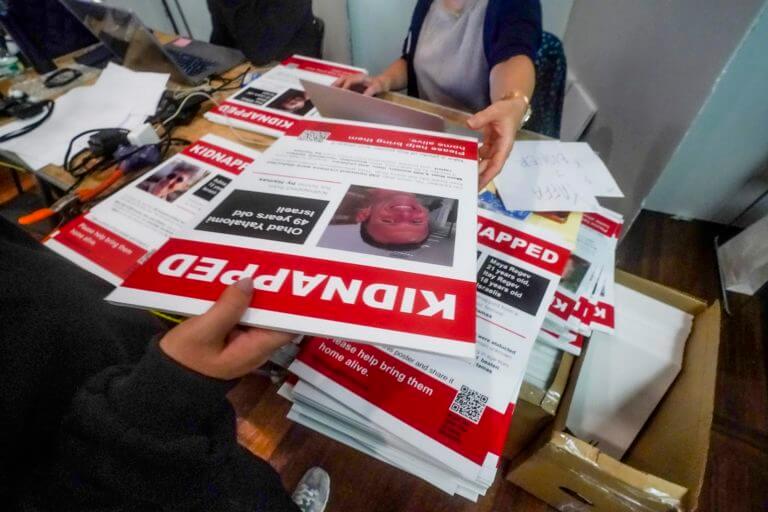
(Jacob Bruns, Headline USA) One of Hamas’s 13 American hostages is a 3-year-old orphan whose parents were killed during the terrorist group’s Oct. 7 massacre, according to a recent release from the United States embassy in Qatar.

President Joe Biden and his administration are reportedly working with Qatar and its leader, Sheikh Tamim bin Hamad al-Thani, to try to negotiate a hostage release “without further delay,” conservative pundit Todd Starnes reported.

Hamas earlier released two of the U.S. hostages, an elderly woman and her daughter, after the Biden administration pledged $100 million in supposedly humanitarian aid to war-torn Gaza. However, there is little indication that the aid was actually used to benefit Palestinian citizens and not horded by Hamas militants.

It is unknown whether U.S. officials have been given any direct updates on the condition of the remaining hostages, believed to be held in the network of underground tunnels that run beneath Gaza City.

In total, Hamas is believed to have taken more than 240 hostages during the brutal attack on Israel, during which it raped, tortured and murdered an estimated 1,400 Israeli citizens. At least 26 of the hostages are children or teenagers, according to information released by the Israeli state newspaper Yedioth Ahronoth.

In the wake of the attack, Israeli Prime Minister Benjamin Netanyahu condemned the kidnapping of babies and toddlers.

“Imaging a baby is held hostage. Who takes a baby hostage,” he said. “What is this, taking children hostage? Threatening to kill them? This is savagery of the highest order.”

Amid demands throughout the Arab world for a ceasefire, Netanyahu has sought to frame the ongoing war as a “battle of civilization against barbarism” while making the case that a Hamas-controld Gaza is no longer an acceptable alternative for Israel’s national security interests.

Nonetheless, he is facing growing pressure from the Biden administration to come to the negotiating table, particularly where the hostages are concerned.

Netanyahu recently told NBC’s Meet the Press that there “could be” a potential hostage deal but did not offer more information.

“I think the less I say about it, the more I’ll increase the chances that it materializes,” he noted.

A hostage deal could only come about as “the result of pressure, military pressure,” he added. “That’s the one thing that might create a deal and if a deal is available.”

He said he would make the announcement as soon as a deal was in place.

“Well, we will talk about it when it’s there. We’ll announce it if it’s achievable,” he said.

He also suggested that Israeli officials know many details about where the hostages are being held, suggesting that officials may also be considering non-diplomatic alternatives for liberating the hostages.

“We know a great deal, but I won’t go beyond that,” Netanyahu said.

Trump’s Older Sister, Ex-Federal Judge Maryanne Trump Barry, Dies at 86

(Headline USA) Maryanne Trump Barry, a retired federal judge and former president Donald Trump ‘s oldest sister, has died at age 86 at her home in New York.

Until her retirement in 2019, Barry was a senior judge on the 3rd U.S. Circuit Court of Appeals, a level below the Supreme Court.

The NYPD confirmed that officers were sent to Barry’s Manhattan home just before 4:30 a.m. and discovered a deceased 86-year-old woman. The cause of death was not immediately clear.

Her death was confirmed by a judicial official who spoke on condition of anonymity because the news hadn’t been announced publicly by either the court or Trump’s family.

Trump’s campaign did not immediately respond to a request for comment, but the former president’s eldest son, Donald Trump Jr., spoke briefly about his aunt as he exited a Manhattan courthouse Monday, calling it a “rough day for myself and my family,”

Trump Jr. told reporters after testifying in a civil fraud trial that he had been informed of the news as he pulled up to the courthouse Monday morning.

“I’m very close with her grandson. We hang out all the time. And so it’s obviously a rough day for that,” he said.

Before becoming a judge, Barry became an assistant U.S. Attorney in 1974 and was nominated to the federal court in New Jersey by former President Ronald Reagan.

She was later elevated to the U.S. Court of Appeals by former President Bill Clinton. She retired in 2019 amid an investigation into her family’s tax practices.

Barry had stayed largely out of the spotlight during her brother’s presidency, but drew headlines after her niece, Mary Trump, revealed that she had secretly recorded her aunt while promoting a book that denounced the former president.

In the recordings, Barry could be heard sharply criticizing her brother, at one point saying the former president “has no principles” and is “cruel.”

Years before her brother became president, Barry wrote in a 2006 immigration case that judges had too little leeway to evaluate who should get to remain in the U.S. because of rigid laws that force “knee-jerk” decisions.

The case involved a man from Northern Ireland, Malachy McAllister, denied asylum by the 3rd Circuit panel on which she sat. Barry urged the federal government to intervene in the case.

“I refuse to believe that ‘Give me your tired, your poor, your huddled masses yearning to breathe free…’ is now an empty entreaty. But if it is, shame on us,” wrote Barry, who said McAllister’s actions came as the Irish sought to end more than 800 years of British rule.

McAllister, a former member of the paramilitary Irish National Liberation Army, was convicted in the 1981 wounding of a British police officer.

Barry was also known for her wry sense of humor, evident in a 2015 case over fan access to Super Bowl tickets.

When the NFL compared the distribution practice to Catholic parishes that got a bounty of tickets to see the pope in Philadelphia, Barry’s colleagues joked that the pope was skipping New Jersey altogether.

“We’re used to it,” Barry quipped.

Trump, who was one of five children, now has one living sibling, his sister Elizabeth Trump Grau.

The former president’s younger brother, Robert Trump, died in 2020 at 71, and Trump held a service at the White House in his honor. His older brother, Fred Trump Jr., died of a heart attack at 42, which the family blamed on alcoholism.

Donald Trump’s ex-wife, Ivana Trump, died in 2022 at the age of 73.

The news of Barry’s death was first reported by the Daily Voice in Nassau County.

Adapted from reporting by the Associated Press

Big Tech Censorship Is 20x Worse for Conservatives

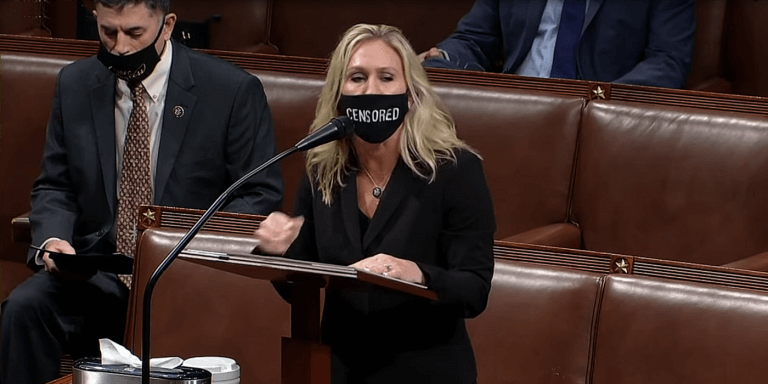
(Jacob Bruns, Headline USA) Even while Facebook, Google and other tech companies have openly acknowledged their own personal biases when called out on their disproportionate political donations and other observable metrics, they have long insisted that algorithms are programmed to make the difficult decisions when it comes to censoring users for violating their so-called community standards.

But as it turns out, Big Tech’s practice of political censorship almost unilaterally assists the Left in shutting down their conservative opposition, the Western Journal reported.

A new report revealed that tech companies tended to censor conservative viewpoints 20 times more than their leftist couterparts.

The announcement was initially made by Rep. Jim Jordan, R-Ohio, the chairman of the House Judiciary Committee, who first revealed the partnership between the federal government and Big Tech to censor conservatives in 2020, especially related to COVID lockdowns, the COVID jab and the 2020 election.

Jordan also heads the Judiciary Committee’s Select Subcommittee on the Weaponization of the Federal Government. In that capacity, he recently explained that the Stanford University “Election Integrity Partnership” was a conspiracy between two government entities that were weaponized against free speech.

According to Jordan, the Department of Homeland Security and the Cybersecurity and Infrastructure Security Agency both teamed up with Stanford to compile lists of who’s social media posts should be removed, or allowed to endure with warning labels.

He made the announcement in a Nov. 6 tweet thread.

According to Jordan, the censorship was directed almost exclusively toward conservatives, grouping their various activities into “pods” of malfeasance, including pods for “conspiracy,” being “right wing” or discriminating against “minority groups.”

In total, there were 19 “right wing” pods to only one “left wing” pod.

Jordan even named some who were specifically targeted, among whom were former president Donald Trump, former House Speaker Newt Gingrich and journalist Mollie Hemingway.

The committee released a longer report which detailed the extent of the censorship and revealed how it was enacted.

The purpose was to publicly reveal “for the first time secret ‘misinformation’ reports” which were previously “accessible only to select parties, including federal agencies, universities, and Big Tech,” said the committee.

As a result, it said, “these reports of alleged mis- and disinformation were used to censor Americans engaged in core political speech in the lead up to the 2020 election.”

Jordan further noted that Americans “deserve to know if they were targeted by their own government and so-called ‘disinformation’ experts.”

He said the committee planned to make the data from these reports publicly available.

The Biden administration’s collusion with Big Tech has largely been curtailed by court order following the decisions in Missouri v. Biden, which the Supreme Court is expecting to hear in its present term.

Nikki Haley Plans $10M Ad Push to Take Down DeSantis in Early Primaries

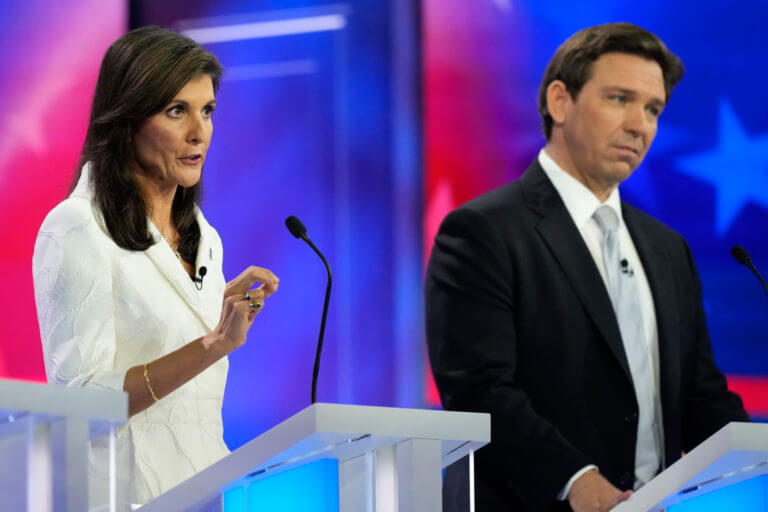
(Headline USA) Nikki Haley’s presidential campaign will reserve $10 million in television, radio and digital advertising across Iowa and New Hampshire beginning in the first week of December, a massive investment designed to give the former United Nations ambassador an advantage over Florida Gov. Ron DeSantis at a critical moment in the GOP nomination fight.

Details of the advertising plans, which represent the Haley campaign’s first official advertising reservation, were obtained by the Associated Press ahead of a public announcement expected Monday.

Haley’s planned investment, as of now, is more than five times larger than DeSantis’s current advertising reserves for the same time period, according to the media tracking firm AdImpact.

Haley’s move comes as she fights to emerge as the clear alternative to former President Donald Trump to represent the GOP against President Joe Biden next fall. DeSantis stands as Haley’s strongest competition for her party’s second-place slot, although the Florida governor’s campaign has shown signs of financial strain following a tumultuous summer.

Trump remains the overwhelming front-runner in the GOP primary. Rival campaigns are betting that if they can emerge as the main alternative to Trump that they can consolidate enough support to mount a strong challenge against him or replace him if he falters.

In U.S. politics, fundraising and advertising strategy can often be more consequential than a candidate’s policies or personality. But money raised and spent by campaigns only tell part of the story in the 2024 election.

Sen. Tim Scott, R-S.C., whose allied super PAC had booked $7.5 million in ads through Iowa’s Jan. 15 caucuses, dropped out of the race late Sunday. Scott had struggled to register in polls nationally, and October polls found him trailing far behind Trump and Haley, his fellow South Carolinian.

Haley will run her advertising through Iowa’s Jan. 15 caucuses and New Hampshire’s primary to follow. As of now, the DeSantis campaign is spending only in Iowa.

Haley’s campaign declined to say whether the ads would attack DeSantis or Trump directly. But campaign manager Betsy Ankney called out DeSantis’s campaign, which after winning the endorsement of Iowa Gov. Kim Reynolds argued that Haley and others in the GOP field could only be “spoilers.”

“Nikki Haley’s momentum and path to victory are clear,” Ankney said. “The same can’t be said for Ron DeSantis, who, even with a decent showing in Iowa, can’t afford a cup of coffee at the Red Arrow diner in New Hampshire and is a mere tourist in South Carolina.”

DeSantis’s campaign reported just $5 million available to spend in the primary at the end of September, although spokesman Andrew Romeo said DeSantis raised millions more last month, including $1 million since last week’s GOP presidential debate.

The DeSantis campaign, which has gone through two rounds of layoffs already, continues to look to an allied super PAC to help build out campaign infrastructure and supplement advertising spending. Haley’s campaign has also leaned on an allied super PAC to keep pace with DeSantis’s allies in recent months. The rival super PACs have largely kept pace with each other.

As of Sunday, Haley’s super PAC had reserved nearly $4.9 million in advertising from Monday through January compared to almost $4 million reserved by DeSantis’ super PAC, according to AdImpact.

DeSantis’s opponents flagged another shift in spending as a potential sign of financial stress. The pro-DeSantis Never Back Down moved late last week to shift roughly $700,000 in advertising initially set to run over the next two weeks into January instead.

Kristin Davison, who leads Never Back Down, said no advertising dollars were “cut.” Instead, she said they were “optimized and placed to complement [the] campaign and get January started.”

Future advertising reserves don’t require payment until just before the ads run, while the bill for this month’s ads were about to come due. In short, the maneuver could have been a way to save money in the short term, although Davison described the decision as standard operating procedure.

Davison expressed optimism about the direction of the DeSantis campaign, pointing to Reynolds’s endorsement last week, which was “not only a huge endorsement and validator for Gov. DeSantis, but also a real setback for Nikki Haley.”

“I think it effectively kills her in Iowa not to have the governor’s support,” Davison said.

As DeSantis and Haley intensify their rivalry, Trump continues to dominate in polling and fundraising.

In his most recent federal filing, Trump’s campaign committee reported more than $37.5 million cash on hand at the end of September, which was more than DeSantis and Haley combined.

Haley acknowledged Trump’s political strength on Sunday, but she also outlined her path forward.

“We have plenty of money that we’re going to be on TV with,” she said on Fox News Sunday.

“We’re going to be strong in New Hampshire. We’re going to be strong in South Carolina, because we spent our money well,” she continued. “We’ve got great ground games in every one of those states. And we’re going to keep surging.”

Adapted from reporting by the Associated Press

Chipotle Founder Plans to Serve Meat-Free Sandwiches, Use Robot Workers

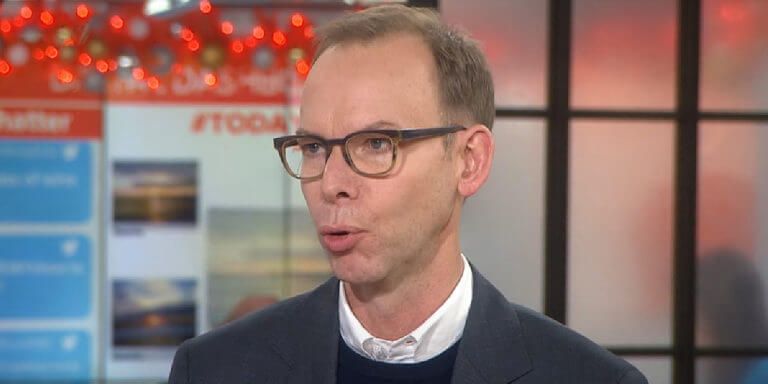
(Molly Bruns, Headline USA) Steve Ells, founder of the Chipotle restaurant chain, recently announced the opening of Kernel—a new vegetarian chain, largely run by robots.

Kernel’s first location will open in Manhattan next year. It feature meat-free sandwiches, salads and sides all cooked, assembled and served by robots, according to the Wall Street Journal.

Ells is opting to stray away from meat replacements, such as beyond meats, and instead heavily emphasizes legumes and other vegetables in their own right.

“It’s not trying to be beef,” Ells said about his veggie burger. “It’s not trying to be pork.”

Customers place their orders via a touchscreen, where robots insert food into ovens, flip buns on the toaster and move dishes through the kitchen.

Only three employees will staff the restaurant at a time; their primary task will be packaging completed meals and inserting them into cubbies where customers can pick them up.

It is unclear whether employees will also be responsible for maintaining the machines.

“We’ve taken a lot of human interaction out of the process and left just enough,” Ells said.

Yet, critics may argue that his new business is the next step in pushing a globalist new world order.

Organizations like the World Economic Forum have long sought to usher in what some consider to be the fourth or fifth industrial revolution, a world in which the prevalence of technology will once again relegate many humans to a state of serfdom, subsisting on the benevolence of a few elite masters who control the technology and algorithms.

In addition to a world in which the majority of humans “own nothing,” the WEF has long pushed for its utopia to be meat-free, replacing animal protein with insects.

Ells left Chipotle in 2020 as a result of a massive outbreak of foodborne illness. In his time off, he read How to Avoid a Climate Disaster, by billionaire Microsoft founder Bill Gates, and dedicated himself to creating a restaurant that used fewer resources.

In his mind, using fewer resources meant primarily employing fewer people. Kernel kitchens also occupy around 1,000 square feet and can quickly cook and send to-go orders.

Ells claims that the robots and technological sensors installed in the new restaurants are more capable of ensuring food safety.

Ells plans to open 15 restaurants around New York over the next two years before continuing on to other densely populated areas.

Money saved from employing a larger staff will be re-invested in the employees’ salaries and benefits.

Tim Scott Suspends Presidential Campaign in Surprise Announcement

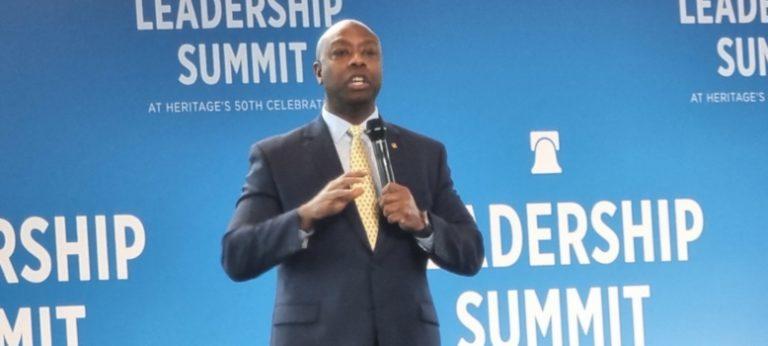
(Eli Pacheco, Headline USA) Sen. Tim Scott, R-S.C. has suspended his presidential campaign.

Scott, a junior U.S. senator since 2013, announced his plans Sunday night in a live interview on Fox News’s Sunday Night in America with Trey Gowdy. 

“When I go back to Iowa, it will not be as a presidential candidate,” Scott told Gowdy, his longtime friend and one-time fellow South Carolina lawmaker.

“I think the voters, who are the most remarkable people on the planet, have been really clear that they’re telling me: not now,” he added.

Scott, like most Republican candidates, failed to keep up with former President Donald Trump, the GOP frontrunner, who leads the field by at least 40 points.

In a Monday morning tweet that included the clip from his interview with Gowdy, he thanked his supporters.

“Traveling this country and meeting all of you has been one of the most fantastic experiences of my entire life,” the post read. “From the bottom of my heart, thank you. God Bless the United States of America.”

Scott, the U.S. Senate’s only black Republican, campaigned with long-term optimism about America. A staunch conservative, Scott began his campaign in May. In announcing his run, Scott vowed to heal the nation’s political divide. 

A child of a single mother, Scott said the Democratic party doesn’t make it easy for all to succeed.

Scott blamed President Joe Biden and the Democratic party for attacking “every rung of the ladder that helped me climb” during his campaign.  

Nonetheless, he said America’s democratic principles had prevailed in spite of the roadblocks that some were determined to put in their way.

“We live in the land where it is absolutely possible for a kid raised in poverty in a single-parent household in a small apartment to one day serve in the people’s house and maybe even the White House,” Scott said as he announced his candidacy.

In addition to Trump, Scott’s departure leaves the GOP field with six other candidates: Doug Burgum, Chris Christie, Ron DeSantis, Nikki Haley, Asa Hutchinson and Vivek Ramaswamy.

Another high-profile figure, former Vice President Mike Pence, ended his campaign in late October.

Scott, who some suggested had been running more to raise his profile as a prospective vice-presidential candidate, said he did not plan to endorse any of the other candidates in the running, NBC News reported.

The Associated Press reported that Scott’s staff didn’t know about his announcement beforehand. It cited a campaign worker who said they learned of the news by watching Gowdy’s show.

San Francisco Scrubs Rioters, Homeless from Area Surrounding APEC Conference

(Headline USA) In what may have been a whiplash-inducing moment for some, the section of San Francisco where the Asia–Pacific Economic Cooperation leaders’ conference was expected to commence, was fenced off more like a police state than the anarchic free-for-all that many have become accustomed to seeing in the City by the Bay. 

Neither the usual gauntlet of homeless drug addicts nor violent pro-Hamas protesters was to be seen anywhere near the area where leaders from nearly two dozen countries, including China’s Xi Jinping, are expected to converge this week alongside U.S. President Joe Biden.

It was unlikely world leaders would even glimpse the protests given the strict security zones accessible only to attendees at the Moscone Center conference hall and other summit sites.

Like the Jan. 6 political dissidents who stormed the U.S. Capitol to object to the certification of the 2020 election, violators could expect the full force of the U.S. government to be weaponized against their First Amendment rights to speak and assemble.

“Any arrest made around or near the APEC event zone will be charged federally,” tweeted San Francisco “world peace” activist Darren Stallcup.

“SFPD, Highway Patrol, National Guard, FBI and CIA are not f**king around with anybody making trouble,” he added. “If you are caught breaking the law or causing any disruptions, enforcement will NOT be lenient unlike the typical San Francisco prosecution.”

Despite the constraints, which assured no global leaders would be subjected to the nuisance or menace they posed, leftist protesters were out in full force throughout the remainder of the city.

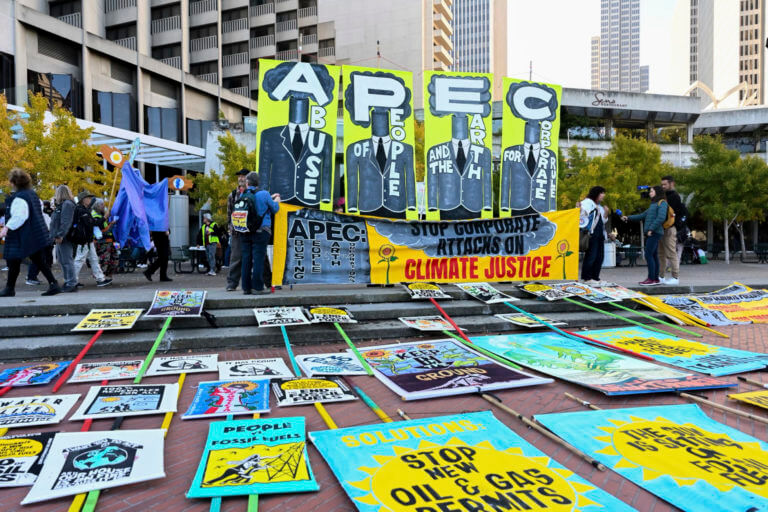
Activists protesting corporate profits, environmental abuses, poor working conditions and the Israel–Hamas war marched in downtown San Francisco on Sunday, united in their opposition to a global trade summit.

Protests are expected throughout this week’s APEC conference, which could draw more than 20,000 attendees, including hundreds of international journalists.

The No to APEC coalition, made up of more than 100 grassroots groups, says trade deals struck at summits such as APEC exploit workers and their families.

Suzanne Ali, an organizer for the Palestinian Youth Movement, said the U.S. government needed to be held to account for supplying weapons to Israel in its war against Hamas.

“Even if they cannot see us, as we’re mobilizing and marching together, they will know that we’re out there,” she said.

Thousands of demonstrators gathered Sunday to hear speeches from activists supporting various causes, followed by a march through downtown.

Among the voices were environmentalists chanting “Rise up” and carrying banners that read “People and planet over profit and plunder!”

They’re opposed to the framing of “supposed ‘clean’ and ‘green’ economies that are really propping up corporate profits,” said Nik Evasco, an organizer with the climate block of the No to APEC coalition.

“Any time there are so-called free trade deals, what we’ve seen historically is that it’s really about opening up pristine lands that go toward making money for corporations,” Evasco said.

San Francisco has a long tradition of loud and vigorous protests, as do trade talks. In 1999, tens of thousands of protesters took to the streets of Seattle during a World Trade Organization conference. Protesters succeeded in delaying the start of that conference and captured global attention as overwhelmed police fired tear gas and plastic bullets and arrested hundreds of people.

Chile withdrew as APEC host in 2019 due to mass protests. Last year, when Thailand hosted the summit in Bangkok, pro-democracy protesters challenged the legitimacy of the Thai prime minister. Police fired at the crowd with rubber bullets that injured several protesters and a Reuters journalist.

Chief Bill Scott of the San Francisco Police Department said he expects several protests a day, although it’s uncertain how many will materialize. He warned against criminal behavior.

“People are welcome to exercise their constitutional rights in San Francisco, but we will not tolerate people committing acts of violence, or property destruction or any other crime,” Scott said. “We will make arrests when necessary.”

APEC, a regional economic forum, was established in 1989 and has 21 member countries, including the world’s two largest economic superpowers—China and the U.S—as well as Mexico, Brazil and the Philippines. An accompanying CEO summit is scheduled for this week, which critics also plan to protest Wednesday.

Headlining the summit is a highly anticipated meeting between Biden and Xi, who rarely—if at all—encounters protesters on home soil.

China has heavy security ahead of any events within its borders to ensure no protests occur. It also steps up border checks at city limits and at transit points such as railway stations and airports. Human rights activists based in China will often receive visits or phone calls from police ahead of important events as reminders to not demonstrate.

Rory McVeigh, sociology professor and director of the Center for the Study of Social Movements at the University of Notre Dame, said politicians use protests to gauge public opinion and that media attention helps.

“Probably a lot of protests just don’t make much difference, but occasionally they do, and occasionally they can make a huge difference,” he said.

The United Vietnamese American Community of Northern California plans to protest Xi and Vietnam President Vo Van Thuong. The International Coalition for Human Rights in the Philippines will be rallying for the rights of Indigenous Filipinos and protesting the presence of President Bongbong Marcos, the son of dictator Ferdinand Marcos.

Protesters are disappointed that San Francisco, with its rich history of standing up for the working class, would host CEOs of companies and leaders of countries that they say do great harm.

“It’s silly, from the mayor to the governor to the president, they want to say this is a great idea to have all these people who have been profiting off the intersecting crises of our time,” Evasco said. “It’s just sickening.”

Adapted from reporting by the Associated Press

Fed. Judge Sets Trial over Dominion Voting Systems’ Vulnerabilities in Ga.

(Headline USA) The question of whether Georgia’s electronic voting system has major cybersecurity flaws that amount to a violation of voters’ constitutional rights to cast their votes and have those votes accurately counted is set to be decided at trial early next year.

U.S. District Judge Amy Totenberg issued a 135-page ruling late Friday in a long-running lawsuit filed by activists who want the state to ditch its electronic voting machines in favor of hand-marked paper ballots.

The state had asked the judge to rule in its favor based on the arguments and facts in the case without going to trial, but Totenberg found there are “material facts in dispute” that must be decided at trial.

She set a Jan. 9 bench trial, which means there will be no jury. But she also suggested that the two sides work together to reach a resolution.

“The Court cannot wave a magic wand in this case to address the varied challenges to our democracy and election system in recent years, including those presented in this case,” she wrote. “But reasonable, timely discussion and compromise in this case, coupled with prompt, informed legislative action, might certainly make a difference that benefits the parties and the public.”

The lawsuit was filed by several individual voters and the Coalition for Good Governance, which advocates for election security and integrity, against Georgia Secretary of State Brad Raffensperger and members of the State Election Board.

It claims that the current configuration of the state’s election system presents a threat to voters’ right to have their votes counted as cast.

It spawned an expert report that identified vulnerabilities in the election system used in Georgia that led a federal cybersecurity agency to issue an advisory to jurisdictions that use the equipment and has prompted some Georgia Republicans to call for abandoning the machines.

University of Michigan computer scientist J. Alex Halderman, an expert witness for the plaintiffs, examined Dominion voting machines and identified vulnerabilities that he said could be exploited by bad actors.

But Gabriel Sterling, chief operating officer in the Secretary of State’s office, earlier this month dismissed Halderman’s findings as “hypothetical scenarios that can’t work.”

Since the Coalition for Good Governance lawsuit was first filed in 2017, Georgia has emerged as a pivotal swing state, putting a national spotlight on its elections. It purchased its current electronic voting system from Dominion Voting Systems in 2019 and implemented statewide in 2020.

Despite multiple lawsuits against Dominion and warnings from both sides of the aisle regarding the system’s potential vulnerabilities, Georgia has said it does not intend to update the equipment prior to the 2024 election, saying it would be impractical to update all of the equipment by then.

The election equipment manufacturer has aggressively responded to critics with defamation litigation, notably reaching a $787 million settlement with Fox News in April. However, that settlement—which came shortly after the Biden-linked, ESG-friendly company BlackRock purchased a substantial share of Fox News’s stock assets—assured that the actual merits of its defamation case and the supposed falsity of the claims made by Fox News guests have yet to be properly adjudicated.

Totenberg, herself a notorious leftist, made clear that the evidence in the Georgia case “does not suggest that the Plaintiffs are conspiracy theorists of any variety,” as noted in a footnote in her order. “Indeed, some of the nation’s leading cybersecurity experts and computer scientists have provided testimony and affidavits on behalf of Plaintiffs’ case in the long course of this litigation.”

The lawsuit long predates the swirl of controversy that followed the 2020 election. When it was initially filed in 2017, it targeted the paperless touchscreen voting machines that Georgia had been using for 15 years. It was then amended to challenge the election system the state bought in 2019, with claims that the new system has similar vulnerabilities.

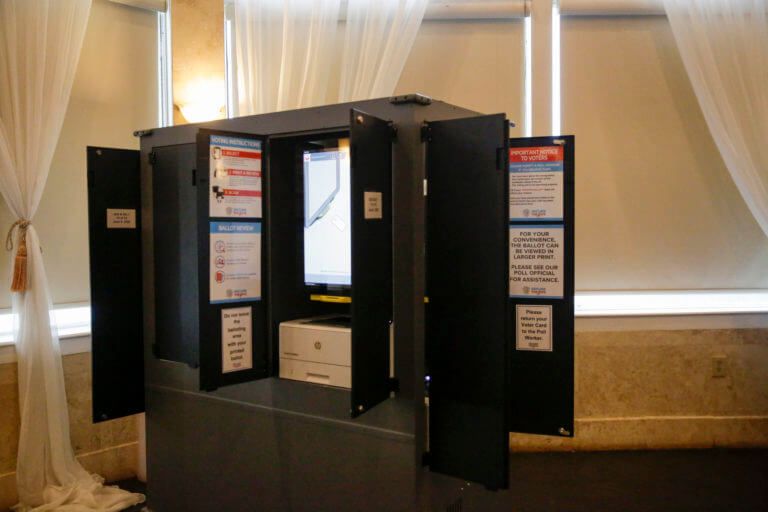
The touchscreen voting machines used by virtually every in-person voter in Georgia print a paper ballot with a human-readable summary and a QR code, a type of barcode, that is read by a scanner to count the votes.

Among other concerns about the election system, the activists say voters can’t be sure that the barcode read by the scanner accurately reflects their selections. Many voters also don’t take the time to check the human-readable part, making meaningful audits impossible, they say.

Lawyers for the election officials have consistently argued that no election system is without vulnerabilities and that the state takes countless measures to protect the integrity of its system.

Totenberg stressed in her order that at this stage in the process, where she was considering the state’s motion for summary judgment, she was required to look at the facts in a light most favorable to the plaintiffs. At the upcoming trial, the plaintiffs have “a heavy burden to establish a constitutional violation” connected to the voting system, she wrote.

Even if she ultimately rules in their favor, she wrote, she can’t order the state to implement a paper ballot system.

She said there are “pragmatic, sound remedial policy measures” that she could order or that the parties could agree upon, including: eliminating QR codes on ballots and having scanners read human-legible text; using a broader scope and number of election audits; and implementing essential cybersecurity measures and policies recommended by leading experts.

“We look forward to presenting our full evidence at trial and obtaining critical relief for Georgia voters,” said David Cross, an attorney for some of the individual voters. “But we hope this decision will be a much-needed wakeup call for the Secretary and SEB, and finally spur them to work with us on a negotiated resolution that secures the right to vote in Georgia.”

Both Cross and Coalition for Good Governance executive director Marilyn Marks said Raffensperger has continually failed to address escalating risks to the state’s voting system.

“The Court’s Order makes it clear that the status quo is far too risky, and that these concerning issues merit a trial,” Marks said.

A representative for Raffensperger did not immediately respond to an email Saturday seeking comment.

Adapted from reporting by the Associated Press

‘QAnon Shaman’ Plans to Run for Congress in Ariz. as Libertarian

(Headline USA) Jacob Chansley spent more than two years behind bars for touring the U.S. Capitol with a police escort in tow and peacefully ascending the dais where, a short time previously, then-House Speaker Nancy Pelosi, D-Calif., and then-Vice President Mike Pence had gaveled in the Joint Session of Congress to certify the disputed 2020 election.

Soon, however, Chansley may find himself on that same platform as a legally elected lawmaker.

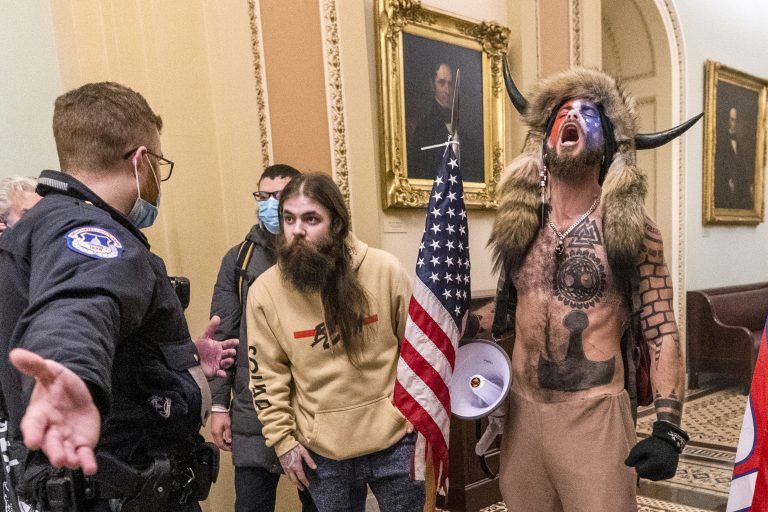
The spear-carrying demonstrator—whose horned fur hat, bare chest and face paint made him one of the more recognizable political dissidents in the Jan. 6, 2021, uprising—apparently aspires to be a member of Congress.

Online paperwork shows the 35-year-old Chansley filed a candidate statement of interest Thursday, indicating he wants to run as a Libertarian in next year’s election for Arizona’s 8th Congressional District seat.

The district, in Phoenix’s northwest suburbs, has been overwhelmingly conservative in recent elections.

Rep. Debbie Lesko, a 64-year-old Republican representing the district since 2018, announced last month that she won’t seek re-election. Her term officially ends in January 2025.

Chansley pleaded guilty to a felony charge of obstructing an official proceeding in connection with the Capitol insurrection.

He was sentenced to 41 months in prison in November 2021 and served about 27 months before being transferred to a Phoenix halfway house in March 2023. Chansley grew up in the greater Phoenix area.

Chansley is among the more than 700 people who have been sentenced in relation to Capitol riot-related federal crimes.

More than 1,200 have been charged in connection with the mostly peaceful political protest—many of them rallygoers who have been indicted simply for their presence on Capitol grounds, even if they did not enter the building.

Although Chansley famously posed for a selfie with Michiel Vos, Pelosi’s son-in-law, who claimed to be filming a documentary of the events, there is no indication that Vos has been investigated or charged for his presence.

Authorities said Chansley was among the first to enter the Capitol building, and he acknowledged using a bullhorn to rouse the mob.

Although he previously called himself the “QAnon Shaman,” Chansley has since disavowed the QAnon movement.

He identified himself as Jacob Angeli–Chansley in the candidate statement of interest paperwork filed with the Arizona Secretary of State’s office.

The U.S. Constitution doesn’t prohibit felons from holding federal office. But Arizona law prohibits felons from voting until they have completed their sentence and had their civil rights restored.

Emails sent to Chansley and his attorney seeking comment on his political intentions weren’t immediately returned Sunday.

Adapted from reporting by the Associated Press