Va. Supreme Court Rules for Teacher Who Declined to Use Student’s ‘Preferred Pronouns’

(Robert Jonathan, Headline USA) Chalk up a win for religious liberty, free speech and, perhaps, common sense, over the pronoun police.

The Virginia Supreme Court has given new life to a lawsuit by a former teacher against a school board that fired him over a pronoun controversy.

In a case that has dragged on for about five years, the state’s highest court ruled that Peter Vlaming, who taught French at a Richmond-area high school, had grounds to sue the board under Article 1, Section 16 (“free exercise of religion”) in the Virginia constitution.

A glance at Section 16 reveals that it appears more far-reaching than the First Amendment to the U.S. Constitution.

States generally have the power to grant more freedoms than the U.S. government in keeping with the federal Supremacy Clause but cannot curtail freedoms granted under federal law.

Vlaming reportedly got into hot water with the West Point School Board for declining to use masculine pronouns when referring to a biologically female student.

“In class, Vlaming referred to a transgender student by the student’s preferred name and avoided the use of third-person pronouns when referring to the student,” noted the 143-page state Supreme Court ruling.

“Vlaming claims that the School Board ordered him to use government-mandated pronouns in addition to using the student’s preferred name,” said the ruling. “The School Board fired Vlaming for refusing to do so.”

Vlaming maintained that his religious convictions precluded him from using male pronouns to refer to a female student.

In a video interview with the Heritage Foundation’s Daily Signal (see above), Vlaming explained that “I understood her point of view, and respected the fact that she could choose to think what she wants to think … but I couldn’t in good conscience designate her via third-person pronouns as a boy…”

As a practical issue, he also pointed out that the use of third-person personal pronouns in directly addressing an individual is grammatically incorrect.

The high court indicated in its decision that “Absent a truly compelling reason for doing so, no government committed to these [constitutional] principles can lawfully coerce its citizens into pledging verbal allegiance to ideological views that violate their sincerely held religious beliefs.”

The nonprofit legal organization Alliance Defending Freedom represented Vlaming in the litigation.

“The West Point School Board violated that constitutional command when it tried to force Vlaming to endorse the school’s ideological viewpoints on gender identity,” said ADF Senior Counsel Chris Schandevel, reacting to the above portion of the court’s opinion. “And the Virginia Supreme Court rightly vindicated Vlaming’s right to stand by his convictions in its decision.”

As part of a statement about this positive outcome, Schandevel implied that there was a component of irony in the case.

“Peter wasn’t fired for something he said; he was fired for something he couldn’t say,” Schandevel noted. “The Virginia Supreme Court rightly agreed that Peter’s case against the school board for violating his rights under the Virginia Constitution and state law should proceed.”

Schandevel added that “As a teacher, Peter was passionate about the subject he taught, was well-liked by his students, and did his best to accommodate their needs and requests. But he couldn’t in good conscience speak messages that he doesn’t believe to be true, and no school board or government official can punish someone for that reason.”

Several other conservative watchdog groups filed amicus curiae briefs in the closely watched, high profile case. Among them was the NC Values Coalition, which saw broader implications in the outcome from the Tarheel State’s northern neighbor.

“A school board policy mandating that teachers and school staff use the pronouns chosen by a transgender student rather than the pronouns matching the student’s biological sex is the epitome of viewpoint-based compelled speech, and as such, violates a teacher’s First Amendment protections of free speech and freedom of religion,” NC Values Executive Director Tami Fitzgerald told Headline USA in an email.

“Thankfully, the Virginia Supreme Court has ruled in favor of the teacher’s right to exercise his First Amendment rights, and thus, teachers in the Fourth Circuit can rest assured they will not be forced to sacrifice their constitutional rights as a condition of employment,” Fitzgerald added. “They are free to use male pronouns for boys and female pronouns for girls. Thus, common sense prevails, thank God.”

Vlaming’s legal complaint, which also includes a breach-of-contract allegation, was previously dismissed by a lower court.

This successful appeal green-lights the case for trial, although not handing the teacher an automatic win to enable him to get his job back right way.

A settlement is also a possibility. Vlaming is seeking $1 million in money damages, in addition to reinstatement.

In the context of procedure, and in law, procedural technicalities rather than the merits can sometimes be decisive. “The lawsuit did not argue that administrators violated Vlaming’s federal constitutional rights, so the Virginia Supreme Court’s ruling is the final say on the matter and cannot be appealed to federal court,” the Washington Post observed.

Under some stubborn, misguided local school boards, the Virginia public school system to  a certain degree has become an epicenter for identity politics, which likely led to the election of GOP candidate Glenn Youngkin as governor in 2021.

Maine’s Efforts to Curb Foreign Election-Meddling Face Legal Challenges, Uncertainty

(Headline USA) Two utilities and two media organizations are suing over a referendum in Maine that closed a loophole in federal election law allowing foreign entities to spend on local and state ballot measures.

The three lawsuits take aim at the proposal overwhelmingly approved by voters on Nov. 7 to address foreign election influence.

The Maine Association of Broadcasters and Maine Press Association contend the new law that goes into effect on Jan. 5 imposes a censorship mandate on news outlets, which are going to be required to police campaign ads to ensure there’s no foreign government influence.

Meanwhile, Central Maine Power and Versant, the state’s largest electric utilities, each filed separate lawsuits raising constitutional challenges about the law they claim violates their free speech and engagement on issues affecting them.

The Maine Commission on Government Ethics and Campaign Practices is studying the federal complaints filed Tuesday and consulting with the attorney general, Jonathan Wayne, the commission’s executive director, said Wednesday in an email.

The attorney general’s office declined comment.

The federal lawsuits “speak volumes about what a deplorable state that we’ve reached in our politics,” said state Sen. Rick Bennett, who led the effort to put the proposal on the ballot.

“This is something that Mainers are united about,” Bennett said Wednesday. “Their voices are being drowned out by these people who are bringing the lawsuits.”

The referendum, which was approved by a margin of 86% to 14%, bans foreign governments—or companies with 5% or more foreign government ownership—from donating to state referendum races.

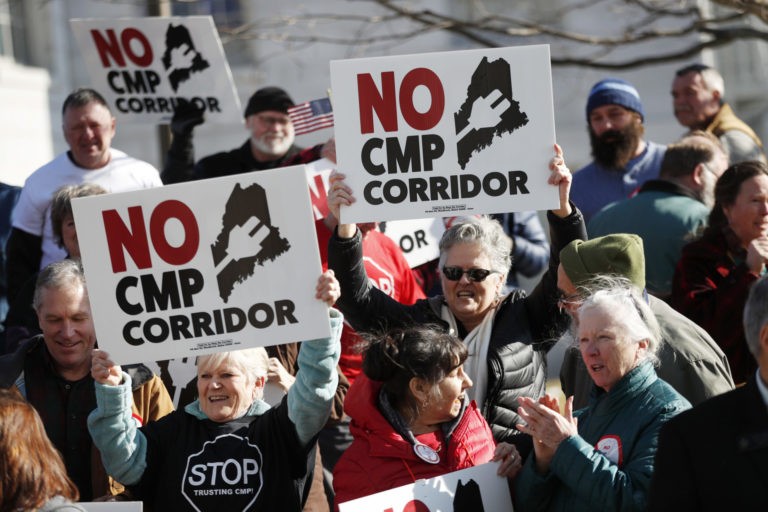
The proposal was put on the ballot after a Canadian government-owned utility, Hydro Quebec, spent $22 million to influence a project on which it’s a partner in Maine. That hydropower corridor project ultimately moved forward after legal challenges.

But there are implications for Maine-based utilities, too.

The law applies to Versant because it’s owned by the city of Calgary in Alberta, Canada. Foreign governments also have a stake in Central Maine Power.

CMP’s corporate parent Avangrid narrowly missed the cutoff by one measure. It is owned by a Spanish company—not the government—and minority shareholders owned by foreign governments, Norway’s central bank Norges Bank and the government-owned Qatar Investment Authority, together fall below the 5% threshold.

But Qatar also has an 8.7% minority stake in Spain-based Iberdrola, which owns Avangrid and CMP, and that’s part of the reason CMP argues that the law is unconstitutionally vague.

Before the Maine proposal went to voters it was vetoed by Democratic Gov. Janet Mills, who cited concerns about the proposal’s constitutionality and said its broadness could silence “legitimate voices, including Maine-based businesses.”

Federal election law currently bans foreign entities from spending on candidate elections but allows such donations for local and state ballot measures.

Maine was the 10th state to close the election spending loophole when the referendum was approved, according to the Campaign Legal Center in Washington, D.C., which supported the Maine proposal.

Bennett, a Republican representing the city of Oxford, said other states’ laws have withstood legal challenges even though some of their definitions are more stringent than Maine’s.

He also said it was ironic that Versant would sue for a right that it doesn’t have in Canada.

“In Canada it is completely illegal for any foreign individual or corporation to be involved in any of their elections,” he said.

The referendum is not the first issue that Maine has face this year with respect to foreign election-meddling.

However, it is unlikely that there is any political or legal recourse to prevent a pair of globalist foreign oligarchs from buying up many of the state’s local media outlets in a devious bid to influence U.S. politics.

After switching over to a ranked-choice voting system prior to the 2020 election, Maine’s elections—and those of other ranked-choice states, like Alaska—are particularly susceptible to manipulation through outside special interests, who can effectively hack the elections by fielding and promoting an unlimited number of spoiler candidates to poach votes from the preferred party frontrunners.

In September, far-left billionaires George Soros of Hungary and Hansjörg Wyss of Switzerland quietly helped to form a coalition called the National Trust for Local News and proceeded to scoop up nearly two-dozen local newspapers.

The long-term aim may be to weaponize the outlets against Sen. Susan Collins, R-Maine— thereby securing Democrats’ U.S. Senate majority in 2026—by sowing disinformation about phony Republican candidates that they plan to run against her and using them to draw votes from the incumbent.

There media stranglehold will also ensure that no Democratic challengers gain a foothold apart from the anointed candidate.

Among the papers that the duo recently purchased were the Portland Press Herald, the Lewiston Sun Journal and the Kennebec Journal.

Adapted from reporting by the Associated Press

Report: Army Platoons Begin Using Killer Robots

(Ken Silva, Headline USA) The thought of someone like President Joe Biden unleashing an army of killer robots might sound like a right-wing fever dream, but it’s closer to reality than one might expect.

According to a Wednesday report from the Military Times, efforts to incorporate robots in the military have reached a breakthrough, and are now being used in dangerous combat scenarios.

The Military Times reported that the Army’s MCOE Experimental Company, 1st Battalion, 29th Infantry Regiment, 316th recently conducted an urban assault.

“But instead of human soldiers rushing across open areas and bursting into buildings, robots took the lead … 20 soldiers with four robotic vehicles were able to cross the open terrain to reach the building. But first robots with smoke generators created a screen,” the publication reported.

“At the same time, robot vehicles with tethered drones jammed enemy signals and extended the soldiers’ network. Small drones dropped robotic ground vehicles with cameras atop buildings to scout the interior while even smaller aerial drones entered windows, scanning the inside of the structure and transmitting back a “blueprint” of the building to soldiers on the ground,” the publication added.

“Then robot “dogs” with cameras of their own, entered the building looking for hazards and seeking out enemy troops.”

The Military Times also reported that another company at Fort Irwin, California is being built to work alongside mechanized formations. Plans there reportedly entail taking a 14-tank company and adding four robots, 10 soldiers and a couple of Armored Multi-Purpose Vehicles.

“That might not seem like a lot of extra firepower, but with those extras, commanders can add loitering munitions, robot ammunition and battery resupply, keeping soldiers in the fight,” the Military Times said.

The Army still acknowledges that “trying to use robots to replace humans is going to take a long time,” the Military Times reported.

“But putting machines and humans together in an integrated formation helps put tasks on machines that unburden soldiers and allow them to do their jobs better,” it added.

In the meantime, members of Congress are proposing another way to address military recruitment shortfalls. Democratic U.S. Senators are pushing to allow illegal immigrants to serve in the armed forces in exchange for granting them citizenship.

Ken Silva is a staff writer at Headline USA. Follow him at twitter.com/jd_cashless.

Militia Leader Targeted by FBI is out of Prison, Still Fighting Conviction

(Ken Silva, Headline USA) About a decade before the FBI infiltrated Midwest militias and fomented a plot to kidnap Michigan Gov. Gretchen Whitmer, the bureau targeted Alaska’s militias as part of an apparent attempt to disrupt what was once a thriving Tea Party movement in that state.

The FBI’s main target in Alaska was militia leader Shaeffer Cox, a liberty activist who was making waves in mainstream politics at the time—as evidenced by the fact that the upstart won 37% of the vote in a Republican primary for Congress in 2010.

Using at least two undercover informants, the FBI concocted a case that Cox had plotted to assassinate federal agents.

Cox beat the charges in state court after an Alaska judge wouldn’t allow the FBI recordings made without a warrant, but the Justice Department then went after him in federal court, where he was eventually found guilty.

Much of Cox’s sentence was served in the hellish Communications Management Unit at the Terre Haute correctional facility, which is often used to house political prisoners. Initially sentenced to nearly 26 years imprisonment in 2013, Cox had 10 years knocked off in 2019, after an appeals court agreed that the federal agents he supposedly plotted to kill didn’t actually exist.

Now, Cox is out of prison. He recently announced on his personal website that he was suddenly sent to a halfway house shortly after he filed another appeal against his conviction.

“The morning they let me go, a guard came to my cell, told me to pack up, shook my hand, told me he knows I’m innocent, then wished me luck in building a new life and walked me out the door,” Cox said.

“Just like that—in 5 minutes—I was standing on the curb outside the prison waiting for a taxi to the airport.”

Cox said he’s now looking for a job so he can pay off his mountainous legal fees. He’s also dealing with PTSD and the overwhelming feeling of the world having passed him by.

One of the biggest changes—for the better—he’s seen is that many people now finally realize what he was talking about more than a decade ago: “One thing I have noticed is that after what was done to Trump, everyone knows the FBI and DOJ are totally corrupt,” he said.

“When people ask why I was in prison, all I have to say is ‘Russian collusion type case’ and they instantly know what was done to me. Perhaps it’s a reason for optimism.”

Meanwhile, Cox continues to appeal his conviction.

In a brief filed Wednesday, he argued that the appeals court was correct in overturning the charge of solicitation to murder federal agents, since those agents didn’t actually exist. But the appeals court should have also vacated the conspiracy charge against him for the same reason, he said, seeking a new trial for the conspiracy charge.

“The supposed “federal employee” targets in the solicitation count … did not qualify as federal “officer[s] or employee[s]” under the relevant test because they did not in fact exist. Cox also argued that he did not agree with (or ask anyone) to commit murder because the plan was only to provide self-defense at the KJNP television station against a supposed team of federal assassins bent on murdering Cox,” the brief said, explaining Cox’s arguments.

“This Court agreed with these arguments about the KJNP theory and accordingly vacated the solicitation count. [But] the panel said nothing about the effect of this holding on the conspiracy count, even though the government had relied primarily on that same factual theory.”

DOJ prosecutors have until Jan. 12 to respond to Cox’s brief.

Ken Silva is a staff writer at Headline USA. Follow him at twitter.com/jd_cashless.

Congress Caves and Extends FBI’s Domestic Spying Power

(Ken Silva, Headline USA) Despite all the bluster about protecting civil liberties, Congress voted on Thursday to extend Section 702 of the Foreign Intelligence Surveillance Act—the controversial law that allows agencies to spy on foreigners, but which often results in the surveillance of Americans’ communications.

Section 702 of FISA was set to expire by the year’s end, and the House Judiciary Committee had recently passed a bill that would require agencies such as the FBI to obtain warrants before searching information collected about Americans under Section 702.

However, FBI Director Chris Wray and numerous other intelligence officials opposed warrant requirements. Caving to that pressure, senior congressional leaders snuck a provision to extend Section 702 in the National Defense Authorization Act, which funds the military every year.

Faced with the choice of opposing FISA or voting to fund the military, most members of Congress voted for the latter. Section 702 is now extended until April.

In the House, most of the GOP Freedom Caucus voted against the NDAA. A notable exception was Rep. Lauren Boebert, R-Co., who voted in favor of the military bill.

After the vote, Rep. Chip Roy, R-Texas, voiced his frustrations at the inability to reform FISA.

“The fact of the matter is what’s being stated is it is impossible to oppose the National Defense Authorization Act because we put a pay raise in it or because we put something in there that is seemingly so important that we have to ignore the critical destruction of our civil liberties by adding FISA extension right on the top of it without doing the forms necessary to protect the American people,” he said, according to The Hill.

“We do this every year.”

The American Civil Liberties Union also put out a statement, calling the vote “disheartening.”

“As long as Section 702 is being used by the government to spy on Americans without a warrant, we will continue to fight this unconstitutional law and work with Congress to strengthen our Fourth Amendment protections against government surveillance,” the ACLU said.

The one happy party is the national security state. Matthew Olsen, assistant attorney general for the National Security Division, reportedly said he was “relieved” by the vote.

“We cannot afford to be blinded to the many threats we face from foreign adversaries,” he said, according to The Hill.

Ken Silva is a staff writer at Headline USA. Follow him at twitter.com/jd_cashless.

Men Charged w/ Illegally Poaching 3,600 Birds, Including Bald Eagles

0

(Headline USA) A federal grand jury in Montana has indicted two men accused of killing about 3,600 birds, including bald eagles and golden eagles, and selling them on the black market.

The indictment returned in U.S. District Court last week charges Simon Paul and Travis John Branson with 13 counts of unlawful trafficking of bald and golden eagles and one count each of conspiracy and violating the Lacey Act, which prohibits trafficking of illegally taken wildlife.

“The Bald and Golden Eagle Protection Act was enacted in 1940 to protect the bald eagle, recognizing that the bald eagle is not merely a bird of biological interest, but this country’s national symbol which reflects America’s ideals of freedom,” the indictment states. The act was extended in 1962 to include golden eagles.

Branson, Paul and others hunted and killed thousands of birds, including eagles, on the Flathead Indian Reservation and elsewhere, then illegally sold them for significant sums of cash across the United States and elsewhere, the indictment states.

Investigators found messages from Branson and others describing the illegal taking of eagles, saying he was “committing felonies” and telling buyers he was “on a killing spree” to collect more eagle tail feathers for future sales, according to the indictment.

The indictment alleges that Paul and Branson conspired to kill and sell the eagles illegally near Ronan, Montana, from 2015 and 2021.

From 2019 and 2021, Branson traveled from Washington state to the reservation to shoot the eagles, and Paul, who lived near the reservation, was a shooter and shipper for Branson.

“When Branson arrived on the Flathead Indian Reservation, Paul would meet and help kill, transport, and ship bald and golden eagles for future sales on the black market,” the indictment states.

Paul and Branson were issued summons to appear for arraignments on Jan. 8.

Court documents do not list attorneys for Paul or Branson.

Adapted from reporting by the Associated Press

Mich. Court Rejects Challenges to Trump’s Spot on 2024 Primary Ballot

0

(Headline USA) The Michigan Court of Appeals said Thursday it won’t stop former President Donald Trump from appearing on the state’s 2024 Republican primary ballot, turning aside challenges from far-left activists who sought to use his role in the 2021 uprising at the U.S. Capitol to disqualify him.

Rejecting the appeals, including one spearheaded by the activist group Free Speech for People, the court affirmed two lower court rulings without determining whether Trump falls under the insurrection clause in the Constitution’s 14th Amendment.

“Who to place on the primary ballot is determined by the political parties and the individual candidates,” the appeals court said in a 3-0 opinion, citing Michigan law.

The court further said Trump’s possible spot on a general election ballot was not ripe for consideration, shooting down a possible trap that the Wisconsin court had left open, that Trump could win the nominating contest only to have activist judges step in and render him ineligible for the election itself.

The two-sentence clause in the 14th Amendment has been used only a handful of times since the years after the Civil War. It’s likely that one of the lawsuits challenging Trump eventually will be appealed to the U.S. Supreme Court, which has never ruled on the insurrection clause.

The Michigan court decision was similar to one from the Minnesota Supreme Court, which said Trump could stay on that state’s primary ballot there because the election is a party-run contest.

In one of the Michigan lawsuits, the anti-Trump plaintiffs included Bob LaBrant, a longtime Republican who was a lawyer and political strategist for decades at the state Chamber of Commerce.

In a statement, Trump campaign spokesman Steven Cheung said, “The Soros-funded Democrats have once again failed in their desperate attempt to interfere in the election via a bad-faith interpretation of the 14th Amendment.”

Despite the fact that far-left activists are attempting to label the event as an “insurrection” in order to push their wild legal moonshot, growing evidence has shown that the Jan. 6 protest was, in fact, hardly the national travesty that the left-wing media and Democrats made it out to be.

Recently released video has confirmed that most of the people who entered into the Capitol conducted themselves peacefully and respectfully, some even being ushered by law-enforcement.

Meanwhile, video also seemed to suggest that there was a considerable presence of plain-clothed government agents who appeared to be working to instigate and foment the violence, and that the U.S. Capitol Police themselves played a significant role in riling up the crowd that had gathered outside the Capitol by firing tear gas and rubber bullets before any provocation had necessitated the use of force.

Officials with the Biden Justice Department thus far have arrested more than 1,200 participants, including several members of the media who were covering the events there.

Adapted from reporting by the Associated Press

Arsonist Sets Small Fire at NYC Courthouse, Forces Engoron to Evacuate

(Headline USA) The man charged with setting a small fire at the courthouse hosting Donald Trump’s civil business fraud trial burned papers bearing complaints about criminal justice, prosecutors said Thursday.

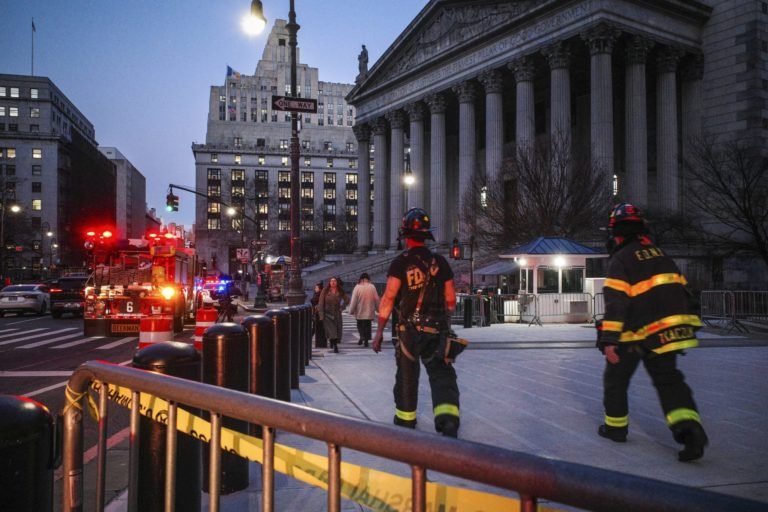
Wednesday’s fire forced an evacuation of the main Manhattan civil court building hours after testimony wrapped up in the former president’s trial. But there was no indication the two events were related.

The 38-year-old man was arraigned Thursday on attempted arson and reckless endangerment charges. Bail was set at $50,000 cash or $150,000 bond.

It’s not clear what brought the man to the courthouse, familiar to many TV viewers as a backdrop for “Law & Order,” “Night Court” and other shows.

While on the fourth floor late Wednesday afternoon, the man set ablaze papers with handwritten criticisms of the criminal justice system, prosecutors said at his arraignment at a criminal courthouse down the street.

They said that after the man ignited the documents, he pulled an alarm and started dousing them with a fire extinguisher.

“I started the fire, then I put it out,” he told a court officer, according to a court complaint.

The smoke and extinguisher chemicals created a haze around the fourth floor and into the stairwells. There were no reports of serious injuries, though court system spokesperson Al Baker said Thursday that “many court officers suffered physically” and praised their “indispensable public service in a trying moment.”

The courthouse was evacuated, but people were allowed to return shortly afterward. Among them was Judge Arthur Engoron, who is deciding Trump’s case.

The trial had been unfolding in a big ceremonial courtroom on the third floor. The lawyers and others involved, including New York Attorney General Letitia James, left more than three hours before the fire upstairs. Trump wasn’t at court at any point Wednesday.

With testimony complete, closing arguments are set for Jan. 11.

Fires have put the brakes on the wheels of justice before in New York, where the court docket often includes prominent people.

In 2010, a smoky fire in the basement of the Manhattan criminal courthouse forced over 1,000 people to evacuate, left eight with minor injuries and shuttered the building for the day, delaying rap star Lil Wayne’s sentencing in a gun case. The blaze happened a few hours before he was due in court.

Adapted from reporting by the Associated Press

Tesla Recalls Nearly All U.S. Vehicles to Fix Autopilot Monitoring System

(Headline USA) Tesla is recalling nearly all vehicles sold in the U.S., more than 2 million, to update software and fix a defective system that’s supposed to ensure drivers are paying attention when using Autopilot.

Documents posted Wednesday by U.S. safety regulators say the update will increase warnings and alerts to drivers and even limit the areas where basic versions of Autopilot can operate.

The recall comes after a two-year investigation by the National Highway Traffic Safety Administration into a series of crashes that happened while the Autopilot partially automated driving system was in use. Some were deadly.

The agency says its investigation found Autopilot’s method of making sure that drivers are paying attention can be inadequate and can lead to “foreseeable misuse of the system.”

The added controls and alerts will “further encourage the driver to adhere to their continuous driving responsibility,” the documents said.

But safety experts said that, while the recall is a good step, it still makes the driver responsible and doesn’t fix the underlying problem that Tesla’s automated systems have with spotting and stopping for obstacles in their path.

The recall covers models Y, S, 3 and X produced between Oct. 5, 2012, and Dec. 7 of this year. The update was to be sent to certain affected vehicles on Tuesday, with the rest getting it later.

Shares of Tesla slid more than 3% in earlier trading Wednesday but recovered amid a broad stock market rally to end the day up 1%.

The attempt to address the flaws in Autopilot seemed like a case of too little, too late to Dillon Angulo, who was seriously injured in 2019 crash involving a Tesla that was using the technology along a rural stretch of Florida highway where the software isn’t supposed to be deployed.

“This technology is not safe, we have to get it off the road,” said Angulo, who is suing Tesla as he recovers from injuries that included brain trauma and broken bones. “The government has to do something about it. We can’t be experimenting like this.”

Autopilot includes features called Autosteer and Traffic Aware Cruise Control, with Autosteer intended for use on limited access freeways when it’s not operating with a more sophisticated feature called Autosteer on City Streets.

The software update will limit where Autosteer can be used. “If the driver attempts to engage Autosteer when conditions are not met for engagement, the feature will alert the driver it is unavailable through visual and audible alerts, and Autosteer will not engage,” the recall documents said.

Depending on a Tesla’s hardware, the added controls include “increasing prominence” of visual alerts, simplifying how Autosteer is turned on and off, and additional checks on whether Autosteer is being used outside of controlled access roads and when approaching traffic control devices.

Drivers could be suspended from using Autosteer if they repeatedly fail “to demonstrate continuous and sustained driving responsibility,” the documents say.

According to recall documents, agency investigators met with Tesla starting in October to explain “tentative conclusions” about the fixing the monitoring system.

Tesla did not concur with NHTSA’s analysis but agreed to the recall on Dec. 5 in an effort to resolve the investigation.

Auto safety advocates for years have been calling for stronger regulation of the driver monitoring system, which mainly detects whether a driver’s hands are on the steering wheel. They have called for cameras to make sure a driver is paying attention, which are used by other automakers with similar systems.

Philip Koopman, a professor of electrical and computer engineering at Carnegie Mellon University who studies autonomous vehicle safety, called the software update a compromise that doesn’t address a lack of night vision cameras to watch drivers’ eyes, as well as Teslas failing to spot and stop for obstacles.

“The compromise is disappointing because it does not fix the problem that the older cars do not have adequate hardware for driver monitoring,” Koopman said.

Koopman and Michael Brooks, executive director of the nonprofit Center for Auto Safety, contend that crashing into emergency vehicles is a safety defect that isn’t addressed.

“It’s not digging at the root of what the investigation is looking at,” Brooks said. “It’s not answering the question of why are Teslas on Autopilot not detecting and responding to emergency activity?”

Koopman said NHTSA apparently decided that the software change was the most it could get from the company, “and the benefits of doing this now outweigh the costs of spending another year wrangling with Tesla.”

In its statement Wednesday, NHTSA said the investigation remains open “as we monitor the efficacy of Tesla’s remedies and continue to work with the automaker to ensure the highest level of safety.”

Autopilot can steer, accelerate and brake automatically in its lane, but is a driver-assist system and cannot drive itself, despite its name.

Independent tests have found that the monitoring system is easy to fool, so much that drivers have been caught while driving drunk or even sitting in the back seat.

In its defect report filed with the safety agency, Tesla said Autopilot’s controls “may not be sufficient to prevent driver misuse.”

A message was left early Wednesday seeking further comment from the Austin, Texas, company.

Tesla says on its website that Autopilot and a more sophisticated Full Self Driving system are meant to help drivers who have to be ready to intervene at all times. Full Self Driving is being tested by Tesla owners on public roads.

In a statement posted Monday on Twitter, Tesla said safety is stronger when Autopilot is engaged.

NHTSA has dispatched investigators to 35 Tesla crashes since 2016 in which the agency suspects the vehicles were running on an automated system. At least 17 people have been killed.

The investigations are part of a larger probe by the NHTSA into multiple instances of Teslas using Autopilot crashing into emergency vehicles. NHTSA has become more aggressive in pursuing safety problems with Teslas, including a recall of Full Self Driving software.

In May, Transportation Secretary Pete Buttigieg, whose department includes NHTSA, said Tesla shouldn’t be calling the system Autopilot because it can’t drive itself.

Some have speculated that Tesla and other companies owned by red-pilled billionaire Elon Musk—including SpaceX, Starlink and Twitter—are being deliberately targeted for harassment by the Biden administration.

Musk’s Twitter takeover has taken a demonstrable toll on Democrats’ political popularity after the Biden administration had previously benefited from widespread collusion between the social-media network and government agencies to suppress and ban opinions with which it disagreed.

Since then, agencies like the Federal Communications Commission, the Federal Trade Commission and the Justice Department have proceeded to interfere with Musk’s business operations at every turn.

Adapted from reporting by the Associated Press

Pro-Hamas Rioters Roil Campuses; 41 Arrested for Trespassing at Brown

(Headline USA) Dozens of student protesters at Brown University were arrested, and a weeklong sit-in at Haverford College ended Wednesday under threat of disciplinary action as U.S. college campuses continue to be roiled by tensions spurred by pro-Hamas protesters demanding that the Palestinian terrorist group avoid consequences for it brutal Oct. 7 massacre in Israel.

Brown’s police department charged 41 students with trespass when they refused to leave the University Hall administrative building after business hours on Monday, according to officials at the Ivy League school in Providence, Rhode Island.

Earlier that day, protesters had met with Brown President Christina H. Paxson and demanded that Brown divest “its endowment from Israeli military occupation,” the school said in a statement on the arrests.

Students were photographed and fingerprinted at the administration building before their release Monday night. Other students waited outside to cheer them on.

It was the second round of arrests at Brown in a little over a month as college administrators around the country try to reconcile the rights of students to protest with the schools’ imperative to maintain order.

Twenty students protesting Israel’s invasion of Gaza were arrested for trespass on Nov. 8, although Brown dropped the charges on Nov. 27, two days after a Palestinian student at Brown, Hisham Awartani, and two other Palestinian college students were shot in Burlington, Vermont.

Brown said Wednesday that while protest is “a necessary and acceptable means of expression on campus,” students may not “interfere with the normal functions of the University.” The school warned of even more severe consequences if students fail to heed restrictions on the time, place and manner of protests.

“The disruption to secure buildings is not acceptable, and the University is prepared to escalate the level of criminal charges for future incidents of students occupying secure buildings,” Brown said.

At Haverford, outside Philadelphia, student activists began their sit-in on Dec. 6 and occupied Founders Hall, which houses administrative offices. They are demanding that college President Wendy Raymond publicly call for a cease-fire in Gaza.

Hundreds of students participated over the last week, taking deliveries of food and setting up study spaces. Professors even dropped in to teach, according to student organizers.

The college asserted that the protesters were hindering fellow students, staff and faculty, and told the sit-in organizers Tuesday night that “they must discontinue actions that impede student learning and the functions of the College, which include the sit-in inside Founders Hall,” Raymond and the college dean said in a campus message Wednesday morning.

Student organizers told the Associated Press that college officials threatened to haul protesters before a disciplinary panel if they didn’t leave the hall.

About 50 students defied the warning and slept in the building overnight before protesters held one last rally Wednesday morning and delivered letters to Raymond before disbanding.

The threat of discipline played a role in the decision to end the sit-in, according to Julian Kennedy, a 21-year-old junior and organizer with Haverford Students for Peace. But he said organizers also concluded that the sit-in would not compel Haverford to meet the group’s demands.

“At this point, we just see that this college as an institution is broken and has lost its values,” said Kennedy, accusing Haverford of betraying its Quaker pacifist roots.

Ellie Baron, a 20-year-old junior and protest organizer, said the group will pressure Haverford in other ways.

“Just because the sit-in is over, doesn’t mean our efforts are over. We are extraordinarily upset our president refuses to call for a cease-fire,” Baron said.

A Palestinian American student at Haverford, Kinnan Abdalhamid, was also among the three Palestinian college students who were shot over Thanksgiving break in Vermont. The suspected gunman was arrested and has pleaded not guilty to three counts of attempted murder. Officials are investigating whether the shooting, which seriously injured one of the other students, was a hate crime.

Abdalhamid, who took part in Wednesday’s rally, said in a statement that “our presence here is a powerful message that we will not stay silent, we will not be passive observers.”

The arrests and sit-in came amid continuing fallout over the testimony given by leaders of the University of Pennsylvania, Harvard and MIT at a congressional hearing on antisemitism last week.

The presidents drew fire for carefully worded responses to a line of questioning from New York Republican Elise Stefanik, who repeatedly asked whether “calling for the genocide of Jews” would violate the schools’ rules.

Penn’s president resigned over the weekend while, at Harvard, the governing board declared its support for the school’s embattled president.

Adapted from reporting by the Associated Press