Attention Criminals: Massachusetts Bans Life w/o Parole Up to Age 21

(Headline USA) The highest court in Massachusetts ruled Thursday to raise from 18 to 21 the minimum age at which a person can be sentenced to mandatory life without parole in a narrow 4-3 ruling.

The decision came in the case of Sheldon Mattis, who was convicted of the 2011 killing of a Boston teen as part of a gang feud. Mattis was 18 at the time of the shooting and was sentenced to life without the possibility of parole.

Mattis’s attorney, Ruth Greenberg, called the release of the ruling “a very good day.”

“People who are 18 are more like people who are 17 than people who are 35. They are capable of change, and often their decisions at that young age were not entirely their own,” Greenberg said. “It is courageous and it is correct, and other courts will follow it.”

As a result of Thursday’s ruling by the state Supreme Judicial Court, Mattis and other “emerging adults” ages 18 to 20 at the time of their crime and sentenced to life without parole before July 25, 2014, will be resentenced to life with the possibility of parole after 15 years.

Mattis’s co-defendant, Nyasani Watt, who pulled the trigger, was only 17 at the time of the killing and received a life sentence with the possibility of parole after 15 years. Thursday’s ruling does not alter his ability to seek parole.

Until the ruling came, Massachusetts was one of 10 states that required people ages 18 to 20 who are convicted of first-degree murder to be sentenced to life without parole, according to the court.

In their decision, the justices referred to people those ages as “emerging adults.”

“Advancements in scientific research have confirmed what many know well through experience: the brains of emerging adults are not fully mature. Specifically, the scientific record strongly supports the contention that emerging adults have the same core neurological characteristics as juveniles,” the justices wrote.

The court also wrote that “by providing an opportunity for parole, we do not diminish the severity of the crime of murder in the first degree because it was committed by an emerging adult.”

Advocates praised the ruling.

“The years of emerging adulthood are a time of intensive brain development. These young people are wired for impulsivity, not fully able to think through consequences, and heavily influenced by peers,” said Lael Chester, director of the Emerging Adult Justice Project at Columbia Justice Lab.

“Like people under age 18, emerging adults are highly likely to desist from crime as they mature,” he added.

The three dissenting justices wrote that decisions about criminal sentences should be left to elected officials.

“The power to ‘define a crime and ordain its punishment’ is an exclusively legislative function,” the justices wrote. “For the crime of murder in the first degree, the Legislature has deemed the mandatory imposition of life without the possibility of parole to be the appropriate punishment for adults eighteen and older.”

Other critics, including some prosecutors, have also argued the decision should be left to lawmakers. More than 200 people are serving life without parole sentences in Massachusetts prisons for killings committed as 18-, 19- and 20-year-olds.

Suffolk District Attorney Kevin Hayden said his office has identified about 70 inmates who will eventually become eligible for parole because of the ruling. He said the ruling doesn’t automatically grant parole to those inmates.

He also said his office is reaching out to family members of homicide victims to help them understand what options they have moving forward.

Watt was 10 days away from turning 18 when, authorities said, Mattis handed him a gun and Watt fatally shot 16-year-old Jaivon Blake in Boston’s Dorchester neighborhood. Mattis and Watt were tried jointly and convicted of first-degree murder.

Mattis had argued that his mandatory sentence of life without parole violated the prohibition of cruel or unusual punishment because he was under 22 at the time.

The Supreme Judicial Court in 2020 ordered a lower court to gather more information about brain development so it could decide whether to extend the ban on life without parole sentences to young adults.

About a decade ago, the Massachusetts court did away with life without the possibility of parole for juveniles.

In 2012, the U.S. Supreme Court also found that life without parole sentences for people under 18 should be rare. In 2021, a more conservative high court made it easier to hand down those punishments for juveniles, ruling that it doesn’t require a finding that a minor is incapable of being rehabilitated.

Adapted from reporting by the Associated Press

Dems Move to Outlaw Militias in Violation of 2nd Amendment

(Jacob Bruns, Headline USA) Democrats in Congress have introduced a bill which would effectively outlaw militias in America, blatantly violating both the freedom of association and also the Second Amendment.

The legislation was introduced by Sen. Edward Markey, D-Mass., and Rep. Jamie Raskin, D-Md., both of whom have been forthright about their desire to strip Americans of the right to defend themselves.

The authors of the bill would use January 6 as justification to strip their political opponents of their right to bear arms.

According to a press release penned by the sponsors, the release of the “Preventing Private Paramilitary Activity Act” is meant to follow “the anniversary of the January 6th attack on the United States Capitol” by creating a “federal prohibition on paramilitary groups through civil and criminal enforcement.”

The law’s enforcement would be provided for by holding individuals liable acting as part of a private paramilitary organization. Whether the law would be applied to left-wing groups like Antifa is unclear.

Markey himself engaged in melodrama when announcing the bill, hearkening back to January 6, 2021 as the day where Democracy itself came under violent assault.

“Three years ago, white supremacists affiliated with paramilitary organizations stormed the U.S. Capitol, shattering windows, walls, and the families of five U.S. Capitol police officers. Private paramilitary actors, such as the Proud Boys and Oath Keepers, pose a serious threat to democracy and the rule of law, and we must create new prohibitions on their unauthorized activities that interfere with the exercise of people’s constitutional rights,” he said.

He proceeded to call such groups “forces of bigotry, hatred, and violent extremism,” which must be stopped “for the sake of our democracy.”

Raskin joined in the hysterics, claiming that “paramilitary operations are in no way protected by our Constitution” and that his legislation will be needed to “deter insurrection and defend our democracy.”

WATCH: Shocking Child-Trafficking, Sex Abuse at Border

(Jacob Bruns, Headline USA) Anthony Aguero, a journalist who exposes sex traffickers, uncovered a child-trafficking operation smuggling children across America’s border with Mexico.

Aguero, who has fashioned himself as a sort of Tim Ballard figure, has dedicated himself to rescuing children from the sexual predators who cross America’s southern border on a daily basis.

Last month, Aguero tweeted a disturbing video of the horrific events taking place at the border, having caught a man sexually assaulting a child.

Aguero also posted video footage a number of children who appeared to be being trafficked. Several of those who appeared on the footage were sedated to the point of being unresponsive, and were accompanied only by single men, who claimed their wives had left them.

Aguero has launched two GiveSendGo campaigns raising money for his efforts to “rescue babies from predators and traffickers”—a phenomenon that appears to be happening, or at least being exposed, at an increasing rate.

His Border Wars Team spends its time “on the frontlines night after night exposing thousands of military aged males coming across.”

He also runs Border Wars Live, a group established to bring more coverage to a story that the mainstream media conspicuously ignores: child trafficking at the border.

Border Wars Live aims to “educate” and bring coverage that would not otherwise be seen.

“We have been covering the southern border full time since November 2017,” he wrote, adding that, through the years, they have taken “footage of terrorists and even rescued children from traffickers.”

Meanwhile, President Joe Biden and his administration have done nothing but encourage increased illegal immigration, even as some prominent Democrats, such as New York City Mayor Eric Adams, begin to publicly question the efficacy of such a policy.

Some Biden administration officials have even suggested abolishing Immigration and Customs Enforcement.

Of course, given the Left’s connections to billionaire pedophile Jeffrey Epstein, and the Biden family’s own dubious connections with the sex-trafficking industry, one suspects they will not be overly-bothered by Aguero’s findings.

House Speaker Johnson Is Accused of Caving on Spending Cuts

(Mike Gleason, Money Metals Exchange) As inflation comes in hotter than expected and the federal deficit comes in higher than ever, investors face rising risks in financial markets.

On Thursday, the Labor Department reported that the Consumer Price Index for December rose by 0.3%. That was a bigger increase than forecasted. It represents an annual rate of 3.4%.

Rising food, energy, and shelter costs contributed to the CPI’s jump. Since the index doesn’t fully capture these components, millions of households are experiencing cost of living increases that are much higher than what’s reported officially.

The Federal Reserve obviously cannot now claim victory over inflation. Not with their stated 2% target still nowhere in sight. And certainly not with inflation now threatening to accelerate.

Fed Chairman Jerome Powell had struck a dovish tone last month, leading to widespread expectations of a pivot toward rate cuts by March.

This week’s CPI report could dissuade policymakers from shifting toward easing. But not necessarily.

Regardless of whether the economy needs lower interest rates, the world’s biggest debtor does. The U.S. government is struggling to service its rapidly expanding debt load.

On Thursday, the Treasury Department reported that the federal budget deficit widened in December to more than $129 billion for that month alone. That’s up from $85 billion in December 2022.

The current fiscal year which began in October is on pace to produce a record annual deficit. The three months so far of accumulated red ink total $510 billion, up from $421 billion in the same period of the previous fiscal year.

Fiscal conservatives are demanding that Congress hit the brakes on spending. But Speaker of the House Mike Johnson is moving forward with a Democrat-backed budget deal that would increase outlays and do nothing to shrink the deficit.

Critics accuse Johnson of capitulating on spending in the same way that his predecessor Kevin McCarthy did. The more things change in Washington, the more they stay the same.

Republicans may have a majority in the House of Representatives. But advocates of fiscal restraint, balanced budgets, and sound money are a small minority on Capitol Hill.

Fiscal recklessness will weigh over time on the creditworthiness of the U.S. government and the value of the U.S. dollar. In such an environment, gold and silver stand to shine as safe havens.

But for now, precious metals markets are taking a back seat to the stock market. The S&P 500 traded at a record high this week.

Meanwhile, gold prices drifted lower through Thursday’s close. But the monetary metal is getting a bump here today and currently checks in at $2,064 an ounce – now showing a slight 0.4% gain for the week. Silver is lagging and is off 3.7% on the week to trade at $23.50 per ounce. Platinum is giving up 4.3% to come in at $932. And finally, the palladium market is posting a weekly loss of 4.6% to come in at $1,016 per ounce as of this Friday morning recording.

Metals markets are losing momentum in the early goings of 2024. But their underlying fundamentals are strengthening. They face supply shortfalls and have the potential to garner massive safe-haven buying when confidence in stocks, bonds, and fiat dollars turns down.

Soros DA Sues to Stop Philly Law Designed to Limit His Authority on Transit System Crimes

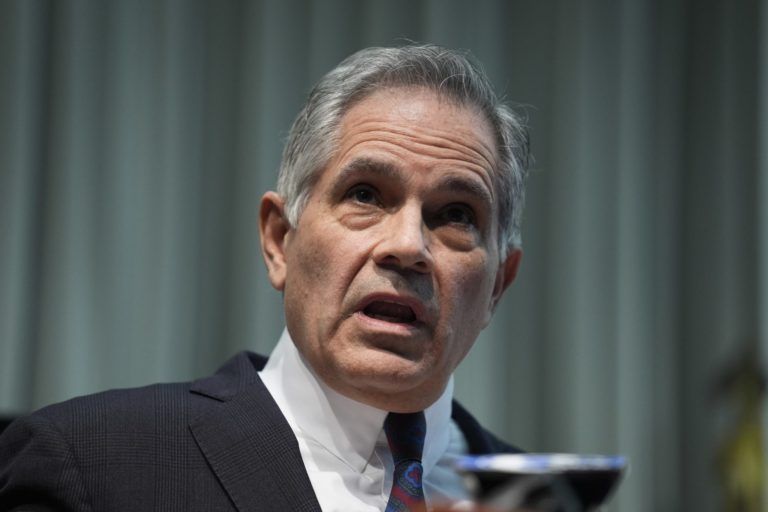
(Headline USA) Philadelphia’s two-term elected district attorney said Thursday that he wants a court to stop plans to appoint a special prosecutor who would handle crimes on the city’s transit system under a new law designed to dilute his authority.

It’s not the first time progressive District Attorney Larry Krasner has gone to court over lawmakers’ efforts, which he argues overstep their authority to punish him over political differences.

The measure, which saw bipartisan support in the House and was signed by Democratic Gov. Josh Shapiro last month, created a special prosecutor with the authority to investigate and prosecute crimes that occur on the city’s public transit system, the Southeastern Pennsylvania Transportation Authority (SEPTA).

The lawsuit seeking to block the law’s implementation alleges the special prosecutor would take 89% of the land area from the city out of the district attorney’s jurisdiction. The lawsuit asks that the law get thrown out and an injunction be issued to prevent Attorney General Michelle Henry from implementing it.

The attorney general’s office was directed to appoint the new special prosecutor within 30 days. The deadline is this week.

The complaint, filed Thursday, alleges that the law specifically targets Krasner and his office, discriminates against Philadelphia and its voters compared with other counties served by SEPTA and that the state constitution doesn’t allow special counsel to “divest and nullify” Krasner’s authority, among other things.

John Summers, Krasner’s attorney, called the measure a “constitutional trainwreck.”

Republicans, for their part, have defended the legislation, saying it is meant to make the city safer, and they emphasized its bipartisan passage. They have said such a move was necessary because high-profile violent crimes, like gun crimes, weren’t adequately prosecuted.

“It is time DA Krasner stops playing political games and starts working with Republicans and Democrats alike” to ensure the safety of Philadelphians, said Senate Republican Leader Joe Pittman of Indiana County.

The bill’s sponsor Sen. Wayne Langerholc, a Republican from Cambria County, said it would not take power from Krasner or encroach on his jurisdiction. He called Krasner’s portrayal of the legislation a “falsehood.”

“I would encourage those who spoke so loudly against the bill to get a copy and read it,” he said.

At the news conference, Krasner dismissed that criticism, saying his office has prosecuted 92% of crimes SEPTA has sent his office. He warned that if the court agrees with him, any cases pursued by the special prosecutor could be overturned.

Krasner has clashed with legislators in Harrisburg for years. He was impeached by Republican members of the House in November 2022, but a state Senate trial has been stalled after Krasner sued to stop it. His case is now before the state Supreme Court.

Krasner’s election to office in 2017 came in a wave of progressive victories, campaigning on policies that include diversion to mental health treatment or drug abuse treatment for low-level crimes, holding police more accountable, and proactive efforts to free inmates who were wrongfully convicted.

But progressive prosecutors have met backlash and scrutiny from conservative lawmakers. In San Francisco, Chesa Boudin was recalled by voters, while St. Louis Circuit Attorney Kim Gardner resigned following a turbulent tenure that included criticism of her policies by Republican lawmakers in Missouri.

Adapted from reporting by the Associated Press

Yale’s Secretive ‘Skull and Bones Society’ Goes Woke

(Molly Bruns, Headline USA) One of the most quintessential symbols of systemic power and privilege in the U.S., the Skull and Bones society, has gone woke—with predictably disastrous results, according to a recent report from The Atlantic.

Over the last few years, Yale University’s notorious secret society shifted its elite membership standards from the most intelligent, athletic students from old American families to members of historically marginalized groups.

The organization’s power is based on the access to power that its legacy lends, including three U.S. presidents (two of whom came from the Bush family) and many other influential leaders who put up-and-coming members on the fast track to success.

However, its newly diverse ranks appear intent on tearing down that legacy, effectively imploding from within all that the Skull and Bones represents.

Some might read into its plight a sort of metaphor for the American political establishment at large, which has been hobbled by the Marxist infiltration masquerading as diversity, equity and inclusion.

The Atlantic detailed the change across all of Yale’s secret societies, with the tap lines changing from the football captain or student-body president to students from low-income backgrounds or minority groups.

“People are, intentionally or not, thinking, ‘Does this cohort have too many white people?'” said Ale Canales, a member of another group known as Berzelius. “It’s definitely an undercurrent.”

A member of the Skull and Bones class of 2021 said the group accepted “people from all kinds of backgrounds,” but did not bring in conservative students.

According to the report, students welcomed into these secret societies are usually far-left to left-of-center on the political spectrum.

Skull and Bones only accepted white men until 1991, when they brought in their first female member.

Today’s members of the group still take issue with the lengthy exclusion. Caleb Dunson, a black Yale student and a member of one of Yale’s Ancient Eight secret societies, wrote an article a few years ago arguing that the entire Yale institution should be abolished on the basis of its exclusionary beginnings.

“It started off excluding women and people of color from its student body and now parades them around for diversity photos and social justice brownie points,” he said. “Since we can’t change Yale, we have to tear it down.”

Despite the inherent discriminatory nature of these societies, the social justice warriors rationalize their participation in the tradition by inserting their modern values into them.

In 2019, the Skull and Bones visited alumnus George W. Bush in Texas and confronting the former president for America’s involvement in the wars in Iraq and Afghanistan.

The group also reportedly removed several portraits of predecessors from its headquarters due to the overwhelming number of white males. They replaced them with hand-made signs criticizing the past members for their exclusionary ways.

The Skull and Bones has frequently been subject to conspiracy theories that it played a central role in the development of the federal administrative state (i.e. deep state) during the late 19th and early 20th century, and had an outsize part in influencing American foreign policy—including most of its major wars of the modern era—as well as developing its financial and public-education systems.

Former Hoover Institution scholar Anthony Sutton outlined much of the evidence in his influential 1983 history of the group, America’s Secret Establishment: An Introduction to the Order of Skull & Bones.

The book argues that the society was built around the ideology of Hegelian Statism, believing the state to be supreme to the individual, and used its influence to gradually supplant America’s system of individual freedoms with one of institutional power that made citizens subservient to the ruling class.

Headline USA’s Ben Sellers contributed to this report.

Appeals Court Upholds Alabama’s Ban on Trans Treatments for Children

(Headline USA) Alabama can begin immediately enforcing a ban outlawing the use of puberty blockers and hormones to treat transgender people under 19, a federal appeals court ruled Thursday, granting the state’s request to stay a preliminary injunction that had blocked enforcement of the 2022 law.

The 11th U.S. Circuit Court of Appeals had previously ruled that the injunction should be vacated, but the decision had been effectively on hold while LGBT activist groups asked the full appellate court to reverse the decision.

The Thursday order will allow the ban to take effect while the full court decides whether it will revisit the decision.

The order marked a “significant victory for our country, for children and for common sense,” said state Attorney General Steve Marshall.

“The physical and psychological safety of our children can now be better protected from these untested and life-altering chemical and surgical procedures through the implementation of the Alabama Vulnerable Child Compassion and Protection Act,” Marshall said.

Lawyers representing the powerful left-wing activist groups who bankrolled lawsuit said the decision will “hurt parents and children in the state.”

“Alabama’s transgender healthcare ban will harm thousands of transgender adolescents across the state and will put parents in the excruciating position of not being able to get the medical care their children need to thrive,” read a joint statement from GLBTQ Legal Advocates & Defenders, the National Center for Lesbian Rights, the Southern Poverty Law Center and the Human Rights Campaign.

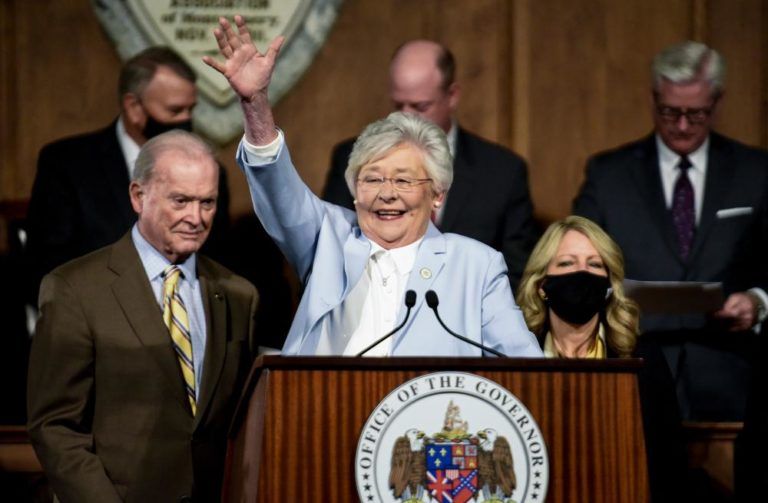
Alabama Gov. Kay Ivey signed the Vulnerable Child Compassion and Protection Act into law in 2022, making it a felony punishable by up to 10 years in prison for doctors to treat people under 19 with puberty blockers or hormones intended to impede their physiological development.

The long-term effects of such treatments have not been fully examined in controlled scientific settings without the influence of political biases. However, some who have taken them warn of serious side effects and regrets later in life.

At least 22 states have now enacted laws restricting or banning the life-altering treatments for underage children, but many of them face lawsuits or blocked enforcement.

Courts have issued mixed rulings, with the nation’s first law, in Arkansas, permanently struck down by an Obama-appointed judge, Jay Moody, who claimed the ban violated the due process rights of young transgender people and their families.

Trans activists in Tennessee have asked the U.S. Supreme Court to block the state’s ban on transgender procedures for minors that a lower court allowed to go into effect. The court is expected to decide later this year if it will hear the case.

Four families with transgender children ranging in ages 12 to 17 challenged the Alabama law as an unconstitutional violation of equal protection and free speech rights, as well as an intrusion into family medical decisions. The U.S. Department of Justice joined their lawsuit, seeking to overturn the law.

U.S. District Judge Liles Burke, nominated to the court by then-President Donald Trump in 2017, ruled when issuing the preliminary injunction that Alabama had produced no credible evidence to show that transitioning medications were “experimental.”

Alabama appealed the decision to the 11th Circuit. The challenge to the Alabama ban is scheduled to go to trial early this year.

Adapted from reporting by the Associated Press
The Common Definition of “Inflation” Is Wrong! It’s Just Government Propaganda

(Mike Maharrey, Money Metals Exchange) The Consumer Price Index for December came in hotter than expected but it’s a lot lower than it was a year ago. That means inflation is decreasing, right?

Not so fast.

It’s important to understand that the term “inflation” as bandied about by government people and the mainstream financial media is vague and imprecise. The word simply means an increase. But an increase in what?

When government officials and pundits on TV talk about “inflation,” they almost always mean price inflation. This is what the CPI attempts to measure – how much prices have generally gone up in the economy. When you hear Federal Reserve Chairman Jerome Powell or some other government official talk about “cooling inflation,” they’re simply saying that prices are not rising as fast as measured by the CPI.

But historically, inflation didn’t mean “rising prices.” Inflation was defined more precisely as an increase in the amount of money and credit in the economy, or more succinctly, an expansion in the money supply.

Economist Ludwig von Mises defined it this way in his essay Inflation: An Unworkable Fiscal Policy.

Inflation, as this term was always used everywhere and especially in this country, means increasing the quantity of money and bank notes in circulation and the quantity of bank deposits subject to check.

A 1970s dictionary offered this definition of inflation.

A sharp increase in the amount of money and credit causing advances in the price level.

Notice in this definition that rising prices are the result of inflation – not inflation itself.

This is an extremely important distinction that has been almost entirely erased in the modern definition of inflation.

Henry Hazlitt is best known for his brilliant book “Economics in One Lesson.” In another essay titled “Inflation in One Page,” he explained why using a more precise definition of inflation is crucial.

Inflation is an increase in the quantity of money and credit. Its chief consequence is soaring prices.

Therefore inflation—if we misuse the term to mean the rising prices themselves—is caused solely by printing more money. For this the government’s monetary policies are entirely responsible. (Emphasis added)

Over the years, government officials, along with government apologists in the mainstream financial media and academia, intentionally shifted the definition of inflation to suit government purposes. The standard definition of inflation you hear during White House press conferences or a CNBC roundtable is basically just government propaganda.

Hazlitt alludes to the reason for this intentional change in definition. Redefining “inflation” as “rising prices” allows government people to shift the blame.

Mises explained it this way.

People today use the term `inflation’ to refer to the phenomenon that is an inevitable consequence of inflation, that is the tendency of all prices and wage rates to rise.

The result of this deplorable confusion is that there is no term left to signify the cause of this rise in prices and wages. There is no longer any word available to signify the phenomenon that has been, up to now, called inflation… As you cannot talk about something that has no name, you cannot fight it.

Those who pretend to fight inflation are in fact only fighting what is the inevitable consequence of inflation, rising prices. Their ventures are doomed to failure because they do not attack the root of the evil. They try to keep prices low while firmly committed to a policy of increasing the quantity of money that must necessarily make them soar.

As long as this terminological confusion is not entirely wiped out, there cannot be any question of stopping inflation. [Emphasis added]

By obscuring the fact that price inflation (a general rise in all prices) is the result of monetary inflation, government and central bank officials can blame “inflation” on all kinds of things. After all, there are a lot of reasons certain prices go up and certain prices go down.

For example, spiking oil prices after the invasion of Ukraine weren’t technically “inflation.” It would be better described as a price shock. Price shocks do, in fact, raise prices. And those price increases can cascade through the economy, causing other prices to rise with them.

But unlike price increases due to monetary inflation, decreases in other areas of the economy will generally balance out price shocks (absent inflation) as people shift spending patterns.

If people have to pay more for gasoline, they may cancel vacation plans or quit eating out. This drop in demand will cause hotel and restaurant prices to fall even as fuel prices rise.

In contrast, there’s only one thing that will cause a general rise in prices with no corresponding price decreases – an increase in the money supply – what we used to define as inflation.

Milton Friedman summed it up.

[Inflation] is always and everywhere a monetary phenomenon. It’s always and everywhere a result of too much money.

But thanks to the change in definition, there is no word for the thing that causes price inflation – money printing. Instead, we’re told “corporate greed,” or “Putin’s price hikes,” or “consumer expectations,” or a “strong economy” are causing prices to rise.

If we use the traditional definition of inflation, the culprit becomes clear.

Who expands the money supply?

The Fed and the federal government.

When you accurately define inflation, you know exactly who to blame. But if the people responsible for your pain can fool you into believing that the symptom of inflation is inflation, they get to wiggle off the hook.

Biden Admin. Runs Half Trillion Dollars Deficit in Q1 of Fiscal 2024

(Mike Maharrey, Money Metals Exchange) Just one quarter into fiscal 2024, the federal government has already run a budget deficit of over half a trillion dollars.

The December budget shortfall came in at $129.37 billion, according to the latest Monthly Treasury Statement. That drove the 2024 deficit to $509.94 billion. That’s a 21 percent increase over the first quarter deficit in fiscal 2023.

This follows on the heels of the third-largest annual budget deficit in history (1.7 trillion).

These massive monthly budget shortfalls are pushing the national debt higher at a dizzying pace. On December 29, the national debt eclipsed $34 trillion for the first time. When Congress effectively eliminated the debt ceiling on June 5, the national debt stood at a “mere” $31.46 trillion.

TOO MUCH GOVERNMENT SPENDING

President Joe Biden blames Republican tax cuts under the Trump administration for the ever-widening budget deficit, but the numbers don’t bear this out. Federal receipts were just under $1.1 trillion in the first quarter. That’s 12 percent higher than through the first three months of fiscal 2023.

Federal revenue did decline in fiscal 2023 after a windfall in 2022. According to a Tax Foundation analysis of Congressional Budget Office data, federal tax collections were up 21 percent in fiscal ‘22. Tax collections also came in at a multi-decade high of 19.6 percent as a share of GDP. But at the time, CBO analysts warned the good times wouldn’t last.  And they didn’t. Government receipts fell by 9.3 percent in fiscal 2023. Even so, receipts are up so far this year even as the deficit climbed.

The real problem is on the spending side of the ledger. Over the last two years, the Biden administration has blown through roughly half a trillion every single month.

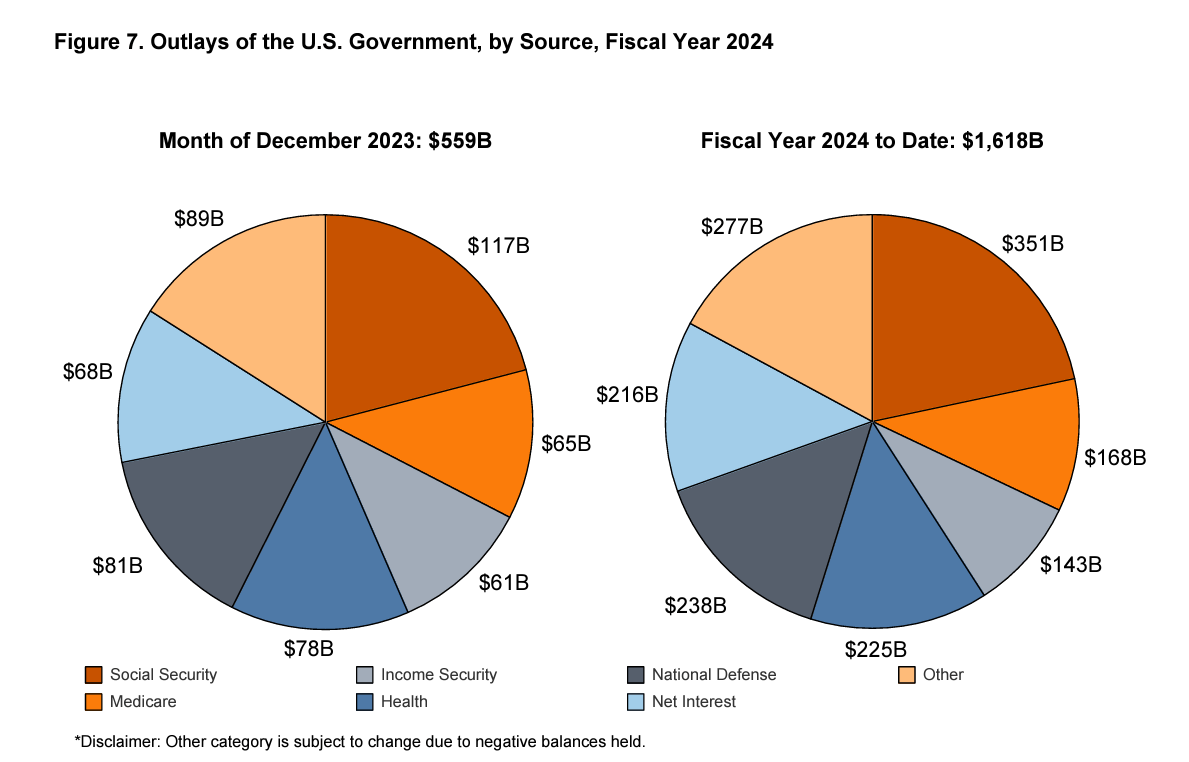
Through the first quarter of fiscal 2024, the federal government spent $1.62 trillion. That’s a 12 percent increase over the first three months of last year.

This isn’t to let Republicans off the hook. Spending under the Trump administration was generating a $1 trillion deficit even before the pandemic.

Excessive borrowing and spending is a bipartisan sport.

This underscores the fact that the fundamental issue isn’t that the U.S. government doesn’t have enough money. The fundamental problem is that the U.S. government spends too much money. Despite the pretend spending cuts, and promises from the Biden administration that it would save “hundreds of billions” the debt ceiling deal  (aka the [misnamed] Fiscal Responsibility Act) didn’t address that problem. No matter what you hear about spending cuts, the federal government always finds new reasons to spend more money.

A DOUBLE-WHAMMY: EXCESSIVE SPENDING & HIGH INTEREST RATES

These big budget deficits are happening during a time of sharply rising interest rates. This is a big problem for a government that primarily depends on borrowing to pay its bills, and it is likely one of the reasons that the Federal Reserve is talking about rate cuts even though the CPI remains well above the mythical 2 percent target. The borrow-and-spend U.S. government can’t function in a high interest rate environment.

Uncle Sam spent $288.01 billion in interest expense to finance the national debt in the first quarter of fiscal 2024. That was more than national defense ($238 billion) and more than Medicare ($168 billion). The only higher spending category was Social Security at $351 billion.

Net interest expense, excluding intragovernmental transfers to trust funds, was $216 billion in Q1, still nearly as much as the government spent on national defense.

Much of the debt currently on the books was financed at very low rates before the Federal Reserve started its hiking cycle. Every month, some of that super-low-yielding paper matures and has to be replaced by bonds yielding much higher rates. The weighted average interest rate on the government’s outstanding Treasury securities rose to 3.17 percent as of the end of December. That compares with a weighted average rate of 2.32 percent in December 2022.

Rising interest rates drove interest payments to over 35 percent as a percentage of total tax receipts in fiscal 2023. In other words, the government is already paying more than a third of the taxes it collects on interest expense.

And it’s only going to get worse.

Interest expense will continue to rise at a rapid rate as more and more Treasuries mature and are replaced by higher-yielding bonds.

The only way out of this fiscal death spiral is significant spending cuts and/or major tax hikes. Congress doesn’t seem to have the political will for either.

Jewish Students Sue Harvard for Civil-Rights Violations amid Hamas Riots

(Headline USA) Several Jewish students have filed a lawsuit against Harvard University, accusing it of becoming “a bastion of rampant anti-Jewish hatred and harassment.”

The lawsuit filed Wednesday mirrors others filed since the Oct. 7 Hamas attack on Israel— including against the Art Institute of Chicago, New York University and the University of Pennsylvania.

In the Harvard lawsuit, the plaintiffs include members of the Students Against Antisemitism, Inc. They accuse Harvard of violating Jewish students’ civil rights and allege that the university tolerated Jewish students being harassed, assaulted and intimidated—behavior that has intensified since the Oct. 7 attack.

“Mobs of pro-Hamas students and faculty have marched by the hundreds through Harvard’s campus, shouting vile antisemitic slogans and calling for death to Jews and Israel,” according to the lawsuit. “Those mobs have occupied buildings, classrooms, libraries, student lounges, plazas, and study halls, often for days or weeks at a time, promoting violence against Jews.”

The university has been rattled by protests since the Oct. 7 attack. At one point, pro-Palestinian students occupied a campus building for 24 hours.

Marc Kasowitz, a partner at the law firm that brought the suit, Kasowitz Benson Torres, said in a statement that the litigation was necessary because Harvard would not “correct its deep-seated antisemitism problem voluntarily.”

“Harvard must be forced to protect its Jewish students and stop applying a double standard when it comes to anti-Jewish bigotry,” he added.

A spokesman for Harvard said the school doesn’t comment on pending litigation.

About a dozen students are potentially facing disciplinary charges for violations of protest rules related to pro-Palestinian activities, but the spokesman said the school couldn’t comment on their cases.

College leaders have struggled to define the line where political speech crosses into harassment and discrimination, with Jewish and Arab students raising concerns that their schools are doing too little to protect them.

Nonetheless, the universities have had no difficulties curtailing speech that they, personally, found objectionable even when it posed significantly less immediate threat of harm or vandalism. Many have imposed strict parameters on having conservative speakers on campus and have likewise restricted certain Christian-based organizations, including pro-life groups.

The double-standard took center stage in December when the presidents of Harvard, Penn and MIT testified at a congressional hearing on campus anti-Semitism.

Asked by Republican lawmakers whether calls for the genocide of Jews would violate campus policies, the presidents declined to say unequivocally that it was prohibited speech.

Their answers prompted weeks of backlash from donors and alumni, leading to the resignation of Liz Magill at Penn and Claudine Gay at Harvard.

Nonetheless, Harvard initially stood behind its diversity hire following rumored pressure from former President Barack Obama, and it was the weight of the anti-Semitism scandal paired with an equally humiliating plagiarism scandal that ultimately brought down Gay long after a white, male leader would have been jettisoned.

The schools, many of which receive sizable donations from oil-rich countries like Qatar and Saudi Arabia, have been reluctant to criticize Hamas and its supporters, even as their rhetoric echoes the rise of the Nazi party in 1930s Germany.

The Biden administration, meanwhile, has callously dealt with the growing concerns over anti-Semitism by conflating it with the backlash that pro-Hamas rioters are facing for their aggressive and disruptive actions while trying to frame themselves as victims.

That has only compounded the mixed messaging and sowed further confusion for both policy-makers and victims alike.

Education Secretary Miguel Cardona said the Department of Education has opened more than 40 investigations at colleges and universities in response to complaints of antisemitism and Islamophobia since the Oct. 7 attacks, including at Harvard, Stanford and MIT.

“No student should feel unsafe on campus,” Cardona told the Associated Press on Wednesday, after he met with students.

“The Office for Civil Rights takes these cases very seriously. They investigate harassment, or violations for antisemitism, Islamophobia, anti-Arab sentiment,” he continued. “We take that role very seriously. If any student on campus feels that any protest or messaging makes them feel unsafe, we ask for an investigation.”

In November, Gay issued a memo laying out plans to address anti-Semitism on campus by studying it and promoting greater awareness rather than taking immediate action against the purveyors of it.

The university said it was starting a process to examine “how antisemitism manifests within our community” and developing a plan to address it.

It also is implementing a program to educate students and faculty about anti-Semitism and “redoubling our efforts to make students aware that appropriate avenues exist to report feelings of fear or incidents causing harm” including an anonymous hotline for bias incidents.

Gay’s tepid response and congressional testimony prompted  Rabbi David J. Wolpe to resign from the school’s anti-Semitism advisory group, saying it was clear the effort was pointless, according to the Harvard Crimson.

“With great respect for the members of the committee, the short explanation is that both events on campus and the painfully inadequate testimony reinforced the idea that I cannot make the sort of difference I had hoped,” tweeted Wolpe, a visiting scholar at the Harvard Divinity School.

Adapted from reporting by the Associated Press