Remains of US Soldier Who Went Missing During Military Exercises in Morocco have been Recovered

(Headline USA) The remains of a U.S. soldier who went missing during military exercises in Morocco a week ago were recovered in the Atlantic Ocean, the army said Sunday. Military teams were still searching for a second missing soldier.

The remains were those of 1st Lt. Kendrick Lamont Key Jr., a 14A Air Defense Artillery officer who was one of two U.S. soldiers who fell off a cliff during a recreational hike in Morocco while off duty. He was 27 years old.

The two were reported missing May 2 after participating in African Lion, an annual multinational military exercise held in Morocco.

“A Moroccan military search team found the Soldier in the water along the shoreline at approximately 8:55 a.m. local time May 9, within roughly one mile of where both Soldiers reportedly entered the ocean,” U.S. Army Europe and Africa said in a statement.

The two went missing around 9 p.m. near the Cap Draa Training Area outside Tan-Tan, a terrain characterized by mountains, desert and semidesert plains, according to the Moroccan military.

Their disappearance triggered a search-and-rescue operation involving more than 600 personnel from the United States, Morocco and other military partners. The operation deployed frigates, vessels, helicopters and drones.

Search efforts will continue for the missing second soldier, a U.S. defense official told The Associated Press on condition of anonymity as they were not allowed to speak publicly on the issue.

The official said a U.S. contingent remained in Morocco after the war games ended Friday to provide command and control and to continue search and rescue operations.

Key was assigned to Charlie Battery, 5th Battalion, 4th Air Defense Artillery Regiment, 10th Army Air and Missile Defense Command, the army said. His decorations include the Army Achievement Medal and Army Service Ribbon.

He entered military service in 2023 as an officer candidate and earned his commission through Officer Candidate School in 2024 as an Air Defense Artillery officer. He later completed the Basic Officer Leader Course at Fort Sill, Oklahoma, according to the statement.

African Lion 26, is a U.S.-led exercise launched in April across four countries – Morocco, Tunisia, Ghana and Senegal – with more than 7,000 personnel from over 30 nations. Since 2004, it has been the largest U.S. joint military exercise in Africa.

In 2012, two U.S. Marines were killed and two others injured during a helicopter crash in Morocco’s southern city of Agadir while taking part in the exercises.

Adapted from reporting by the Associated Press


Abe Foxman, Longtime Head of Anti-Defamation League, Dies at 86

(Headline USA) Abraham H. Foxman, who was a forceful advocate for American Jews as national director of the Anti-Defamation League for nearly three decades, has died, the ADL said Sunday. He was 86.

The ADL said in a statement that it “deeply mourns the loss of our longtime national director,” without providing details about where and when Foxman died.

Over 28 years as head of the ADL before retiring in 2015, Foxman counseled presidents and diplomats, CEOs and celebrities. He took on prominent figures over antisemitic remarks or representations and accepted any ensuing apologies on behalf of an entire community.

“Abe’s voice was heard –- and listened to -– by popes, presidents, and prime ministers, a voice he used wherever Jews were at risk,” Jonathan Greenblatt, ADL’s current director, said in a statement. “Abe Foxman spoke on the global stage with moral authority and clarity and was relentlessly dedicated to his pursuit of a world without hate.”

Born in 1940 to Polish Jews in what’s now Belarus, Foxman survived the Holocaust after a nanny had him baptized as a Catholic to conceal his Jewish identity. He was reunited with his parents after the war and the family moved to New York.

After earning a law degree, Foxman joined the ADL as a staff lawyer. He spent his entire 50-year career with the group, becoming a leading national voice against antisemitism and hate. He was named the organization’s national director in 1987.

Upon his retirement, Foxman told The Associated Press that he worried that the internet was giving bigots a way to spread their beliefs “not only anonymously but at the speed of light.”

The ADL was founded in 1913 with a mandate to fight antisemitism and all bias. But the emphasis differed over time depending on who was in charge and the issues of the day.

Foxman faced criticism that the ADL put too many resources into non-Jewish issues. 

Under him, the organization built a formidable research arm into white supremacists and other extremists, advocated for immigrant and gay rights, conducted diversity training for law enforcement and developed programs for schools on issues ranging from the Holocaust to the 1964 Civil Rights Act to the impact of bullying.

Foxman long endured objections that he overreacted to perceived slights against the Jews and was too quick to condemn. Yet he was also chided for too easily forgiving and embracing those who repented their anti-Jewish remarks.

Foxman said it was essential to accept apologies, especially from those who can serve as prominent allies for Jews.

“If you don’t let them change, then you become the bigot.”

Adapted from reporting by the Associated Press

Trump: Iran’s Response to US Proposal Is ‘Totally Unacceptable’

(Dave DeCamp, Antiwar.com) President Donald Trump said on Sunday that Iran’s response to the latest US proposal to reach a deal was “totally unacceptable,” signaling that the two sides are still not close to reaching a deal.

“I have just read the response from Iran’s so-called ‘Representatives.’ I don’t like it — TOTALLY UNACCEPTABLE! Thank you for your attention to this matter,” the president wrote on Truth Social.

Trump made similar comments to Axios reporter Barak Ravid, saying, “I don’t like their letter. It’s inappropriate. I don’t like their response… They have been tapping along many nations for 47 years.”

The president said that he spoke with Israeli Prime Minister Benjamin Netanyahu on Sunday about Iran’s response. According to Israeli media, Israeli officials are trying to convince their US counterparts to launch major airstrikes aimed at destroying Iran’s energy infrastructure.

An Iranian source told Iran’s Tasnim news agency that Trump’s rejection of Tehran’s response was “of no importance” because no one “writes proposals to please Trump.” 

The source added that the “negotiating team should draft proposals only for the rights of the Iranian people, and when Trump is dissatisfied with them, naturally that is better.”

Iranian media has reported that the Iranian response, which came after the US provided its response to a 14-point Iranian proposal, is focused on bringing a permanent end to the conflict and other hostilities in the region, including in Lebanon, where the Israeli military killed dozens of people over the weekend.

Iranian sources said Iran is also asking for an immediate end to the US blockade, the lifting of US sanctions, the release of frozen assets overseas, and the ability to freely sell its oil. The Wall Street Journal reported that Iran had offered to move some of its enriched uranium to a third country, but that hasn’t been confirmed by Iranian sources, which suggest the idea is to end the hostilities before negotiating on the nuclear issue.

This article originally appeared at Antiwar.com.  


Netanyahu Says Iran War Is ‘Not Over’

(Dave DeCamp, Antiwar.com) Israeli Prime Minister Benjamin Netanyahu has said that the US-Israeli war against Iran is “not over,” pointing to the fact that Iran still has its stockpile of enriched uranium and maintains its ballistic missile program.

“I think it accomplished a great deal, but it’s not over,” Netanyahu said when asked if the conflict was over during an interview with 60 Minutes, a clip of which was posted on Sunday morning.

The Israeli leader said there is “still nuclear material, enriched uranium that has to be taken out of Iran. There are still enrichment sites that have to be dismantled. There are still proxies that Iran supports. There are ballistic missiles that they still want to produce.”

“Now, we’ve degraded a lot of it, but all of that is still there, and there’s work to be done,” he added. When asked how Iran’s enriched uranium should be removed, Netanyahu said, “You go in, and you take it out.”

The Israeli leader suggested there could be a diplomatic deal to remove the uranium, something Iran has repeatedly rejected, and wouldn’t elaborate on potential military operations.

“Well, you’re gonna ask me these questions, I’m gonna dodge them, because I’m not gonna talk about our military possibilities,” he said. “I’m not gonna give a timetable to it, but I’m gonna say that’s a terrifically important mission.”

President Donald Trump also discussed Iran’s enriched uranium, which is believed to be buried under rubble following the June 2025 US airstrikes on Iran’s nuclear facilities.

“We’ll get that at some point… We have it surveilled. I did a thing called Space Force, and they are watching that… If anybody got near the place, we will know about it — and we’ll blow them up,” Trump said.

While much hype is made over Iran’s uranium, it has only been enriched to the 60% level, below the 90% needed for weapons-grade, and Iran’s enrichment program has been effectively suspended by the US airstrikes.

There was also no evidence either before the June 2025 war or the current conflict that Iran was pursuing a nuclear bomb, unlike Israel, which maintains a secret nuclear arsenal and covert nuclear weapons program that the US and Israel don’t acknowledge exists.

This article originally appeared at Antiwar.com. 

The Anatomy of a Silver Bull Run and Other Silver News

(Mike Maharrey, Money Metals News Service) Silver surged to record highs last year, peaking at $84 in December, before climbing as high as $110 early this year.

What caused this extraordinary bull run?

As the Silver Institute explains in its latest edition of silver news, it was a combination of factors, including tight liquidity and growing investor interest.

“Exceptionally strong physical demand, tight inventories, and robust industrial metal prices, copper in particular, fueled silver’s outperformance of gold during that period. This trend eventually became self-fulfilling, as investors that had previously favored gold shifted their attention to the white metal.”

More fundamentally, it was a shortage of physical metal.

“Silver’s deficit finally caught up with it, as lower inventories and metal being pulled out of London or tied up in exchange-traded products (ETPs) created explosive conditions for lease rates and prices.”

The shortage of physical metal, along with the displacement of silver due to tariff worries last year, set the stage for two silver squeezes.

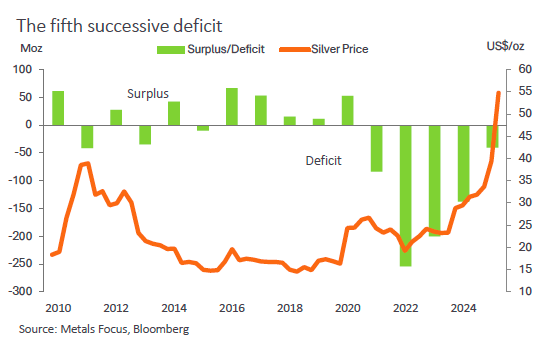
The silver demand has outstripped supply for five straight years. The 5-year market deficit amounted to 716 million ounces. To put that into perspective, total silver mining output last year was 846 million ounces. Metals Focus forecasts a 46.3-million-ounce supply deficit this year.

We can see the trajectory of the silver rally in the movement of the gold-silver ratio. This ratio tells you how many ounces of silver it takes to buy one ounce of gold, given the current spot price of both metals.

In the modern era, the gold-silver ratio has averaged between 40:1 and 60:1. Through the first 10 months of 2025, the gold-silver ratio was historically high, averaging 91:1. The ratio peaked in April at 107:1. By the end of the year, the ratio had plunged to 61:1 before falling into the sub-50s early this year. It was the narrowest gold-silver ratio since March 2013, indicating a significant correction in the silver price.

Even with the recent correction, the Silver Institute remains bullish moving forward, warning that despite some easing in the market, the environment remains favorable for additional squeezes.

“Policy uncertainty remains unusually high, sovereign debt fears are, if anything, worsening in the face of war-related fiscal pressures, and concerns about the future role of the U.S. currency also remain relevant. The Iran war has complicated the short-term outlook, but in our view, on balance, strengthens the longer-term case for precious metals. Our base case is that the situation will be contained, and that the recent pressure that rising U.S. rate expectations have placed on precious metals prices will be temporary.”

The most recent edition of Silver News also highlighted some interesting technological advances using silver.

Just when you thought that silver nanowires could not be more versatile, a group of Korean scientists has developed a new insulating layer to encase the wires that results in greater electrical conductivity and more durability.

While most people are trying to figure out how to minimize CO2, it is an important input in some industrial applications, and there are scientists working to produce it more efficiently. Carbon dioxide is generally considered a waste product, but it has many uses, particularly as a precursor to other chemicals and products such as fertilizers and for making methanol, which is used in paints, plastics, and adhesives. Carbon dioxide is also used in the production of pharmaceuticals such as aspirin.

A research team at the Korea Advanced Institute of Science & Technology (KAIST) has developed a silver nanowire network that looks like a bird’s nest to more efficiently produce CO2 for industrial use. The team noted that they achieved 86 percent efficiency in producing carbon dioxide with their silver nanowire configuration, compared to 33 to 60 percent in similar non-silver nanowire-based systems (such as copper).

Silver may help efficiently produce hydrogen for use as a power source. Not only is hydrogen clean-burning – leaving only water – but it is easier to store and transport than petroleum-based fuels. Conventional methods of producing hydrogen, such as steam methane reforming (SMR) or water electrolysis, have disadvantages that silver may help to overcome.

One up-and-coming method is known as dehydrogenation – literally, removing hydrogen. This process can be performed at low temperature and pressure, without requiring large amounts of electrical power. The process uses formic acid – a chemical released by ants – and a catalyst of silver-nickel. While scientists have experimented with catalysts composed of nickel alone, the addition of silver enhances the amount of hydrogen gas produced.

Vanadium oxide batteries are an alternative to lithium-ion batteries. However, they have a drawback. They are subject to crystal growth that can cause failures. Researchers have found that adding silver to the batteries can prevent this phenomenon, leading to a safer, longer-lasting battery.


Mike Maharrey is a journalist and market analyst for Money Metals with over a decade of experience in precious metals. He holds a BS in accounting from the University of Kentucky and a BA in journalism from the University of South Florida.

Inflation Is Americans’ Biggest Financial Worry and It’s Not Even Close

(Mike Maharrey, Money Metals News Service) The inflation dragon is alive and well.

Last November, Donald Trump called himself “the affordability president.”  However, it appears that the message is falling flat with your average American.

Based on a recent Gallup poll, affordability tops the list of Americans’ most pressing financial problems. In total, 65 percent of the respondents mentioned rising costs as their biggest economic concern.

The survey was conducted between April 1 and April 15.

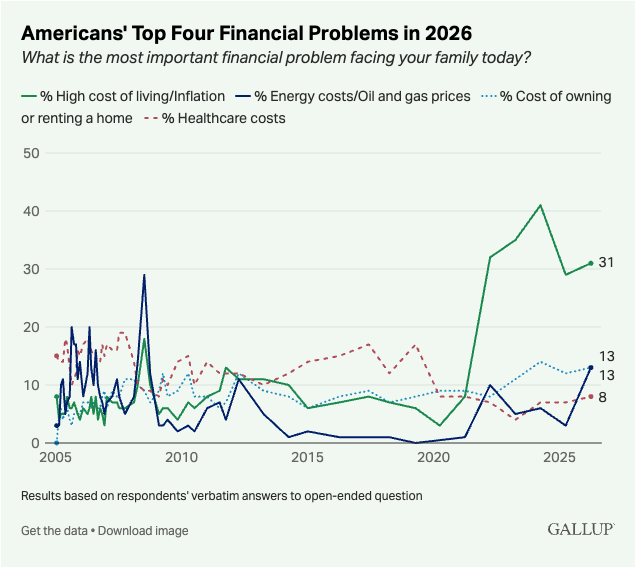
Of those surveyed using open-ended questions, 31 percent mentioned generally high inflation with rising persistently high and rising prices as their biggest financial worry. That was below the 41 percent peak in 2024, but similar to last year’s results.  According to Gallup, general inflation worries are among the highest in its more than 20-year trend.

On top of the nearly third of Americans worried about inflation generally, many more pointed to increasing prices in specific categories as their biggest concern.

“Overall, affordability concerns dominate this year’s list, with combined mentions of inflation, energy, housing, and healthcare costs — along with college expenses, transportation costs, and childcare — far exceeding all other types of financial concerns.”

Rising energy and housing costs tied as the second biggest financial concern, cited specifically by 13 percent of the respondents. Worries about rapidly increasing energy prices were up 10 percent from last year and at the highest level since 2008.

Eight percent of the respondents cited rising healthcare costs as their biggest concern.

Other issues mentioned as pressing economic problems included taxes (6 percent), debt (6 percent), the overall state of the economy (2 percent), interest rates (2 percent, and Social Security (1 percent).

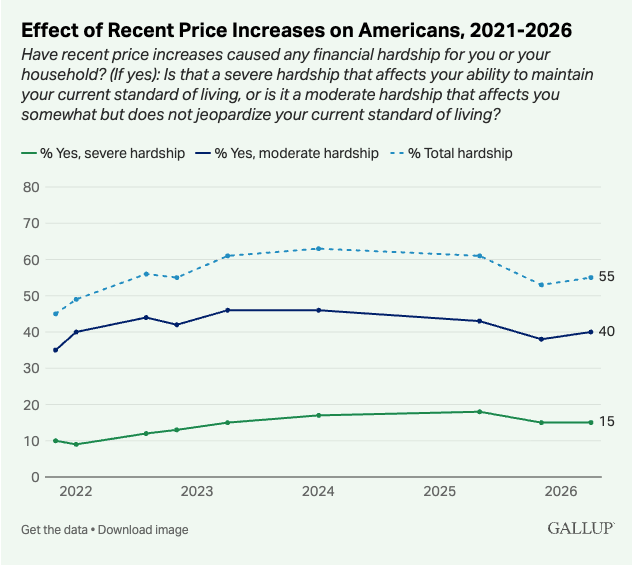
In a separate Gallup Panel survey, 55 percent of those surveyed said recent price increases have created hardships.

Less than half of Americans view their financial situation as excellent or good. Around 35 percent described it as “fair,” with 19 percent calling their overall financial position “poor.”

Inflation Isn’t a Figment of Our Imagination

Inflation worries are supported by the data.

We’re all painfully aware of rising fuel prices due to the Iran conflict. The energy index rose 10.9 percent month-to-month in March. That was driven by a 21.2 percent monthly increase in gasoline prices.

But other prices continue to creep higher as well. Annual core inflation, stripping out those fuel prices, nudged up slightly, from 2.5 percent in February to 2.6 percent in March. It’s important to point out that core CPI remains above the Fed’s stated 2 percent target and has been mired in this range for well over a year.

Also, keep in mind that the CPI formula intentionally understates price inflation. The government revised the CPI formula in the 1990s so that it understated the actual rise in prices. Based on the formula used in the 1970s, CPI is closer to double the official numbers. So, if the BLS used the old formula, we’d be looking at CPI closer to 6 percent. And using an honest formula, it would probably be worse than that.

And there is no relief in sight. The Federal Reserve is creating more inflation as we speak.

Consumer price inflation is just one symptom of monetary inflation (what economists historically defined as inflation). The Fed has been ratcheting that up for well over a year.

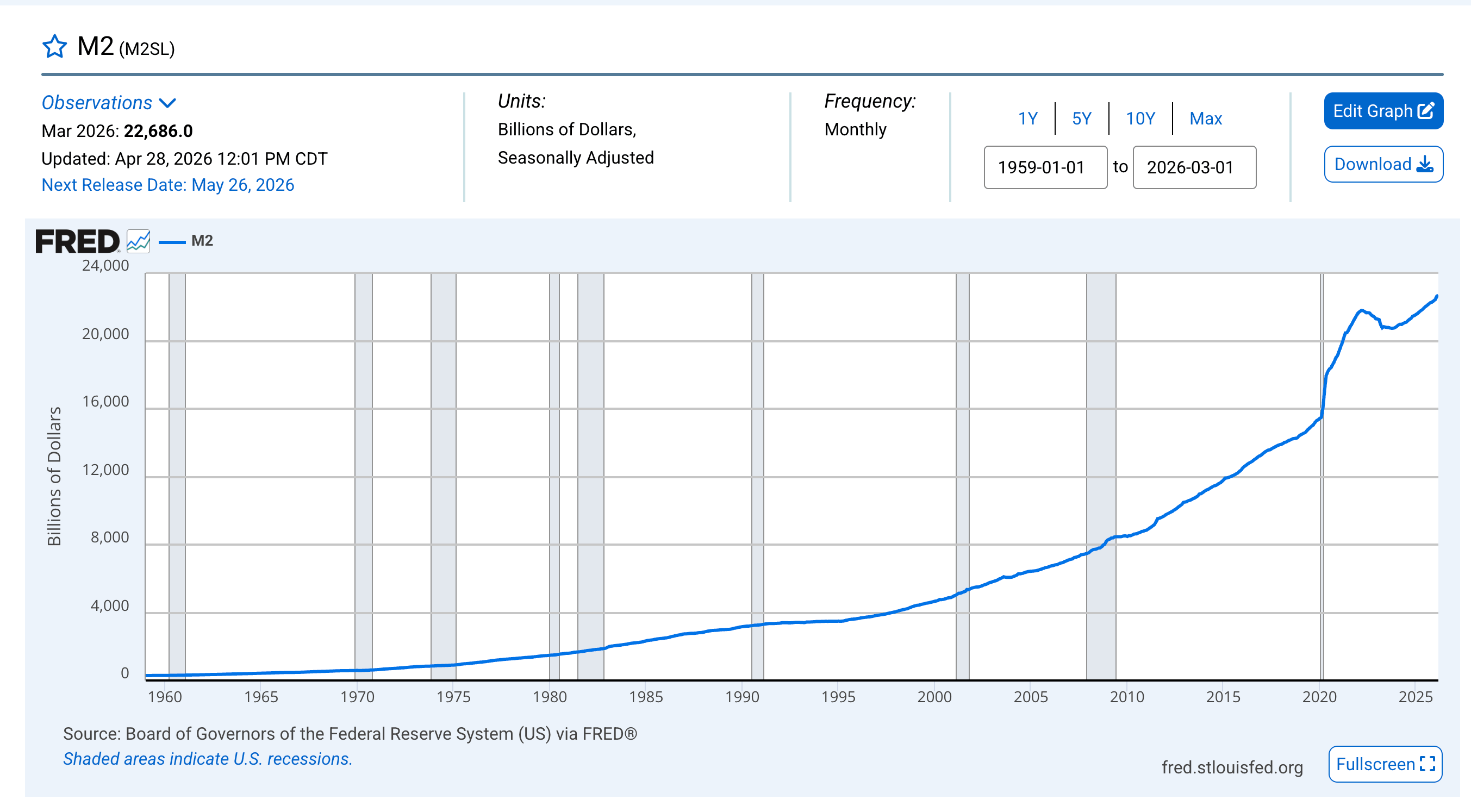
Based on the Fed’s M2 data, the money supply increased from $21.61 trillion in February 2025 to $22.67 trillion in February 2026, a 4.9 percent increase.

In other words, we have an actual inflation rate of nearly 5 percent.

The M2 money supply increased by another $57 billion in March.

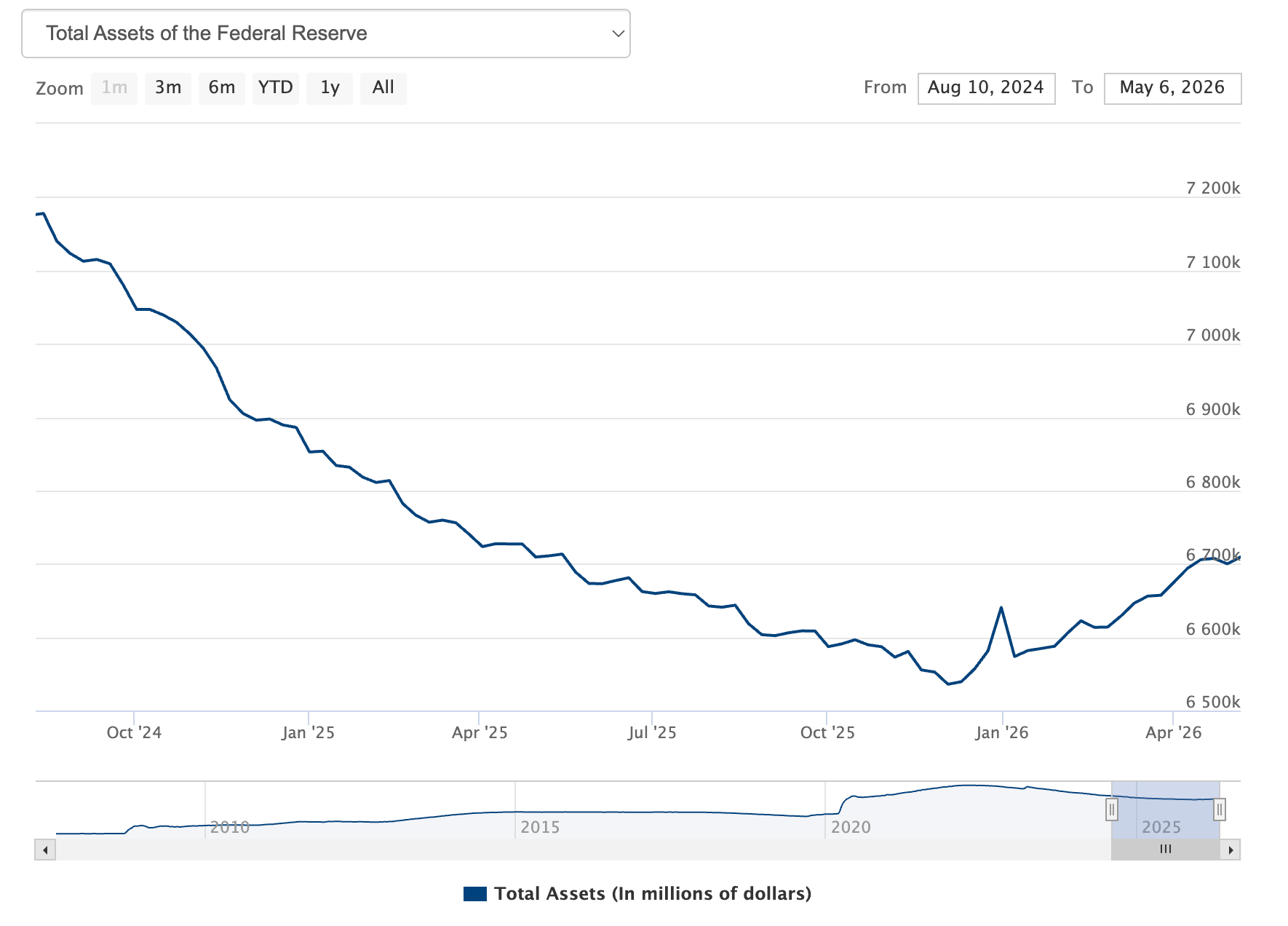
We also know inflationary pressures are increasing because the Federal Reserve is once again expanding its balance sheet.

While you’ll never hear anybody at the Fed utter the term, the central bank relaunched quantitative easing in December. That means they are once again buying U.S. Treasuries using money created out of thin air.

Ultimately, this monetary inflation will work its way through the economy. It will either manifest in rising asset prices or rising consumer prices. Ultimately, it is devaluing your money (by design).

So, if you’re hoping inflation will cool, don’t hold your breath. In fact, you should do everything you can to position yourself to weather more inflationary pressure.


Mike Maharrey is a journalist and market analyst for Money Metals with over a decade of experience in precious metals. He holds a BS in accounting from the University of Kentucky and a BA in journalism from the University of South Florida.

2 More Passengers Test Positive for Hantavirus as a Third Shows Symptoms

(Headline USAA French woman and an American tested positive for the hantavirus, as nations around the world scrambled Monday to repatriate passengers from a cruise ship hit by a deadly outbreak and quarantine or isolate them.

Passengers from the ship began flying home aboard military and government planes Sunday after the MV Hondius anchored in the Canary Islands. Personnel in full-body protective gear and breathing masks escorted the travelers from ship to shore in Tenerife, an effort that continued Monday.

It is the first-ever outbreak of the rare hantavirus on a cruise ship, according to Maria Van Kerkhove, WHO’s director of epidemic and pandemic preparedness. So far three cruise ship passengers have died, but health authorities continue to stress that the risk to the broader public is low.

The ship’s captain, Jan Dobrogowski, issued a video message Monday praising passengers and crew for their perseverance and calling for respect for their privacy.

“I’ve witnessed your caring, your unity and quiet strength amongst everybody on board — guests and crew alike — and I must commend my crew for the courage and the selfless resolve that they showed time and again in the most difficult moments,” he said. “I could not imagine sailing through these circumstances with a better group of people, guests and crew alike.”

New cases in France, United States

The French woman tested positive for hantavirus and her health worsened in the hospital overnight, French Health Minister Stephanie Rist said Monday. The woman was among five French passengers repatriated on Sunday. She developed symptoms on the flight to Paris, Rist told public broadcaster France-Inter.

One of 17 American passengers evacuated from the ship and flown to Nebraska also tested positive for the hantavirus but is not showing any symptoms, and another had mild symptoms, U.S. health officials said late Sunday. The flight landed in the early hours of Monday morning and passengers were transferred to awaiting buses and driven away from the airport.

The Americans would first be taken to the University of Nebraska Medical Center, which has a federally funded quarantine facility, to assess whether they have been in close contact with any symptomatic people and their risk levels for spreading the virus.

“One passenger will be transported to the Nebraska Biocontainment Unit upon arrival, while other passengers will go to the National Quarantine Unit for assessment and monitoring. The passenger who is going to the Biocontainment Unit tested positive for the virus but does not have symptoms,” said Kayla Thomas, a spokesperson for the Nebraska Medicine network that will help care for the passengers.

The university medical center also has a special unit for treating people with highly infectious diseases that was used early in the pandemic for COVID-19 patients and previously for Ebola patients.

The WHO recommended close monitoring of the former passengers, and many countries quarantined them.

The planes arriving in Tenerife were to fly out passengers from more than 20 countries in an evacuation effort that was due to wrap up on Monday.

A Dutch plane expected to reach Tenerife Monday afternoon will carry passengers that were previously going to be evacuated on a plane sent by Australia, Spain’s Health Minister Mónica García said. On Monday, 54 passengers and crew remained on the ship, of which 22 were expected to disembark, while the remaining 32 will remain on the ship as it returns to the Netherlands.

Three people have died since the outbreak began, and six people have been infected, WHO spokesperson Sarah Tyler said Monday. She said one person from the U.S. showed inconclusive lab results.

The Hondius left the southern Argentine port of Ushuaia on April 1 and a Dutch passenger died on board April 11. It wasn’t until early May that the World Health Organization said it was reacting to a suspected hantavirus outbreak on the ship, which by that time was off the West African island nation of Cape Verde.

Health officials say risk to public is low

Hantavirus usually spreads from rodent droppings and is not easily transmitted between people. But the Andes virus detected in the cruise ship outbreak may be able to spread between people in rare cases. Symptoms — which can include fever, chills and muscle aches — usually show between one and eight weeks after exposure.

WHO Director-General Tedros Adhanom Ghebreyesus said Sunday that the general public should not be worried about the outbreak. “This is not another COVID. And the risk to the public is low. So they shouldn’t be scared, and they shouldn’t panic.”

WHO is recommending that passengers’ home countries “have active monitoring and follow-up, which means daily health checks, either at home or in a specialized facility,” said Van Kerkhove, the organization’s top epidemiologist.

Numerous countries have said their people will be quarantined or hospitalized for observation.

The ship’s captain, Dobrogowski, said his thoughts “are with the ones that are no longer with us, and whatever I say will not ease this loss, but I’d like you to know that they are with us every day in our hearts and our thoughts.”

Adapted from reporting by the Associated Press

Report: Handwriting on Epstein’s ‘Suicide Notes’ Matches Earlier Writings

(Headline USAA note that a former cellmate said he discovered after Jeffrey Epstein’s first suspected jail suicide attempt was all but certainly penned by the same person as a note that authorities found in the millionaire sex offender’s cell after he killed himself, handwriting experts say.

Three forensic document examiners who reviewed the notes at the request of The Associated Press concluded that they have or appear to have common authorship, with shared characteristics such as the same spacing, letter shapes, usage of capital letters and unique punctuation.

In the first note, made public this week, the writer states: “They investigated me for month — found nothing!!!” and talks about being able to choose the “time to say goodbye.” The other note, which has been public for years, is a list of grievances about conditions at the jail, including the showers, food and “Giant Bugs.”

While no one has definitively said Epstein wrote the notes, they point to his grim outlook before his death and echo some frustrations he conveyed to jail personnel about being confined in the crumbling Metropolitan Correctional Center in Manhattan after living in luxury for decades. They also contain phrases he had used in the past.

Both notes, written in pen on notepad paper, include the underlined phrase “NO FUN” and end with double exclamation points — the first of which is bowed slightly with similar curvature. The first few words of each note are larger than the rest and each successive line slants away from the left margin.

“These are the kinds of things that would suggest that we’re dealing with the same writer,” said Thomas Vastrick, the president of the American Society of Questioned Document Examiners.

“They are written by the same person,” said Bart Baggett, who founded the forensic analysis firm Handwriting Experts Inc. and has testified in court as an expert witness more than 130 times.

“Both of those documents have the same author,” said Grace Warmbier, who worked for a decade for the New York City Police Department performing document examinations and handwriting analysis.

None of the experts were able to say definitively that Epstein wrote the notes, in part because there are few if any confirmed examples of his handwriting in the millions of pages of records the Justice Department recently released on the late financier.

In addition to the two jail notes, Warmbier and Vastrick also reviewed writing samples from the former cellmate, Nicholas Tartaglione, including part of a note he sent to the New York Daily News in 2019 in which he denied any involvement in Epstein’s death.

Warmbier ruled out Tartaglione as the author, finding “significant dissimilarities between his handwriting and the handwriting in question.”

Vastrick said Tartaglione’s writing samples had “a wide range of variation from one to another” and that there were at least some similarities that require further examination.

“At this point, I certainly would not eliminate him as a potential writer,” Vastrick said. “I don’t at the same time want to suggest that he is the writer.”

For years, only a few people known about the note that Tartaglione claimed he found. Then, last summer, he mentioned it on writer Jessica Reed Kraus’ podcast. That piqued the interest of writers at The New York Times, who convinced a judge on Wednesday to release the note, which had been sealed in an unrelated case.

Tartaglione, an ex-police officer serving a life sentence for killing four people, said he discovered the note in a book in his cell after Epstein was found on July 23, 2019, on the floor with a strip of bedsheet around his neck. Epstein was placed on suicide watch and moved to a different cell. He had no cellmate when he was found dead on Aug. 10, 2019.

Epstein and Tartaglione shared a cell for about two weeks, beginning soon after Epstein’s July 6, 2019, arrest on sex trafficking charges and ending with the suspected suicide attempt. Both men were awaiting trials.

According to a chronology in the Justice Department’s files on Epstein, Tartaglione told his lawyer about the note four days after the suspected July 23 attempt. There is no indication that anyone alerted jail officials or Epstein’s representatives.

The note was later submitted as evidence in Tartaglione’s criminal case and placed under seal amid a dispute over his legal representation. It wasn’t mentioned in government reports examining the circumstances of Epstein’s death, nor did it surface in the Justice Department’s files. The other note, found after Epstein’s death, was shown on CBS’ “60 Minutes” in 2020 and is in the files.

Beyond handwriting analysis, the phrasing of the notes could give clues to their authorship. The note Tartaglione said he found contains the line: “Watcha want me to do — Bust out cryin!!”

Epstein previously referenced that line, mimicking dialogue from a 1931 “Little Rascals” film, in three emails that were included in the Justice Department’s files, including one he sent to his brother four months before going to jail.

Adapted from reporting by the Associated Press

VA Dems’ Longshot Redistricting Appeal Rattled by Typos

(Luis CornelioHeadline USA) Virginia Democrats are seeking to have the U.S. Supreme Court review the state high court’s ruling against their redistricted map, but the filing was marred by a series of typos that undercut the seriousness of the appeal.

State Democrats on Friday asked the Virginia Supreme Court to delay enforcement of its ruling while they prepare what they described as an emergency petition to the U.S. Supreme Court.

The filing quickly drew ridicule online after two glaring spelling mistakes appeared in the document’s header.

Virginia House of Delegates Speaker Don Scott, who filed the appeal on behalf of House Democrats, misspelled “Virginia” as “Virgnia” while identifying his official title.

The filing also misspelled “senator” as “Sentator” while listing Republican state Sen. Ryan T. McDougle as an appellee.

Later in the filing, Scott asked the justices to delay the court’s mandate, writing that the appellants and the commonwealth “intend to file an Emergency Petition to the Supreme Court of the United States.”

Critics quickly noticed the glaring typos on the filing.

Former Virginia Attorney General Jason Miyares was among the first to mock the filing, writing on X: “First, if you are going to appeal to SCOTUS maybe don’t misspell Virginia????”

Miyares then shifted to a broader criticism of the appeal, saying that the “adequate and independent state grounds doctrine is a key principle of U.S. federalism.” It is this doctrine, he added, that “limits the U.S. Supreme Court’s jurisdiction to review decisions from state courts.”

Miyares continued: “This is a motion that has zero chance to succeed and is Hail Mary to save face after wasting $70 million in political money and $10 million in taxpayer money on an illegal, unconstitutional gerrymandering amendment. This motion will be declared dead on arrival.”

Critics also resurfaced past scrutiny of Virginia’s newly elected attorney general, Jay Jones, who previously misspelled his title as “attoney general” in a social media post earlier this year.

Friday’s appeal followed after the Virginia Supreme Court ruled that constitutional amendments in the commonwealth must pass the legislature twice, with an election held between the votes.

Democrats passed the redistricting proposal first in 2025 before the general election, but after early voting had already begun. They then approved the measure a second time after Gov. Abigail Spanberger took office in January.

Fednapping Redux? Man Jailed over Protected Speech against Michigan Official

(Ben Sellers, Headline USA) The new lawyer for a Massachusetts lawfare victim revealed he had spent the past two and a half years in a Michigan jail for exercising his First Amendment right to criticize a public official.

Marc Aisen was extradited in December 2023 and has been awaiting trial since then on charges that he sent harassed a Bloomfield Township official with accusatory emails between July and October 2023.

As a result of his being denied due process, Aisen, who was 47 at the time of his arrest, “lost his job, was evicted from his apartment, and lost every worldly possession he owned,” wrote lawyer Jonathan Gross in a piece for the Gateway Pundit.

Gross, also a rabbi, recently took over Aisen’s legal representation alongside the Jewish Community Advocacy Council and Pacific Justice Institute. He previously served as senior counsel to the Assistant Attorney General for Civil Rights during the Trump administration and represented Jan. 6 defendants.

In many ways, the case against Aisen echoes the malicious J6 prosecutions, in which defendants frequently were overcharged and forced, in some instances, to wait exceedingly long for their trials, a violation of the Sixth Amendment.

It further violates a Michigan law that limits pretrial detention to 180 days, Gross said.

The case also has echoes of the notorious Michigan “fednapping” case, in which federal agents were accused of entrapping several unwitting militia members in a bungled plot to kidnap Gov. Gretchen Whitmer.

“Most Americans don’t believe the system can be weaponized against ordinary citizens. Judges and prosecutors are given the presumption of innocence and good faith, while criminal defendants are given the presumption of guilt,” Gross wrote about Aisen’s miscarriage of justice.

Ironically, with Aisen having only recently changed counsel after dropping his public defenders, the judge in the case is now eager to push forward with the proceedings, which were due to start on Monday with little prep time for the defense.

The ordeal started when Aisen sent an email accusing Bloomfield Treasurer Michael Schostak of having “covered up child sexual exploitation in [a]  Jewish nonprofit.” He sent the email to 56 addresses, including 23 official local government emails, 14 officials from community boards and homeowners associations, and 19 private individuals, Gross said.

The allegations against Schostak stemmed from his alleged work at Secure Communities Network in support of transgender “genital mutilation” experiments on young children.

The sex-change operations were designed “to make them more sexually appealing to the gay predators,” Aisen alleged.

He further claimed that, despite occurring under the auspices of a Jewish nonprofit that advertised on the website JewishBoston.com, the procedures were an affront to the Jewish religion.

“Faggotry is against the Jewish religion and this is precisely why,” Aisen wrote.

After receiving no satisfactory reply from Schostak, other than a cease-and-desist letter threatening legal action, Aisen proceeded to escalate the matter by emailing more people to draw attention to the response.

Harsh though it may have been — and perhaps actionable as a civil defamation case (if Schostak were able to establish falsity of the statements and meet other criteria) — Gross noted that the criminal charges against Aisen were baseless since he never made any threats of violence against his target.

But records reveal that Schostak was communicating in private with Bloomfield Township Police Chief James Gallagher to shut down the accusations by any means necessary.

“Another email this morning. What are my options here?” he wrote to Gallagher, who was not contracted to provide legal counsel to Schostak or other public officials.

Following his extradition halfway across the country, Gross sad that the prosecution against Aisen came “straight out of a Soviet playbook.”

He was charged with “Unlawful Posting of a Message,” a felony that carries up two years in prison for messages that may leave the targeted recipient feeling “terrorized, frightened, intimidated, threatened, harassed, or molested.”

Yet, Gross said the second charge was even more egregious. Aisen faces four additional years on the charge of “Using a Computer to Commit a Crime.”

Even if the jury were to find Aisen not guilty on the predicating charge, should the jury agree that there was no basis for Schostak to feel terrorized, he could still be convicted of this count.

Gross said the prosecution against Aisen presented a slippery slope that could empower Michigan’s corrupt leftist officials to terrorize individuals anywhere in the country over speech to which they objected.

“Under this law, a random X user in Oklahoma who tags Governor Gretchen Whitmer in a text that makes her feel frightened can be arrested at their home and dragged to Michigan to face felony charges,” he wrote.

Ben Sellers is a freelance writer and former editor of Headline USA. Follow him at x.com/realbensellers.