(Headline USA) A top California Democratic political aide agreed to plead guilty Thursday to charges including conspiracy to commit bank fraud related to a scheme to steal campaign funds from Xavier Becerra when he served as the federal health secretary.
The case has drawn attention to Becerra in his bid for California governor, with voting underway and concluding June 2.
In Dana Williamson’s plea deal, she admits to three of the 23 counts of which she was initially charged. Williamson is a former top aide to Becerra and Gov. Gavin Newsom. Neither have been implicated.
If convicted of all charges, including subscribing to false tax returns and making false statements, Williamson faces a maximum sentence of 30 years in prison and up to a $1 million fine, according to court documents.
The federal indictment alleged that Williamson developed a plan with co-conspirators including Sean McCluskie, a longtime Becerra aide. The scheme was to siphon money from one of Becerra’s dormant state campaign accounts to give to McCluskie to pad his salary after he accepted a job as his chief of staff in Washington.
McCluskie signed a plea agreement Oct. 30 in which he admitted to one count of conspiracy to commit bank fraud and wire fraud, according to court filings. He agreed to pay back the $225,000 he took from the account.
Becerra is a former member of Congress who was appointed California attorney general in 2017 to fill a vacancy and reelected in 2018 with Williamson running his campaign. Former President Joe Biden later appointed him as secretary of Health and Human Services.
Becerra hasn’t commented on Williamson’s plea deal. In November, he said the “accusations of impropriety by a long-serving trusted advisor are a gut punch.”
Williamson is a longtime Democratic power player in Sacramento known for her savvy and aggressive style, often unafraid to spar publicly and privately with those who disagree with her. She was a Cabinet secretary for former Gov. Jerry Brown before opening her own political affairs firm and later rejoined state government as Newsom’s chief of staff.
The indictment accused Williamson of filing fraudulent tax forms for her business from 2021 to 2023 claiming more than $1 million in business deductions for personal expenses, including luxury handbags and jewelry; private jet travel; vacations in Mexico; installation of a home HVAC system; and several hundred thousand dollars paid to various relatives for fake jobs.
(Headline USA) Six people who were found dead in a rail yard shipping container in Laredo, Texas, were from Honduras and Mexico and included a 14-year-old boy, all part of a human smuggling effort, authorities said Thursday.
Police released more details about the discovery made Sunday in Laredo, near the U.S. border with Mexico, but said federal authorities were leading the investigation.
“They did not pass away in our city, but they were discovered here after hours of suffering,” Laredo Mayor Victor Treviño said at a news conference. “We are demanding justice for these lives lost. It doesn’t matter where they came from.”
The bodies were discovered by a Union Pacific employee. The Webb County medical examiner suspects the deaths were caused by hyperthermia, or heat stroke, a conclusion repeated by the mayor.
The six people were put in the shipping container on Saturday in Del Rio, Texas, two days after the train departed from Long Beach, California, Laredo Police Chief Miguel Rodriguez Jr. said.
He said the train traveled to the San Antonio area before arriving Sunday in Laredo. Laredo is a busy land port for trade on the U.S.-Mexico border and a common nexus for the illegal movement of people.
“We did not know what we had at the beginning. We did not know that it was a human smuggling situation,” Rodriguez said. Asked about the route taken, the chief said it was a federal investigation and that he would not be releasing further details.
Bexar County Sheriff Javier Salazar said Monday that he believed the body of a 49-year-old Mexican man found in the region was connected to the same train. Bexar County, the county seat of San Antonio, is about 150 miles (240 kilometers) north of Laredo.
Two smugglers last year were sentenced to life in prison for what remains the nation’s deadliest human smuggling attempt across the U.S.-Mexico border. They were convicted in the deaths of 53 migrants found in the back of a sweltering tractor-trailer in Texas in 2022.
Smuggling on trains crossing the border has long been a concern partly because trains headed to the United States often slow or stop in Mexico before crossing the border. That creates an opportunity for smugglers or immigrants to climb aboard or hide drugs or other contraband on a train before it enters the U.S.
Border encounters dropped toward the end of the Biden administration and reached record low numbers during the second Trump administration. About 40 people were encountered daily in March crossing illegally by Border Patrol agents in Laredo, making it the third busiest sector among nine along the border with Mexico, according to the agency’s statistics.
(Headline USA) When Kash Patel visited Hawaii last summer, the FBI took pains to note the director was not on vacation, highlighting his walking tour of the bureau’s Honolulu field office and meetings with local law enforcement.
Left out of the FBI’s news releases was an exclusive excursion that Patel took days later when he participated in what government officials described as a “VIP snorkel” around the USS Arizona in an outing coordinated by the military. The sunken battleship entombs more than 900 sailors and Marines at Pearl Harbor.
The swim, revealed by The Associated Press, comes to light amid criticism of Patel’s use of the FBI plane and his global travel, which have blurred professional responsibilities with leisure activities. The FBI did not disclose the snorkeling session or that Patel had returned to Hawaii for two days after his initial stopover on the island.
“It fits a pattern of Director Patel getting tangled up in unseemly distractions — this time at a site commemorating the second deadliest attack in U.S. history — instead of staying laser-focused on keeping Americans safe,” said Stacey Young, who founded Justice Connection, a network of former federal prosecutors and agents who advocate for the Department of Justice’s independence.
With few exceptions, snorkeling and diving are off-limits around the USS Arizona. The battleship, now a military cemetery reachable only by boat, has stood as one of the nation’s most hallowed sites since Japan bombed and sank it in 1941. Marine archaeologists and crews from the National Park Service make occasional dives at the memorial to survey the condition of the wreck. Other dives have been conducted to inter the remains of Arizona survivors who wanted to rest eternally with their former shipmates.
Still, since at least the Obama administration, the Navy and the park service have quietly allowed a handful of dignitaries, including military and government officials responsible for management of the memorial, to swim at the site. The Navy and park service declined to provide details of those permitted to take such excursions.
Former FBI directors have visited Pearl Harbor on official business, but none going back to at least 1993 has gone snorkeling at the memorial, according to those familiar with their activities and a former government diver who spoke to AP on condition of anonymity for fear of retribution. The diver said it was unusual for a director or anyone not connected to the memorial to be granted such access because the swims come with physical risks and present security, safety and logistical challenges.
Patel has faced scrutiny over his leadership for the past year, with his use of government resources emerging as a recurring storyline of his tenure. The issue flared in February when video surfaced of Patel partying in the locker room with members of the U.S. men’s hockey team after their gold medal win at the Winter Olympics in Milan. Patel defended the trip as recently as this week as “purposely planned” in connection with a cybercrime investigation involving the Italian authorities.
Unanswered questions about exclusive outing
Patel’s excursion was in August as he spent two days in Hawaii on his return to the United States from official visits to Australia and New Zealand. On his way to those countries, he stopped in Hawaii to visit the Honolulu field office. An FBI spokesman did not answer questions about the snorkeling session.
The FBI said in a statement that top regional commanders hosted Patel at Joint Base Pearl Harbor-Hickam “as they commonly do with US government officials on official travel.” The Pearl Harbor visit, the spokesman said, “was part of the Director’s public national security engagements last August with counterparts in New Zealand, Australia, our Honolulu Field Office, and the Department of War.”
It was not clear how Patel’s snorkeling session was arranged. A Navy spokesperson, Capt. Jodie Cornell, confirmed the outing but said the service was not able to track down who initiated it.
Participants in Patel’s swim were told “not to touch/come into contact with” the sunken ship in any way, Cornell said. She added that the snorkelers were also briefed about “the historic significance of the Memorial as the final resting place/tomb for hundreds of service members.”
A ‘VIP Snorkel’
Government emails obtained by the AP through a public records request show military officials coordinated logistics and personnel for the “VIP Snorkel.”
The National Park Service, which administers the site in coordination with the Navy, told AP it was not involved in Patel’s swim and declined to comment on the excursion. It also declined to answer questions about any other such outings.
Among those afforded invitations to snorkel have been Navy admirals, secretaries of defense and interior, according to the former government diver. The diver added that the swims were intended to provide officials with insights into the memorial and its operations.
The Navy declined to provide examples or numbers showing how frequently it organizes such excursions. It described Patel’s outing as “not an anomaly.”
Hack Albertson, a Marine veteran, is part of a select group from the Paralyzed Veterans of America trained to dive on the Arizona annually to check on the condition of the wreck. He said it was inappropriate for Patel and other political figures to snorkel or dive at the memorial.
“It’s like having a bachelor party at a church. It’s hallowed ground,” he said. “It needs to be treated with the solemnity it deserves.”
Some family members don’t object to snorkeling
Some family members of Pearl Harbor survivors said they were not bothered by such official excursions, though some expressed a desire to also be permitted to snorkel at the site. They said they have not been permitted to do so.
“I have not heard of anyone who would object to these visits as they are very rare and there aren’t any survivors of the Arizona left alive,” Deidre Kelley, national president of the Sons and Daughters of Pearl Harbor Survivors, wrote in an email. “Their children might have some objections but I haven’t heard any.”
Patel visited Pearl Harbor several years ago during a trip he made to Hawaii while serving as chief of staff to Christopher Miller, then the acting secretary of defense, according to the former government diver.
Miller said he snorkeled over the Arizona during an official visit to the base, but Patel was not present for that excursion. Miller said he was invited to snorkel by regional military officials and was told such a tour was for “special occasions and for special visitors, of which you’re one.” He called it a “meaningful” experience.
“It was a very somber and meaningful event,” Miller said in an interview. “It was a historical tour. It wasn’t a recreational thing.”
FBI will not discuss Patel’s return to Hawaii
Beyond the snorkeling excursion, it is not clear what else Patel did during his second stop in Hawaii.
Flight tracking data for the Gulfstream G550 typically used by the FBI director show the jet remained on the island two nights during that stay before flying on to Las Vegas, Patel’s adopted hometown. The jet has a published range of about 7,700 miles (12,391 kilometers), meaning the plane would have needed to refuel somewhere between New Zealand and Washington.
The snorkeling session happened one day after Patel stopped in Wellington to open the FBI’s first standalone office in New Zealand. The visit sparked controversy after the AP revealed that Patel had gifted that country’s police and spy bosses inoperable 3D-printed replica pistols that were illegal to possess under local gun laws.
(Headline USA) The leader of an Eastern European neo-Nazi group has been sentenced to 15 years in prison for trying to recruit others to commit violent attacks against Jews and racial minorities, including one plot that would have involved dressing as Santa Claus to hand out poisoned candy to children.
Michail Chkhikvishvili, a 22-year-old from the country of Georgia who goes by the nickname “Commander Butcher,” was sentenced by a federal judge in Brooklyn on Wednesday. He pleaded guilty in November to soliciting hate crimes and distributing information about making bombs and ricin.
“I acknowledge that my actions have brought harm by spreading hatred and violence and I’m truly sorry for that,” Chkhikvishvili wrote in a letter to the judge last month.
His lawyer, Zachary Taylor, asked for a five-year sentence, citing Chkhikvishvili’s mental health struggles since he was a teenager who “fell under the spell of the violent extremist content” on social media, but has since reformed. Taylor also mentioned harsh conditions during Chkhikvishvili’s nearly yearlong confinement in Moldova, where he was arrested in 2024on an international warrant, according to his letter to the judge.
Prosecutors described Chkhikvishvili as the leader of the Maniac Murder Cult, an international extremist group that adheres to a neo-Nazi ideology promoting violence intended to trigger a racial and religious war.
They said the group’s violent solicitations — promoted through Telegram channels and outlined in the “Hater’s Handbook” — appear to have inspired multiple real-life killings, including a school shooting in Nashville, Tennessee, last year that left a 16-year-old student dead.
Chkhikvishvili “repeatedly called for the murder of innocent civilians, including children, and schemed to attack and terrorize Jewish communities and racial minorities in the United States,” Assistant Attorney General for National Security John Eisenberg said in a statement. “Chkhikvishvili, for example, tried to recruit a supposed associate to dress up as Santa Claus and pass out poisoned candy to minority children.”
Since 2021, prosecutors said Chkhikvishvili distributed the “Hater’s Handbook” to members and others.
“I’m very ashamed authoring Haters Handbook, hoping one day it will disappear, I wish I never wrote it,” Chkhikvishvili wrote to the judge.
Prosecutors said Chkhikvishvili traveled to Brooklyn in 2022 and began repeatedly encouraging others to commit hate crimes and other acts of violence. They said in 2023, he solicited an undercover FBI employee to commit bombings and arsons “for the purpose of harming racial minorities, Jewish individuals and others.”
In 2024, the undercover worker was directed “to target the Jewish community, Jewish schools, and Jewish children in Brooklyn with poison,” prosecutors said in a statement.
“Chkhikvishvili sent detailed manuals about creating and mixing lethal poisons and gases, including ricin.”
(Mike Maharrey, Money Metals News Service) As is typical in April, the federal government ran a budget surplus last month thanks to the influx of income tax revenue. But despite this seemingly good news, every metric reveals further deterioration in America’s fiscal situation.
The surplus of $215.02 billion was 16.8 percent lower than last year, as revenues dropped and spending increased.
Through the first seven months of fiscal 2026, the deficit stands at $953.56 billion, about 9 percent lower than through the same period in 2025. The lower deficit is primarily a function of increased tariff revenue, as spending is up.
For context, the biggest deficit run by the Obama administration was $1.41 trillion in 2009.
Total federal receipts came in at $837.34 billion in April. That was up over 117 percent from last month, reflecting April income tax receipts. But total revenues were down 1.7 percent compared to April 2025.
Through the first seven months of fiscal 2026, the federal government has collected $3.3 trillion. That is up 7 percent compared to the same period in fiscal 2025.
Tariff receipts totaled $22.1 billion last month. This includes $2 billion in tariff refunds.
So far in fiscal 2026, the federal government has collected $195 billion in customs duties.
Tariff revenue appears to be softening. Customs receipts last month were roughly the same as March, but down from $26.6 billion in February and from an average of $30 billion per month late last year.
Spending It All and More
Meanwhile, the Trump administration continues to spend money hand over fist.
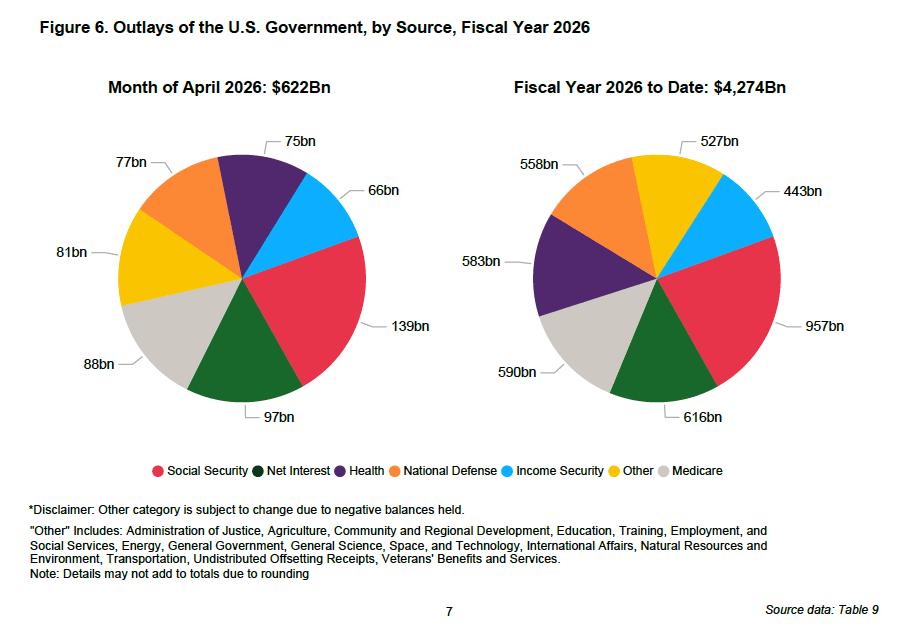
The government blew through another $622.32 billion last month. That was up 5.2 percent over the same period last year.
That drove total spending to $4.27 trillion through the first seven months of fiscal 2026. That’s up 3 percent from the same period last year.
A 3 percent increase in spending might not sound significant. But weren’t we told there would be spending cuts?
In fact, there were some cuts in the Big Beautiful Bill (along with spending increases).
The increased spending comes despite cuts to the EPA and the Department of Education budget, along with staffing reductions that are now showing up in the data. Lower disaster spending also helped moderate spending levels through the first two months of fiscal ’26.
However, looking at the big picture, the spending trajectory is up. Even with all the hype about DOGE and some lip service to cutting spending during the early days of the Trump administration, the U.S. government spent just over $7 trillion last year. That’s an average of $583.3 billion per month or $19.2 billion per day.
And now there’s a war.
That cost is starting to show up in the data. Military spending was up by $6 billion or 10 percent year-on-year. However, a Treasury official told Reuters that while the increase reflected some war spending, the costs of the Iran conflict were spread across several categories, including personnel and maintenance costs, research and development operations, and procurement.
A Pentagon official recently estimated the federal government had spent $29 billion on the war as of mid-May.
Despite some non-specific talk about “spending cuts,” there seems to be little to no commitment to dealing with the runaway spending substantially.
The Big Beautiful Bill trimmed some spending but increased it in other areas. Furthermore, those “cuts” were from projected spending increases. Actual expenditures will still go up, just not as fast as originally planned. The bottom line is that even with the Big Beautiful Bill, spending will increase on an absolute basis. We’re seeing it now.
And all that waste uncovered by DOGE? Virtually none of it was removed from the budget.
This is par for the course. It’s a lot easier to talk about spending cuts than it is to actually cut spending.
You might recall that President Biden promised that the [pretend] spending cuts would save “hundreds of billions” with the debt ceiling deal (aka the [misnamed] Fiscal Responsibility Act).
The ugly truth is the government isn’t committed to cutting spending in any meaningful way, and it always finds new reasons to spend even more, whether for “crises” at home or wars overseas.
The Cost of the Debt
Uncle Sam must pay interest on the nearly $40 trillion debt. Interest expense has grown into the second-largest spending category in the federal budget behind only Social Security.
In April, the Treasury forked out $111.6 billion on interest payments alone. That was a new monthly record.
April interest payments pushed total interest expense to $734.2 billion through the first seven months of fiscal 2026. That was up 7.3 percent compared to the same period in fiscal ’25.
Interest on the national debt cost $1.2 trillion in fiscal 2025. That was up 7.3 percent over 2024.
Net interest (interest expense – interest receipts) was $97 billion in April.
Through the first half of the fiscal year, the federal government spent more on interest on the debt than it did on national defense ($558 billion) or Medicare ($590 billion). The only higher spending category is Social Security ($957 billion).
Much of the debt currently on the books was financed at very low rates before the Federal Reserve started its hiking cycle. Every month, some of that super-low-yielding paper matures and must be replaced by bonds yielding much higher rates.
When people say the spending is unsustainable, it feels like an understatement. In fact, it’s fair to call the federal government insolvent.
However, very few people in the political class seem the least bit interested in tackling the problem. The bad news is that at some point, the problem is going to tackle them.
Mike Maharrey is a journalist and market analyst for Money Metals with over a decade of experience in precious metals. He holds a BS in accounting from the University of Kentucky and a BA in journalism from the University of South Florida.
(Headline USA) A man who goes by “Chud the Builder” and livestreams himself saying racially derogatory statements to black people in public settings was arrested and charged with attempted murder after a shooting outside a Tennessee courthouse on Wednesday, authorities said.
Dalton Eatherly, 28, and an unidentified man were involved in a confrontation that resulted in gunfire, District Attorney Robert J. Nash said in a statement. But Nash wouldn’t say why Eatherly was at that courthouse in Clarksville, what he was doing or what prompted the confrontation.
Police didn’t provide the race of the other man. However, a witness who said she saw him loaded into an ambulance described him as black.
Both men were transported to hospitals for medical treatment and were stable, the Montgomery County Sheriff’s Office said.
Eatherly was being held at the Montgomery County jail until bond can be set at an arraignment hearing, the county sheriff’s office said. Eatherly was also charged with employing a firearm during dangerous felony, aggravated assault and reckless endangerment with a deadly weapon, the sheriff’s office said.
Jacob Fendley, an attorney listed in court records as representing Eatherly in a separate harassment case from November, did not immediately return a phone message.
Claire Martin, who works in an attorney’s office across the street from the courthouse, said Eatherly is “well known in Clarksville for antagonizing people to see what he can get them to do.” She said he “yells racial slurs” at people while filming them. “He’s not a contributing member of society,” she said.
Martin did not see the altercation but saw the aftermath. The other man “waved at us as he got in the ambulance,” she said.
‘Did I shoot myself … ?’
In a video posted on the website Pump.fun on Wednesday, Eatherly said he shot a man in self-defense after the person starting hitting him. Eatherly speaks with paramedics in the clip, one of whom takes note of a wound’s entry and exit point.
“Did I shoot myself or did it graze it?” Eatherly asked.
Eatherly had been scheduled to appear in court Wednesday morning in Clarksville, located about 50 miles northwest of Nashville, over a $3,300 debt allegedly owed to a credit company, according to Montgomery County court records. The civil case was filed in February on behalf of Midland Credit Management.
Court records didn’t indicate whether Eatherly showed up for the status hearing. Online records list the case as open.
Eatherly, a white man, livestreams confrontations to social media where he can be seen and heard making racially derogatory statements to black people in public.
In one video taken in a market, he says to a passing black man, “You chimpin’ out,” a reference to chimpanzees. He then uses the N-word a number of times.
The black man is seen using a cellphone to record the confrontation, telling Eatherly, “Don’t touch me.”
A clerk tells Eatherly he’s not allowed to say that word. He responds “America is free speech. Tell me I can’t say something again. This is (expletive) America.”
— The Black Tucker Carlson Jr 🇺🇸 (@B1TuckerCarlson) May 14, 2026
Steakhouse theft and disorderly conduct charges
In addition to the credit debt case, Eatherly faces a separate criminal case in which he is accused of becoming unruly at a Nashville steakhouse on Saturday and refusing to pay the nearly $400 bill.
According to an affidavit in the case, the restaurant had asked him not to stream inside the business, but he did anyway. When they asked him to stop, he began yelling and screaming and “started making racial statements.”
He was arrested and charged on Sunday with theft of services, disorderly conduct and resisting arrest and released on $5,000 bond. His next appearance in this case was scheduled for July 17 in Davidson County criminal court.
Clarksville resident Larry Quillen said he’s seen videos in which Eatherly carries a gun and mace “and goes around and starts things.”
“I was just kind of like it’s a matter of time. I mean, because what he’s doing is hate. It’s not even freedom of speech and that’s what he claims to do,” Quillen said.
The Montgomery County Sheriff’s Office said one of the two men involved in Wednesday’s shooting was taken to Vanderbilt of Clarksville Hospital for treatment. A message left with the hospital wasn’t immediately returned.
The other was transported by Lifeflight to Vanderbilt University Medical Center in Nashville, the sheriff’s office said. A spokesperson for the hospital, Craig Boerner, said medical privacy laws prohibited the disclosure of information about victims of violence.
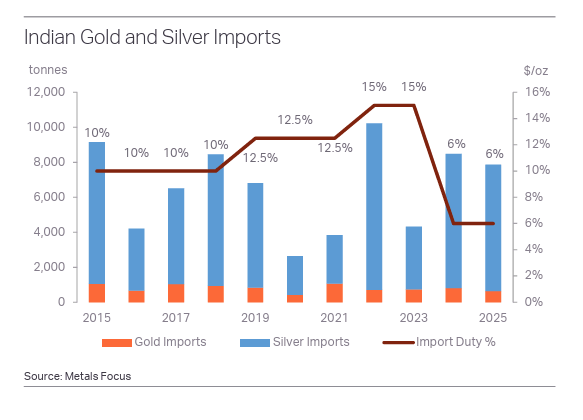
The 9 percent duty increase ranks as the largest on record.
The duty on doré (unrefined alloy generally containing 80 to 90 percent precious metal) was hiked from 5.35 percent to 14.35 percent, leaving the 0.65-percent differential between refined gold and doré unchanged.
The move comes as India struggles with a surging trade deficit that is pressuring its currency.
Gold and silver make up around 11 percent of India’s total imports. According to Metals Focus, the country typically imports around 800 tonnes of gold annually. Import volumes fell to 640 tonnes in 2025. However, higher gold prices meant that the total value still rose significantly.
Meanwhile, oil accounts for around 22 percent of the nation’s imports. The sudden spike in oil prices due to the U.S.-Iran war has hit India particularly hard. The country imports nearly 85 percent of its fuel, and about 50 percent of its crude imports flow through the Strait of Hormuz.
With both gold and oil prices spiking, India’s import bill has exploded. The country’s merchandise trade deficit topped $330 billion in the financial year ending March 2026. That was up from over $280 billion a year ago, a 17.9 percent increase.
The trade situation has put significant downward pressure on the rupee.
To buy oil, silver, and gold, Indian importers must sell rupees for dollars. Due to supply and demand dynamics, this causes the value of the rupee to fall against the dollar. In turn, the weakening rupee makes imports more expensive.
Along with the new duties, Indian Prime Minister Narendra Modi urged Indians to pause buying gold for a year and to limit their purchases of overseas goods. He also recommended using public transportation and carpooling to save fuel.
In an interview with CNBC, an Indian economist, Trinh Nguyen, pointed out that the Indian government has discouraged companies from raising prices at the pump, creating the potential for “demand destruction.”
“India is backtracking on liberalization of the market, which investors like about India.”
The Indian government took a similar approach in the previous decade when its trade deficit spiked. It raised the customs duty on precious metals from a flat ₹300 per gram to 15 percent by 2022.
The higher tax will undoubtedly put downward pressure on gold demand. Higher gold prices have already pushed gold jewelry demand down by 22 percent in 2025. Increasing investment demand helped offset the decline in jewelry offtake.
However, Metals Focus notes that Indian gold and silver demand have historically remained resilient in a higher tax environment. This reflects the fact that Indians have a deep cultural connection to precious metals, and they value them highly as a store of wealth. As the rupee depreciates, gold will become increasingly attractive.
According to Metals Focus analysts, “Consumers often delay purchases initially following sharp price increases but typically adjust to higher price levels over time. In addition, elevated duties could encourage a recovery in unofficial flows, which had collapsed following the 2024 duty reduction.”
A Bullish Angle on the Gold and Silver Import Duties
In an article published by Metals Daily, Ross Norman argued that the move by India is simultaneously bearish and bullish.
“At its core, however, gold is an asset of last resort — and Indians know that. So, when the government takes an action like this — effectively burning the lifeboats to keep warm — you know there is a real problem. There is a whiff of a real panic about this … and that makes it good and bad for gold simultaneously.”
He noted that the tax may put a damper on gold demand. But it could also spark demand. Ross noted, “The move also signals that conditions are so severe the Prime Minister felt compelled to ask people not to buy gold one day and impose punitive taxes the next — and in doing so reinforces the fundamental reason for owning gold.”
Ross said Indians are already treating gold as an asset of last resort, with coin and bar demand spiking even as jewelry demand cools.
“Modi’s actions have shades of a wartime appeal, where leaders request restraint and sacrifice from its people. India’s currency is falling and gold and oil bills are weighing heavily. The public appeal from Prime Minister Modi has a tone verging on panic, and if I had to bet, I’d say longer term the scales tip bullish.”
Mike Maharrey is a journalist and market analyst for Money Metals with over a decade of experience in precious metals. He holds a BS in accounting from the University of Kentucky and a BA in journalism from the University of South Florida.
(José Niño, Headline USA) An ex-girlfriend of Rep. Thomas Massie, R-Ky., has accused him of offering her $5,000 in cash to drop a wrongful termination complaint, per a storyAxios published on Wednesday—nearly a week before his Kentucky Republican primary.
Cynthia West, a social worker and school board candidate in Okaloosa County, Florida, claims she began dating Massie in August 2024, shortly after his wife Rhonda died, after he messaged her on X. She says Massie arranged a job for her in the Washington office of Rep. Victoria Spartz, R-Ill., so West could be nearby in D.C.
West alleges that after she refused to “engage in behavior I wasn’t comfortable with” and ended the relationship in mid-January 2025, she was fired from Spartz’s office. She then filed a wrongful termination complaint with the Office of Congressional Workplace Rights. Congressional payroll records confirmed West worked for Spartz’s office, earning approximately $17,000 over a temporary 90-day probationary period as “Director of Operations and Scheduling,” per a report by The Washington Free Beacon.
The core accusation is that when West informed Massie she was naming him as a witness in her complaint against Spartz, he offered her $5,000 in cash at a Kentucky Cracker Barrel. According to Axios, West says the money was half of a $10,000 “envelope of $100 bills” he had given her earlier in their relationship as a financial cushion when she left her job to work for Spartz. She says she returned the cash to him at the meeting. West claims Massie told her: “You’re just one person. You’re not going to make a difference. Just walk away.”
She was later offered a $60,000 settlement with a non-disclosure agreement through the Office of Congressional Workplace Rights, which sherefused to sign, per a Newsweek report. Axios obtained the settlement document.
The allegations first emerged in a video interview West gave to Northern Kentucky attorney Marcus Carey—who ran against Massie in the 2012 Republican primary—that circulated widely on X before Axios published its own reporting. Massie declined to comment to Axios and referred questions to Kentucky State Rep. Steven Doan.
Newsweek reported that Doan argued that West has a “documented history of making false abuse allegations,” pointing to a domestic violence complaint she made against her ex-husband that was dismissed by a Florida court. West told Axios the petition failed because she chose to represent herself rather than hire an attorney, as court records confirm.
Per a Kentucky Lantern report, Massie issued his own statement denying the allegations: “All of the claims of inappropriate conduct are false.” His campaign separately called the story“last-minute dirty tricks” that “don’t merit a response” and labeled the allegations “trashy lies,” as RawStory reported.
A Spartz spokesperson confirmed West’s employment but said it was not extended “due to unsatisfactory job performance.”
The timing of the story has fueled accusations of a coordinated hit. The allegations surfaced exactly one week before what multiple outlets havedescribed as the most expensive House primary in American history, with Trump’s MAGA PAC, AIPAC, and allied groups pouring millions into unseating Massie, who has become one of the president’s most vocal Republican critics.
West told Axios she did not coordinate with Trump’s operation or the campaign of Ed Gallrein, Massie’s Trump-backed challenger.
TheWashington Free Beaconnoted that Doan called $5,000 “too low of a price” for a genuine hush money scheme given Massie’s profile as a likely millionaire.
José Niño is the deputy editor of Headline USA. Follow him at x.com/JoseAlNino
(Money Metals News Service) In the latest episode of the Money Metals Midweek Memo, host Mike Maharrey challenged the optimistic mainstream narrative surrounding the U.S. economy, arguing that beneath strong headline numbers lies a far more troubling inflationary and monetary reality.
Maharrey opened with a personal hockey story about an overhyped Canadian team that ultimately proved ordinary on the ice, using it as a metaphor for today’s economy. Americans keep hearing that the economy is strong, inflation is cooling, and the labor market remains healthy. But according to Maharrey, the real-world data increasingly tells a different story.
He pointed to recent downward revisions from the Bureau of Labor Statistics, which trimmed 16,000 jobs from February and March employment data, as another example of economic headlines failing to match reality. Meanwhile, a recent Gallup poll found that 65% of Americans identified rising costs and affordability as their biggest financial concern, underscoring how deeply inflation continues to affect households.
CPI Data Signals Inflation Pressures Are Growing
Maharrey spent much of the episode analyzing the latest Consumer Price Index data, arguing that inflation is broadening well beyond energy costs tied to geopolitical tensions involving Iran.
April CPI rose 0.6% month-over-month after a 0.9% increase in March, pushing annual headline inflation to 3.8%, the highest level since May 2023. Energy prices accounted for roughly 40% of the increase, with the energy index jumping 3.8% in a single month and gasoline prices surging 5.4% in April alone. Compared to a year earlier, gasoline prices were up 28.4%.
But Maharrey emphasized that inflationary pressures are spreading into other areas of the economy. Core CPI, which excludes food and energy, rose 0.4% in April, bringing annual core inflation to 2.8%. Annualized, that monthly pace would imply roughly 4.8% inflation — far above the Federal Reserve’s stated 2% target.
Other categories also showed persistent upward pressure. Food prices increased 0.5% during the month, shelter costs rose 0.6%, and services excluding energy climbed another 0.5%. Producer Price Index data released the same week further reinforced the trend. Producer prices rose more than 1% month-over-month, while core producer prices still increased 0.6% even after stripping out food and energy. Maharrey noted that producer prices often serve as a leading indicator for future consumer inflation.
According to Maharrey, these figures undermine the argument that inflation is merely the result of temporary oil shocks.
He argued that CPI is not inflation, but rather a symptom of inflation. Historically, economists defined inflation as an increase in the supply of money and credit, not simply higher consumer prices. Rising prices are merely the visible consequence of monetary expansion.
Maharrey also criticized the methodology behind modern CPI calculations, claiming formula changes implemented during the 1990s systematically understate actual inflation. Using older CPI formulas from the 1970s, he argued, current inflation would likely measure closer to 6% or 7% rather than the official 3.8%.
He cited electricity prices as an example, noting that electricity costs have reportedly climbed 50% over the past five years, or roughly 10% annually. In his view, these kinds of increases better reflect the inflation Americans experience in daily life.
Maharrey repeatedly returned to the idea that monetary inflation — specifically government and central bank money creation — ultimately drives sustained price increases across the economy.
Money Supply Growth and the Return of Quantitative Easing
To support his argument, Maharrey pointed to rapid growth in the M2 money supply.
According to Federal Reserve data cited during the episode, M2 increased from $21.61 trillion in February 2025 to $22.67 trillion in February 2026, representing a 4.9% increase in the money supply over the course of a year. The money supply expanded by another $57 billion in March alone.
He argued that this nearly 5% increase in money supply represents the “real” inflation rate and suggested it better explains persistent price pressures throughout the economy.
Maharrey also claimed the Federal Reserve quietly resumed quantitative easing in December, even if officials avoid using the term publicly. By purchasing U.S. Treasuries with newly created money, he said, the Fed is once again expanding its balance sheet and injecting fresh liquidity into the economy.
According to Maharrey, these policies guarantee continued inflation regardless of whether oil prices eventually stabilize or geopolitical tensions ease.
Deutsche Bank Raises Alarm Over De-Dollarization
The second half of the episode focused heavily on de-dollarization and a new report from Deutsche Bank that Maharrey described as especially significant because it came from a mainstream financial institution rather than an alternative economic outlet.
The report, authored by analysts Malikica Sakdeva and Michael Hsu, argued that the post-Cold War “end of history” era dominated by U.S. economic and geopolitical supremacy may be ending. The analysts wrote that the world is once again entering a period of superpower competition, with major implications for gold and the dollar.
Maharrey highlighted several striking statistics from the report. The dollar’s share of global central bank reserves has reportedly fallen from around 60% to roughly 40%, while gold’s share has doubled over the last four years to approximately 30% of reserves.
He noted that central banks — especially in emerging markets — have aggressively accumulated gold since the 2008 financial crisis and even more rapidly after the U.S. weaponized the dollar through sanctions following Russia’s invasion of Ukraine.
Since 2008, emerging market central banks have purchased approximately 225 million ounces of gold, according to the Deutsche Bank report.
The analysts argued that gold’s growing role is not merely the result of higher gold prices. Instead, central bank buying itself is helping drive those price increases. They estimated that for every additional 1 million ounces of gold purchased by central banks, the gold price rises roughly 1%.
Gold Could Reach $8,000 Under Some Scenarios
One of the episode’s most eye-catching claims involved Deutsche Bank’s long-term gold projections.
Using several de-dollarization scenarios, Sakdeva and Hsu concluded that gold prices could potentially rise to $8,000 per ounce over the next five years if emerging market central banks increase gold holdings to 40% of their reserves, even if overall emerging market foreign exchange reserves decline to $5 trillion.
Maharrey stressed that this scenario does not require a collapse of the dollar or complete abandonment of the global reserve currency system. Even modest reductions in global dollar demand, he argued, could significantly impact the U.S. economy.
Because the United States relies heavily on global demand for dollars and dollar-denominated assets, Maharrey warned that reduced foreign appetite for dollars would make it far more difficult for Washington to finance large deficits without higher interest rates and stronger inflationary consequences.
He argued that the dollar’s reserve currency status has long allowed the Federal Reserve to create trillions of dollars without triggering an immediate currency crisis because foreign economies absorb much of that liquidity.
“If the world didn’t want those dollars,” Maharrey warned, inflationary pressures inside the United States would intensify dramatically.
Precious Metals as “Real Money”
Throughout the episode, Maharrey repeatedly encouraged listeners to view gold and silver as protection against ongoing currency devaluation.
He argued that fiat currencies are designed to lose purchasing power over time, while gold and silver cannot be created by central banks. Even under official inflation figures, he noted, the dollar loses meaningful value every few years.
The episode concluded with Maharrey urging listeners to consider precious metals before inflationary and monetary pressures worsen further, warning that “you can’t get your fire insurance when your house is burning down.”
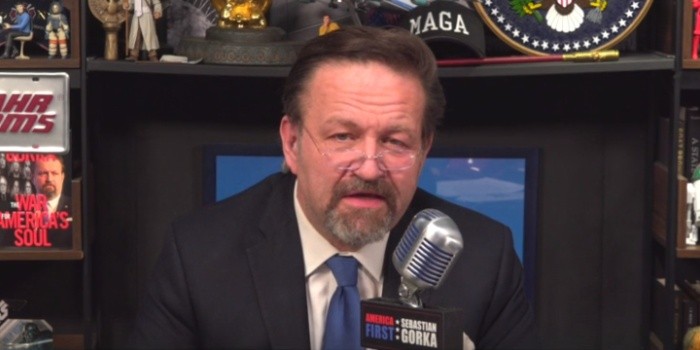
Gorka, a former right wing influencer who now serves as a National Security Council principal, has been making rounds on conservative media explaining the meaning behind the President’s new National Counterterrorism Strategy. The strategy identifies three priority groups for the administration, including narco-terrorists, Islamist terrorists, and “Violent Left-Wing Extremists.” The document makes no mention of right-wing extremists.
However, Gorka’s remarks make clear that those on the right are not immune.
Asked by Breitbart editor in chief Alex Marlow if there’s any “right-wing terror” or “right-wing extremism” threat, Gorkareplied by pointing to Carlson and Fuentes, both of whom have become vocal critics of the Trump administration, arguing they are not actually conservatives anyway.
“I’m not sure that Nick Fuentes or Tucker Carlson are conservatives,” Gorka said. “If you are lauding Sharia law, if you are saying that there are Muslim states that seem to be better qualitatively than America in terms of freedom and prosperity, I’m not sure that means you’re part of the conservative movement. So if you remove those individuals and you understand that they’re not conservatives, what’s left?”
Klippenstein notes that Gorka’s charge that Carlson lauds Sharia law is “to put it lightly, ridiculous.”
What Carlson actuallysaid was that Gulf countries display a “self-confidence” that results in a “welcoming attitude” toward visitors of different faiths.
“So you’ll be sitting at dinner in Riyadh, Saudi Arabia, and you’ll say, you know, I just, I’m really kind of pro-Jesus, like I’m a Christian. They’ll be like, ‘That’s so great!'” Carlson remarked. “No, they’re Muslims. It’s a country governed by Sharia law! — [laughs] — I mean, and they’re like, ‘That’s great!'”
Klippenstein argues that none of this is actually about extremism. It stems from the fact that both Carlson and Fuentes recently broke with Trump over the Iran war.
Carlson has called Trump’s Iran war “the single biggest mistake Trump, or any American president, has made in my lifetime” and slammed the strikes as “reprehensible and immoral,” insisting the war “doesn’t serve American interests in any conceivable way.”
When Trump ordered strikes on Iran, Fuentes posted on social media “NO WAR WITH IRAN. ISRAEL IS DRAGGING US INTO WAR. AMERICA FIRST.”
Klippenstein describes the tactic as a “terrorism two-step” in which the administration first strips someone of their conservative credentials, redefines them as foreign affiliated and dangerous, and then targets them. He compares this to the “No True Scotsman” fallacy.
In a separateinterview with actor Dean Caine, Gorka boasted about the lack of negative media coverage of the counterterrorism strategy.
“I did a kind of press call when we released the strategy. 50 articles were written that day about the press call. Only one of them from those putzes at Politico was even slightly negative… We are moving so fast, they just can’t keep up with us, which is delicious,” Gorka said.
José Niño is the deputy editor of Headline USA. Follow him at x.com/JoseAlNino