(Mike Maharrey, Money Metals News Service) As is typical in April, the federal government ran a budget surplus last month thanks to the influx of income tax revenue. But despite this seemingly good news, every metric reveals further deterioration in America’s fiscal situation.
The surplus of $215.02 billion was 16.8 percent lower than last year, as revenues dropped and spending increased.
Through the first seven months of fiscal 2026, the deficit stands at $953.56 billion, about 9 percent lower than through the same period in 2025. The lower deficit is primarily a function of increased tariff revenue, as spending is up.
For context, the biggest deficit run by the Obama administration was $1.41 trillion in 2009.
The relentless monthly budget deficits keep pushing the national debt higher. After eclipsing $38 trillion in October, it blasted through the $39 trillion mark in March.
Rolling in the Dough
Total federal receipts came in at $837.34 billion in April. That was up over 117 percent from last month, reflecting April income tax receipts. But total revenues were down 1.7 percent compared to April 2025.
Through the first seven months of fiscal 2026, the federal government has collected $3.3 trillion. That is up 7 percent compared to the same period in fiscal 2025.
Tariff receipts totaled $22.1 billion last month. This includes $2 billion in tariff refunds.
So far in fiscal 2026, the federal government has collected $195 billion in customs duties.
Tariff revenue appears to be softening. Customs receipts last month were roughly the same as March, but down from $26.6 billion in February and from an average of $30 billion per month late last year.
Spending It All and More
Meanwhile, the Trump administration continues to spend money hand over fist.
The government blew through another $622.32 billion last month. That was up 5.2 percent over the same period last year.
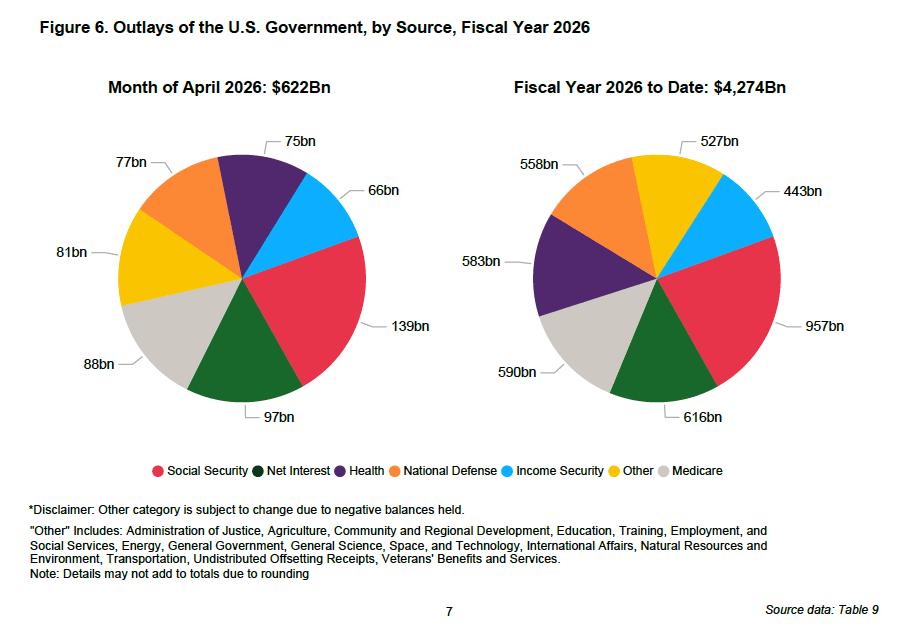
That drove total spending to $4.27 trillion through the first seven months of fiscal 2026. That’s up 3 percent from the same period last year.
A 3 percent increase in spending might not sound significant. But weren’t we told there would be spending cuts?
In fact, there were some cuts in the Big Beautiful Bill (along with spending increases).
The increased spending comes despite cuts to the EPA and the Department of Education budget, along with staffing reductions that are now showing up in the data. Lower disaster spending also helped moderate spending levels through the first two months of fiscal ’26.
However, looking at the big picture, the spending trajectory is up. Even with all the hype about DOGE and some lip service to cutting spending during the early days of the Trump administration, the U.S. government spent just over $7 trillion last year. That’s an average of $583.3 billion per month or $19.2 billion per day.
And now there’s a war.
That cost is starting to show up in the data. Military spending was up by $6 billion or 10 percent year-on-year. However, a Treasury official told Reuters that while the increase reflected some war spending, the costs of the Iran conflict were spread across several categories, including personnel and maintenance costs, research and development operations, and procurement.
A Pentagon official recently estimated the federal government had spent $29 billion on the war as of mid-May.
Despite some non-specific talk about “spending cuts,” there seems to be little to no commitment to dealing with the runaway spending substantially.
The Big Beautiful Bill trimmed some spending but increased it in other areas. Furthermore, those “cuts” were from projected spending increases. Actual expenditures will still go up, just not as fast as originally planned. The bottom line is that even with the Big Beautiful Bill, spending will increase on an absolute basis. We’re seeing it now.
And all that waste uncovered by DOGE? Virtually none of it was removed from the budget.
This is par for the course. It’s a lot easier to talk about spending cuts than it is to actually cut spending.
You might recall that President Biden promised that the [pretend] spending cuts would save “hundreds of billions” with the debt ceiling deal (aka the [misnamed] Fiscal Responsibility Act).
That never happened.
Supporters of the Big Beautiful Bill expect economic growth stimulated by tax cuts to boost revenue and narrow the deficit. However, history casts significant doubt on this claim.
The ugly truth is the government isn’t committed to cutting spending in any meaningful way, and it always finds new reasons to spend even more, whether for “crises” at home or wars overseas.
The Cost of the Debt
Uncle Sam must pay interest on the nearly $40 trillion debt. Interest expense has grown into the second-largest spending category in the federal budget behind only Social Security.
In April, the Treasury forked out $111.6 billion on interest payments alone. That was a new monthly record.
April interest payments pushed total interest expense to $734.2 billion through the first seven months of fiscal 2026. That was up 7.3 percent compared to the same period in fiscal ’25.
Interest on the national debt cost $1.2 trillion in fiscal 2025. That was up 7.3 percent over 2024.
Net interest (interest expense – interest receipts) was $97 billion in April.
Through the first half of the fiscal year, the federal government spent more on interest on the debt than it did on national defense ($558 billion) or Medicare ($590 billion). The only higher spending category is Social Security ($957 billion).
Much of the debt currently on the books was financed at very low rates before the Federal Reserve started its hiking cycle. Every month, some of that super-low-yielding paper matures and must be replaced by bonds yielding much higher rates.
When people say the spending is unsustainable, it feels like an understatement. In fact, it’s fair to call the federal government insolvent.
However, very few people in the political class seem the least bit interested in tackling the problem. The bad news is that at some point, the problem is going to tackle them.
Mike Maharrey is a journalist and market analyst for Money Metals with over a decade of experience in precious metals. He holds a BS in accounting from the University of Kentucky and a BA in journalism from the University of South Florida.