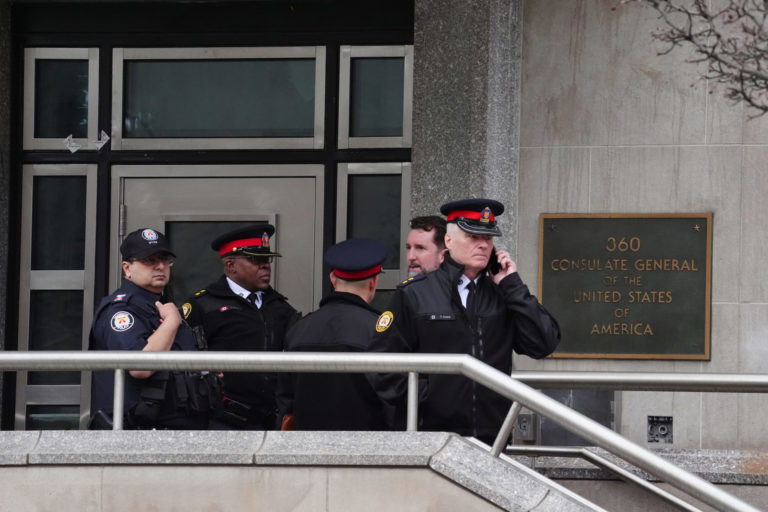
(Headline USA) The former secretary of public security for Mexico’s Sinaloa state appeared in a U.S. court Friday, days after his arrest in Arizona on charges he and other officials took bribes to help the Sinaloa Cartel smuggle vast quantities of drugs into the U.S.
Gerardo Mérida Sánchez, 66, was not required to enter a plea during his initial appearance in federal court in Manhattan. He was ordered jailed but could request bail at a later date. He is due back in court on June 1. A message seeking comment was left for his lawyer.
Mérida Sánchez is one of 10 current or former Sinaloa government or law enforcement officials charged by the U.S. last month and the first to appear in court. He is charged with narcotics importation conspiracy, possession of machine guns and destructive devices and conspiracy to possess machine guns and destructive devices and faces 40 years to life in prison if convicted.
Other defendants include Gov. Rubén Rocha Moya and Mayor Juan de Dios Gámez Mendívil of the Sinaloa state capital of Culiacán, both of whom said they were taking temporary leaves of absence to deal with the charges. They have yet to be apprehended.
Mexico’s Security Cabinet stated on social media that Mérida Sánchez entered the U.S. from Hermosillo, Sonora, on Monday, and was taken into custody by the U.S. Marshals Service at the Nogales border crossing into Arizona. He appeared in court in Arizona before being moved to New York, court records show.
Mérida Sánchez was Secretary of Public Security, an appointed cabinet-level position in Moya’s Sinaloa government, from September 2023 until his resignation in December 2024. He was responsible for overseeing the Sinaloa State Police and appointing its director.
Mérida Sánchez is accused of taking at least $100,000 in monthly cash bribes from “Los Chapitos,” a Sinaloa Cartel faction run by the sons of incarcerated ex-cartel leader Joaquín “El Chapo” Guzmán, in exchange for arresting rivals and providing information about ongoing investigations and planned drug raids.
In 2023 alone, Mérida Sánchez warned the Chapitos about at least 10 upcoming raids on labs and safe houses where they stored drugs, weapons, and money, allowing them to remove personnel and evidence of criminal activity before they happened, according to an indictment unsealed last month.
Some of the indicted officials are members of Mexican President Claudia Sheinbaum ’s progressive Morena party.
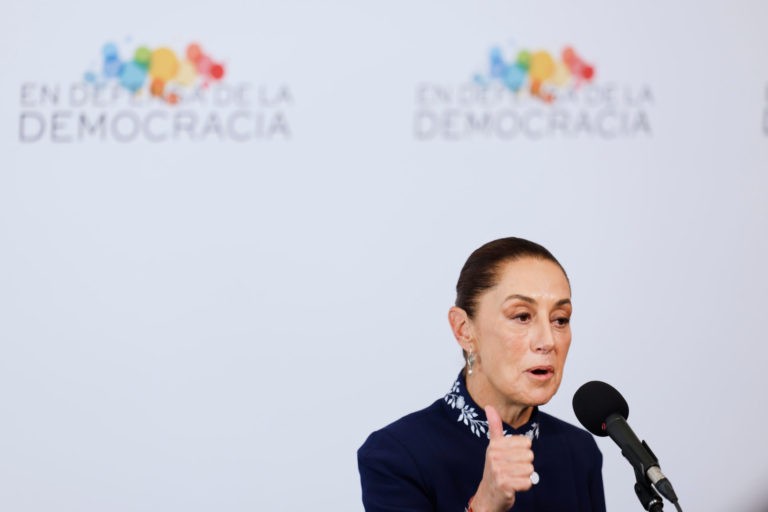
After the indictment was announced, Sheinbaum said she wouldn’t defend anyone found to have committed a crime but argued that, if authorities uncovered “irrefutable” evidence linking the officials to cartel crime, they should be tried in Mexico, not the U.S.
“We will never subordinate ourselves because this is a matter of the dignity of the Mexican people,” she said, risking backlash from U.S. President Donald Trump, who has threatened military action against cartels on Mexican soil.
Mexico’s Foreign Ministry and Security Cabinet have been maintaining institutional communication with U.S. authorities within the framework of international cooperation mechanisms.
“El Chapo” was convicted in 2019 and sentenced to life in prison.
Another Sinaloa kingpin, Ismael “El Mayo” Zambada, pleaded guilty last year to U.S. drug trafficking charges and apologized for helping flood the country with cocaine, heroin and other illicit substances and for fueling deadly violence in Mexico. He is scheduled to be sentenced in July to life in prison.
Under Zambada and Guzmán’s leadership, prosecutors say, the Sinaloa cartel evolved from a regional player into the largest drug trafficking organization in the world.
(José Niño,Headline USA) Rep. Thomas Kean Jr., (R-N.J.) has vanished from public life, missing from both Capitol Hill and the campaign trail for over two months while his office refuses to provide answers about his whereabouts, the New York Timesreported.
The Republican lawmaker last cast a vote in Congress in early March. Despite facing re-election in one of the tightest midterm contests in the nation, he has made no campaign appearances. Not a single candid photograph has emerged to calm the concerns of supporters and voters.
His office put out astatement two weeks ago claiming the congressman was addressing a “medical issue” and would return “very soon.”
Nobody has seen him since.
Meanwhile, his social media presence continues uninterrupted. The posts frequently use first person language but feature photographs that appear to be from earlier dates.
During a Tuesday debate featuring Democrats competing for his seat, candidate Tina Shah directly confronted the elephant in the room.
“What we are being assured is that his team is carrying the torch,” Shah said. “But we elected Tom Kean Jr., not his team.”
Kean’s staffers watched from the third row as Democratic candidates took turns discussing their invisible opponent. Chief of staff Dan Scharfenberger repeated the familiar talking points afterward.
“He’s dealing with a personal health condition, and he’ll be back soon,” Scharfenberger said.
Asked to clarify the nature of the condition and explain why the congressman has been absent from both Washington and his home state of New Jersey, Scharfenberger gave an enigmatic answer.
“There’s no cameras where Tom is,” he said, offering nothing further.
Spokesman Harrison Neely expressed confidence in the congressman’s eventual return.
“He’s going to be totally fine, and he’ll be back to a full schedule soon,” Neely said Tuesday.
Yet that timeline appears uncertain. The Morris County Chamber of Commerce hasupdated its program for a May 28 breakfast event to reflect that Kean will not be attending.
“As you no doubt have heard, Congressman Kean will be unable to appear due to his ongoing health concerns,” the chamber’s notice stated. “We wish him well.”
Democratic candidates have treaded carefully around the issue, seemingly mindful that attacking someone with an undisclosed medical condition carries political dangers. Still, several voiced frustration with the congressman’s silence.
“Look, at the end of the day you’re a public servant,” said Brian Varela, a child care business owner seeking the Democratic nomination. “And while I don’t think you need to be putting your own personal medical history out there, you at the very least have a responsibility to be communicating with your constituents and with your district.”
Michael Roth, a former leader at the Small Business Administration under President Biden, framed it more directly.
“If you were missing work, you would tell your boss,” he said. “And Tom Kean Jr.’s boss is the people.”
Democratic strategists consider the Seventh District among their strongest opportunities to flip a seat this November. The district encompasses an affluent suburban swath of North Jersey running from the Atlantic coast to the Pennsylvania border.
Had Kean withdrawn from the race at least 62 days before the June 2 primary, a committee of three campaign advisers would havenamed his replacement. Should he exit after the primary, Republican county leaders from the six counties in the district would choose a new nominee. His staff maintains he intends to stay in the race.
Former Representative Leonard Lance, a moderate Republican who represented the district for five terms beforelosing in 2018, expressed confidence that Kean remains the strongest candidate to hold off the expected Democratic offensive.
“I take at face value the statement of his office that he will be back at 100 percent,” Lance said.
No sightings of the congressman were reported on Wednesday. His X account, however, published new content.
“I’m pleased to join the Congressional Crypto Caucus,” the post read. “The United States must lead on digital assets — driving innovation, delivering regulatory clarity and protecting consumers. I look forward to working with this bipartisan group of colleagues to advance that agenda.”
José Niño is the deputy editor of Headline USA. Follow him at x.com/JoseAlNino
(José Niño, Headline USA) PayPal agreed to forgo roughly $30 million in transaction fees to settle a Justice Department probe into allegations that the financial services company adopted unlawful preferences for minority owned businesses, the Wall Street Journalreported.
Justice Department officials had been investigating whether PayPal violated a federal civil rights law that prohibits creditors from discriminating against applicants based on race. The probetargeted PayPal’s $530 million plan to support Black and minority owned businesses, which the company created in 2020 shortly after the killing of George Floyd by a police officer prompted a nationwide conversation about racial inequality.
The settlement requires PayPal to waive processing fees for $1 billion of transactions for small businesses owned by veterans, as well as businesses involved in farming, manufacturing, or technology. Justice Department officials said the fee waivers are worth approximately $30 million.
PayPal did not admit wrongdoing as part of the settlement. The company said in a statement it was excited “to infuse American small businesses with even more economic opportunity.”
As the Wall Street Journal reported, the settlement fits into a broader Trump administrationpush to root out diversity initiatives in American corporations.
“American corporations are on notice: you will face our aggressive enforcement if you use race or national origin to discriminate against qualified Americans,” acting Attorney General Todd Blanche said.
The Justice Department is conducting multiple civil probes under the umbrella of the False Claims Act. The department has embraced the argument that holding a federal contract while still considering diversity when hiring constitutes fraud against the government, entitling officials to recoup potentially millions of dollars.
That theory produced a settlement with IBM last month. The company agreed to pay the federal government more than $17 million to resolve allegations that it failed to comply with anti-discrimination requirements in contracting by considering diversity in employment decisions.
PayPal also faces private litigation over its funding program for minority startups. An Asian American venture capital investorsued PayPal in January 2025, accusing the company of illegal discrimination by earmarking investments for Black and Latino owned operations.
José Niño is the deputy editor of Headline USA. Follow him at x.com/JoseAlNino
(Money Metals News Service) In a recent episode of the Money Metals Podcast, host Mike Maharrey sat down with veteran market analyst J. Michael Oliver, founder of Momentum Structural Analysis (MSA), for a sweeping discussion on precious metals, government debt, the stock market, and what Oliver believes could become a historic turning point for gold and silver investors.
Oliver, who launched MSA in 1992 after beginning his career in futures brokerage with E.F. Hutton in 1975, explained that his analytical approach differs sharply from conventional technical analysis. Rather than relying on price charts or moving averages alone, MSA focuses on momentum structures that often reveal market turning points before they become obvious in price action. According to Oliver, momentum frequently signals tops and bottoms long before traditional analysts recognize them.
That framework has led him to one of the most bullish outlooks on precious metals he has ever held.
(Interview Starts Around 6:42 Mark)
Geopolitical Headlines Are a Distraction
Despite ongoing geopolitical turmoil, including the Iran conflict and lingering fallout from the Ukraine war, Oliver argued that global headlines are largely irrelevant to the deeper forces driving markets.
He pointed to the fact that gold, oil, and commodities peaked shortly after the Ukraine war began and noted that silver and oil had already been declining before the latest Middle East tensions escalated. Likewise, fears surrounding tariffs sparked a stock market selloff during the first quarter of 2025, yet markets later recovered and pushed to new highs even though tariffs themselves never disappeared.
To Oliver, these events are temporary emotional catalysts rather than primary market drivers.
Instead, he believes the real story lies underneath the surface: a structural crisis forming in the U.S. government bond market combined with a massive revaluation of gold and silver.
According to Oliver, the stock market is in the process of forming a major long-term top while the U.S. Treasury market is nearing a dangerous breaking point. He predicts gold and silver are preparing for what he described as an unprecedented upside explosion that could unfold within the next three to four months.
Why Oliver Thinks Silver Could Reach Triple Digits — Or Higher
One of the interview’s most striking moments came when Oliver discussed silver’s upside potential.
He argued that silver has been historically mispriced for decades, trapped in a range between roughly $5 and $50 per ounce for nearly half a century. While gold repeatedly broke into new bull market highs during previous cycles, silver consistently failed to sustain major breakouts.
Oliver believes that imbalance is now correcting violently.
He compared silver’s current setup to copper in the late 2005 breakout period. Copper had traded lethargically between roughly 50 cents and $1.50 per pound throughout the 1980s and 1990s before suddenly exploding higher without any major headline catalyst. Within several quarters, copper surged to approximately $4.10 per pound.
Oliver also referenced the lead market’s sharp move in 2007 as another example of long-dormant commodities suddenly repricing upward after years of suppression.
He suggested silver could eventually reach between $300 and $500 per ounce, acknowledging that such targets sound extreme but arguing that markets frequently overshoot when correcting long-term pricing distortions. He noted that silver remains “insanely cheap” relative to gold and believes the gold-silver ratio is beginning to reverse decisively in silver’s favor.
Industrial Demand Is Colliding With Investment Demand
He pointed out that the global silver market has operated in a supply deficit for approximately five consecutive years, with annual demand consistently exceeding available supply. Yet higher prices have failed to stimulate sufficient new production because most silver is mined as a byproduct of base metal operations rather than from primary silver mines.
That means rising silver prices alone do not necessarily encourage substantial increases in output.
At the same time, industrial demand continues to accelerate.
Oliver highlighted the rapid global expansion of solar power, particularly Chinese solar panel manufacturing. Photovoltaic cells rely heavily on silver, and China currently accounts for roughly 80% to 90% of global solar panel production demand. As renewable energy adoption expands worldwide, Oliver sees silver consumption continuing to rise sharply.
Layered on top of that industrial demand is silver’s historic role as money.
For thousands of years, silver served alongside gold as a trusted store of value, and Oliver believes investors are beginning to rediscover that reality as confidence in fiat systems weakens.
He noted that gold’s previous two major bull markets — from 1976 to 1980 and from 2001 to 2011 — both generated roughly eightfold gains from bear-market lows to cycle highs.
Starting from gold’s 2015 low near $1,050 per ounce, Oliver argued that the current move has only achieved approximately a fourfold increase so far. If gold merely replicated its historical performance, he suggested prices could approach $8,500 per ounce.
He also referenced a recent JPMorgan projection calling for gold prices around $9,200, noting that such targets align surprisingly well with his broader structural outlook.
Still, Oliver stressed that he does not believe gold would necessarily stop there because the monetary backdrop today is fundamentally different from prior cycles.
The Real Crisis Is Government Debt
Throughout the interview, Oliver repeatedly returned to what he sees as the central issue confronting global markets: government debt.
He contrasted today’s environment with the 2007-2009 financial crisis, which revolved around mortgage debt and private sector leverage. This time, he said, the danger lies in sovereign debt itself.
Oliver warned that the U.S. Treasury market, particularly long-duration bonds, is approaching a crisis stage. He believes 30-year Treasury bonds are on the verge of breaking down to new lows in price while yields move sharply higher.
Even Federal Reserve intervention may not be enough to stop it.
He cited comments from JPMorgan CEO Jamie Dimon, who recently warned about an approaching government debt crisis. Oliver agreed with that assessment completely, arguing that the Fed’s ultimate response will be aggressive money creation.
In his words, “Gold knows this.”
Oliver believes gold has already been pricing in the coming debt emergency long before the broader public recognizes it.
Mike Maharrey argued that many investors focus too narrowly on CPI data while ignoring money supply growth, and Oliver strongly agreed.
According to Oliver, money supply expansion itself is inflation, while rising consumer prices merely reflect that inflation later in the process. He noted that the S&P 500’s enormous gains since the 2000 dot-com peak largely mirror the expansion of the M2 money supply rather than representing genuine increases in real value.
Oliver also criticized the Federal Reserve’s long period of artificially cheap money. He pointed out that for roughly 10 of the last 15 years, Fed funds rates remained near zero, creating what he described as a massive liquidity-driven bubble in financial assets.
Now, he believes that bubble is beginning to crack.
Warning Signs Are Emerging Beneath the Surface
Although major stock indexes continue hovering near highs, Oliver sees deterioration occurring underneath the surface of the financial system.
He specifically highlighted weakness within the financial sector, noting that Visa, Mastercard, banks, insurers, and broker-dealers have all started underperforming the broader S&P 500.
According to Oliver, the XLF financial sector ETF is collapsing relative to the S&P in a manner similar to the pattern that emerged before the 2007 financial crisis.
He warned that investors remain focused on the wrong stories — Iran, tariffs, artificial intelligence, and short-term market moves — while missing the far more important structural deterioration taking place in credit markets and financial institutions.
Oliver also suggested that recent vertical moves in semiconductor stocks and companies like NVIDIA resemble classic late-stage bubble behavior rather than healthy long-term market leadership.
Why Oliver Prefers Silver Over Cash
Toward the end of the interview, Maharrey asked Oliver about his own investment positioning.
Oliver revealed that his personal portfolio is heavily concentrated in silver bullion ETFs and silver mining stocks, along with some exposure to gold miners and commodity-related assets.
Of course, we also know the many risks and issues that arise from paper ETFs when compared with physical precious metals (e.g., physical silver and physical gold). Physical precious metals carry far less counterparty risk than paper investments and provide final settlement because they are non-liability monetary assets.
Importantly, however, Michael Oliver said he has little interest in eventually rotating profits back into fiat cash because he views paper currencies as rapidly depreciating stores of value.
Instead, once silver experiences the explosive upside move he anticipates, Oliver expects to rotate substantial gains into physical gold bullion, treating gold not as an investment but as true savings and real money.
For Oliver, the coming years are not simply another commodity cycle. They represent a broader reckoning with debt, fiat currency, and confidence in financial institutions themselves.
(Dave DeCamp, Antiwar.com) The Cuban government has said that it has run out of oil reserves under the ramped-up US oil embargo on the country, which has caused a devastating humanitarian crisis and widespread power outages across the country.
“We have absolutely no fuel oil, absolutely no diesel,” Vicente de la O Levy, Cuba’s minister of energy and mines, said on Wednesday, according to The New York Times. “In Havana, the blackouts today exceed 20 or 22 hours.” Cuba produces some oil domestically, but nowhere close to the level needed to stave off the crisis.
The Trump administration caused the crisis by ending Venezuelan oil shipments to the island nation following the US attack on the country to abduct President Nicolas Maduro and by pressuring Mexico to also end oil exports to Cuba and threatening tariffs.
At one point, the US issued an oil waiver for private companies in Cuba, but the measure brought no relief for the country’s state-run power grid. The US has also been ramping up the military pressure against Cuba, surging surveillance flights around the island as President Donald Trump has been threatening to “take” the country.
On Thursday, Cuba said that it hosted CIA Director John Ratcliffe, the highest-level US official to visit the country since the blockade and pressure campaign began, and that he held talks with the country’s Interior Ministry.
“Following the request submitted by the US government that a delegation presided over by the CIA Director John Ratcliffe be received in Havana, the Revolutionary Directorate approved the realization of this visit and the meeting with its counterpart from the Ministry of the Interior,” the Cuban government said.
While there have been talks between the US and Cuba, it’s unclear what deal would satisfy the Trump administration as Secretary of State Marco Rubio, who is leading the policy, has made clear he wants regime change.
“You cannot change the economic trajectory of Cuba as long as the people who are in charge of it now are in charge of it. That’s what’s going to have to change because these people have proven incapable,” Rubio told Fox News this week. “I hope I’m wrong. We’ll give them a chance. But I don’t think it’s going to happen. I don’t think we’re going to be able to change the trajectory of Cuba as long as these people are in charge in that regime.”
(Elyse Apel, The Center Square) Michigan House Republicans passed a resolution calling on Michigan Secretary of State and Democrat gubernatorial candidate Jocelyn Benson to release records tied to her past involvement with the Southern Poverty Law Center following a federal indictment against the organization.
House Resolution 313, introduced by State Rep. Rachelle Smit, R-Martin, urges Benson to voluntarily disclose any information in her possession related to the SPLC’s operations and alleged financial ties to extremist groups.
“The legislature has a responsibility to hold state officers accountable for their actions; especially when those actions throw their ability to carry out constitutionally mandated responsibilities into question,” Smit, R-Martin, said in a statement. “If the person charged with operating our elections fairly for all Michiganders stands accused of leading an organization funneling money to hate groups like the KKK, lawmakers must demand accountability.”
Benson did not respond to The Center Square’s request for comment on the resolution.
The Republican-led House passed the resolution on a party-line vote. No Democrats supported the resolution.
This comes after federal prosecutors announced charges against the SPLC last month, including wire fraud, bank fraud and conspiracy to commit money laundering.
According to the federal indictment, the SPLC allegedly directed more than $3 million in donor funds between 2014 and 2023 to individuals associated with extremist organizations, including the Ku Klux Klan, Aryan Nations and the National Socialist Movement.
Benson served on the SPLC’s board of directors from 2014 through early 2019, overlapping with part of the timeframe outlined in the indictment.
“Secretary Benson led an organization now accused of funneling money to some of the most hateful, twisted extremist groups in our nation,” Smit said. “Secretary Benson is at a very serious crossroads. Did she knowingly help fund some of the worst extremist group in the U.S., or was she blind at the wheel of an organization laundering money to perpetuate hate?”
The resolution also calls on Benson to publicly address her role within the organization, which she has yet to do.
State Rep. Joseph Fox, R-Fremont, said lawmakers and the public deserve answers regarding Benson’s involvement.
“What we need is transparency,” Fox said in a statement. “The accusations that have been made against the SPLC are extremely troubling. When an organization like the SPLC is accused of funding extremists, the people of Michigan deserve to know who was involved and to what extent.”
Fox also referenced Benson’s past work as an undercover investigator for the SPLC and said she should disclose “what she knew, and when she knew it.”
“Anything less would be a betrayal to the people of this state,” Fox said.
Federal officials have alleged the SPLC solicited donations under the premise of combating extremism while secretly funding individuals tied to hate groups.
“The SPLC was not dismantling these groups,” Acting Attorney General Todd Blanche said at a news conference announcing the charges. “It was instead manufacturing the extremism it purports to oppose by paying sources to stoke racial hatred.”
The SPLC has denied the allegations. SPLC CEO Bryan Fair previously called the accusations “false” and defended the organization’s work monitoring extremist groups.
Separately, Benson is also facing multiple lawsuits alleging racial discrimination within the Michigan Department of State, which she leads.
A lawsuit filed just before the announcement of the indictment by Metro Detroit employees Jaqueline Griffin and Cherylann Sanker alleges they were subjected to discrimination and retaliation. The plaintiffs are seeking $10 million in damages.
“We unequivocally refute these false allegations,” Angela Benander, Benson’s chief communications officer, previously told The Center Square. “The secretary and department leadership hold themselves and every employee to the highest legal and ethical standards across the board. We do not tolerate any discrimination, harassment, or retaliation and we are prepared to fight this case in court.”
The case marks at least the fourth lawsuit in recent years alleging racial discrimination within the department. A separate lawsuit filed in January on behalf of four employees also alleged a “racially hostile environment.”
In a sworn statement included in that case, former Assistant Secretary of State Heaster Wheeler said he raised concerns directly with Benson.
“I brought these matters to the attention of Secretary of State Jocelyn Benson,” Wheeler wrote. “Ms. Benson did not act to correct this situation.”
Benson’s department has denied the allegations of racial discrimination. Previous disputes have resulted in settlements, including a $775,000 agreement reached in 2024 with a former employee who alleged a “racially hostile” work environment.
This all comes as Benson campaigns for governor and is considered a leading Democrat candidate for the election, which is in just 172 days.
(Headline USA) A Tennessee man who goes by the moniker Chud the Builder and is known for posting racist videos to social media was given a $1.25 million preliminary bond on attempted murder and other charges on Friday.
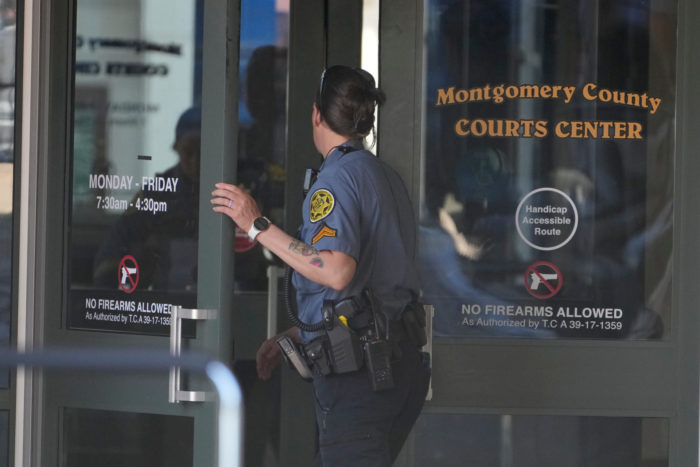
Dalton Eatherly, 28, is accused of shooting another person in the middle of the day on Wednesday outside the Montgomery County Courthouse during an altercation.
An affidavit filed with the arrest warrant says that Eatherly and the other man “engaged in a verbal altercation” at about 1:19 p.m. “During this verbal altercation, Mr. Eatherly turned his body in a bladed stance … and reached for his firearm located in his right jacket pocket. Thereafter, a physical altercation ensued.”
Eatherly fired, striking the other man multiple times. The man was taken by helicopter to a hospital in Nashville, where he underwent emergency surgery, according to the affidavit. Police have said the man was in stable condition after surgery. The hospital has declined to give out information about his condition, citing medical privacy laws.
The affidavit notes that there were “several innocent bystanders” outside the courthouse when Eatherly shot his gun. “Surveillance video of the incident shows a ricocheting projectile hitting nearby walls.” Audio recording and witness accounts of the shooting also indicate that Eatherly shot himself in the arm.
At an arraignment on Friday, prosecutors asked that he be held without bond until there can be a full hearing next week. Judge H. Reid Poland III declined that recommendation but set a high bond nonetheless, “based upon the fact of how many people were here in the courtyard or at the courthouse and the seriousness of these felonies.”
In addition to the attempted murder charge, Eatherly faces charges of employing a firearm during a dangerous felony, aggravated assault, and reckless endangerment with a deadly weapon.
Poland also noted that Eatherly had previously been released on bond in two other cases. He faces a harassment charge in Montgomery County from November. He was also charged last week in Nashville’s Davidson County with theft of services, disorderly conduct and resisting arrest.
An attorney who was appointed to represent Eatherly on the felony charges Friday, Jacob Fendley, did not return a phone call requesting comment.
Eatherly, who is white, posts videos to social media where he tries to provoke Black passersby by using racial slurs and racist dog whistles. Although police have not responded to questions about the race of the person he shot, a witness described him as Black.
Eatherly was being held in the Montgomery County jail on Friday, according to jail records. A full bond hearing is scheduled on May 21, and a preliminary hearing is scheduled for May 26.
(Headline USA) An Iraqi national accused of plotting at least 18 terror attacks in Europe in retaliation for the United States and Israel’s war with Iran, including firebombing a bank in Amsterdam and stabbing Jewish men in London, has been arrested and charged with supporting Iran-backed terrorist organizations.
According to a complaint unsealed Friday in federal court in Manhattan, Mohammad Baqer Saad Dawood Al-Saadi sought to attack a New York City synagogue last month and provided an undercover law enforcement officer with photos and maps of Jewish centers in Los Angeles and Scottsdale, Arizona, that he planned to target.
Al-Saadi is also accused of involvement in two recent attacks in Canada: an attack on a synagogue and a shooting at the U.S. consulate in Toronto in March. U.S. prosecutors said he directed and urged other people to attack U.S. and Israeli interests, including by killing Americans and Jews.
Al-Saadi posted about the attacks on Snapchat and Telegram and spoke about them in phone calls recorded by an FBI informant whose help he solicited in planning attacks in the U.S., the complaint said. Al-Saadi told the informant he was willing to kill people in any such attacks, the complaint said.
Al-Saadi, 32, is charged with conspiracy to provide material support to Kata’ib Hizballah, an Iran-backed Iraqi Shia militant group, and Iran’s Islamic Revolutionary Guard Corps, both of which have been designated by the U.S. government as foreign terrorist organizations. U.S. prosecutors said Al-Saadi was a Kata’ib Hizballah commander.
He is also charged with conspiring and providing material support for acts of terrorism and conspiring to bomb a place of public use.
FBI Director Kash Patel described Al-Saadi as a “high-value target responsible for mass global terrorism” and said his arrest was the product of “a righteous mission executed brilliantly” by the agency’s agents, investigators, tactical units and law enforcement partners.
New York City Police Commissioner Jessica Tisch, whose officers investigated Al-Saadi as part of the FBI’s Joint Terrorism Task Force, said the case “puts into stark relief the global threats posed by the Iranian regime and its proxies like Kata’ib Hizballah.”
Al-Saadi smiled throughout his initial court appearance but did not speak.
Through his lawyer, he called himself a political prisoner and a prisoner of war and said he is being persecuted by U.S. authorities for his relationship with Qasem Soleimani, the Revolutionary Guard leader who was killed in a U.S. drone strike in Baghdad in 2020.
Al-Saadi was not required to enter a plea. He will remain jailed but could request bail.
His lawyer, Andrew Dalack, said Al-Saadi was arrested in Turkey and turned over to U.S. authorities. In his statement, Patel thanked U.S. Ambassador to Turkey Tom Barrack, calling him “instrumental in bringing this successful mission home to the United States.”
Al-Saadi has been kept in solitary confinement since he arrived at a federal jail in Brooklyn on Thursday night, Dalack said, adding that such treatment was “unusual given the nature of charges in the complaint.”
According to the criminal complaint, Al-Saadi and unnamed associates planned, coordinated, and claimed responsibility for a barrage of attacks in the name of Harakat Ashab al-Yamin al-Islamiya, a component of Kata’ib Hizballah, since the war started on Feb. 28.
They include the bombing of a Bank of New York Mellon building in Amsterdam in mid-March and a thwarted bomb attack on a Bank of America office in Paris on March 28, the complaint said. Teenage suspects were previously arrested in both cases.
The Amsterdam attack caused a fire and significant damage to the building, but no injuries, according to local media reports. It followed an explosion outside a Jewish school in Amsterdam, which Al-Saadi celebrated on Snapchat with an Ashab al-Yamin-branded video showing the blast and the assailants fleeing on a motorcycle, the criminal complaint said.
In Paris, police found a homemade bomb consisting of a gasoline-filled container taped to a powerful firework. Forensic experts said the device contained 650 grams (about 23 ounces) of explosives and that it could have produced a large fireball and ignited a significant blaze.
Mind you, it’s not a thing that interests me in the least. But some people do eat gold.
The other day, I was doing a little headline search for gold stories, and I ran across a blog post on a site called Tita Italian. It’s a high-end food company that sells caviar, cured meats, and other delicacies.
The company also sells gold that you can eat.
But why?
Gold doesn’t add to the taste. But it is pretty. As the Tita Italian blog post explains, it’s all about plating and presentation.
“Food can tell a story. Use plating to create a visual narrative, letting your ingredients speak for themselves. Edible gold can be the finishing touch, adding a touch of luxury or symbolism.”
Now, I don’t know about you, but I don’t need my food to tell a story. I need it to fill my belly. However, some people are more concerned with aesthetics than I am. And by aesthetics, I mean showing people how much money they have.
My wife and I often joke that people blowing down the highway 20 or 30 mph over the speed limit have “ticket money.” We don’t. We also don’t have “eat gold” money. But as the saying goes, if you have it, flaunt it.
And some people do!
Tita Italian sells 23-karat edible gold in three forms: leaf, powder, and crumbs.
According to the blog post, “Edible gold isn’t just about opulence; it’s a subtle yet impactful way to add a touch of luxury and elegance to your culinary creations.”
In fact, there are people out there who consider gold-covered food “art.”
Keep in mind here, when I say art, I’m using air quotes. When you use air quotes, you can turn anything into art. Randomly throw paint at a canvas – “art.” Throw sticks in a pile – “art.” Pee in a cup – bingo – “art.”
Anyway, back in 2019, French artist and performer Frederique Lecerf put on the dinner as a performance art piece to “celebrate extravagance and exuberance.”
The menu was actually pretty pedestrian: chicken, hard-boiled eggs, and vegetable crisps. What made the meal special, and apparently qualified the dinner as “art,” was the fact that all the food was covered in gold. I’m talking real gold here. The 24-karat kind. There were even gold-covered pastries for dessert.
Now, don’t get me wrong; I love art. But I find the pretension in the art world a bit amusing. Lecerf said she has been putting on these golden dinners since about 2004. She told EuroNews, “She was interested in illustrating the transience of her art through the dinners since nothing remained the next day except the experience.”
Yes! That was exactly what I was thinking when I heard gold-covered dinner — said nobody ever.
And the curators of Vanities Gallery said the idea was to critique the gold market, but at the same time, to show the importance of the material in contemporary art.
What exactly is the critique here? I have no idea. That you can’t have your gold and eat it too? Haven’t they already proved that with cake?
Perhaps I’m being too harsh. Or maybe I just don’t get it. Nobody ever accused me of being sophisticated.
But I do understand the appeal of gold. If you want people to know you have wealth, showing off some gold is a good way to do it. People around the world recognize the value of gold. It is instantly recognized as money. And if you can afford to eat money, well, you’ve probably “made it!”
And consider this – you never hear about people eating dollar bills.
That said, I still have no plans to eat real money either. I’d rather hold on to my gold and allow it to preserve my wealth instead of flushing it down the toilet.
We can help with that.
Call 800-800-1865 and talk to a precious metals specialist today.
Mike Maharrey is a journalist and market analyst for Money Metals with over a decade of experience in precious metals. He holds a BS in accounting from the University of Kentucky and a BA in journalism from the University of South Florida.
(Headline USA) Two people inside a small plane were found dead Thursday after it crashed into a house in Ohio and exploded into flames, the Akron Fire Department said.
There were no immediate reports of injuries inside the home after the crash shortly before 4 p.m., the department said in a news release. The home and another house had to be evacuated.
The Federal Aviation Administration said in an email the plane was a Piper PA-28.
2 dead after plane crashes into home in the 2200 block of Canterbury Circle inside the Coventry Crossing development in Akron
AKRON, Ohio — Akron police confirmed that two people are dead after plane crashed into a home on Thursday afternoon.
— News Channel3 NOW (@channel3newsnow) May 14, 2026
Video circulating on X appeared to show a large plume of thick black smoke rising above a residential neighborhood after the crash. The aircraft itself is not visible in the footage, but flames can be seen at the base of the smoke as it rises into the sky above nearby homes.