(Headline USA) An Iraqi national accused of plotting at least 18 terror attacks in Europe in retaliation for the United States and Israel’s war with Iran, including firebombing a bank in Amsterdam and stabbing Jewish men in London, has been arrested and charged with supporting Iran-backed terrorist organizations.
According to a complaint unsealed Friday in federal court in Manhattan, Mohammad Baqer Saad Dawood Al-Saadi sought to attack a New York City synagogue last month and provided an undercover law enforcement officer with photos and maps of Jewish centers in Los Angeles and Scottsdale, Arizona, that he planned to target.
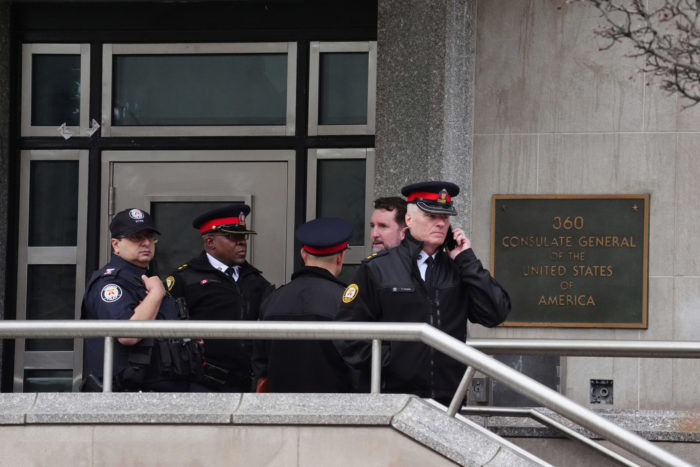
Al-Saadi is also accused of involvement in two recent attacks in Canada: an attack on a synagogue and a shooting at the U.S. consulate in Toronto in March. U.S. prosecutors said he directed and urged other people to attack U.S. and Israeli interests, including by killing Americans and Jews.
Al-Saadi posted about the attacks on Snapchat and Telegram and spoke about them in phone calls recorded by an FBI informant whose help he solicited in planning attacks in the U.S., the complaint said. Al-Saadi told the informant he was willing to kill people in any such attacks, the complaint said.
Al-Saadi, 32, is charged with conspiracy to provide material support to Kata’ib Hizballah, an Iran-backed Iraqi Shia militant group, and Iran’s Islamic Revolutionary Guard Corps, both of which have been designated by the U.S. government as foreign terrorist organizations. U.S. prosecutors said Al-Saadi was a Kata’ib Hizballah commander.
He is also charged with conspiring and providing material support for acts of terrorism and conspiring to bomb a place of public use.
FBI Director Kash Patel described Al-Saadi as a “high-value target responsible for mass global terrorism” and said his arrest was the product of “a righteous mission executed brilliantly” by the agency’s agents, investigators, tactical units and law enforcement partners.
New York City Police Commissioner Jessica Tisch, whose officers investigated Al-Saadi as part of the FBI’s Joint Terrorism Task Force, said the case “puts into stark relief the global threats posed by the Iranian regime and its proxies like Kata’ib Hizballah.”
Al-Saadi smiled throughout his initial court appearance but did not speak.
Through his lawyer, he called himself a political prisoner and a prisoner of war and said he is being persecuted by U.S. authorities for his relationship with Qasem Soleimani, the Revolutionary Guard leader who was killed in a U.S. drone strike in Baghdad in 2020.
Al-Saadi was not required to enter a plea. He will remain jailed but could request bail.
His lawyer, Andrew Dalack, said Al-Saadi was arrested in Turkey and turned over to U.S. authorities. In his statement, Patel thanked U.S. Ambassador to Turkey Tom Barrack, calling him “instrumental in bringing this successful mission home to the United States.”
Al-Saadi has been kept in solitary confinement since he arrived at a federal jail in Brooklyn on Thursday night, Dalack said, adding that such treatment was “unusual given the nature of charges in the complaint.”
According to the criminal complaint, Al-Saadi and unnamed associates planned, coordinated, and claimed responsibility for a barrage of attacks in the name of Harakat Ashab al-Yamin al-Islamiya, a component of Kata’ib Hizballah, since the war started on Feb. 28.
They include the bombing of a Bank of New York Mellon building in Amsterdam in mid-March and a thwarted bomb attack on a Bank of America office in Paris on March 28, the complaint said. Teenage suspects were previously arrested in both cases.
The Amsterdam attack caused a fire and significant damage to the building, but no injuries, according to local media reports. It followed an explosion outside a Jewish school in Amsterdam, which Al-Saadi celebrated on Snapchat with an Ashab al-Yamin-branded video showing the blast and the assailants fleeing on a motorcycle, the criminal complaint said.
In Paris, police found a homemade bomb consisting of a gasoline-filled container taped to a powerful firework. Forensic experts said the device contained 650 grams (about 23 ounces) of explosives and that it could have produced a large fireball and ignited a significant blaze.
Adapted from reporting by the Associated Press.