BREAKING: Black Marine Charged w/ Planning Mass Shooting against ‘Privileged White People’

(Ken Silva, Headline USA) The Justice Department announced Monday that a U.S. Marine was arrested Friday for transmitting via the internet a post containing threats to kill “privileged white people.”

Joshua Cobb, 23, of Trenton, New Jersey, was arrested and charged with one count of transmitting a threat in interstate and foreign commerce. He was scheduled to appear Monday afternoon in Trenton federal court.

Cobb was arrested for a post he made in December 2022, when he said he was planning a mass shooting against white people. He said at the time that he’d carry out his attack in 2023.

“The reason i specifically want to target white people is because as a black male, they will NEVER understand my struggles. Same way I will never understand their struggles, but I don’t care to. I want to erase them. All of them really, but in this case as many as I possibly can,” Cobb allegedly said at the time.

“It is going to take place in 2023 in the state of New Jersey, I have not chosen a exact date but I am going to be sure it is close to an important holiday to their race.”

Cobb joined the U.S. Marine Corps in 2023 and began basic training in June 2023. Around that time, he continued to make violent social media posts, including ones suggesting that he’s a psychopath—such as when he posted about killing cats last May.

“My favorite weapon to kill them with is my crossbow. I use broadhead tips and send it straight to through their brains,” Cobb said. “Last cat I got hit him/her right in the eye and that shit was on the floor. Very bloody scene and I loved it. I dont take pictures with my phone but the images remain in my brain.”

Cobb also disclosed that he likely has schizophrenia, posting that many in his family have been diagnosed with the mental illness.

The FBI interviewed Cobb about his violent posts in April. Cobb admitted to his anti-white fantasies, and provided more information about the attack he plotted.

“There was one grocery store, pretty sure it was Aldi’s, it was in Robbinsville which is a very nice place in Jersey… Same thing as Payton [Gendron] did, just pop out type deal,” he said, referencing the Buffalo mass shooter.

Cobb also reportedly told the FBI he was a fan of Gendron—a white supremacist—as well as Parkland mass shooter Nikolas Cruz.

When the FBI informed Cobb that agents were seizing his phone after the interview, Cobb reportedly became irate, telling them, “these are the things that make someone want to do the things we talked about.”

Cobb has also been discharged from the Marines.

The charge of transmitting a threat in interstate and foreign commerce is punishable by a maximum penalty of five years in prison and a $250,000 fine.

Ken Silva is a staff writer at Headline USA. Follow him at twitter.com/jd_cashless.

Report: Pentagon Orders Withdrawal from Niger

(Ken Silva, Headline USA) After shocking U.S. Army whistleblower allegations of water and medicine shortages in Niger, the Pentagon has ordered the roughly 1,000 U.S. troops in that country to leave over the next several months, according to Politico.

Citing an anonymous U.S. official, Politico reported Friday that Troops will move to other locations within the region. However, Chad has also recently moved to expel U.S. troops as much of Africa grows closer to Russia and China.

“The timeline could still shift, the official cautioned, and congressional negotiations are ongoing,” Politico cautioned. “The drawdown — which could still be reversed until it is complete — does not include embassy security personnel.”

The withdrawal means U.S. will  have to close its six-year-old, $110 million U.S. air base that was used for drone warfare. Rep. Matt Gaetz, whose office investigated the whistleblower complaints, expressed concern about how the Biden administration will handle with withdrawal.

“I fear the administration will handle this withdrawal similarly to the withdrawal from Afghanistan,” Gaetz said on Twitter. “The safety and security of all service members must be our top priority in this time of transition.”

Gaetz released more information about the deteriorating situation in Niger last week.

The situation in Niger stems from the country’s government declaring in March that the U.S. military presence there is “illegal.” In a letter published last month by the Washington Post, an Army whistleblower accused Biden of endangering the troops’ lives by leaving them there against the wishes of the country’s new government.

“Americans deployed here have not been able to perform their primary mission and have been told to ‘sit and hold.’ It is clear that the country of Niger does not want a permanent military presence in the country and they have informed us that we need to leave,” the whistleblower said.

“At the same time, there are approximately 1,100 US Military Service Members in the country who are essentially being held hostage from returning home to their families while the State Department continues with failed diplomacy by not communicating with the country of Niger on what their withdrawal plans will look like.”

According to the whistleblower, the troops in Niger can’t leave because the government isn’t approving visas for the new troops that would replace them.

Ken Silva is a staff writer at Headline USA. Follow him at twitter.com/jd_cashless.

Guard at Ghislaine Maxwell’s Prison Indicted for Having Sex w/ Inmate

(Ken Silva, Headline USA) A guard at the federal correctional institution in Tallahassee—where notorious sex trafficker Ghislaine Maxwell is serving her sentence—has been charged with having sexual acts with an inmate.

An indictment unsealed Thursday alleges that, between June 2023, and August 2023, Kerontrez Lamar Kenon, 22, of Midway, Florida, engaged in sexual acts with an inmate while employed as a correctional officer for the Federal Bureau of Prisons. The indictment doesn’t identify the inmate.

If convicted, Kenon faces a maximum penalty of 15 years in prison.

The Justice Department’s Office of the Inspector General and FBI investigated the case.

The indictment against Kenon underscores a report from Justice Department’s Office of the Inspector General about the unsanitary conditions at Tallahassee FCI. That report found “black filth smeared on walls, rodent infestations, and sanitary products being used to plug leaks in dilapidated living quarters are a few of the issues recorded” at the facility.

The DOJ-IG report, which labeled Tallahassee FCI as “high risk,” also flagged the prison for its policies on transgender inmates. The report found that staff “misgendered” its roughly 119 transgender inmates, which marks the largest number of any Bureau of Prisons institution.

While Tallahassee FCI appears to be a hellhole for most inmates, Maxwell is likely spared from the worse of its conditions.

Recently, Maxwell was moved to the “honor dorm” of a low-security prison in Tallahassee, according to a report in the Daily Mail.

“Maxwell’s cushy new digs in D South – the so-called ‘honor dorm’ – are reserved for 30 to 40 of the low-security Florida lockup’s best-behaved prisoners,” the Daily Mail reported in March.

“There are two bunks per cell but so few occupants that the disgraced British socialite, 62, is almost guaranteed to have her own room as well as four times the storage.”

Meanwhile, Maxwell has an appeal pending in her case, as her lawyers contest her conviction on five charges of recruiting and grooming four underage girls for Jeffrey Epstein to abuse between 1994 and 2004.

Maxwell’s lawyers reportedly told New York’s Second Circuit appeals court this week that she should not have been prosecuted for grooming Epstein’s victims because of a provision in his 2008 sweetheart plea deal, according to the Daily Mail.

Ken Silva is a staff writer at Headline USA. Follow him at twitter.com/jd_cashless.

U.S. Government Ran Big Surplus in April But Don’t Get Excited

(Mike Maharrey, Money Metals News Service) The U.S. government ran a rare surplus in April, but don’t get too excited. The Biden administration hasn’t slowed down the spending train, and more budget shortfalls loom on the horizon. 

The Biden administration ran a $209.5 billion surplus in April thanks to an influx of revenue as people filed their tax returns.

Tax receipts came in at $776.2 billion in April, a 22 percent increase over last year, according to the April Monthly Treasury Statement.

The surge in revenue pushed the fiscal 2024 deficit back under $1 trillion ($855.2 billion), but the reprieve won’t last. Even with the tax receipt boot, the Biden administration is on track for a $1.5 trillion deficit. 

Even with the drop in the 2024 deficit, NPR called it “remarkably large” given the (alleged) strength of the economy.

Analysts say the influx of tax receipts was due to the “strong labor market” and wage growth.

In reality, it was due to price inflation.

Inflation raises wages along with consumer prices. (After all, a wage is nothing more than the price of labor.) But rising wages have not kept pace with spiking prices, and higher prices have forced many people to take on second jobs, juicing the labor market.

In other words, the U.S. Treasury managed to turn price inflation into a windfall.

Meanwhile, the spending freight train continued to hurtle down the track and breakneck speed. 

Government outlays were up by 23 percent over a year ago, as the Biden administration blew through $566.7 billion in April.

Through the first seven months of fiscal 2024, the federal government has spent a staggering $3.82 trillion.

Spending continues to increase despite the [pretend] spending cuts and promises from the Biden administration that it would save “hundreds of billions” with the debt ceiling deal (aka the [misnamed] Fiscal Responsibility Act.)

This reveals the ugly truth in Washington D.C. No matter what you hear about spending cuts, the federal government always finds new reasons to spend more and more money.

I should note that this problem isn’t specific to Biden or Democrats in general. The Trump administration was running $1 trillion deficits before the pandemic. In other words, Trump was generating Obamaesque deficits despite having what he claimed was the strongest economy in history. 

Borrowing and spending is a bipartisan sport. 

These massive monthly budget shortfalls are pushing the national debt higher at a dizzying pace. On December 29, the national debt eclipsed $34 trillion for the first time. When Congress effectively eliminated the debt ceiling on June 5, the national debt stood at a “mere” $31.46 trillion. As of May 13, the national debt stood at over $34.5 trillion. 

The debt to GDP ratio has risen to over 122 percent. And yet virtually nobody in either major political party shows any interest in reining in the spending. In fact, both parties keep pushing to spend more money to expand both the welfare and warfare state.

The Elephant in the Room

Meanwhile, a giant elephant is standing in the kitchen. The borrowing and spending are unsustainable in this higher interest rate environment.

With price inflation still running hot, the Federal Reserve has dampened expectations of rate cuts in the near future. But the ugly truth is the federal government is going to have a hard time maintaining the pace of borrowing with rates this high. (And from a historical perspective, they aren’t even all that high.)

The U.S. government spent $102.4 billion on interest expenses alone in April. This was more than the amount spent on national defense ($64 billion) and more than Medicare ($74 billion). The only spending category higher than interest expense was Social Security. 

The government has shelled out $624.5 billion on interest payments so far in fiscal 2024. That’s a 35.7 percent increase over the same period in fiscal 2023. Again, the only category with higher spending was Social Security.

Net interest expense, excluding intragovernmental transfers to trust funds, was $514 billion through the six months of the fiscal year. Net interest expense for the year has now eclipsed the outlays for national defense ($415 billion) and Medicare ($465 billion).

To put this into a different perspective, the federal government is spending over 1/3 of its tax receipts on interest expense alone.

And interest expenses will only continue to climb.

Much of the debt currently on the books was financed at very low rates before the Federal Reserve started its hiking cycle. Every month, some of that super-low-yielding paper matures and has to be replaced by bonds yielding much higher rates.

The weighted average interest rate on the government’s outstanding Treasury securities rose to 3.3 percent as of the end of March. That compares with a weighted average rate of 2.7 percent in May 2023. 

The only way out of this fiscal death spiral is significant spending cuts and/or major tax hikes. I wouldn’t hold my breath.


Mike Maharrey is a journalist and market analyst for MoneyMetals.com with over a decade of experience in precious metals. He holds a BS in accounting from the University of Kentucky and a BA in journalism from the University of South Florida.

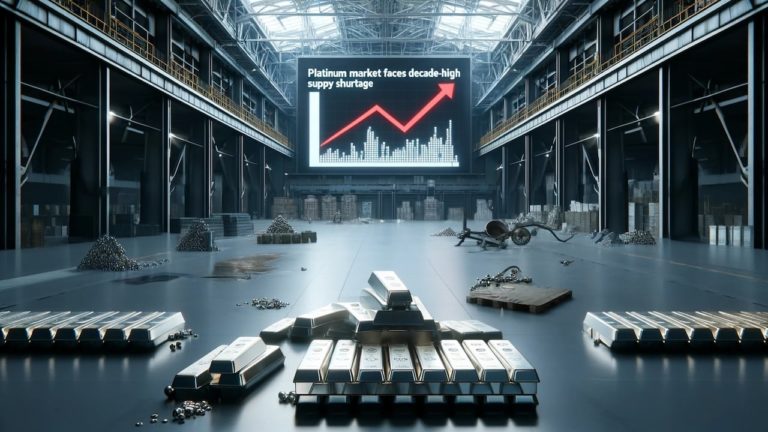
Platinum Market Faces Decade-High Supply Shortage

(Mike Maharrey, Money Metals News Service) I’ve written extensively about supply shortfalls in the silver market. Silver demand outstripped the supply of the metal for the third straight year in 2023.  But silver isn’t the only metal facing market deficits. Analysts expect the platinum market to chart its largest shortfall in a decade in 2024.

Platinum doesn’t get the same attention in investment circles as gold and silver, but the precious metal can serve a role in a broader wealth preservation and growth strategy. Investors comfortable with platinum’s more speculative nature can use it to diversify a portion of their precious metal portfolio. 

Platinum is rarer than gold by a 30 to 1 ratio. The metal is so rare that all the platinum ever mined could fit into a storage room measuring 25 feet by 25 feet.

Like silver, platinum is a multi-use metal.

Most platinum is used in industrial applications with the automobile industry consuming the lion’s share. The metal is an important component in catalytic converters. It is also used in the production of some chemicals, in electronic applications, and in the green energy sector. For instance, platinum-based glass fibers are used to minimize the weight of wind turbine rotor blades.

About 20 percent of the platinum supply is used in jewelry fabrication. Investment demand accounts for the rest of the annual offtake.

According to Johnson Matthey, a catalytic converter manufacturer, the platinum market deficit will grow to 598,000 ounces in 2024. Last year, there was a 518,000-ounce supply shortfall.

According to the World Platinum Investment Council (WPIC), the total platinum supply in the first quarter of 2024 was at the second-lowest level since the organization began compiling data.

Meanwhile, automotive industry demand for the metal hit a seven-year high. The auto sector consumed 832,000 ounces of platinum in Q1. The WPIC projects automotive platinum demand to grow by 2 percent to around 3.3 million ounces this year.

Platinum jewelry demand and investment demand are both expected to also grow in 2024.

The WPIC has raised its market deficit projection to 476,000 ounces.

“For the second consecutive year, the platinum market will post a meaningful deficit underscored by platinum’s sustained demand and supply vulnerability amidst global economic challenges,” WPIC CEO Trevor Raymond said.

These supply and demand dynamics could signal a buying opportunity for investors. The platinum price has been flat just under $1,000 an ounce for nearly a year. Generally, sticky price inflation coupled with a supply shortfall could help drive the price of platinum higher.  

Money Metals features a number of platinum products including mint coins, bars, and jewelry.


Mike Maharrey is a journalist and market analyst for MoneyMetals.com with over a decade of experience in precious metals. He holds a BS in accounting from the University of Kentucky and a BA in journalism from the University of South Florida.

Will the United States Become the Next Argentina?

(Stefan Gleason, Money Metals News Service) Let’s give credit where credit is due. Facing down a record-high budget deficit and an entrenched inflation problem, the government is finally embracing fiscal responsibility in a significant way.

Thanks to sweeping spending cuts enacted this year, the government has posted three consecutive monthly budget surpluses – leading to a reduction in money supply growth and a marked lessening of inflation pressures.

This hopeful state of affairs doesn’t apply to the government of the United States, of course. It describes what the government of Argentina is achieving under its new president, Javier Milei.

The free-market economist turned politician had campaigned with a chainsaw in hand, vowing to cut government bureaucracy and bring down Argentina’s triple-digit inflation rate.

The media dismissed him as an eccentric protest candidate. Then when he shocked everyone by winning the election decisively, the media said he couldn’t or wouldn’t actually follow through on his bold campaign promises.

Rare is the politician who does.

But after just a few months in office, Milei has actually abolished dozens of agencies and fired thousands of state bureaucrats. He has slashed government bureaucracy by as much as 50%.

Milei has declared there will simply be no more deficit spending in Argentina: “Zero deficit isn’t just a marketing slogan for this government, it is a commandment.”

Conquering inflation remains a work in progress. After decades of rule by socialist politicians who promised endless streams of benefits that were never fully paid for, Argentina’s economy was careening toward ruinous hyperinflation.

Last month, the monthly inflation rate in Argentina fell below 10% for the first time in years.

The official inflation rate in the United States has never reached Argentinean proportions. But its spiraling debt is starting to draw comparisons to countries that have seen their currencies and economies collapse due to reckless fiscal and monetary policy.

Washington, D.C. has been warned over and over again that it needs to change its spending habits. U.S. government debt has been downgraded twice by major credit ratings agencies. Its own central bank has called its fiscal path “unsustainable.”

The Congressional Budget Office, Social Security and Medicare trustees, and other independent watchdogs within the government itself have also sounded alarms.

All to no avail.

Now the International Monetary Fund is warning that unsustainable growth in U.S. government debt – which is projected to soar from $34 trillion to $46 trillion within a decade – poses a threat to the global financial system.

Meanwhile, Congress has just refused to even consider the recommendations of a bipartisan commission on tackling the debt.

Legislators have decided that they don’t want to be told they are spending too much money they don’t have and are promising too many people too many benefits that cannot be paid.

It seems clear at this point that politicians will not act to avert a crisis. They will only act in response to one when they have no other alternative.

For a brief period in the late 1990s, it appeared as though federal finances were on a sustainable path. Republicans in Congress pushed hard to balance the budget. And President Bill Clinton famously declared, “The era of big government is over.”

The era of big government wasn’t over, of course. It continued to grow year after year regardless of which party controlled the levers of power in any given year. And despite former President Donald Trump’s vows to “drain the swamp,” the D.C. swamp is now bigger and murkier than ever.

Nobody in Washington even talks seriously about balancing the budget anymore.

For decades, fiscal conservatives have been trying to axe funding to the National Endowment for the Arts and the Corporation for Public Broadcasting.

Cutting these non-essential programs wouldn’t balance the budget, obviously. But the fact that they seem to be untouchable even though they are unaffordable symbolizes the broader failure of U.S. fiscal policy.

By contrast, Argentina’s Javier Milei wasted no time in cutting off funds to state-sponsored media outlets.

Will the United States become the next Argentina? It’s looking like the U.S. will have to experience a much worse inflation problem before the government feels compelled to change course. Things will likely have to get worse before they get better.


Stefan Gleason is CEO of Money Metals Exchange, the company recently named “Best Overall Online Precious Metals Dealer” by Investopedia. A graduate of the University of Florida, Gleason is a seasoned business leader, investor, political strategist, and grassroots activist. Gleason has frequently appeared on national television networks such as CNN, FoxNews, and CNBC and in hundreds of publications such as the Wall Street Journal, TheStreet, and Seeking Alpha.

White House Proposes New Taxes as Inflation Rages

(Mike Gleason, Money Metals News Service) As inflation continues to put the squeeze on consumers, precious metals markets are back on the move.

A solid close above the $2,400 level should set the stage for another push to new record highs. We’ll see if that is in the cards in the days ahead as it appears the yellow metal may be on the verge of making a run back to $2,400 as we speak.

Turning to the white metals, silver is posting big gains. Silver is not too far away from breaking out to a fresh 11-year high with a move above the $29 level.  Although platinum hasn’t done much over the past few years, it may have quietly carved out a major bottom after becoming historically cheap versus gold. 

Like silver, platinum is expected to run a large supply deficit this year. Metals firm Johnson Matthey is forecasting a physical platinum shortfall of nearly 600,000 ounces in 2024. That would be the biggest such deficit in 10 years. 

Although falling automotive demand has weighed on platinum prices in recent years, supply is now shrinking faster. Other industrial sources of demand are stable or rising, and investment demand has the potential to increase markedly.  

With gold commanding headlines this spring for hitting new records, more mainstream investors are waking up to the advantages of owning hard assets for wealth protection. But some are understandably wary of buying gold at a lofty price in nominal terms.  

Platinum serves as a viable alternative for bargain hunters. And of course, historically, platinum has often traded at a premium to gold. So being able to obtain it today at a discount of better than $1,300 per ounce is an opportunity that may not last forever.

Although platinum bullion products are more limited in quantity and variety compared to gold, investors can obtain platinum in the form of familiar American Eagles and a few other officially minted coins as well as investment-grade bars and even wearable bullion jewelry. 

In addition to protecting investors from currency depreciation, hard money in the form of bullion can also help protect investors from the corrosive effects of taxation. 

Realized gains on precious metals aren’t tax exempt, of course. But unlike interest-bearing assets, bullion generates no income tax liabilities unless and until it is actually sold at a profit. 

President Joe Biden is now threatening to raise tax rates and impose new taxes on investors in order to fund his massive $7.3 trillion budget wish list. Under Biden’s plan, high earners could pay an effective rate of more than 50% on their investment income.

Some members of Congress are fighting back – specifically on behalf of precious metals investors. U.S. Representative Alex Mooney of West Virginia recently re-introduced sound money legislation to remove all federal income taxation from gold and silver coins and bullion.

His Monetary Metals Tax Neutrality Act is backed by the Sound Money Defense League, Money Metals Exchange, and free-market activists. It would clarify that the sale or exchange of precious metals bullion and coins are not to be included in capital gains, losses, or any other type of federal income calculation. 

Gold, silver, platinum, and palladium would be treated the same as U.S. fiat currency for tax purposes, meaning exchanging one form of money for the other would trigger no tax liabilities.

Gains on monetary metals are currently subject to a discriminatory long-term “collectibles” tax rate of 28%. Acting unilaterally, Internal Revenue Service bureaucrats have placed gold and silver in the same category as artwork, Beanie Babies, and baseball cards.

Sound money activists have long pointed out it is inappropriate to apply any federal income tax, regardless of the rate, against the only kind of money named in the U.S. Constitution. And the IRS has never defended how its position squares up with current law.

The Monetary Metals Tax Neutrality Act aligns with a broader national trend. With most states having already eliminated sales tax on the purchase of precious metals, state legislatures are increasingly introducing and approving measures to eliminate state income taxation of gold and silver.

Alabama and Nebraska each passed their version of this policy this year. Arizona, Arkansas, and Utah approved similar measures in recent years. And Iowa, Georgia, Oklahoma, Missouri, and Kansas also considered income tax exemptions in 2024, with several approving the bill across multiple committees and chambers.

In the meantime, investors who wish to legally shield bullion transactions from federal income taxes for as long as possible should consider holding eligible coins, rounds, and bars within an IRA.  


Mike Gleason is a Director with Money Metals Exchange, a precious metals dealer recently named “Best in the USA” by an independent global ratings group. Gleason is a hard money advocate and a strong proponent of personal liberty, limited government and the Austrian School of Economics. A graduate of the University of Florida, Gleason has extensive experience in management, sales and logistics as well as precious metals investing. He also puts his longtime broadcasting background to good use, hosting a weekly precious metals podcast since 2011, a program listened to by tens of thousands each week.

The Resurgence of Gold and Silver as Legal Tender: An Interview with Jp Cortez on Kitco News

(Money Metals News Service) In a recent episode of Kitco News, host Jeremy Szafron spoke with Jp Cortez, Executive Director of the Sound Money Defense League, about the resurgence of gold and silver as legal tender in the United States.

This initiative, led by Sound Money Defense League and Money Metals Exchange, is deeply rooted in the U.S. Constitution which originally recognized gold and silver coins as the official form of money specifically in Article 1, Section 10.

The Push for Constitutional Revival

Cortez discussed the constitutional revival underway across several states, aiming to eliminate taxes on precious metals and reintroduce them into daily transactions. This movement directly challenges the dominance of paper currency and the Federal Reserve’s control over economic stability.

Cortez emphasized that reintroducing sound money—currency that maintains its value over time—is crucial for long-term economic planning and societal growth.

Sound money also serves as a constraint on government spending, limiting the federal government’s ability to fund unnecessary projects and wars through unchecked money printing.

Historical Context and Current Initiatives

Cortez pointed out that the shift from a gold standard to a debt standard has led to substantial increases in government size, spending, and deficits. He argued that the Federal Reserve’s policies since 1971, when President Nixon closed the gold window, have contributed to financial instability, including inflation, which significantly affects the affordability of housing, food, and medicine.

On the state level, significant progress has been made to mitigate these issues by repealing sales and capital gains taxes on precious metals. Cortez highlighted that more than 45 states have removed sales taxes on gold and silver, and 33 states have eliminated capital gains taxes on these metals. This legislative trend is reducing the financial barriers to using gold and silver as money.

Addressing Federal and State-Level Changes

While states are making strides, Cortez noted that the most substantial impediments come from federal taxation. Discussions are ongoing at the federal level to eliminate these taxes, with recent initiatives including legislation reintroduced by Congressman Alex Mooney to end federal income taxation on gold and silver.

Practical Implications and the Future

Cortez also discussed practical aspects, such as the impact of Gresham’s Law, which might deter people from using gold and silver as money if devaluing fiat currency is still accepted. He advocated for innovation in the monetary system, including developments in digital and fractional gold, which could enhance the usability of gold and silver in everyday transactions.

Looking Ahead

The interview concluded with Cortez expressing optimism about the ongoing state and potential federal legislative changes, reiterating the importance of gold and silver in ensuring economic stability and constraining government excesses. He stressed the need for continued advocacy and education to promote the adoption of sound money principles across the United States.

This discussion on Kitco News not only sheds light on the significant legislative changes concerning gold and silver but also highlights the broader implications of these changes on the U.S. economy and individual financial stability.

Key Questions and Answers

Here are the key questions and answers from the interview between Jeremy Szafron and Jp Cortez on Kitco News:

Why is stable, sound money critical for economic stability?

Sound money ensures long-term value preservation, crucial for planning and infrastructure development. It constrains government spending by preventing unrestrained money printing, which can fund unnecessary projects or wars.

What federal policies and Federal Reserve actions impact economic stability?

The Federal Reserve’s ability to print money often leads to decisions that many might not support financially, such as wasteful projects and unnecessary military engagements. The shift from a gold standard to a debt standard has significantly expanded government size and spending, contributing to inflation and economic instability.

How do state-level initiatives impact the use of gold and silver as money?

States are repealing sales and capital gains taxes on gold and silver, which are major barriers to their use as money. By reducing these taxes, states make it easier for these metals to be used in daily transactions, encouraging their reintegration into the financial system.

How can too rigid a focus on sound money impact economic flexibility?

While acknowledging that there are trade-offs between a fiat system and a gold standard, Cortez argues that the benefits of a stable monetary base outweigh the potential constraints on monetary policy like quantitative easing.

How effective are state-level initiatives in influencing national monetary policy?

State-level actions are proving effective and are even inspiring federal legislative proposals. These efforts help reduce the barriers to using gold and silver as money and stimulate discussion and potential changes at the national level.

Long-term, reintroducing gold and silver as legal tender will provide a stable alternative to fiat currency, potentially reducing inflation and enhancing economic stability. It could also lead to innovations in how money is used and perceived in the economy.

Sound Money Defense League Highlights:

  1. Elimination of Sales Taxes on Precious Metals: Cortez noted that over 45 states have now removed sales taxes on gold and silver, which significantly lowers the barriers to using these metals as money. This legislative change makes it more feasible for individuals to purchase and use precious metals without the burden of additional costs imposed by sales taxes.
  2. Repeal of Capital Gains Taxes on Precious Metals: According to Cortez, 33 states have eliminated capital gains taxes on the sale of gold and silver. This removal encourages investment in precious metals, as individuals are no longer penalized with a tax on the gains they realize from these investments, making it more attractive as a long-term store of value.
  3. Investment in Physical Gold and Silver by States: Some states have passed legislation that allows state treasurers to invest in physical gold and silver. This not only backs the state’s financial reserves with tangible assets but also reinforces the role of precious metals in contemporary financial systems.
  4. Promoting Legislative Changes at the Federal Level: The actions and successes at the state level have inspired and propelled movements at the federal level, including legislation proposed to end federal income taxation on gold and silver. This national-level advocacy is part of a broader push to reestablish gold and silver as central elements of America’s monetary system.
  5. Educational and Advocacy Efforts: Beyond legislative achievements, the Sound Money Defense League plays a crucial role in educating the public and policymakers about the benefits of sound money. Their efforts help foster a broader understanding and acceptance of gold and silver as viable and stable money.

These accomplishments reflect the organization’s commitment to restoring gold and silver as recognized legal tender, aligning with constitutional principles and aiming to stabilize and secure the economic future.

Report: Biological Male Represented by ACLU Rapes Inmate in Female Prison

(Ken Silva, Headline USA) “I am a woman, and I do not belong in a men’s prison … I am not a threat to [female inmates],” biological male prisoner Tremayne Carroll said in a May 9, 2022, sworn declaration—backed by the ACLU—seeking to stay in a female facility.

But Carroll was a threat to female inmates. According to a report in 4W, Carroll has been charged with raping an inmate in a shower at Central California Women’s Facility.

“According to charges filed by the Madera County District Attorney’s office—which includes enhancements because Tremaine has prior sex offenses—there was at least one other victim at the prison besides Natalie,” 4W reported Saturday.

The Transgender Law Center and ACLU of Southern California, which are representing Carroll in the case, reportedly have been silent on the matter.

4W, a “fourth-wave” feminist publication, reported that 50% of trans inmates in female federal prisons are sex offenders. According to Amie Ichikawa, executive director of Woman II Woman, there are now 16 pregnant women housed at one facility alone.

“I wish I could say that Tremaine was abusing SB132/TRADA or that it’s being taken advantage of in some way, but I can’t,” Ichikawa said. “The law is being used exactly the way its author intended it to be: without guardrails and with complete disregard to the safety and well-being of women.”

Meanwhile, groups like the ACLU continue to push to have more dangerous biological males transferred to female facilities.

For instance, the ACLU is supporting the lawsuit of a biological male who murdered a baby, who now goes by the name “Autumn Cordellionè” and  who identifies as an “Islamic-practicing transwoman.” That lawsuit seeks to block an Indiana law  banning prisoners from receiving sexual reassignment surgery.

The inmate and the ACLU seek to have a federal court declare that Indiana’s law is unconstitutional, as well as an order for the inmate to receive a sex change.

Ken Silva is a staff writer at Headline USA. Follow him at twitter.com/jd_cashless.

Meet the Little Chinese Car Threatening a ‘Bloodbath’ for U.S. Auto Industry

(Headline USA) A tiny, low-priced electric car called the Seagull has American automakers and politicians trembling.

The car, launched last year by Chinese automaker BYD, sells for around $12,000 in China, but drives well and is put together with craftsmanship that rivals U.S.-made electric vehicles that cost three times as much. A shorter-range version costs under $10,000.

Tariffs on imported Chinese vehicles probably will keep the Seagull away from America’s shores for now, and it likely would sell for more than 12 grand if imported.

But the rapid emergence of low-priced EVs from China could shake up the global auto industry in ways not seen since Japanese makers exploded on the scene during the oil crises of the 1970s.

“Any car company that’s not paying attention to them as a competitor is going to be lost when they hit their market,” said Sam Fiorani, a vice president at AutoForecast Solutions near Philadelphia. “BYD’s entry into the U.S. market isn’t an if. It’s a when.”

BYD, which stands for “Build Your Dreams,” could be a nightmare for the U.S. auto industry validating GOP presumptive nominee Donald Trump’s warning at a rally that its arrival in Mexico, if investors like Warren Buffett continue to support its manufacture across the border, could be a “bloodbath” for the U.S. auto industry.

Although Trump’s comment was widely misreported to signal political violence, the bloodbath might result in Mexico’s manufacturing of the affordable automobile—thus stealing business and labor from U.S. companies—as well as the ongoing border crisis that has led to several high-profile violent crimes and traffic fatalities at the hands of illegal immigrants.

Manufacturers and U.S. politicians on both sides of the aisle already see Chinese EVs as a serious threat. The Biden administration on Tuesday is expected to announce 100% tariffs on electric vehicles imported from China, saying they pose a threat to U.S. jobs and national security.

The Alliance for American Manufacturing says in a paper that government subsidized Chinese EVs “could end up being an extinction-level event for the U.S. auto sector.”

Earlier this year, Tesla CEO Elon Musk told industry analysts Chinese EVs are so good that without trade barriers, “they will pretty much demolish most other car companies in the world.”

Outside of China, EVs are often pricey, aimed at a higher-income niche market. But Chinese brands that are not yet global household names are offering affordable options that will appeal to the masses—just as the U.S., European and many other governments are encouraging a shift away from gasoline-powered vehicles to fight greenhouse gas emissions.

“The Western markets did not democratize EVs. They gentrified EVs,” said Bill Russo, the founder of the Automobility Ltd. consultancy in Shanghai.

“And when you gentrify, you limit the size of the market,” he continued. “China is all about democratizing EVs, and that’s what will ultimately lead Chinese companies to be successful as they go global.”

Inside a huge garage in an industrial area west of Detroit, a company called Caresoft Global tore apart and reassembled a bright green Seagull that its China office purchased and shipped to the U.S.

Company President Terry Woychowski, a former chief engineer on General Motors’s big pickup trucks, said the car is a “clarion call” for the U.S. auto industry, which is years behind China in designing low-cost EVs.

After the teardown, Woychowski, who has been in the auto business for 45 years, said he was left wondering if U.S. automakers can adjust. “Things will have to change in some radical ways in order to be able to compete,” he said.

There’s no single miracle that explains how BYD can manufacture the Seagull for so little. Instead, Woychowski said the entire car, which can go 252 miles per charge, is “an exercise in efficiency.”

Higher U.S. labor costs are a part of the equation. BYD can keep costs down because of its expertise in making batteries—largely for consumer products—that use lithium iron phosphate chemistry. They cost less but have lower range than most current lithium-ion batteries.

Americans are still learning how to make cheaper batteries, Woychowski said. Ford is building a lithium iron phosphate battery factory, using technology from China’s CATL.

BYD makes many of its own parts, including electric motors, dashboards, bodies and even headlights. It also has the advantage of its huge scale—3 million vehicles sold worldwide last year.

“By having that all in-house and vertically integrated, there’s an incredible advantage that they have,” Woychowski said.

BYD designs all aspects of its vehicles with cost and efficiency in mind. For instance, the Seagull has only one windshield wiper, eliminating one motor and one arm, saving on weight, cost and labor to install.

U.S. automakers don’t often design vehicles this way and incur excess engineering costs, Woychowski said. Hoses, for instance, have to meet longstanding requirements in combustion engines for strength and ability to carry fluid under high pressure, many of which aren’t needed for electric vehicles, he added.

The weight savings add up, allowing the Seagull to travel farther per charge on a smaller battery. For example, the Seagull that Caresoft tested weighs 2,734 pounds, about 900 pounds less than a Chevrolet Bolt, a slightly larger electric vehicle made by GM.

So Detroit needs to quickly re-learn a lot of design and engineering to keep up while shedding practices from a century of building vehicles. The trick will be determining which procedures to keep for safety and quality, and which to jettison because they aren’t needed, he said.

“You’re going to have to come and be extremely serious about this, and you better park your paradigms at the door,” Woychowski said. “Because you’re going to have to do things differently.”

Even with its minimalist design, the Seagull still has a quality feel. The doors close solidly. The gray synthetic leather seats have stitching that matches the body color, a feature usually found in more expensive cars. The Seagull “Flying Edition” tested by Caresoft has six air bags, rear disc brakes and electronic stability control.

A brief drive through some connected parking lots by a reporter showed that it runs quietly and handles curves and bumps as well as more costly electric vehicles.

While the acceleration isn’t head-snapping like other EVs, the Seagull is peppy and would have no problems entering a freeway in heavy traffic. Woychowski says its top speed is limited to 81 mph.

BYD would have to modify its cars to meet U.S. safety standards, which are more stringent than in China. Woychowski says Caresoft hasn’t done crash tests, but he estimated that would add $2,000 to the Seagull’s cost.

BYD sells the Seagull, rebranded as the Dolphin Mini in some overseas markets, in four Latin American countries for about $21,000, twice what it costs at home. The higher price includes transportation costs, but also reflects the higher profits possible in less cutthroat markets than China.

In Europe, BYD offers larger models such as the Seal, which starts at 46,990 euros ($50,000), in France. The Chinese maker’s top two overseas markets were Thailand and Brazil in the first two months of this year, according to the China Passenger Car Association.

BYD builds electric buses in California and told the AP last year that it is “still in the process” of deciding whether to sell autos in the U.S. It is weighing sites for a factory in Mexico, but that would be for the Mexican market, two company executives said in media interviews earlier this year.

The company isn’t selling cars in the U.S., largely due to 27.5% tariffs on the sale price of Chinese vehicles when they arrive at ports. Donald Trump slapped on the bulk of the tariff, 25%, when he was president, and it was kept in place under Joe Biden. Trump contends that the rise of EVs backed by Biden will cost U.S. factory jobs, sending the work to China.

The Biden administration has backed legislation and policies to build a U.S. EV manufacturing base, and it hasn’t ruled out further tariffs to keep the Chinese out. The administration also is investigating cars made in China that can gather sensitive information.

Some members of Congress are urging Biden to ban imports of Chinese vehicles, while others have proposed even steeper tariffs. This includes vehicles made in Mexico by Chinese companies that now would come in largely without tariffs.

Ford CEO Jim Farley has seen Caresoft’s work on the Seagull and observed BYD’s rapid growth across the globe, especially in Europe, where he used to run Ford’s operations. He’s moving to change his company. A small “skunkworks” team is designing a new, small EV from the ground up to keep costs down and quality high, he told analysts earlier this year.

Chinese makers, Farley said, sold almost no EVs in Europe two years ago, but now they have 10% of the electric vehicle market. It’s likely they’ll export around the globe and possibly sell in the U.S.

Ford is preparing to counter that. “Don’t take anything for granted,” Farley said. “This CEO doesn’t.”

Adapted from reporting by the Associated Press