Dem. Sen. Allegedly Shows Up Drunk for Legislative Meeting, Parks in Fire Lane

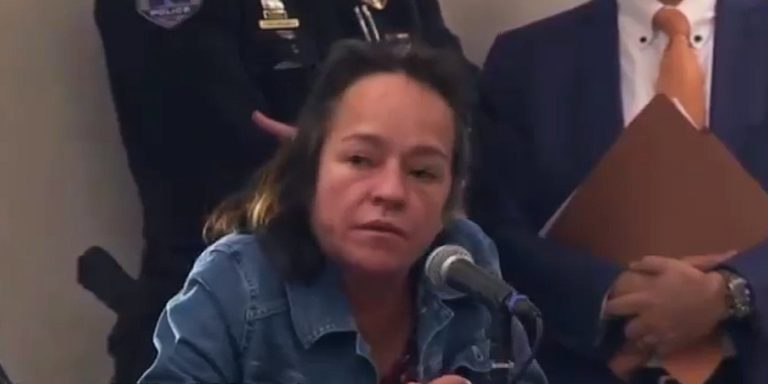
(Molly Bruns, Headline USA) Faith Winter, a Democrat state senator from Westminister, Colorado, drove to an April legislative meeting while intoxicated, then parked in a fire lane before going inside and conducting the meeting drunkenly.

According to Colorado Public Radio, a bipartisan committee opened an ethics complaint against her for her actions. Officials used video footage of the meeting, as well as body camera footage from concerned police officers, as evidence in the complaint.

The day following the meeting, she announced she would seek help and entered a rehab facility.

On Thursday, a state Senate ethics committee voted to move forward with a complaint against Winter for her drunken appearance.

“I just want to say that this is hard. This sucks,” said state Sen. Julie Gonzales, D-Denver, the chair of the ethics committee.

“This entire situation has just been really challenging, because when she’s at her best, Sen. Winter is phenomenal in upholding trust and integrity,” Gonzalez added.

The ethics complaint alleged that Winter neglected to “uphold her office with integrity.”

The rules of legislative conduct stipulate that an elected officer must “perform his or her legislative duties at all times in a manner that promotes public confidence.”

According to the complaint, Winter refused to answer direct questions and came across as argumentative and difficult.

Thursday’s vote simply confirmed the continuation of the investigation into the matter, and the committee did not announce any conclusive disciplinary measures.

If the committee comes to the conclusion that Winter violated ethics rules, she could face the stripping of her committee assignments or receive an official censure.

Nearly 400 people attended the initial meeting to discuss a mental health facility moving into a local neighborhood. Some locals expressed concern that the facility would likely end up housing sex offenders as a result of a law sponsored by Winter.

Winter started her public tenure in 2014. She is currently in her second term as state Senator.

Report: Bidens Refinanced House 20 Times to Borrow $4.2M

(Ken Silva, Headline USA) They say corruption pays. But in the case of President Joe Biden, it apparently didn’t pay him enough to prevent him from borrowing a whopping $4.2 million on a house he bought for $350,000.

According to a Monday report from the Daily Mail, Biden refinanced his two Delaware homes 35 since 1975.

“Over the decades the Bidens have borrowed a total of $6million on both properties – and there’s still an outstanding $541,000 mortgage on their current three-bed, 4.5-bath Wilmington mansion nearly three decades after they bought it,” the Daily Mail said.

“The constant refinancing raises the question of why the Bidens, who have a reported net worth of $10 million, needed a constant flow of extra cash.”

Citing mortgage documents, the Daily Mail said President Biden and First Lady Jill Biden purchased their current four-acre lot for $350,000 in March 1996. They have reportedly saddled it with 20 different home credit agreements and mortgages totaling $4.23million.

“Their previous five-bed, 2.5-bath home in the same town was purchased for $185,000 in 1975 – and sold controversially for $1.2million in 1996. Records show the property had a total of 15 mortgages and lines of credit attached to it,” the Daily Mail added.

The news that the Bidens use their homes as personal ATMs follows a nearly 18-monthlong investigation by the House Oversight Committee into his family’s finances.

In May, the Oversight Committee released records revealing that more than 20 companies, 12 banks and nine Biden relatives were used in an alleged complex money-laundering scheme.

Perhaps the most shocking revelation from the May records was that one of Biden’s grandchildren was allegedly used in this scheme.

Sen. Chuck Grassley, R-Iowa, has also revealed that the FBI was likely aware of this scheme for years before the 2020 election.

According to Grassley, more than 40 FBI informants “provided criminal information to the FBI relating to Joe Biden, James Biden, and Hunter Biden.” The informants were managed by FBI field offices throughout the country, including in Seattle.

Ken Silva is a staff writer at Headline USA. Follow him at twitter.com/jd_cashless.

New Lawsuit: Jeffrey Epstein Was a Mossad Agent

(Ken Silva, Headline USA) A new lawsuit from one of Jeffrey Epstein’s victims has alleged what many observers have suspected for years: that Epstein was an intelligence asset.

Specifically, Monday’s lawsuit from an unknown Epstein victim “Jane Doe 200” said that Epstein worked for the Mossad, which is Israel’s intelligence service.

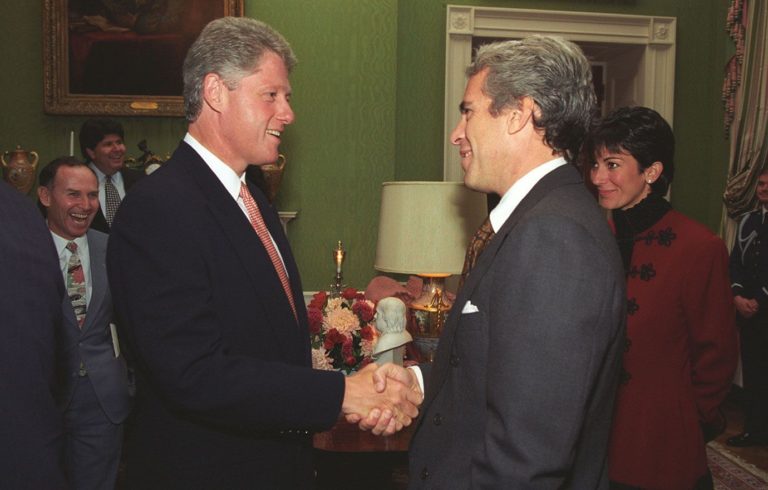
“Doe was told that Maxwell’s father, Robert Maxwell, was in the Mossad and Doe was led to believe by both Maxwell and Epstein that Epstein was as well, further demonstrating the unique power and connections that Epstein possessed,” stated the lawsuit, referring to Ghislaine Maxwell’s father, who was also known as “Israel’s superspy.”

“Epstein himself praised Robert Maxwell as an exceptional Mossad agent while also weaving in stories about his own personal and business relationships with powerful and diverse individuals, from presidents, to the intelligence community, to an infamous arms dealer,” the lawsuit said.

“Not only did Epstein hint at being a Mossad agent, but he also further demonstrated his power and unique connections by boasting that he was a member of the Trilateral Commission and a member on the Council on Foreign Relations, always in the context of portraying himself as one of the most influential men in the world.”

While detailing the alleged Mossad connections, the lawsuit didn’t mention that Epstein may have been an FBI informant and a CIA asset, too.

Epstein and his longtime girlfriend Ghislaine Maxwell were accused of flying underage girls by private jet to his private island in the U.S. Virgin Islands for sexual exploitation. There, it’s widely thought, though still unproven, that they used the underage girls to entice and blackmail a variety of politicians, businessmen and other powerbrokers.

Epstein faced criminal charges in Florida in 2006 but was able to get a more lenient plea deal that saved him from a long prison sentence. He was sentenced to 18 months but served more than a year in a Florida state prison.

In 2019, Epstein died while awaiting trial in New York after prosecutors concluded they were not bound to the terms of Epstein’s 2006 deal.

Authorities said he committee suicide by hanging himself in his jail cell, but that ruling has been widely scrutinized because of the circumstances related to his death and the potential number of high-profile co-conspirators he could have implicated.

Ken Silva is a staff writer at Headline USA. Follow him at twitter.com/jd_cashless.

Maricopa Co. Election Worker Arrested for Stealing Security Keys to Tabulation Machines

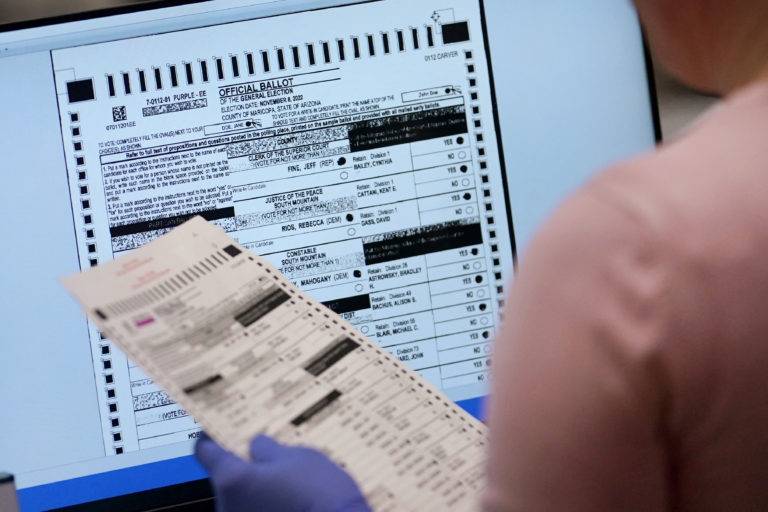
(Jacob Bruns, Headline USA) An election worker in Arizona’s Maricopa County was arrested Friday for allegedly stealing a key fob to the state’s primary election tabulator machines, the AZ Mirror reported.

Maricopa County detectives arrested and charged Walter Ringfield Jr., 27, a Phoenix resident and temporary county employee, with one count of theft and another count of criminal damage.

Election workers turned security footage after noticing the fob was missing from the Maricopa County Tabulation and Election Center. The footage reportedly revealed that Ringfield took the fob out of the facility in his pocket.

When confronted, Ringfield denied the accusations, leading to a police investigation.

He later told detectives that he had removed the key fob from the premises for 20 minutes on the prior day, but returned it. After acquiring a search warrant, however, detectives found the key fob in his house.

Following the discovery, the county was in the process of re-programming and re-testing its equipment ahead of the July 30 primary election, the Center Square reported.

Maricopa County Recorder Stephen Richer told Headline USA via email that county supervisors initially flagged and reported the suspicious activity.

“The Maricopa County Board of Supervisors oversees tabulation, and it was they who promptly noticed the theft, apprehended the individual, determined that nothing had been affected, but decided they would reset and retest everything nonetheless,” Richer wrote.

According to an Arizona Republic report, the measure will prove costly.

“The security fobs are used in conjunction with special secure tablets during the election,” Maricopa County Sheriff’s Office detectives wrote in court documents.

“A director at the facility stated that the estimated cost of the reprogramming would be greater than $19,000 dollars, and the secure operation of the facility is greatly impeded until the reprogramming is complete.”

Complicating the situation, Maricopa County, a hotbed of election irregularities for the past two major elections, will send out its mail-in ballots in just one week.

But Richer, who is up for re-election and faces two Republican challengers, said he personally was not concerned by the development, despite the county’s rocky relationship with maintaining the perception of election integrity in recent cycles.

“I have full confidence in the tabulation of results,” he said.

“Accuracy tests are done both before and after the election,” he added. “And the political parties do a hand count audit of the random sampling of the ballots to make sure the tabulators read the ballots correctly.”

According to the police report, Ringfield claimed that he was simply trying to be a good employee so that he might get hired full-time.

“Walter said the job was temporary and he was trying to make it permanent, so he wanted to clean up,” the report says.

Ringfield’s father, Walter Ringfield Sr., told reporters that he “will wait to pass judgment until all of the facts come out.”

“I love my son,” he added.

The county planned to further address the issue in a press conference Friday.

Headline USA’s Ben Sellers contributed to this report.

Bank Info Could Be at Risk in Possible Russian Hack of Fed

(Money Metals News Service) A Russian hacking organization appears to be in the process of blackmailing the Federal Reserve.

On June 23, 2024, the criminal organization LockBit 3.0, a Russian ransomware cybercriminal group, publicly stated that it hacked the Federal Reserve and implied it would release over “33 terabytes of juicy banking information containing details of Americans’ banking secrets” unless a large ransom is paid.

More specifically, the cyber-terrorist organization says the Federal Reserve and the U.S. government have until tomorrow afternoon, June 24, at 4:27 p.m. EDT to comply with its undisclosed monetary demands. A LockBit Tweet last night alludes to the hacking group’s displeasure about the Federal Reserve’s response to their demands:

“You better hire another negotiator within 48 hours, and fire this clinical idiot who values Amercans’ bank secrecy at $50,000.”

Only a flurry of cyber security news websites have reported on this situation so far.

Meanwhile, the Fed itself has not yet confirmed publicly that indeed this serious hack has actually occurred, as LockBit claims.

U.S. and Russian LockBit Hackers Are Locked in Battle

It’s possible LockBit cyber terrorists are simply playing a prank… and that they have not actually accessed and downloaded 33 terabytes of sensitive data from Federal Reserve servers.  They have played such pranks in the past.

Brett Callow, a threat analyst at the cybersecurity firm Emsisoft, told the Daily Dot that he believed LockBit was merely attempting to garner attention:

“LockBit’s claim is likely complete and utter bollo… erm, nonsense, and a tactic designed to get its ailing RaaS [Ransomware-as-a-Service) back into the limelight.”

Given the Tuesday deadline, though, it may not be long until we find out.

Whether Lockbit’s claims are true, there have been many hacks… and LockBit and the United States government have been battling back and forth.

According to Simon Sharwood of The Register, on February 19, 2024, the National Crime Agency, in collaboration with Europol and other international law enforcement agencies, seized control of darknet websites belonging to the LockBit ransomware gang as part of Operation Cronos.

Only weeks ago, the FBI released 7,000 decryption keys that it obtained from the group – keys that would enable prior victims of ransomware attacks to finally access their frozen data.

Also, one month ago, the U.S. government indicted and imposed international sanctions on LockBit’s administrator Dmitry Yuryevich Khoroshev.

According to the U.S. Department of State, as of May 7, 2024, the government is offering a reward of up to $10,000,000 for information leading to the arrest and/or conviction of LockBit’s Dmitry Khoroshev in any country.

This most recent U.S. response was triggered by LockBit’s activities in May 2024, when the organization conducted more successful ransomware attacks around the world than any other terroristic cybergroup.

LockBit started its activities around 2019 and has since conducted multiple high-profile ransomware attacks on major companies, banks, and government departments around the world.

Some of LockBit’s most prominent attacks have included the United States Department of Justice, Fulton County Georgia Boeing, British Royal Mail, Taiwan Semiconductor Manufacturing Company Limited (TSMC), and the Port of Nagoya in Japan.

The U.S. government tends to not pay ransom demands since doing so encourages further hacks and uses of ransomware. Instead, the DOJ and other departments tend to pour more resources into finding the culprits in partnership with international agencies, while remediating the damages.

A Hack of Federal Reserve Data Could Be Damaging

If LockBit 3.0 indeed has 33 terabytes of Federal Reserve data, the implications could be severe.

Private citizens could be more vulnerable to identity theft, to say nothing of the breach of Americans’ privacy relating to their past spending habits, social security and bank account numbers, and other private information.

More fundamentally, such a hack could further undermine the confidence in the Federal Reserve System worldwide.

Meanwhile, ransomware attacks connected with the financial system could prompt central planners to attempt to fast-track a central bank digital currency (CBDC) as a means to “protect” the U.S. dollar (aka the Federal Reserve Note) and supposedly provide more security via blockchain technology.

No matter the response, a serious hack of the Federal Reserve conceivably poses a threat to national security, the stability of the Fed, the fiat dollar, and the current monetary system. Confidence can be fleeting. And when there’s little more than confidence backing the whole system, we’re indeed in a precarious situation.


Bank of America Eyeballs $3,000 Gold

(Mike Maharrey, Money Metals News Service) Bank of America is eyeballing $3,000 gold.

According to a report released by the big bank, gold prices could potentially hit $3,000 an ounce in the next 12 to 18 months as the Federal Reserve begins cutting interest rates and rising debt drives economic uncertainty. 

BofA commodity strategist Michael Widmer said he thinks the next bull run will be contingent on a pickup in investment demand.

“If non-commercial demand picks up from current levels on the back of the Fed rate cut, the yellow metal could push higher again.”

Widmer said this will likely happen when there is more certainty about Federal Reserve rate cuts. He said a pickup in ETF inflows and increasing LBMA clearing volumes are signs to look for.

ETF inflows globally were positive for the first time in 12 months in May.

The Bank of America report said central bank gold buying will remain a crucial factor supporting gold prices. 

Last year, central banks added a net 1,037 tons of gold to their reserves, just slightly below the record of 1,082 tons in the previous year.

According to the most recent World Gold Council Central Bank Gold Survey, that appetite for gold isn’t waning. Twenty-nine percent of central banks indicated they plan to add more gold to their reserves in the next 12 months. The WGC said it was the highest level since the survey began in 2018.

Widmer noted that de-dollarization is driving this central bank gold-buying spree, especially in China. 

“While the motivation of individual central banks for owning gold may vary, many reserve portfolios have one thing in common: the share of USD has been declining, while gold holdings have risen.”

The People’s Bank of China has added around 8 million ounces of gold to its reserves since January 2023. Meanwhile, the Chinese central bank has divested $102 billion in U.S. Treasuries in the past year.

The Bank of America report highlighted bond yield volatility as another tailwind for gold.

Widmer pointed out that the U.S. Treasury is flooding the market with bonds as borrowing surges with the ever-widening deficits, and the market is having a hard time absorbing all of the Treasuries. Widmer said the bond market is “one shock away from not functioning seamlessly.”

“Increased macro uncertainty today may pose an even greater threat to market stability in a context where growth in government debt has vastly overwhelmed the intermediation capacity of the market.”

If demand for Treasuries continues to ebb, yields could rise even with Federal Reserve rate cuts. Higher yields typically create headwinds for gold since it is a non-yielding asset. Widmer said gold prices would likely fall initially with rising bond yields, but “the search for a ‘safe-haven’ asset will ultimately divert flows into the gold market, so the yellow metal will then likely pick up.”

“The long-standing inverse relationship between gold and rates has become more tenuous already and, in our view, this is unlikely to change going forward.”

The question is when will the Federal Reserve cut rates. Sentiment shifts back and forth with every fluctuation in CPI and economic data. But it seems like the central bank will cut rates sooner rather than later in order to ease pressure on the economy. 

The Fed faces an ugly reality – this economy can’t function in a higher interest rate environment. While the central bank hasn’t done enough to slay price inflation, it has driven rates high enough to wreck a bubble economy blown up by easy money. The economy feeds on inflation.

Rate hikes have already kicked off a financial crisis that continues to bubble under the surface. It’s only a matter of time before something breaks in the economy. At that point, the Fed will likely cut rates rapidly to zero and launch new rounds of quantitative easing. That means more price inflation and the perfect environment for gold to run even higher.

The Bank of America report doesn’t even consider this scenario, and yet it still makes a strong case for $3,000 gold. 


Mike Maharrey is a journalist and market analyst for MoneyMetals.com with over a decade of experience in precious metals. He holds a BS in accounting from the University of Kentucky and a BA in journalism from the University of South Florida.

How Does Gold Measure Up to Other Asset Classes?

(Mike Maharrey, Money Metals News Service) The investment world generally treats gold like a second-class citizen. Sure, the mainstream will sit up and take notice during a strong bull run, but generally, the financial media and investment gurus tend to spurn the yellow metal. 

I’m not completely sure why the mainstream pooh-poohs gold (although I have my theories), but I do know this — they’re missing out.

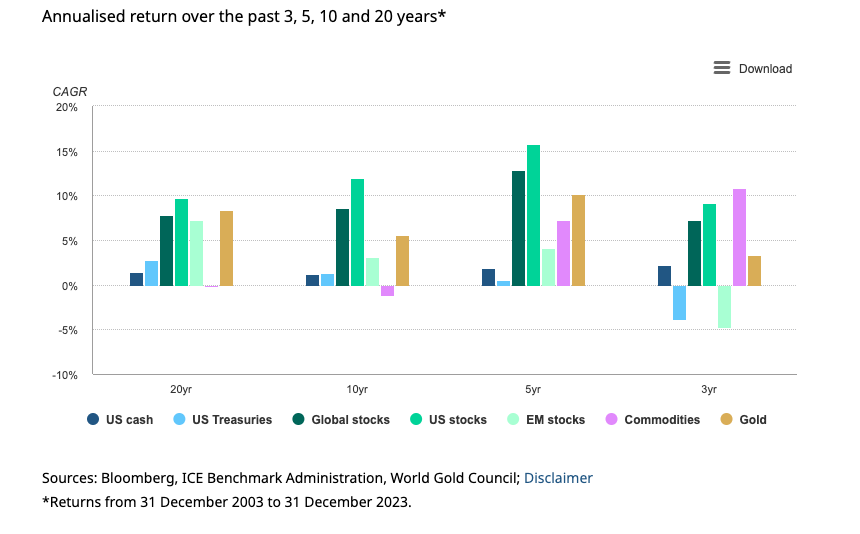
Despite the lack of love, gold has outperformed most major asset classes over the last 20 years.

As the World Gold Council notes, “Historically, gold has generated long-term positive returns in both good and bad economic times.”

Taking a longer view, the returns on the yellow metal have been similar to equities, and gold has outperformed bonds since 1971.

On average, the price of gold has increased by nearly 8 percent annually since ’71 when Nixon severed the dollar’s last tie to gold. 

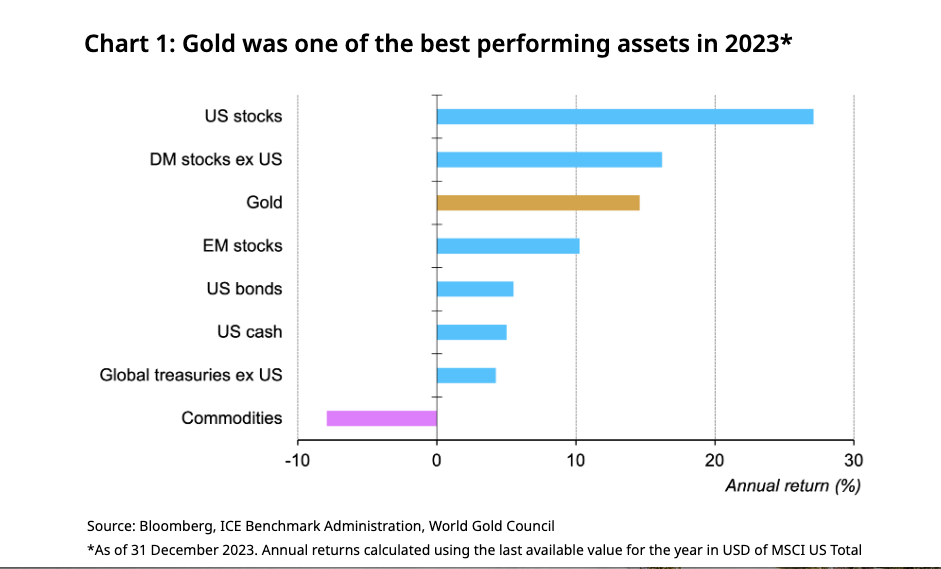
The price of gold was up about 13 percent in 2023 and was among the best-performing assets. Gold outperformed emerging market stocks, U.S. bonds, the U.S. dollar, global treasuries, and commodities in general. The only asset classes that performed better than gold were U.S. stocks and developed-market foreign stocks.

Gold also tends to be less volatile than other asset classes.

This is due to its diverse sources of demand. As the World Gold Council put it, this diversity “gives gold a particular resilience and the potential to deliver solid returns in various market conditions.”

“Gold is, on the one hand, often used as an investment to protect and enhance wealth over the long term, but on the other hand, it is also a consumer good, via jewelry and technology demand. During periods of economic uncertainty, it is the counter-cyclical investment demand that drives the gold price up. During periods of economic expansion, the pro-cyclical consumer demand supports its performance. Combined, these factors give gold the ability to provide stability under a range of economic environments.”

Gold serves particularly well as an inflation hedge. Since 1971 it has outpaced both U.S. and and global CPI. The yellow metal also tends to do well in high inflation periods. This has proved true during the recent inflationary cycle.

The price of gold has increased by about 29 percent since June 2021 (as inflation started heating up). In that same period, CPI increased by 12.30 percent based on official Bureau of Labor Statistics data.

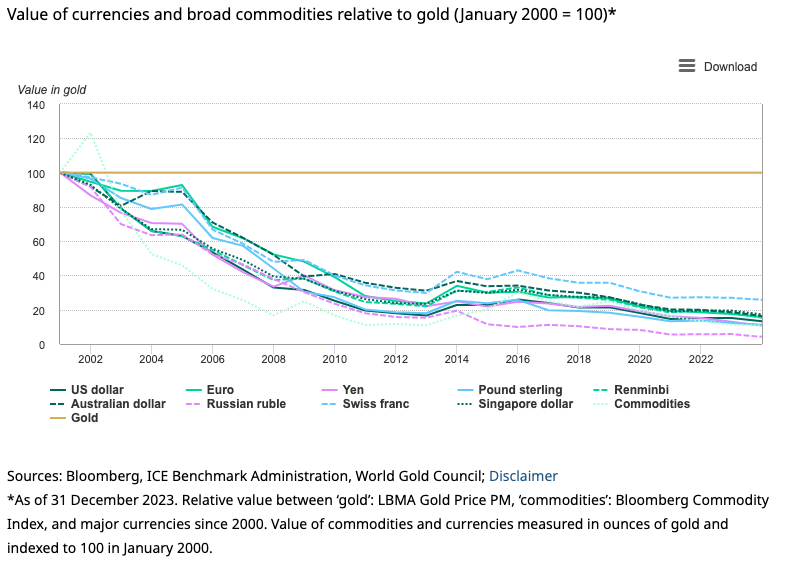
Ultimately, gold is money. And it is sound money. Every major currency has depreciated significantly compared to gold.

Despite its strong performance over time, most investors don’t hold any gold in their portfolios. Is it perhaps time to change that?


Mike Maharrey is a journalist and market analyst for MoneyMetals.com with over a decade of experience in precious metals. He holds a BS in accounting from the University of Kentucky and a BA in journalism from the University of South Florida.

Biden’s Unconstitutional Student-Debt Transfer Gets Struck Down AGAIN

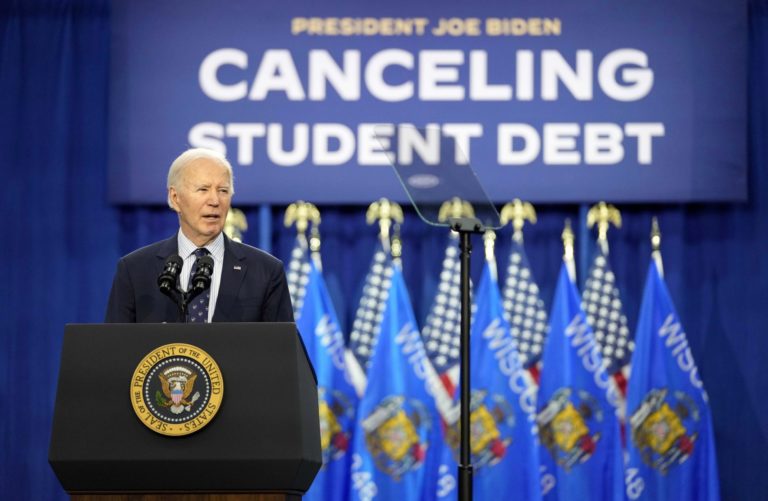
(Headline USA) Federal judges in Kansas and Missouri on Monday blocked parts of a Biden administration student loan debt-transfer ploy that the Democrat president had hoped to use to staunch the loss of younger voters ahead of the November election.

Biden had openly boasted about forging ahead with the plans without congressional approval, despite having has a prior proposal shut down by the U.S. Supreme Court last year—which contributed in part to the growing irritation that some younger voters have with the 81-year-old for making promises that he cannot keep.

The judges’ rulings said that the U.S. Department of Education cannot assume borrowers’ loan-repayment burdens going forward under a rule set to go into effect July 1. The decisions do not cancel assistance already provided to borrowers.

In Kansas, U.S. District Judge Daniel Crabtree ruled in a lawsuit filed by the state’s attorney general, Kris Kobach, on behalf of his state and 10 others.

In his ruling, Crabtree allowed parts of the program that allows students who borrowed $12,000 or less to have the rest of their loans forgiven if they make 10 years’ worth of payments, instead of the standard 25.

Crabtree’s ruling means that the Department of Education won’t be allowed to implement parts of the program meant to target students with larger loans who hoped to have their monthly payments lowered and their required payment period reduced from 25 years to 20 years.

In Missouri, U.S. District Judge John Ross’s order applies to different parts of the program than Crabtree’s. His order says that the U.S. Department of Education cannot forgive loan balances going forward.

Ross issued a ruling in a lawsuit filed by Missouri Attorney General Andrew Bailey on behalf of his state and six others.

Together, the two rulings appeared to significantly limit the scope of the Biden administration’s efforts to help borrowers after the U.S. Supreme Court last year rejected the Democratic president’s first attempt at a forgiveness plan.

Both orders are preliminary, meaning the injunctions imposed by the judges would remain in effect through a trial of the separate lawsuits. However, to issue a temporary order each judge had to conclude that the states were likely to prevail in a trial.

Both judges were appointed by former President Barack Obama.

There was no immediate statement on the rulings from the White House.

Bailey hailed the ruling, calling it “a huge win for the rule of law, and for every American who Joe Biden was about to force to pay off someone else’s debt.”

Kobach also praised the decisions, framing the Biden plan as “unconstitutional” and an affront to “blue collar Kansas workers who didn’t go to college.”

Adapted from reporting by the Associated Press

FBI Still Wants to Hide 9/11 Evidence

(Ken Silva, Headline USA) More than 20 years after the deadliest terrorism attack in American history, the FBI still wants to limit the disclosure of evidence from that case.

Justice Department attorneys wrote a letter on June 14 to the judge presiding over the long-running 9/11 civil litigation, informing him that the FBI still wants more time to review evidence.

“In the FBI’s view, it is not appropriate to seek a blanket Privacy Act order unsealing a large collection of documents before the FBI has had the opportunity to review them …,” the DOJ attorneys said.

“Moreover, while the majority of the redactions identified through the FBI’s review to date have been subject to the Privacy Act, the FBI has a broader law enforcement interest in avoiding wholesale public disclosure of the personally identifying information of U.S. persons who were witnesses or of investigative interest in FBI investigations,” they said.

“To the extent [plaintiffs] seek an order authorizing disclosure of information subject to the Privacy Act, they should do so with regard to specific redactions or categories of redactions.”

The judge has yet to rule on the matter.

The FBI’s move to suppress 9/11 evidence came days before a bombshell 60 Minutes report revealed that the bureau had been hiding footage of a Saudi Arabian official Omar al-Bayoumi “casing” Capitol Hill in June 1999—months before al-Qaeda made the decision to include Washington DC in its terrorist plot. Numerous investigators believe the Capitol building was the target of Flight 93, which instead crashed in Pennsylvania.

“British police are believed to have turned over the video to the FBI shortly after 9/11,” said a 60 Minutes reporter. “Why, after more than 20 years, is it just now surfacing?”

Meanwhile, last December a military judge at Guantanamo Bay ordered the FBI to produce 3,000 pages of documents about al-Bayoumi, who was a subject of FBI investigations for more than 20 years because he was the handler for two of the plane hijackers, Nawaf al-Hazmi and Khalid al-Mihdhar.

Shockingly, SpyTalk also published last year a sworn statement from Office of Military Commissions investigator Don Canestraro, who said that Bayoumi was a CIA asset.

According to Canestraro, at least two FBI agents told him that the CIA had attempted to recruit al-Hazmi and al-Mihdhar. The CIA was directing its recruiting efforts through Bayoumi, Canestraro said.

Families of 9/11 victims have lamented that alleged terrorists at Gitmo are being able to access more information about the incident than they are.

“The defense counsel for those accused of mass murder on 9/11 is getting more access to documents than the terror victims themselves,” a man who lost his father from 9/11 told SpyTalk.

Ken Silva is a staff writer at Headline USA. Follow him at twitter.com/jd_cashless.

Gov. Whitmer Reveals What She Really Thinks of Her Supposed Kidnap Plotters

(Ken Silva, Headline USA) In a December 2022 victim impact statement, Michigan Governor Gretchen Whitmer claimed to be in constant fear over the alleged 2020 militia plot to kidnap her.

“I now scan crowds for threats. I think carefully about the last thing I say to people when we part. I worry about the safety of everyone near me when I’m in public. And I’m reluctant to share too much because I worry it will endanger a loved one, a staff member, a police officer on my security detail,” Whitmer said last December during the sentencing hearing of three men found guilty of conspiring against her.

“I am changed and my family is changed.”

Whitmer’s statement led to the three defendants—Pete Musico, Joe Morrison and Paul Bellar—being sentenced to 12, 10 and seven years imprisonment, respectively.

But now, Whitmer has indicated that her impact victim statement was false. In a recent interview with Michigan Advance, she said she never feared for her safety.

“I’ll say it’s very different being governor of the state. I have got state police that are part of the detail that keep me and my family safe. And even with everything over the last six years, I’ve never personally worried about my safety,” she told the publication.

“Being a public servant in another office, almost any other office, doesn’t have anything like the security that I have.”

Meanwhile, the families of the men are still reeling from what the overwhelming evidence has shown to be a conspiracy fomented by FBI agents and their undercover informants.

Rosemarie Battaglia-McGuire, the mother of incarcerated plot defendant Barry Croft Jr., told Headline USA last year that her son had been supporting three daughters at the time of his arrest. Now, he’s lost custody of them to a mother who hadn’t been in their lives in more than a decade, she said.

Croft was convicted along with co-defendant Adam Fox in August 2022, receiving a 235-month prison sentence in December 2022.

Croft and Fox have appeals pending, but Battaglia-McGuire said neither she nor her son are optimistic given their experience with the U.S. legal system so far—though the recent hearing might prove them pleasantly surprised. The mother said she’s thankful that her son has remained strong in prison.

“He’s going to church regularly, he’s helping the other men with their legal problems and their rights,” she said. “He’s studying the Bible … It’s been a joy to my heart that he’s at least turning to the Lord.”

Ken Silva is a staff writer at Headline USA. Follow him at twitter.com/jd_cashless.