

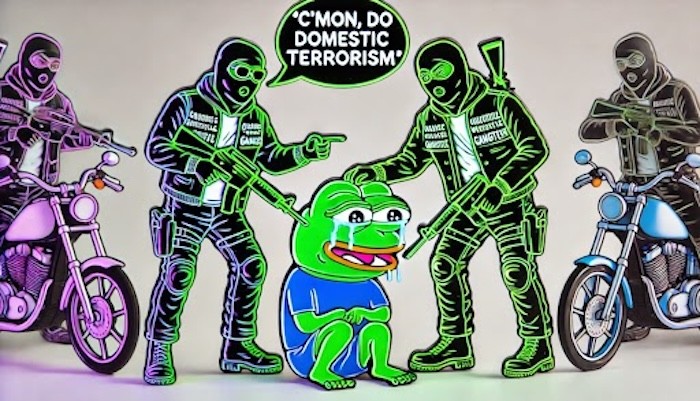
(Ken Silva, Headline USA) FBI Director Kashyap Patel said Wednesday that the number of online undercover FBI agents have increased during his tenure—claiming that the boost in online operatives helped solve four terrorist plots in December alone.
Patel first touted the increase in online agents in response to a question from Sen. Susan Collins, D-Maine, about thwarting terror attacks.
“What we’ve done in the [counterterrorism] space specifically is expand the number of agents and analysts that go online and detect [threats] … and what that leads us to is what we saw last December, where we at the FBI stopped four terrorist attacks—four, in California, Texas, North Carolina and Pennsylvania—three of which were ISIS-inspired,” Patel said.
FBI Director Kashyap Patel revealed today that the bureau has increased the number of online counterterrorism agents — known in some parts of the internet as 'glowies.' He credits this for stopping 4 terrorist attacks in December. pic.twitter.com/Ssk7UEru22
— Ken Silva (@JD_Cashless) March 18, 2026
The FBI director later said the bureau has increased funding online covert activity in response to a question from Sen. James Lankford, R-Ok., who was asking about his efforts to thwart online scams.
“You have to drown and get online with your covert employees and platforms, and we’ve increased funding [for that],” he said.
The terrorist attacks Patel reference include a left-wing group named “Turtle Island Liberation Front” that planned to bomb empty businesses in California on New Year’s Eve; a North Carolina teenager who allegedly planned a mass stabbing; and a 21-year-old Texan who tried sending money to ISIS. It’s unclear what Pennsylvania plot Patel’s referring to.
In the Turtle Island case, it’s unclear whether the defendants were capable of pulling off a bombing. Much of the case seems to be based on an eight-page planning document obtained by an FBI informant, and at one point one of the defendants admitted his lack of bomb-making skills: “I have the basics down but building circuits is beyond me (which is needed for a digital timer),” one of the defendants said 5 days ago,” a defendant said about five days before the arrest.
Looks like the defendants in this case may not have had the capacity to pull off the New Year's Eve attack they were allegedly planning.
"I have the basics down but building circuits is beyond me (which is needed for a digital timer)," one of the defendants said 5 days ago. https://t.co/th8J02ZoMi pic.twitter.com/yMKEP4NETa— Ken Silva (@JD_Cashless) December 16, 2025
In the North Carolina mass stabbing case, meanwhile, the defendant was on the FBI’s radar since 2022, when he was just 14 years old. Similarly in the Texas case, the defendant was first approached online by an undercover New York Police Department detective, who then introduced him to two undercover agents.
On the feds' radar since he was 14 years old. https://t.co/PuFUBsSnQV pic.twitter.com/2fY0AFMftJ
— Ken Silva (@JD_Cashless) January 2, 2026
The FBI has long been criticized for using undercover agents and informants to provoke and nudge vulnerable individuals to commit terroristic crimes—even when those individuals wouldn’t have the capacity to do so by themselves.
The 2015 ISIS-inspired shooting at a contest to draw the Prophet Muhammed in Garland, Texas is perhaps one of the starkest examples of the FBI provoking a terrorist attack.
In that case, FBI informants had been monitoring the shooters for years, the bureau allowed one of them to purchase a weapon from a gun store involved in the Operation Fast & Furious scandal, and an undercover agent even encouraged the shooting by telling the attackers to “tear up Texas.”
Perhaps most damningly, the same undercover agent who provoked the shooters was at the “Draw the Prophet” event when the attack occurred. Then, when local cops detained the undercover agent because they thought he was one of the attackers, other FBI agents intervened immediately. They placed a hood over the undercover agent’s head and whisked him away to another location before confiscating footage of the incident from bystanders.
There are cases that make you go "mmm that's weird" when you hear a shooter was on the FBI's radar.
Then, there's the 2015 Garland, Texas shooting: pic.twitter.com/LbugxglzqF
— Ken Silva (@JD_Cashless) June 27, 2025
The FBI continues to defend itself in this case some 10 years later. In a brief filed last June in an ongoing appeal, Justice Department prosecutors said the undercover FBI agent’s presence at the “Draw the Prophet” contest was a total coincidence.
Numerous other examples of the FBI provoking crime can be found here.
Ken Silva is the editor of Headline USA. Follow him at x.com/jd_cashless.
