

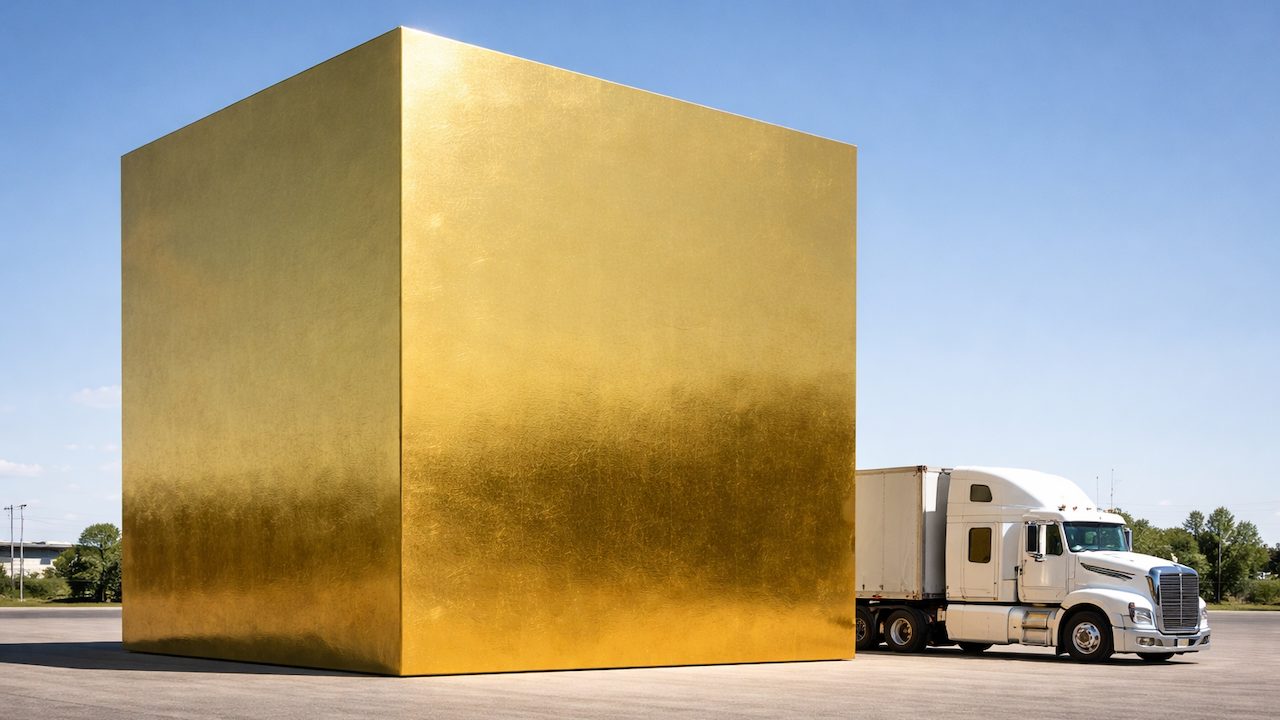
(Mike Maharrey, Money Metals News Service) One of the things that makes gold valuable is its scarcity. But just how rare is gold?
Based on best estimates, geologists at Metals Focus estimate that there are 219,890 tonnes of gold currently above ground.
That sounds like a lot, but if you melted all that gold into a cube, it would only measure 22 meters on each side. That’s about 73 feet.
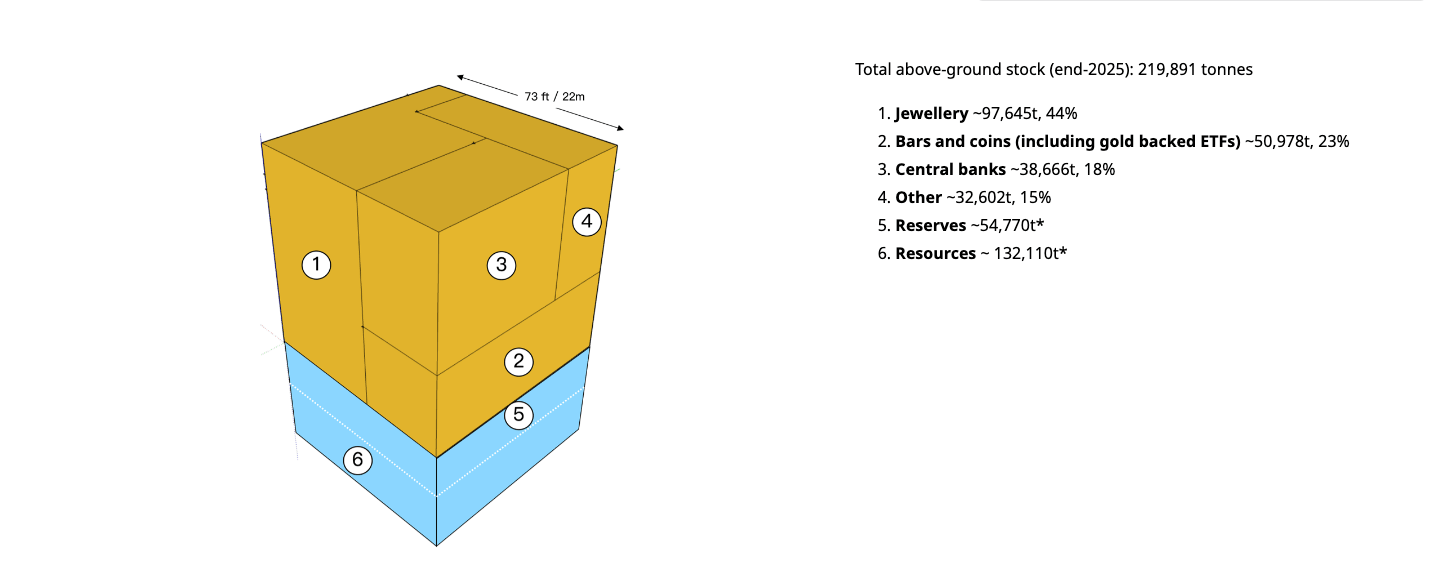
To give you a visual, all the gold in the world would fit inside four-and-a-half Olympic-sized swimming pools.
Here’s a cube of that size compared to a semi.

Metals Focus estimates there are 54,770 tonnes of mineable gold reserves. These are known gold deposits that are economically viable to extract under 2025 conditions. The U.S. Geological Survey has a slightly larger estimate of 64,000 tonnes.
Furthermore, based on geological evidence and sampling, Metals Focus estimates there are an additional 77,340 tonnes of known gold deposits underground that aren’t extractable under current economic conditions.
The World Gold Council notes, “Estimates of below-ground reserves have remained stable for decades even as gold is being continually mined out.”
That means the pace of new gold discoveries tends to roughly correspond with the amount of gold mined each year.
According to the World Gold Council, three factors explain the stability of underground reserves:
- Lower-grade deposits, once unprofitable, become economically viable – in other words, they move from resources to reserves as the gold price increases.
- More gold is discovered, albeit at a slower pace. When a gold deposit is discovered, sufficient reserves are drilled out to justify the project construction. But as some of the deposits deplete, further exploration often takes place, keeping total resources relatively stable.
- Often, when a mine is built and brought into production, exploration geologists start to look for near-to-mine resources (often small deposits, sometimes known as satellite deposits) that can supplement reserves.
How Much Gold Is Mined Annually?
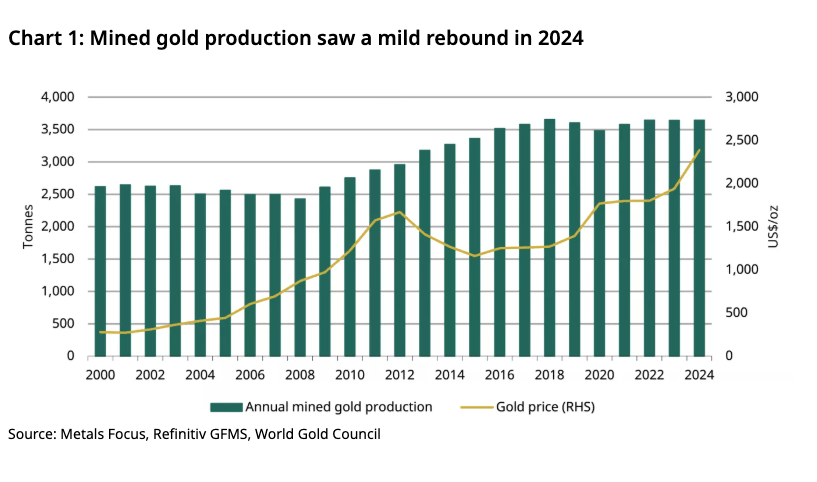
Last year’s mine output set a record of 3,672 tonnes. That represented a 1 percent increase over the prior year.
Looking at mining output over time, it has been relatively consistent between just above 2,500 and 3,500 tonnes. Between 2001 and 2008, mine output was on a downward trajectory, but began climbing in 2009 before generally plateauing in the last decade.
To put the mine output in context, gold demand set a record just over 5,000 tonnes in 2025.
Mining isn’t the only source of gold supply. In 2025, recycling added 1,404.3 tonnes of gold to the mix, bringing the total 2026 supply to just over 5,000 tonnes.
Could We Run Out of Gold?
There is a theory that the world will eventually hit “peak gold.” At that point, mining output will steadily decline.
Some analysts claim that there are only 15 years of reserves at the current production rate. However, this doesn’t account for the relatively consistent pace of new discoveries.
So, although peak gold followed by a decline in gold production isn’t totally out of the question, it won’t likely happen soon. While it is true that the supply of easily mineable gold is declining, ongoing technological advances will likely unlock some of those unviable reserves in the future. Furthermore, better exploration methods will allow geologists to discover new reserves.
However, this won’t happen quickly, and we could see some periodic supply shortages year to year, especially if geopolitical conditions drive a drop in mine production.
In the longer-term, the World Gold Council forecasts that gold production will likely remain at a plateau rather than peaking and declining.
“A key reason for this is that the new gold mining projects are getting harder to discover, due mainly to geopolitical instability in many prospective regions; lengthening development timelines amid protracted permitting processes for environmental and social licenses; rising capital costs; and complicated project financing in remote areas.”
There is no question that the amount of gold close to the surface and easy to mine is declining rapidly. But advances in mining technology are making more difficult deposits economically viable.
“Technology advancing, better geological modelling, and deeper underground mining becoming more effective is making new discoveries more viable and extending the current usable supply. … In conclusion, while there is a slim possibility that we run out of ‘easy’ and ‘cheap’ gold to mine – if all discoveries stopped, technological advancement and a price that is high enough could see gold extracted from previously unfeasible supply sources.”
Mike Maharrey is a journalist and market analyst for Money Metals with over a decade of experience in precious metals. He holds a BS in accounting from the University of Kentucky and a BA in journalism from the University of South Florida.
