(Mike Maharrey, Money Metals News Service) Gold has dropped more than 11 percent from its all-time high of just over $5,102 an ounce in January, and selling pressure continues to dominate the market. A well-established mainstream narrative is driving the bearish sentiment. However, while seemingly plausible on the surface, this mainstream storyline is missing two extremely important dynamics.
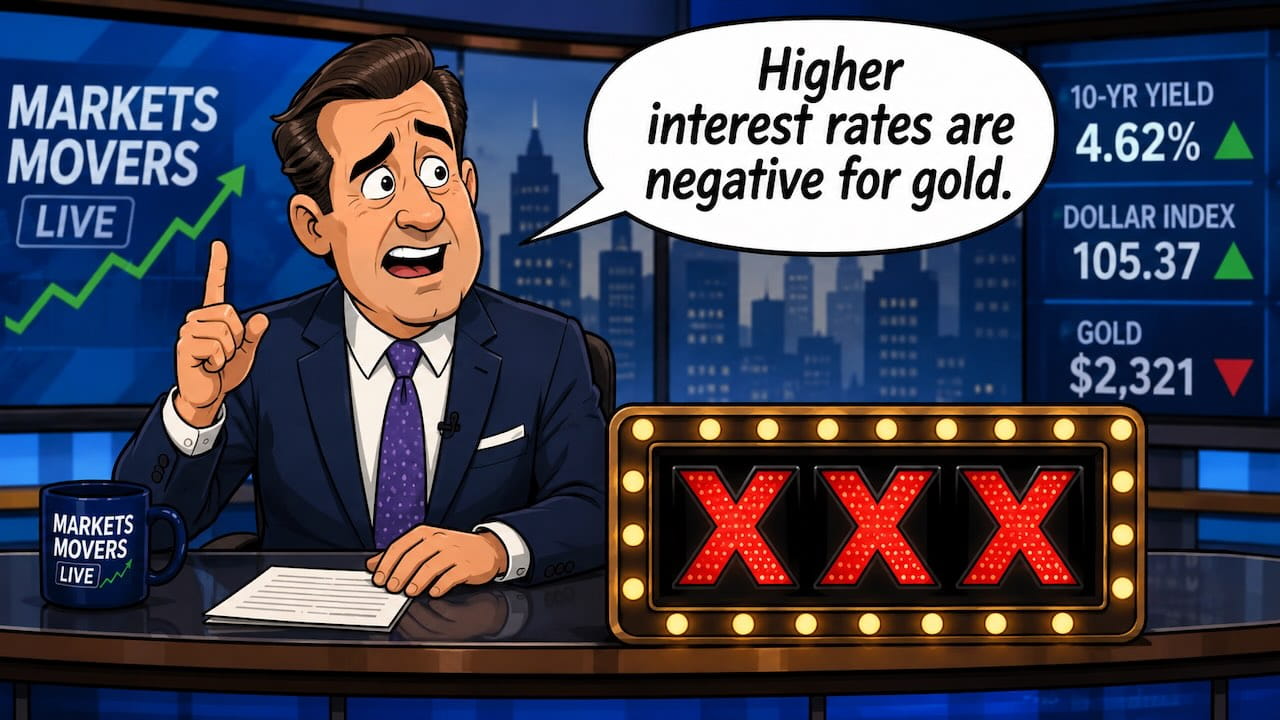
According to the prevailing narrative, the Federal Reserve will have to keep interest rates higher for longer to control inflationary pressures introduced into the economy by skyrocketing oil prices due to the U.S.-Iran war. The central bank may even need to raise rates this year to combat inflation. As the mainstream analysts typically put it, “higher rates are negative for gold because it is a non-yielding asset.” In other words, since gold doesn’t pay interest or dividends, investors will spurn the yellow metal to chase increasing yields in the bond market.
Sounds reasonable, right? However, the mainstream pundits aren’t telling the full story, and two key dynamics are missing from this mainstream narrative.
- It ignores real interest rates.
- It is far from certain that the Fed will keep rates higher for longer because of thw the Debt Black Hole.
Real Interest Rates
When mainstream analysts talk about rising interest rates, they almost always mean nominal rates. However, the real interest rate is far more important when determining the income-generating potential of an asset.
So, what is the “real” interest rate?
In simplest terms, the real interest rate is the stated rate you see on the news adjusted for price inflation. To calculate the real interest rate, you take the quoted nominal rate and subtract CPI. This tells you how much your investment will yield in real purchasing power over time.
For example, the 10-year Treasury bond is currently yielding just over 4.6 percent. That seems like a pretty good return. However, the CPI is running at 3.8 percent. That means the real interest rate on a 10-year Treasury is only 0.8 percent (4.6-3.8=0.8).
That’s hardly a reason to spurn gold (or silver).
Note that in a low-interest-rate environment or if price inflation is particularly high, real interest rates can go negative. So, if price inflation rises to 5 percent (certainly not an unreasonable target given the oil shock), the real interest rate would be -0.4 percent. In other words, you would lose money in real terms holding a 10-year Treasury.
Keep in mind, the actual inflation rate is higher than the CPI reveals. The government revised the CPI formula in the 1990s so that it understated the actual rise in prices. Based on the formula used in the 1970s, CPI is closer to double the official numbers. So, if the BLS used the old formula, we’d be looking at CPI closer to 6 percent. And using an honest formula, it would probably be worse than that.
That means the real interest rate is generally lower than the calculation indicates.
It should be obvious that a 0.8 percent real return, with the potential for negative yields in the near future, is not a good reason to dump gold for Treasuries.
Can the Fed Really Hold Rates Higher?
Most people just assume that central bankers at the Fed will see hot CPI data and hold rates higher or maybe even raise them. However, it’s not that simple. The economy is dominated by a Debt Black Hole, and it does not play well in a higher interest rate environment.
In other words, keeping interest rates elevated risks crashing this debt-riddled, bubble economy.
As I have put it over and over again, the Fed is in a Catch-22. And when push comes to shove, I believe the central bankers will abandon the inflation fight to rescue the economy.
In fact, the central bank is already struggling to control the yield curve (especially the long end). U.S. government borrowing costs are shooting through the roof. The Fed has restarted quantitative easing (although it will never use that term) to put its big fat thumb on the Treasury market.
So, what happens when the higher rate environment finally pops the bubble?
We know the Fed’s playbook because we’ve seen this movie three times already. (The dot-com bubble, the 2008 Financial Crisis/Great Recession, and the pandemic.)
What do the Fed people do in a crisis?
They cut rates.
They buy Treasuries and mortgage-backed securities.
They print money.
They create inflation.
The Fed ultimately has a choice. It can fight the inflation dragon, or it can surrender to inflation and try to keep the debt bubble inflated and the economy tottering onward. It can’t do both.
History tells us the Fed will pick inflation. It’s the fork they know.
The bottom line is you need to take this mainstream narrative about gold and inflation with a grain of salt. It’s not as cut and dry as your CNBC and Fox Business pundits would like you to believe.
Mike Maharrey is a journalist and market analyst for Money Metals with over a decade of experience in precious metals. He holds a BS in accounting from the University of Kentucky and a BA in journalism from the University of South Florida.