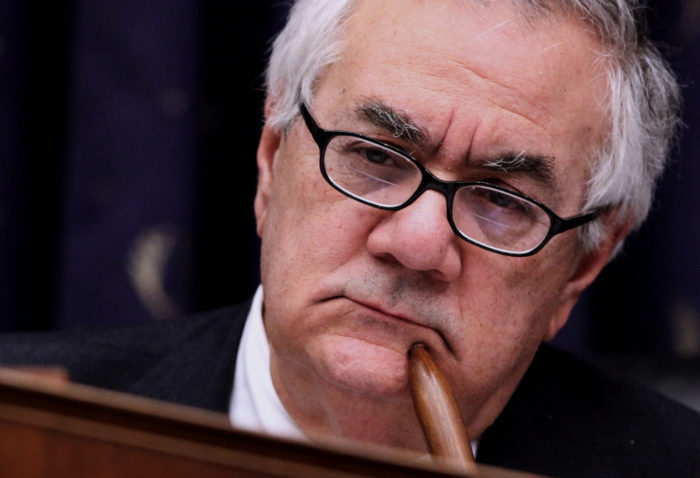
(Headline USA) Barney Frank, the longtime Democratic congressman and leading liberal who brought new visibility to gay rights and crafted the most significant reforms to the financial system in a generation, has died. He was 86.
Frank died late Tuesday, according to Jim Segel, Frank’s former campaign manager and close friend.
After representing broad swaths of Boston’s suburbs in Congress for 32 years, Frank and his husband moved to Ogunquit, Maine. He entered hospice there in April with congestive heart failure and is survived by his husband, Jim Ready, and sisters, the longtime Democratic strategist Ann Lewis and Doris Breay, along with brother David Frank.
A self-described “left-handed gay Jew,” Frank was known for his acerbic wit, combative style and focus on marginalized communities. He represented the party’s left wing while keeping close with Democratic leaders who sometimes frustrated progressives.
He is best known as a pioneer for LGBT rights. After decades of grappling with his sexuality, he publicly came out as gay in 1987, the first member of Congress to do so voluntarily. With his 2012 marriage to Ready, he became the first incumbent lawmaker on Capitol Hill to marry someone of the same sex.
But in an April interview as he entered hospice, Frank said he hoped he would be remembered for advocating a brand of politics that embraced progressive ideals without forcing them on voters prematurely.
“I hope I made the point that the best way to accomplish the improvements in our society that we need, particularly in making it less unfair economically and socially, is by conventional political methods,” Frank said. “The main obstacle to our defeating populism and going further in the right direction is that mainstream Democrats have to make it clear that we oppose that part of the agenda of our friends on the left that is politically unacceptable. They’re right about a lot of things but you have to have some discretion.”
“You should not take the most unpopular parts of your agenda and make them litmus tests,” he added. “And that’s what my friends on the left have been doing.”
Born in 1940 in Bayonne, New Jersey, he entered politics in 1968 as an aide to Boston Mayor Kevin White before winning a seat in the Massachusetts House in 1972. Frank was elected to Congress in 1980, an otherwise dismal year for Democrats as the party lost dozens of seats in the U.S. House and Republican Ronald Reagan won the White House.
Frank’s pragmatic style surfaced early in his congressional career. He joined the liberal
Democratic Study Group to help push then-Speaker Tip O’Neill, D-Mass., to respond more aggressively to the Reagan administration. But Frank said he found himself more often agreeing with O’Neill’s less confrontational approach.
Years later, as Congress prepared to pass a massive tax overhaul package, Frank intended to vote “no,” opposed to the bill’s lowering of top tax rates. He changed his mind, however, when he worked out a deal boosting affordable housing tax credits.
“I was happy to sacrifice my ideological purity to improve legislation that was going to become law with or without me,” he wrote.
Rep. Nancy Pelosi, the California Democrat and former House speaker, called Frank an “idealist to the nth degree.”
“The goals, the vision, the promise of it all,” she recalled in an interview. “Nobody could ever surpass what he brought to the table in that regard.”
Through his early years in Washington, Frank led something of a double life.
Privately, he socialized in the city’s gay circles and had relationships but did not publicly acknowledge his sexuality. The media at the time rarely reported that someone was gay unless that person was involved in a scandal. When Frank in 1987 invited a reporter to his office to formally ask whether the congressman was gay, Frank responded, “yeah, so what?”
Other elected leaders, perhaps most notably San Francisco’s Harvey Milk, had come out years before. Members of Congress, including Rep. Gerry Studds, D-Mass., were previously outed through scandal.
Frank’s approach made him the most prominent gay leader in national politics for much of the 1980s and 1990s. He helped secure AIDS funding and pressed the Democratic Clinton administration, unsuccessfully, to lift a ban on gays serving in the military.
But there were low points, too, most notably an overwhelming 1987 House vote to reprimand him for poor judgment involving a male prostitute he hired in 1985. Rep. Newt Gingrich of Georgia, the Republican whip at the time, pressed for the more severe punishment of censure, which was rejected by a large margin.
Frank became something of a punch line among conservative Republicans, with House Majority Leader Dick Armey, R-Texas, calling him “Barney Fag” in 1995. Armey said he misspoke and later apologized from the House floor.
By 2007, Frank was the chairman of the House Financial Services Committee, where he would leave his lasting policy mark as the U.S. economy careened toward collapse. He worked with the Republican Bush administration to pass a rescue package, providing vital support to financial institutions but spurring a populist revolt that still courses through American politics.
Once the initial crisis eased, Frank helped develop the most significant reform legislation since the New Deal. Working with then-Senate Banking Committee Chairman Chris Dodd, D-Conn., the Dodd-Frank Act would enhance consumer protections, impose new capital requirements for banks and boost the ability of regulators to monitor risk.
“Barney and I shared a fantastic relationship,” Dodd said. “I had many good moments in those 36 years in Congress, but none more significant, joyful, or productive than those almost two years working with Barney on our banking bill.”
During President Donald Trump’s second term, his Republican administration has worked to roll back many of the legislation’s provisions, arguing they were too onerous.
Frank faced his toughest reelection campaign in years in 2010 as the tea party wave swept over American politics. He opted against running again in 2012, though remained engaged in politics long after leaving Congress, including spending time as a contributor to the conservative Newsmax network.
He remained a fierce critic of Trump. Asked for his prediction on who might succeed the president, Frank said “unfortunately I won’t get to vote for it.”
Adapted from reporting by the Associated Press.