


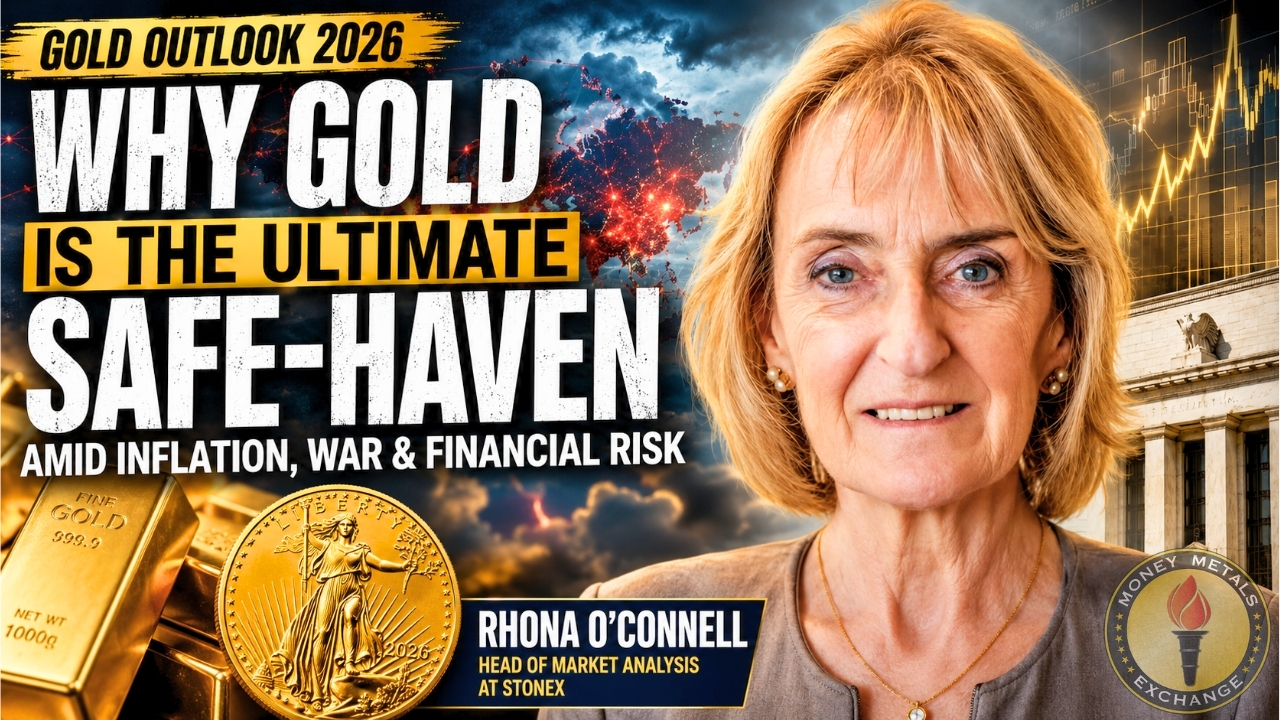
(Money Metals News Service) In a detailed interview on the Money Metals Podcast, host Mike Maharrey spoke with Rhona O’Connell, Head of Market Analysis at StoneX, about the forces driving gold and silver markets in 2026.
Drawing on more than 40 years of experience in precious metals, O’Connell explained why gold continues to function as a critical safe-haven asset during periods of inflation, geopolitical instability, and financial market stress.
O’Connell began by describing StoneX, the global financial services company originally founded in 1923 by F.C. Stone, a former door-to-door egg salesman in Chicago. Formerly known as INTL FCStone, the company operates across commodities, precious metals, agriculture, equities, energy, and global payments markets. O’Connell referred to StoneX as “the largest company you’ve never heard of,” highlighting the firm’s broad institutional presence despite relatively low public recognition.
She also shared details about her own career, which began in 1981 at Consolidated Gold Fields, then the world’s second-largest gold mining company behind Anglo American. Early in her career, she worked on long-term silver and platinum group metals feasibility studies during the volatile aftermath of the 1980 precious metals boom. That experience inside the mining industry, she said, gave her a practical understanding of markets that many analysts never acquire.
(Interview Starts Around 6:38 Mark)
Why Gold Is Still a Powerful Safe-Haven Asset
A major theme throughout the interview was gold’s evolving role in investment portfolios. O’Connell explained that while gold was once viewed primarily as an inflation hedge, professional investors now increasingly see it as a “mitigator of risk.”
She noted that gold’s famous intraday peak of $850 per ounce in January 1980 would equal roughly $3,590 in today’s dollars when adjusted using the U.S. Consumer Price Index. According to O’Connell, gold surpassed that inflation-adjusted level in April 2025, reaching new highs in real purchasing-power terms.
Still, she cautioned that gold should not be viewed as a perfect inflation hedge. Treasury Inflation-Protected Securities, or TIPS, often provide more direct protection against inflation itself. Gold’s greater value, she argued, lies in its ability to improve overall portfolio stability during periods of uncertainty and market volatility.
O’Connell explained that adding even a small amount of gold to a traditional stock-and-bond portfolio can improve what portfolio managers call the “efficient frontier.” In practical terms, investors may achieve better returns for the same level of risk or reduce risk without sacrificing performance.
Why Gold Prices Sometimes Fall During Market Crashes
Maharrey also asked about a common source of confusion among investors: why gold prices sometimes decline during financial crises even though gold is considered a safe-haven asset.
O’Connell explained that during periods of market panic, investors frequently sell gold temporarily to raise cash and meet margin calls. Because gold is one of the world’s deepest and most liquid markets, investors can reliably find buyers even when stock markets are collapsing.
She noted that gold’s daily trading volume ranks second only to the S&P 500 and can even exceed trading activity in U.S. Treasuries. As a result, gold often functions like an insurance policy. Investors may liquidate some holdings during moments of extreme stress, but they typically buy back into the market once conditions stabilize.
O’Connell pointed to the COVID-19 market crash as a clear example. Gold fell approximately 7% during the initial selloff but recovered all of its losses within roughly six weeks. Industrial metals experienced much steeper declines and took months to recover, while the S&P 500 required even more time to fully rebound.
How Geopolitical Uncertainty Is Driving Gold and Silver Prices
The interview then turned toward current geopolitical risks, including the Iran conflict and broader global instability.
According to O’Connell, geopolitical uncertainty has been one of the primary drivers of gold investment demand over the past 18 months, particularly since Donald Trump reentered the political spotlight. Investors today face an environment dominated by wars, tariffs, inflation concerns, recession fears, and rapidly changing political developments.
She explained that traders across nearly every asset class have become reluctant to commit capital aggressively because markets can reverse direction almost instantly based on headlines. In her words, the market is now heavily “headline-driven,” with investors reacting constantly to geopolitical developments and central bank signals.
During recent weeks, gold traded within a relatively narrow 5% range while silver moved within a broader 12% range because of silver’s traditionally higher volatility. Investors have been closely monitoring Treasury yields, the VIX volatility index, and the MOVE index for bond volatility while waiting for greater clarity on Middle East tensions and global economic conditions.
Federal Reserve Policy, Inflation, and Rising Debt Concerns
Maharrey and O’Connell also discussed the increasingly difficult position facing the Federal Reserve and other central banks.
O’Connell agreed that policymakers are trapped between persistent inflation pressures and unsustainable debt burdens. She pointed out that U.S. debt-to-GDP levels now sit near 110%, while Europe faces similarly limited fiscal flexibility. Meanwhile, inflation remains above central bank targets, with U.S. Personal Consumption Expenditures inflation running near 3.4%.
Although many investors expect eventual interest rate cuts, O’Connell suggested that another rate hike cannot be ruled out if inflation pressures intensify further, particularly if geopolitical conflict drives energy prices higher. She also questioned whether the Federal Reserve’s long-standing 2% inflation target is realistically achievable under current economic conditions.
Throughout the conversation, O’Connell emphasized that uncertainty itself has become one of the market’s biggest concerns. Investors are struggling to forecast future monetary policy, inflation trends, and geopolitical outcomes with any degree of confidence.
Hidden Financial Risks Supporting Long-Term Gold Demand
One of the most important sections of the interview focused on risks O’Connell believes markets may be underestimating.
The first involved the ongoing Supreme Court case surrounding Federal Reserve Governor Lisa Cook. O’Connell warned that if political pressure were perceived to undermine Federal Reserve independence, confidence in U.S. monetary policy could weaken substantially. Even the perception of political interference, she argued, could destabilize Treasury markets and damage confidence in the U.S. dollar globally.
She also expressed concern about the rapid expansion of shadow banking and private credit markets. O’Connell cited estimates placing the size of the private credit sector in the United States and Europe somewhere between $2 trillion and $10 trillion. Because much of the sector remains lightly regulated, she warned that liquidity problems and systemic vulnerabilities could emerge during periods of financial stress.
O’Connell compared the situation to the overlooked warning signs that preceded the 2007 subprime mortgage crisis. She noted that Federal Reserve Chair Jerome Powell himself has acknowledged concerns surrounding private credit risks during Senate testimony.
In her view, these growing systemic vulnerabilities continue to strengthen the long-term case for gold ownership.
Favorite Gold Coins and Silver Coins From Around the World
Toward the end of the interview, Maharrey asked O’Connell about her favorite precious metals coins.
Rather than choosing based on investment value alone, O’Connell selected coins based on artistic design. She praised the Pamp Suisse Cornucopia coin and the Austrian Vienna Philharmonic coin for their beauty, while also mentioning the Chinese Panda and Australian Koala coins as particularly appealing collectible designs.
Maharrey responded that the South African Krugerrand remains his personal favorite because it was his grandfather’s preferred gold coin and originally sparked his own interest in precious metals investing.
O’Connell then shared the historical origins of the famous slogan “Gold is money you can trust,” connecting it to the creation of the Krugerrand and the later formation of the World Gold Council during the apartheid era in South Africa.
Why Gold Remains Important in 2026
By the end of the conversation, both Maharrey and O’Connell returned to the interview’s central theme: gold continues to serve as a uniquely trusted monetary asset during periods of economic instability, inflation, geopolitical conflict, and financial stress.
For O’Connell, gold’s long-term importance extends far beyond short-term price movements. In a world increasingly shaped by debt expansion, political uncertainty, and fragile financial systems, gold remains one of the few globally recognized assets that exists outside the direct control of governments and central banks. As she summarized near the close of the interview, gold remains “money you can trust.”

 StoneX analyst Rhona O’Connell explains gold’s safe-haven role amid inflation, war, Fed uncertainty, rising debt, and growing risks in global financial markets.)